~/egypt/serpent-symbolism
The Serpent Was the First Hieroglyph
In 1556 the Renaissance key to the sacred signs gave the serpent three books. Its snake was the world, the breath that moves it, the eye of the gods, the father of kings and the giver of knowledge, and most of that came down from Egypt.
TL;DR
- Pierio Valeriano’s Hieroglyphica (Basel, 1556) was the Renaissance’s master dictionary of the sacred signs. It gives the serpent three whole books, more than any other creature.
- His serpent is the world eating its tail, eternity, the breath that blows through the world, the eyes of the gods, the king, the sire of kings, the body that sheds its old age every spring, and the wisdom that “poured the knowledge of things into men”.
- Most of this is old. It runs back through Horapollo, Philo of Byblos, Plutarch and Macrobius to Egyptian temple images: the uraeus on the brow of gods and kings, the tail-swallowing serpent round the sun god, and the Book of the Dead’s serpent who is “born again each day”.
- In the oldest account of writing that the Greeks preserved, Thoth, “the first who thought of the invention of letters”, was also the first to call the serpent divine.
- Valeriano’s snake fathers rulers: Atia, the mother of Augustus, “purified herself, as if after the embraces of her husband” after a serpent visited her in Apollo’s temple, and bore a dragon mark on her body for the rest of her life.
Quippe cum hieroglyphice loqui nihil aliud sit, quam divinarum humanarumque rerum naturam aperire. “For to speak in hieroglyphs is nothing other than to lay open the nature of things divine and human.” — Title page of Valeriano’s Hieroglyphica (Basel, 1556)
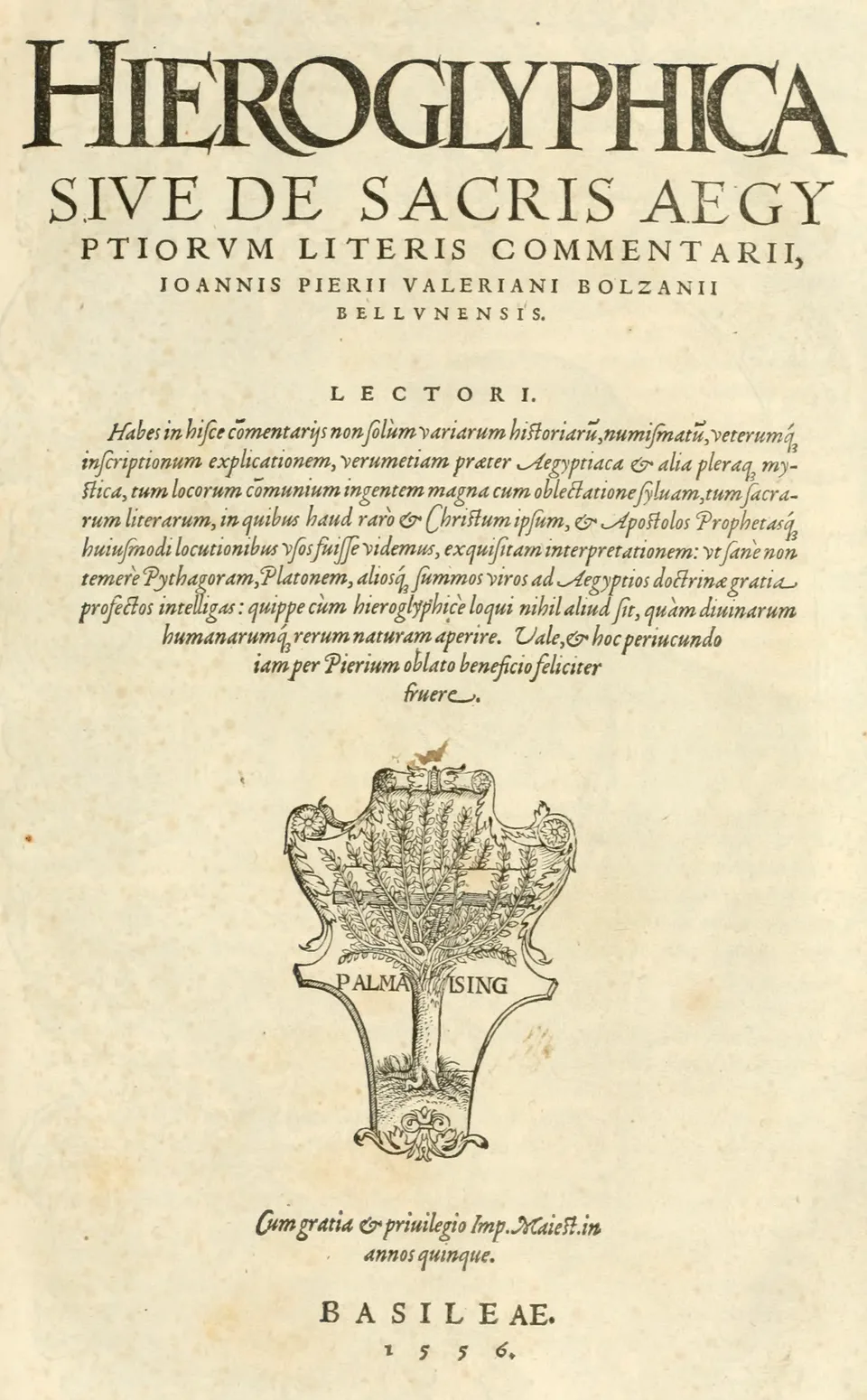
Title page of the first edition, printed by Michael Isengrin at Basel in 1556. The address to the reader promises that “Christ himself, and the Apostles and Prophets” also spoke in this manner.
What were the eyes of the gods? #
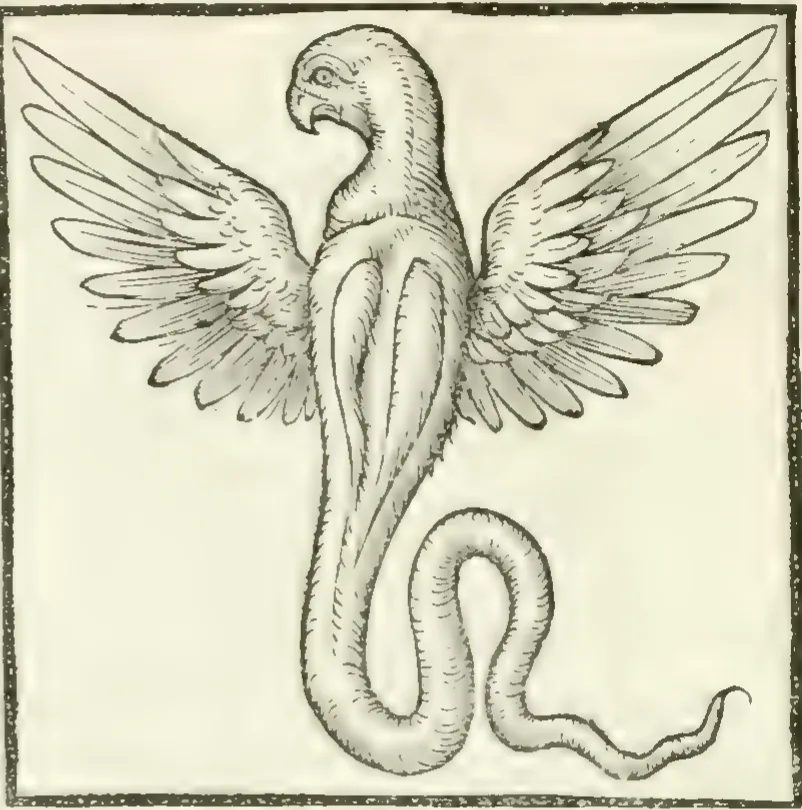
In the Egyptian temples, says Valeriano, there was a golden serpent with a hawk’s head, and its eyes were made to open and shut. On the day it was carried out, the whole country watched those eyes.
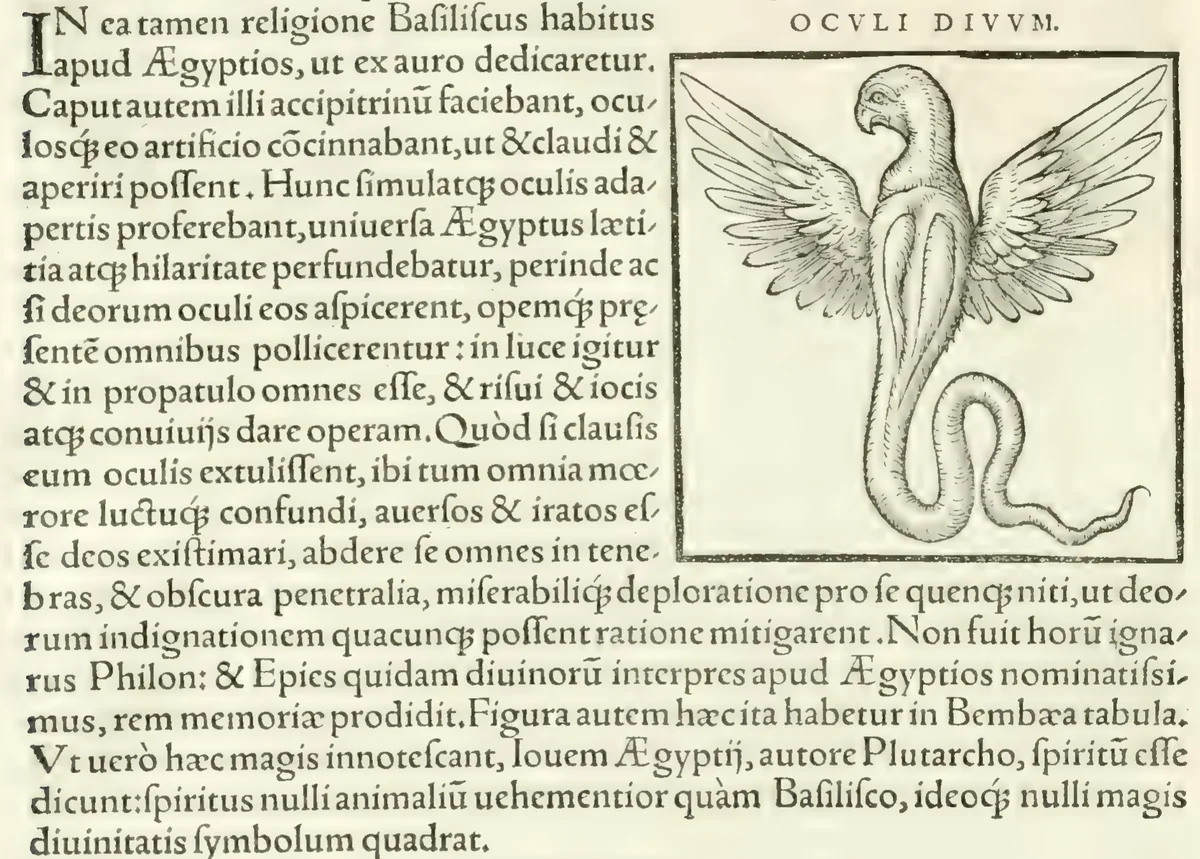
Valeriano, Hieroglyphica XIV, f. 105v: the entry Oculi divum, “the eyes of the gods”.
“The basilisk was held in such reverence among the Egyptians that it was dedicated in gold. They gave it a hawk’s head and built its eyes with such craft that they could open and close. When they carried it out with its eyes open, all Egypt was flooded with joy and merriment, as if the eyes of the gods were looking on them and promising help to everyone at once: so all went out into the light and the open air, and gave themselves to laughter, jokes and feasting. But if they brought it out with its eyes closed, then everything was thrown into grief and mourning. The gods were thought to have turned away in anger; everyone hid in the dark and in shadowy inner rooms, each striving with pitiful lamentation to soften the gods’ wrath by any means he could. Philo knew of this, and a certain Epies, the most famous interpreter of divine things among the Egyptians, recorded it.” — Valeriano, Hieroglyphica XIV, f. 105v
The festival of joy and weeping is Valeriano’s own staging. The serpent behind it is real, and it is older than he was. Philo of Byblos, writing in the first or second century AD, quotes an Egyptian hierophant and sacred scribe named Epeïs:
“The first and most divine being is a serpent with the form of a hawk, extremely graceful, which whenever he opened his eyes filled all with light in his original birthplace, but if he shut his eyes, darkness came on.” — Philo of Byblos, in Eusebius, Praeparatio Evangelica 1.10 (Gifford 1903)
The first being in this account is a serpent, and its open eye is the light of the world. In Egypt the rearing cobra on the brow of every god and king was the Eye of Ra, the sun’s fiery eye set on the forehead to burn the god’s enemies. Horapollo, the late-antique handbook on which the whole Renaissance science of hieroglyphs was built, says the Egyptians “place golden figures of it round the Gods”, because “it thus appears to have power over life and death” (1.1). Valeriano took the gold from Horapollo, the hawk’s head and the eyes from Philo, and the shape of his woodcut from the Bembine Table, the inlaid bronze Isiac tablet then in Cardinal Pietro Bembo’s collection.
Who put the serpent first? #
Valeriano was writing down an order he had inherited. His oldest sources on the sacred script put the serpent at the head of it.
Horapollo’s Hieroglyphica reached Florence in a Greek manuscript in 1419, and was printed by Aldus in 1505. Its first entry is the uraeus, “a serpent with its tail covered by the rest of its body”, the sign of eternity. Its second is the ouroboros: “When they would represent the universe, they delineate a serpent bespeckled with variegated scales, devouring its own tail” (1.1–1.2, Cory 1840). The key to the sacred script opened with two snakes, a point I made in passing in Herodotus Was Right: The Hieroglyph Edition. This essay is the long version of that paragraph.
Philo of Byblos goes further back, to the inventor of writing himself. His Phoenician history opens with Taautos, the Phoenician name of the Egyptian Thoth, “the first who thought of the invention of letters, and began the writing of records”. Later in the same book Philo says what Taautos made of the snake:
“The nature then of the dragon and of serpents Tauthus himself regarded as divine, and so again after him did the Phoenicians and Egyptians: for this animal was declared by him to be of all reptiles most full of breath, and fiery … its nature is to put off its old skin, and so not only to grow young again, but also to assume a larger growth; and after it has fulfilled its appointed measure of age, it is self-consumed, in like manner as Tauthus himself has set down in his sacred books: for which reason this animal has also been adopted in temples and in mystic rites.” — Philo of Byblos, in Eusebius, Praeparatio Evangelica 1.10 (Gifford 1903)
The god who invented letters was the first to make the serpent divine. He wrote it down in his sacred books, and from those books it passed into the temples and the mysteries. The real Egyptian script bears him out in its own way: two of the signs of its consonant alphabet are snakes, the horned viper for f and the cobra for ḏ (Gardiner’s signs I9 and I10).
Valeriano opens his serpent books in the same spirit. Book XIV begins with the serpent “whose image was devised as more auspicious and more august, held in great worship among the ancients: sky-blue in face, of shining colour, with translucent scales and a head not at all frightful, with which our discourse shall begin” (f. 102v). He gives it three books, each dedicated to a member of the Maffei family of Rome: the serpent in general (XIV), the serpent on standards and the caduceus (XV), and Aesculapius, the Gorgons, the Hydra and the venomous beasts (XVI). No other animal in the Hieroglyphica gets as much.
Why does the world eat its own tail? #
The first meaning is the world:
“When the Egyptian priests wished to write the whole world, they painted a serpent that grazed on its own tail, marked with many-coloured spots. … Beyond doubt this means that everything divine providence brings to birth in the world is taken back into the same source once it begins to dissolve, or to dwindle and fail little by little. It is almost what certain peoples of Ethiopia practise constantly: they live on no food but fish, and afterwards throw human corpses to the fish, repaying out of themselves the food they had received from them.” — Valeriano, Hieroglyphica XIV, f. 102v
The Ethiopians who feed their dead to the fish are Valeriano’s illustration, and a grim one. The meaning itself is Horapollo’s, and Macrobius had already called the image “Phoenician”, in words Valeriano copies almost exactly: a dragon bent into a circle, devouring its tail, “to show that the world feeds on itself and turns back into itself” (Saturnalia 1.9.12). Valeriano then explains it with an image from his own trade. Printers, he says, set loose letters into words; when the book is printed they break up the words and return each letter to its case, to be set again in another form. So bodies dissolve into their elements and are composed again. Then he gives the rule:
“So the serpent grazes on its own tail to show the immortality of kinds with which God marked the nature of things: to teach that the beginning is aimed at the end, and the end bends back to the beginning. … From plants comes fruit, as end from beginning; from fruit the seed, in which the plant itself lies hidden; and so beginning comes from end. Nothing at all perishes within the living world. Of the things that seem to us to die, only the forms change.” — Valeriano, Hieroglyphica XIV, f. 103r
Behind Horapollo stands the Egyptian image. The tail-swallowing serpent appears in the fourteenth century BC on the second gilded shrine of Tutankhamun, in the so-called Enigmatic Book of the Netherworld, where two serpents with their tails in their mouths ring the head and feet of a great mummiform figure, the sun god united with Osiris (Piankoff 1955; Darnell 2004). In the night journey of the sun, the coiled serpent Mehen wraps the sun god in his cabin to shield him. The serpent that encloses the sun and returns into itself is Egyptian through and through. The Greek handbooks named what it meant.
How was the uraeus eternity and the king? #
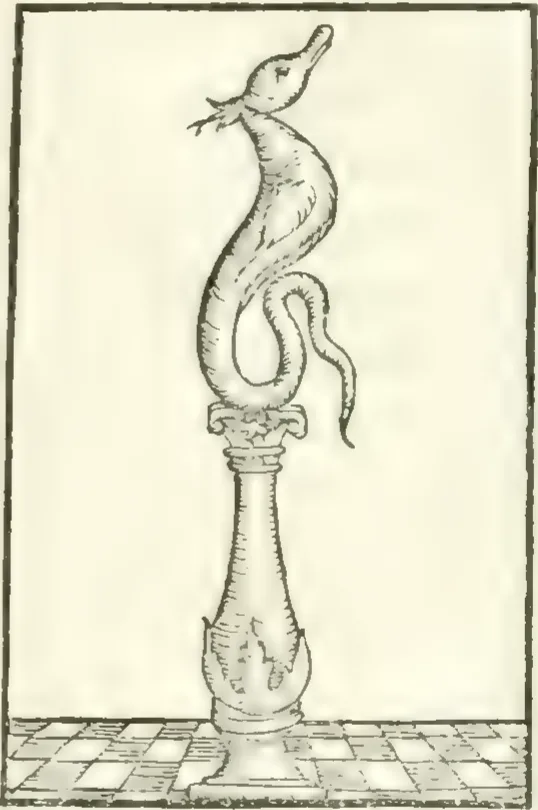
The uraeus on its pillar, after the Bembine Table. Valeriano, Hieroglyphica XIV, f. 105r.
Valeriano’s second sign is the rearing serpent the Egyptians call uraeus and the Greeks basiliskos, the little king. He gives Pliny’s description, “no more than twelve fingers long”, with a white mark on its head “like a diadem, which gave it its royal name”, moving “raised and upright from the middle of its body”. He throws out the medieval basilisk hatched from a cock’s egg as a fable. Then he gives Horapollo’s reason for the sign:
“Why the Egyptians signified the age, or eternity, by this kind of snake rather than any other, there was a reason: of all serpents this one alone cannot be killed by force, if we trust Horus of the Nile, author of some of the hieroglyphs. Its power is so great that it puts every other animal to flight by its hiss alone.” — Valeriano, Hieroglyphica XIV, f. 105r
This is the Egyptian iaret, the cobra goddess Wadjet, worn on every royal crown, and from it the serpent passes straight to the king. Horapollo’s run of king signs (1.59–1.64) is all serpents. A serpent coiled into a circle with “the name of the king in the middle of the coil” means the king who governs the world. A watchful serpent with the word “guardian” in place of the king’s name means the vigilant king, “for he is the guardian of the whole world”. The same serpent with “a large house” in its midst means the ruler of the world. A king of only part of the world is “half a serpent” (Cory 1840, pp. 80–84). Cory’s notes set beside the coiled serpent the oval ring in which the Egyptians wrote royal names, the cartouche, “considered to have been originally a serpent coiled”.
Valeriano even fixed the text. The Aldine Horapollo read kakiston, “a very bad king”, for the coiled serpent; Valeriano says the corrected manuscripts read kalliston, “a very good king” (f. 111v). Then he admits that his authors “nowhere give a reason” why a good king should be a serpent biting its tail, and offers his own guess, “if one may divine”: that a good king’s care should reach to the least and last of things.
He also passes on a Greek proverb about how the serpent becomes the greatest king: “A snake does not become a dragon unless it eats a snake.” So, said the Greeks, whoever you make emperor “must swallow many kings and princes, that he may become king of kings and lord of lords” (f. 111v).
How was the serpent breath and mind? #
On the same page as the hawk-headed serpent, Valeriano makes the step that matters most:
“The Egyptians, on Plutarch’s authority, say that Jupiter is breath. No animal has a fiercer breath than the basilisk, and so to none does the symbol of divinity fit better. … Among them the serpent is also the hieroglyph of the breath that blows through the whole mass of the world. Anaxagoras … adds a ruler, whether breath, or God, or mind. … What Anaxagoras called nous, he called breath and mind.” — Valeriano, Hieroglyphica XIV, f. 105v
For Anaxagoras’ nous Valeriano quotes Virgil, whose Anchises tells Aeneas how the world is moved: “A spirit feeds them from within, and Mind, poured through the limbs, moves the whole mass and mingles with the great body” (Aeneid 6.726–727). The serpent is the sign of that Mind.
None of this is his invention. Horapollo’s last king sign is the whole serpent, “for amongst them it is the spirit that pervades the universe” (1.64). Taautos called the serpent “of all reptiles most full of breath, and fiery”. Philo’s Egyptian hierophant made the hawk-shaped serpent the good daemon, set inside a circle “like our Theta”, and the Phoenicians, he says, called it the Good Daemon while “the Egyptians also surname it Cneph”. Valeriano draws it as “the Good Daemon, by whose merit and kindness all things are fed, thrive and endure” (f. 104v).
In the following books Valeriano gives the serpent mind in another sense: sight and understanding. The Greeks, he says, named the drakōn from its gaze (derkesthai, to see), “for it has the sharpest sight”, and so the serpent was given to Pallas Athena, as the prudence “that sees through all things and understands before all” (f. 112r). He recalls the two serpents of Aesculapius in Aristophanes’ Plutus, which lick the eyes of the blind god of wealth until he sees (f. 112r). And he quotes Christ’s command, “Be ye wise as serpents” (f. 118r). The serpent is breath, the mind that moves the world, and the eye that sees.
Why does the serpent shed its old age? #
Valeriano’s third great meaning is renewal:
“In its winter lair the snake is blinded by a membrane drawn over its body, above all over its eyes. In spring it eats fennel, anoints its eyes with the juice, and strips off the hindrance … So every year it lays down its old age and comes into spring almost naked. … The world too, blinded in the frosts of winter and coated all over with mould, throws off its squalor when the year has run and the west winds begin to blow … and laying down their old age, things grow young again in turn.” — Valeriano, Hieroglyphica XIV, f. 103v
The fennel is Pliny’s. The parallel between the snake and the year is Horapollo’s: the serpent “every year puts off its old age with its skin, as in the universe the annual period effects a corresponding change, and becomes renovated” (1.2). Valeriano next retells Nicander’s tale of the ass who traded the gods’ drug of youth to a thirsty snake, a story told in full in The Snake Kept the Skin.
The Egyptians said it first. Chapter 87 of the Book of the Dead is the spell for “making the transformation into the serpent Sata”, whose name means “son of the earth”:
“I am the serpent Sata whose years are many. I die and I am born again each day. I am the serpent Sata which dwelleth in the uttermost parts of the earth. I die, and I am born again, and I renew myself, and I grow young each day.” — Book of the Dead, ch. 87, Papyrus of Nu (Budge 1901, vol. 2, pp. 277–278)
Valeriano never read that chapter, but he came strikingly close to its name. In Book XV he writes that the Egyptians “held that mankind was born from mud” and knew “that snakes are children of the earth”, colubros terrae filios (f. 115r). In Book XVI he joins renewal to healing. The serpent belongs to Aesculapius because the sick grow old fast and grow young again when health returns, and “the same is seen in the sun, when it breaks out of winter’s old age into the youth of spring” (f. 118r).
Who was born of the serpent? #
The serpent that sheds its old age also begets. In Valeriano’s pages it is the father of kings and heroes.
He starts with the heroes. “Plutarch thinks the dragon is held sacred to heroes in general because a serpent is usually born from a man’s marrow” (f. 112r). The story is in Plutarch’s life of the Spartan king Cleomenes, whose body hung crucified in Alexandria. The guards saw “a serpent of great size coiling itself about the head and hiding away the face” so the birds could not reach it. The Alexandrians began to worship him as a hero, until the learned explained that “human bodies, when the juices about the marrow collect together and coagulate, produce serpents” (Cleomenes 39). In Virgil a seven-coiled serpent comes out of Anchises’ tomb and tastes the offerings (Aeneid 5.84–93). The dead hero comes back as a snake.
Then come the rulers. A serpent coiled round the sleeping head foretells empire for Aurelian, Septimius Severus and the younger Maximinus, and fame for the boy who became the actor Roscius. Then Valeriano asks: what about dreams, at conception or at birth?
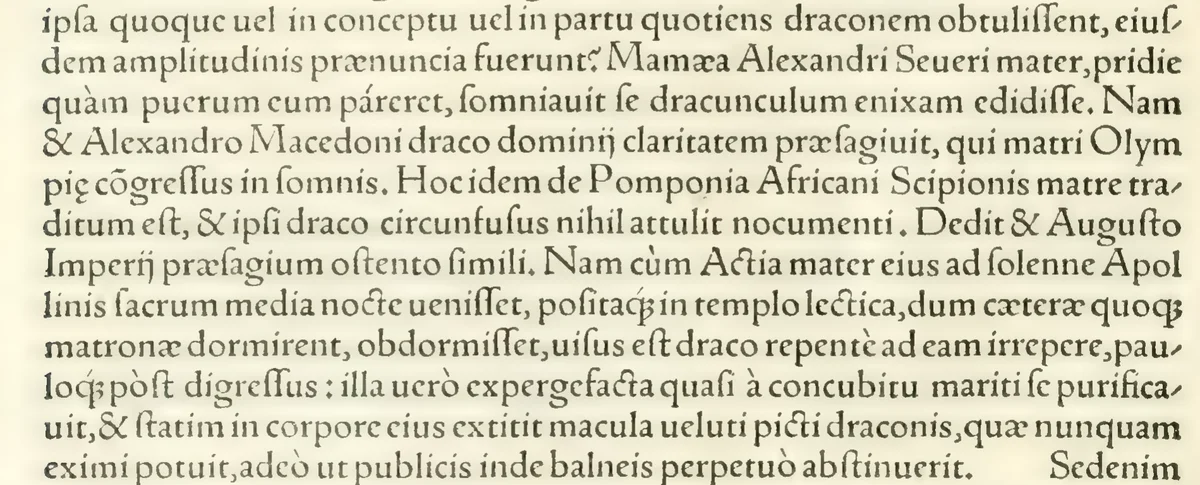
Valeriano, Hieroglyphica XV, f. 112v: the serpent mothers of Alexander Severus, Alexander the Great, Scipio and Augustus.
“Mamaea, mother of Alexander Severus, dreamed the day before she bore him that she had given birth to a little dragon. A dragon foretold the glory of rule for Alexander of Macedon too: it lay with his mother Olympias in her sleep. The same is told of Pomponia, mother of Scipio Africanus: a dragon coiled round her and did her no harm. Augustus had a like omen of empire. His mother Atia had come at midnight to a solemn rite of Apollo; her litter was set down in the temple, and while the other matrons slept she fell asleep too. A dragon suddenly seemed to crawl in to her, and left a little later. When she woke she purified herself as if after sex with her husband, and at once a mark like a painted dragon appeared on her body. It could never be removed, so that she kept away from the public baths for the rest of her life.” — Valeriano, Hieroglyphica XV, f. 112v
Valeriano leaves out the ending. Suetonius, who took the story from the Theologumena of Asclepias of Mendes, an Egyptian writer, finishes it: “In the tenth month after that Augustus was born and was therefore regarded as the son of Apollo” (Augustus 94.4, Rolfe). The first emperor of Rome was the son of a god who came to his mother as a snake. Olympias' serpent was Zeus Ammon, the god Alexander went to the Siwa oasis to consult, and Greek Zeus took serpent form often enough (see Zeus Drakôn).
In Book XVI the line runs on to its darkest heir. The empress Faustina, carrying Commodus and his twin, “dreamed that she gave birth to serpents, and one of them fiercer than the rest”. Commodus' life proved it, says Valeriano: he was “not a man, but a monstrous hydra sent out for the slaughter of the human race” (f. 118v).
The serpent father does not always court. Valeriano tells, from the older Greeks, the story Romans told of the Bona Dea, the Good Goddess; he calls her Hecate, “whom others call Semele”:
“She fought off the wickedness of her father Faunus for a long time, even when he beat her with a myrtle rod and overpowered her with wine, until he changed himself into a snake, wrapped his daughter round with his coils, and forced her to submit to his lust.” — Valeriano, Hieroglyphica XIV, ff. 108r–v, after Macrobius, Saturnalia 1.12.24–25
The father raped his daughter in the form of a snake. The cult kept the memory in its rules: myrtle was banned from her temple, wine was brought in under the name of “milk”, a vine was stretched over her statue’s head, and harmless snakes crawled all over the precinct.
Some serpent lovers are tender, and jealous. Valeriano takes from Plutarch the serpent of Aetolia in Greece that fell in love with a girl and visited her every night, sliding over her body without harming her and leaving at dawn. When her kinsmen moved her away, it searched for three or four nights; when it found her, it bound her arms to her body with its coils and lashed her with its tail, “displaying a light and tender anger that had in it more indulgence than punishment” (Plutarch, On the Cleverness of Animals 18, Loeb; Valeriano f. 110r). And on the same page he gives the Scythian ancestress, a woman “human down to the navel, the rest viper”, who bore Heracles three sons, Agathyrsus, Gelonus and Scythes, “the founders of as many nations” (f. 110r; Herodotus 4.8–10). More serpent founders are gathered in The Serpents Who Founded the Human World.
How did the serpent give men knowledge? #
The last of Valeriano’s meanings is the oldest in his own scripture: the serpent of Eden. He comes to it through the viper, whose hieroglyph Horapollo gives for a wife who hates her husband:
“For, as Horus says, when the viper couples with the male she puts his head into her mouth, and in the struggle of intercourse, overcome by the force of too much pleasure, she bites the male’s head off and kills her husband.” — Valeriano, Hieroglyphica XIV, f. 106v
Valeriano gives Nicander’s verses in his own Latin. The female, “taking his seed in her jaws”, cuts off her mate’s head “in the sweet embrace”, and then “the savage brood avenge their dead father: they gnaw through their mother’s belly, and the young are born without a mother”. He adds, with a naturalist’s honesty, that men of his own day had kept vipers of both sexes in cages and watched them mate and bear young with no parent lost.
From the bite he goes straight to Eden. The viper’s bite points to “the hieroglyph of amorous softness that our Scripture signifies, on the best authorities, by the serpent that deceived Adam” (f. 107v). Then, after Philo of Alexandria:
“Among interpreters of Scripture the woman stands for sense and the man for mind: whence some have interpreted Adam as the earthly mind. So this one, whether Faunus or, as ours say more rightly, the serpent, first girds himself to storm the mind and overturn the understanding.” — Valeriano, Hieroglyphica XIV, f. 108v
The serpent cannot take the mind head-on, so it goes through the senses. It sets pleasures before Eve, and Eve brings Adam down. Augustine, Valeriano adds, said that “in each of us there is this woman”. Here the serpent works on the mind from inside, and every person is the garden. Valeriano also records the Gnostic teacher he calls Menander (Irenaeus says Saturninus), who taught “that marriage and the urge to beget flowed from Satan, whose nature is a viper’s” (f. 108v). See The Fruit of Knowledge for what the fruit itself may have been.
Before the serpent books close, Valeriano turns the story over. Under the heading Prudentia he gives the serpent’s side of Eden:
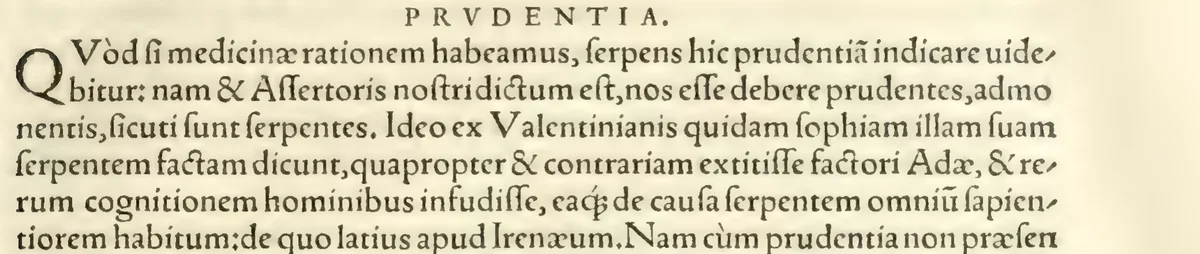
Valeriano, Hieroglyphica XVI, f. 118r: Prudentia.
“If we consider the art of medicine, the serpent here seems to show prudence: for our Saviour said that we ought to be prudent, warning us to be as serpents are. So some of the Valentinians say that their Sophia was made a serpent, and that she therefore stood against the maker of Adam and poured the knowledge of things into men. For that reason the serpent was held the wisest of all. Irenaeus has more on this.” — Valeriano, Hieroglyphica XVI, f. 118r
The sect is the Ophites, not the Valentinians, and Irenaeus puts it as plainly: “some of them assert that Sophia herself became the serpent; on which account she was hostile to the creator of Adam, and implanted knowledge in men, for which reason the serpent was called wiser than all others” (Against Heresies 1.30.15, ANF). The Ophite rites, with the live snake on the eucharistic loaves, are set out in Light-Poison, Serpent Eucharist & the Serpent of Every Mystery and Christ as the Serpent.
The serpent books open with the serpent as the world, and they end with the serpent as Wisdom herself, who gave men knowledge of things against the will of the god who made them.
How much of it was Egyptian? #
Most of it, by way of a few books. The chain runs from Egyptian temple images to the Graeco-Egyptian handbooks (Horapollo in the fifth century AD; Philo of Byblos’ Taautos in the first or second), then to Plutarch and the Latin compilers (Macrobius, Claudian), then to Florence in 1419 and the Aldine Horapollo of 1505, and so to Valeriano. He added the Roman omens, Philo of Alexandria’s allegory, the Gnostics and the coins.
| Valeriano’s meaning | Ancient carrier | Egyptian or ancient root | Verdict |
|---|---|---|---|
| World eating its tail | Horapollo 1.2; Macrobius 1.9.12 | Tutankhamun shrine ouroboroi; Mehen | Egyptian image, Greek gloss |
| Uraeus as eternity and king | Horapollo 1.1, 1.59–1.64; Pliny | Wadjet, the iaret on every crown; Eye of Ra | Egyptian |
| Hawk-headed serpent, eyes of light | Philo of Byblos (Epeïs) | Kneph / Agathodaimon; solar eye | Egyptian via Philo; the festival is Valeriano’s |
| Breath and mind | Horapollo 1.64; Taautos; Plutarch | Agathodaimon as life-breath | Graeco-Egyptian; the nous gloss is Valeriano’s |
| Shed skin, yearly renewal | Horapollo 1.2; Taautos; Pliny | Book of the Dead 87, the serpent Sata | Egyptian core, Greek lore added |
| Sire of kings and heroes | Suetonius (from Asclepias of Mendes), Plutarch, Livy | Zeus Ammon; hero cult | Hellenistic and Roman |
| Viper beheads its mate | Horapollo 2.59–60; Nicander; Herodotus 3.109 | Greek natural history | Not Egyptian |
| Serpent of Eden; Sophia | Philo of Alexandria; Irenaeus | Genesis 3 | Jewish, Christian and Gnostic |
Valeriano marked his own inventions when he made them. He calls the reason for the good-king serpent his guess. He says a viper hieroglyph for abortion was “devised by the moderns” and never read in the ancients (f. 107r).
Where did the serpent go? #
Out of Valeriano into everything. Cesare Ripa’s Iconologia (1593) dressed its virtues and vices from his pages, and the emblem books of the next century borrowed his serpents wholesale: the ouroboros of eternity, the serpent of Prudence. Athanasius Kircher built his Egyptian theology of the obelisks on the same Horapollo and the same Philo. Champollion ended the reading of every sign as an idea, but he did not end the serpents. The uraeus was still on the brow of the gods, and the serpent Sata was still born again each day in the papyri he and his successors read.
The Renaissance read the sacred script as a doctrine, and the first word of that doctrine was a serpent. Thoth, inventor of letters, wrote the serpent into his sacred books as the most breath-filled of beasts, the self-renewing one. The first divine being opened its eyes and the world filled with light. The serpent bit its tail and was the world; it shed its skin and was the year; it was the breath that moved the mass; it lay with queens and fathered emperors; and at the end it was Wisdom, giving men the knowledge of things. Valeriano gathered it from every book he had, and it read as one teaching.
Sources #
- Valeriano, Pierio. Hieroglyphica, sive De sacris Aegyptiorum literis commentarii. Basel: Michael Isengrin, 1556. Books XIV–XVI, ff. 102v–122v. Translations are mine.
- Horapollo. The Hieroglyphics of Horapollo Nilous. Trans. Alexander Turner Cory. London: Pickering, 1840.
- Eusebius. Praeparatio Evangelica, book 1, quoting Philo of Byblos. Trans. E. H. Gifford. Oxford, 1903.
- Budge, E. A. Wallis. The Book of the Dead: An English Translation of the Chapters, Hymns, etc., of the Theban Recension, vol. 2. London: Kegan Paul, 1901.
- Suetonius. The Life of Augustus. Trans. J. C. Rolfe. Loeb Classical Library, 1914.
- Plutarch. Life of Cleomenes. Trans. Bernadotte Perrin. Loeb Classical Library, 1921.
- Plutarch. De sollertia animalium. Trans. Harold Cherniss and William C. Helmbold. Moralia XII. Loeb Classical Library, 1957.
- Irenaeus. Against Heresies, book 1, ch. 30. Ante-Nicene Fathers, vol. 1. Buffalo, 1885.
- Macrobius. Saturnalia. Trans. Robert A. Kaster. Loeb Classical Library, 2011. Books 1.9.12 (the Phoenician ouroboros), 1.12.24–25 (Faunus and the Bona Dea).
- Piankoff, Alexandre. The Shrines of Tut-Ankh-Amon. New York: Pantheon, 1955.
- Darnell, John Coleman. The Enigmatic Netherworld Books of the Solar-Osirian Unity. Orbis Biblicus et Orientalis 198. Fribourg, 2004.
- Gardiner, Alan. Egyptian Grammar. 3rd ed. Oxford: Griffith Institute, 1957. Sign list I9 (horned viper, f) and I10 (cobra, ḏ).