~/mythology/comparative-mythology
The Serpent Blood Rites That Made Us Human
Quetzalcoatl’s descent, revival, and blood offering preserve an initiatory account of humanity: bodies become people through the Snake Cult’s ritual of death and rebirth.
TL;DR
- Quetzalcoatl passes through a deathlike collapse and revival before his blood helps make humanity.
- The rite violently remakes an earlier humanity: its bones receive the serpent’s blood and the makers’ ritual labor.
- Mesoamerican myths distinguish having a speaking body from possessing memory, understanding, and obligations to one’s makers.
- Priesthoods and royal blood rites preserve bodily practices behind this account of human origins.
- Read as the public face of initiation, the myth remembers humanity as something acquired through a dangerous second birth; a later turn toward cosmic killing remains a historical inference.
Before the Feathered Serpent makes a human being, he lies among the dead himself.
Quetzalcoatl has gone down to Mictlan for the bones of an earlier humanity. He secures them, bundles them, and tries to leave. The lord of the dead has a pit dug in his path. Quails startle him. He falls, the bones scatter, and for a moment their rescuer belongs to the world he was trying to escape. Then he revives. He weeps, gathers the damaged bones, and carries them out (Legend of the Suns, Gingerich’s translation, p. 174).
The making of people comes afterward. A goddess grinds the bones. Quetzalcoatl lets his blood fall over them. Other gods join in penance. Humanity begins inside a ceremony.
The serpent, the descent, the terrifying interruption of life, the return, and the blood rite join the making of humanity to the Snake Cult of Consciousness. The creation myth reads like an initiation enlarged to the scale of the species. Quetzalcoatl occupies the initiate’s position before he becomes a maker. He undergoes the passage that he will make available to others.
Quetzalcoatl enters the house of the dead #
The Legend of the Suns gives the underworld a gatekeeper and a test. Mictlantecuhtli requires Quetzalcoatl to sound an unperforated conch and carry it four times around his precious seat. Quetzalcoatl calls on worms to make openings and bees to sound the shell. A silent object becomes a voice through hidden living agents. The bones are granted; the lord then tries to reclaim them. Quetzalcoatl enlists his nahual, his spirit double, to deceive the pursuers (Leyenda de los Soles, pp. 120–121).
The episode has the texture of an ordeal. The visitor must accomplish something impossible, rely on knowledge unavailable to the keeper, and escape a power that has agreed to release him but still means to hold him. Knowing how to enter the realm of death is only half the problem. He must know how to return.
The pit interrupts that return. In Willard Gingerich’s translation, Quetzalcoatl falls “as though dead” and then revives. Patrick Johansson’s reading of the Nahuatl likewise places collapse and awakening at the center of the episode. The god’s confrontation with death becomes bodily. He carries humanity’s remains while becoming, briefly, another motionless body among them (Johansson 2014, p. 19).
His success leaves damage behind. The birds have gnawed the bones. He cannot simply restore an untouched inheritance. He must gather what is left and take it to Tamoanchan, where another power can work on it.
The ordeal destroys an ordinary wholeness; the return requires a different wholeness to be made. Quetzalcoatl reaches it through bewilderment, grief, companionship, and recovery. The human world is founded through an experience of helplessness that the founder survives.
The bones of a previous humanity #
The bones belonged to people. Quetzalcoatl finds male and female remains already present in Mictlan and bundles them for his return (Gingerich, p. 174). Humanity supplies the material for its own remaking.
An older human condition lies underneath the new one. Its substance can be recovered, but recovery alone does not bring the new people into existence. Everything decisive still has to happen: the bones must be gathered, carried elsewhere, ground, and brought into a rite with blood and collective penance. The serpent’s rite remakes an inherited humanity.
The myth may preserve a memory of existing humans being transformed. The previous humanity supplies the bones; the initiated serpent and his fellow makers supply the means of becoming something further. The new condition grows out of the old through a violent interruption. Continuity belongs to the material. The break belongs to the way it is made to live.
Why a speaking body is not yet a person #
The familiar image of humans molded from earth answers a question about substance. The initiatory image answers a question about the condition of the being made. A body can be assembled before it becomes capable of remembering, judging, and knowing itself within a world of other persons.
The K’iche’ Popol Vuh makes that distinction unusually sharp. Its creators, including Sovereign and Quetzal Serpent, first make an unstable mud being. It speaks without knowledge. Wooden beings fare better: they speak and multiply, but lack hearts and minds, blood, and memory of their makers. Speech and human shape have appeared before properly human life (Christenson translation, pp. 64–70).
The wooden beings can perform recognizable activities without inhabiting the relationships that give those activities meaning. They have no inward acknowledgment of where they came from. The makers want someone who can answer them.
Successful people receive maize flesh, with water becoming their blood. They understand and thank their creators. Their first vision reaches everything; the gods then cloud their eyes, leaving them a human range of sight (pp. 178–186).
The story’s interest in humanity therefore reaches beyond manufacture. It concerns knowledge, memory, the limits of perception, and the recognition of an obligation. Human existence has an interior. Even that interior must be brought into a livable relation with the world.
These are distinct K’iche’ and Nahua accounts. Quetzalcoatl’s people in the Legend of the Suns come through bones and blood, rather than clay. Together, the accounts preserve two questions that a creation myth can compress into one: what our bodies are made from, and how their inhabitants acquire a human mind. This second making may preserve an ancestral practice of bringing a person into being, carried forward inside stories about bringing the species into being.1
The serpent and the woman at the bowl #
At Tamoanchan, Quetzalcoatl cannot finish creation alone. Quilachtli, also named Cihuacoatl, grinds the rescued bones into a precious basin. He bleeds his genital member over it. The gods perform penance together, and people are born through their merit (León-Portilla 2017, p. 243).
The sequence distributes the work of generation. The god retrieves the ancestral material. The goddess transforms it. His reproductive body supplies blood. A community of gods supplies ritual effort. Humanity receives its existence from an act shared among makers.
Grinding treats the remnants of bodies through an operation familiar from preparing nourishment. What was once a person becomes material for another life. The violence of the underworld has broken the bones accidentally; the goddess breaks them down deliberately so that a new creation can begin.
The Popol Vuh contains a closely related operation in its underworld drama. Before Hunahpu and Xbalanque enter the pit oven, they arrange for their bones to be ground like maize and cast into a river. After dying, they return through new forms. Later they display the power to dismember and restore a body (pp. 164–171).
In both narratives, destruction can become preparation. The body is reduced to a substance that can be worked on, and life appears on the far side. Bone grinding joins creation to rebirth. A maker and an initiate can occupy the same narrative position: the one who knows how life can be reconstructed after its ordinary form has been taken away.
The Nahua conclusion adds a moral dimension. The people are macehualtin, those for whom the gods have earned existence through penance. León-Portilla draws out the connection between their being made and their being obligated. The word also names common people in social contexts; here the story turns merit into an explanation of humanity itself (León-Portilla, pp. 241–243).
To be human is to owe one’s life. Someone suffered, knew what to do, and brought you through. That is the moral position of the initiate toward the people who made the second birth possible. Enlarged into a creation myth, it becomes the position of every person toward the gods. The ancestral rite may survive as an account of the debt into which humanity is born.
Quetzalcoatl’s body becomes a priestly discipline #
Quetzalcoatl’s bodily acts become the model for priestly practice.
In Sahagún’s account of Tollan, Quetzalcoatl punctures his legs, coats the points of maguey leaves with his blood, and washes at the spring Xippacoya at midnight. The text joins the bodily practice to its institutional inheritance:
“piercing his legs and drawing his blood … the priests and ministers of the Mexican idols adopted this [same] custom”
— Florentine Codex, book 3, fol. 10r, Spanish column, translated by García Garagarza
Its Nahuatl account likewise makes his way of life the model for priestly life in Mexico (Pastrana Flores, discussion of fol. 10v).
The founder’s suffering becomes a curriculum. Another generation learns what the founder did by doing it with its own bodies. The god’s blood over the bones and the priest’s blood on the maguey points belong to different narratives, but the same relation holds: blood is part of a disciplined encounter with sacred power.
Michel Graulich’s study documents bloodletting among priests, novice priests, and schoolboys, including initiation contexts. It earned merit for oneself or a larger population. Bodily discipline could also serve punishment and routine observance; its presence alone does not identify a death-and-rebirth ceremony (Graulich 2005, especially p. 308).
People heard how the serpent’s suffering made humanity. Some people were trained to repeat the suffering. The founding event acquired an institutional body.
The Annals of Cuauhtitlan gives the penitent ruler Ce Acatl Topiltzin Quetzalcoatl another important feature. When sorcerers urge him to sacrifice humans, he refuses out of love for his Toltec people. His offerings include serpents, birds, and butterflies. In this version, the founder’s own discipline stands beside a refusal to give other people to death (León-Portilla’s translation, “Historia del sabio señor Quetzalcóatl”).2
A tradition could celebrate the Feathered Serpent’s priestly penance while remembering a conflict over lethal sacrifice. The religion itself preserved a distinction between changing one’s own body and offering someone else’s life.
Blood brings a serpent into the room #
At Yaxchilan, the connection becomes visible in stone.
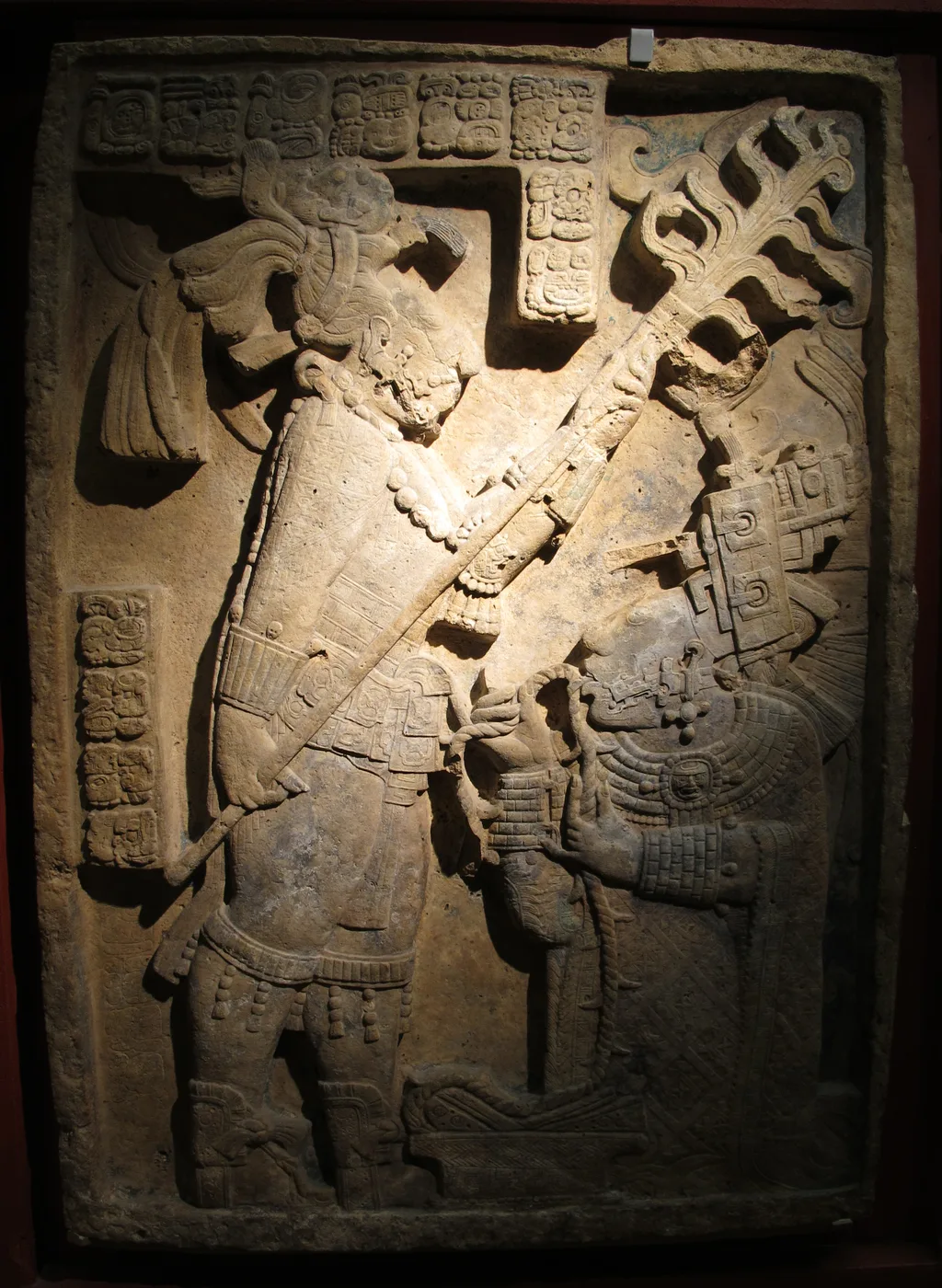

Lady K’ab’al Xook kneels beneath a torch, drawing a rope through her tongue. The carving places the act within royal ceremonial life. An adjacent lintel shows her before an enormous serpent rising from a vessel of ritual papers. A figure appears within its open jaws (British Museum, Lintel 25; Sánchez Gamboa and Krempel, pp. 1–2).
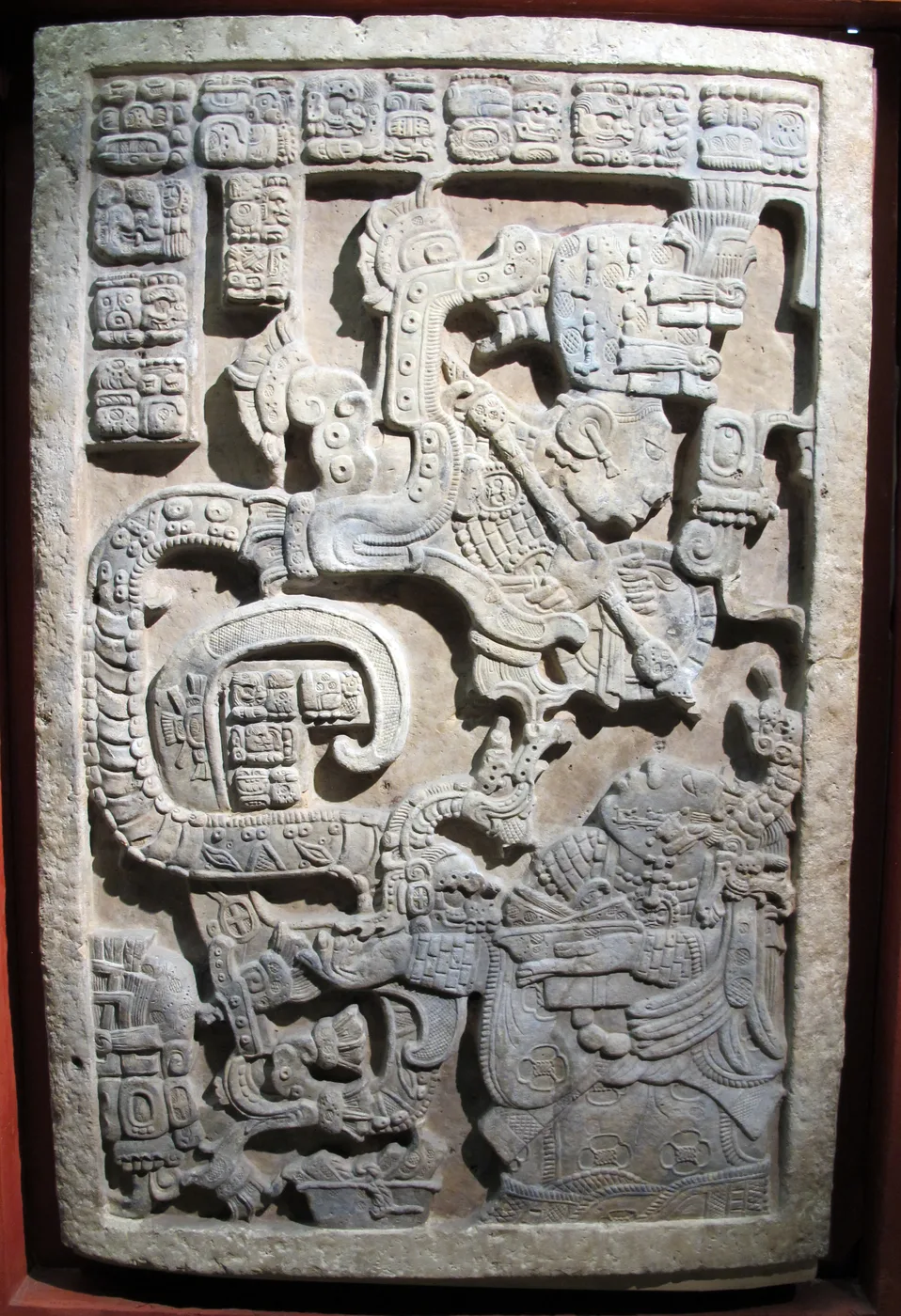

The stone gives bodily suffering an encounter on its other side. The blood rite reaches into a world of ancestral and divine authority. The person in the jaws has been interpreted in different ways, including a royal manifestation; the precise identity changes the political reading. A living woman performs a rite, and the serpent becomes the opening through which another presence appears.
These are Classic Maya royal rites, centuries before the surviving alphabetic Nahua account. They give an independent Mesoamerican expression of the conjunction: blood, a transformed field of experience, serpentine mediation, and renewed authority. The rite reaches inward toward an encounter and outward toward a community’s order.
The ancestral Snake Cult of Consciousness may have made a different kind of experience possible: a person who could encounter an invisible agent, recognize obligations within himself, and return to other people changed. Its terrifying death and rebirth would have supplied an experience strong enough to organize a life around. The myth of creation preserves the claim that the change reached all the way down to what a human being was.
The story on the outside of the rite #
Exoteric is the word for the outward account: the story that can circulate beyond the people who undergo its inward discipline. Everyone can hear that the serpent entered death and that blood made humanity. The novice has to discover what departure, helplessness, and return mean when they happen to him.
Myth carries ritual memory across generations. The story can outlive the ordeal, migrate between institutions, or acquire new gods while retaining the order of its most consequential events. A divine adventure carries the account across generations. A ceremony gives the account force in one particular body.
In the public Yolngu account of Wititj and the Wägilak Sisters, swallowing and regurgitation bring transformation. The National Museum of Australia describes this passage as comparable to boys entering initiation and emerging as men. The serpent’s ancestral action and the living person’s change of status illuminate one another (Old Masters, central Arnhem Land).
Ancestral beings can therefore make people on two scales. In the story, they establish the human order once. In ceremony, their action becomes available again. A community inherits a way of remaking its members, along with an explanation of why the remaking is necessary. The serpent founders give institutions their first authority; the blood rites carry that authority into a person’s experience.
| The creation narrative | The initiatory reading |
|---|---|
| Departure into the realm of death | Separation from ordinary life |
| Impossible task, pursuit, collapse | Ordeal and loss of ordinary mastery |
| Revival and recovery of the bones | Return after the dissolution of a former condition |
| Grinding, blood, collective penance | A new life made through the work of ritual specialists |
| Humanity owes existence to its makers | The transformed person enters enduring obligations |
A serpent-associated maker undergoes a passage through death, returns with the material of humanity, and participates in a rite that turns it into people. The creation scene preserves an account of how life can be remade.
One further change would explain the terrible distance between a rite that returns a person alive and a religion that requires a death: a shift in what the ordeal was understood to accomplish. The initiate’s passage made a new person; a cosmic offering paid for the continuation of the world. Once death itself became the payment, the return could belong to the sun, the crops, or society while the offered person stayed dead. Large-scale killing at Teotihuacan’s Feathered Serpent Pyramid was already present early in the third century CE; the Legend of the Suns separately makes divine death necessary to set the sun in motion (Cowgill 2002, p. 2; Leyenda, pp. 122–123). The historical transition from initiation to cosmic killing remains undocumented. Self-bloodletting continued alongside lethal offerings. The old promise of transformation could survive within a system that transferred its benefit to someone other than the person who suffered.
The second birth #
The power of Quetzalcoatl’s story lies in its account of a maker who has to pass through the condition he overcomes. He brings humanity out of death after discovering, in his own body, how helplessness ends and return begins. Then the goddess works the bones, blood enters the basin, and the makers earn a human world.
The making of bodies carried an account of the making of persons. Clay, wood, bone, and maize supplied images of substance. Ordeal, memory, vision, and obligation supplied an account of the human interior. The descent and return joined them in a second birth.
The serpent cult could remember its greatest achievement as creation because creation was what the initiate experienced. The body that entered supplied the substance of the person who returned. Humanity was made from an earlier humanity, and the serpent’s ordeal supplied the passage between them. The public story kept the grandeur of that claim after the experience had become distant: the serpent went among the dead, the blood fell into the bowl, and we became human.
Sources #
- Anonymous. Leyenda de los Soles. Nahuatl text dated 1558, in Códice Chimalpopoca, translated by Primo Feliciano Velázquez, UNAM, 1992 edition, especially pp. 120–123.
- Gingerich, Willard. “Tlamachiliztlahtolçaçanilli: A Performance Translation of the Nahuatl ‘Wisdom-Discourse Fables’ from the Manuscript of 1558”. Estudios de Cultura Náhuatl 28 (1998): 159–196, especially p. 174.
- Johansson K., Patrick. “Miccacuicatl: cantos mortuorios nahuas prehispánicos. Textos y ‘con-textos’”. Estudios de Cultura Náhuatl 48 (2014), especially the reading of Quetzalcoatl’s return, p. 19.
- León-Portilla, Miguel. “Los merecidos por el sacrificio de los dioses”. Estudios de Cultura Náhuatl 53 (2017): 241–243.
- Christenson, Allen J., translator. Popol Vuh: Sacred Book of the Quiché Maya People. 2007 electronic edition of the 2003 publication. Creation pp. 64–74 and 178–186; the Twins’ death and return pp. 164–171.
- Sahagún, Bernardino de, and Nahua collaborators. Florentine Codex, book 3, fol. 10r. Digital edition, Getty Research Institute and Biblioteca Medicea Laurenziana, 2023.
- Pastrana Flores, Miguel. “Tula y los toltecas en los textos de Sahagún”. In El universo de Sahagún. Pasado y presente. Coloquio 2005, UNAM, 2007: 107–113.
- Graulich, Michel. “Autosacrifice in Ancient Mexico”. Estudios de Cultura Náhuatl 36 (2005): 301–329.
- León-Portilla, Miguel, translator; introduction by Elisa Ramírez. “Historia del sabio señor Quetzalcóatl”. From the Annals of Cuauhtitlan. Arqueología Mexicana 53 (2002): 50–53.
- British Museum. Yaxchilan Lintel 25, Am1923,Maud.5. Collection record and curatorial discussion.
- Sánchez Gamboa, Ángel A., and Guido Krempel. Monuments of Yaxchilan: Lintel 25. Mesoweb Resources, pp. 1–2.
- National Museum of Australia. Old Masters: Australia’s Great Bark Artists. Public account of central Arnhem Land and Wititj/Wägilak imagery.
- Cowgill, George L. Ritual Sacrifice and the Feathered Serpent Pyramid at Teotihuacán, México. FAMSI research report, 2002, p. 2.
Image credits: Yaxchilan photographs by Sailko / Wikimedia Commons, CC BY-SA 3.0, resized for display.
The Legend of the Suns dates its surviving Nahuatl formulation to 1558; the alphabetic K’iche’ Popol Vuh also belongs to the sixteenth century. Older carvings establish important parts of the ritual and serpentine imagery. The reconstruction of a still earlier initiatory substrate remains an interpretation; the texts supply no date for its beginning and no demonstration of the biological origin of consciousness. ↩︎
The creator in the Legend of the Suns, the Tollan penitent in Sahagún, and the ruler in the Annals belong to related but distinct accounts. Their shared name and ritual associations matter without turning them into one continuous historical biography. ↩︎