TL;DR
- If “consciousness” were directly selected in the last 50,000 years, the default demographic+neutral models would systematically misread the genome: selection distorts coalescent times, site-frequency spectra, and polygenic score trajectories (cf. “all models are wrong” in model-building, but the wrongness becomes directional).
- The strongest predictions are about time series: ancient DNA should show coordinated, trait-linked allele-frequency shifts—mostly as soft sweeps and polygenic drift-with-a-bias, not clean hard sweeps.
- Gene–culture feedback would dominate: institutions (schools, markets, states) change the fitness landscape faster than mutation can supply “new” cognition alleles.
- The hypothesis is testable, but the hard part is identifiability: population structure, assortative mating, and GWAS portability can counterfeit “selection on cognition.”
“Since all models are wrong the scientist must be alert to what is importantly wrong.”
— George E. P. Box, “Science and Statistics” (1976), Journal of the American Statistical Association (JSTOR record)
What we are imagining (and what we are not)#
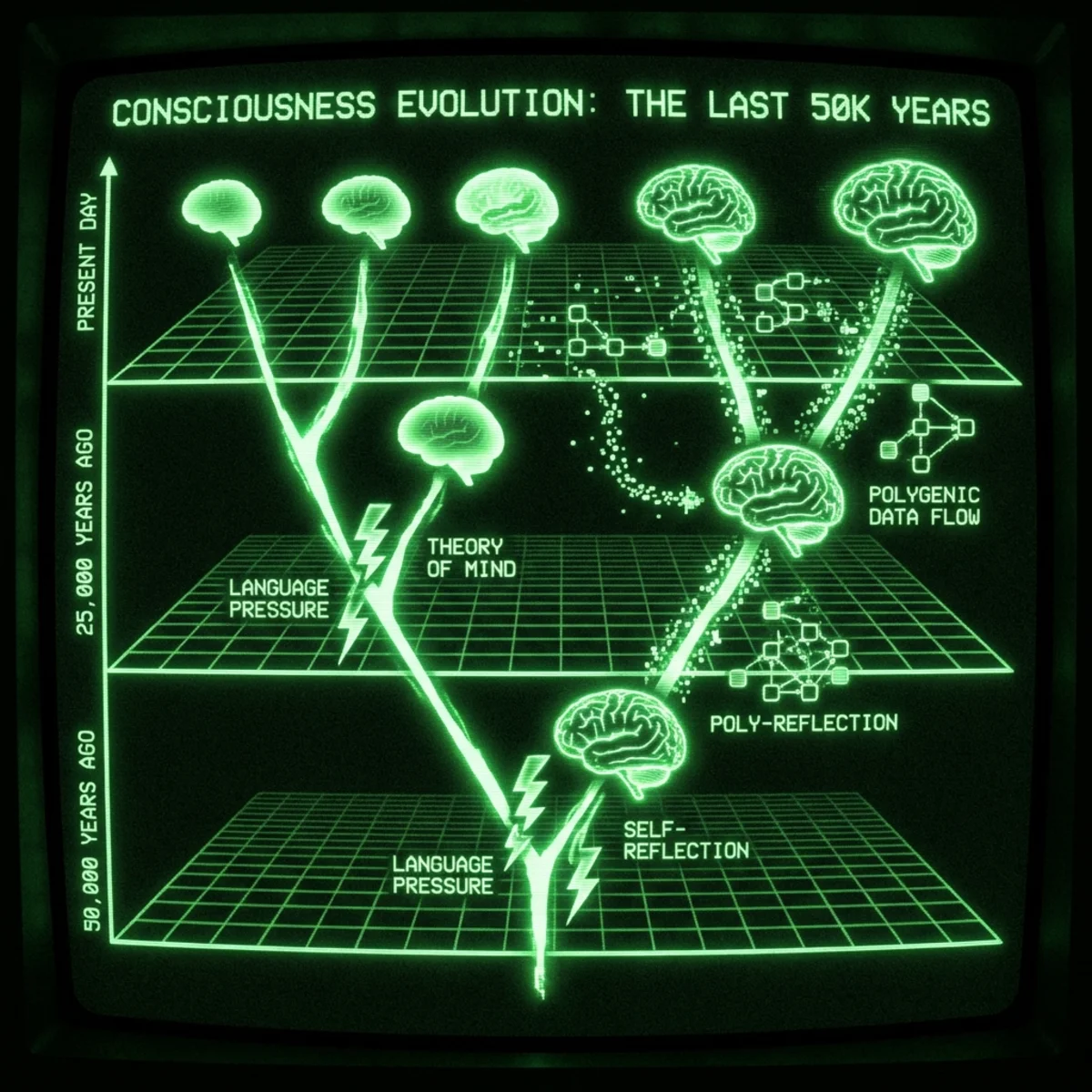
This is a deliberately sharp counterfactual: suppose that, in the last ~50,000 years—and especially in the last ~15,000—there was direct positive selection on a cluster of capacities we loosely label “consciousness”: self-reflective thought, language competence, theory of mind, metacognitive control, and the ability to learn and deploy complex social norms.
Not “selection for bigger brains” (a crude proxy) and not merely “culture got more complex.” The claim is stronger: genetic variants that causally shift these cognitive capacities increased in frequency because they improved reproductive success under late Pleistocene and Holocene conditions.
We are not asserting this is true. We’re asking: if it were true, what should we expect in the data—and how would our modeling habits change?
First principles: what selection on cognition would look like in a genome
1) Consciousness is almost certainly polygenic (so selection is mostly subtle, not cinematic)#
If the trait is highly polygenic—many loci of tiny effect—then selection changes allele frequencies at many sites by small increments, producing polygenic adaptation rather than a few textbook sweeps (Berg & Coop 2014, PLOS Genetics). The core intuition is blunt:
- For a polygenic trait, the “adaptation budget” can be paid by many small coins instead of a single gold bar.
- That makes classic sweep-detection tools underpowered or misleading.
- It also makes “selection for consciousness” plausible in principle without leaving a giant neon sign at one locus.
But polygenic inference is fragile. Polygenic score (PGS) signals can be inflated by subtle stratification and other biases (Sohail et al. 2019, eLife; Novembre & Barton 2018, PMC). So our thought experiment must predict not just signals, but how the signals can be faked.
2) Most adaptation would be from standing variation → “soft sweeps” and frequency nudges#
In late time windows (50k → present), the raw supply of new beneficial mutations is limited; much adaptation comes from standing variation (alleles already present) and from recombining existing variants. That tends to produce soft sweeps (multiple ancestral haplotypes rise) rather than hard sweeps (one ancestral haplotype takes over) (Hermisson & Pennings 2017, Methods in Ecology and Evolution). Empirically, soft sweeps have been argued to dominate in humans (Schrider & Kern 2017, MBE), though that claim is contested and likely model-sensitive (Harris et al. 2018, PMC).
So: if consciousness were selected, expect many modest allele shifts, scattered across networks involved in neurodevelopment, synaptic plasticity, myelination, neurotransmission, cortical interneuron balance, etc.—with footprints that look like diffuse, entangled, and annoyingly non-Hollywood.
3) Selection + demography are not separable: selection distorts the “neutral scaffolding”#
Demographic inference tools often assume neutrality (or treat selection as nuisance). But selection at linked sites can depress diversity and mimic demographic events—especially in the site-frequency spectrum (SFS) and local genealogies (Dehasque & Mérot 2020, Evolution Letters; Comeron 2014, PLOS Genetics). If a large fraction of the genome is repeatedly “tugged” by selection on cognition-linked variants (plus linked background selection), then:
- inferred bottlenecks can be exaggerated,
- effective population sizes can be underestimated in a trait-correlated way,
- branch lengths in population trees can be systematically warped.
In other words, if selection targets cognition, the genome becomes an adversarial witness about population history unless your model explicitly co-estimates selection.
Why the last 15,000 years is the interesting (and dangerous) window#
The Holocene is when cultural environments became extremely nonstationary: agriculture, higher population densities, infectious disease regimes, social stratification, markets, writing, and state formation. These are not merely “backdrop”—they are fitness-landscape machines.
Gene–culture coevolutionary theory exists precisely because culture can change selection pressures faster than genes change (Boyd & Richerson 1985, University of Chicago Press; Odling-Smee, Laland & Feldman 2003, Princeton). In this window:
- cultural innovations can create new payoffs for language, executive function, planning, norm learning, and social inference;
- institutions can amplify assortative mating and social sorting;
- selection can become frequency-dependent (your fitness depends on what others do/believe).
This is also where naive “selection for consciousness” stories can go off the rails, because the same cultural changes can produce huge cognitive phenotypic shifts with minimal genetic change (via learning, pedagogy, cumulative culture).
Henrich’s argument—roughly, that humans’ advantage is in culturally evolved know-how more than individual “raw” intelligence—makes the “direct selection” hypothesis harder, not easier: the world might reward cultural learners, but culture can also substitute for genetic upgrades (Henrich 2015, author page).
What would change in our image of the past?
A. “Behavioral modernity” becomes a moving target, not a threshold event#
Archaeology already shows deep roots of symbolic behavior well before 50k years (e.g., engraved ochre at Blombos, ~77k years ago: Henshilwood et al. 2002, PDF). In the last ~50k, we see repeated surges in representational art and symbolic systems, including very early narrative/figurative traditions outside Europe (e.g., Indonesian cave art >40k: Aubert et al. 2014, Nature; and more recent work pushing narrative art to ~51.2k: Oktaviana et al. 2024, Nature).
Under direct selection for consciousness, “modernity” would not be a binary switch but a selective gradient that can steepen or flatten depending on ecology and social structure. The prediction: you’d expect regional mosaics—places where selection pressures intensified earlier (dense exchange networks, complex coalitions) and places where they didn’t.
B. The Holocene would be interpreted as a cognitive arms race and a domestication event#
There’s a provocative empirical puzzle: some datasets suggest reductions in cranial capacity across the Holocene (Henneberg 1988, PubMed), with competing explanations and debates about sampling and interpretation (DeSilva et al. 2021, Frontiers; critique/reassessment in Villmoare & Grabowski 2022, PDF).
In a “selection for consciousness” world, a brain-size decrease is not fatal. Selection could favor efficiency, wiring economy, developmental canalization, and social-cognitive specialization rather than volumetric bloat. (If anything, high-cost brains are vulnerable to selection for energetic efficiency in dense, calorie-volatile societies.)
So the Holocene might be read as: cognitive capacity ↑ (functional), brain size ↔/↓ (morphometric), cultural scaffolding ↑↑.
C. “Human nature” would become historically contingent, not species-typical#
If selection meaningfully changed the distribution of cognitive capacities in the last 15k years, then projecting “the human mind” back onto the Upper Paleolithic becomes a methodological sin. Models in evolutionary psychology that treat late Pleistocene cognition as basically modern would require stronger caveats.
Not because earlier humans were “less human,” but because the trait distribution (means, variances, covariances) could have shifted. The key is variance: selection and assortative mating can reshape not only averages but correlation structure among abilities.
What would change in our models?
1) Demography-first models would be replaced by joint inference (selection + structure + culture)#
In the standard workflow, we do:
infer demography → assume neutrality conditional on demography → scan for selection as a residual.
In the thought experiment, this fails because cognition-linked selection is not a residual—it’s a generator of many “demographic-looking” patterns. So you’d need models that jointly infer:
- population sizes and splits,
- migration/admixture,
- linked selection (background selection and polygenic adaptation),
- changing environments driven by culture.
Ancient DNA makes this at least tractable in principle, because it provides time-stratified allele frequencies rather than only present-day snapshots (Dehasque & Mérot 2020, Evolution Letters).
2) Polygenic score time series becomes the natural observable (with a warning label)#
In this world, the “smoking gun” is directional change through time in trait-associated alleles. People already attempt analogous analyses for other traits; height is the canonical cautionary tale because signals were overinterpreted and then partially deflated by better controls (Sohail et al. 2019, eLife; Berg et al. 2019, eLife).
For cognition proxies (education attainment, cognitive performance), we also have modern-time evidence that genetic variants correlated with those outcomes can covary with reproductive timing and fertility, implying contemporary selection gradients—though interpretation is delicate because environment and culture mediate “fitness” in modern societies (Kong et al. 2017, PNAS; Beauchamp 2016, PNAS).
A rigorous model in the counterfactual would predict:
- increasing “consciousness-linked” polygenic scores in populations where selection was strongest, but not necessarily globally (because selection pressures differ);
- frequent reversals if social regimes change (e.g., selection for certain executive traits in early states might differ from selection in egalitarian foragers);
- sensitivity to admixture: mixing can create apparent score shifts that are purely demographic.
3) The unit of analysis would shift from “populations” to “fitness ecologies”#
The late Holocene is full of stratified mating markets, status inheritance, and differential survival under pathogen loads. If cognition is selected, selection gradients are conditioned on social institutions, not merely climate or latitude.
So you’d model selection as a function of fitness ecologies:
- dense agrarian states vs. dispersed foragers,
- literate bureaucracies vs. oral chiefdoms,
- market integration, warfare intensity, pathogen regimes.
This pulls population genetics toward cultural evolution and historical demography—toward the messy humanities swamp where your priors get mud on their shoes. Gene–culture coevolution is the formal bridge here (Boyd & Richerson 1985, UChicago).
What “raw data” would look different under this hypothesis
1) Ancient DNA: allele frequency changes in neurodevelopmental and regulatory regions#
Hard sweeps in single loci would be the exception, not the rule. But you might still expect:
- enrichment of selection signals in brain-expressed regulatory regions, especially those affecting development timing and synaptic plasticity;
- signals of adaptive introgression contributing useful variants, because admixture is a fast way to import pre-tested alleles (review context: Gokcumen 2020, AJPA; African “ghost” introgression signals in Durvasula & Sankararaman 2020, Science Advances).
2) Archaeology: cognitive “ratchets” should correlate with selection opportunity#
If selection for consciousness is strong, it likely tracks reproductive variance and payoff to strategic social cognition. That means a prediction of correlation (not perfect, but detectable) between:
- intensification of social complexity (trade networks, hierarchy),
- externalized memory (notation, writing, accounting),
- institutionalized teaching, and genomic signals of directional change.
But beware the confound: cumulative culture can create these same ratchets with negligible genetic change (Henrich 2015, author page).
3) Morphology: “more conscious” does not mean “bigger skull”#
If the Holocene cranial-capacity decrease is real in some regions (Henneberg 1988, PubMed), selection for consciousness could still occur via:
- efficiency of neural circuitry,
- changes in connectivity and inhibitory control,
- metabolic trade-offs,
- developmental canalization.
So morphology becomes a weak proxy; genetics + behavior proxies matter more.
A concrete comparison table#
| Data stream | Standard interpretation (neutral+demography baseline) | If direct selection for consciousness is real | Key confounds / failure modes |
|---|---|---|---|
| Site-frequency spectrum (SFS) | shaped mainly by bottlenecks/expansions | selection at many linked sites mimics demographic change; joint inference required | background selection depresses diversity (Comeron 2014, doi:10.1371/journal.pgen.1004434) |
| Sweep scans | look for hard sweeps at single loci | expect soft sweeps / polygenic shifts; single-locus scans under-detect | soft-sweep inference model dependence (Schrider & Kern 2017 vs. Harris 2018) |
| Ancient DNA time series | track ancestry shifts and a few selected loci (e.g., diet) | coordinated allele shifts across many cognition-linked loci; patchy by ecology | polygenic score portability; population structure |
| Archaeology (symbolic tech) | culture drives “modernity”; genetics mostly stable | culture both selects for and substitutes for cognition; expect eco-social correlation | cultural diffusion decouples genes from artifacts |
| Brain size | proxy for cognition | weak proxy; efficiency and specialization matter | sampling bias; body-size scaling debates |
The “last 15,000 years” zoom: what selection mechanisms could plausibly intensify?#
Here’s a menu of mechanisms that would make selection on language/metacognition sharper in the Holocene, even if earlier humans were already “behaviorally modern”:
- Coalitional complexity in large groups. In small bands, reputational cognition matters; in proto-states, it becomes career-critical and heritable through social position.
- Externalized symbolic systems. Writing and accounting create niches where abstract manipulation is directly rewarded—and can translate into status and fertility.
- Assortative mating and stratification. If high-status individuals preferentially mate within strata, genetic covariance with traits that predict status can rise without any “IQ gene” story.
- Institutional selection. Bureaucracies can act like selection regimes: they differentially retain and reward certain cognitive profiles, altering lifetime reproductive success.
Notice what’s missing: a need for “new” mutations. This is mostly selection on pre-existing variation plus gene–culture feedback.
A methodological caution: “selection for consciousness” is almost too easy to hallucinate
Why false positives are likely#
- Population structure + GWAS: small residual stratification can inflate polygenic selection tests (Sohail et al. 2019, eLife).
- Changing environments: education attainment is a phenotype heavily constructed by institutions; allele associations can be environment-specific (Kong et al. 2017, PNAS).
- Admixture: mixing populations with different allele frequencies creates time trends that can be mistaken for selection unless you model ancestry explicitly.
- Linked selection: background selection and hitchhiking can distort neutral baselines (Comeron 2014, PLOS Genetics).
What would actually count as persuasive evidence (in this thought experiment’s spirit)#
Not “a gene for consciousness,” but a convergence of:
- time-stratified allele-frequency shifts that replicate across independent regions with similar socio-ecological transitions,
- enrichment in plausible neurodevelopmental regulatory annotations,
- models that explicitly control for ancestry and linked selection,
- coherence with archaeological proxies without assuming artifacts are direct cognition meters.
A speculative twist: genetic assimilation as the bridge from culture to genome#
If culture changes behavior first, selection can later “lock in” phenotypes by favoring genotypes that make culturally induced traits easier to develop—a classic Waddington-style logic of canalization (Waddington 1953, doi:10.1111/j.1558-5646.1953.tb00070.x).
In our counterfactual, you might imagine:
- culture creates intense training environments (ritual, pedagogy, literacy),
- individuals vary genetically in how efficiently they learn/execute those norms,
- selection increases alleles that reduce the developmental cost of becoming a “norm-competent linguistic self.”
That yields a plausible mechanism for late selection on cognition without requiring a sudden “mutation for self-awareness.”
Where this leaves the models: the “consciousness selection” world is less tree-like, more landscape-like#
If direct selection on cognition is substantial in the last 50k years, then:
- population “trees” are not just distorted by admixture; they’re distorted by trait-linked selection that changes coalescent patterns unevenly across the genome,
- demography is not a neutral scaffold; it is co-produced with selection and culture,
- the right mental picture is not a single species-wide cognitive upgrade, but a shifting fitness landscape where culture continually redraws the contour lines.
That doesn’t make the past unknowable. It makes it model-dependent in a principled way: your inference is only as good as your explicit treatment of selection, structure, and cultural niche construction.
FAQ #
Q 1. Wouldn’t strong selection for consciousness leave obvious “hard sweep” signatures?
A. Not if the trait is highly polygenic and selection mostly acts on standing variation; then adaptation is expected to proceed via soft sweeps and small frequency shifts across many loci rather than a single sweeping haplotype (Berg & Coop 2014; Hermisson & Pennings 2017).
Q 2. What is the single most diagnostic prediction of this thought experiment?
A. Directional time-series change in trait-linked allele frequencies in ancient DNA that cannot be explained by ancestry shifts, linked selection, or GWAS stratification—i.e., “drift with a bias” that replicates across comparable Holocene transitions.
Q 3. Why focus on the last ~15,000 years instead of the Upper Paleolithic “revolution”?
A. Because Holocene institutions (densities, stratification, schooling, markets, states) can plausibly steepen selection gradients on language and social cognition while also massively expanding cultural scaffolding, creating the best chance for detectable gene–culture feedback.
Q 4. Doesn’t evidence of sophisticated symbolic behavior earlier than 50,000 years undermine the idea?
A. It undermines any claim of a late origin of symbolism, but not the counterfactual that selection continued to reshape the distribution of cognitive capacities; earlier symbolism shows the capacities existed, not that their genetic architecture stopped evolving.
Q 5. What’s the biggest practical risk in testing for selection on cognition?
A. Confounding: subtle population structure and GWAS portability issues can counterfeit polygenic selection signals, as seen in debates over polygenic adaptation tests for other traits (Sohail et al. 2019; Novembre & Barton 2018).
Footnotes#
Sources#
- Berg, Jeremy J., and Graham Coop. “A Population Genetic Signal of Polygenic Adaptation.” PLOS Genetics 10 (2014): e1004412. doi:10.1371/journal.pgen.1004412
- Novembre, John, and Nicholas H. Barton. “Tread Lightly Interpreting Polygenic Tests of Selection.” Genetics 208 (2018): 1351–1355.
- Sohail, Mashaal, et al. “Polygenic Adaptation on Height Is Overestimated Due to Uncorrected Stratification in GWAS.” eLife 8 (2019): e39702.
- Hermisson, Joachim, and Pleuni S. Pennings. “Soft Sweeps and Beyond: Understanding the Patterns and Probabilities of Selection Footprints Under Rapid Adaptation.” Methods in Ecology and Evolution 8 (2017): 700–716.
- Schrider, Daniel R., and Andrew D. Kern. “Soft Sweeps Are the Dominant Mode of Adaptation in the Human Genome.” Molecular Biology and Evolution 34 (2017): 1863–1877.
- Harris, R. B., et al. “On the Unfounded Enthusiasm for Soft Selective Sweeps II.” PLOS Genetics 14 (2018): e1007859.
- Comeron, Josep M. “Background Selection as Baseline for Nucleotide Variation Across the Drosophila Genome.” PLOS Genetics 10 (2014): e1004434.
- Dehasque, Marianne, and Claire Mérot. “Inference of Natural Selection From Ancient DNA.” Evolution Letters 4 (2020): 94–112.
- Boyd, Robert, and Peter J. Richerson. Culture and the Evolutionary Process. University of Chicago Press, 1985.
- Henrich, Joseph. The Secret of Our Success: How Culture Is Driving Human Evolution, Domesticating Our Species, and Making Us Smarter. Princeton University Press, 2015.
- Waddington, C. H. “Genetic Assimilation of an Acquired Character.” Evolution 7 (1953): 118–126. doi:10.1111/j.1558-5646.1953.tb00070.x
- Henshilwood, Christopher S., et al. “Emergence of Modern Human Behavior: Middle Stone Age Engravings from South Africa.” Science 295 (2002): 1278–1280.
- Aubert, Maxime, et al. “Pleistocene Cave Art from Sulawesi, Indonesia.” Nature 514 (2014): 223–227.
- Oktaviana, Adhi Agus, et al. “Narrative Cave Art in Indonesia by 51,200 Years Ago.” Nature (2024).
- Henneberg, Maciej. “Decrease of Human Skull Size in the Holocene.” Human Biology 60 (1988): 395–405.
- DeSilva, Jeremy M., et al. “When and Why Did Human Brains Decrease in Size? A New Answer to an Old Puzzle.” Frontiers in Ecology and Evolution 9 (2021): 742639.
- Villmoare, Brian, and Mark Grabowski. “Did the Transition to Complex Societies in the Holocene Drive a Reduction in Brain Size?” (2022).
- Durvasula, Arun, and Sriram Sankararaman. “Recovering Signals of Ghost Archaic Introgression in African Populations.” Science Advances 6 (2020): eaax5097.
- Kong, Augustine, et al. “Selection Against Variants in the Genome Associated with Educational Attainment.” PNAS 114 (2017): E727–E732.
- Beauchamp, Jonathan P. “Genetic Evidence for Natural Selection in Humans in the Contemporary United States.” PNAS 113 (2016): 7774–7779.
- Box, George E. P. “Science and Statistics.” Journal of the American Statistical Association 71 (1976): 791–799.