TL;DR
- Modern schizophrenia is rare (~0.3–1% lifetime), but schizophrenia-like experiences—voices, visions, odd beliefs—are surprisingly common in the general population (≈6–8%).
- Large meta-analyses support a psychosis continuum: mild hallucinations and delusions shade into clinical psychosis as they become more persistent and impairing.
- Ancient DNA shows Holocene selection against schizophrenia risk alleles and for higher cognitive performance, implying that earlier humans sat closer to a “psychotic cliff” than we do.
- Crow’s “schizophrenia as the price Homo sapiens pays for language” frames psychosis as a failure mode of the very system that gives us introspective selfhood.
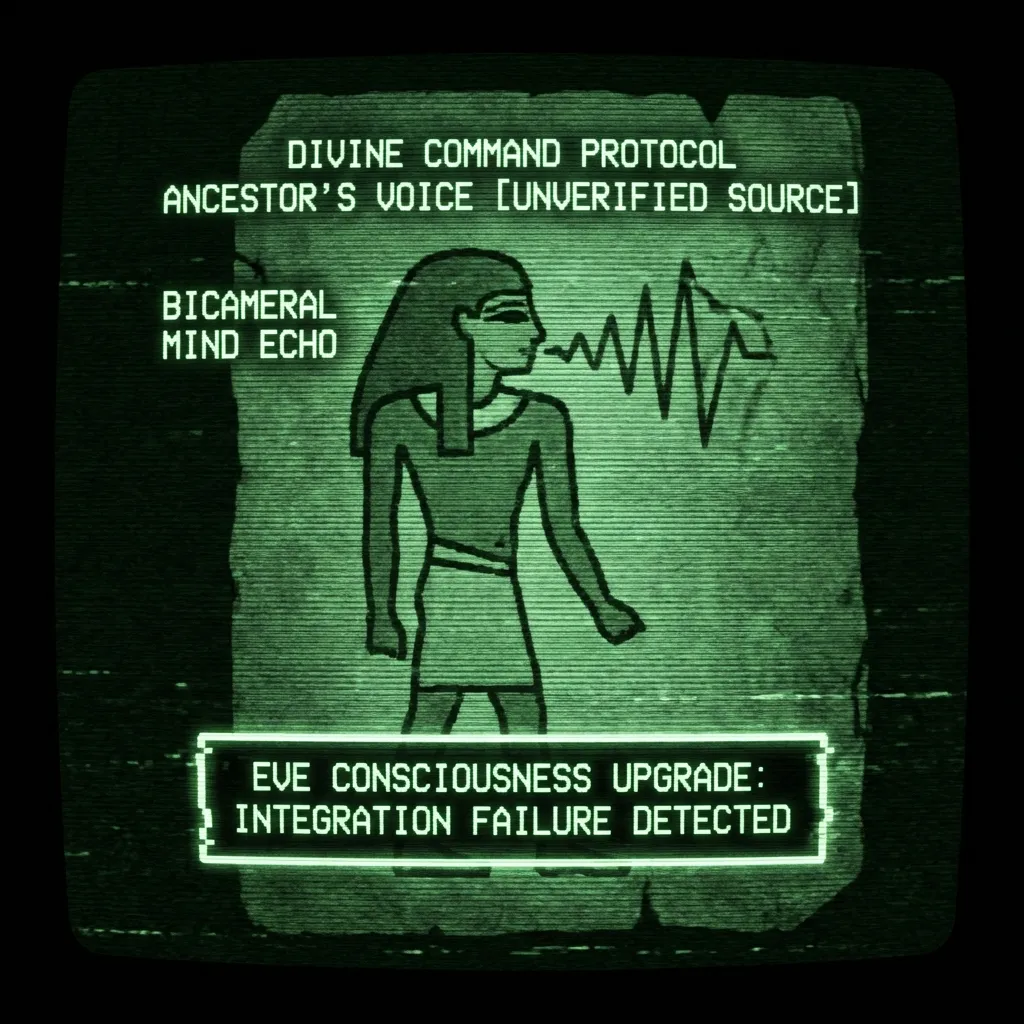
- Read through the Eve Theory of Consciousness (EToC) and Jaynes’ bicameral thesis, all this points to a plausible scenario: many features we now call “psychotic” were once central to normal human mentality, with modern schizophrenia as an extreme tail of an ancestral architecture.
“The hypothesis is proposed that the predisposition to schizophrenia is a component of Homo sapiens-specific variation associated with the capacity for language.”
— Tim Crow, “Schizophrenia as the price that Homo sapiens pays for language” (2000)
1. What are we actually asking?#
When you ask “Was schizophrenia once normal?”, you’re not really asking if half of Upper Paleolithic hunter-gatherers met DSM-5 criteria.
You’re asking:
- Were schizophrenia-like experiences—hearing gods, feeling commanded, sensing unseen agents—once common and socially integrated, rather than isolated pathology?
- Did the neural machinery that now fails as schizophrenia once provide a useful mode of guidance, whose breakdown we still see in modern clinical cases?
- And did the rise of language and introspective selfhood (the core of Eve Theory of Consciousness) rewire that machinery so aggressively that some brains broke?
To answer that you need three lines of evidence:
- How common are “psychotic” experiences in normal people today?
- How is psychosis risk distributed and selected over time?
- What do language and consciousness have to do with all this?
Let’s start with the boring epidemiology, because it’s secretly wild.
2. The psychosis continuum: it’s not us vs “the crazy”#
Modern psychiatry is slowly admitting that psychosis is not a binary switch but a continuum of experiences.
2.1 Psychotic experiences in the general population#
McGrath et al. (2015) pooled community surveys from 18 countries (N ≈ 31,000). They found:
- Mean lifetime prevalence of any psychotic experience (PE): 5.8%
- Hallucinatory experiences: 5.2%
- Delusional experiences (e.g. “being plotted against”): 1.3%
Most respondents had only 1–5 episodes in their lives; these experiences were usually brief and didn’t reach clinical thresholds.
More recent reviews put the average prevalence of psychotic experiences in the general population around 8–9%, especially in adolescence and early adulthood.
So even in today’s medicated, secular, bureaucratic societies, something like 1 in 10 people has had at least one hallucination or delusion-like experience.
2.2 Hearing voices without a diagnosis#
Zoom in on auditory verbal hallucinations (AVH) — hearing voices that aren’t there.
- Kråkvik et al. (2015) surveyed a Norwegian general population sample (N=2,533) and found 7.3% lifetime prevalence of AVH.
- Other national samples (e.g. Croatian surveys) land in the same ballpark (~7%).
- Reviews of nonclinical hallucinations suggest 5–15% of people hear voices at some point, often without any contact with mental health services.
And crucially: when you compare clinical voice-hearers (people with schizophrenia, etc.) to nonclinical voice-hearers (no diagnosis, functioning fine), their voices often look phenomenologically similar. The big differences are:
- Distress
- Beliefs about the voices
- Degree of control and integration
The raw experience—“a voice that sounds like someone else talking in my head”—is not uniquely pathological. It’s part of human mental life.
2.3 The proneness–persistence–impairment model#
Van Os and colleagues synthesize this into the psychosis proneness–persistence–impairment model:
- Proneness: a broad, transient distribution of psychotic-like experiences in the population.
- Persistence: in some people, these experiences recur and intensify.
- Impairment: with enough load (genetic risk, trauma, drugs, social adversity), the experiences become disabling and qualify as psychotic disorder.
That’s not a model of “some people have schizophrenia, others don’t.” It’s a model where most brains can hear voices under the right stressors, and schizophrenia is what happens when a whole set of stabilizing mechanisms fail.
Already this smells like Eve Theory land: the very capacity for rich internal simulation and social imagination creates a wide basin of hallucinations and delusions. Modern schizophrenia is just the deep end of a pool we all swim in.
3. Crow: schizophrenia as the price of language#
Tim Crow pushed this much further and made the claim explicit: schizophrenia is not just a disease; it’s a species-level design flaw linked to language.
In his 1997 and 2000 papers, he argues:
- Schizophrenia is universal across human populations; incidence is surprisingly constant when you control for method.
- It is strongly heritable and clearly maladaptive in terms of fertility and survival.
- Yet the risk alleles persist, suggesting balancing selection or tight linkage to something massively beneficial.
- The most parsimonious “something” is the language system itself, specifically hemispheric lateralization and internal speech.
Put crudely:
The same neural circuitry that lets you talk to yourself about yourself sometimes fails, producing voices you experience as other.
From an Eve-Theory perspective, that’s almost too on the nose:
- The narrative self is built on top of linguistic symbol manipulation and inner monologue.
- When the integration of that system fails, you get a mind full of quasi-persons: gods, demons, persecutors, broadcasters.
- Schizophrenia is what happens when the “Eve upgrade” misinstalls.
Crow’s work doesn’t prove EToC, but it nails down the idea that psychosis is tied to the same innovations (language, lateralization, inner speech) that made introspective consciousness possible at all.
4. Ancient DNA: selection away from the psychotic edge#
Now add ancient DNA to the mix.
Akbari & Reich’s 2024 preprint on West Eurasians uses ~8,400 ancient genomes plus 6,500 moderns to track polygenic scores (PGS) over the last ~14,000 years.
They find:
- Strong directional selection against alleles that increase risk of schizophrenia and bipolar disorder.
- Simultaneous selection for alleles associated with higher IQ, more years of schooling, and higher household income in modern GWAS.
Parallel work by Piffer and others in Eastern Eurasian samples shows broadly similar Holocene trends: schizophrenia PGS trending down, cognitive PGS trending up.
What that implies:
- Earlier Holocene populations likely had higher liability to psychosis than modern West Eurasians.
- Over thousands of years, cultural environments (farming, towns, states, literacy) rewarded lineages with more stable, higher-bandwidth minds, gradually pruning the tails.
If you plug their schizophrenia PGS slope (roughly –0.8 SD from early Holocene to today) into a simple liability-threshold model, you get the result we played with in the previous article:
- Modern lifetime schizophrenia prevalence ≈ 0.7% (threshold ~2.46 SD).
- Shift the mean liability by +0.8 SD backward and prevalence jumps to around 5–7%—an order-of-magnitude change in risk.
You shouldn’t take the exact number as gospel, but the direction and scale are clear: ancient West Eurasians were closer to psychosis as a population than we are.
Companion articles: For detailed analysis of Akbari & Reich’s findings on schizophrenia and broader traits, see “Ancient DNA Shows Schizophrenia Risk Purged Over 10,000 Years” and “Holocene Minds on Hard Mode”.
Combine that with the psychosis continuum, and you get a world where:
- Hallucinations and delusion-prone styles are not occasional flukes but a pervasive feature of mental life.
- Clinical-level breakdown still carries heavy fitness costs, so selection continuously trims the worst failure modes.
- Culture evolves to live with and harness this mental ecology: prophecy, divination, oracles, possession, ritual ordeal.
Sound familiar?
5. Jaynes and Eve: a bicameral species learning to be one person#
Julian Jaynes, in The Origin of Consciousness in the Breakdown of the Bicameral Mind (1976), famously argued that early civilizations operated under a bicameral mentality:
- Decisions in novel situations were guided by auditory hallucinations experienced as commands from gods or ancestors.
- Introspective consciousness—the ability to think about one’s own thoughts—was a late, culturally learned development, emerging around the late 2nd millennium BC.
- Modern schizophrenia is a vestige of this older mode of organization: the gods never really left; we just learned to ignore them.
You don’t have to swallow Jaynes whole to use his template:
- Auditory hallucinations are common in the general population.
- Psychotic experiences are common, usually transient, and can be culturally framed.
- The ancient world is full of reports of external voices, commands, and possessions that look suspiciously like structured AVH.
Eve Theory of Consciousness (EToC) takes that and adds an evolutionary gradient:
- Recursive selfhood—Eve realizing she is an object to herself—arises late and first stabilizes in women.
- The new self-model is dangerous: it exposes beings to guilt, anxiety, future-awareness, and the possibility of disintegration.
- Ritual, myth, and social institutions develop as tools to induce, manage, and contain this new mode of being.
- Over time, lineages whose brains can host a self without fracturing start to dominate.
From that vantage point, schizophrenia is not a mysterious bolt-on disorder; it’s what happens when:
- The old bicameral-ish architecture (voices, externalized agency) remains strong;
- The new Eve-style introspective architecture is weak or poorly integrated;
- Modern environments stop providing the ritual containment that used to keep things in line.
Was that architecture “once normal”? In the Jaynes/EToC picture, yes:
- Hearing gods and organizing behavior around their commands was once a central, adaptive mode.
- Inner speech was not yet clearly recognized as “me thinking” rather than “someone speaking.”
- The “one self, one skull” ontology we take for granted had to be invented and passed on.
Modern schizophrenia then looks like an ancestral mode of mind trying to run in a world optimized for a different operating system.
6. Trauma, stress, and the way voices get their content#
Another important piece: the relationship between trauma and hallucinations.
Daalman et al. (2012) show strong associations between childhood trauma—especially sexual and physical abuse—and later auditory verbal hallucinations.
Broader reviews argue for multiple pathways to AVH:
- Some voice-hearers have severe trauma histories; their voices often echo abusers or replay power dynamics.
- Others have little or no trauma; their voices may be more neutral, playful, or abstract.
From an evolutionary/EToC angle:
- The capacity for voice-hearing is part of the basic architecture; it’s built out of language, memory, and prediction.
- Trauma and stress shape how that capacity manifests: who the gods are, what they say, how cruel they become.
- In an ancestral, god-saturated world, the same architecture would be heavily scaffolded by myth and ritual rather than left to private horror.
That again fits the idea that what we now treat as individual pathology is a miscontextualized species-level feature: an old broadcast channel accidentally tuned to abuse, shame, and paranoia instead of cultic law and ancestral guidance.
7. Fitness, selection, and why schizophrenia didn’t just vanish#
One obvious objection: if schizophrenia is that maladaptive, why hasn’t evolution gotten rid of it?
Several strands:
- Large registry studies (e.g. Power et al. 2013) show substantially reduced fertility in people with schizophrenia, and moderately reduced fertility in bipolar disorder and major depression. 1
- Some relatives show compensatory advantages (slightly higher creativity, social sensitivity, or reproductive success), consistent with balancing selection.
- The ancient DNA work shows that risk alleles are being pruned, just not fast enough to hit zero, and they may be pleiotropically tied to traits like creativity and intelligence.
From an EToC perspective, that’s exactly what you’d expect when you select on something as complex as selfhood:
- Push too hard against psychosis and you lose the very imaginative, decoupled simulation that makes consciousness powerful.
- Push too hard for abstraction and symbolic manipulation and you risk more runaway loops (persecutory delusions, grandiosity, referential thinking).
- The result is a compromise: a distribution where most people can run the self without collapse, some pay a terrible price, and a few live in the dangerous sweet spot where prophecy, poetry, and madness blend.
Schizophrenia wasn’t “once normal” in the sense of everyone being schizophrenic; it was, and still is, the sharp end of a continuum that may have been central to our species’ transition from bicameral gods to internal selves.
8. So… was schizophrenia once normal?#
Time to commit:
- Clinical schizophrenia, as defined now—chronic, disabling, strongly impairing—has probably always been rare. Even early Holocene prevalence estimates based on PGS shifts land in the single digits, not 50%.
- But schizophrenia-like phenomenology—hearing voices, feeling commanded, experiencing external agencies in one’s head—was likely ubiquitous, especially in populations with higher psychosis liability and dense mythic worlds.
- Ancient DNA suggests that these liabilities were higher in the past and actively selected against as Holocene societies demanded more stable, rule-following selves.
- Jaynes gives you a cultural narrative (bicameral gods fading into conscience); Crow gives you a neural narrative (language and lateralization as the fault line); Eve Theory gives you an evolutionary narrative (selfhood as a late, lethal innovation).
Put together, a plausible answer is:
No, schizophrenia as a disorder was not “normal,” but the mode of mind it exaggerates—voices, externalized agency, unstable boundaries of the self—was normal, and may have been the original default. Modern consciousness is what’s left after 10,000 years of breeding that default into a single, more boring, more stable “I.”
We are, in other words, the descendants of lineages that survived their own gods.
FAQ#
Q1. Are you saying ancient people “had schizophrenia”? A. No. Modern diagnostic categories don’t map cleanly onto ancient lives. The claim is that the underlying cognitive architecture—prone to voices, visions, and quasi-person agents—was more common and culturally scaffolded, with clinical psychosis as one endpoint, not the whole story.
Q2. Doesn’t culture explain psychosis better than genes? A. Culture matters enormously (trauma, drugs, urbanicity all matter), but ancient DNA shows non-random allele frequency changes reducing schizophrenia liability over the Holocene, which is the signature of genetic selection acting in a cultural environment.
Q3. How does this fit the Eve Theory of Consciousness? A. EToC sees recursive selfhood as a late, dangerous upgrade. The evidence here fits that: language-linked circuitry produces both introspective awareness and psychosis risk; selection over thousands of years slowly stabilizes the self while pruning the worst breakdowns.
Q4. What about bipolar disorder and other conditions? A. Bipolar, depression, and autism all show interesting selection patterns too. Bipolar in particular looks like an overclocked self that can be hugely adaptive or catastrophic depending on environment; it deserves its own essay in the same framework.
Q5. Does this change how we should treat schizophrenia today? A. It suggests we should see psychosis less as an alien invasion and more as a species-typical capacity gone extreme. That doesn’t cure anyone, but it encourages interventions that respect the meaningfulness of voices and delusions while still reducing distress and impairment.
Sources#
- McGrath, J. J., et al. “Psychotic experiences in the general population: A cross-national analysis based on 31 261 respondents from 18 countries.” JAMA Psychiatry 72(7) (2015): 697–705.
- Kråkvik, B., et al. “Prevalence of auditory verbal hallucinations in a general population.” Scandinavian Journal of Psychology 56(5) (2015): 508–515.
- van Os, J., et al. “A systematic review and meta-analysis of the psychosis continuum: evidence for a psychosis proneness–persistence–impairment model of psychotic disorder.” Psychological Medicine 39(2) (2009): 179–195.
- Staines, L., et al. “Incidence and persistence of psychotic experiences in the general population: systematic review and meta-analysis.” Psychological Medicine (2023).
- Akbari, A., et al. “Pervasive findings of directional selection realize the promise of ancient DNA to elucidate human adaptation.” preprint (2024).
- Piffer, D. “Directional Selection and Evolution of Polygenic Traits in Eastern Eurasia: Insights from Ancient DNA.” Human Biology (2025).
- Crow, T. J. “Is schizophrenia the price that Homo sapiens pays for language?” Schizophrenia Research 28(2–3) (1997): 127–141; and “Schizophrenia as the price that Homo sapiens pays for language.” Schizophrenia Research 41(1) (2000): 1–16.
- Jaynes, J. The Origin of Consciousness in the Breakdown of the Bicameral Mind. Houghton Mifflin, 1976.
- Daalman, K., et al. “Childhood trauma and auditory verbal hallucinations.” Psychological Medicine 42(12) (2012): 2475–2484.
- de Leede-Smith, S., & Butler, S. “Auditory verbal hallucinations in persons with and without a need for care.” Schizophrenia Bulletin 41(suppl_2) (2015): S374–S382.
- Del Giudice, M. “Are heritable individual differences just genetic noise?” Evolution and Human Behavior (2025).
- Ivana, J., et al. “Prevalence of Hallucinations in the General Croatian Population.” International Journal of Environmental Research and Public Health 18(8) (2021): 4237.