The Sumerian and Egyptian Roots of China’s Terracotta Army
TL;DR
- The Terracotta Army did not emerge from a gradual Chinese sculptural tradition: thousands of life-size bodies, anatomical entertainers, bronze giants, chariots, and waterfowl appeared around one emperor and largely disappeared after him.
- Sumer created the buried royal court of attendants, animals, musicians, and vehicles. Egypt made the king’s tomb a cosmic monument populated by statues and an eternal household.
- Achaemenid Persia combined Mesopotamian, Egyptian, Anatolian, Greek, Iranian, and Central Asian craftsmen inside mobile imperial workshops capable of transmitting an entire royal art.
- Ancient DNA confirms that people as well as goods crossed Central Asia long before the formal Han Silk Road. Qin stood at the Chinese end of this human corridor.
- Qin craftsmen made the army locally, but local clay does not explain the foreign ancestry of the life-size body, colossal spectacle, and unusual large-bronze techniques they suddenly mastered.
The First Emperor buried an empire of bodies.
Thousands of ceramic soldiers stood at nearly human scale. Muscular acrobats twisted in states of undress. Bronze birds inhabited an underground water garden. Two minutely engineered bronze chariots waited for the dead sovereign. Ancient histories remembered twelve gigantic bronze men. At the center rose an earthen mountain over a buried palace whose ceiling carried the heavens and whose floor reproduced the rivers and seas.
Then the experiment largely stopped. Han tomb figures returned to smaller scales. China possesses no continuous excavated school leading from Warring States miniatures to the naked tendons, kneecaps, ribs, and muscles of the Qin entertainers, then onward through generations of monumental sculpture. Life-size naturalism erupted at Lishan, served one imperial project, and vanished.
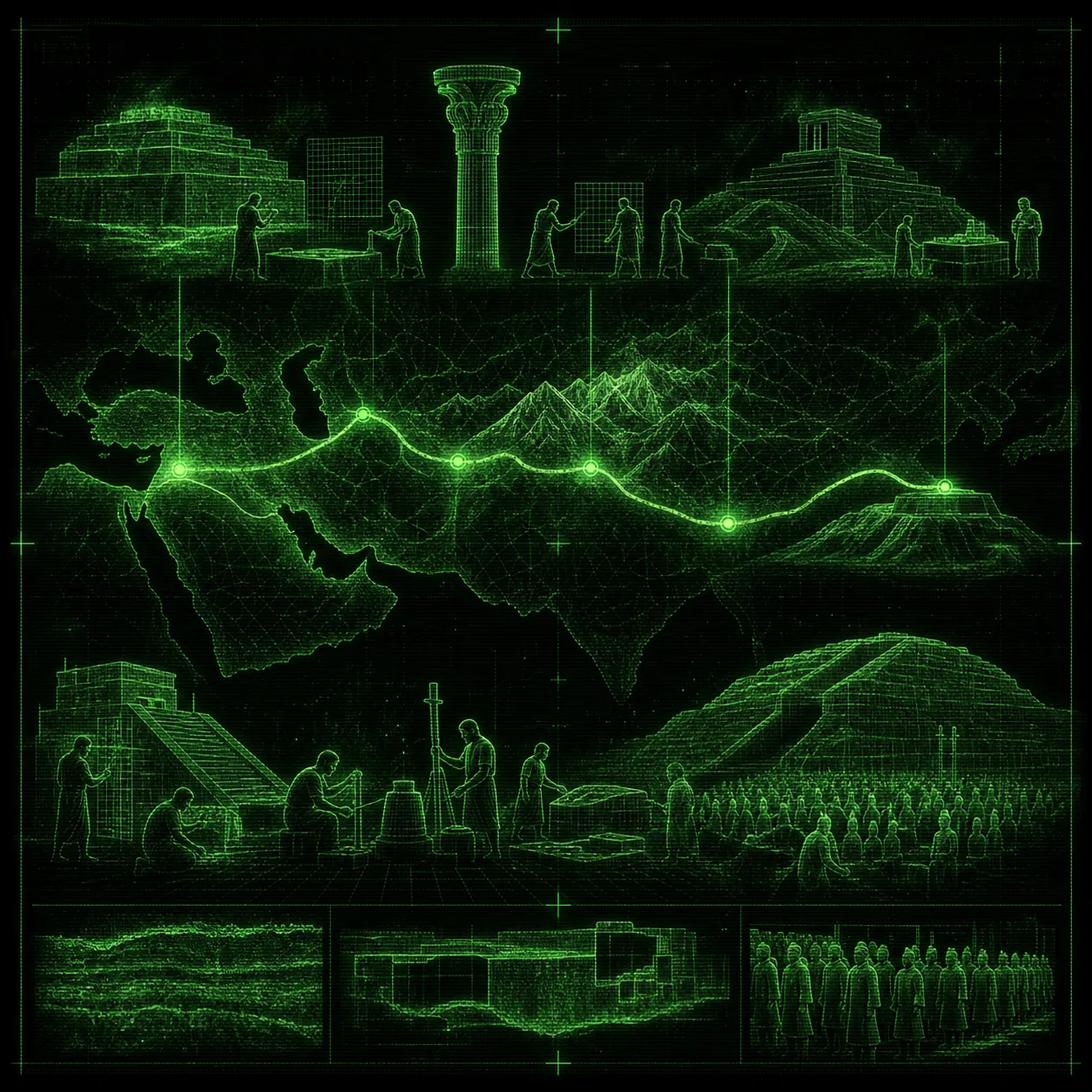
The rupture is not a coincidence. The Terracotta Army belongs to a royal tradition whose oldest great systems arose in Sumer and Egypt. For millennia, western Eurasian civilizations had joined the dead ruler to an artificial mountain, a preserved court, full-size and colossal bodies, vehicles, gardens, animals, cosmic geography, and an organized workshop state. Achaemenid Persia gathered these inheritances into a mobile imperial art. That art reached east through the Persian and Central Asian world and entered a Qin state powerful enough to reproduce it on an unimaginable scale.
Qin did not import finished statues. It imported knowledge carried in human beings: how to enlarge the body, model anatomy, coordinate monumental workshops, repair thin skins of cast bronze, and turn a ruler’s tomb into a populated image of the world. Chinese craftsmen translated that knowledge into Chinese clay, armor, color, ranks, bureaucracy, and cosmology. The result was not a foreign monument standing in China. It was western royal technology reborn as the Terracotta Army.
The royal art that traveled east #
| Royal tradition | Earliest western form | Qin transformation |
|---|---|---|
| Elevated sacred and royal power | Mesopotamian platforms; Egyptian pyramids; Cyrus’s tiered tomb | Vast earthen mound containing a nine-level inner structure |
| Court preserved around the dead | Ur’s attendants, musicians, animals, and vehicles; Egyptian afterlife households | Soldiers, officials, entertainers, horses, birds, chariots, stables, offices |
| Full-size and colossal bodies | Egyptian tomb statues and colossi; Persian and Hellenistic court sculpture | Life-size army and entertainers; twelve remembered bronze giants |
| Monument joined to vehicles | Royal chariots at Ur; Egyptian funerary boats and vehicles; Halicarnassus quadriga | Two bronze chariots and an immense buried vehicle corps |
| Multinational court workshop | Achaemenid palace projects combining craftsmen from across the empire | Conquered labor and specialist production cells under Qin foremen |
| Cosmic royal landscape | Egyptian afterlife cosmos; Persian royal gardens and controlled water | Heaven above, geography below, mercury rivers, water garden, imperial parks |
| Monumental hollow bronze | Egyptian and Mediterranean statuary traditions | Life-size waterfowl, intricate chariots, and remembered colossi |
These features arrived at Lishan together. Their simultaneity is the signature of transmission.
Sumer buried the first royal court #
Sumer supplied the first unmistakable ancestor of Qin’s buried government: a royal court moved underground.
Around the middle of the third millennium BCE, the rulers buried at Ur entered death with attendants, musicians, animals, vehicles, weapons, vessels, games, and the equipment of rank. The Great Death Pit and the tomb of Puabi did not treat burial as the disposal of one body. They reconstructed a social order below ground. The king or queen remained surrounded by the people and things that made sovereignty possible. The Penn Museum’s Ur archive lets that court be reconstructed object by object.
The same governing idea dominates Lishan more than two thousand years later. The First Emperor is not buried alone. An army guards him. Officials administer him. Entertainers perform for him. Stable hands, horses, chariots, armor, birds, musicians, acrobats, and bureaucratic offices keep the dead state functioning. Sumer used human retainers; Qin perfected the manufactured substitute. The medium changed from flesh to terracotta, but the institution remained a court made permanent by burial.
Mesopotamia also made elevation into sacred power. Temple platforms lifted divine buildings above the city; the later ziggurat turned that rise into a staged artificial mountain. The king, the gods, the ordered city, and monumental labor became aspects of the same vertical system. The Metropolitan Museum’s history of Ur’s ziggurat captures the long development of this architecture of command.
Qin combined both Sumerian inventions at imperial scale: the ruler’s world assembled around his death and an artificial mountain marking the center.
Egypt made the dead king larger than life #
Egypt completed what Sumer began. It joined ruler, pyramid, cosmic landscape, preserved body, statue, and eternal household into a single royal technology.
In the Old Kingdom, the king’s tomb became the dominant form in the landscape. Its chambers were stocked for continuing life; its temples sustained offerings; statues provided enduring bodies; servant figures and models reproduced work; the pyramid joined the ruler’s ascent to the ordered heavens. Egyptian art also mastered what is most shocking at Qin: the authoritative human body at full and colossal scale. The king could appear repeatedly in stone or metal, each body both an image and a vessel of presence. The Metropolitan Museum’s Old Kingdom synthesis shows how architecture, statuary, ritual, and afterlife provisioning operated together.
Qin Shi Huang’s underground empire speaks the same monumental language. His mound covers a cosmic palace. Sima Qian describes the patterns of heaven above and the forms of the earth below, with mercury reproducing the rivers and seas. Statues replace living subjects. Chariots wait for royal movement. The ruler occupies a manufactured universe whose scale announces that ordinary death no longer applies to him.
The transmission did not require an Egyptian architect to reach Shaanxi. Egypt’s royal art had already moved into the empires that conquered, employed, and imitated Egypt. By the fifth century BCE, its craftsmen and monumental ideas belonged to the multinational world of Achaemenid Persia. Persia became the hinge that turned the old Sumerian and Egyptian inheritance toward Asia.
Persia made the royal tradition portable #
Around 500 BCE, Darius I recorded how he built his palace at Susa. His foundation inscription, known as DSf, is a roster of civilization in motion.
The project was deliberately multinational. Babylonian workers made bricks. Ionian and Lydian stonecutters dressed stone. Median and Egyptian goldsmiths worked precious metal. Cedar came from Lebanon; other materials arrived from territories including Bactria, Sogdia, Lydia, Egypt, and India. Darius assembled bodies, skills, and substances from an imperial world into one royal monument (DSf translation and text).
“Persian art” was already the organized movement of older arts. Achaemenid kings turned specialists from many populations into coordinated court production. Their reliefs represented many peoples as the ordered support of one throne. Their palaces combined Mesopotamian planning, Egyptian and Anatolian stonework, Greek carving, Iranian kingship, gardens, channels, colossal scale, and a bureaucracy capable of moving material and masters across continents. The Persian-language study by Rāygāni and Bāsafā describes this integration of peoples and artistic traditions as a central Achaemenid practice (2021 study).
Pasargadae shows the same synthesis in the tomb of Cyrus. Six receding stone courses lift the founder’s burial chamber above a royal landscape of gardens and channels (Arrian and the archaeological record). The tomb joins stepped elevation, imperial foundation, cultivated nature, and a ruler made into the permanent center of his state.
Most importantly, Persia extended directly into Bactria and Sogdia. It did not merely preserve the western tradition; it placed that tradition on the eastern Iranian frontier. Egypt and Sumer no longer needed a direct route to China. Persia had absorbed them and carried their royal art halfway across Asia.
At Halicarnassus, the inheritance took recognizable shape #
The Mausoleum at Halicarnassus stood at modern Bodrum on the southwestern coast of Turkey. In the fourth century BCE this was Caria: an Anatolian kingdom ruled by the Hecatomnid dynasty inside the Achaemenid Persian imperial world, while its cities and artists were deeply Greek-speaking. The monument therefore rose exactly where Persian power, Anatolian kingship, Egyptian precedent, and Greek sculpture met.
Visitors saw a gigantic burial podium carrying colossal dynastic bodies, battle and ceremonial sculptures, a colonnaded upper story, a twenty-four-step pyramidal roof, and a four-horse chariot at the summit. Named masters coordinated the sculptural faces of the building. Assistants, common models, component marks, and specialized teams turned the dead ruler into a mountain of bodies and motion. The British Museum’s Halicarnassus collection preserves the surviving colossi and architectural sculpture; Vitruvius and Pliny preserve the design and the division of labor (classical texts).
Halicarnassus already contains the constellation that later erupts at Lishan: the ruler’s tomb as an artificial mountain, colossal human presences, a vehicle commanding the summit, and multiple workshops subordinated to one dynastic image. Qin moved much of the sculpture underground and translated marble into clay and bronze. The political imagination remained recognizable.
Persia reached China through a living human corridor #
The old picture of an isolated China waiting for Zhang Qian to “open” the Silk Road in the second century BCE is finished. The roads existed before diplomats named them.
The Achaemenid Empire already joined the Mediterranean and Egypt to Bactria, Sogdia, and the edge of the Indian world. Alexander’s conquest of Bactria and Sogdia in 329–327 BCE intensified this eastward traffic and created Hellenistic courts in the same eastern Iranian zone. Qin Shi Huang died in 210 BCE. More than a century separated Alexander’s arrival in Bactria from the completion of the First Emperor’s tomb, while Persian rule had connected the route much earlier.
Ai Khanoum in northern Afghanistan shows what happened when the western court tradition reached Central Asia. Greek institutions and art operated inside an Iranian and Bactrian environment. Soldiers, administrators, metalworkers, architects, and artists moved with the successor kingdoms (Iranica, “Āy Ḵānom”). The cities of the eastern Iranian world translated monumental bodies into clay, stucco, wood, and metal—the portable media through which a sculptural tradition could continue without moving marble.
Ancient DNA shows that these corridors carried people as well as objects. By about 3000 BCE, Yamnaya-related Afanasievo populations had moved roughly 3,000 kilometres east into Dzungaria. A study of 201 ancient Xinjiang genomes records continuing mixture among western steppe, Central Asian, Tarim, and East Asian populations through the Bronze and Iron Ages (Kumar et al. 2022). Across the wider Inner Asian Mountain Corridor, the movement of domesticated animals and crops was accompanied by the movement of people (Narasimhan et al. 2019).
The genetics does not make pastoralists the designers of royal tombs. It establishes the human road on which Persian and Central Asian court knowledge could travel. The earliest Tarim mummies make the complementary point: a predominantly local population adopted western wheat, barley, dairying, herding, and clothing practices without genetic replacement (Zhang et al. 2021). Some traditions moved with people; others passed from people to people. Both mechanisms operated on China’s western approach.
Qin faced this world from the northwest. Majiayuan in eastern Gansu is the physical hinge: elite chariots and metalwork combine Chinese forms with traditions arriving through the steppe and Central Asia in the very zone where Qin power was expanding. Russian archaeologists Pavel and Daria Shulga place the formation of Chinese monumental sculpture inside this northern and western contact world rather than reducing it to a lone Greek visit (Шульга and Шульга 2024).
The route runs from Achaemenid and Hellenistic court centers into Bactria and Sogdia, through the oasis networks of Xinjiang and the Hexi–Gansu corridor, into Qin’s Lintao frontier and finally Lishan. Steppe routes supplied mobility between those zones; the monument-and-workshop tradition itself came from Persian and eastern Iranian courts.
The western eruption at Lishan #
Within a single royal program, Qin produced:
- thousands of near-life-size modeled bodies;
- semi-nude entertainers with ribs, tendons, muscles, and kneecaps articulated in clay;
- a set of twelve bronze colossi remembered in later texts;
- half-scale bronze chariots of extraordinary mechanical detail;
- life-size hollow bronze waterfowl in an underground court garden;
- an inset-patch repair method with western large-bronze comparisons;
- a tiered structure embedded inside the mound;
- the bureaucracy, army, stable, entertainment corps, and geography of universal rule assembled around one dead king.
Before Qin, excavated Chinese human figures were generally small, usually measured in decimetres. At the imperial necropolis they suddenly approached or exceeded ordinary human height. The K9901 entertainers are even more revealing than the uniformed soldiers because their exposed anatomy makes the body itself the subject. Lukas Nickel centered this scale and anatomical break in the modern debate (Nickel 2013). Chinese excavator Duan Qingbo expanded the connection beyond Greek sculpture. He compared the mound, waterfowl, chariots, tiered tomb forms, workshop systems, and imperial ideas across Eurasia and described the western material as a coherent system rather than a gallery of coincidences (Duan 2023).
Procedures travel more easily than monuments. A handful of experts can teach proportion, enlargement, anatomical surface modeling, large hollow-bronze skin repair, or workshop coordination without importing a single finished marble statue. Qin had the coercive capacity to magnify a small nucleus of foreign-derived knowledge through hundreds of local workers. Models, measured cords, wax figures, wooden armatures, drawings, repair habits, and bodily demonstrations could generate thousands of objects while leaving almost no imported raw material behind.
The disappearance after Qin strengthens this reconstruction. A local sculptural revolution should have produced descendants. A court-bound school tied to one emperor, one budget, and one specialist nucleus would die with the dynasty. That is what the archaeological sequence looks like: a sudden arrival, an astonishing flowering, and a contraction back toward smaller funerary figures.
Qin turned western knowledge into a Chinese army #
The necropolis had a six-century Chinese foundation.
Royal cemeteries developed from Qin’s northwestern homeland through Yongcheng, Xianyang, Zhiyang, and finally Lishan. Before unification they already possessed rammed-earth platforms, walled and planned compounds, over-tomb buildings, chariot and horse burials, storage pits, drainage, palace-like organization, gates, tiles, and the treatment of the cemetery as a capital after death. The engraved plan of King Cuo of Zhongshan proves that Warring States rulers could design axial, bounded royal landscapes without a Persian architect. Jie Shi traces stepped shafts, terraces, and high-platform funerary architecture inside China (Shi 2014).
The warriors were made from clay and temper processed around Lishan, through combinations of coiling, molded parts, applied details, carving, and hand finishing. Their weapons came from semi-autonomous production cells operating under Qin standards and accountability (Quinn et al. 2017). This is exactly how Qin absorbed a foreign art: outside knowledge entered a mature local manufacturing state and was multiplied by Chinese production.
The state itself had a direct history. The Shang Yang bronze measure of 344 BCE, later reinscribed with the First Emperor’s unification edict, makes Qin standardization tangible decades before the empire (Shanghai Museum, 商鞅方升). Qin did not import administration from Persepolis. It used its own administrative machine to industrialize a monumental tradition that had traveled from the Persian world.
The chamber’s cosmos is likewise expressed in Chinese language: 上具天文, 下具地理—above, the patterns of heaven; below, the forms of the earth
(Shiji, Qin Shi Huang annal). Duan’s
Chinese-language interpretation places the mausoleum within yin-yang, Five Phases, Qin Water
Virtue, and the ruler’s centrality in tianxia
(段清波 2018).
The content has been naturalized, but its monumental form still belongs to the broader western
history of the ruler whose tomb reproduces the cosmos. Cultural transmission does not preserve a
foreign style under glass. It gives a receiving civilization new powers, which that civilization
then makes its own.
The bronze birds preserve a workshop fingerprint #
The clearest technical witness is not a warrior’s face. It is a repair.
Metallurgical analysis of the bronze waterfowl from Pit K0007 found copper-tin plates fitted into deliberately undercut recesses. The research team found no equivalent in the pre-Qin Chinese corpus it surveyed and compared the method with repairs on large Egyptian and Greek bronzes (Mei Jianjun et al. 2015). This is more probative than a silhouette because it joins a non-obvious procedure to the unfamiliar project of producing life-size mimetic bronze animals.
The metal came through Chinese supplies and the clay cores connect the birds to local mausoleum industries. That is the expected signature of imported expertise: a foreign procedure embedded in local material. Bronze cannot tell us the name of the master who demonstrated the repair, but it can preserve the movement of his hands.
The waterfowl matter because the repair belongs to the same sudden complex as life-size anatomy, colossal bodies, bronze chariots, and the cosmic royal landscape. A tiny undercut patch is the forensic edge of a civilizational transfer.
The strange giants at Qin’s western gate #
The Shiji says Qin collected the weapons of the conquered realm and cast twelve enormous metal
figures. The Hanshu preserves another memory: “great men” (大人) appeared at Lintao on Qin’s
northwestern frontier, dressed in foreign style. Later tradition connected the apparition to the
twelve colossi.
Frederick Shih-Chung Chen has shown that 大人 also belongs to the language of political omens and
that the surviving texts do not identify the figures as Greek artisans
(Chen 2021). The value of the story lies deeper
than a literal visitor list. Qin memory joined three things: foreigners at the western gate,
superhuman bodies, and the casting of colossal men at the moment of unification.
The number twelve intensifies the Eurasian echo. Diodorus describes Alexander raising twelve giant altars at the eastern limit of his conquests (Bibliotheca historica 17.95). Qin’s twelve bronzes were not those altars, but both rulers used a set of twelve colossal monuments to translate continental conquest into sacred space. By the time Qin’s historians wrote, the arrival of gigantic foreign bodies from the northwest had become the mythic prelude to the First Emperor’s own giants.
Pots and people #
The old archaeological question asks whether a cultural change records “pots or people”: objects moving through trade, or human beings carrying their practices into a new society. Qin’s western transformation required both.
Horses, glass, goldwork, chariot fittings, pigments, and metal techniques could pass through many hands. Monumental sculpture demanded something more intimate. A worker had to know how a full-size body carries weight, how its parts can be enlarged without losing proportion, how clay behaves at that scale, how molds and hand finishing can coexist, and how hundreds of makers can follow a common visual canon. Large bronze work required knowledge of cores, skins, joins, patches, deformation, and finishing. These were embodied crafts. They traveled inside trained people and their students.
The genetic record establishes a Eurasia full of such movement. The archaeological record shows western techniques arriving at China’s Gansu frontier. The Lishan record then shows a new body, new scale, new bronze procedures, new spectacle, and a complete buried court appearing together. The simplest historical synthesis is that foreign-trained specialists—or Chinese specialists trained by western masters in the contact zone—entered Qin’s enormous labor system.
They did not need to command the project. Qin already possessed foremen, kilns, corvée labor, metrology, clay recipes, piece-mold bronze traditions, and a state capable of enforcing standards. A small teaching nucleus could disappear among thousands of workers while its knowledge multiplied into an army.
The Terracotta Army’s western ancestry #
The Terracotta Army belongs to China. Its soldiers wear Chinese armor, hold Chinese ranks, carry Chinese weapons, and were manufactured in Qin clay under Qin officials. None of that makes its history self-contained.
Sumer had already buried the royal court. Egypt had already made the dead ruler into a colossal, statue-filled cosmic monument. Persia had already merged Mesopotamian, Egyptian, Anatolian, Greek, Iranian, and Central Asian masters into mobile imperial workshops. Halicarnassus had already raised a dead dynast above colossal bodies and a four-horse chariot on a stepped tomb. Bactria and the oasis corridors carried the Persian court world to China’s approach. Ancient DNA confirms that the roads were filled with moving populations, not disembodied influence.
At Lishan, these old western inventions met the most disciplined manufacturing state of ancient East Asia. Qin did what conquering civilizations do: it seized a foreign power, erased its foreign surface, and rebuilt it as an expression of itself.
That is why the Terracotta Army looks unique. It was neither a Greek curiosity nor the predictable next step in Chinese figurine making. It was the eastern culmination of a royal art that began in the tombs of Sumer and Egypt, became portable under Persia, crossed Asia in skilled hands, and reappeared around the First Emperor as eight thousand Chinese giants.
FAQ #
Q 1. Who taught Qin workshops to make the Terracotta Army?
A. Qin workers manufactured the army, while its unprecedented life-size sculptural knowledge
came through the Persian and Central Asian court world, carried by specialists or their students.
Q 2. What connects the Terracotta Army to Sumer and Egypt?
A. Sumer created the buried court of attendants, animals, musicians, and vehicles. Egypt joined
the eternal ruler to colossal bodies, statues, a cosmic tomb, and an afterlife household.
Q 3. Which evidence for diffusion is strongest?
A. The sudden leap to life-size anatomical bodies and the unusual inset repairs on bronze
waterfowl are the most concentrated anomalies.
Q 4. Did people or ideas carry the tradition east?
A. Both. Ancient DNA records west-to-east population movement through Central Asia, while the
Tarim Basin shows local populations adopting western practices without genetic replacement.
Q 5. Why does the Terracotta Army look Chinese?
A. Qin absorbed foreign-derived knowledge into local clay, armor, weapons, pigments,
mass-production cells, and imperial bureaucracy. Naturalization was the final stage of diffusion.
Sources #
- Duan, Qingbo. “Sino-Western Cultural Exchange as Seen through the Archaeology of the First Emperor’s Necropolis.” Journal of Chinese History 7.1 (2023): 21–72.
- 段清波. 《秦始皇陵的宇宙观》. 西北大学学报(哲学社会科学版) 48.2 (2018): 90–95.
- Shi, Jie. “Incorporating All for One: The First Emperor’s Tomb Mound.” Early China 37 (2014): 359–391.
- Nickel, Lukas. “The First Emperor and Sculpture in China.” BSOAS 76.3 (2013): 413–447.
- 陈民镇. 《秦帝国是否受到波斯的影响?》. 中华读书报, 1 August 2018.
- Chen, Frederick Shih-Chung. “Not That Kind of Big Men.” Journal of the American Oriental Society 141.2 (2021): 427–436.
- Quinn, Patrick Sean, et al. “Building the Terracotta Army.” Antiquity 91 (2017): 966–979.
- Mei, Jianjun, et al. “Metallurgical Studies of the Bronze Waterfowl.” Journal of Archaeological Science 56 (2015): 221–232.
- 邵安定、梅建军、杨军昌等. 《秦始皇帝陵园出土青铜水禽的补缀工艺及相关问题初探》. 考古 2014.7: 96–104.
- Шульга, П. И., and Д. П. Шульга. «Эллины» или «скифы»: проблема инокультурных влияний на формирование традиций монументальной скульптуры в Древнем Китае. ΣΧΟΛΗ 18.1 (2024): 204–223.
- Rāygāni, E., and N. Bāsafā. بررسی همگرایی ملی در ساختار حکومت هخامنشی. مطالعات باستانشناسی پارسه (2021): 57–76.
- Darius I. DSf: Susa Foundation Inscription, ca. 500 BCE.
- Sima Qian. 《史记·秦始皇本纪》, first century BCE.
- Encyclopaedia Iranica. “Āy Ḵānom.”
- British Museum. “Mausoleum at Halikarnassos.”
- Vitruvius and Pliny. Classical descriptions of Halicarnassus.
- The Metropolitan Museum of Art. “Ur: The Ziggurat.” and “Egypt in the Old Kingdom.”; Penn Museum, Ur Online.
- Arrian. “Alexander and the Tomb of Cyrus.”, Anabasis 6.29.4–8.
- Diodorus Siculus. Bibliotheca historica 17.95.
- Zhang, Fan, et al. “The Genomic Origins of the Bronze Age Tarim Basin Mummies.” Nature 599 (2021): 256–261.
- Kumar, Vikas, et al. “Bronze and Iron Age Population Movements Underlie Xinjiang Population History.” Science 376 (2022): 62–69.
- Narasimhan, Vagheesh M., et al. “The Formation of Human Populations in South and Central Asia.” Science 365 (2019): eaat7487.
Continue exploring #
Read other posts