Pyramids in China: History, Extent, and Interpretations
TL;DR
- “Chinese pyramids” is a modern umbrella for several different monuments: Neolithic altars, palace-citadels, Qin and Han mausoleum mounds, Goguryeo stone tombs, and Western Xia tower cores.
- Niuheliang Locality 13 is a genuine man-made pyramid: a 10,000 m² earth-and-stone ceremonial altar built more than five thousand years ago.
- Qin Shi Huang’s mound contains an internal nine-level rammed-earth structure. Western Han rulers then made the flat-topped square mound a dynastic signature—with the moundless Baling as the decisive exception.
- China never “rediscovered” these monuments. Ancient histories, local ritual, gazetteers, antiquarian stelae, early photographs, and modern archaeology form a continuous record.
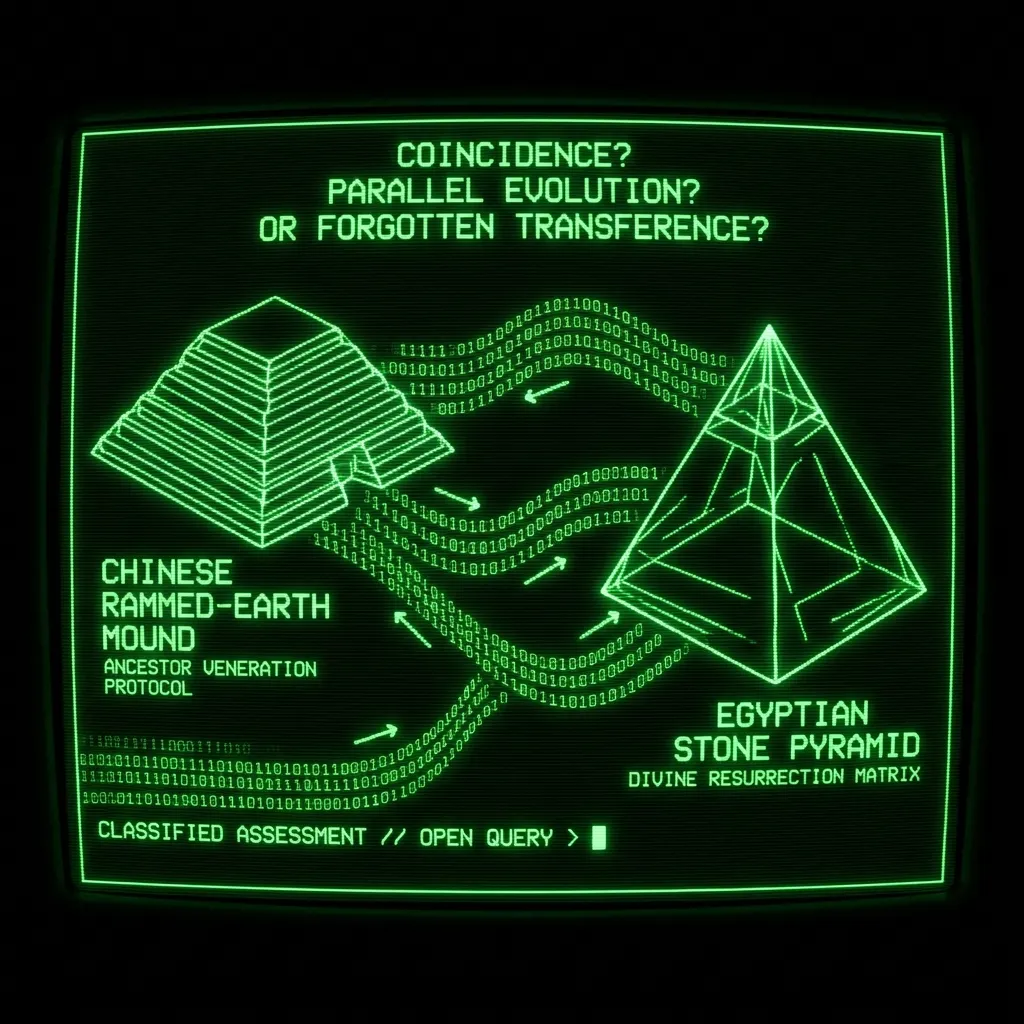
- The tradition has deep Chinese roots, but Qin also absorbed western royal art, monumental-body knowledge, and specialist techniques through Persia and Central Asia.
China has pyramids—but they are not one tradition #
China has real pyramids. Some are flat-topped masses of rammed earth. One is a vast Neolithic ceremonial altar. Others are literal stepped-stone tombs. The famous Western Xia silhouettes are the stripped cores of tower-like mausoleum structures. The phrase is visually useful precisely because the monuments are so different.
Chinese archaeology has better names for them. A Qin or Western Han emperor rests beneath a
封土, the packed-earth mound over a burial; its characteristic flat-topped form is often called
覆斗形, “inverted grain-measure shaped.” Niuheliang Locality 13 is an 大型祭坛, a great altar.
Shimao’s Huangchengtai is a 皇城台, a palatial citadel platform. A Goguryeo royal tomb is a
方坛阶梯石室墓, a square stepped stone-chamber tomb. The Western Xia monuments are 陵台,
mausoleum towers or platforms.
| Monument family | Material and form | Primary purpose | Strong example |
|---|---|---|---|
| Hongshan ceremonial altar | Circular earth-and-stone artificial rise | Regional public ritual | Niuheliang Locality 13 |
| Neolithic palace-citadel | Natural hill transformed by rammed earth and stone terraces | Royal, ritual, and administrative center | Shimao Huangchengtai |
| Qin–Western Han imperial mound | Square, flat-topped rammed earth above a subterranean palace | Imperial burial and continuing court | Qin Shi Huang, Maoling |
| Mountain mausoleum | Chamber cut into a natural mountain | Imperial burial using the peak itself | Tang Qianling |
| Goguryeo stepped tomb | Dressed stone in seven receding stages around a chamber | Royal or elite burial | Jiangjunfen |
| Western Xia mausoleum tower | Tiered rammed-earth core once finished with brick, plaster, timber, and tile | Imperial burial compound | Mausoleums 3, 6, and 7 |
The modern language 中国金字塔群 or “China’s pyramid group” belongs mainly to museums,
tourism, journalism, and public archaeology. Ancient writers used 陵, 冢, 坟, 方上, and
other precise terms. Calling the monuments pyramids does not import an Egyptian identity. It lets
us ask the larger question: why did so many Chinese societies turn earth, stone, death, and sacred
power into an artificial mountain?
The Neolithic pyramid at Niuheliang #
The earliest secure Chinese monument that deserves the word “pyramid” is not a tomb. It is a ceremonial mountain.
At Niuheliang in Liaoning, Hongshan communities created a regional sanctuary of altars, a Goddess Temple, stone-cairn cemeteries, elite jade burials, platforms, and processional space. Locality 13, 3.7 kilometres from the temple, proved to be a wholly artificial earth-and-stone construction. Excavation resumed in July 2025; the Liaoning field announcement of March 2026 described a surviving rise about 7.5 metres high and a ritual area of roughly 10,000 square metres. A later Chinese account reported a circular rammed-earth core about 40 metres wide, stone casing, staged elevation, and a human burial beneath the fill. Its archaeological identity is a great public altar. Its massing is pyramidal.
This makes Niuheliang stranger than the old Giza comparison. A society without a palace or writing system built an ancestral female sanctuary and a man-made mountain as parts of one sacred landscape. The current excavation does not support the frequently repeated internet plan of one 100-metre pyramid surrounded by thirty satellites in a miniature Giza. The real discovery is larger in meaning: temple, ancestor, elite dead, precious jade, measured circle, and collective labor were already being organized into monumental religion more than five thousand years ago. Our detailed investigation follows Nüwa, the Goddess Temple, and the pyramid of Niuheliang.
Two later northern platforms show how many things “pyramid” can mean. At Zhaizi’egedan in Ordos, a
walled Longshan-era settlement contained a central, stepped, truncated platform. Chinese local
scholars have compared it with the 众帝之台, the “Terrace of the Many Emperors” in the
Shanhaijing. That proposal joins archaeology to a living textual geography; it is not a recovered
inscription identifying the place.
At Shimao, around 2300–1800 BCE, builders transformed a natural loess hill into Huangchengtai, a stone-revetted palace and ritual citadel. Its artificial summit measures roughly 130 by 130 metres. The famous “70 metres high” includes the natural descent from summit to ravine; the engineering achievement was to cut, retain, face, terrace, drain, and crown an entire hill. Reliefs, large timber buildings, and sacrificial deposits made it the political heart of a 4.25 km² city (Chinese archaeological synthesis). It is pyramidal architecture without being a pyramid tomb.
Qin buried a nine-level structure inside an earthen mountain #
The First Emperor’s mound at Lishan is the monument that makes the Chinese comparison unavoidable. Modern surveys give slightly different dimensions because erosion has made the surviving base irregular; a widely used recent survey places it around 350 by 345 metres and 51.7 metres high. Ancient writers remembered an intended height of fifty zhang, roughly 115 metres. The ancient number records the planned grandeur, not the present measurement.
The crucial discovery is hidden inside. Geophysical work led by Duan Qingbo reconstructed an approximately 30-metre-high, nine-level rammed-earth retaining structure around the grave zone. The nine levels belong within the larger mound; they were not simply nine exposed steps on the outer face. Duan’s reconstruction also places substantial timber architecture on that buried high platform, turning the mound into the entombed remains of a colossal imperial building (Duan Qingbo, 2018).
Below it, Sima Qian describes an underground palace with models of palaces and towers, mercury rivers and seas, the patterns of heaven above, and the geography of earth below. Modern soil and atmospheric surveys have found a persistent mercury anomaly but the central chamber remains sealed. The mound was therefore only the upper half of the monument. The complete work joined artificial mountain, buried architecture, cosmic geography, court, army, entertainers, animals, chariots, and an entire state continuing around the emperor. See why China still will not open the chamber.
The Western Han field of pyramids—and the mound that vanished #
Western Han rulers made the square truncated mound a dynastic landscape. Nine imperial programs stand on the Xianyang plateau north of the Wei River. Baling and Duling lie southeast of ancient Chang’an. The tombs were not solitary heaps: walls, gates, ritual buildings, empress mounds, companion burials, outer pits, and mausoleum towns turned each emperor’s grave into a second capital.
Maoling, tomb of Emperor Wu, remains the giant of the group at roughly 240 metres square and about
48 metres high. Changling, Yangling, Pingling, Weiling, Yanling, Yiling, Kangling, and the other
imperial compounds create the famous field visible from the air and across the plain. Their
technical description, 覆斗形封土, evokes an inverted grain measure: steep battered sides rising
to a flat summit.
But the dynasty had eleven imperial mausoleum programs, not eleven pyramid mounds. Emperor Wen’s
Baling at Jiangcun has no monumental mound. For centuries, scholars followed a Yuan-period text
and Ming–Qing stelae that placed Baling under the natural hill called Fenghuangzui. Archaeology
found no imperial tomb there. Looting cases and survey work instead revealed the great 亞-shaped
Jiangcun tomb, more than a hundred external pits, an enclosure, and the adjacent tomb of Empress
Dou. In 2021 the national heritage authority confirmed Jiangcun as Baling
(Chinese archaeological account).
Baling does not weaken the Chinese pyramid tradition. It shows that even an emperor could express monumentality underground, through plan, pits, enclosure, association, and landscape rather than an enormous pile of earth.
From lower Han mounds to mountain tombs #
The square pyramid field did not continue unchanged. Eastern Han rulers shifted the capital to Luoyang, where surveys of the imperial zones reveal lower, often circular mounds. The change is visible enough to mark a new funerary regime even when individual emperor identifications remain revisable.
Tang rulers often abandoned the freestanding artificial mountain altogether. Qianling, the joint
mausoleum of Emperor Gaozong and Wu Zetian, was excavated into Mount Liang. Gates, towers, colossal
stone figures, and a processional road monumentalized the approach; the natural peak supplied the
mass. The Chinese phrase 因山为陵 says it exactly: make the mountain itself the mausoleum.
Goguryeo built literal stone pyramids #
At Ji’an in Jilin, the royal tombs of the Goguryeo kingdom supply China’s clearest literal step-pyramid architecture. Jiangjunfen—the General’s Tomb—is a square stone-chamber tomb rising in seven receding stages, roughly 31.6 metres on each side and 12.4–13 metres high. Huge buttress stones brace the lower courses; the chamber sits inside the stepped mass. UNESCO’s nomination describes twelve royal tombs in the property as stepped stone pyramids (nomination dossier).
The monument belongs to Goguryeo’s own regional piled-stone tomb tradition. Its occupant has been identified variously with King Jangsu, Gwanggaeto, and others because no excavated inscription names the dead. The uncertainty of the king does not touch the architecture: it is a dressed-stone pyramid built around a royal chamber.
The Western Xia pyramids are the bones of lost towers #
Near Yinchuan, beneath the Helan Mountains, the Tangut-led Western Xia state built nine imperial
mausoleums and 271 subordinate tombs. Each imperial compound covered roughly 8–16 hectares and
contained walls, gates, sacrificial buildings, subsidiary structures, drainage, and a tall
陵台. The entire landscape, including 32 flood-control works, entered the UNESCO World Heritage
List in 2025 (UNESCO nomination).
The wind-cut earthen silhouettes are not the complete buildings. Excavation has found rammed-earth cores, sockets for beams, brick and plaster finish, colored surfaces, tiles, and evidence for multiple eaves. The lost appearance was closer to a huge solid funerary tower or pagoda than to a bare mound. Individual mausoleums differed; the familiar octagonal seven-tier reconstruction is strong for particular excavated examples and should not be stamped onto all nine.
This is the family most consistently called 东方金字塔, the “Eastern Pyramids,” in modern Chinese
heritage language. The nickname records what the ruined towers look like now. Archaeology restores
what they were: the rammed-earth skeletons of elaborate imperial buildings.
How many Chinese pyramids are there? #
No serious answer is a single number. A count may include only emperors, or add empresses, princes, generals, companion burials, satellite pits, ordinary tumuli, Goguryeo tombs, Western Xia subordinate tombs, and prehistoric altars. The often repeated total of “about 400 around Xi’an” has no identified official survey behind it. What can be counted securely are particular projects: eleven Western Han imperial mausoleum programs; nine Western Xia imperial mausoleums and 271 subordinate tombs; forty protected Goguryeo tombs in the UNESCO property; and dozens of individually surveyed Qin–Han imperial, empress, royal, and companion mounds across Shaanxi.
The visual field is real even when the internet total is not. Around Xianyang, great mounds and their smaller companions still rise between roads, villages, orchards, and fields. Modern land use and trees soften their geometry; archaeology, aerial photographs, and old maps recover the walls, roads, vanished satellites, and construction sequence.
What did a Chinese pyramid mean? #
The earliest Chinese discussion begins with visibility. The Liji remembers an old distinction:
墓而不坟—burial without a raised mound. Confucius, needing to recognize his parents’ grave as a
traveler, raised a marker four chi high. Over the following centuries, royal states turned that
marker into a hierarchy of earth. Height, volume, labor, walls, gates, and approach announced rank.
The king’s political body remained present in the landscape.
Imperial mounds were also working institutions. Sacrifice continued at halls and precincts around them. Mausoleum towns moved administrators and populations into the dead ruler’s orbit. Companion tombs made proximity to the emperor permanent. Outer pits stored the offices, animals, food, weapons, vehicles, and labor of an underground court. A Chinese pyramid was not simply a lid over a body. It was the visible center of a state designed to continue after death.
At Qin, that state became a cosmos. Sima Qian’s phrase 上具天文,下具地理—“above, the patterns of
heaven; below, the forms of earth”—places celestial order over geographical order. Mercury made
the rivers and seas; mechanisms kept them moving. Duan Qingbo reads the buried nine-level
structure as a high-platform architecture of ascent, rulership, and communication between realms.
Whether every timber element of that reconstruction survives or not, the mound, chamber, walls,
army, parks, and cardinal plan indisputably made the emperor the fixed center of a manufactured
world.
Niuheliang gives the artificial mountain a different protagonist: the assembled living community. Goguryeo gives it a stone chamber. Western Xia gives it a tower. The recurring equation is sacred height plus organized labor plus a power that must endure.
The pyramid idea moved in more than one wave #
The choice between “copied from Egypt” and “invented independently” is too small for the evidence. China possessed a deep local grammar of earthen elevation, ancestral burial, public altars, and rammed-earth platforms. It also stood inside a Eurasia through which crops, livestock, metals, chariots, glass, artisans, armies, religions, and populations repeatedly moved.
At Neolithic Niuheliang, no excavated chain presently carries an Egyptian building manual to Liaoning. The more powerful comparison reaches farther back: Southwest Asia had already discovered the social technology of permanent ritual centers, artificial sacred height, ancestor or deity at the center, and collective labor made monumental. Between the Near East and northeast China stood the Caucasus, the steppe, the Iranian plateau, Central Asia, and generations of now poorly sampled communities. Ancient DNA shows Hongshan people were principally Northeast Asian and Yellow River-related; it does not require them to have invented every institution without foreign stimulus. Ideas can cross through small priestly, marriage, craft, or prestige networks without population replacement. Our broader essay traces the creation-and-monument package that came east.
By Qin, the route and the transmitted cargo become much more concrete. The Achaemenid Empire had already joined Egypt and Mesopotamia to Bactria and Sogdia. Persian courts mobilized Egyptian, Babylonian, Anatolian, Greek, Iranian, and Central Asian specialists. Hellenistic kingdoms then intensified the same eastern corridor. Qin’s sudden eruption of life-size naturalistic bodies, bronze giants, engineered waterfowl, chariots, and a populated cosmic tomb belongs to that world.
Chinese excavator Duan Qingbo has argued that terraced tomb architecture, monumental sculpture, bronze techniques, and ideas of universal empire formed a coherent western system that reached the First Emperor’s project. The strongest technical fingerprint is an inset-patch repair on Qin’s life-size bronze waterfowl with Egyptian and Mediterranean comparisons. The strongest historical mechanism is the Persian court workshop: skills carried by mobile human beings, then multiplied by Qin’s local bureaucracy, clay, kilns, metals, and labor. We make the full case in “The Sumerian and Egyptian Roots of China’s Terracotta Army”.
The result is neither a foreign monument in China nor a sealed indigenous miracle. Niuheliang, Shimao, Eastern Zhou cemeteries, Qin statecraft, Persian royal art, and Central Asian human mobility all belong to the ancestry. China repeatedly took mobile ideas of sacred height and eternal rule and rebuilt them in its own most powerful material: rammed earth.
China did not lose its pyramids #
There was no modern discovery of a forgotten Chinese pyramid civilization. Chinese knowledge was continuous. The Shiji described the First Emperor’s underground cosmos. The Sanfu Huangtu recorded Han mausoleums and dimensions. The Shui Jing Zhu remembered locations and looting. Ritual, tomb towns, local place-names, stelae, gazetteers, and antiquarian study kept the imperial landscape legible.
That continuity did not prevent error. In the 1770s, Shaanxi governor Bi Yuan erected stelae at many imperial tombs and helped fix their identities in public memory. His Baling marker at Fenghuangzui also helped fix the wrong location for another two centuries. Jiangcun’s 2021 identification is a warning and a promise: the mounds were never unknown, but archaeology can still rearrange the canonical map.
Foreign documentation belongs to the same story. Japanese scholar Adachi Kiroku surveyed the Chang’an tombs around 1906–10. Victor Segalen’s 1914 expedition photographed and described Qin and Han tumuli as ancient monuments, not new discoveries. The famous 1947 episode is more complicated. Maurice Sheahan reported a huge white pyramid roughly forty miles southwest of Xi’an near the Qinling foothills; a widely reproduced newspaper photograph looks strongly like Maoling, but that does not automatically identify the differently located object in his verbal account. The James Gaussman pilot story still lacks an authenticated wartime report, mission record, or original negative. The “White Pyramid” remains an archival problem, not a substitute for the hundreds of documented monuments.
The real mystery is not whether China has pyramids. It is how many distinct societies kept returning to the same act: gather a population, measure a center, raise earth or stone, place an ancestor or ruler within it, and make political order look like geography.
FAQ #
Q 1. Are there really pyramids in China?
A. Yes. China has monuments accurately described as pyramidal: the Niuheliang ceremonial altar, Qin and Han rammed-earth mounds, Goguryeo stepped-stone tombs, and surviving Western Xia mausoleum-tower cores.
Q 2. Is Qin Shi Huang buried under a nine-step pyramid?
A. Geophysical work supports a nine-level rammed-earth structure embedded inside the larger mound. The visible exterior was not necessarily an exposed nine-step pyramid.
Q 3. Were all eleven Western Han emperors buried under pyramid mounds?
A. No. All eleven had imperial mausoleum programs, but Baling at Jiangcun lacks the canonical monumental mound. Nine imperial programs occupy the Xianyang plateau north of the Wei; Baling and Duling lie southeast of ancient Chang’an.
Q 4. How many Chinese pyramids exist?
A. No authoritative total covers every category. Counts change depending on whether they include only emperors or also empresses, nobles, companion mounds, satellite tombs, stone tombs, and prehistoric ceremonial platforms.
Q 5. Did the pyramid idea travel to China from the West?
A. China had deep local traditions of mounds, altars, and rammed-earth platforms. Qin later absorbed a recognizable western royal and sculptural inheritance through Persia and Central Asia, then rebuilt it inside an indigenous funerary and administrative system.
Sources #
- Sima Qian. Shiji, “Basic Annals of the First Emperor of Qin”.
- Sanfu Huangtu, juan 6, early record of the Chang’an mausoleum landscape.
- Duan Qingbo. “The Mausoleum of Qin Shihuang and Its Cosmology.” Journal of Northwest University 48.2 (2018): 90–95.
- Duan Qingbo. “Sino-Western Cultural Exchange as Seen through the Archaeology of the First Emperor’s Necropolis.” Journal of Chinese History 7.1 (2023): 21–72.
- Shelach-Lavi, Gideon. “Incorporating All for One: The First Emperor’s Tomb Mound.” Early China.
- Liaoning Department of Culture and Tourism. Official report on the renewed excavation of Niuheliang Locality 13, 5 March 2026.
- People’s Daily. “牛河梁第十三地点:红山先民筑起的‘金字塔式’祭坛”, 24 April 2026.
- UNESCO World Heritage Centre. “Archaeological Sites of the Hongshan Culture.”
- Chinese Social Sciences Network. Archaeological synthesis of Shimao and Huangchengtai.
- Chinese Social Sciences Network. “The Archaeological Discovery of Jiangcun and the Identification of Baling.”
- UNESCO World Heritage Centre. Nomination dossier for the Capital Cities and Tombs of the Ancient Koguryo Kingdom.
- UNESCO World Heritage Centre. Nomination dossier for the Western Xia Imperial Tombs, 2025.
- ICOMOS. Evaluation of the Western Xia Imperial Tombs, 2025.
- State Council of the People’s Republic of China. “Notice on Strengthening and Improving Cultural-Relics Work”, 30 March 1997.
- Tan, Kunshan, et al. “The Application of Remote-Sensing Technology in the Archaeological Study of the Mausoleum of Emperor Qin Shihuang.” International Journal of Remote Sensing 27 (2006).
- Zhao, Guangyu, et al. “Mercury as a Geophysical Tracer Gas—Emissions from the Emperor Qin Tomb Studied by Laser Radar.” Scientific Reports 10 (2020).
- Zhang, Hai, Andrew Bevan, and Guo Dashun. “The Neolithic Ceremonial Complex at Niuheliang and Its Wider Landscape Context.” Journal of World Prehistory 26 (2013): 1–24.
- BnF. Victor Segalen’s 1914 archaeological-photography archive.
- Sheahan, Maurice. “U.S. Flier Reports Huge Chinese Pyramid in Isolated Mountains.” New York Times, 28 March 1947.
- Barnes, Gina L., and Guo Dashun. “The Ritual Landscape of ‘Boar Mountain’ Basin: The Niuheliang Site Complex of North-eastern China.” World Archaeology 28 (1996): 209–219.
Continue exploring #
Read other posts