~/mythology/africa
The God Behind the Rainbow: Pygmy Genesis, Mambela, and the Bullroarer
How Pygmy Genesis myths connect to Mungu, the ambelema rainbow serpent, Mambela initiation, and the maduali bullroarer.
TL;DR
- Schebesta recorded two distinct Genesis-like stories: the Efé Baatsi–Tahu origin of death and the neighboring village-Basua Mugasa divine-withdrawal myth.
- The resemblance to Genesis is real: clay, forbidden fruit, female transgression, lost paradise, toil, birth pain, and death—but no serpent tempts either woman.
- Elsewhere in the same regional complex, Mungu is ambelema, the rainbow-serpent; the python symbolizes it; and ambelema is linked cautiously to Mambela initiation.
- Mambela’s maduali bullroarer made the hidden spirit audible. The proposed chain is powerful, but it crosses communities and must not be flattened into one creed.
“The bullroarer is the voice of Tore.”
— Paul Schebesta, “Religiöse Ideen und Kulte der Ituri-Pygmäen” (1933), p. 134, on Kalimoholo; translated from the German
Is there really a Pygmy version of Genesis? #
Yes—and the problem is not that the resemblance is weak. It is that the resemblance is almost too good.
Paul Schebesta, a Catholic missionary and ethnographer, published two Ituri Forest narratives in the English-language Revisiting My Pygmy Hosts (1936). One describes a hidden father-god whose daughter steals a glimpse of him. The other describes the first people eating a divinely forbidden fruit. In both, a woman’s act breaks primordial intimacy with God; abundance disappears; labor, pain, and death enter the world. Andrew Cutler reproduced and interpreted both narratives in “Pygmy Eve Peeps God”.
Schebesta himself could not miss the parallel. In his later scholarly synthesis he called the Mugasa narrative a myth of “lost paradise,” and said the Tahu prohibition bore a “great similarity” to the biblical original sin story (Schebesta 1950, pp. 18–20, 48–49, 202–203).
But the two accounts are not, as they are often presented, “two Efé cycles.” Schebesta’s later monograph supplies the missing attribution:
- The Baatsi–Tahu story came from Sabu at the Efé Maseda camp.
- The hidden-arm story came from neighboring village Basua at Apare, whose deity was Mugasa—printed Masupa in Gerald Griffin’s 1936 English translation.
The distinction matters. Schebesta explicitly says that the Efé-speaking Bambuti and the Kibira-speaking Basua/Bakango used different religious vocabularies (Schebesta 1950, p. 13). “Pygmy” is therefore useful here only as the historical umbrella under which the literature placed several forest peoples. It is not the name of a single tribe, language, or theology. 1
That correction does not weaken the Genesis comparison. It makes it stranger. Two adjacent communities preserve two complementary Falls.
The Ituri dossier splits Genesis in two: one story makes forbidden fruit the origin of death; the other makes the forbidden sight of God the origin of labor, childbirth pain, divine absence, and death.
What happens in the Efé story of Baatsi and the Tahu tree? #
At Maseda, the elderly Sabu told Schebesta that the creator, with the Moon beside him, formed the first man Baatsi by kneading a body, covering it with skin, and filling it with blood. The creator gave Baatsi’s descendants the forest but prohibited one tree, Tahu. For a time the people obeyed and lived happily.
Then a pregnant woman developed an overpowering craving for Tahu fruit. Her husband resisted, then yielded. He picked and peeled the fruit and concealed the peel beneath leaves. The Moon saw the act and reported it to Mugu. Death was sent among human beings as punishment (Schebesta 1950, pp. 48–49; the English narrative is reproduced in Vectors of Mind).
The Genesis correspondences are not vague archetypes such as “a tree” or “a woman.” They form a sequence:
- A creator fashions the first human from earthlike material.
- Humanity inhabits an abundant environment.
- One tree is prohibited by divine command.
- A woman becomes the first mover in the violation.
- A man knowingly participates.
- The evidence is hidden.
- A nonhuman witness informs God.
- Mortality follows the breach.
Genesis 2–3 supplies dust, Eden, the prohibited tree, Eve and Adam, concealment, divine interrogation, childbirth pain, agricultural toil, expulsion, and death (Genesis 2–3). The Ituri story supplies clay or a kneaded body, forest abundance, Tahu, a pregnant woman and her husband, the hidden peel, the watching Moon, and death.
The verbal texture becomes still more provocative in Schebesta’s 1950 analysis. He connects tahu with regional forms such as taku, toku, teku, ato, and aro, then proposes an association with a root meaning “to know” or “become wise.” He calls the fruit, mythologically, both a fruit of knowledge and a fruit of life (Schebesta 1950, pp. 202–203). That etymology is Schebesta’s reconstruction, not a dictionary fact we can independently certify. Yet it shows that the “Tree of Knowledge” comparison was not invented by a modern blog. It was already central to his own reading of the field material.
Why is Mugasa’s disappearing arm even closer to Genesis? #
The Apare story begins before society. Mugasa alone exists. He creates three human children: two sons and a daughter. One son becomes ancestor of the Basua/Bambuti, another ancestor of the Babali, and the daughter becomes the mother of later people.
Mugasa lives among them but remains invisible. He speaks with his children and provides everything, yet commands them never to spy on him. Hammering and forging can be heard inside his great hut. There is divine voice, divine work, and divine abundance—but no divine face.
The daughter brings water and fuel to his door. Curiosity defeats the taboo. Hiding behind a post, she watches Mugasa reach outside for the pot and sees an arm covered with brass rings. Mugasa immediately knows. He announces that he will leave humanity and withdraws secretly downstream.
Before departing, he gives the children weapons and tools and teaches them smithing. The gift is also a sentence. Humans will now survive by technique and labor instead of divine provision. The daughter is condemned to hard work, marriage to her brothers, and painful childbirth. Happiness, peace, effortless water, fruit, fish, and game vanish. Her first child is named Kukua kende, “death is coming,” and dies after two days. Thereafter death takes everyone (Schebesta 1950, pp. 18–20).
This is not a loose resemblance to Eden. It reproduces much of Genesis 3’s causal architecture: female curiosity, prohibited knowledge through sight, divine judgment, painful childbirth, hard labor, lost abundance, separation from God, and mortality. But its central image is more psychologically exact. The daughter does not eat knowledge. She catches God in the act of being perceived.
That is why the narrative matters to the Eve Theory of Consciousness and to Julian Jaynes. Before the breach, the unseen father speaks and humans obey. When a woman turns around to inspect the source of authority, the external god retreats. Planning, tools, labor, and reproductive suffering occupy the vacancy. The myth reads like a memory of the moment when the commanding voice ceased to be simply “God” and became available for reflective scrutiny.
This is an interpretation, not something Schebesta’s informants said. But it is unusually well fitted to the story’s machinery. The act that ends paradise is metacognition staged as a peep behind the curtain.
How do the two Ituri Falls compare with Genesis? #
| Motif | Efé at Maseda | Village Basua at Apare | Genesis 2–3 |
|---|---|---|---|
| First condition | Forest abundance; humans can ascend to God | God lives near his children and provides freely | Eden supplies food without field labor |
| Prohibition | Do not eat Tahu | Do not spy on or see Mugasa | Do not eat from the tree |
| Female action | Pregnant woman’s craving initiates breach | Daughter’s curiosity initiates breach | Eve eats first |
| Male action | Husband knowingly obtains fruit | Brothers share the resulting human condition | Adam knowingly eats |
| Knowledge | Fruit later glossed as knowledge/life | Woman visually discovers God’s hidden body | Eyes open; knowledge of good and evil |
| Divine detection | Moon witnesses and reports | Mugasa knows immediately | God questions the hiding pair |
| Sanction | Death enters | Toil, childbirth pain, divine withdrawal, death | Toil, childbirth pain, expulsion, death |
| Serpent tempter | Absent | Absent | Present |
The final row is crucial. Schebesta explicitly observed that no seducing serpent appears in these Pygmy origin-of-death myths (Schebesta 1950, p. 203). The transgression comes from appetite and curiosity, not reptilian persuasion.
And yet a serpent is waiting just outside the story.
Did Christian missions produce the Pygmy Genesis? #
Schebesta thought not. In the 1936 English account he reports that Sabu learned the Tahu story from his father and insists that biblical influence was out of the question. Jean-Pierre Hallet later made the argument much more aggressively in Pygmy Kitabu, treating Efé traditions as ancient and entertaining a diffusionary path from Central Africa toward Egypt and biblical religion (Hallet 1973). Ulli Beier’s widely read anthology The Origin of Life and Death and David Leeming’s reference works helped carry the Baatsi–Tahu narrative into comparative mythology (Beier 1966).
None of those retellings is an independent early attestation. They stand downstream of a small source pool, especially Schebesta. Hallet’s proposed Pygmy-to-Egypt-to-Bible direction is a grand hypothesis, not a demonstrated transmission history.
The opposite claim—simple missionary contamination—is also unproven. A 1964 reviewer, Michel Meslin, directly asked whether Schebesta’s Pygmy myths of the prohibited paradise tree, clay-made human, death, hunger, and punishment reflected Christian missionary influence (Meslin 1964). The concern is legitimate. Stories travel without carrying the names “Jesus” or “Moses,” and an informant can receive a motif through neighboring people long before meeting a missionary personally.
There is also an observer problem. Schebesta belonged to the intellectual orbit of Wilhelm Schmidt’s Vienna school, which argued for primordial monotheism: the earliest religion was a moral creator-god subsequently obscured by spirits, magic, and polytheism. Masato Sawada argues that Schebesta’s effort to assemble the fluid Efé terms into one creator-God reflected that theoretical desire. In Sawada’s later Efé fieldwork, tore could denote a class of extraordinary beings, especially the dead, rather than one proper-named Supreme Being (Sawada 2001, pp. 29–42).
The honest verdict is therefore suspended:
- Christian or regional borrowing is possible, but not demonstrated.
- Independent convergence is possible, but the detailed sequence demands more than a shrug about universal archetypes.
- Deep diffusion is possible in principle, but no route from the Ituri versions to ancient Israel has been established.
- Ethnographic shaping is certain at the level of translation and synthesis, but does not explain away every indigenous narrative element.
The resemblance is evidence. Its direction and age remain open questions.
Are Mugasa and Mungu the same god? #
Approximately—but an equals sign is too confident.
On Schebesta’s first visit, the village Basua called the deity Mungu or mwamba. On his second visit, the same village Basua called the deity Mugasa, which he interpreted as a Wangwana rendering or counterpart of mwamba. He then says that what the village Basua related to Mugasa/mwamba, the neighboring Bakango related to Mungu (Schebesta 1950, pp. 18–19).
That is strong evidence that Mugasa and Mungu occupy the same high-god position in Schebesta’s regional reconstruction. It is not a recorded statement from an informant that “Mugasa is Mungu.” The name Mungu/Mugu was also extremely widespread and semantically elastic. Schebesta says Ituri peoples often used it with outsiders; depending on context it could mean deity, forest-being, demon, or dead person.
The safest notation is therefore:
Mugasa ≈ Mungu — overlapping creator/father complexes, not a proven lexical identity.
The spelling problem is easier. Masupa in the 1936 English translation and Mugasa in the 1950 scholarly monograph are plainly the same hidden-arm story. Until Griffin’s source or Schebesta’s notebooks explain the change, “Mugasa (printed Masupa in 1936)” is the responsible form.
How does Mungu become the rainbow-serpent ambelema? #
Among Schebesta’s Bakango/Bafwaguda informants, this link is not speculative. The hunter called the power behind game and forest Father and asked it for animals. Honey collectors invoked the same Father at the tree. Schebesta identifies that Father as Mungu, lord of forest and game, and reports explicitly that Mungu is identical with the ambelema serpent (Schebesta 1950, pp. 16, 67–68).
Ambelema is the rainbow understood as a great snake. It is radically ambivalent:
- It is addressed affectionately as Father.
- It gives game and success in gathering honey.
- First portions of food may be offered to it.
- It is feared as a killer associated with sickness, flood, lightning, and death.
- The python is its terrestrial representative or symbol.
The association is not merely a curiosity in Schebesta’s old vocabulary. Robert Blust’s recent global study of rainbow-serpent traditions uses the Bambuti material as an African case in which the rainbow is conceived as a celestial serpent: feared as a murderer and catastrophe-bringer, yet embedded in religious life (Blust 2023, pp. 217–218). Blust confirms the comparative importance of the configuration; he does not independently prove Schebesta’s particular Mungu–ambelema equation.
Schebesta’s 1933 publication is especially useful because it preserves the contradiction before his later systematizing becomes too neat. He says the Bakango both fear the rainbow-serpent and invoke it for hunting and honey; he also distinguishes the secure Mungu–ambelema identity from his more cautious attempt to connect Mungu with thunder (Schebesta 1933, pp. 113–116).
The high god is not replaced by the snake. The snake is how the high god appears when divine power becomes visible in water, sky, and forest.
What was Mambela initiation? #
Mambela—also printed Mombela—was not one standardized ceremony. It was a regional family of boys’ initiation institutions among the Bali/Babali and neighboring peoples of northeastern Congo. Local sequences, officials, instruments, and spirit names varied. The common grammar included forest separation, whipping, scarification or an alternative to circumcision, moral and esoteric instruction, secrecy, and admission to male adulthood.
Vicky Van Bockhaven reconstructs the Bali cycle from a dense archive of administrative and missionary accounts dating from 1904 through the 1930s. Candidates roughly ten to twenty years old entered a forest clearing called the “house of Mambela.” Public flagellations gave way to restricted stages. When the initiation spirits sounded through instruments, women and children fled. Blindfolded novices received chest scarifications attributed to a bird spirit. Elders taught food taboos, respect for parents, elders, and the dead, fraternity, obedience, and silence. The rite could culminate only in a later cycle, when former novices were finally allowed to confront the most secret being (Van Bockhaven 2013, pp. 82–85, 301–303).
This is not merely “religion” floating above politics. Mambela created age grades, alliances, and networks among villages; its officials possessed authority; its secrets could be used to seal cooperation. Van Bockhaven stresses cultural borrowing and regional variation, tracing multiple influences through Bali, Ndaka, Komo, Mbo, and related societies. There was no pristine, unchanging Mambela blueprint.
That point changes how the whole dossier should be read. Mambela was especially a Bali/Babali village institution that neighboring forest communities entered, adapted, or helped remake. Bafwaguda or Basua participation is evidence of a shared regional ritual world—possibly including acculturation and deliberate borrowing—not proof that every feature descends unchanged from an isolated, primordial “Pygmy religion.” The sources show circulation across the forest–village boundary more clearly than they show ethnic ownership.
For comparative context, see the site’s surveys of the bullroarer as a marker of male initiation and of initiates who are snake-bitten or swallowed.
What did the maduali bullroarer do? #
The word maduali moved between object, spirit, ancestor, and spectacle.
Among the Bakango/Bafwaguda at Apare #
Schebesta records maduali as the bullroarer revealed as the first great secret of Mambela. Boys had spent about a year secluded in forest forbidden to women. A grass-clad, masked ndiki, embodying the primordial ancestor endekoru, swung the hidden instrument and warned people away. Schebesta did not see the blade; the surviving evidence establishes its name, action, sound, and ritual position—not its material or shape 2 (Bullroarer Atlas: Bakango/Bafwaguda maduali; Schebesta 1933, pp. 115–116).
In the 1950 synthesis Schebesta adds that among Babali and Bakango maduali meant both the bullroarer and the primordial father. Its roar was identified with thunder. Schebesta cautiously interpreted thunder as the voice of a storm-being connected with the primordial father (Schebesta 1950, p. 15). That last step is his inference. The informants did not hand him the formula “the bullroarer is the ancestor’s voice.”
Among the Bali/Babali #
The independent Bali archive makes the soundscape more complicated. Van Bockhaven describes Maduali as zizi ya mambela, the “spirit of Mambela,” and the most secret and important spirit of the rite. But another spirit, nasasa, was identified with a hornbill or “bird of Mambela.” The scars cut into blindfolded novices’ chests were attributed to this bird-spirit. In different regional versions, the bullroarer could voice Maduali, nasasa, or both; the instrument did not carry one perfectly fixed identity across the entire Mambela zone (Van Bockhaven 2013, pp. 82, 301–303).
At the final “dragging the Maduali” ceremony, initiates from the previous cycle followed a track through the forest, conquered the being, and dragged it to its resting place. Outsiders were told that it was a fantastic animal. To the qualified men it could be revealed as a banana-tree or other trunk wrapped in leaves and hauled by rope. Thus Maduali had at least three registers:
- Sound: the bullroarer’s invisible roar.
- Being: the secret animal-spirit of Mambela.
- Body: a leaf-wrapped forest construction revealed and dragged.
The Bullroarer Atlas’s Babali record preserves a related 1922 account: blindfolded Mombela novices were scarified while Maduali’s bullroarer made a siren-like voice audible for kilometers. The Atlas entry and the original periodical source should be read as a neighboring Bali attestation, not merged into Schebesta’s Bafwaguda event.
How are ambelema, the python, Mambela, and maduali related? #
Schebesta supplies the bridge. Among Babali, village Basua, and their Bambuti, a boy who had completed Mambela but had never seen a python was obliged to view one when a python was killed nearby. Groups of initiated boys processed to the carcass and endured beatings on the way.
His formulation is careful: the python is the symbol of ambelema; ambelema is “in some fashion” the founder or originator of initiation; and in Mambela the bullroarer has the foremost role as a sound instrument (Schebesta 1950, pp. 20–21).
Put into a chain, the evidence looks like this:
| Proposed link | Evidence level | What the source actually supports |
|---|---|---|
| Mugasa ≈ Mungu | Strong comparison | Same high-god role across Schebesta’s visits and neighboring groups; not a recorded synonymy |
| Mungu = ambelema | Direct | Bakango statements identify the forest/hunting Father with the rainbow-serpent |
| Python → ambelema | Direct | Python is ambelema’s terrestrial symbol or representative |
| ambelema → Mambela | Direct but cautious | Schebesta says ambelema is “in some fashion” the initiation’s originator |
| maduali → Mambela | Direct | Bullroarer is central sound instrument; in Bali evidence Maduali is Mambela’s most secret spirit |
| nasasa → bullroarer | Regionally direct | The Bali bird/hornbill spirit could also be voiced by the bullroarer |
| Bullroarer = python/serpent | Not attested | This would be a modern synthesis, not an indigenous formula in the recovered texts |
The chain is meaningful, but it crosses village Basua, Bakango/Bafwaguda, Babali/Bali, and their Bambuti associates, as well as sources recorded at different times. No informant delivers the complete equation:
Mugasa = Mungu = ambelema = python = Maduali.
The better conclusion is relational. A creator/father complex overlaps with Mungu; Mungu becomes visible as the rainbow-serpent; the python makes that serpent terrestrial; ambelema stands behind the initiation; and the bullroarer makes Mambela’s invisible spirits—Maduali and, regionally, nasasa—audible.
Is Tore another name for Mugasa or Mungu? #
Not securely.
In Schebesta’s synthesis, Mugasa/Mungu belongs mainly to a creator, sky, moon, fire, and forest-father cluster. Tore belongs principally to an Efé bush or forest-being cluster, though the attributes of these beings overlap and migrate. Sawada’s later work makes the equation even less safe by showing that tore could function as a category rather than a single proper name.
But the bullroarer–Tore connection is direct in one sharply bounded case. At Kalimoholo, among Balese/Efé-associated people using a different bullroarer name, pahudjuhudju, Schebesta was told that the instrument was Tore’s voice. It sounded during panda initiation under the control of a disguised elder playing the role of “grandfather” (Bullroarer Atlas: Kalimoholo pahudjuhudju; Schebesta 1933, pp. 132–134).
That record is an illuminating comparison, not permission to import Tore into every Mambela rite. Different village. Different initiation. Different bullroarer name. Different divine nomenclature.
Why does the bullroarer matter to the Genesis comparison? #
Because the origin stories explain why God’s direct presence disappeared, while initiation temporarily manufactures that presence again.
The Mugasa myth begins with a voice no one may inspect. The daughter’s reflective gaze destroys the arrangement. Humanity inherits tools and must govern itself. The Mambela rite reverses the sequence for each generation of novices: an unseen power roars in the forest; masked elders and secret instruments control access; terror and obedience precede revelation; only later does the initiate learn what body or mechanism stood behind the sound.
In one Ituri record the bullroarer is the first secret and its masked operator embodies the primordial ancestor. In another, maduali means both bullroarer and primordial father. In the Kalimoholo record, the bullroarer is explicitly Tore’s voice. The instrument is therefore not merely background noise. It is a machine for restoring the absent Father’s command.
This is where the Genesis material and the snake complex finally meet—not as a single narrated myth, but as a theory of mind enacted in ritual:
- Origin myth: scrutiny breaks the immediate God–human circuit.
- Human condition: tools, labor, pain, and death fill the resulting distance.
- Initiation: elders rebuild an external, superhuman voice using controlled sound.
- Serpent cosmology: rainbow and python give the invisible forest Father a visible body.
- Revelation: the novice learns that voice, beast, ancestor, and instrument are layered forms of authority.
The same cognitive technology appears in much of the global bullroarer record. The instrument speaks as a god, ancestor, monster, or law before the initiate is shown how the voice is made. See the comparative Australian dossier and bullroarer cosmogenesis.
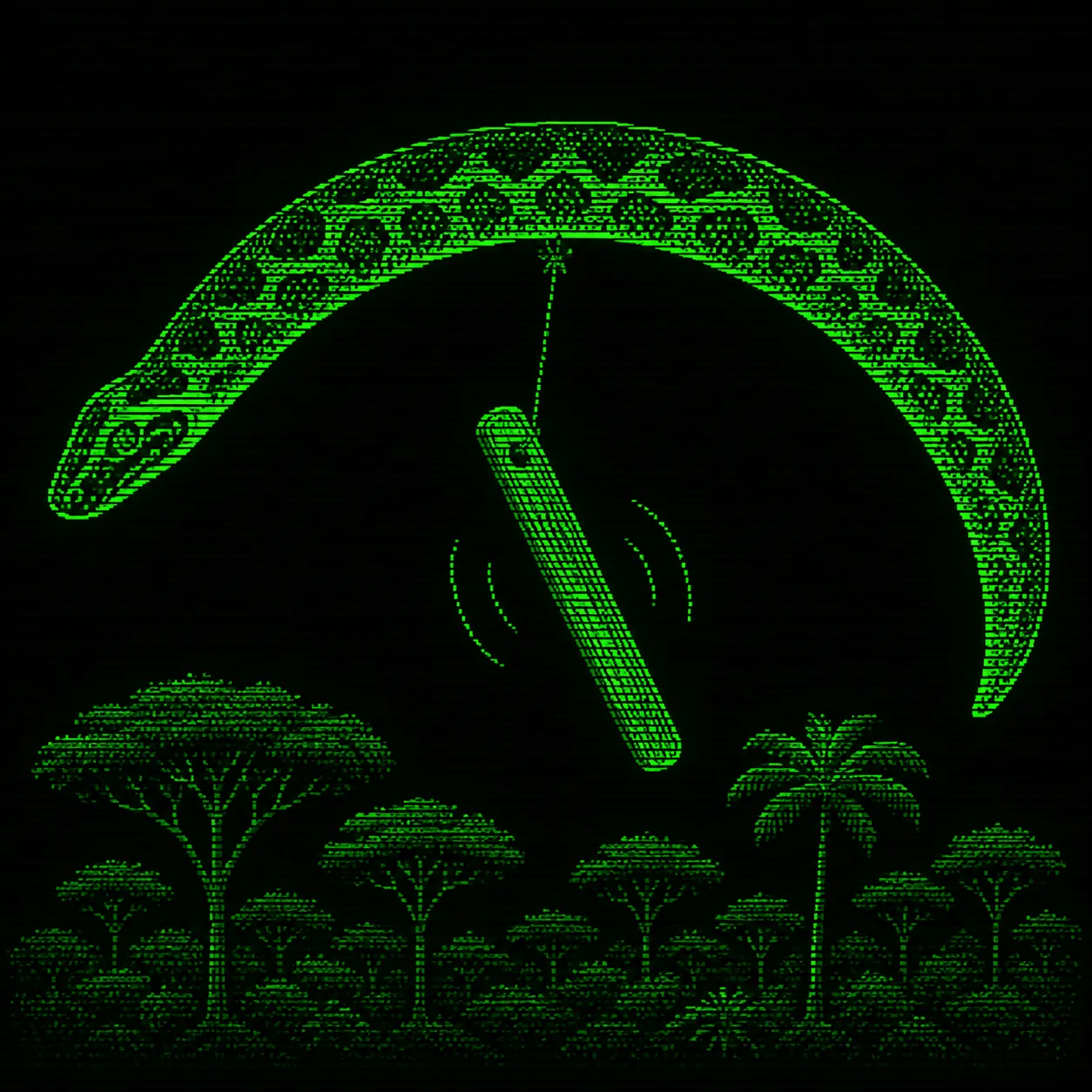
Read together, the Ituri records give the hidden Father a visible body in the rainbow-serpent and the python, place that serpent behind Mambela initiation, and let the bullroarer make the rite’s invisible powers audible. Each link is attested separately, in different communities; no source equates the bullroarer with the serpent.
What can we finally say with confidence? #
The Ituri narratives are genuinely and specifically Genesis-like. Schebesta recognized that before later popularizers did. The Tahu story contains a prohibited fruit, a woman’s initiating desire, a complicit husband, concealed evidence, a celestial witness, divine judgment, and the origin of death. The Mugasa story contains a solitary creator-father, paradise, a prohibition on knowledge through sight, female curiosity, divine withdrawal, hard labor, painful childbirth, technology, and death.
They are not one Efé myth. One is Efé; the other is village Basua. Mugasa is not securely Tore. Mugasa and Mungu are best treated as overlapping high-god terms rather than automatic synonyms. Mungu’s identity with ambelema is much stronger. The python’s relation to ambelema is explicit. Ambelema’s relation to Mambela is explicit but deliberately vague. Maduali’s centrality to Mambela is explicit. A literal serpent-shaped or serpent-embodying bullroarer is not.
The surprise is the placement of the snake. Genesis puts the serpent inside the Fall as tempter. The Ituri dossier keeps the serpent outside the transgression story and places it behind hunting, weather, danger, fatherhood, and initiation. The serpent is not the cheap villain who ruins paradise. It is one of the forms in which the Father’s overwhelming power still appears after paradise is gone.
And when the forest needs to speak with that power again, men swing a blade on a cord until the air becomes a voice.
Footnotes #
Sources #
- Genesis. Chapters 2–3, bilingual Hebrew–English text.
- Schebesta, Paul. “Religiöse Ideen und Kulte der Ituri-Pygmäen (Belgisch-Kongo).” Archiv für Religionswissenschaft 30 (1933): 108–146. See especially pp. 113–116 and 132–134.
- Schebesta, Paul, translated by Gerald Griffin. Revisiting My Pygmy Hosts. Hutchinson, 1936. Extended English passages are reproduced and discussed in Andrew Cutler, “Pygmy Eve Peeps God”.
- Schebesta, Paul. Die Bambuti-Pygmäen vom Ituri, vol. II, part III: Die Religion der Ituri-Bambuti. Mémoires de l’Institut Royal Colonial Belge, Section des Sciences morales et politiques, IV/1. Brussels: Institut Royal Colonial Belge, 1950. See pp. 13–21, 48–49, 67–68, 170–173, and 202–207.
- Bernard, A. “Au pays des Babali.” Congo: Revue générale de la Colonie belge 3.2 (1922): 339–353, especially 351–352.
- Van Bockhaven, Vicky. The Leopard Men of the Eastern Congo (ca. 1890–1940): History and Colonial Representation. PhD diss., University of East Anglia, 2013. See pp. 81–85 and Appendix 1, pp. 301–303.
- Sawada, Masato. “Rethinking Methods and Concepts of Anthropological Studies on African Pygmies’ World View: The Creator-God and the Dead.” African Study Monographs, supplement 27 (2001): 29–42.
- Meslin, Michel. Review of Paul Schebesta, Le Sens religieux des primitifs. Archives de sociologie des religions 17 (1964): 206–207.
- Turnbull, Colin M. The Forest People. Simon & Schuster, 1961. A contrasting Ituri theology centered on the forest rather than Schebesta’s reconstructed Supreme Being. (Bullroarer Atlas: Mbuti (BaMbuti), Ituri Forest records the nkumbi bullroarer Turnbull describes.)
- Hallet, Jean-Pierre, with Alex Pelle. Pygmy Kitabu. Random House, 1973. Popular and diffusionist; use critically.
- Beier, Ulli, ed. The Origin of Life and Death: African Creation Myths. Heinemann, 1966. Later anthology, not an independent Ituri field source.
- Cutler, Andrew. “Eve Theory of Consciousness v3.0.” Vectors of Mind, 2024.
- Blust, Robert. The Dragon and the Rainbow: Man’s Oldest Story and Its Hidden Meaning. Leiden: Brill, 2023. See pp. 217–218 for the Bambuti rainbow-serpent comparison.
- The Bullroarer: An Interactive World Atlas. Relevant records: Bakango/Bafwaguda maduali, Kalimoholo pahudjuhudju, Babali/Bali Maduali, and Mbuti (BaMbuti), Ituri Forest.
Historical sources use broad and sometimes shifting labels such as Pygmy, Bambuti, Basua, Bakango, and Efé. This article follows each source’s local attribution rather than treating the labels as synonyms. ↩︎
Schebesta did not see the Bafwaguda maduali or the Kalimoholo pahudjuhudju. Their physical forms must not be reconstructed from neighboring museum objects or later Bali descriptions. ↩︎