~/archaeology/paleolithic
Pre-sapient humans in America
Pre-sapient humans in America: the case for sparse, technologically simple hominin arrivals long before Clovis and the faint traces they might have left.
TL;DR
- Sparse, technologically simple hominins could have reached America long before Clovis without transforming its ecology.
- Bison crossed from Asia roughly 195,000–135,000 years ago; archaic humans already inhabited Siberia. Bison study; Denisova chronology.
- Cerutti supplies a concrete, disputed example of the faint traces such arrivals might leave. Original study.
- The argument is ecological: entering a continent, dominating it, and leaving descendants are different achievements.
- Sapience itself might have spread culturally much later than the first arrivals.
Could primitive humans have reached America? #
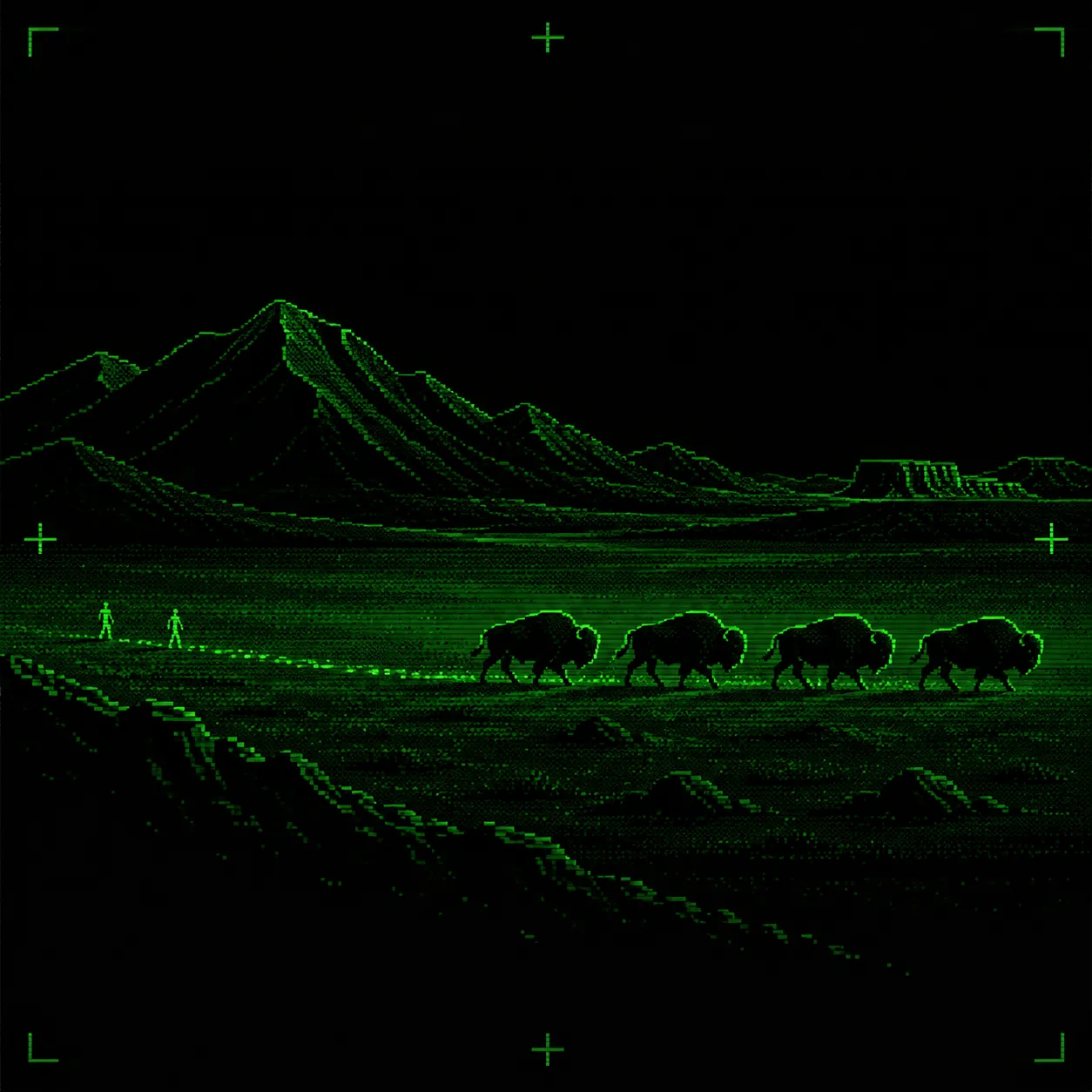
A bison does not discover a continent. It finds more grass. Across generations, its descendants occupy country that its ancestors never reached. What looks to us like a migration between worlds is, on the ground, a succession of ordinary lives.
Early humans could have entered America in much the same way. A small band extending its range through northeastern Asia did not need a conception of the New World. It needed food, shelter, and another habitable valley. If its descendants eventually crossed exposed Beringia, no decisive cultural breakthrough had to occur at the continental boundary.
The case for pre-sapient humans in America is that entry could have preceded dominance by an enormous interval. Technologically simple hominins could have lived there as a sparse part of the fauna: gathering, scavenging, hunting opportunistically, and sometimes disappearing. Such inhabitants need not have produced either a continent-wide archaeological tradition or a wave of megafaunal extinction.
This is a hypothesis about a human presence with a small footprint. Its strength comes from putting three things together: a repeatedly traversed animal route, an ancient human presence in northern Asia, and American finds that some researchers interpret as very early human work. It also explains why such finds would be scarce: perhaps we are looking for the signature of demographic success where there was only precarious occupation.
What does “pre-sapient” mean? #
Here, sapience means recursive self-awareness: the capacity to make oneself an object of thought. The Eve Theory of Consciousness proposes that this developed through culturally transmitted practices and subsequent genetic selection. Biological and cultural origins need not coincide. On that hypothesis, even Homo sapiens could precede established sapience; the species name does not settle the question.
The sparse populations and simple technology considered here describe how such inhabitants might have lived. They cannot, by themselves, establish what their makers experienced inwardly.
The possible occupants include archaic Homo sapiens, Neanderthals, Denisovans, or another branch of Homo, depending on the period. These names are alternatives, not identifications. Éric Boëda, Christophe Griggo, and Christelle Lahaye explicitly considered several such human lineages when discussing the Cerutti mastodon site. The suggestion of an archaic American population therefore has a scholarly history. Boëda and colleagues, 2017.
The broad question concerns opportunities during the last million years. The most concrete case developed here concerns the later part of that span, especially the interval around 200,000–130,000 years ago. Extending the possibility farther backward requires different human populations and additional evidence; a million years is a search window, not a settlement date.
Could humans have followed animals across Beringia? #
The detailed animal history belongs in Old World–New World animal migrations. One example carries the argument here. Fossils and ancient DNA place the first bison dispersal from Asia into North America approximately 195,000–135,000 years ago. The same research identifies another dispersal around 45,000–21,000 years ago. Passage was a recurring feature of the landscape. Froese and colleagues, 2017.
When sea levels fell, Beringia became an extensive inhabited landscape connecting Asia and Alaska. Migration through it could be a gradual expansion of feeding territories. The National Park Service describes precisely this food-and-shelter mechanism for human movement through Beringia. About Beringia.
Imagine a population exploiting animals already familiar on the Asian side. As those animals' ranges expand, opportunities to hunt or scavenge expand with them. The humans need not become specialist mammoth killers. A carcass, a small animal, or a patch of seasonal plant food can matter as much to the next day’s survival as a successful large-game hunt.
The geography imposes timing, not a permanent prohibition. Exposed land between Asia and Alaska did not guarantee an open route through Canada’s ice sheets. Entry into Alaska and expansion farther south could have occurred in different climatic phases, an issue Boëda and colleagues also discuss. A population could reach the northern landscape during one interval and spread southward when another opened. Their discussion.
Animal crossings establish that the continents were permeable. Human passage additionally requires adequate winter food, fuel or shelter, and a viable breeding population. Those are concrete ecological requirements. They do not demand that the migrants already possess the technology or population density of much later Americans.
How far north did ancient humans live? #
Archaic humans were already established in Siberia hundreds of thousands of years before Clovis. At Denisova Cave in the Altai, sediment DNA identifies Denisovans from about 250,000 years ago; the oldest identified Denisovan fossils there date to roughly 200,000 years ago. These occupants used early Middle Paleolithic stone tools. Denisova chronology, 2025.
Farther northeast, Diring Yuriakh on the Lena River, near 61° north, supplies a particularly suggestive comparison. Published luminescence work placed its proposed Lower Paleolithic occupation approximately 260,000–370,000 years ago. It is the combination of latitude and simple stone technology that matters: northern occupation need not begin with an Upper Paleolithic toolkit. Waters, Forman, and Pierson, 1997.1
Much later, a mammoth at Sopkarga records human hunting and butchery activity around 45,000 years ago, at approximately 72° north. That evidence reaches deep into the Siberian Arctic, although it does not identify the hunters’ species or establish Arctic occupation 200,000–400,000 years ago. Pitulko and colleagues, 2016.
These sites perform different jobs in the argument. Denisova establishes archaic inhabitants; Diring supplies a much more northeasterly early occupation claim; Sopkarga demonstrates actual Arctic exploitation. They are not a continuous trail to Alaska. Together, they give the proposal an empirical starting point: ancient humans inhabited northern environments, and their ability to live there cannot be dismissed simply because their technology was old.
What evidence could very early Americans have left? #
The Cerutti mastodon site near San Diego gives this model something more concrete than an empty map. In 2017, Steven Holen, Thomas Deméré, and colleagues reported a mastodon bone bed: the fragmentary remains of a single animal, with a uranium-series age of 130,700 ± 9,400 years. They interpreted fractured bones and associated cobbles as evidence of hammerstone-and-anvil processing for marrow or bone material. Their case combines percussion features, refitting fragments, and the placement and damage of the stones. Holen and colleagues, 2017.
That is an arrestingly modest activity on which to hang a continental arrival: breaking a bone. No elaborate projectile point is required. Neither is proof that the animal was hunted. Scavengers can open bones, too. If the interpretation is right, the inhabitants become visible through an episode of food or material extraction, rather than through a spectacular cultural achievement.
Cerutti’s human agency remains disputed. Critics argue that the damage and associations do not adequately exclude other processes. The ancient date of the animal does not, by itself, date a human action. That distinction is essential to the site’s use here: it is a concrete possible example of the predicted behavior, not an established American archaic-human population. “Contesting early archaeology in California”.
Other researchers have argued for much older American archaeology. Virginia Steen-McIntyre, Roald Fryxell, and Harold Malde published geological evidence for an age around a quarter-million years at Hueyatlaco, Mexico. Such claims have to establish the relationship between dated sediments and actual human activity. Our account of the older pre-Clovis claims covers that history; repeating the entire catalogue would confuse the present argument with a defense of every proposed site. Hueyatlaco geological study.
The relevant point is that very early occupation has generated specific excavations, analyses, and competing interpretations. The ecological model explains why a real occupation might first appear in this frustrating form: scattered traces whose makers left few immediately recognizable objects. It cannot turn an ambiguous trace into an artifact simply by needing one.
Why isn’t there more evidence? #
The amount of archaeology we should expect depends on how many people lived in a landscape, how long they stayed, what they discarded, and what survived to be found. “Humans were present” does not specify any of those quantities.
Consider two proposed populations. One is numerous, well connected, and repeatedly manufacturing distinctive stone weapons. The other consists of small, mobile groups using local cobbles, flakes, and perishable materials. Even before erosion or burial, the second produces fewer recognizable concentrations. If its settlement attempts end in local extinction, gaps between occupations can be longer than the occupations themselves.
| Proposed behavior | Expected archaeological signal | Consequence for this model |
|---|---|---|
| Small groups spread thinly | Few dense occupation sites | A sparse record is compatible with presence |
| Short or intermittent occupations | Disconnected episodes | No continuous regional tradition is required |
| Mostly expedient stone use | Simple flakes and battered cobbles | Context becomes crucial to recognizing human work |
| Heavy use of wood, fiber, or hide | Loss of much everyday equipment | Surviving stone understates the toolkit |
| Limited total predation | No necessary continent-wide extinction pulse | Faunal survival does not establish human absence |
| Extinction without descendants | No contribution to living people’s genomes | Modern ancestry cannot inventory every failed arrival |
These are conditional expectations, not a measured reconstruction of an unknown population. They explain why the right comparison is with a sparse hominin range margin, rather than a well-populated archaeological culture.
Preservation then removes part of the signal. River erosion can destroy an occupation surface; new sediment can bury one beyond ordinary survey; rising seas can drown coastal land. Much of the central Beringian landscape is now underwater. That loss affects the very territory through which the proposed entry occurred. National Park Service.
Time still matters. A substantial population occupying two continents continuously for hundreds of thousands of years should accumulate more evidence than a few failed incursions. Among occupation hypotheses, the scarcity favors brief or intermittent incursions over a large, enduring population. It does not justify making a large, enduring population arbitrarily invisible.
There is also no calibrated calculation showing that today’s disputed finds are exactly the number we should expect. Their scarcity is compatible with this model, but also with natural processes producing misleading objects. The explanatory gain is narrower and useful: a thin record is not inherently surprising if the proposed inhabitants were thin on the ground.
Wouldn’t early humans have killed the megafauna? #
Only if their combined pressure was sufficient. A population can eat large animals without causing their continental extinction. Total impact depends on hunter numbers, killing rates, prey reproduction, and environmental conditions. Being capable of hunting and being numerous enough to transform a fauna are separate matters.
Nor should archaic humans automatically be imagined as helpless scavengers. At Neumark-Nord in Germany, Neanderthals hunted and processed straight-tusked elephants weighing up to 13 tonnes around 125,000 years ago, and contemporary sites show that elephant butchery was widespread. A sparse American population could include capable hunters while exerting relatively little aggregate pressure. The model needs limited ecological impact; it does not require every archaic lineage to occupy a low position in the food web. Gaudzinski-Windheuser and colleagues, 2023; wider exploitation.
White Sands makes the separation between presence and extinction especially vivid. Its human footprints date to approximately 23,000–21,000 years ago, supported by independent dating. People therefore coexisted with American megafauna for millennia before the terminal Pleistocene extinction event. This does not prove a 130,000-year-old population. It does show why immediate faunal collapse is an unsuitable entrance requirement for humans. Pigati and colleagues, 2023; USGS account.
Why no art or sophisticated stone tools? #
A modest material signature follows naturally from the proposed way of life. A sharp flake can cut; a cobble can strike. The hypothesis does not require early arrivals to leave the distinctive forms through which archaeologists most easily recognize later cultures.
But tools, art, and ecological dominance are not a single package that switches on at one date. A simple stone tool is not an intelligence test. An adept hunter need not make durable pictures, and an absence of surviving pictures cannot establish an absence of symbolic thought. Sapience might nevertheless have been a late adaptation whose spread was partly memetic: learned and transmitted between communities. Its wider establishment could have continued around the end of the Ice Age, long after an initial emergence. Eve Theory develops this possibility; its proposed beginnings around 50,000 years ago are distinct from later diffusion.2 Applied here, that would separate the arrival of humans from the arrival of a transformative cultural repertoire. It is a proposed mechanism, not a date read from missing art.
Likewise, a comparison with technology hundreds of thousands of years old should concern a particular repertoire, not an imaginary universal “400,000-year-old stage.” The Denisova record itself includes Middle Paleolithic tools. An isolated American group might have relied heavily on simple percussion and expedient flakes; that behavior would need to be demonstrated locally, not assigned to every Denisovan or Neanderthal. Denisova chronology.
Clovis, around 13,000 years ago, is a conspicuous archaeological horizon, but sophistication did not begin there. At the Debra L. Friedkin site in Texas, researchers reported pre-Clovis stemmed projectile points in deposits dated roughly 15,500–13,500 years ago. Those people cannot be swept into a category of uniformly primitive predecessors. The Paleolithic technology timeline follows the more varied record. Waters and colleagues, 2018.
The much earlier scenario stands independently: before those recognizable late Pleistocene populations, other humans could have arrived with fewer distinctive possessions, remained scarce, and vanished.
Could the first arrivals have left no descendants? #
A successful crossing need not found an enduring population. A few groups could survive for generations and still disappear when environments changed or contact with neighboring groups was lost. Their arrival would belong to American natural history even if it contributed nothing to the ancestry of later inhabitants.
The genetic consequence follows directly: a population that left no descendants cannot be recovered from those descendants’ genomes. Ancient remains might reveal it, but living people’s ancestry alone cannot exclude every failed colonization. This is a limit of the test, not positive evidence for a lost population.
The distinction also prevents an unnecessary conflation. This hypothesis does not identify the ancestors of Indigenous Americans as cognitively deficient. It proposes possible earlier populations whose relationship, if any, to subsequent Americans is unknown.
Could America have had humans before human dominance? #
The proposal becomes coherent once the first arrival is separated from everything that might come afterward. Crossing Beringia did not require a continental population explosion. Occupying a valley did not require exterminating its animals. Opening a bone did not require producing an archaeological tradition recognizable across thousands of miles.
There are evidentiary objections, especially the missing sequence of securely identified sites. There is no demonstrated permanent geographical barrier that makes every earlier hominin arrival impossible. Animal dispersals supply the route’s history, Siberian archaeology supplies ancient human neighbors, and Cerutti supplies a specific possible encounter between the two histories.
Sparse, technologically simple humans could have inhabited America long before its conspicuous human transformation. The first populations may have lived within the existing ecology, expanded only a little, and disappeared. They would belong to the continent’s history in the same ordinary way as other immigrant animals: present for a time, constrained by the landscape, and not guaranteed a future. If sapience also traveled through culture, its spread and the first footprints could belong to different chapters. America could have had humans long before it became a human world.
Notes #
Sources #
- Froese, D., et al. (2017). “Fossil and genomic evidence constrains the timing of bison arrival in North America.” PNAS.
- National Park Service (2025 update). “About Beringia.”
- Jacobs, Z., et al. (2025). “Pleistocene chronology and history of hominins and fauna at Denisova Cave.” Nature Communications 16, 4738.
- Waters, M. R., Forman, S. L., and Pierson, J. M. (1997). “Diring Yuriakh: A lower paleolithic site in central Siberia.” Science 275: 1281–1284.
- Pitulko, V. V., et al. (2016). “Early human presence in the Arctic: Evidence from 45,000-year-old mammoth remains.” Science 351: 260–263.
- Holen, S. R., et al. (2017). “A 130,000-year-old archaeological site in southern California, USA.” Nature 544: 479–483.
- Boëda, É., Griggo, C., and Lahaye, C. (2017). “The Cerutti Mastodon Site: Archaeological or Paleontological?” PaleoAmerica 3: 193–195. Open copy.
- Ferraro, J. V., et al. (2018). “Contesting early archaeology in California.” Nature 554: E1–E2.
- Steen-McIntyre, V., Fryxell, R., and Malde, H. E. (1981). “Geologic evidence for age of deposits at Hueyatlaco archeological site, Valsequillo, Mexico.” Quaternary Research 16: 1–17.
- Gaudzinski-Windheuser, S., Kindler, L., MacDonald, K., and Roebroeks, W. (2023). “Hunting and processing of straight-tusked elephants 125.000 years ago: Implications for Neanderthal behavior.” Science Advances 9: eadd8186. See also Gaudzinski-Windheuser, S., Kindler, L., and Roebroeks, W. (2023). “Widespread evidence for elephant exploitation by Last Interglacial Neanderthals on the North European plain.” PNAS.
- Pigati, J. S., et al. (2023). “Independent age estimates resolve the controversy of ancient human footprints at White Sands.” Science. USGS explanation.
- Waters, M. R., et al. (2018). “Pre-Clovis projectile points at the Debra L. Friedkin site, Texas—Implications for the Late Pleistocene peopling of the Americas.” Science Advances 4: eaat4505.
- Jansen, J. D., et al. (2024). “Redrawing early human dispersal patterns with cosmogenic nuclides.” EGU General Assembly, abstract EGU24-4168; preliminary conference chronology.
- Cutler, A. (2024). “Eve Theory of Consciousness v3.0.” Vectors of Mind, February 27. Source for the proposed cultural and evolutionary mechanism.
The 1997 Science study is the published chronology used here. Jansen and colleagues presented a newer burial-age estimate of 417,000 ± 82,000 years at the 2024 European Geosciences Union meeting, associating occupation with the warm MIS 11c interglacial. That is a conference result, not an interchangeable replacement for a settled journal chronology. Neither dating scheme identifies the toolmakers’ species or demonstrates a contemporaneous open route to America. Primary conference abstract. ↩︎
Eve Theory v3.0, especially “Weak EToC,” separates cultural diffusion from genetic ancestry. Its chronology is a hypothesis, not an established archaeological dating of consciousness. ↩︎