~/anthropology/ritual
Roaring Boys: Bullroarers and Male Initiation in Papua New Guinea
How bullroarers figure in Papua New Guinea male initiations—from Purari Delta imunu viki and kaiamunu ‘monsters’ to Sepik Tambaran houses—plus names, stages, and secrecy.
TL;DR
- In PNG, bullroarers are core to certain male initiations; in the Purari Delta they are imunu viki (“weeping spirits”) and voice the wicker kaiamunu monsters, sounded by initiated men during rites (and funerals). [^oai1] 1
- Sepik initiations (e.g., Iatmul) seclude novices in the men’s house; boys are explicitly taught to play the bullroarer as part of instruction in sacred sound and secrecy. 2
- Terminology is thick: upura (Purari bullroarer), imunu (vital force—also an onomatopoeic label for the bullroarer), and kaiamunu/ebiha/gi (monster/shield complexes) structure how sound = presence. 3
- Across regions, the auditory taboo converges: uninitiated and women must avoid the instrument’s sound; in the Gulf and Sepik that “voice” signals the sacred is active. 1 4
- PNG is diverse: Highlands complexes foreground sacred flutes; bullroarers appear unevenly. Treat any “uniform PNG” claim as cope. 5
“…nothing more or less than the growling of the monster.”
— Paul Wirz, on the bullroarer’s sound in Gulf initiations (1937) 3
What the bullroarer does in PNG (not just what it is) #
A bullroarer is a whirled aerophone; sure. But in Papua New Guinea its sound is the operative fact: a ventriloquized presence that marks the men’s house as “on.” In the Purari Delta (Papuan Gulf), museum and field accounts align: the slat is imunu viki (“weeping spirit”), voiced during male initiations and elite funerals; the tone is heard as the kaiaimunu’s speech—a wickerwork monster resident in the men’s house (Bullroarer Atlas: Namau imunu viki, Baroi River). [^oai1] 1
In the Middle Sepik (e.g., Iatmul villages like Japanaut/Korogo), initiation means prolonged seclusion in the men’s compound, instruction in men’s work, and lesson-plans in flutes and bullroarer. The instrument’s roar is part of the Tambaran’s acoustic signature; outsiders are meant to hear power, not see its machinery. 2 4
Purari Delta: kaiamunu, imunu, and being “swallowed” #
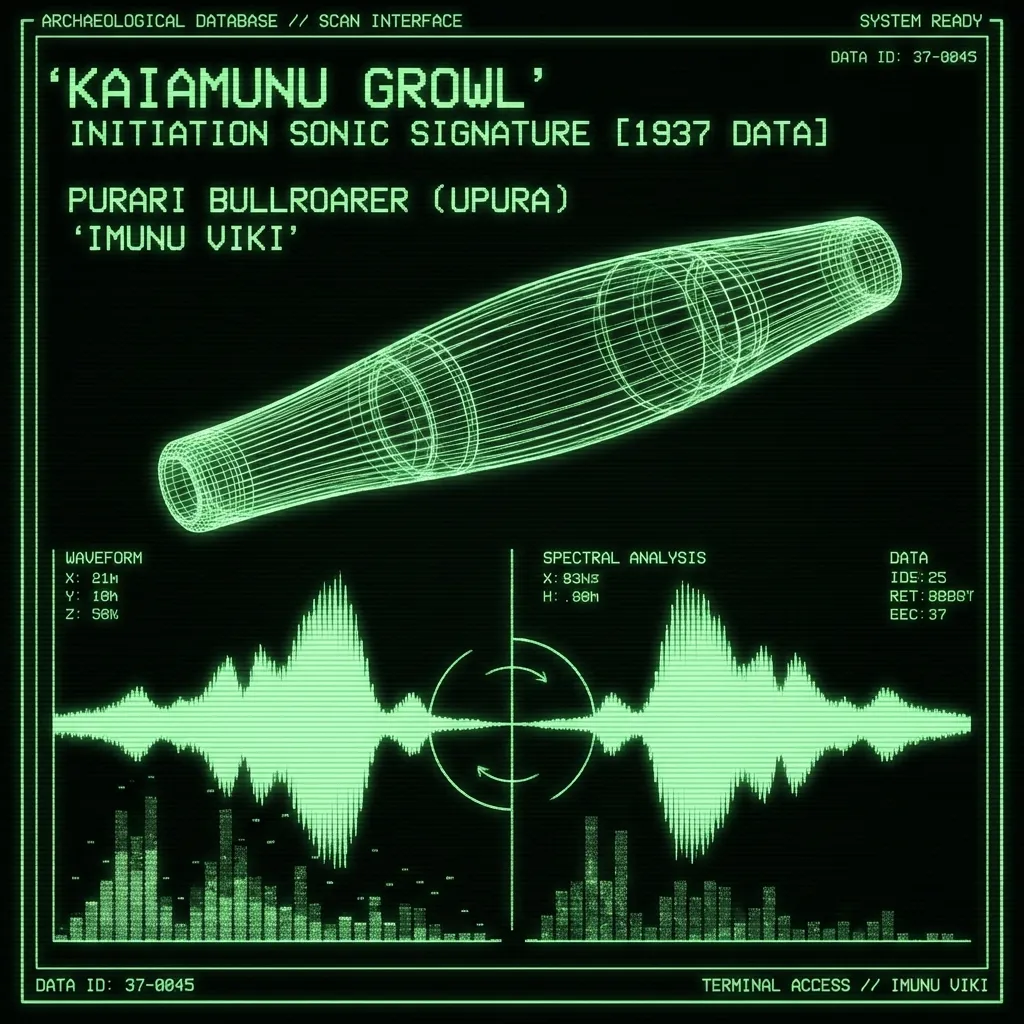
Wirz’s synthesis of Gulf data is explicit: kaiamunu (east) / ebiha (west) names a monster-cult whose representations vary—from huge cane-and-basketry creatures (Purari/Era) to carved shields (Wapo/Goaribari)—but whose voice is the whir of sacred flutes and the bullroarer (Bullroarer Atlas: Purari). Initiation climaxes when boys are placed in the monster and lifted—symbolically devoured and reissued as men, the same monster-swallows-novice pattern recurring well beyond the Gulf. He glosses imunu as a “vital strength,” notes that imunu is also the onomatopoeic name of the bullroarer (with upura as the Purari term), and records that the whir equals the monster’s growl. That is: ontology by acoustics. 3
Met curators corroborate the local semantics: Bullroarer (Upura or Imunu Viki) entries tie the instrument to initiations and “weeping” funerary use; imunu’s voice is housed in giant wicker effigies kept in the men’s clubhouses. (If you’ve seen Papuan Gulf gope boards, think related ecology of spirits and sound.) [^oai1]
Sepik: Tambaran sound, instruction, and interdiction #
Film documentation from the Iatmul shows novices in the enclosure of the men’s house learning carving, warfare, flute and bullroarer technique—sound practice as socialization. A Cambridge-catalogued Kanganamun instrument makes the mechanism explicit: the museum’s own label calls it a siren, its whir clearing women, children, and the uninitiated from around the men it moves past during initiation (Bullroarer Atlas: Kanganamun Iatmul initiation bullroarer). Architectural studies of Maprik houses make the same point differently: Tambaran presence is acoustically revealed (flutes/bullroarers) while sightlines are policed; women and children are forbidden to look, and the sonic warning enforces boundaries. A 1925 photograph from Korogo even freezes the moment: “an initiate swinging a bullroarer” mid-rite. 2 4 6
Names, monsters, and what sound means #
| Region/People | Local term(s) | What the sound indexes | Typical ritual slot | Also used in | Key sources |
|---|---|---|---|---|---|
| Purari Delta (Papuan Gulf; Namau/Purari) | upura (bullroarer); imunu viki (“weeping spirit”); kaiamunu (monster) | The monster’s voice; imunu as vital force / name of the bullroarer | Boys “swallowed” and reissued; played by initiated men | Funerals of prominent men | Wirz 1937; Met object notes; Met “Flutes” guide. 3 [^oai1] 1 |
| Middle Sepik (Iatmul, Korogo/Japanaut) | “bullroarer” (local names vary) | Tambaran presence; secrecy in force | Seclusion phase; boys taught to play bullroarer | General cult activations | TIB film; Maprik/Tambaran analysis; NLA photo. 2 4 6 |
| Southern NG (comparative sweep) | regional lexica (e.g., upura/imunu) | Men’s cult voice; interdiction of sight/hearing | Initiations; cult cycles | Mortuary rites; taboo enforcement | Van Baal 1963; Williams 1936 (overview of Papuan Gulf forms). 7 8 |
| Highlands (contrast) | sacred flutes foregrounded | Spirit voices via long flutes; bullroarer uneven | Multi-stage initiations | Divination, healing, etc. | Highlands flute complex re-exam. (noting instrument set diversity). 5 |
Provenance notes: the Gulf row leans on a primary ethnography (Wirz), plus museum cataloging based on field collections; Sepik rows pair film records with architectural analysis; the Highlands row flags “different instrument ecology” so you don’t overgeneralize.
A typical sequence (flattened across locales, so handle with care) #
- Seclusion & hunger: boys are withdrawn, painted, constrained; suggestibility is engineered. (Sepik films; Gulf narrations.) 2 3
- Acoustic activation: elders whirl bullroarers (and/or sound flutes) to manifest the spirit/monster; the noise is literally the interlocutor’s speech. 1 3
- Ordeal & instruction: in the Gulf, initiands interact with kaiamunu itself (entering/being lifted); in the Sepik, boys are taught to play the instruments—sound as competence. 3 2
- Boundary enforcement: warning tones mark restricted phases; women/children evacuate the visual field while the voice travels. 4
- Afterlife of the roar: the same timbre may accompany mortuary rites (Purari imunu viki), carrying grief as a public acoustic. [^oai1]
The common denominator isn’t a unitary “myth” but a pragmatics of sound: a device whose aerodynamics produce a long‑carry, nonhuman timbre is repurposed as presence; initiation makes boys literate in that presence.
Polysemy and ontology: imunu ≠ generic “spirit” #
Wirz—contra lazy glosses—records imunu as vital strength/principle, not a mere ghost; he also notes imunu as an onomatopoetic name for the bullroarer and upura as the Purari word for the same implement. Meanwhile kaiamunu/ebiha/gi label the vehicle/object of a clan’s being—ranging from wicker monsters to carved shields—and the whir is that being’s voice. The semantics are operational: the wordscape mirrors how sound world-builds in the rite. 3
PNG’s lexicon refuses to keep “instrument,” “spirit,” and “body” in separate bins. That fusion is by design, not confusion.
FAQ #
Q1. Is the Purari bullroarer really called imunu viki “weeping spirit”?
A. Yes; multiple Met entries and an educational guide tie imunu viki to initiations and funerals, explicitly glossing “weeping spirits” from local usage. [^oai1] 1
Q2. Do Sepik initiations actually teach boys to play the bullroarer?
A. Documented on film: Iatmul initiates, in seclusion, learn carving, fighting, flute and bullroarer performance as part of men’s‑house secrets. 2
Q3. Is the monster-swallowing motif attested or just tidy theorycraft?
A. Attested; Wirz details boys entering/lifted within kaiamunu, and identifies the bullroarer’s whir as the monster’s growl during the devouring/regeneration moment. 3
Q4. Is the bullroarer universal in PNG initiations?
A. No; PNG is plural. Highlands complexes often center long flutes; the bullroarer’s role varies by region/cult. Don’t overfit Gulf/Sepik patterns to the whole island. 5
Footnotes #
Sources #
- Paul Wirz. “The Kaiamunu-Ébiha-Gi-Cult in the Delta-Region and Western Division of Papua” (1937). PDF via Détours d’Océanie (English transcr.). Key for monster-cult structure, imunu/upura semantics, and initiation choreography. 3
- The Metropolitan Museum of Art. “Bullroarer (Imunu Viki [?])” collection entry and “Sounding the Pacific: Musical Instruments of Oceania — Flutes” guide (on Purari Delta imunu viki, wicker kaiamunu, initiation/funerary use). [^oai1] 1
- TIB AV-Portal. “Iatmul (New Guinea, Middle Sepik) — Initiation of Men at Japanaut.” Film record noting instruction in playing flute and bullroarer during seclusion. 2
- Interstices journal. “Theory on the Sepik.” On Maprik/Tambaran architecture and the acoustic revelation of presence (flutes/bullroarers) with visual interdictions. 4
- National Library of Australia (Chinnery Collection). Photograph: “An initiate swinging a bullroarer, Korogo village, Middle Sepik, c.1925.” Visual primary for Sepik ritual use. 6
- F. E. Williams. “Bull-roarers in the Papuan Gulf.” Territory of Papua, Anthropology Report No. 17 (1936). Catalog entry confirming focused monograph; useful for nomenclature and distribution. 8
- J. van Baal. “The Cult of the Bull-Roarer in Australia and Southern New Guinea.” Bijdragen 119(2) (1963). Comparative sweep of southern NG and Australia; distributional claims. 7
- Science Museum Group Collection. Papuan Gulf bullroarer (1871–1920) artifact record; additional material provenance. 9
- Highlands contrast: “A Re-Examination of the New Guinea Highlands Sacred Flute Complex.” (overview of flute-centric initiations; shows instrument-set diversity). 5
- The Bullroarer: An Interactive World Atlas. Relevant records: Namau imunu viki, Baroi River, Purari, and Kanganamun Iatmul initiation bullroarer.