~/bullroarer/paleolithic
La Roche Bullroarer: Peyrony’s 1930 Report in English
The first publication of the Magdalenian antler bullroarer from Lalinde, which Peyrony calls a churinga, and of the engraved stones Breuil read as headless women. The whole article, in English for the first time.
TL;DR
- In 1930 Denis Peyrony published the finds from the cave of La Roche near Lalinde, Dordogne. One is a blade of reindeer antler, pierced, covered in red ochre and then engraved.
- He says it is “an instrument identical to the one that certain Australian natives call churinga”, the bull-roarer, and that it “must certainly have had the same purpose”.
- He describes that purpose from living peoples: sounded at the great tribal ceremonies, against spirits, and at circumcision.
- The same cave gave stones engraved with figures that the abbé Breuil read as headless women. Peyrony links them to a cult of woman’s sexual parts and asks whether Lalinde and Petersfels share “a common stock of distant traditions”.
- This is the whole article, pp. 19–29, with page markers. I found no earlier English translation.
Nous pensons qu’il faut plutôt y voir un instrument identique à celui que certains indigènes australiens appellent « churinga ». “We think that one must rather see in it an instrument identical to the one that certain Australian natives call ‘churinga’.” — D. Peyrony, L’Anthropologie 40 (1930), p. 24
Why does Peyrony’s 1930 article matter? #
It is the first publication of the best-known Ice Age bullroarer, the antler blade from Lalinde. Denis Peyrony (1869–1954) was the schoolmaster of Les Eyzies who became the leading excavator of the Dordogne and the curator of its museum. In 1927 two local men, Louis Peyrille and Delmas, dug out the cave of La Roche, also called the cave of Birol, and the finds were scattered before anyone studied them. Peyrony published the best pieces in “Sur quelques pièces intéressantes de la grotte de La Roche, près de Lalinde (Dordogne)”, L’Anthropologie 40 (1930), pp. 19–29.
The antler blade is Final Magdalenian and is now in the Musée d’Archéologie nationale at Saint-Germain-en-Laye (MAN 74482). The abbé Breuil had called it a churinga in 1928 (Delluc, Delluc and Guichard 2008), and Henry Field reported Breuil’s identification in English in Man 54 (1954), p. 162. Peyrony’s words are the ones that are cited. Four lines carry the claim:
| Page | Peyrony’s French | English |
|---|---|---|
| p. 22, fig. 3 | « 1, churinga australien; 2, churinga de La Roche » | “1, Australian churinga; 2, churinga of La Roche” |
| p. 24 | « Nous pensons qu’il faut plutôt y voir un instrument identique à celui que certains indigènes australiens appellent « churinga » » | “We think that one must rather see in it an instrument identical to the one that certain Australian natives call ‘churinga’” |
| p. 25 | « La pièce de La Roche […] devait certainement avoir la même destination » | “The piece from La Roche […] must certainly have had the same purpose” |
| p. 29 | « l’utilisation du « churinga » dès un temps très reculé que nous ne soupçonnions pas » | “the use of the ‘churinga’ from a very remote time that we did not suspect” |
Two things in the article bear on this site’s argument beyond the object itself. Peyrony takes the instrument’s meaning from living peoples, where it is ritual, sounded at tribal ceremonies and at circumcision (the bullroarer and male initiation). And the same cave holds the image of woman: the engraved figures Breuil read as headless women, which Peyrony sets beside the “Vénus impudique”, an Aurignacian cult of woman’s sexual parts and a statuette from Petersfels, asking whether the likeness shows un fonds commun de traditions lointaines, a common stock of distant traditions. The Bullroarer Atlas has the record for the object and an essay on that question, The European mother culture.
The earlier Ice Age claim, Andrew Lang’s of 1902, is in Cook’s article on the Saint-Marcel pendant (the Saint-Marcel record); for the old story of woman’s rule behind such images see Bachofen’s preface to Das Mutterrecht; for what the instrument’s age implies see the bullroarer and the sapient paradox.
“On some interesting pieces from the cave of La Roche near Lalinde (Dordogne)”, by D. Peyrony #
The cave and its bone industry #
[p. 19] The cavern of La Roche, also called the cavern of Birol, in the commune of Lalinde (Dordogne), opens on the right bank of the Dordogne, between the famous prehistoric site of Le Soucy and Couze railway station. It was excavated by Messrs. Peyrille (Louis) and Delmas; unfortunately, what it yielded was scattered far and wide before a complete study of the fauna, the industry and the works of art had been made. We shall not linger over describing the stone industry, which is that of the whole Magdalenian. We shall confine ourselves to presenting the most characteristic pieces.
They are: 1. Harpoons. No. 3 (fig. 1) is the fragment of a harpoon with barbs on one side; no. 4 (fig. 1), with a double row of barbs, seems to belong to a horizon directly following that of the preceding one, and no. 7 (fig. 1), with angular, almost quadrangular barbs, to the last phase of the Magdalenian. 2. Long spear points of reindeer antler, with a single-bevelled base (fig. 1, no. 1), which are generally found with the primitive harpoons, that is, in the horizon underlying that of the harpoons with barbs on one side.
These four types of object each correspond to one of the various divisions we have established in the Magdalenian sites of the Les Eyzies region, particularly [p. 20] at La Madeleine1 and at Laugerie-Basse2. It can therefore be said that the site of La Roche must have been of the same period as these.
Fig. 1. Bone industry of the cave of La Roche (two thirds natural size).
The bone industry also included: needles (fig. 1, [p. 21] no. 5), chisels (fig. 1, no. 8), fish-hooks (fig. 1, no. 6), awls, smoothers, spear points with a double-bevelled base, fragments of half-round rods, bâtons de commandement (fig. 1, no. 2), pierced shells and teeth with perforated roots.3
The decorated pieces #
It is the decorated pieces that have chiefly held our attention. In the first place we must mention two batons of reindeer antler, each pierced with a large hole in the widest part (fig. 1, no. 2). Both are ornamented with three deep curved grooves forming almost a triangle drawn around the hole. They seem to have been abandoned before they were finished. Their system of decoration places them at the end of the Magdalenian, with the harpoons with angular barbs. A chisel of reindeer antler bears on its two edges (fig. 1, no. 8) a lozenge design that may be compared with the preceding one.
A piece of rib shows on one face two small equids: a forequarters and a whole body; the head of the latter has been slightly damaged by a break. On the other face one sees the hindquarters of a similar animal. The whole is finely executed, with a movement that reveals a true artist. A galloping chamois or izard is drawn on a flat limestone 9 centimetres long. The short head, the [p. 22] small horn curved backward, the pricked ear are perfectly rendered; but the length of the body is out of proportion to the neck and the head. One also notices on it the hindquarters of another, the rest of whose body is hidden by the first, and likewise two rough sketches of equid heads (fig. 2).4
Fig. 2. Izards engraved on stone (natural size).
The antler piece, ochred and engraved #
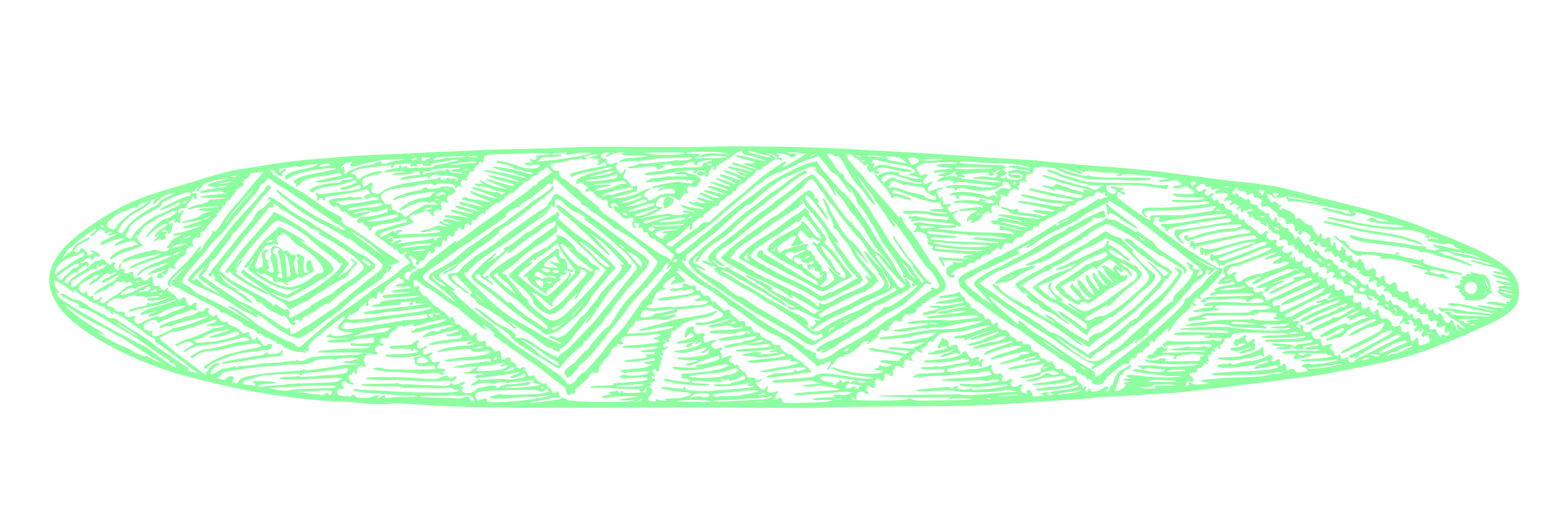
According to the excavators, another piece (fig. 3, no. 2) comes from the upper part of the layer. It lay in a block of breccia; in coming away it left a hollow impression of the design that decorates one of its faces. It is of reindeer antler and has the shape of a fish without a tail. A suspension hole is at one of its ends. It was entirely covered with red ochre; the engraving was done after this operation, which makes it stand out light against the dark ground.
The decoration consists of four groups of five parallel lines and a fifth of only four, arranged at regular intervals, lengthwise, in the middle, separated from one another by transverse series of five strokes, likewise parallel. On each side a row of strokes, 2 millimetres long on average, set crosswise, is separated from the edge by three roughly parallel lines, which frame the first designs but leave, in the most convex part of the side, a space filled with a series of dots.
Fig. 3. 1, Australian churinga; 2, churinga of La Roche (half natural size).5
Red grounds: ochre and blood #
[p. 23] This is not the first time we have met with pieces daubed with ochre and then engraved or painted. Several limestones from our latest excavations in a small shelter at La Madeleine show this peculiarity. It must be admitted that, to observe it, precautions have to be taken. The object must be examined carefully while still covered with earth and washed without rubbing, for the ochre would disappear under the action of the brush.
Another limestone, found in the Solutrean level of the Fourneau du Diable, commune of Bourdeilles, has one face wholly red, while the other shows only a few patches of it; but on it one observes a tangle of fine engraved lines, probably belonging to several designs, now too confused to be intelligible. A limestone block, discovered in the Upper Aurignacian of La Ferrassie, has one side daubed in red, and two animal protomes were painted in black on the surface thus prepared.67
This custom seems to have had its origin in the Aurignacian, that is, at the beginning of art, to have continued through the Solutrean and to have developed further in the Magdalenian. Although we find black and red colour in all prehistoric deposits, it is the latter that always served to make the ground. One cannot object, to explain this choice, that light lines stood out better on red than on black, for the opposite would rather be the case. We think the reason must be sought in usages that were probably ritual or superstitious and lasted as long as the hunting peoples.
It would perhaps not be improbable to suppose that most of the rock drawings were likewise executed on a red ground obtained with the blood of the animals killed. This liquid, which animates every living being, perhaps had in the eyes of the Primitives a life-giving power that soaked into the image and so must have made the incantations performed before it by the sorcerer or the initiates more favourable to the wishes of the tribe. [p. 24] Blood, being a corruptible substance, disappeared little by little without leaving a trace. This is what would explain the abundance of superimposed engravings, as at Les Combarelles, where the last ones made would certainly have been very confused without this custom or another identical to it.
Sometimes, when blood was lacking, it must have been replaced, though very rarely, by red ochre, which gave the illusion of it. Being mineral in nature, unlike blood, the ochre has often been fairly well preserved.
“An instrument identical to the churinga” #
What is this singular piece (fig. 3, no. 2), the first reported so far in the Palaeolithic? Decorated on one face only, it could be taken for an ornament, a kind of amulet. We think that one must rather see in it an instrument identical to the one that certain Australian natives call “churinga”, likewise decorated with geometric designs on one face only (fig. 3, no. 1).8
The word “churinga”9 is improperly used, though it has passed into common usage, to designate the musical instrument that the English call “bull roarer”, the Germans “Schwirrholz” and the French “planche ronflante” (humming board) or “diable” (devil). This instrument, one of the oldest known, is still used in our day by many peoples and by the Italian children of the Lido, at Venice.
How the bull-roarer is made and sounded #
It may be of stone, as in New Caledonia, or of hard wood, as in Australia. In general it is ellipsoidal or lancet-shaped (as the Germans say) and pierced at one end with a round hole that allows the fastening of a cord of greater or lesser length (a metre and more) joining the object to a wooden rod that a person carries in the hand: this is the case among the Indians and the Eskimos. Other peoples, such as the Australians, who make great use of it, do not use sticks and hold the cord directly in the hand.
When about to use it, the operator raises his hand above his head and gives it a rapid circular motion. The “bull roarer”, carried along in this course, describes a [p. 25] perfect circle and spins on itself across its width, at great speed. Because of its fish-like shape and its cutting edges it produces, in contact with the air, a fairly loud humming. The different tones are obtained by increasing or decreasing the speed at the circumference. The dimensions of this instrument vary greatly and are not in proportion to one another.
Ordinarily they are covered on one face only with decoration that is almost always geometric, which may be regarded a priori as inscriptions far more than as ornaments (fig. 3, no. 1). A great many, however, are completely bare, for example where they have been used as playthings, or in the equally frequent case where the maker had not the time or sufficient skill to decorate them.
Its ritual use #
This instrument is at present chiefly widespread among primitive natives: the Melanesians, the Indonesians, the Bushmen, the Indians, the Eskimos, etc. They all regard it as an object of ritual character and employ it at the great tribal ceremonies, with the aim of spreading evil spirits or of driving them away, as the case may be, and often at the time of the celebration of the cult of circumcision.10 It is found in use under different names in all parts of the world.11
The La Roche piece had the same purpose #
The piece from La Roche, showing the same features as the Australian “churingas”, must certainly have had the same purpose. It is to be believed that this instrument was not as rare as its absence, noted until now in the various known prehistoric sites, might lead us to suppose. But since, as a general rule, it must have been made of wood, it has everywhere disappeared. With the whistle made from a reindeer phalanx and the flute of Isturitz, it forms the still small group of musical instruments of our primitive ancestors that have come down to us.12
The engraved stones #
A last type of design, repeated several times on [p. 26] limestones, is rather enigmatic. According to the excavators, these stones all come from the base of the deposit. They would therefore belong to the first phase of occupation. Two are particularly remarkable and interesting. One is in the Prehistoric Museum of Les Eyzies13, the other in the Field Museum in Chicago. The first measures 60 centimetres long by 45 centimetres wide. On one even face it bears ten roughly similar designs, deeply engraved, arranged, it seems, without order over the whole surface (fig. 4).14
[Fig. 4, the engraved stone in the museum of Les Eyzies with its ten designs. The caption was not legible in our copy of the text.]
[p. 27] The second (fig. 5), 35 centimetres long by 24 centimetres wide, likewise shows six identical images, four of them grouped in a cluster and the other two placed beside them. At first sight one would say they were heads of stylized birds. The two roughly parallel lines would be the neck, the convex part the head, and the pointed part the beak.
Fig. 5. Engraved stone from La Roche (one quarter natural size).
At a pinch this interpretation might seem satisfactory if one considered only nos. 4, 5, 7, 8, 9 and 10 (fig. 4) and nos. 1, 2 and 3 (fig. 5), for the two converging lines that seem to form the beak stop where they meet, or, if they stay apart, neither goes further than the other (fig. 4, nos. 3, 4 and 9). But in nos. 1, 2 and 6 (fig. 4) the same lines cross and run on, diverging; on no. 5 (fig. 5) the upper line, after meeting the other, continues, curving toward the prolongation of the latter. In no. 4 (fig. 5) the two lines draw together to within 2 millimetres, then the upper one curves to the right and runs on a long way.
Breuil: headless women #
What, then, can these enigmatic figures be? The abbé Breuil, who has seen them, thinks they could represent highly stylized headless women. No. 6 (fig. 5) [p. 28] would seem to bear him out: the convex part would represent the strongly marked buttocks, and the two narrower parts, above, the torso below the breasts, and below, the thighs.
This hypothesis seems to be corroborated by the recent discovery at Petersfels (Baden), in a Magdalenian site without harpoons, of a female statuette of jet (fig. 6, no. 3) showing the general features of the various designs of figures 4 and 5. This projection of the buttocks is found today among Bushman women, who seat their children astride it, tying them to themselves to carry them more conveniently. It is also seen on the various steatopygous Aurignacian statuettes.
The schematic drawing of the body of Bushman women, seen in three-quarter view, from the breasts to the knees, with the legs crossed, gives an image (fig. 6, nos. 1 and 2) coming appreciably close to the figures on the stones we have just described, the line of the groin and of the crotch forming the median stroke that we notice on the designs of figures 4 and 5.
Fig. 6. Nos. 1, 2, schematic profiles of Bushman women from the breasts to the knees; no. 3, statuette from Petersfels.
Woman’s sexual parts as an object of cult #
It is known that in the course of the Aurignacian woman, and above all her sexual parts, were often depicted. They would seem to have been the object of a special cult. That would not surprise us, for was not the engendering of life by these organs a mystery apt to strike the imagination of the primitives? It would therefore not be surprising if they [p. 29] brought them into the procession of images in use in their cult or superstitious ceremonies.
These engravings and sculptures, though less frequent, are also found in the Magdalenian. The “Vénus impudique” (Shameless Venus)15 and the “Woman with the Reindeer” of Laugerie-Basse16 are the best-known specimens. A bâton de commandement from La Madeleine bears on one of its faces the suprapubic triangle characteristic of the sexual parts of woman. This last piece comes from the level of the harpoons with barbs on one side, the same level that yielded a half-round rod decorated with the male and female sexual attributes and with a fine bear’s head.1718
Petersfels and a common stock of traditions #
The sculptural features of the “Vénus impudique” would place it in the lower levels of the site of Laugerie-Basse (without harpoons or with primitive harpoons), contemporary, it seems, with the base of that of La Roche and probably with that of Petersfels19, which, like those of Laugerie-Basse, has yielded bone discs that are not met with in the other Magdalenian horizons. It is curious to observe that the statuette of Petersfels shows roughly the same features as the designs of La Roche. Could it be an effect of chance? Or should one see in it a common stock of distant traditions among these tribes? However that may be, the comparison is interesting.
Conclusion #
All these representations grow rare in the period of La Madeleine; they seem to correspond to conceptions less and less precise, and are far from having the general character that one notices in the Aurignacian period. To sum up, the site of La Roche would belong to the last four phases of the Magdalenian, corresponding to levels III, IV, V and VI of the abbé Breuil and to the industrial horizons of La Madeleine and Laugerie-Basse.
It brings us two interesting new facts: the use of the “churinga” from a very remote time that we did not suspect, and the existence of images that we did not yet know.20
Sources #
- Peyrony, Denis. “Sur quelques pièces intéressantes de la grotte de La Roche, près de Lalinde (Dordogne).” L’Anthropologie 40 (1930): 19–29.
- Delluc, Brigitte, Gilles Delluc, and Jean Guichard. “La grotte de la Roche à Lalinde (Dordogne).” Préhistoire du Sud-Ouest 16 (2008-2), pp. 200, 204.
- Field, Henry. Note on the La Roche churinga. Man 54 (1954), p. 162.
- Dietrich, Oliver, and Jens Notroff. “A Decorated Bone ‘Spatula’ from Göbekli Tepe.” Neo-Lithics 1/16 (2016): 22–31, p. 28.
- Morley, Iain. The Evolutionary Origins and Archaeology of Music. Darwin College Research Report DCRR-002. Cambridge, 2003, pp. 34–35.
- Peters, Eduard. Die altsteinzeitliche Kulturstätte Petersfels. Augsburg: Benno Filser, 1930.
- Bullroarer Atlas. “La Roche de Birol.”
Peyrony’s note: Dr. Capitan and D. Peyrony. La Madeleine: son gisement, ses industries, ses oeuvres d’art. Nourry, publisher, 62 rue des Ecoles, Paris, 1928. ↩︎
Peyrony’s note: D. Peyrony and J. Maury. Gisement préhistorique de Laugerie-Basse (Fouilles de M. Le Bel). (Revue anthropologique, April 1914.) ↩︎
Translator’s note: A bâton de commandement (“staff of command”) is the old French name for a length of antler pierced with a large hole; the name is kept here as Peyrony’s term. ↩︎
Translator’s note: The izard (isard) is the Pyrenean chamois. The caption of fig. 2 is printed at the foot of p. 21. ↩︎
Translator’s note: The caption in French: « 1, churinga australien; 2, churinga de La Roche ». The printed caption already gives the La Roche piece the Australian name. ↩︎
Peyrony’s note: Dr. Capitan and Peyrony. Les origines de l’art à l’Aurignacien moyen. (Revue anthrop., 1921.) ↩︎
Translator’s note: A protome is the head and forequarters of an animal. ↩︎
Translator’s note: The French of the identification: « Nous pensons qu’il faut plutôt y voir un instrument identique à celui que certains indigènes australiens appellent « churinga » ». ↩︎
Peyrony’s note: In the Austro-Asiatic language, “churinga” means bat. When the instrument is not in use it is hung on a peg or a nail, and it looks a good deal like a bat hanging by its feet. [Translator: The etymology is Peyrony’s as printed. Churinga (tjurunga) is an Arrernte word of central Australia for sacred things, the stone and wooden boards among them.] ↩︎
Peyrony’s note: This information was supplied by M. Pierre Champion, on the staff of the Trocadéro ethnographic museum, whom we thank most warmly. ↩︎
Translator’s note: « répandre les mauvais esprits » is what the page prints: literally to spread, or scatter abroad, evil spirits. It sits oddly beside “or of driving them away”; the translation leaves it as printed. ↩︎
Translator’s note: The French: « La pièce de La Roche, présentant les mêmes caractères que les « churingas » australiens, devait certainement avoir la même destination. » ↩︎
Peyrony’s note: This piece was given to the Museum of Les Eyzies by the excavators Peyrille and Delmas, whom we again thank warmly for their generosity. ↩︎
Translator’s note: The wording of footnote 1 follows a transcription whose last words (« encore vivement ») were restored from the sense and not confirmed on the page. ↩︎
Peyrony’s note: De Vibraye collection at the Muséum in Paris. ↩︎
Peyrony’s note: Discovered by the abbé Landesque. ↩︎
Peyrony’s note: Dr. Capitan and Peyrony, loc. cit. ↩︎
Translator’s note: The Vénus impudique is the small ivory figure of a naked girl, headless, with the vulva cut as a deep slit, found by the Marquis de Vibraye at Laugerie-Basse in 1864; its name answers the Venus pudica of classical sculpture, who covers herself. ↩︎
Peyrony’s note: E. Peters, Die altsteinzeitliche Kulturstätte Petersfels. Benno Filser Verlag, Augsburg, 1929. [Translator: Footnote 4 was not clearly legible in the transcription this page was made from. It is given as the reference it must be, Eduard Peters’s monograph on Petersfels, with the year 1929 as the scan’s text has it; the monograph’s title page is dated 1930.] ↩︎
Translator’s note: The French: « l’utilisation du « churinga » dès un temps très reculé que nous ne soupçonnions pas ». ↩︎