TL;DR
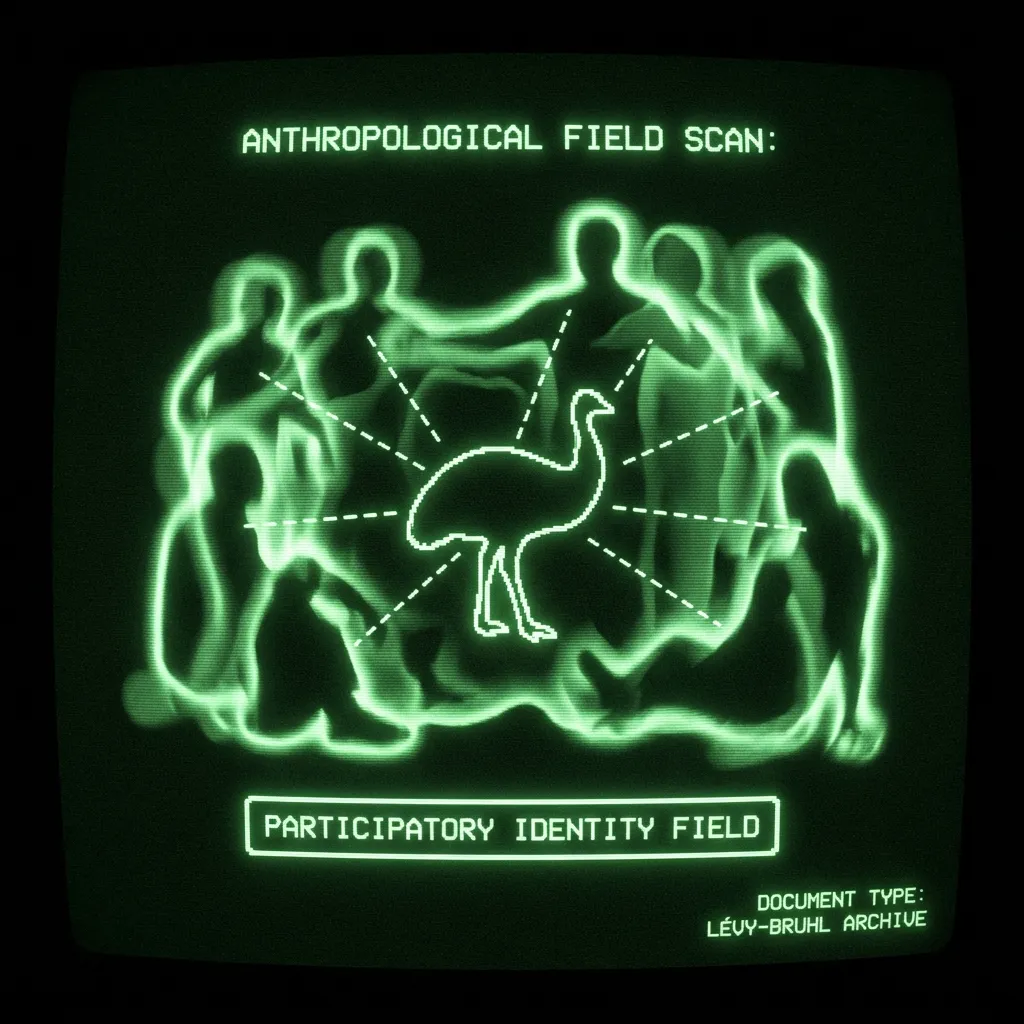
- Participation mystique names a mode of consciousness where people and things share a field of “partial identity,” not a sharp subject–object divide.1
- Ethnography, developmental psychology, religion, and crowd behavior all show cases where “we” and “it” really are lived as one process rather than separate entities.23
- The concept explains totemism, relic cults, spirit possession, identity fusion, and everyday animism more cleanly than purely “symbolic” or rational-choice models.45
- Lévy-Bruhl’s evolutionary scaffolding (primitive vs modern) was wrong, but the underlying insight about multiple styles of mind is still live.67
- The theory fell out of favor largely because scholars got allergic to talking about different mentalities at all, preferring to flatten everything into one universal style of reason.
“The god of the clan … can therefore be nothing else than the clan itself, personified and represented by the totem.”
— Émile Durkheim, The Elementary Forms of the Religious Life (1912)8
The Claim: Minds Come in Different Textures#
Lucien Lévy-Bruhl coined participation mystique to describe a “peculiar psychological connection” where the subject does not clearly distinguish themself from the object but is bound to it in a relation “amounting to partial identity.” Carl Jung later adopted the phrase for exactly this kind of blurred boundary.910
The standard dismissal is: “Everyone everywhere is just as logical as everyone else; ‘primitive mentality’ is colonial nonsense.” There is something right there—Lévy-Bruhl’s ladder from prelogical to logical was teleological, patronizing, and empirically leaky.7 But if we strip away the 1910s Parisian smugness, there’s a stubborn remainder:
- Many people in many times and places do not experience themselves as sealed Cartesian egos inspecting a neutral world.
- They inhabit a field of relationships where persons, animals, ancestors, relics, and places share substance, agency, and fate.
That field is what “participation mystique” points at. It’s not a slur; it’s a phenomenological hypothesis about how self and world can be configured.
To steelman the concept, I want to do three things:
- Show ethnographic examples where “partial identity” is not metaphor but lived ontology.
- Show parallels in development, religion, and modern group psychology.
- Argue that without this concept, a lot of data gets forced into misshapen boxes—“symbol,” “belief,” or “bias”—and loses its structure.
Then, at the end, we can talk about why the idea was buried and why the burial was too tidy.
What Lévy-Bruhl Actually Saw
Totemic clans: the animal is the people#
Durkheim’s study of Australian totemism—one of Lévy-Bruhl’s primary inspirations—argued that the totem animal is simultaneously the symbol of the god and of the clan.1112 He pushes the identity hard:
The god of the clan “can therefore be nothing else than the clan itself, personified and represented … under the visible form of the animal or vegetable which serves as totem.”11
The point is not that people “believe as if they were emus.” Rather:
- The clan, the totem animal, and the sacred principle are the same thing seen under different descriptions.
- Eating the totem, violating its taboos, or wearing its image isn’t just symbolic action; it alters the shared substance of clan and creature.
Subsequent Durkheimian anthropology kept worrying this theme: Maurice Bloch, for instance, describes ritual and kinship as “going in and out of each other’s bodies,” a literal flow of substance and identity, not a metaphor for “strong feelings.”13
What Lévy-Bruhl calls participation mystique is a name for this ontological overlap. The clan doesn’t have a concept of “representation” sitting between self and world; it has relations of participation.
Mana, souls, and diffuse agency#
Lévy-Bruhl’s books are choked with examples of mana-like forces: diffuse powers that inhere in persons, objects, and words, making them efficacious.1415 He describes cases where:
- A hunter’s name, shadow, or blood can be injured, stolen, or manipulated, with real bodily consequences.
- A curse isn’t just speech; it is the extension of a person’s agency through language into the victim’s body.
- Sacred sites and objects are dangerous because they are coiled concentrations of collective power.
Durkheim talks the same way about “collective representations”: social classifications and symbols that constitute how things are experienced, not just how they’re labeled.1617 The world is not a set of inert objects onto which meanings are pasted; the social field is built into what counts as a thing in the first place.
This is exactly the structure Lévy-Bruhl wants: subject and object hooked together in ways that make partial identity normal and strict separation weird.
We Keep Rediscovering Participation Mystique#
The critic’s move is: “Sure, they say the totem is the clan, but really that just means they symbolically represent it; deep down they think like us.” The problem is that the same flattening move becomes impossible once you notice how often something like participation shows up in places that are not safely “primitive.”
Children: animism as the default#
Piaget and his descendants observed that young children routinely attribute life, consciousness, and moral intention to inanimate objects.1819
- “The moon is following me.”
- “The chair is mean because it hit me.”
- “The teddy bear is tired and needs to stay home.”
Developmental texts still call this animism—the belief that objects are alive and possess consciousness.3 It’s not stupidity; it is a way of organizing experience where:
- The boundary between self and object is permeable.
- Motion, attention, and moral valence bleed across that boundary.
You can interpret this as “error” relative to an adult physics ontology. But phenomenologically it’s very close to participation mystique: the child and the world share a field of agency.
Religion: relics, saints, and shared substance#
Take medieval and early modern relic cults. Bones, teeth, and bits of cloth belonging to saints were preserved and venerated because they carried the saint’s power; people traveled long distances to pray in their presence and seek healing.[^relictalk]20
Historians of religion like Peter Brown describe the cult of the saints as collapsing the boundary between heaven and earth, locating the saint’s presence in physical remains and tombs.2122
- The saint’s body is not a reminder or symbol of the saint; it is where the saint is.
- The tomb is the “primary locus of his power,” the site where protection and miracles radiate out.22
Again: this is not reducible to “belief in magic” tacked onto an otherwise Cartesian subject. The saint, the relic, the shrine, and the community exist in a nexus of partial identity: harm to one is harm to all; honoring one is participation in the same sanctity.
Spirit possession and the rented body#
In many Afro-Brazilian religious traditions—for example Candomblé—rituals revolve around spirit possession: the deity “mounts” the devotee, who speaks and acts as the god.234
Contemporary cognitive anthropologists treat these possession events as part of a stable repertoire of human religiosity rather than exotic margins.2423
But if we take participants seriously, possession is not just “role-play.” While possessed:
- The human and the deity share a body.
- Speech, gesture, and memory are not clearly attributable to one or the other.
- Responsibility is genuinely distributed: “It was the orixá speaking.”
We can cram this into frameworks of “belief about agency,” or we can say what is obvious: in that moment the boundary between persons is reorganized. The god–worshiper dyad is a single system.
Modern identity fusion: “I am my group”#
Fast-forward to contemporary social psychology. Identity fusion theory describes a state where personal and group identities become “functionally equivalent and mutually reinforcing,” yielding unusually porous borders between self and group.525
Fused individuals feel:
- A visceral “oneness with the group” and
- A willingness to self-sacrifice for it that outstrips standard social identity effects.2627
Empirical work shows that strongly fused people treat threats to the group as threats to self, and will endorse extreme pro-group behavior, including dangerous or violent actions.2728
Whitehouse and collaborators connect this to high-arousal, emotionally intense rituals that “fuse” personal and collective memories.429
Read that back in Lévy-Bruhl’s idiom: here are late-modern citizens, not “primitives,” entering a state where the individual is partially identical with the group. Participation mystique, run through the lab.
Everyday animism and anthropomorphism#
Anthropologist Stewart Guthrie’s Faces in the Clouds argues that religion is best understood as systematic anthropomorphism: seeing the world as human-like and responsive.3031
But Guthrie also notes that this habit isn’t restricted to formal religion. We talk to computers, curse at cars, feel watched by CCTV cameras, and ascribe intentional malice to “the market.”31
Again, we can call this “bias.” Or we can admit that humans constantly live in a world where:
- Non-human entities are treated as co-participants in moral life.
- Subjectivity is projected outward and then experienced as coming back at us.
That loop—project, lose track of the projection, and become bound to it—is exactly what Jung meant when he kept pairing participation mystique with projection.932
A Useful Distortion: Three Ways to Relate Self and World#
Here is where participation mystique does real explanatory work. It gives us a third option between “it’s all literal” and “it’s all symbolic.”
| Mode of relation | Self–world boundary | Typical examples |
|---|---|---|
| Participation mystique | Porous; person and object/other share substance or agency | Totems; relics; possession; intense group fusion |
| Symbolic representation | Clear boundary; object stands for something else | National flags; corporate logos; ritual metaphors |
| Objectivist stance | Hard boundary; world is inert stuff; mind is spectator | Scientific measurement; instrumental tool use |
This is deliberately schematic, but notice:
- In participation mystique, harming the object is harming the person; the relation is ontological.
- In symbolism, destroying the flag is an insult, not literally killing the nation.
- In objectivism, the flag is pigment on cloth plus maybe a social convention.
The charge against Lévy-Bruhl was that he wanted to stuff whole cultures into the first box while reserving the third for himself and his friends. Fair. But the stronger claim—that the first box just doesn’t exist—is less defensible in light of the examples above.
Once you allow that these modes exist, you can ask:
- Which situations invite which mode?
- How do people move between them?
- What happens when they clash inside one person or one society?
That’s a much richer research program than “everyone is secretly a late-modern rationalist maximizing utility.”
Why Participation Mystique Solves Real Puzzles
Ritual power without metaphysical embarrassment#
Anthropologists and cognitive scientists of religion have wrestled with why rituals feel powerful and why they bind groups so tightly. Work on “modes of religiosity” and ritual cognition shows that causally opaque, high-arousal rituals foster durable social cohesion and identity fusion.42423
Participation mystique gives you an intuitive handle on this:
- Causal opacity + strong affect ≈ we stop treating actions as mere signals and start treating them as sites of shared being.
- Blood oaths, initiation scars, communal chanting, or marching don’t just “signal commitment”; they knit self and group into a common substance.
The ritual works because participation is not merely in the head; it is enacted in bodies, spaces, and things.
Why some objects are “more than objects”#
Think of:
- A wedding ring you refuse to replace even though identical copies exist.
- A jersey “signed by the player himself.”
- A childhood toy that cannot be thrown away because “part of me is in it.”
Standard economics and semiotics can explain some of this as sentimental value or indexicality. Participation mystique goes further: the object is a piece of an extended person.
This is why the destruction of certain objects feels like maiming. In medieval relic cults, the saint’s tomb is explicitly treated as “the primary locus of his power”; damage to it is sacrilege, not vandalism.22 Modern fans who freak out when a stadium is demolished are not entirely different creatures.
Explaining moral parochialism without assuming stupidity#
Fusion research shows that strongly fused individuals are more willing to sacrifice for their group, but also more prone to moral parochialism and out-group hostility.2733[^chinchilla]
If I am my group, then:
- Threats to “us” are existential threats to “me.”
- Norms applying within the fused circle may not apply outside it.
This looks ethically ugly from a universalist standpoint. But conceptually it’s clean: participation mystique at the group level predicts exactly this pattern without positing irrationality. The same mechanism that lets monks die for their monastery can fuel football hooligans or extremist cells.
Why the Concept Was Buried (Mostly for Bad Reasons)#
Lévy-Bruhl’s reputation cratered in mid-20th-century anthropology, and participation mystique went down with the ship. The standard charges:
- Evolutionism and ethnocentrism. He contrasted a “prelogical, mystical” primitive mentality with a fully logical Western one, implying a developmental ladder.347
- Underestimating rationality. Ethnographers showed that so-called primitives could reason quite well about practical affairs, and their “contradictions” often dissolved once context was understood.3536
- His own recantation. Late in life, in posthumously published notebooks, Lévy-Bruhl softened his earlier claims and admitted that “primitive” and “modern” modes could coexist in the same person.3437
All fair as far as they go. But notice what got jettisoned along with the bad scaffolding:
- The claim that there are multiple stable ways to experience self–world relations.
- The insistence that some of these ways involve real ontological overlap, not just “beliefs” that could be translated into our own categories without remainder.
A lot of mid-century anthropology wanted to defend “the Other” by saying, essentially, “they are just like us, only with different customs.” On the other side, some universalist cognitive science tends to say “they are just like us, only with different parameter settings.” In both cases the impulse is to flatten.
Participation mystique is uncomfortable because it refuses the flattening. It says:
- No, sometimes people really do inhabit a world where persons, objects, and groups share substance.
- No, you cannot entirely redescribe that in the language of symbols, beliefs, or preferences without losing something essential.
That doesn’t make “primitive mentality” inferior. It just means that the space of possible minds is bigger than one.
FAQ #
Q 1. Does participation mystique mean “non-Western people are irrational”?
A. No. The strong claim is that everyone can and does enter states where self–world boundaries blur; Lévy-Bruhl’s mistake was to map those states onto a rigid ladder of cultures, not to notice them.
Q 2. How is participation mystique different from simple symbolism?
A. Symbolism presupposes a gap between sign and referent; participation mystique denies or suspends that gap so that harming the “sign” is, in some real sense, harming the thing itself.
Q 3. Is there modern empirical support for anything like participation mystique?
A. Yes: identity fusion research, studies of high-arousal rituals, spirit possession ethnographies, and developmental work on animism all show recurring patterns of porous self–world boundaries.4273
Q 4. Did Lévy-Bruhl himself abandon the idea?
A. He backed away from the strong primitive-versus-modern dichotomy in his notebooks, but recent historians argue that the core notion of “participation” remains central to his mature view.738
Q 5. Why does this matter for thinking about consciousness?
A. If consciousness is historically plastic, then understanding modes like participation mystique helps us see that the egoic, bounded self is not the only way subjectivity can be organized.
Footnotes#
Sources#
- Jung, C. G. Psychological Types. Princeton University Press, 1971 (orig. 1921). See esp. discussion of participation mystique and archaic identity.4039
- Lévy-Bruhl, Lucien. How Natives Think. Knopf, 1925. English translation of Les fonctions mentales dans les sociétés inférieures, introducing the “law of participation.”14
- Lévy-Bruhl, Lucien. Primitive Mentality. Allen & Unwin, 1923; Routledge Revivals, 2018. Extends the account of mystical participation and prelogical mentality.15
- Mousalimas, S. A. “The Concept of Participation in Lévy-Bruhl’s ‘Primitive Mentality’.” JASO 21(1) (1990): 33–46. Clarifies participation as the core of Lévy-Bruhl’s system.51
- Bogdanović, Miloš. “The Theory of Primitive Mentality and the Problem of Cultural Relativism.” 2024. Reassesses Lévy-Bruhl’s legacy and argues for its continuing relevance.43
- Durkheim, Émile. The Elementary Forms of the Religious Life. 1912. Classic analysis of totemism and collective representations; argues that the totemic god is the clan itself.1112
- Durkheim, Émile, and Marcel Mauss. Primitive Classification. 1903. On social origins of classification and categories.1617
- de Laguna, Frederica. “Lévy-Bruhl’s Contributions to the Study of Primitive Mentality.” Philosophy of Science 7(2) (1940). Classic critical review of strengths and weaknesses.35
- Whitehouse, Harvey. “The Ties That Bind Us: Ritual, Fusion, and Identification.” Current Anthropology 55(6) (2014): 674–695.42
- Whitehouse, Harvey. “Cognitive Evolution and Religion.” Issues in Ethnology and Anthropology 3(3) (2008): 7–36.44
- Newson, Martha, et al. “The Role of Identity Fusion and Self-Shaping Group Events.” PLOS ONE 11(8) (2016). On transformative group events and fusion.25
- Swann, William B., et al. “When Group Membership Gets Personal: A Theory of Identity Fusion.” Psychology of Religion and Spirituality 4(1) (2012). Foundational statement of identity fusion theory.26
- Varmann, A. H., et al. “How Identity Fusion Predicts Extreme Pro-Group Orientations.” Meta-analysis of fusion and extreme behaviors.45
- Chinchilla, Jesús, et al. “Identity Fusion Predicts Violent Pro-Group Behavior When It Is Perceived as Instrumental.” Group Processes & Intergroup Relations 2022.28
- Reese, Elaine, and Harvey Whitehouse. “The Development of Identity Fusion.” Perspectives on Psychological Science 16(4) (2021). On life-history pathways into fusion.49
- Páez, Darío, and Bernard Rimé. “Collective Emotional Gatherings.” In Collective Emotions (2013). On gatherings, shared emotion, and fusion.29
- McLeod, Saul. “Preoperational Stage of Cognitive Development.” SimplyPsychology, 2023. Overview of Piaget and animism.18
- OpenStax. “Cognition in Early Childhood.” Lifespan Development (2024). Short section on children’s animism.19
- Athabasca University. “Animism – Online Glossary of Psychological Terms.” Defines animism and gives classic examples.41
- Guthrie, Stewart. Faces in the Clouds: A New Theory of Religion. Oxford University Press, 1993. Anthropomorphism as core to religion.48
- Brazinski, Paul. “The Smell of Relics: Authenticating Saintly Bones in the Middle Ages.” Papers from the Institute of Archaeology 23(1) (2013). On relics and authenticity.47
- Head, Thomas. “The Cult of the Saints and Their Relics.” (2013). Historical overview of relic cults and tombs as power centers.46
- Brown, Peter. The Cult of the Saints: Its Rise and Function in Latin Christianity. University of Chicago Press, 1981.50
- Peacock, James L. “Durkheim and the Social Anthropology of Culture.” Social Forces 60(1) (1981). On Durkheim, classification, and culture.17
- Bloch, Maurice. “Durkheimian Anthropology and Religion: Going in and Out of Each Other’s Bodies.” Religion 37(3) (2007). Durkheim, embodiment, and shared substance.13
- “Participation Mystique.” Wikipedia. Good concise overview of Jung’s usage and Lévy-Bruhl’s recantation.40
- “Projection and Participation Mystique.” Encyclopedia of Psychology. Short lexicon entry on Jung’s concepts.32
- Winborn, Mark. “Participation Mystique: An Overview.” IAAP (2019). Jungian elaboration on Lévy-Bruhl.39
- Various authors. “How Natives Think – summary and commentary.” Academia.edu compilations; useful for Lévy-Bruhl’s two theses.37
- Thomas, William I. “Review of Primitive Mentality by Lucien Lévy-Bruhl.” New Republic (1923). Early critique from a sociologist’s angle.36
Jung’s classic formulation: participation mystique denotes a psychological connection where subject and object are not clearly distinguished, amounting to partial identity (Jung, Psychological Types). Summarized in standard lexica of analytical psychology.1039 ↩︎
Durkheim’s analysis of totemism and collective representations underwrites Lévy-Bruhl’s sense that primitive social ontology is participatory rather than representational.1116 ↩︎
Standard developmental texts describe children’s tendency to treat objects as alive and intentional—“the moon follows me,” “the chair is mean”—under the heading of animism.181941 ↩︎ ↩︎ ↩︎
Harvey Whitehouse and colleagues link high-arousal rituals to strong social cohesion and identity fusion; see The Ties That Bind Us and related work on ritual and cognition.4224 ↩︎ ↩︎ ↩︎ ↩︎ ↩︎
Identity fusion theory explicitly describes a porous border between personal and social self, where group and individual are felt as “psychological kin.”2627 ↩︎ ↩︎
Lévy-Bruhl’s How Natives Think and Primitive Mentality develop the idea of collective representations and the law of participation as fundamental to so-called primitive thought.1415 ↩︎
Recent reassessments argue that Lévy-Bruhl’s theory is more ambivalent and self-critical than the caricature suggests, and remains important for debates on cultural relativism.43 ↩︎ ↩︎ ↩︎ ↩︎
See Durkheim’s formulation in The Elementary Forms of the Religious Life, where the totem is simultaneously the symbol of god and of the clan, hence god and society are “only one.”12 ↩︎
Carl Jung credits Lévy-Bruhl for the term and uses it to describe archaic identity between ego and world; see [Jung, Psychological Types] and later discussions.1039 ↩︎ ↩︎
See concise definitions in Jungian reference works and encyclopedias of analytical psychology.4032 ↩︎ ↩︎ ↩︎
Durkheim 1912, summarized at the University of Chicago site. ↩︎ ↩︎ ↩︎ ↩︎
See also the concise summary in the Elementary Forms article. ↩︎ ↩︎ ↩︎
Bloch 2007, “Going in and out of each other’s bodies.” ↩︎ ↩︎
Lévy-Bruhl, Primitive Mentality; see abstract in modern reprint. ↩︎ ↩︎ ↩︎
Peacock 1981 on Durkheim’s influence on cognitive categories. ↩︎ ↩︎ ↩︎
SimplyPsychology summary of Piaget’s preoperational stage and animism. ↩︎ ↩︎ ↩︎
OpenStax, Lifespan Development, on animism in early childhood. ↩︎ ↩︎ ↩︎
Historical surveys of relic veneration highlight the belief in healing and protective powers attached to saints’ remains.47 ↩︎
Peter Brown’s work on the cult of saints details how relics were experienced as extensions of the saint’s agency in late antiquity.50 ↩︎
Work on relic cults emphasizes the saint’s tomb or body as the primary locus of power and presence, not a mere reminder.46 ↩︎ ↩︎ ↩︎
Cognitive anthropologists analyze spirit possession as a recurrent mode of religiosity, emphasizing shared agency and altered self–boundaries rather than mere role-play.44 ↩︎ ↩︎ ↩︎
See Religion, Anthropology, and Cognitive Science for an overview. ↩︎ ↩︎ ↩︎
Newson et al. 2016 on self-shaping group events and fusion. ↩︎ ↩︎
Swann et al., identity fusion as “oneness with the group.” ↩︎ ↩︎ ↩︎
Meta-analyses show identity fusion predicts extreme pro-group orientations, including self-sacrifice, beyond standard social identity measures.45 ↩︎ ↩︎ ↩︎ ↩︎ ↩︎
Chinchilla et al. 2022 on fusion predicting violent pro-group acts. ↩︎ ↩︎
Páez & Rimé 2013 on collective emotional gatherings and identity. ↩︎ ↩︎
Stewart Guthrie’s Faces in the Clouds defines religion as systematic anthropomorphism—seeing nonhuman phenomena as human-like.48 ↩︎
Guthrie, Faces in the Clouds; see summaries emphasizing systematic anthropomorphism. ↩︎ ↩︎
Encyclopedia entry on projection and participation mystique. ↩︎ ↩︎ ↩︎
Recent work suggests identity fusion may be useful for understanding extreme pro-group behavior, including crime and violence.49 ↩︎
Brief overview of Lévy-Bruhl’s theses and later reception. ↩︎ ↩︎
de Laguna 1940, “Lévy-Bruhl’s Contributions to the Study of Primitive Mentality.” ↩︎ ↩︎
S. A. Mousalimas’s classic paper clarifies that “participation” sits at the center of Lévy-Bruhl’s theory, not as a throwaway metaphor but as its keystone.51 ↩︎
IAAP white paper on participation mystique in Jung. ↩︎ ↩︎ ↩︎ ↩︎
Wikipedia overview of participation mystique and Jung’s adoption. ↩︎ ↩︎ ↩︎
Bogdanović 2024 on primitive mentality and relativism. ↩︎ ↩︎
Varmann et al. meta-analysis of fusion and extreme pro-group orientations. ↩︎ ↩︎
Head 2013 on tombs as primary locus of a saint’s power. ↩︎ ↩︎
Brazinski 2013 on saints’ bones and relic authentication. ↩︎ ↩︎