TL;DR
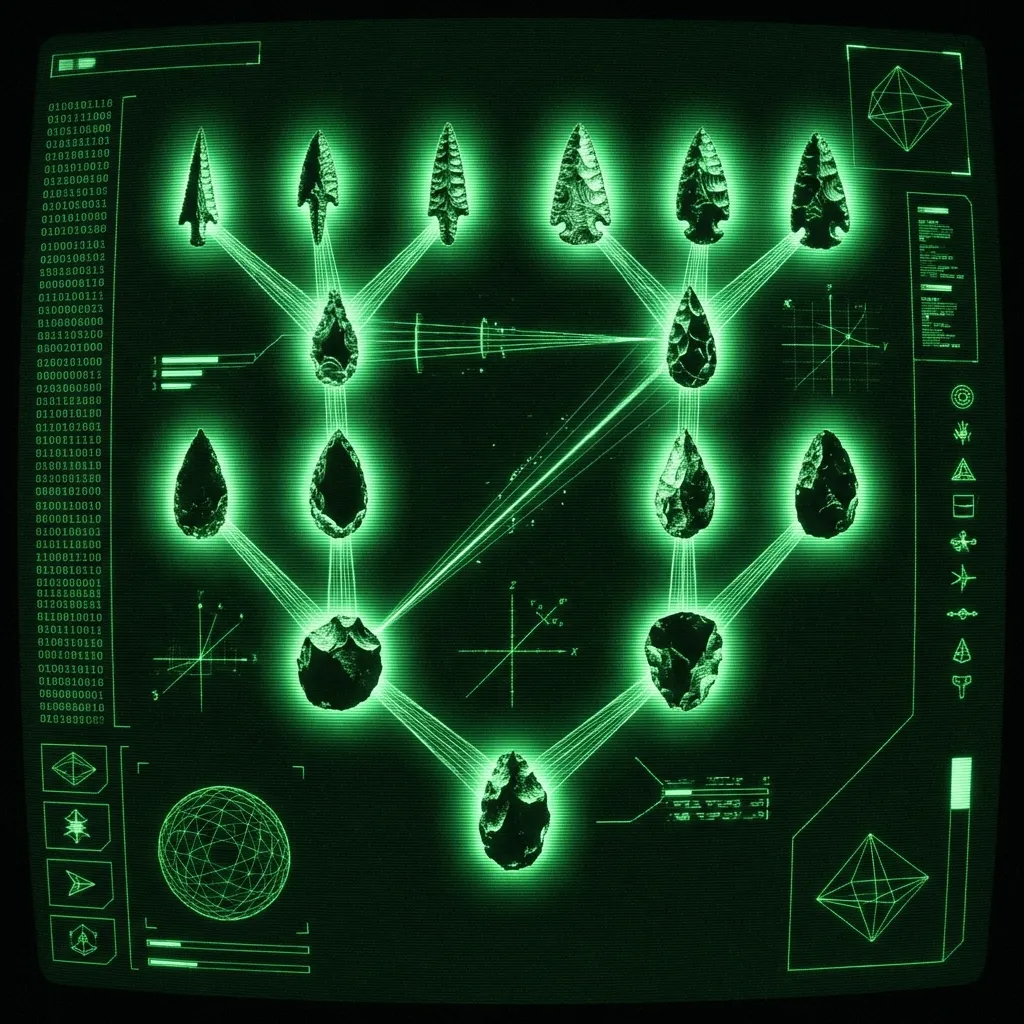
- The Americas’ “Paleolithic” is a mosaic: classic Old World Mode 2 (Acheulean handaxes) and Mode 3 (Levallois/Mousterian prepared cores) are rare-to-absent as sustained traditions, while Mode 1-like expedient flake tech persists late in many places and Mode 4/5-like blade/microblade systems appear early in the North.
- The strongest pre-Clovis archaeological record clusters ~16,500–14,000 cal BP across both continents (e.g., Cooper’s Ferry, Debra L. Friedkin, Page-Ladson, Paisley, Monte Verde) with stemmed points, bifaces, blades/flake tools, and coastal/riverine adaptations Davis et al. (2019) Waters et al. (2018) Halligan et al. (2016) Dillehay et al. (2015).
- The classic “Clovis horizon” is tight in time (≈13,100–12,900 cal BP in many syntheses) and diagnostic in tech (overshot biface thinning, fluting, cache behavior), but it’s not the beginning of culture—just a conspicuous lithic signature Waters & Stafford (2007).
- “Holdouts” (surprisingly simple, Mode 1-ish toolkits) are common: expedient flakes often beat fancy points in real subsistence, especially in coasts, forests, and wet tropics where stone signatures are sparse and organic tech vanishes.
- Cultural sophistication is best inferred from bundles (burials + pigment + ornament + transport traces + land-use intensity), not from point typology alone: e.g., the Anzick burial shows explicit ritual patterning tied to Clovis tech Rasmussen et al. (2014); White Sands trackways imply planning, transport, and group movement well before the Clovis window Bennett et al. (2021) Pigati et al. (2023) Holliday et al. (2025).
“Archaeology is anthropology or it is nothing.”
— Lewis R. Binford, commonly attributed to his programmatic statements (mid-20th century; see context in many retrospectives)
1) How to read this (without getting hypnotized by point types)#
The Paleolithic record in the Americas is unevenly preserved, unevenly sampled, and unevenly published. Lithics survive; wood, fiber, hide, basketry, adhesives, and most art media do not. So the tables below treat stone tools as proxies for broader technological and cultural systems—not the systems themselves.
Two practical conventions:
- Dates are in “cal BP” (“calibrated years before present,” where “present” = AD 1950).1
- “Modes” are heuristics originally built around Old World sequences—useful, but not sacred. The same “mode” can hide very different behaviors.
1.1 A minimalist “Mode” cheat-sheet (Old World-derived)#
| Mode | Core idea (stone) | Old World hallmark traditions (very rough) | Typical Old World span | Americas: what you actually see |
|---|---|---|---|---|
| 1 | Core-and-flake, expedient, few formal bifaces | Oldowan-like, many “Lower Paleolithic” flake industries | from ~2.6 million years ago | Common everywhere, often late; can coexist with fancy points; often dominates assemblages even when points exist |
| 2 | Large bifacial core tools (handaxes/cleavers) | Acheulean | ~1.7 million–~200,000 years ago (regionally variable) | Sparse/episodic; no continent-wide Acheulean-like tradition |
| 3 | Prepared cores (e.g., Levallois), standardized flakes | Mousterian / Middle Paleolithic variants | ~300,000–~40,000 years ago (varies) | Rare as a sustained system; occasional prepared-core behaviors occur, but not as a stable “Mousterian-equivalent” horizon |
| 4 | Systematic blades/bladelets + diverse tools | Upper Paleolithic (Aurignacian/Gravettian/etc.) | ~50,000–~12,000 years ago | Appears in pockets (blade industries, careful bifacial thinning, caches); Clovis is partly “Mode 4-ish” in organization but unique in form |
| 5 | Microliths / microblades (often composite tools) | Later Upper Paleolithic / Mesolithic-ish strategies | late Pleistocene–Holocene | Strong in the North (Beringia/Alaska microblades); often paired with mobile lifeways and composite weapons |
For a critical take on “modes” as analytical categories, see Shea (2013).
2) Master timeline: Paleolithic Americas in one table (with Old World comparison hooks)#
This is the “zoomed-out map.” Later sections zoom in, site-by-site.
| Time slice (cal BP) | North America: tech signals | South America: tech signals | Cultural signals (best-evidence) | Old World comparison anchor |
|---|---|---|---|---|
| >30,000 (highly disputed) | Claimed lithics at a few sites; debates about geofacts vs artifacts | A few controversial early claims (site integrity issues recur) | Cultural inference is weak because context is weak | If real, it would overlap with Eurasian Upper Paleolithic / late Middle Paleolithic, but “mode-matching” is mostly meaningless here |
| ~26,500–19,000 (LGM) | Evidence claims exist (e.g., high-altitude Mexico cave assemblage), debated | Sparse/contested | If present, implies survival/route strategies under LGM constraints | Eurasia has lots of Upper Paleolithic diversity; the Americas would be a tiny, ecologically stressed frontier |
| ~23,000–21,000 (trackway evidence) | White Sands footprints: repeated human trackways in lake-margin sediments; dating now supported by multiple independent methods Bennett et al. (2021) Pigati et al. (2023) Holliday et al. (2025) | (No equivalently famous South American trackway case of this age in mainstream syntheses) | “Culture” here is behavior: movement patterns, group composition (many child tracks), possible transport traces in later analyses | Old World has Upper Paleolithic art/ornament in many regions; White Sands is behavioral not “tool-type” evidence |
| ~24,000 (Beringia claim) | Bluefish Caves cut-marked bone + dates suggest LGM-age human presence in Yukon (contested but influential) Bourgeon et al. (2017) | — | If accepted: deep-time Beringian occupations and refugia logic | Would be broadly contemporary with Gravettian/Solutrean-era Eurasian timelines, but tech is not “the same kind” of record |
| ~16,500–15,000 (stronger pre-Clovis) | Western Stemmed / stemmed points + bifaces; riverine inland route evidence (Cooper’s Ferry) Davis et al. (2019); Texas Friedkin pre-Clovis points Waters et al. (2018) | Coastal Peru early occupations; mixed toolkits; “simple technologies” but intense coastal provisioning Dillehay et al. (2017) | Repeated use of places, mounds/coastal camps, long-distance movement implied | Old World Upper Paleolithic diversity; comparison is organizational (mobility + composite gear), not point-by-point matching |
| ~14,800–14,000 (pre-Clovis widely cited) | Page-Ladson butchery association Halligan et al. (2016); Paisley coprolites with DNA and later biomarker work support Jenkins et al. (2012) | Monte Verde II: structures, organics, coastal plant use incl. seaweed Dillehay et al. (2015) Dillehay et al. (2008) | High-confidence “human signature” bundles emerge: structures, subsistence breadth, transport planning | Eurasian Upper Paleolithic; again, the “mode” label is less important than the behavioral package |
| ~13,100–12,900 (Clovis horizon) | Fluted Clovis points, overshot thinning, caches; continent-wide lithic signal Waters & Stafford (2007) | South America has different early widespread point forms (e.g., fishtail) that are broadly comparable in being “big-game era” signatures Prates & Pérez (2022) | Ritual/burial evidence explicit at Anzick (ochre + toolkit) Rasmussen et al. (2014) | Compared with late Upper Paleolithic organizational complexity (caching, long-distance raw material), but not a direct typological match |
| ~12,900–11,500 (post-Clovis diversification) | Folsom and other regional point traditions; refined bison hunting systems; microblades remain important in the North | Fishtail + regional diversification; coastal and interior adaptations | More regionally distinct “cultural provinces” | Old World: terminal Pleistocene regionalization in toolkits; again, organizational parallels |
| ~11,500–10,000 (terminal Paleoindian / transition) | Burials (e.g., Upward Sun River infants) with ochre and grave goods Potter et al. (2014) | Coastal intensification and early plant management begins to creep in some regions | Increasing sedentism in pockets; still “Paleolithic-like” economies widely persist | Approaches the global threshold where many regions shift toward Holocene systems |
| <~10,000 (agriculture begins regionally) | Not the focus here | Not the focus here | Domestication/food production ramps in some areas (e.g., Mesoamerican squash) | Beyond our scope |
3) “Before Clovis”: what tools exist, where, and how solid is the case?
3.1 A pre-Clovis site ledger (high to low confidence)#
Key to “confidence”:
- A = strong context + multiple dating lines + broad acceptance
- B = good evidence, still debated edges
- C = heavy controversy (artifact vs geofact, dating association, site formation)
| Site | Region | Claimed age (cal BP) | What was found (tech) | Why it matters | Confidence | Core sources |
|---|---|---|---|---|---|---|
| White Sands (trackways) | New Mexico, USA | ~23,000–21,000 | Human footprints in lake-margin sediments; repeated track surfaces; later work adds independent dating | Behavioral evidence of people during/near LGM; not a “tool site” | A/B | Bennett et al. (2021); Pigati et al. (2023); Holliday et al. (2025) |
| Cooper’s Ferry | Idaho, USA | ~16,560–15,280 | Stemmed projectile points, flakes, hearth/feature context; Bayesian modeled sequence | Strong inland river corridor evidence; links to NE Asia coastal-ish tech comparisons | A | Davis et al. (2019) |
| Debra L. Friedkin (Buttermilk Creek Complex) | Texas, USA | ~15,500–13,500 | Pre-Clovis projectile points below Clovis layer; robust stratigraphy | Shows pre-Clovis point tech in interior plains/edges | A/B | Waters et al. (2018) |
| Monte Verde II | Chile | ~14,800–14,000 (often summarized ~14,500) | Wood structures, cordage, plant remains incl. seaweed, hearths, lithics | The canonical South American pre-Clovis site; preservation jackpot | A | Dillehay et al. (2015); Dillehay et al. (2008) |
| Page-Ladson | Florida, USA | ~14,550 | Stone tools associated with mastodon remains in submerged context | Pre-Clovis in the Southeast; wet-site taphonomy | A/B | Halligan et al. (2016) |
| Paisley Caves | Oregon, USA | ~14,300 (often cited) | Human coprolites, Western Stemmed points, genetic evidence; ongoing validation work | Direct biological signal + tech in the West | A/B | Jenkins et al. (2012) |
| Bluefish Caves | Yukon, Canada | ~24,000 | Cut-marked bone + AMS dates; interpretation disputed | Candidate for LGM Beringian occupancy | B/C | Bourgeon et al. (2017) |
| Chiquihuite Cave | Zacatecas, Mexico | possibly as early as ~33,000–31,000; strong claims at least pre-LGM | Lots of stone pieces argued as tools; no human DNA; ongoing debate about natural fracture | Pushes earliest tech claims deep; also a cautionary tale of “artifactness” | C | Ardelean et al. (2020) |
Takeaway: the best-supported tool-bearing pre-Clovis occupations cluster late (≈16–14k). The much earlier end is increasingly discussed, but the burden of proof is brutal because rocks are liars and strata are tricksters.
3.2 What were the pre-Clovis tools like?#
A useful (imperfect) dichotomy:
- Stemmed-point traditions (often grouped under “Western Stemmed Tradition” in North America): points/knives with stems for hafting, often paired with bifaces and flake tools; visible at Cooper’s Ferry and discussed at Friedkin and Paisley contexts Davis et al. (2019) Waters et al. (2018).
- “Expedient but effective” flake toolkits: a lot of cutting/scraping happens on sharp flakes with minimal retouch; these often dominate assemblages even when diagnostic points exist (a recurring “holdout” theme).
In South America, the pre-Clovis story is strongly shaped by preservation and coastlines: Monte Verde’s organics show a broad perishable toolkit that stone alone would not reveal Dillehay et al. (2015). Coastal Peru’s early sites emphasize diverse subsistence with comparatively “simple” lithics—an explicit reminder that cultural sophistication does not require lithic baroque Dillehay et al. (2017).
4) Clovis (and why it’s both overhyped and genuinely weird)#
Clovis is not “the first culture in the Americas.” It’s the first continent-scale lithic signal that is easy to see, classify, and argue about.
4.1 Clovis in one diagnostic table#
| Feature | Clovis “signature” | Why archaeologists care | Best anchor |
|---|---|---|---|
| Point type | Fluted lanceolate points (channel flake removed) | A strong, recognizable style with wide distribution | Clovis chronology syntheses: Waters & Stafford (2007) |
| Biface manufacture | Aggressive thinning strategies (incl. overshot flakes in some contexts) | Suggests skill, standardization, and high mobility | (Commonly discussed in Clovis technical literature; see broader syntheses around the Waters/Stafford time window) |
| Tool system | Points + bifaces + blades/flake tools + osseous tools (often invisible archaeologically) | A complete hunting/processing kit, not just points | — |
| Behavior | Caching, long-distance raw material transport in some regions | Organizational complexity, planning | — |
| Time span | Often modeled as a relatively tight window | Supports the idea of rapid spread/communication | Waters & Stafford (2007) |
4.2 Clovis as “Mode 4-ish” without being Aurignacian-with-fluting#
If you try to “map Clovis to Old World traditions,” you get misleading arguments fast:
- Typology doesn’t port cleanly. Aurignacian/Gravettian/Magdalenian are embedded in European stratigraphic and cultural histories; Clovis is a New World pattern with its own constraints.
- The more meaningful comparisons are organizational: high-quality bifacial thinning, weapon standardization, and landscape-scale planning look like what you expect from mobile foragers in harsh late-glacial environments—regardless of continent.
4.3 Clovis-era culture: the Anzick burial as a concentrated “meaning package”#
The Anzick burial in Montana is one of the clearest windows into Clovis-linked ritual behavior: ochre, grave goods, and a directly dated child whose genome connects to Native American ancestry narratives in powerful ways Rasmussen et al. (2014).
A point here that’s easy to miss: burials are technology (social technology). They encode kinship, memory, obligation, and value—none of which can be read from a point’s basal concavity.
5) South America: parallel problems, different lithic “loudness”#
South America’s early record is often framed as “fast colonization southward,” but the material record suggests a more interesting story: rapid dispersal plus early regionalization and persistent coastal intensification.
5.1 Monte Verde as the anti-typology site#
Monte Verde II gives you the stuff that typology can’t: structures, cordage, preserved organics, and plant use including seaweed—evidence consistent with a coastal/riverine provisioning strategy Dillehay et al. (2015) Dillehay et al. (2008).
This matters for your “holdouts” interest: Monte Verde shows how easily a highly capable culture can look lithically “simple” if you only have stone scraps.
5.2 Fishtail points: South America’s early widespread “signal”#
Fishtail projectile points are often treated as the earliest widely recognized point phenomenon across large parts of South America (especially the Southern Cone), and recent work explicitly relates changes in prey/technology through time Prates & Pérez (2022).
A productive analogy (not identity): Clovis : North America :: Fishtail : much of South America as far as “big, loud, early point signal” goes.
5.3 “Simple technologies, diverse food strategies” as a theme, not an embarrassment#
Coastal Peru (Huaca Prieta / Paredones) is explicitly framed as simple lithic tech paired with diverse subsistence and long-term use—a useful antidote to the “advanced = fancy points” fallacy Dillehay et al. (2017).
6) The “Kelp Highway” and why coasts scramble your mode-mapping#
If boats, nets, baskets, cordage, hooks, and harpoons are central, then stone may be merely auxiliary. This is why coastal migration models are so hard to test—sea-level rise ate the early shoreline sites.
A classic statement of the kelp-coast logic is the “Kelp Highway Hypothesis,” arguing that kelp forest ecosystems could support maritime dispersal along the Pacific Rim Erlandson et al. (2007). Monte Verde’s seaweed evidence is a nice on-the-ground consonance with that ecological plausibility Dillehay et al. (2008).
7) “Holdouts”: why “primitive” tech persists late (and why that’s rational)#
Your question about “primitive tools found later than you’d expect” has a simple answer with an insulting punchline:
If a sharp flake solves the problem, a baroque point is a waste of time.
7.1 Three reasons expedient (Mode 1-ish) lithics persist#
- Ecology: In forest, wetland, and tropics, cutting/scraping tasks are constant; hunting weapon points are only one slice of life.
- Perishable dominance: Many “advanced” technologies are perishable. Without Monte Verde–style preservation, they vanish.
- Risk management: High-investment points are excellent when replacement is costly and failure is fatal; low-investment flakes are excellent when resupply is easy and tasks are diverse.
This is why “mode” curves don’t behave like a clean global staircase. They behave like tool economics under local constraints.
8) Art and symbolic life (Paleolithic-only, best-evidence picks)#
Stone tools are rarely “art”; they’re mostly work. But Paleolithic Americas do yield symbolic traces.
| Evidence | Site/region | Approx. age | Medium | Why it matters | Source |
|---|---|---|---|---|---|
| Engraved proboscidean image | Vero Beach (“Old Vero”), Florida | late Pleistocene context; argued ~13k-ish in popular summaries, but the key point is the validated engraving on extinct faunal bone | Incised fossil bone | One of the most discussed candidates for very early representational art in the Americas | Purdy et al. (2011); author PDF: Smithsonian copy |
| Ochre-rich ritual burial with tools | Anzick, Montana | ~12,700–12,600 | Pigment + grave goods | Strong evidence of ritual practice linked to Clovis toolkit and genetic ancestry | Rasmussen et al. (2014) |
| Trackway “social slice” | White Sands, New Mexico | ~23k–21k | Footprints in sediment | Demography (many child tracks), movement, possible transport behaviors—cultural behavior without artifacts | Bennett et al. (2021); Pigati et al. (2023) |
Important caution: “art scarcity” in the Paleolithic Americas is plausibly a preservation artifact and sampling artifact, not an actual deficit in symbolic life. Ritual behavior, landscape knowledge, and composite technologies can be culturally deep without leaving Lascaux-style signatures.
9) A practical comparison: Americas vs Eurasia (what’s comparable, what isn’t)
9.1 Comparable dimensions (good comparisons)#
- Mobility organization (caching, raw material transport, site reuse)
- Composite technology reliance (hafting, adhesives, microblades)
- Subsistence breadth vs specialization (coastal intensification vs megafauna focus)
9.2 Bad comparisons (category errors)#
- “Where is the American Mousterian?”
- “Which American culture is the Aurignacian equivalent?”
- “Why no Acheulean in the Americas?” (Because the human and time prerequisites for the Acheulean’s Old World story aren’t mirrored; the Americas are populated late in global terms.)
If you want a single sentence: Eurasia’s Paleolithic is deep time plus multiple hominin lineages; the Americas’ Paleolithic is shallow time plus rapid dispersal and regionalization. Trying to force them into the same typological ladder produces confident nonsense.
FAQ#
Q 1. What tools existed in the Americas before Clovis? A. The best-supported pre-Clovis sites (~16–14k cal BP) include stemmed projectile points, bifaces, and lots of expedient flake tools (e.g., Cooper’s Ferry, Friedkin, Paisley) plus strong organic/structural evidence at Monte Verde Davis et al. (2019) Waters et al. (2018) Dillehay et al. (2015).
Q 2. When did “Mode 4” (Upper Paleolithic-like) tech appear in the Americas? A. “Mode 4” is a fuzzy Old World label, but blade systems, careful bifacial thinning, and organized composite-weapon behaviors are clearly present by the strong pre-Clovis window (~16–14k) and become lithically “loud” in Clovis-era strategies Davis et al. (2019) Waters & Stafford (2007).
Q 3. Is there credible evidence for humans in the Americas during the Last Glacial Maximum? A. There is increasingly discussed LGM-adjacent evidence—especially White Sands footprints dated ~23–21k cal BP with multiple independent approaches, plus contested Beringian signals like Bluefish Caves—but acceptance varies by evidence type and association strength Pigati et al. (2023) Holliday et al. (2025) Bourgeon et al. (2017).
Q 4. Why do “primitive” (expedient) stone technologies persist so late? A. Because expedient flakes are often the economically optimal solution for daily cutting/scraping and plant/animal processing, while many “advanced” technologies are perishable (boats, fiber, wood, adhesives) and vanish archaeologically unless preservation is exceptional (as at Monte Verde) Dillehay et al. (2015).
Q 5. What’s the cleanest way to compare Old World industries (Mousterian, Aurignacian…) to the Americas? A. Compare functions and organization (mobility, composite tools, provisioning, ritual signals) rather than forcing a one-to-one typological mapping, because Eurasia’s deep-time “industry ladder” reflects different hominin lineages and much longer time depth than the late-peopled New World Shea (2013).
Footnotes#
Sources#
- Ardelean, Ciprian F., et al. “Evidence of human occupation in Mexico around the Last Glacial Maximum.” Nature 586 (2020).
- Bennett, Matthew R., et al. “Evidence of humans in North America during the Last Glacial Maximum.” Science 373 (2021).
- Bourgeon, Lauriane, Ariane Burke, and Thomas Higham. “New Radiocarbon Dates from Bluefish Caves, Canada.” PLOS ONE (2017). doi:10.1371/journal.pone.0169486
- Davis, Loren G., et al. “Late Upper Paleolithic occupation at Cooper’s Ferry, Idaho, USA, ~16,000 years ago.” Science 365 (2019). doi:10.1126/science.aax9830
- Dillehay, Tom D., et al. “Monte Verde: seaweed, food, medicine, and the peopling of South America.” Science 320 (2008). doi:10.1126/science.1156533
- Dillehay, Tom D., et al. “New archaeological evidence for an early human presence at Monte Verde, Chile.” PLOS ONE (2015). doi:10.1371/journal.pone.0141923
- Dillehay, Tom D., et al. “Simple technologies and diverse food strategies of the Late Pleistocene and Early Holocene at Huaca Prieta, Coastal Peru.” Science Advances 3 (2017). doi:10.1126/sciadv.1602778
- Erlandson, Jon M., et al. “The Kelp Highway Hypothesis: Marine Ecology, the Coastal Migration Theory, and the Peopling of the Americas.” Journal of Island and Coastal Archaeology 2 (2007). doi:10.1080/15564890701628612
- Halligan, Jessi J., et al. “Pre-Clovis occupation 14,550 years ago at the Page-Ladson site, Florida, and the peopling of the Americas.” Science Advances 2 (2016). doi:10.1126/sciadv.1600375
- Holliday, Vance T., et al. “Paleolake geochronology supports Last Glacial Maximum age for human footprints at White Sands.” Science Advances (2025). doi:10.1126/sciadv.adv4951
- Jenkins, Dennis L., et al. “Clovis Age Western Stemmed Projectile Points and Human Coprolites at the Paisley Caves.” PNAS (2012). doi:10.1073/pnas.1206953109
- Pigati, Jeffery S., et al. “Independent age estimates resolve the controversy of ancient human footprints at White Sands.” Science (2023). doi:10.1126/science.adh5007
- Potter, Ben A., et al. “A terminal Pleistocene double infant burial at Upward Sun River, Alaska.” PNAS (2014). doi:10.1073/pnas.1413131111
- Prates, Luciano, and S. Iván Pérez. “Changes in projectile design and size of prey reveal the emergence of socio-ecological adaptations in the earliest peopling of South America.” Scientific Reports (2022).
- Purdy, Barbara A., et al. “Incised image of a proboscidean on a mineralized extinct animal bone from Vero Beach, Florida.” Journal of Archaeological Science 38 (2011). (Author PDF: Smithsonian copy)
- Rasmussen, Morten, et al. “The genome of a Late Pleistocene human from a Clovis burial site in western Montana.” Nature 506 (2014).
- Shea, John J. “Lithic Modes A–I: A new framework for describing global-scale variation in stone tool technology illustrated with evidence from the East Mediterranean Levant.” Journal of Archaeological Method and Theory (2013).
- Waters, Michael R., et al. “Pre-Clovis projectile points at the Debra L. Friedkin site, Texas—Implications for the Late Pleistocene peopling of the Americas.” Science Advances (2018). doi:10.1126/sciadv.aat4505
- Waters, Michael R., and Thomas Stafford Jr. “Redefining the age of Clovis: implications for the peopling of the Americas.” Science (2007). doi:10.1126/science.1137166
“BP” means “before present,” where “present” is defined as AD 1950 for radiocarbon conventions. “cal BP” indicates calibrated calendar estimates rather than raw radiocarbon years. ↩︎