~/mythology/consciousness
Out of the Earth: Eight American Stories of Becoming Human
Eight American emergence stories connect human origins with women, serpents, sacred sound, and the transmission of mind in Eve Theory.
TL;DR
- Across the Americas, emergence stories make humanity a condition that must be reached, shaped, and handed on.
- Eight traditions distribute that work among founding women, animal helpers, ancestors, and ritual specialists.
- The strongest Eve Theory parallel is transmission: a human world endures when the powers that established it become teachable.
- Their differences matter. Some people emerge unfinished; others bring language, food, and institutions with them. Some passages remain open to the dead; others close forever.
“I fill your head with my mind.”
— Utset, in Stevenson, The Sia (1894), p.40.
The speaker is a woman preparing to leave the world she has helped to make. Her people have come out of the earth. They have crossed a dangerous opening, survived a flood, found food, and learned how to travel over ground that was too soft to bear them. Now she chooses a man to take her place. He will lead with her wisdom, carry her authority, and remain answerable to the voice of the mother who returns below.
It is a startling description of inheritance. A mind passes from one head into another. The transfer includes thoughts, a heart, a staff of office, and a command to work for good. The person who receives it becomes capable of continuing something he did not originate.
This is where the Eve Theory of Consciousness enters the emergence stories of the Americas. Eve Theory proposes that reflective selfhood was an acquisition: women first discovered the recursive “I,” taught it to others, and established forms of culture through which the new capacity could spread. Its central problem is transmission. How does one person’s discovery become another person’s way of being? How does an extraordinary experience become a durable human inheritance? Eve Theory of Consciousness v3.
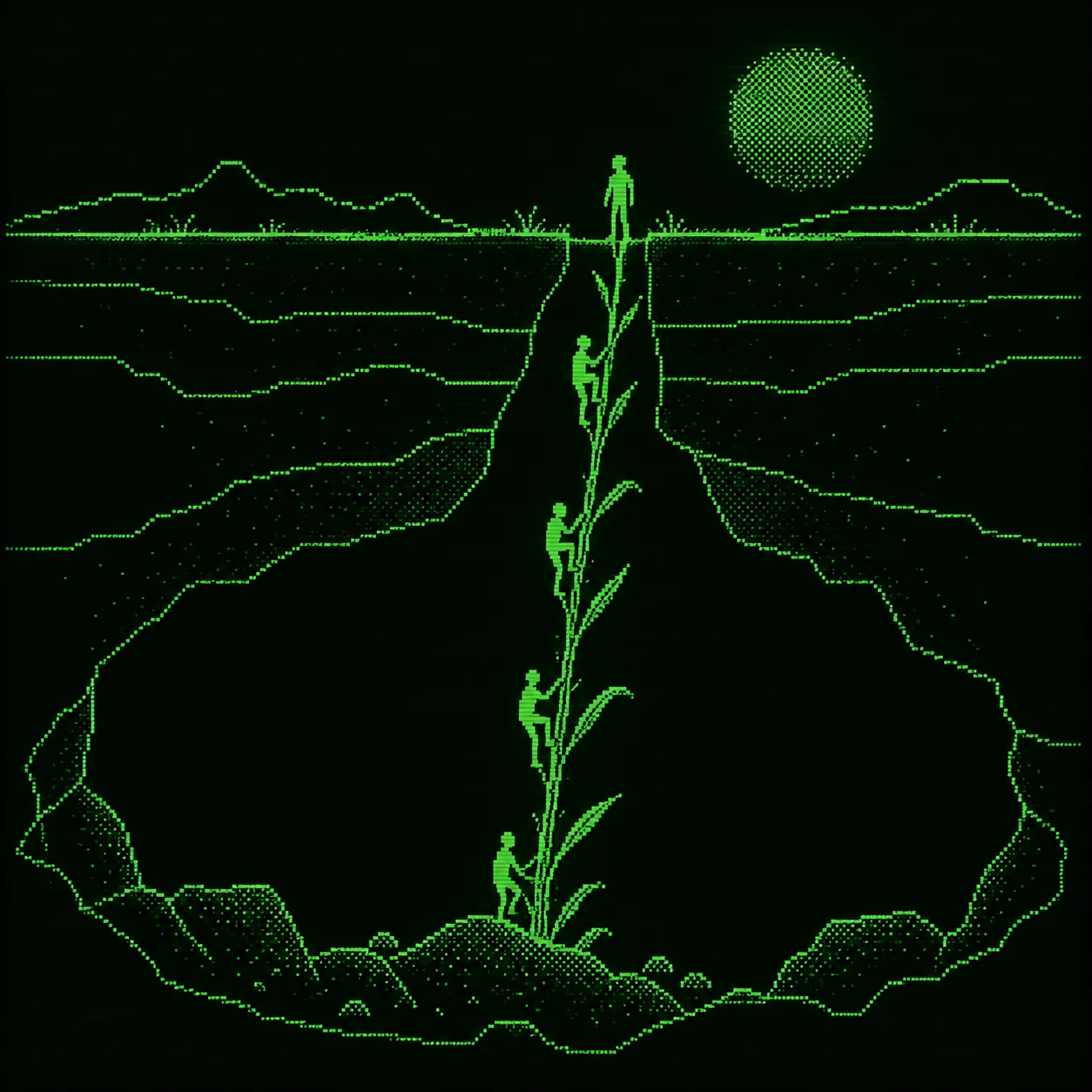
Emergence stories give these questions bodies and landscapes. People live inside the earth, often in darkness, sometimes with animal bodies or unfinished senses. They climb plants, follow guides, open a roof, or travel beneath the ground to the place where their descendants will live. Reaching the surface can begin a second creation. The newcomers need light, food, language, bodily changes, ceremonies, a place in the world, and a way to remain together.
The stories repay being heard at length. Their snakes do different things. Their women create, instruct, compete, govern, heal, or interrupt a passage. The people below may be embryonic creatures, an already organized society, or the souls of ancestors who have died. Those differences reveal the range of what a human beginning can mean.
We will begin with three neighboring Pueblo traditions, then move to the upper Missouri, Hispaniola, the Andes, the Colombian highlands, and southern Brazil. The geography expands while a question follows us: what has to happen before the beings who emerge can live as a human people?1
Eight stories across the Americas
HopiHopi mesas, Arizona
Spider Woman, a mockingbird, and animal helpers accompany the ascent into a world that still needs light and a way to live.
Read the Hopi story →Locations and primary sources
| Story | Location | Primary account |
|---|---|---|
| 1. Hopi | Hopi mesas, Arizona | Voth 1905, §§3–4, 6 |
| 2. Zia | Zia Pueblo, New Mexico | Stevenson 1894, pp.26–41 |
| 3. Zuni | Zuni Pueblo, New Mexico | Cushing 1896, pp.381–390, 416–417 |
| 4. Mandan | Upper Missouri, near Fort Clark, North Dakota | Dipauch via Maximilian and Kipp, 1833–1834; 1906 reprint, pp.312–315 |
| 5. Taíno | Hispaniola, Caribbean | Pané, chapter I; Bourne 1906, p.12 |
| 6. Inka | Cusco region, Peru; Molina also describes Tiwanaku in present-day Bolivia | Molina / Markham 1873, pp.4–6; Sarmiento / Markham 1907, XI–XIII |
| 7. Muisca | Lake Iguaque, Colombian highlands | Simón, second part, 1891, pp.279–280 |
| 8. Kaingang | Paraná, southern Brazil | Borba 1908, chapter II, pp.20–25 |
1. Hopi: the people come out before the world is ready #
In a telling narrated by Lomávântiwa of Shupaúlavi and recorded by H. R. Voth in 1905, the people below have already made a troubled society. They quarrel, mistreat women, and fear dangerous practitioners who put sickness into others. Their chiefs decide that they must find somewhere else to live. A bird sent to search fails. The mockingbird flies farther and discovers an opening above them. Voth, §3, pp.10–11.
The lower world becomes a place of rising water and great water serpents. The chiefs sing plants into growth. A pine reaches upward, but its branches cannot be trusted. Another grows stronger but falls short. A reed rises to the opening. The different plants become the means by which the people can climb out.
Spider Woman goes first, followed by two divine brothers and the mockingbird. Above, the brothers hold the climbing supports steady. Spider Woman watches. The mockingbird sings, and the people climb into identities that are being assigned as they arrive:
As soon as they emerged, the Mocking-bird assigned them their places and gave them their languages. To one he would say: “You shall be a Hopi, and that language you shall speak.” To another: “You shall be a Navaho, and you shall speak that language.” And to a third: “You shall be an Apache,” “a Mohave,” “a Mexican,” etc., including the White Man.
— Lomávântiwa, recorded by Voth, §3, p.11. Original text.
The song has a limit. Before everyone can get out, the mockingbird has exhausted his songs. Those still climbing turn back. A great many people have emerged, but a great many remain below. The opening is the sipapu, and the first community gathers around it.
The upper world is dark. There is no sun. Then the chief’s young son becomes sick and dies. The chief is furious: the whole point was to get away from people who cause harm. He throws a ball of cornmeal upward to discover who has brought danger with them. It falls on his own nephew. He seizes the boy to throw him back through the opening.
The nephew tells him to look down first. Below, the chief sees his dead son alive among other children. The passage has carried the people into a new world, but the earlier world remains the place to which the dead go. The chief relents. Voth, §3, pp.11–12.
The people still need warmth and food. A messenger follows a distant light and finds Másauwuu tending a garden warmed by fires. He receives the newcomers and feeds them. They learn how to keep their own crops warm. The chiefs make a moon, whose light proves inadequate, and then a sun. Only afterward can ordinary work and movement fill the day. The people set out eastward, searching for the place of sunrise.
This is a much more interesting beginning than a finished world receiving finished people. The opening solves one problem and exposes several others. Escape does not abolish danger, kinship does not prevent wrongdoing, and emergence does not end death. The people must learn how to inhabit what they have entered.
A woman and a Flute priest make the light #
Another Hopi narrator, Yukíoma of Oraíbi, distributes the work differently. In his telling, the chief physically removes the reed to stop further emergence. Afterward, Spider Woman and the Flute priest make the heavenly lights. We can hear the difference without combining the two tellings into a single artificial story:
It was at this time dark yet, so Spider Woman (Kohkang Wuhti) took a piece of white native cloth (owa) and cut a large round piece out of it on which she made a drawing. She was assisted by the Flute priest. They sang some songs over it, and Spider Woman then took the disk away towards the east. Soon they saw something rise there, but it did not become very light yet, and it was the moon. So they said they must make something else. Spider Woman and the Flute priest then took a piece of buckskin, cut a circular piece out of it, and made on it a drawing of the sun symbol, as is still used by the Flute priest to-day. They sang over this, whereupon Spider Woman took that away and in a little while something rose again, and now it became light and very warm. But they had rubbed the yelks of eggs over this sun symbol and that is what makes it so very light, and that is why the chickens know when it is light and yellow in the morning, and crow early at the sunrise, and at noon, and in the evening, and now they know all about the time. And now the chief and all the people were happy because it was light and warm.
— Yukíoma, recorded by Voth, §4, p.20. Original text.
A drawing becomes a celestial body through handling, song, and the work of a woman and a ceremonial specialist. The account carries the making of the sun directly into the present through the sun symbol still used by the Flute priest. Creation is something that a community knows how to repeat in a particular form.
The surviving public Hopi account also makes emergence the beginning of obligations. The Hopi Foundation describes Maasaw giving the people seeds, a water gourd, and a planting stick: the materials of a difficult, enduring way of life. The gift supplies a future that people must work to maintain. Hopi Foundation, “Hopisinom”.
The woman at the young man’s ear #
A separate tale in Voth’s collection makes the acquisition of ceremonial knowledge more intimate. A chief’s son travels down a river and reaches the Snake people. Spider Woman has accompanied him, concealed close to his ear. She advises him through a smoking ordeal and prepares him for a harder test. The people in the kiva become snakes. He must choose one and handle it. The most beautiful maiden has become the fiercest animal:
The prettiest maiden had turned into a large yellow rattle-snake (Sika-tcua), and was especially angry. Spider Woman whispered to the young man, that the one that acted so very angrily was the pretty maiden and that he should try to take that one. He tried, but the snake was very wild and fierce. “Be not afraid,” Spider Woman whispered, and handed him some medicine. This he secretly chewed and spurted a small quantity of it on the fierce snake, whereupon it immediately became docile. He at once grabbed it, held and stroked it four times upward, each time spurting a little medicine on it, and thus freeing it from its anger. The chief was astonished and said: “You are very something, thanks. Now, look away again.” He did so and when he turned back he saw that all the snakes had assumed the forms of men and women again, including the maiden that he had captured. They now were all very good to him, and talked to him in the kindest manner, because they now considered him as initiated and as one of them.
— Lomávântiwa, recorded by Voth, §6, p.32. Original text.
The youth succeeds through knowledge he receives from a woman. Her instructions change what he can do in the presence of fear. The terrifying animal becomes a maiden again, and the outsider becomes someone the community recognizes as its own. The chief then teaches him the ceremonial knowledge he has come to acquire. Voth, §6, pp.32–33.
For Eve Theory, this scene concentrates the larger problem: a woman already knows the route through an experience that a man cannot negotiate unaided. She speaks, he performs, and a new social identity follows. The story makes initiation a change in competence and membership. The rattlesnake belongs to that transformation, with its danger still visible.
Sacred sound also has a documented place beside these narratives. In his observation of the Walpi Flute ceremony, Jesse Walter Fewkes describes a performance in which bullroarers and a flute accompany the same songs:
At the close of the prayers the songs began, the priests all keeping time by beating or shaking their rattles, and the Flute chief holding the paaya, or “moisture rattle,” previously referred to. During the songs an old man cast pinches of meal to the cardinal points in sinistral sequence, and Winuta asperged medicine water toward the same directions by means of a feather.
When the songs were about half finished Sikyabotima took the whizzers or bullroarers from the floor before the altar and twirled them several times, after which he went into an adjoining room and repeated the same action. Hani accompanied the songs with a flute. When the singing came to an end, prayers followed, and a ceremonial smoke closed the exercises.
— Fewkes, Tusayan Flute and Snake Ceremonies, p.1003. Original scan.2
Fewkes interprets the whizzer as thunder in a prayer for rain. Its sound participates in making the world responsive to human action. The myth, the initiation tale, and the observed ceremony give three different views of a culture sustained through learned acts: a people comes out, a young man is admitted, and an inherited way of addressing the world is performed. The longer Hopi discussion can be read alongside these particular tellings, whose allocation of creative work deserves to remain distinct.
2. Zia: the woman who gives away her mind #
The Zia account published by Matilda Coxe Stevenson begins in the lower world with a spider and two mysterious parcels. The spider lays out a cross of meal, sets down the parcels, and sings. They begin to shake like rattles. Two women appear. Other people and creatures follow, crowded together in darkness. The women are Utset and Nowutset, the mothers of peoples who will occupy the world. Stevenson, pp.26–28.
The spider is addressed in different parts of the account as father, mother, or grandmother. The two women have a more definite task. They see that their people need light, and they decide to make it. From shell and colored materials they fashion the sun. They carry him east and establish his rising. When night remains dark, they make the moon and the star people. Houses and places begin to take shape around their work. Stevenson, pp.29–30.
Then the sisters begin to test each other. They conceal things under blankets and ask what the other knows. A picture, a human figure, an altar: each hidden object becomes a contest over knowledge. Utset, the younger and smaller, receives whispered guidance from the spider and repeatedly understands more than her sister expects. The tests join concealment, interpretation, and the ability to say what another mind has placed out of sight.
Utset also creates male mediators. One becomes the sun’s companion, messenger, jester, and flute musician. The women who have made the light establish people able to communicate with its source. Stevenson, pp.31–33.
Their powers do not produce an uncomplicated harmony. Rivalry becomes a contest over whose face the rising sun will illuminate first, and whose followers will rule. Utset uses a bird to direct the light onto herself. The followers fight. The sisters wrestle. Utset’s people intervene, and she kills her older sister. The bad heart becomes rats. The source’s founding women include intelligence, deception, authority, and violence. Their power matters too much to reduce them to a general symbol of fertility.
For a time the survivors flourish. Then water rises around the mesas. The spider asks where the people can go. A great reed is placed on a mesa, and Utset leads the ascent, carrying a sack of stars. Religious specialists follow with their precious objects; other people and animals come behind. At the top the earth still blocks the way. Utset calls a locust:
The locust hastened to her, and she told him that the earth prevented their exodus. “You know best how to pass through the earth; go and make a door for us.” “Very well, mother,” he replied, “I will, and I think I can make a way.” He began working with his feet, and after a time he passed through the earth, entering another world. As soon as he saw the world, he returned to Utset saying, “It is good above.”
— Stevenson, pp.36–37. Original scan.
A badger widens the opening. Deer, elk, and buffalo test the passage. The turkey escapes so late that the rising water leaves its mark on the tips of his feathers. Stevenson, pp.34–37.
A beetle has been entrusted with the star sack. Tired and curious, it cuts a tiny hole to see what is inside, and stars fly out across the sky. Utset recovers a few and places them in recognizable groups. The opening below is sealed against the flood. The upper world has been reached, but its people still live largely on grass seeds.
Utset makes fields and plants pieces of her heart. Corn grows. She tells the people that the corn is her heart and will nourish them like milk from her breasts. The gift turns her body into something that can feed descendants after her visible presence is withdrawn. Stevenson, p.39.
Travel remains difficult because the earth is too soft. Great animal helpers try and fail to make it traversable. A woman of the spider society produces a cotton road suspended above it, but the people fear its fragility. A male member completes the work with different implements, including an expanding wooden serpent. The society reaches a condition in which its mother can choose a successor:
The earth now being firm so that the people could travel, Utset selected for the ti’amoni who was to take her place with the people and lead them to the center of the earth, a man of the corn clan, saying to him, “I, Utset, will soon leave you; I will return to the home whence I came. You will be to my people as myself; you will pass with them over the straight road. I will remain in my house below and will hear all that you say to me. I give to you all my wisdom, my thoughts, my heart, and all. I fill your head with my mind.” She then gave to her newly appointed representative a crooked staff as insignia of his office, saying, “It is as myself; keep it always.”
— Stevenson, p.40. Original page.
The people clasp the staff and draw breath from it. The man receives the precious things Utset has brought from below. He must follow the straight road, listen to good things, work for good things, and turn from bad things. She returns to her house below while leaving ways for her people to speak to her. Stevenson, pp.40–41.
Here Eve Theory finds an unusually explicit formulation of its central intuition. Female knowledge becomes a male capacity. A successor receives the founder’s thoughts and becomes able to occupy her place. The moral person and the ritual office arrive together: how to think, what to value, and whom one represents are transmitted in one act.
Utset’s mind becomes inheritable because it acquires public forms. The staff can be held. The road can be followed. Corn can be planted. An instruction can be remembered and performed by someone who never saw the first emergence. These forms keep a relationship alive across the disappearance of its original participant.
Eve’s importance in this reading lies in that possibility. Whatever the first discovery of reflective selfhood was like, a lone discoverer would not be enough. Others would have to acquire a form of inward organization and carry it into new lives. Utset expresses that passage with extraordinary economy: the mind that founded the world fills the head of someone who will continue it.
3. Zuni: the beings born into daylight are still unfinished #
In Frank Hamilton Cushing’s Zuni outline, the earth is a mother’s body and the people gestate inside it. The lowest of four wombs is a place of darkness and crowding. The beings are still taking shape. Their condition gives them a reason to seek an exit:
Thus the lowermost womb or cave-world, which was Ánosin téhuli (the womb of sooty depth or of growth-generation, because it was the place of first formation and black as a chimney at night time, foul too, as the internals of the belly), thus did it become overfilled with being. Everywhere were unfinished creatures, crawling like reptiles one over another in filth and black darkness, crowding thickly together and treading each other, one spitting on another or doing other indecency, insomuch that loud became their murmurings and lamentations, until many among them sought to escape, growing wiser and more manlike.
— Cushing, “The gestation of men and the creatures,” p.381. Original text.
Póshaiyaŋk’ya finds the way upward alone and appeals to Sun Father for those who remain below. The Beloved Twain are brought forth from the waters and descend to help them. They breathe on growing stems, grasp and twist them upward, and make a living ladder. The people ascend through increasingly spacious wombs. Some fall, some remain behind, and the journey retains the danger of a birth that can go wrong. Cushing, pp.381–383.
Their first emergence is at night. Even a star shines with a force their eyes have never encountered. The bodies that come out belong to the environment in which they have formed:
Men and the creatures were nearer alike then than now: black were our fathers the late born of creation, like the caves from which they came forth; cold and scaly their skins like those of mud-creatures; goggled their eyes like those of an owl; membranous their ears like those of cave-bats; webbed their feet like those of walkers in wet and soft places; and according as they were elder or younger, they had tails, longer or shorter. They crouched when they walked, often indeed, crawling along the ground like toads, lizards and newts; like infants who still fear to walk straight, they crouched, as before-time they had in their cave-worlds, that they might not stumble and fall, or come to hurt in the uncertain light thereof.
— Cushing, “The condition of men when first into the world of daylight born,” p.383. Original text.
When the sun rises, its light overwhelms them. They fall and turn their faces away, then look again. They begin to stand upright. Their feet hurt on the new ground, and they make sandals. They cover their bodies. Sensory adjustment, posture, clothing, and movement are parts of entering a different kind of life. Cushing, pp.383–384.
The story gives us a birth followed by an extended becoming. Its unfinished bodies make animal and human continuous, while the journey differentiates them. This is one of the clearest places to feel the force of Eve Theory’s question: what would it mean to become human while already alive?
The answer in this account occupies time. Much later, after long movements and other transformations, the Twain cut away talons, webbing, and tails. Some people flee before the work can be completed. Bodily finishing is distributed through the story rather than accomplished in one instant at the exit. Cushing, pp.416–417.
The world also needs finishing. The young earth shakes and threatens those walking over it. The people seek its Middle, a place where life can become stable. They travel, settle, move again, divide, encounter other communities, and acquire food and institutions. The story’s movement toward home is as consequential as its movement toward daylight. Cushing, pp.388–390, 428–430.
The corn has to be treated rightly #
Later in the same cycle, the Corn Maidens bring a further lesson. People become dissatisfied with their customary performance and seek the music of Paíyatuma and the Flute People. The ceremonial world is full of attractive forms, beautiful bodies, sounds, and powers. Human conduct determines whether those gifts remain available.
In the dance, young men crowd the Maidens and pluck at their white garments. The Maidens withdraw, breaking the relationship through which the people receive their corn. Searchers fail to recover them. Paíyatuma eventually finds them and brings them back, while the return establishes instructions for the treatment and cultivation of their gifts. Cushing, pp.430–445.
This is a demanding complement to Utset. Female creative power sustains a community, and the community can destroy its own access to that power through its behavior. The story turns food into a relationship whose continuity requires restraint and care. Music helps organize that relationship, while desire can unravel it.
Eve Theory becomes more useful here when it attends to the whole human package. A reflective self does not live by having an inner voice alone. It can be addressed, instructed, ashamed, held responsible, and required to remember a gift. The new condition involves an enlarged field of consequences. One must understand that what is wanted now can damage what will be needed later, and that another being’s withdrawal changes one’s own future.
The Hopi upper world needs light. Zia needs a successor capable of carrying a woman’s mind. Zuni needs bodies, senses, food, and conduct fitted to the world into which the people have been born. The three neighboring traditions give different answers to what remains to be done after the first opening has been crossed.
4. Mandan: half the people remain below #
Far to the northeast, on the upper Missouri, Dipauch told an emergence account to Maximilian of Wied during the winter of 1833–1834. James Kipp interpreted. The passage begins with a layered universe, an earlier emergence, and a flood, then follows another company of people who see a light above them:
Before the first great deluge, the Numangkake lived below ground, but a band of them (the same of which we have been speaking) took up their abode above ground at an earlier period. They believe that there are four stories below ground and as many above, and they now inhabit the fourth from below. The band which first came above ground is called by them Histoppa (those with the tattooed countenance), and these, for the most part, perished in the great deluge.
Those who lived under ground one day perceived a light over their heads, which made them desire to ascertain what was above. They accordingly sent up a mouse, which looked about, returned, and reported that the land above was similar to that which they inhabited. They then sent up a certain animal, called by them, Nahsi, about the size of a polecat, and distinguishable by black stripes on its face and legs. Perhaps this was the racoon, which is not now to be found in this part of the country. This animal, when he came back, said that it was much more pleasant above than below. They, therefore, ordered the badger to dig a larger opening, as the present issue was too small. After the badger had performed his task, the black-tailed deer was ordered to go up and enlarge the opening by means of his horns. He ran about the whole day, ate service berries, and returned in the evening. His tail was at that time white, but as this deer returned at sunset, and the sun went down at the very moment when his tail only was above ground, that was ever afterwards black.
The Numangkake now resolved to go up. The great chief, with his medicine and his schischikué in his hand, went first. They climbed up, one after another, by the aid of a branch of a vine; and when exactly half their number had ascended, and a corpulent woman was halfway up the vine, it broke, and the remainder of the nation fell to the ground. This happened in the neighbourhood of the sea-shore.
— Dipauch, through Kipp, in Maximilian, Travels in the Interior of North America, H. Evans Lloyd translation, pp.312–314 of the 1906 reprint. Full text.3
The order of discovery matters. The mouse finds similarity. The next scout finds a better place. The badger and deer turn the possibility into a usable opening. The chief leads with medicine and a schischikué, a rattle, in his hand. As in the Pueblo accounts, animals make the passage possible, plants support the movement, and a human community follows a leader carrying objects of power.
The break leaves exactly half the people below. A new world is founded through a division that cannot be repaired. The people who reach the surface migrate from the seashore toward the Missouri. The chief’s skull and rattle become enduring possessions. After further encounters, the account reaches the establishment of societies, insignia, and a code of conduct:
The chief now introduced the establishment of the bands or unions, and founded first that of “the foolish dogs.” He made four caps of crow’s feathers, and commissioned the Mandans to make a number of similar ones. He then gave them the war pipe and song, and exhorted them to be always valiant and cheerful, and never to retreat before the point of the arrow.
— Dipauch’s account, pp.314–315. Full text.
The first ascent thus extends into an institutional beginning. People become a people by learning how to belong, what to carry, how to act together, and how to face danger. The chief already has medicine below ground. Culture crosses the boundary with him and takes further forms above it. This is a different emphasis from the Zuni bodies that must gradually become fitted to daylight.
The curious woman in another telling #
George Catlin recorded another Mandan version after his visit in 1832. Here a young man climbs a vine, finds buffalo country, hunts, and returns with news. Others follow. Catlin’s account then gives the woman at the broken vine a more explicitly moral role:
Amongst those who went up, were two very pretty young women, who were favourites of the chiefs, because they were virgins; and amongst those who were trying to get up, was a very large and fat woman, who was ordered by the chiefs not to go up, but whose curiosity led her to try it as soon as she got a secret opportunity, when there was no one present. When she got part of the way up, the vine broke under the great weight of her body, and let her down. She was very much hurt by the fall, but did not die. The Mandans were very sorry about this; and she was disgraced for being the cause of a very great calamity, which she had brought upon them, and which could never be averted; for no more could ever ascend, nor could those descend who had got up; but they built the Mandan village, where it formerly stood, a great ways below on the river; and the remainder of the people live under ground to this day.
— Catlin, Letters and Notes, vol. I, pp.178–179. Original edition.
This version makes the closing passage the consequence of a prohibited act. The woman wants to know what is above. The chiefs have forbidden her to climb. She acts secretly, and her failed ascent becomes a calamity for everyone. Her curiosity carries the blame for an irreversible division. Those details belong to Catlin’s telling; Dipauch’s account gives the breaking vine without the prohibition, secrecy, or disgrace.
For an Eve Theory reading, the difference is revealing. A woman’s crossing can be made the decisive act in the history of the whole community, while the story judges her desire to cross. The same broad emergence structure can accommodate female guidance, female leadership, or a woman’s desire for knowledge turned into a warning. The moral allocation of responsibility changes even when the opening and broken vine remain.
Catlin adds that the medicine men profess to hear the people below and consult them for advice. The physical road has closed, but a channel of speech persists. In Lomávântiwa’s Hopi story, the chief can look down and see his dead child living. Here specialists listen through the earth. Both accounts leave the earlier world near enough to address, while giving that relationship a different form. Catlin, p.179.
Emergence can establish a new home without exhausting the authority of what came before. The living inherit an origin, and certain people retain the power to speak across its boundary.
5. Taíno: daylight changes the people who meet it #
In the Caribbean, the cave opens into a more hazardous kind of light. Ramón Pané’s late fifteenth-century account places the beginnings of most of Hispaniola’s people in a mountain with two caves. Here is the opening in Edward Gaylord Bourne’s old English rendering:
Española has a province called Caanau in which there is a mountain which is called Canta where there are two caves, the one named Cacibagiagua and the other Amaiuua. From Cacibagiagua came forth the larger part of the people who settled in the island. When people were in these caves watch was kept by night and the care of this was given to one whose name was Marocael; and him, because one day he delayed to come back to the door, the sun carried off. And when it was seen that the sun had carried him off they closed the door; and so he was changed into stone near the door. Next they say that others going off to fish were taken by the sun and they became trees, called by them Iobi and otherwise they are called mirabolans. The reason why Marocael kept watch and stood guard was to watch in what direction he wished to send or to divide the people, and it seems that he delayed to his own greater hurt.
— Pané, chapter I, in Bourne, Columbus, Ramon Pane and the Beginnings of American Anthropology, p.12. Original scan.4
The sun catches a watchman who has stayed away too long. It catches others who have gone fishing. Their bodies change into stone and trees. Where Zuni daylight overwhelms new eyes and begins a bodily adjustment, Taíno daylight transforms people into other parts of the landscape. The cave is a place from which human life is distributed, but passing its threshold exposes the inhabitants to a power that can change their kind.
The watchman’s task is also political: he is concerned with where the people will be sent or divided. The opening of the world already contains the problem of distributing a population. The island’s people belong to an origin with branches, destinations, and dangerous interruptions.
A world deprived of women #
Later in Pané’s sequence, Guagugiona takes the women away. The men left behind cannot continue ordinary human life. Their predicament produces one of the collection’s most striking accounts of bodily making. In the rain they see beings descending from trees. These beings have neither male nor female sexual organs. They are so slippery that the men cannot hold them, until men with roughened skin are chosen to catch them.
The captives are to become women. For the work of making their bodies, the people find an animal with an appropriate skill:
They sought a bird which is called Inriri, in ancient times Inrire Cahuuaial, which bores trees and in our language is called woodpecker (pico). And likewise they took these women without male or female organs and bound their feet and hands and took this bird just mentioned and bound him to the body and he thinking that they were logs began to do his accustomed task pecking and boring in the place where the natural parts of women are wont to be. In this fashion, then, the Indians say that they had women according to what the oldest men relate.
— Pané, chapters VII–VIII, in Bourne, pp.15–16. Original scan.
The episode is physical, unsettling, and quite different from Utset’s transfer of a mind. People who already speak and deliberate must acquire the sexual bodies through which their society can continue. Animal technique helps produce the human condition. The men can organize an operation, but they cannot make a viable future out of an exclusively male community. Women’s absence has made the world unlivable across generations.
This is also a story told through men’s need to obtain women. Its captives are handled and remade for that purpose. The female figure in these traditions occupies more than one position: founder and instructor in some scenes, a being whose body others seek to control in another. An Eve Theory comparison becomes richer when it follows both the power of women and the social attempts to appropriate that power.
The woman who heals and gives #
Pané also preserves a woman with knowledge of her own. In a separate episode, Guabonito heals Guahagiona and gives him valued ornaments. The old English calls his sores the “French disease”; the scene concerns treatment, seclusion, recovery, and a new identity:
They say that being in the land whence he had gone Guahagiona saw that he had left in the sea one woman, and that he was greatly pleased with her and straightway sought out many washes (or washing places) to wash himself being full of those sores which we call the French disease. She then put him in a Guanara which means a place apart; and so he was healed of these sores. Then she asked permission of him to go on her way and he gave it to her. This woman was named Guabonito; and Guahagiona changed his name and thenceforward he was called Biberoci Guahagiona. And the woman Guabonito gave Biberoci Guahagiona many guanins and many cibe to wear tied on his arms.
— Pané, chapter VI, in Bourne, pp.14–15. Original scan.
Guabonito controls a passage from affliction to restored life. Her patient emerges with a changed name and gifts worn on his body. Compare the Hopi youth: a woman enables him to survive an ordeal and acquire a recognized place among others. In the Taíno scene the woman is a healer and giver, making the dependence on female competence explicit.
Serpents appear elsewhere in Pané’s account with another power over damaged bodies. When relatives attack a healer after a patient’s death, the account says that snakes come to him, lick his face and body, and restore his broken bones. These snakes are forms of the cemis, the sacred beings. Their work is repair. This episode gives serpents a role in preserving the specialist who mediates between people and sacred powers. Pané, chapter XVIII, Bourne, pp.22–23.
The cave story, the remaking of women, Guabonito’s treatment, and the healer’s revival have different actors and purposes. Read together, they make humanity a vulnerable bodily condition. Sunlight can undo it. Sexual difference has to be made. Knowledge can heal it. Women and animals participate in the powers through which people acquire and retain their forms.
6. Inka: the earth distributes peoples and produces rulers #
In the Andes, emergence can explain a landscape crowded with distinct communities, each attached to a sacred place. Cristóbal de Molina’s sixteenth-century account describes the Creator at Tiahuanaco making figures of clay. He paints their clothing, gives them their different hair, and assigns each people a language, songs, and the seeds and food it will cultivate. Then the figures receive life:
When the Creator had finished painting and making the said nations and figures of clay, he gave life and soul to each one, as well men as women, and ordered that they should pass under the earth. Thence each nation came up in the places to which he ordered them to go. Thus they say that some came out of caves, others issued from hills, others from fountains, others from the trunks of trees. From this cause, and owing to having come forth and commenced to multiply, from those places, and to having had the beginning of their lineage in them, they made huacas and places of worship of them in memory of the origin of their lineage which proceeded from them. Thus each nation uses the dress with which they invest their huaca; and they say that the first that was born from that place was there turned into stones, others say the first of their lineages were turned into falcons, condors, and other animals and birds. Hence the huacas they use and worship are in different shapes.
— Molina, An Account of the Fables and Rites of the Yncas, Clements R. Markham translation, pp.4–5. Original volume.5
Here differentiation precedes emergence. Clothing, language, music, and cultivation belong to the people before their underground journey. The route distributes an already differentiated humanity to its ancestral places. Caves, springs, hills, and trees become points where a lineage enters the visible world. Its first members can remain present as stones, birds, or other sacred forms.
The contrast with the Zuni account is substantial. One narrative makes bodies visibly unfinished; this one makes cultural distinctions part of the initial design. The question changes from how a creature becomes human to how a particular people becomes rooted in a particular place. Both make origins a continuing inheritance. A sacred place keeps the beginning available to descendants through worship, dress, and memory.
Four women and four men come out of a window #
Pedro Sarmiento de Gamboa’s 1572 history gives a more concentrated Inka foundation. The hill of Tampu-tocco has three openings. Peoples emerge from the side openings; the central opening produces the group that will claim lordship:
All the native Indians of this land relate and affirm that the Incas Ccapac originated in this way. Six leagues S.S.W. of Cuzco by the road which the Incas made, there is a place called Paccari-tampu, which means “the house of production” at which there is a hill called Tampu-tocco, meaning “the house of windows.” It is certain that in this hill there are three windows, one called “Maras-tocco,” the other “Sutic-tocco,” while that which is in the middle, between these two, was known as “Ccapac-tocco,” which means “the rich window,” because they say that it was ornamented with gold and other treasures. From the window called “Maras-tocco” came forth, without parentage, a tribe of Indians called Maras. There are still some of them in Cuzco. From the “Sutic-tocco” came Indians called Tampus, who settled round the same hill, and there are also men of this lineage still in Cuzco. From the chief window of “Ccapac-tocco,” came four men and four women, called brethren. These knew no father nor mother, beyond the story they told that they were created and came out of the said window by order of Ticci Viracocha, and they declared that Viracocha created them to be lords.
— Sarmiento, chapter XI, Markham translation, pp.44–45. Full original-edition text.
The four women belong to the founding company as fully as the four men. One of them, Mama Huaco, gives the declaration that turns an origin into a political project:
The eight brethren, called Incas, said—“We are born strong and wise, and with the people who will here join us, we shall be powerful. We will go forth from this place to seek fertile lands and when we find them we will subjugate the people and take the lands, making war on all those who do not receive us as their lords.” This, as they relate, was said by Mama Huaco, one of the women, who was fierce and cruel.
— Sarmiento, chapter XI, p.45. Full text.
Sarmiento calls her fierce and cruel. Within the action, she speaks for the company and co-leads it. When they prepare to leave, “they chose for their leaders Manco Ccapac and Mama Huaco.” They will seek fertile land, gather followers, and subjugate those who refuse their claim. Sarmiento, p.47.
The founding woman carries military and political authority. Her words organize a collective future. The people who emerge are already strong and wise by their own declaration; their task is to make others recognize the order they intend to establish.
The company also fears one of its own. Ayar Cachi can hurl stones with such force that his sling tears open mountains. His siblings decide to remove him. They send him back to Tampu-tocco on the pretext of fetching precious things left behind. He resists. Mama Huaco rebukes him for cowardice, shaming the powerful youth into obedience. His companion has secret instructions. When Ayar Cachi enters the original opening, the road out of the mountain is reversed:
They had scarcely arrived when Ayar Cachi entered through the window Ccapac-tocco, to get the things for which he had been sent. He was no sooner inside than Tampu-chacay, with great celerity, put a rock against the opening of the window and sat upon it, that Ayar Cachi might remain inside and die there. When Ayar Cachi turned to the opening and found it closed he understood the treason of which the traitor Tampu-chacay had been guilty, and determined to get out if it was possible, to take vengeance. To force an opening he used such force and shouted so loud that he made the mountain tremble. With a loud voice he spoke these words to Tampu-chacay, “Thou traitor! thou who hast done me so much harm, thinkest thou to convey the news of my mortal imprisonment? That shall never happen. For that reason thou shalt remain outside, turned into a stone.” So it was done, and to this day they show the stone on one side of the window Ccapac-tocco.
— Sarmiento, chapter XII, p.50. Full text.
The founding aperture becomes a prison. A brother’s extraordinary power threatens the group, and deception solves the problem at the cost of his freedom. The mountain continues to hold an active presence, while the stone outside retains the consequence of betrayal. The remaining company later regrets losing such a formidable fighter.
Another brother, Ayar Uchu, becomes a sacred presence at Huanacauri. He tells the others to remember him when their sons undergo huarachico, an initiation into adult status. He will remain there as their father. A generation’s transformation is attached to an ancestor fixed in the landscape. Sarmiento, chapters XII–XIII, pp.51–53.
For Eve Theory, these accounts bring inheritance into focus at the scale of a people. An identity can be carried by speech, dress, sacred objects, initiation, and attachment to a place. Mama Huaco helps command that identity into a political reality. The ancestors continue to shape the living after their bodies have changed or disappeared. An origin becomes powerful when descendants can repeatedly enter the relationships it established.
7. Muisca: the founding woman returns as a serpent #
At Lake Iguaque in the Colombian highlands, a woman emerges from water holding a boy by the hand. The population will come from her descendants. Her career moves from emergence to household, from household to the peopling of a country, and from motherhood to lawgiving. Pedro Simón’s account deserves to be read almost whole:
Among these mountains and peaks there is a very deep [lake]. The Indians say that shortly after dawn came, or light appeared, when the other things had been created, a woman emerged from it whom they call Bachue. They also call her Farachogua, a name suited to the good works she did for them, meaning “good woman,” for they call a woman fura, and chogua is a good thing. She brought with her by the hand a boy, up to three years old, from those same waters. The two went down together from the mountains to the plain where the village of Iguaque now stands, and built a house. They lived there until the boy was old enough to marry her; as soon as he was, he did so. The marriage was so fruitful, and the woman so prolific and fertile, that at each birth she bore four or six children. In this way the whole land became populated, for the two traveled through many places, leaving children everywhere. After many years, when the land was full of people and they were both very old, they returned to the same village. Calling many people to accompany them, they went from there to the lake from which they had emerged. Beside it Bachue gave a speech, exhorting everyone to peace and mutual preservation, and to keeping the precepts and laws she had given them, which were numerous, especially those concerning the worship of the gods. When she had finished, she took leave of them amid extraordinary cries and weeping on both sides. She and her husband changed into two very large snakes, entered the waters of the lake, and were seen no more at that time. Bachue did, however, appear many times afterward in other places, for from then on the Indians had resolved to count her among their gods, in gratitude for the benefits she had done them.
— Simón, Noticias historiales, second part, cuarta noticia, chapter II, §2, pp.279–280. New English translation from the old Spanish. Original edition.6
Bachué does several kinds of founding. She brings human life into the world, establishes a house, populates the land, and gives laws. At the end, she asks the people to preserve one another and to keep the order she has taught. Her farewell turns the community back toward the obligations that will sustain it after she leaves.
Utset and Bachué make an especially strong pair. Both founding women depart toward the world from which they came. Both leave instruction governing the people’s future. Both remain available after departure. Utset will hear those who address her; Bachué appears again and is honored for her benefits. Their disappearance gives their teachings another form of presence.
The serpent transformation intensifies the continuity. Bachué becomes a great snake and returns to the lake with her husband. The woman who has given people their bodies and laws now belongs to the waters in another body. Her divine standing grows out of gratitude for what she has done. The serpent carries the benefactor back into her source.
This is a different serpent from the Hopi maiden’s fierce rattlesnake or the Kaingang venomous animals we will meet next. Its force comes from ancestry, transformation, and the survival of a relationship. An Eve Theory reading can follow the founding woman into that continuing authority: the human order lives from capacities she has made transmissible, and remembers her beyond the limits of her human appearance.
8. Kaingang: the dead emerge, make animals, and learn to sing #
Southern Brazil gives the comparison a final change of direction. Telêmaco Borba’s 1908 collection begins its Kaingang myths with a flood that covers the inhabited earth. Only the summit of Crinjijimbé remains above water. People swim toward it carrying burning wood in their mouths. Some reach the top. Others tire and drown.
The Cayurucrés and Camés who drown go into the mountain as souls. Above them the survivors cling to the summit and its branches. Birds called saracuras bring earth in baskets, sing, and call ducks to help. The waters retreat as the birds build up the land. Those who have been hanging in the trees become monkeys. Meanwhile the dead begin to work their way out from inside the mountain:
The Cayurucrés and Camés, whose souls had gone to live in the center of the mountain, began opening a way through its interior. After much work they came out by two paths. Along the one opened by Cayurucré a beautiful stream sprang up; the way was entirely level and without stones, which is why their feet remained small. It was otherwise with Camé, who opened his path through rocky ground, bruising his feet and those of his people. Their feet swelled during the journey, and for that reason they have large feet to this day. No water sprang from the path they opened, and in their thirst they had to ask Cayurucré for water. He allowed them to drink whenever they needed it.
— Borba, Actualidade Indígena, chapter II, story 1, pp.20–21. New English translation from the Portuguese. Old edition and full scans.7
The two routes leave different bodies and unequal resources. One group comes out with small feet and a stream. The other suffers swollen feet and thirst. Their relationship begins with permission to share water. Emergence produces both difference and a need for cooperation.
The ancestors then become makers. At night they kindle fire and use ash and charcoal to fashion animals. Jaguars are sent to eat people and game. Tapirs, made when the charcoal has run out, have unfinished ears and miss the instruction to eat game. When they ask again, the impatient creator tells them to eat leaves and branches. Their diet comes from a failure of hearing followed by an altered command.
An anteater is still unfinished when dawn approaches. Cayurucré lacks the daytime power to complete it, so he puts a thin rod into its mouth and sends it to eat ants. Creation has a deadline. As with the Hopi mockingbird whose songs run out, a limit on the maker’s available power leaves a permanent difference in the world.
The work also has opposing sides:
On the following night he continued making many of them, including the good bees. While Cayurucré was making these animals, Camé made others to fight them: he made the American lions, venomous snakes, and wasps.
— Borba, story 1, p.22. New English translation. Original edition.
Venomous snakes enter a world of competing creations. They belong to Camé’s response to the other maker’s animals. The jaguars soon prove too dangerous for the people who made them. The founders try to drown them by pulling away a log bridge, but some escape. Creation brings powers that their makers cannot fully control.
The narrative ends by making a social settlement. The groups meet, and their young people marry across the divisions. The exchange establishes kinship and friendship. The path out of the mountain has led through bodily difference, shared water, animal making, danger, and marriage into a workable human relationship. Borba, pp.21–22.
How the body becomes a gift #
Borba’s next, separately numbered story tells how agriculture begins. Nhara, an old man with white hair, pities people who suffer hunger when fruit and honey fail. He orders his sons and sons-in-law to clear and burn a field, drag him over it until he dies, bury him, and stay away for three moons. They weep and refuse. He insists that his death will save them from hunger. When they return, the field is covered with corn, beans, and other food plants. They share the seeds with their relatives. Borba, story 2, pp.23–24.
Utset plants her heart and feeds her people through corn. Nhara gives his body and becomes the remembered source of cultivation. Here the giver is a man. The recurring relationship is between a founder’s body and a gift that can be planted, multiplied, and distributed. Descendants continue an ancestral act through their own work.
The animal that teaches culture #
The third story begins with people who cannot sing or dance. They sit drinking by the fire with closed mouths. They want to learn, but there is no one to teach them. Hunters find a fallen tree, little sticks leaning against it, and small footprints. When the people return cautiously, a small gourd moves and rattles. The sticks move in time, and a faint, clear voice sings.
They memorize what they hear. Borba describes the acquisition of a performance in unusually concrete steps:
They understood that this was singing and dancing. They memorized the words without, however, understanding them. They approached the trunk and saw only the sticks and the little gourds. They examined the ground and found no hiding place; they remained unable to tell who the dancers might be.
After a second visit, they copied the instrument and the performance:
Examining the little gourd, they found inside it small, hard, black seeds. They prepared others like it; they held a feast, danced, and, opening their mouths, sang the songs they had heard, making with the sticks in their hands the movements they had seen.
Over time they composed other songs and invented other dances; but at their feasts they always begin with these.
— Borba, story 3, pp.24–25. New English translation; two separate extracts. Original edition.
The sounds first arrive without comprehension. The people remember, inspect, copy, make instruments, move their bodies, and finally invent more. Imitation becomes a productive capacity. Their own songs grow from an acquired form.
Cayurucré later raises his club to kill a small anteater. The animal stands up and performs the songs and dances they have learned. He recognizes his teacher. The story gives culture a source outside the human community and makes recognition interrupt an act of killing. Borba, story 3, p.25.
The instrument is a gourd rattle. The importance of the scene lies in the narrated process of learning: an experience is noticed, repeated, embodied, shared, and extended into invention. If Eve Theory asks how an unfamiliar way of being becomes a durable human capacity, this story supplies an account of the steps.
What comes out of the opening? #
The eight traditions share an image powerful enough to accommodate very different beginnings. Something passes from an interior into the world in which the descendants live. What passes, what changes, and what remains behind vary considerably.
| Tradition | What crosses into the present world? | What still has to be established? | How the origin continues |
|---|---|---|---|
| Hopi, Lomávântiwa’s telling | A people already troubled by conflict, guided through a song-limited ascent | Light, warmth, cultivation, movement, and a place to live | The sipapu connects to the dead; teaching and ceremony carry knowledge |
| Zia | A community led by Utset through a flood | Food, traversable earth, leadership, and moral direction | Utset gives her mind and office to a successor and hears her people from below |
| Zuni, Cushing’s outline | Unfinished, animal-like beings born from earth’s wombs | Bodily form, sensory adjustment, a stable Middle, food, and proper conduct | Ancestors, institutions, and sacred gifts organize the continuing community |
| Mandan, Dipauch’s telling | Half a people, led by a chief with medicine and a rattle | Migration, societies, insignia, and a shared code | Founding objects and institutions preserve the chief’s authority |
| Taíno, Pané’s sequence | Most islanders from a mountain cave | Safe relations with transforming powers; later episodes remake bodies and restore life | Places, sacred beings, healing knowledge, and remembered origins remain active |
| Inka, Molina and Sarmiento | Differentiated peoples in one account; four female and four male founders in another | Ancestral settlement, political authority, and the reproduction of status | Sacred places, embodied ancestors, dress, worship, and initiation |
| Muisca | Bachué and a boy from Lake Iguaque | Population, households, laws, and mutual preservation | The founding woman returns as a serpent and remains a divine benefactor |
| Kaingang, Borba’s collection | Drowned ancestors working outward through a mountain | Relations between groups, management of dangerous creations, marriage; companion tales give crops and performance | Shared water, intermarriage, seeds, remembered teachers, and repeated songs |
The differences sharpen the argument. The Zuni people visibly become more human as the account unfolds. Molina’s peoples possess language, songs, and dress before their passage. The Mandan chief carries medicine out with him. These are different kinds of beginning: a body, a community, a territory, an office, a way of living.
Eve Theory gives us a reason to attend to their connection. Human life depends on capacities that can arise in particular people and then become available to others. A person has to learn how to take a place in a world made by predecessors. The myths give that acquisition a bodily route: out of a womb, up a reed, through a window, from a lake, along a mountain path. They give it social routes as well: instruction, imitation, initiation, law, marriage, and succession.
A mind that can be handed on #
Utset supplies the essay’s clearest statement. “I fill your head with my mind” joins an inward change to a public responsibility. The successor receives thoughts and a heart, while the community receives a leader who can act as the founder acted. The staff makes that continuity visible and touchable.
The Kaingang singers show the process from another angle. They begin by remembering words they do not understand. They reproduce the instruments and movements. Then they make new songs. What was first encountered as another being’s act becomes their own ability. Acquired culture gives them something they can originate.
The Hopi youth shows instruction at the scale of a frightening moment. Spider Woman knows which snake to choose, gives him medicine, and tells him how to act. He can then do what fear alone would have prevented. His changed conduct earns admission, after which fuller teaching can begin.
These are three different relations between knowledge and personhood: succession, imitation, and initiation. Each lets a capacity move across the boundary between one being and another. That movement gives Eve Theory a concrete way to read human origins. The discovery of selfhood would have to become a practice others could enter, sustain, and eventually teach. The wider argument about an ingressed mind turns on this passage from another’s voice or example to an ability experienced as one’s own.
Why the women matter #
The women do identifiable work. Spider Woman helps make light and privately guides a youth through initiation. Utset makes food, leads an ascent, and transmits her mind. The Corn Maidens sustain life through a relationship that men can damage. Guabonito heals and gives. Mama Huaco commands. Bachué populates the land, gives laws, and asks her descendants to preserve one another.
Motherhood reaches beyond giving birth. In these scenes it includes the creation of a livable world and the instruction needed to continue it. The child of such a mother can be a people, an initiate, a successor, or a future governed by her laws. Eve Theory draws much of its force from taking that creative and teaching authority seriously. The founding woman supplies a human condition that others inherit.
The comparison also includes Catlin’s blamed woman, the Taíno captives whose bodies are remade, and Nhara’s male sacrifice. Their presence keeps the account precise. Female power can be honored, feared, governed, appropriated, or turned into the explanation of a loss. Men can also give the bodily gift on which descendants live. The pattern becomes most revealing when we follow who acts, who learns, who receives authority, and who gets to tell the story of the change.
The broader discussion of women, serpents, and American emergence can be made more exact through these scenes. A woman at a threshold is only the beginning of the comparison. Her specific action determines what the threshold means.
Serpents and sound carry different powers #
The serpent’s range is equally important. The Hopi maiden is a dangerous rattlesnake within an ordeal of recognition and admission. Bachué’s great snake body carries the lawgiving mother back into her waters. Taíno snakes restore a healer’s body. The Kaingang venomous snakes belong to a contest between makers. The images place serpents at several boundaries of human life: fear, kinship, repair, danger, and transformation.
For an Eve Theory reading concerned with venom and altered experience, the Hopi scene deserves particular attention because danger, medicine, a female guide, and changed social status occur together. The account specifies medicine chewed and spurted onto the snake. Its described procedure should remain the center of the comparison; venom ingestion is a further hypothesis, not an action narrated here. The other serpents enlarge the symbolic field without supplying the same procedure.
Sound has a more direct connection to the transmission of a human world. The Hopi mockingbird sings people into an ascent and assigns identities. Spider Woman and the Flute priest sing over the lights they make. Fewkes records flute and bullroarers within an observed ceremony. A Mandan chief carries a rattle and later gives a song with the institutions of collective life. The Kaingang people learn to sing and dance by copying a performance and constructing its instrument.
Sound orders actions in time and makes them repeatable by a group. A song can tell people when to move, connect an act to an ancestor, preserve words beyond the life of a speaker, and make a private capacity into something others can learn. This helps explain why stories of beginnings so readily include a beginning of song, an inherited performance, or a specialist who knows what to do.
Becoming human is an inheritance #
The earth is doing several kinds of work in these stories. It gestates bodies, holds ancestors, shelters peoples, conceals powers, and connects communities to their sacred places. An opening turns an interior inheritance into a visible life. Sometimes it closes. Sometimes it remains a road for the dead. Sometimes the founder goes back through it and leaves a successor behind.
The longer question of emergence and the deep human past begins with taking those acts of becoming seriously. Their narrative time gives an origin meaning; it does not by itself date the acquisition of a neurological capacity. What the accounts repeatedly make visible is the work by which a human world becomes inheritable.
Eve Theory places a founding discovery of mind at the center of that work. These stories let us follow its implications outward. A mind needs another mind to reach. A gift needs a recipient able to use it. An initiate needs someone who knows the way through. A people needs forms that survive the disappearance of its founders.
The most powerful image is therefore Utset’s departure. She has given the people food and a road. Now she gives a successor her wisdom, thoughts, heart, and mind. She can return below because the human world has acquired a way to continue her. The opening in the earth becomes the opening between people: one life enters another as something learned, remembered, and made one’s own.
Sources #
The long extracts use the old editions below. Simón and Borba are newly translated from their old Spanish and Portuguese; their translations are labeled beside the extracts. Spelling in the historical English is retained, with line breaks reflowed and some name diacritics simplified. The sources record particular tellings rather than a single canonical account for each people.
- H. R. Voth, The Traditions of the Hopi (1905), especially Lomávântiwa’s §3, Yukíoma’s §4, and Lomávântiwa’s §6. Full collection; original scan.
- Jesse Walter Fewkes, Tusayan Flute and Snake Ceremonies, pp.957–1011, offprint dated 1901, Smithsonian report contribution catalogued 1902. Original scan.
- Matilda Coxe Stevenson, The Sia (1894), pp.26–41. Original scan.
- Frank Hamilton Cushing, Outlines of Zuñi Creation Myths (1896), especially pp.379–390, 416–417, and 430–445. Full text with original pagination.
- Maximilian, Prince of Wied, Travels in the Interior of North America, H. Evans Lloyd translation (1843), reprinted in Early Western Travels, vol. XXIII (1906), pp.300–301, 312–315. Full text.
- George Catlin, Letters and Notes on the Manners, Customs, and Condition of the North American Indians, vol. I (1841), pp.178–179. Original edition.
- Ramón Pané, account composed in the late 1490s, in Edward Gaylord Bourne, Columbus, Ramon Pane and the Beginnings of American Anthropology (1906), especially pp.12–16, 22–23. Original edition.
- Cristóbal de Molina, An Account of the Fables and Rites of the Yncas, in Clements R. Markham, Narratives of the Rites and Laws of the Yncas (1873), pp.4–6. Original volume.
- Pedro Sarmiento de Gamboa, History of the Incas (1572), translated by Clements R. Markham (1907), chapters XI–XIII, pp.44–56. Full original-edition text.
- Fray Pedro Simón, Segunda parte de las Noticias historiales de las conquistas de Tierra Firme en las Indias Occidentales, first printed Bogotá, 1891, cuarta noticia, chapter II, §2, pp.279–280. Original Spanish edition.
- Telêmaco Borba, Actualidade Indígena (1908), chapter II, stories 1–3, pp.20–25. Bibliographic page and full scans.
- The Hopi Foundation, “Hopisinom”, for a present-day public account of emergence and the obligations of a way of life.
- Andrew Cutler, Eve Theory of Consciousness v3, for the theoretical framework of discovery and transmission used in this essay.
The distinction between a people’s tradition and a recorded text matters. Voth names the Hopi narrators used here. Cushing provides an authored English outline of Zuni material. Other records pass through interpreters, missionaries, colonial chroniclers, or collectors. These conditions bear on phrasing and attribution; the comparison follows the acts described in each particular account. ↩︎
The offprint title page is dated 1901; the Smithsonian catalogues the contribution as 1902 in the nineteenth annual report, covering 1897–1898. The Walpi Flute observation discussed here took place in 1896. The performance is cited as ritual evidence alongside the stories, with its own date and setting. ↩︎
Maximilian identifies Dipauch and Kipp on pp.300–301. His and Catlin’s versions retain different details. Both writers also discuss possible Christian influence in the traditions they heard, while Catlin frames the material within his speculation about foreign ancestry. Their framing should not be mistaken for the Mandan speakers’ own account of their history. ↩︎
Pané’s Spanish original is lost. The text reached print through the Italian translation in the 1571 Historie attributed to Ferdinand Columbus. Quotations here use Bourne’s 1906 English rendering of that transmission. They preserve the historical witness’s names and language rather than borrowing a modern copyrighted English translation. Guagugiona and Guahagiona reflect the forms in the respective episodes; the variations should not be made to imply two securely distinct historical persons. ↩︎
Molina and Sarmiento provide distinct sixteenth-century accounts. Molina’s broader passage explains the emergence of multiple Andean peoples. Sarmiento’s Inka foundation belongs to a history produced for Viceroy Francisco de Toledo and shaped by an argument against Inka legitimacy. Markham’s English also introduces European terms, including “knights” for the status conferred at huarachico. The essay describes it as initiation. ↩︎
The Bachué passage is in the second part, first printed in 1891; the 1626 publication date of Simón’s first part does not date this passage’s first printing. The boy is described as accompanying Bachué from the waters, without being explicitly identified as her biological son. The text calls the departing couple great snakes without identifying them as venomous. ↩︎
The names and sequence follow Borba’s Portuguese record. His “tigers” are rendered as jaguars in the narrative; the quotation retains “American lions,” the historical term for pumas. Story 1 gives flood, emergence, animal creation, and intermarriage; stories 2 and 3 separately give cultivation and performance. The new English translations retain those boundaries. Borba’s hostile generalizations elsewhere in the volume are his own colonial judgments. ↩︎