~/archaeology/mythology
The Olmec Mysteries and the Serpent Before Quetzalcoatl
What remains mysterious about the Olmecs, and why their bird-serpent is probably an ancestor of the later Quetzalcoatl tradition.
A man sits inside the curve of an enormous serpent. Its head rises above him, combining a snake’s body with the beak and crest of a bird. His own headdress repeats the creature’s features. Whoever commissioned this carving wanted the connection between the human and the supernatural being to be unmistakable.
The carving is Monument 19 from La Venta. It belongs to the Olmec world, centuries before Teotihuacan’s great Feathered Serpent temple and much earlier than the Aztec accounts of Quetzalcoatl. It is one of the most compelling reasons to suspect that the later god had deep roots in Olmec religion. Archaeologist Karl Taube identifies the creature as an Avian Serpent, an early combination of bird and snake. Taube, The Rainmakers
What we lack is the story that once made the scene intelligible. We can recognize a carefully constructed religious image without knowing what its makers called the being, what they said it had done, or what the seated man expected from it. That gap runs through the larger mystery of the Olmecs: an extraordinarily visible civilization whose own voice remains largely inaccessible.
What do we actually know about the Olmecs? #
The Olmec heartland lay along Mexico’s southern Gulf Coast, in present-day Veracruz and Tabasco. San Lorenzo and La Venta were major centers in a tradition conventionally placed roughly between 1500 and 400 BCE, although individual sites and cultural developments have their own chronologies. INAH’s La Venta museum uses that broad span for the civilization. INAH, Museo de Sitio de La Venta
Their achievements include monumental earthworks, colossal basalt heads, finely worked greenstone, and an influential artistic language. The heads are generally interpreted as portraits of rulers; their individualized features and headgear suggest particular people. But the portraits have survived without readable biographies. Even “Olmec” is a later label, derived from Nahuatl terminology for the rubber-producing region, rather than a recovered name these ancient people used for themselves. Doyle, “Olmec Art”
This distinction matters. A society can be archaeologically well established while its dynasties, languages, and religious narratives remain difficult to reconstruct. Knowing where a city stood and how its people organized a ceremonial landscape does not tell us what they believed justified a ruler’s commands.
The missing words #
One strong linguistic hypothesis connects at least some Olmec populations with the Mixe-Zoquean language family. Lyle Campbell and Terrence Kaufman developed the argument from geography, reconstructed vocabulary, and words borrowed into other Mesoamerican languages. It provides a plausible linguistic setting, rather than a deciphered statement of Olmec identity. It also need not imply that every community participating in Olmec culture spoke one language. Campbell and Kaufman, “A Linguistic Look at the Olmecs”
The tantalizing possibility of recovering actual words is represented by the Cascajal block, an incised stone from Veracruz. Its investigators proposed a date in the early first millennium BCE and identified its signs as an otherwise unknown writing system. If that interpretation is correct, it places writing within the Olmec heartland at a remarkably early date. Rodríguez Martínez and colleagues, “Oldest Writing in the New World”
The block’s archaeological context and authenticity have been debated. Subsequent imaging and materials research found that its manufacture, surface characteristics, and signs fit other Formative-period Olmec objects, strengthening the case for its antiquity. That work does not supply a translation. An authentic inscription can remain unreadable, and an unreadable inscription cannot yet give us a king’s name or a serpent’s mythology. Englehardt and colleagues, analysis of the Cascajal block
How did their rulers become so powerful? #
At San Lorenzo, the setting itself helps explain the concentration of power. The settlement occupied a strategic position among navigable rivers and floodplains, with access to both land and water transport. INAH describes it as a capital controlling communications across this landscape. Transport routes, concentrated populations, and monumental construction give us concrete pieces of the political system. INAH, San Lorenzo Tenochtitlan
The harder question is how those pieces were held together. How much labor could a ruler command? How much did communities contribute through shared ritual obligations? Did the balance change as a center expanded? Earthworks establish that collective labor happened; they do not, by themselves, reveal the bargain between leaders and households.
Olmec serpent imagery may illuminate part of that bargain. In his study of early avian serpents, Santiago Andres Garcia argues that their association with prominent people helped legitimate religious or political authority. On this reading, possessing access to the supernatural world was part of what made a leader a leader. Garcia, Early Representations of Mesoamerica’s Feathered Serpent
The seated man on Monument 19 brings that proposition into focus. His proximity to the creature, and the correspondence between their headgear and features, make their relationship the subject of the composition. We cannot reconstruct his ceremony. We can see that the image presents a person whose identity is bound up with supernatural power.
Were the Olmecs Mesoamerica’s “mother culture”? #
Olmec influence was extensive, but its mechanisms remain a serious research question. Objects can travel through trade, gifts, pilgrimage, migration, and conquest. Artists can copy prestigious styles without becoming subjects of the people who first used them.
That is why pottery became central to the debate. One influential chemical-composition study argued for the production and export of Olmec-style ceramics from the Gulf Coast. A competing petrographic study identified reciprocal exchanges between highland and lowland centers. The disagreement concerned both how to establish a pot’s origin and what its movement implied about political and cultural relationships.1
The most useful synthesis is that the Olmecs were exceptionally important participants in an interconnected Mesoamerican world. Their influence does not require every neighboring society to have received a complete civilization from them. Nor does evidence for exchange in both directions make the Olmec contribution trivial.
For the serpent, this suggests a plausible route of transmission: a religious image could spread with prestigious objects and ritual practices, then acquire local meanings. We do not need to imagine a single priesthood supervising its interpretation everywhere. Garcia proposes an early religious network as one possible explanation for the distribution and varied uses of Avian Serpent imagery. Garcia, 2011
What does Monument 19 reveal about the feathered serpent? #
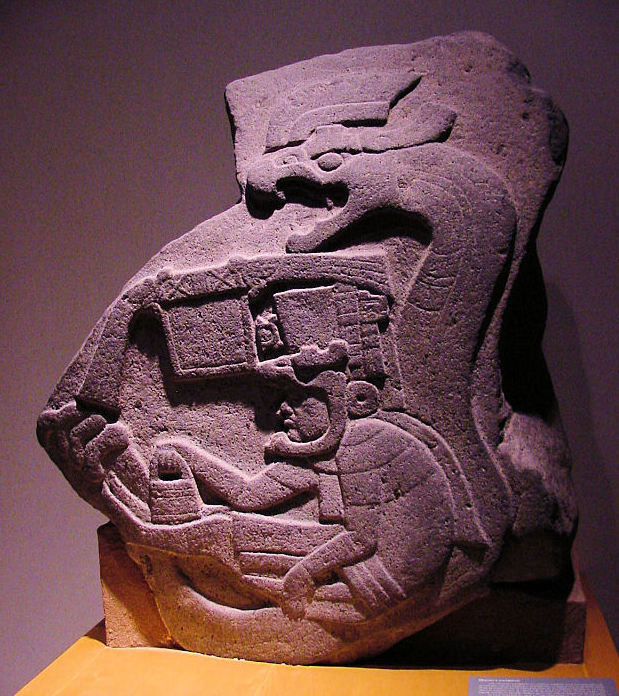
Monument 19 from La Venta. Notice the serpent’s beaked head above the seated person and the related form of the person’s headdress. Photograph: Audrey and George Delange; reuse permitted with attribution.

Calling this creature a bird-serpent is more informative than simply labeling it “Quetzalcoatl.” Taube’s analysis connects its feather and wing features with a wider family of Olmec supernatural images. He interprets this complex through the sky, rain, and the movement of life-giving forces between cosmic realms. His argument also draws on other monuments, including San Lorenzo Monument 47; the case does not depend on one isolated carving. Taube, The Rainmakers
The likely connection to the later Feathered Serpent rests on a cluster of features: the combination of bird and snake, celestial associations, and relationships with ritual authority. This is a stronger argument than resemblance alone. It places the creature inside a regional history in which people repeatedly adapted related religious forms.
Yet a visual ancestry is not a complete theological genealogy. We cannot attach all the later god’s attributes to the Olmec image simply because some of its features are familiar.
How does the Olmec serpent connect to Quetzalcoatl? #
The chronological distance becomes clearer when the evidence is placed in sequence.
| Setting | Approximate period | What the evidence gives us |
|---|---|---|
| Olmec centers | Second millennium–400 BCE | Bird-serpent imagery, including Monument 19; original divine names remain unknown |
| Teotihuacan’s Feathered Serpent complex | About 150–250 CE | Monumental plumed serpents within a major civic and ritual setting |
| Later central Mexican traditions | Classic and Postclassic periods | Further serpent imagery at sites including Xochicalco, Cacaxtla, and Tula |
| Late Postclassic and early colonial accounts | Centuries around the Spanish conquest | Much fuller evidence for the named deity Quetzalcoatl and related traditions |
Chronological synthesis from Taube, Barnes, and Nicholson. These are overlapping traditions, not a demonstrated chain of direct succession.
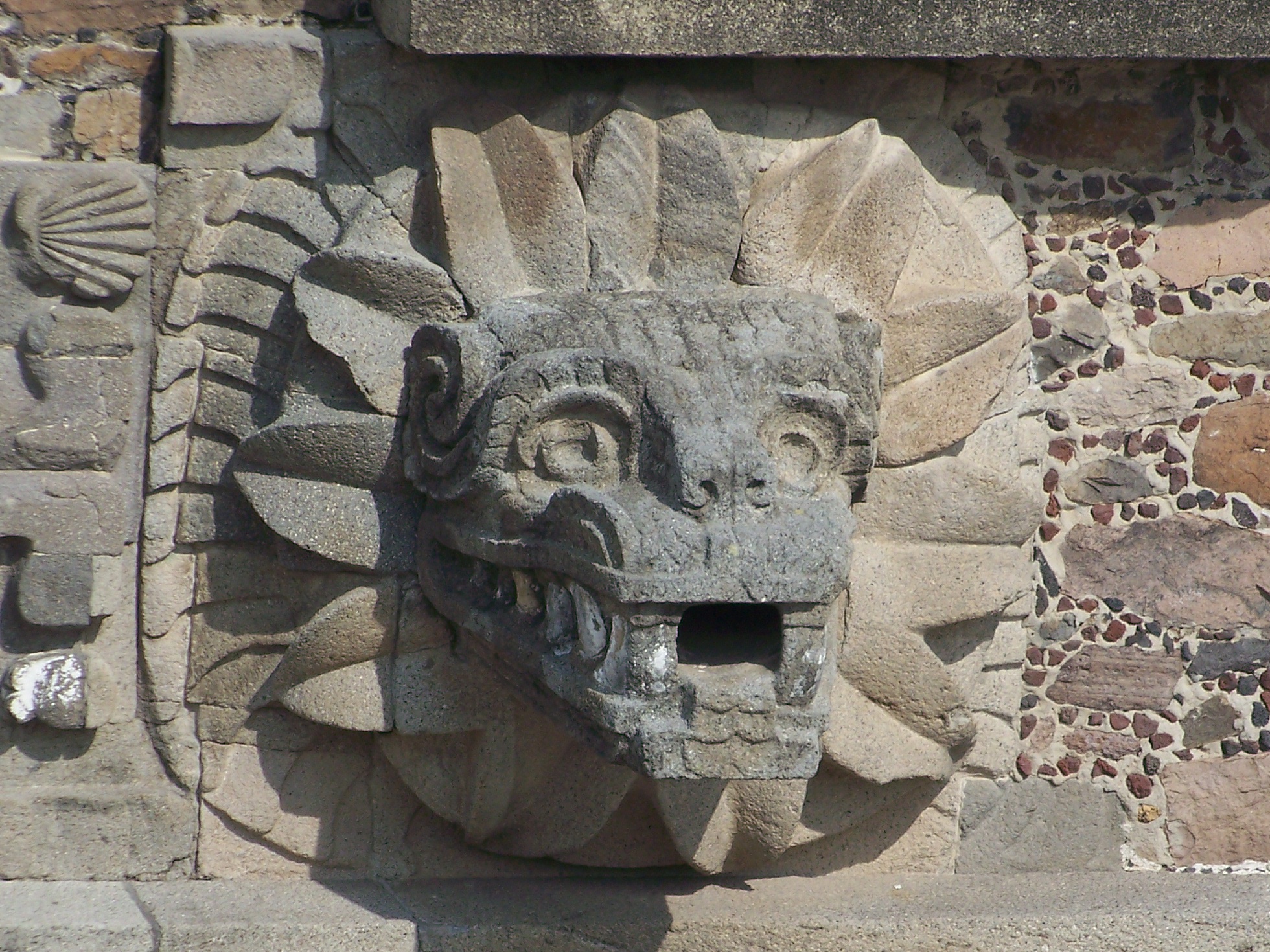
A Feathered Serpent head at Teotihuacan. The plumed form is unmistakable, although the name its makers used is unknown. Photograph: Jami Dwyer, CC BY-SA 2.0; reproduced without alteration.

At Teotihuacan, feathered serpents appear with shells and other elaborate imagery on a temple complex constructed around 150–250 CE. Its dedication involved mass human sacrifice. Whatever continuity links these beings with earlier serpents, they now belong to the institutions and ambitions of a different society. “Temple of Quetzalcoatl” is a familiar modern designation; it does not establish that the builders used that Nahuatl name. Barnes, “Teotihuacan: Ciudadela”
In the later Mexica tradition, Quetzalcoatl has a far more recoverable identity. The name means Feathered Serpent, and the deity appears in forms associated with wind and with Venus as the Lord of Dawn. These associations make a distant relationship with earlier celestial serpents plausible, but they do not date every aspect of the later god to Olmec times. Vatican Museums, Quetzalcóatl
There is another complication: Quetzalcoatl is also entwined with accounts of Topiltzin Quetzalcoatl, the ruler-priest of Tollan. Henry B. Nicholson’s analysis shows how the deity and the ruler’s traditions overlap. Those much later accounts cannot be treated as the biography of a person who introduced civilization to the Olmecs. The distinction between divine identity, priestly impersonation, and remembered rulership is part of the historical problem. Nicholson, “Ehecatl Quetzalcoatl vs. Topiltzin Quetzalcoatl of Tollan”
The best working interpretation is that Olmec bird-serpent religion contributed to a long-lived Mesoamerican tradition that was repeatedly reshaped, eventually including the Quetzalcoatl we know from later sources. The ancestry is probable. An unchanged identity across the entire interval is unproven.
Why did the Olmec centers decline? #
San Lorenzo’s major decline began around 900–850 BCE. INAH identifies conflict, disease, and environmental change as possible contributors, rather than presenting a single settled cause. Recycling of sculptures also increased during this period, but that evidence does not independently tell us who was responsible or why. INAH, San Lorenzo Tenochtitlan
La Venta’s monumental activity ended much later, around 400 BCE. Other centers continued producing sculpture and ceramics. The chronology describes successive political changes, not the simultaneous disappearance of an entire people. Doyle, “Olmec Art”
Religious continuity need not imply political continuity. A center can lose its population or authority while neighboring communities retain its ritual practices, reinterpret its images, or preserve valued objects. The survival of Olmec artworks into much later settings shows that the past remained physically available: the Aztecs themselves deposited an ancient Olmec mask at the Templo Mayor. That proves later engagement with Olmec material, although it cannot prove that the mask’s meaning remained unchanged. Doyle, “Olmec Art”
The mystery that remains #
The most consequential missing evidence would connect an image to a name, a ritual to its explanation, or a ruler’s portrait to a history that can actually be read. Additional inscriptions and securely excavated sequences of religious imagery could change our understanding more than another impressive object without context.
Monument 19 already gives us something substantial. An Olmec artist joined a human figure to a supernatural bird-serpent in a composition meant to carry authority and meaning. Later Mesoamerican peoples made feathered serpents central to their own sacred worlds. The likely relationship between those traditions is one of the most interesting inheritances in ancient American religion.
What we are still trying to recover is how that inheritance worked: which ceremonies carried it, which communities transformed it, and which stories made a serpent with a bird’s head intelligible to the people standing before it.
Related reading: New World Serpent Myths and the later bearded-god traditions.
Sources and image note #
The linked archaeological studies and museum accounts support the factual discussion. The proposed continuity between Olmec imagery and Quetzalcoatl is an editorial synthesis of that evidence. “Avian Serpent” is a scholarly descriptive label, not a recovered Olmec name. No direct quotations from ancient Olmec speakers are available here.
The cover is an AI-generated editorial illustration combining an Olmec-style head and a bird-serpent; it does not reproduce an excavated scene. The two photographs show actual carved monuments and retain their separately stated reuse terms.
The competing studies are Jeffrey P. Blomster, Hector Neff, and Michael D. Glascock, “Olmec Pottery Production and Export in Ancient Mexico Determined Through Elemental Analysis”, Science 307 (2005): 1068–1072; and James B. Stoltman and colleagues, “Petrographic Evidence Shows that Pottery Exchange Between the Olmec and Their Neighbors Was Two-Way”, PNAS 102 (2005): 11213–11218. For the continuing interpretive dispute, see Robert J. Sharer, “Early Formative Pottery Trade and the Evolution of Mesoamerican Civilisation”. ↩︎