~/evolution/prehistory
The Animals That Made America: Five Million Years of Migration
Old and New World animal migrations brought mammoths, bison, elk, birds, and parasites to the Americas in separate waves over five million years.
TL;DR
- Mammoths reached North America about 1.5 million years ago; bison followed roughly 195,000–135,000 years ago. Mammoth study; bison study.
- People were present at White Sands before the approximately 15,000-year-old arrival of elk indicated by the cited chronology. Human dates; elk study.
- Horses crossed Beringia both ways, long before domestication. Ancient genomes.
- American fauna also includes natural Atlantic colonists and parasites carried by migrating hosts. Egrets; tapeworms.
Which animals migrated between the Old and New Worlds? #
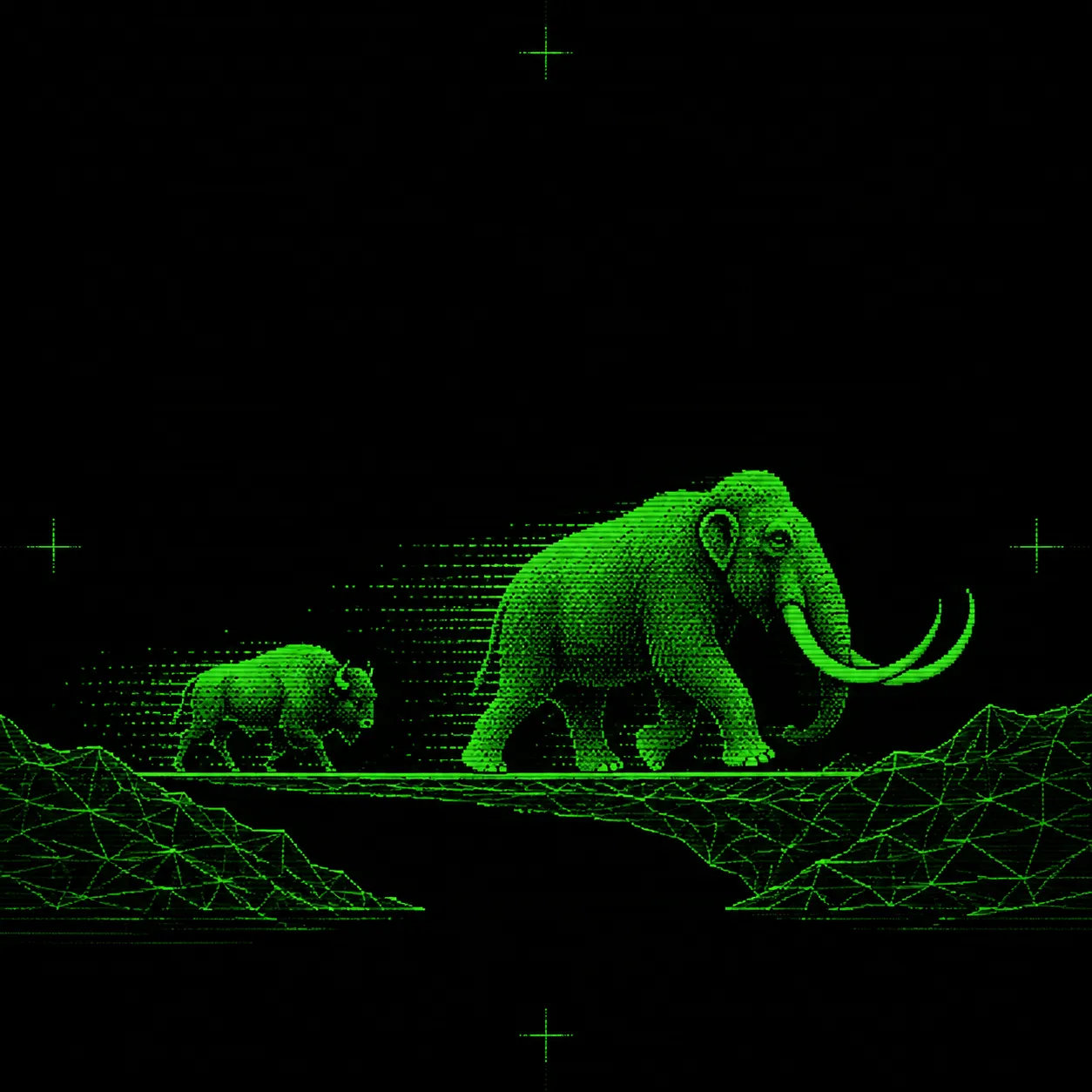
A mammoth, a bison, and an elk make a plausible picture of ancient North America. Put them in a single procession across the Bering land bridge, however, and the picture conceals the most interesting part of their history. Mammoths preceded the first bison by more than a million years. Elk arrived so late that people were already leaving footprints in New Mexico. The familiar American fauna accumulated over an immense span of time, through different openings in a changing landscape. Van der Valk et al.; Froese et al.; Meiri et al.; Pigati et al..
This history becomes stranger when the extinct animals return to the picture. North America had running hyenas. Northwestern Canada had saiga antelope. Pliocene Washington had a relative of the red panda. Their fossils preserve combinations of animals that modern continental labels make difficult to imagine. Arctic hyenas; Canadian saiga; the first North American Parailurus.
Here, Old World means Africa and Eurasia; New World means the Americas, including Greenland and the Caribbean. The focus is natural establishment during the last five million years, chiefly from Eurasia into North America, with return journeys and Atlantic crossings where they clarify the story. Seasonal migration and a lone bird blown offshore are different from the establishment of a population. Human transport belongs to another part of the history.1
How did animals cross the Bering land bridge? #
Beringia joined northeastern Asia and northwestern North America when lower sea levels exposed the intervening continental shelf. It was a large region with its own environments, rather than a narrow path leading straight from Siberia to the Great Plains. Animals could live there, expand through it, or fail to advance beyond it. The National Park Service’s account of Ice Age survivors places this northern region at the center of repeated exchanges.
Three conditions mattered: land had to be available for terrestrial travelers, the environment had to support them, and a route onward had to exist. Those conditions did not always coincide. Reconstructing late-glacial environments, Pedersen and colleagues found that the opening between the continental ice sheets became biologically useful only after the ice itself began to retreat. A gap on a map could precede a corridor capable of feeding its travelers. Pedersen et al..
This makes arrival in Alaska and expansion south of the ice sheets separate historical events. It also explains why one animal’s successful passage cannot establish that the route was equally usable by another. Different diets, vegetation preferences, and movement abilities produced different migration histories. The elk study is especially revealing because it identifies Beringian habitat as a constraint on an animal that was already present on the Asian side. Meiri et al..
When did mammoths, bison, humans, and elk reach America? #
The following chronology compares selected lineages. Ma means million years ago; ka means thousand years ago. A date preceded by by establishes presence. Other dates describe estimated dispersal or colonization, as specified in the final column.2
| Animal or lineage | Approximate time | Movement | What the date records |
|---|---|---|---|
| Running hyenas, Chasmaporthetes | By 4.7 Ma | Asia → North America | Early American fossil appearance; later Arctic fossils support the route. Study |
| Caribou / reindeer, Rangifer | By 2 Ma | Direction not established by this sample | Environmental DNA in Greenland establishes New World presence. Study |
| Mammoths | About 1.5 Ma; later influxes | Asia → North America | Initial colonization, followed by additional ancestry from later arrivals. Study |
| Wild caballine horses | 875–625 ka and 200–50 ka | Eurasia ↔ North America | Two broad intervals of bidirectional dispersal inferred from ancient DNA. Study |
| Jaguar lineage | By about 850 ka | Eurasia → North America → South America | North American fossil appearance; later American population history is distinct. Study |
| Native red foxes | About 300–130 ka | Asia → North America | Reconstructed first colonization, long before imported European foxes. Study |
| Bison | 195–135 ka | Asia → North America | First arrival constrained by fossils and ancient DNA. Study |
| Brown bears | A wave at 191–130 ka; later waves | Asia → North America | Genetically reconstructed colonizations. Study |
| Humans | By 23–21 ka | Asia → North America | Dated footprints at White Sands; these do not date the crossing. Study |
| Elk / wapiti | Around 15 ka | Asia → North America | Late-glacial establishment reconstructed from dated remains and DNA. Study |
| Modern moose | Within about 15 ka | Asia → North America | Late-Pleistocene colonization model for Alces. Study |
One striking consequence is the order of people and elk. Independent dating supports human presence at White Sands about 23,000–21,000 years ago, whereas the cited wapiti reconstruction places American establishment around 15,000 years ago. On this evidence, humans were in the Americas before elk. This compares a demonstrated human presence with an animal-colonization estimate; it does not turn either into an exact border-crossing date. Pigati et al.; Meiri et al..
Human settlement has its own geographical and archaeological sequence, explored in the Paleolithic technology timeline of the Americas. The animal chronology supplies an essential setting: the continent people entered was still receiving new populations of large mammals.
Why did some animals cross more than once? #
An immigrant lineage could establish itself, become isolated, and later encounter another wave of relatives. Ancient DNA can reveal those encounters where a list of fossil species cannot.
Mammoths provide a particularly consequential example. Million-year-old Siberian DNA revealed deeply separated lineages and showed that Columbian mammoths carried ancestry from both a Krestovka-related lineage and a woolly-mammoth-related lineage. Their American history included hybridization. A single arrow labeled “mammoths” hides the assembly of that ancestry. Van der Valk et al..
Brown bears and lions also crossed in multiple waves. Salis and colleagues reconstructed episodes of dispersal shared by these large carnivores, including movements during the glacial interval approximately 191,000–130,000 years ago. These are histories recovered from sampled genetic lineages; the oldest fossil and the oldest surviving or sampled maternal lineage need not mark the same event. Salis et al..
Horses add a reversal. Their deep history is North American, but ancient caballine genomes identify subsequent movement in both directions, including natural Eurasian returns to North America. Two broad dispersal intervals fall around 875,000–625,000 and 200,000–50,000 years ago. The animals carried ancestry across Beringia long before people transported domestic horses across the Atlantic. Vershinina et al..
The long natural history of the horse follows that larger story. The relevant distinction here is between where a lineage originated and where a particular migrant population came from. A North American origin is entirely compatible with a later arrival from Eurasia.
Which extinct immigrants once lived in North America? #
Modern wildlife makes a poor inventory of ancient arrivals because extinction has removed so many of them. Chasmaporthetes, the running hyena, entered North America by about 4.7 million years ago. Two teeth from the Old Crow Basin in Yukon later supplied fossil evidence along the previously inferred northern route. The Arctic finds connect a history otherwise represented by widely separated Old World and more southerly American sites. Tseng, Zazula, and Werdelin.
Saiga antelope also occupied northwestern North America during the Late Pleistocene. Their Canadian remains show that an animal associated today with Eurasia once belonged to the American Arctic fauna. Harington and Cinq-Mars.
The fossil carnivores add further lineages with Old World relatives: dholes and Xenocyon among canids, Homotherium among scimitar-toothed cats, and Dinofelis among other saber-toothed forms. The cited studies chiefly document where and when these animals occur in North America; they do not each date a particular crossing. These were distinct lineages with distinct histories. “Wolf-like” and “saber-toothed” describe appearances too broadly to identify a single migration. Fossil Caninae; Homotherium study; revision of Dinofelis.
An even less familiar immigrant was Parailurus, an extinct red-panda relative documented in Pliocene Washington. Calling it an American red panda conveys the surprise, provided we retain the distinction from the living Asian species. America once hosted branches of families whose surviving distributions now tell only part of their story. Tedford and Gustafson.
Did smaller animals, birds, and parasites migrate too? #
The large mammals are the most conspicuous travelers. Smaller animals record a wider exchange, including separate waves of mustelids, rodents, shrews, birds, and insects. One immigrant ancestor could subsequently produce several American species, so the number of living species is not a count of intercontinental crossings.
| Group | Examples and approximate timing | What their history adds |
|---|---|---|
| Small carnivores | Marten, ermine, least-weasel, and black-footed-ferret ancestry; Pleistocene | Several younger mustelid entries, alongside much older branches of the family. Study |
| Pikas | Later Ochotona incursions; Pleistocene | Host and parasite histories expose movements hidden by the modern distribution. Study |
| Voles and lemmings | Multiple Pliocene–Pleistocene arrivals | Incoming lineages diversified within America and sometimes exchanged populations again. USGS fossil synthesis |
| Shrews | Arctic-shrew ancestor about 3.5–2.7 Ma; tundra-shrew history later | At least two reconstructed Asian-to-American histories. Study |
| Woodland birds | Brown-creeper ancestry about 4.4 Ma; pygmy/brown-headed nuthatch ancestor 4.3 Ma; red-breasted nuthatch ancestry 3.1 Ma | Three modeled entries; the two small southern nuthatches share one incoming ancestor. Study |
| Gadwall | About 81 ka; estimated interval 8.5–450 ka | A genetic test supports Eurasian colonization of North America, with substantial dating uncertainty. Study |
| Freshwater fish | Northern-pike and burbot lineages; Pleistocene | Fish have lineage-specific dispersal histories, including a proposed burbot return to Eurasia. Pike; burbot |
| Insects | Later northern bumblebee lineages; Oeneis butterflies around 3 Ma and later | Smaller flying colonists participated in northern exchanges. Bumblebees; butterflies |
| Parasitic worms | Arostrilepis tapeworms; Pleistocene | Rodent movements carried parasites between continents during repeated glacial episodes. Study |
The parasites change the scale of the picture. A dispersing rodent could carry another animal lineage inside it. The Arostrilepis reconstruction links Asian-to-American colonization to as many as four glacial intervals. Intercontinental migration therefore moved ecological relationships as well as the visible animals themselves. Galbreath et al..
Which animals crossed the Atlantic naturally? #
Flying animals did not always need Beringia. Cattle egrets reached South America naturally from Africa and subsequently expanded through the Americas. Historical records document them in the New World during the nineteenth century, while meteorological research examines how winds could have enabled the crossing. The record of expansion is much more recent than the northern mammalian exchanges. Massa et al.; Arendt.
Little egrets provide a more recent example of establishment: breeding in Barbados dates to 1994. That matters because a population on a Caribbean island is already a New World population; continental spread is not a prerequisite. Glossy ibis belong to the broader Atlantic history of natural range expansion as well. Hayes and White; glossy-ibis records and historical review.
Dogs belong in a separate category. Perri and colleagues proposed an arrival with people around 15,000 years ago from genetic and archaeological synthesis. That is a model of human-assisted dispersal, rather than an independently established wildlife migration or a direct date for the oldest American dog remains. Perri et al..
What can migration dates actually tell us? #
The five-million-year window is useful because it makes the question testable. It also excludes some familiar examples. The earliest deer immigration may precede that boundary, even though American deer fossils occur just within it. White-breasted nuthatch ancestry is reconstructed as an older entry, about 7.5 million years ago, unlike the younger nuthatch arrivals listed above. Camels ran the other way on a similarly older clock: the family originated in North America, and the lineage of modern camels had reached Eurasia by the Late Miocene. A mid-Pliocene giant camel from Ellesmere Island shows that this lineage was also at home in a forested High Arctic. Early Pliocene deer; certhioid biogeography; Rybczynski et al..
Direction requires evidence too. Early Pliocene Gulo fossils from Tennessee support a North American origin for wolverines and challenge the familiar account of an initial Asian arrival. A present-day range on both continents cannot settle which way the ancestors traveled. Samuels et al..
Taken together, the crossings describe a continent repeatedly receiving, transforming, and losing animal populations. Some migrants left American descendants; some disappeared; some crossed back. An animal’s modern range is the surviving result of that history. The mammoth and bison in the imagined procession belong on the same landscape, but the road that brought their ancestors there was used across more than a million years.
Methodology and notes #
Sources #
Additional specialist sources are linked beside the relevant claims and table rows.
- Froese, D., et al. (2017). “Fossil and genomic evidence constrains the timing of bison arrival in North America.” Proceedings of the National Academy of Sciences. Open author copy.
- Van der Valk, T., et al. (2021). “Million-year-old DNA sheds light on the genomic history of mammoths.” Nature.
- Vershinina, A. O., et al. (2021). “Ancient horse genomes reveal the timing and extent of dispersals across the Bering Land Bridge.” Molecular Ecology. Open manuscript.
- Meiri, M., et al. (2014). “Faunal record identifies Bering isthmus conditions as constraint to end-Pleistocene migration to the New World.” Proceedings of the Royal Society B. Open full text.
- Pigati, J. S., et al. (2023). “Independent age estimates resolve the controversy of ancient human footprints at White Sands.” Science. USGS account.
- Kjær, K. H., et al. (2022). “A 2-million-year-old ecosystem in Greenland uncovered by environmental DNA.” Nature.
- Salis, A. T., et al. (2022). “Lions and brown bears colonized North America in multiple synchronous waves of dispersal across the Bering Land Bridge.” Molecular Ecology.
- Tseng, Z. J., Zazula, G., and Werdelin, L. (2019). “First fossils of hyenas (Chasmaporthetes, Hyaenidae, Carnivora) from north of the Arctic Circle.” Open Quaternary 5:6.
- Pedersen, M. W., et al. (2016). “Postglacial viability and colonization in North America’s ice-free corridor.” Nature.
- Rybczynski, N., et al. (2013). “Mid-Pliocene warm-period deposits in the High Arctic yield insight into camel evolution.” Nature Communications.
- Perri, A. R., et al. (2021). “Dog domestication and the dual dispersal of people and dogs into the Americas.” Proceedings of the National Academy of Sciences.
This is a selective synthesis of published dispersal studies, strongest for mammals. Catalogue entries should not be read as independently demonstrated crossings. Selected examples are developed here; the tables are not a complete inventory of animals or routes. Movements between North and South America are distinct from initial Old-to-New entry. ↩︎
Fossils, footprints, and environmental DNA establish presence at a sampled place and time. Genetic divergence dates concern lineage separation; biogeographic models infer geographical transitions. Neither automatically supplies the date of first establishment. “Pleistocene” is retained where narrower timing would overstate the evidence. Older syntheses also use taxonomic groupings that subsequent work may divide differently. ↩︎