Nüwa in the Neolithic: The Goddess Temple and Pyramid of Niuheliang
TL;DR
- More than five thousand years ago, Hongshan communities at Niuheliang installed painted clay female figures, one of them life-size, in a purpose-built temple. Excavators and later scholars read her as a deified common ancestor.
- The sanctuary joined the Goddess Temple, stone cairn burials furnished almost only with jade, circular and square altars, and Locality 13, a wholly artificial stepped mound of earth and stone covering about 10,000 square metres.
- Lu Sixian identified the goddess with Nüwa in 1993. We argue that Niuheliang is the best candidate for the Neolithic cult behind her: an earth-made ancestral mother, turtle-bearing elite dead, and a measured landscape of circle and square anticipate the creator, sky-repairer, and compass-and-square emblem of later texts and Han art.
- No inscription names the goddess, and rival scholars place Nüwa’s origins elsewhere. The case rests on a match of office, material, and cosmology rather than a recovered name.
On 2 November 1983, a woman’s face came out of the red earth of western Liaoning.
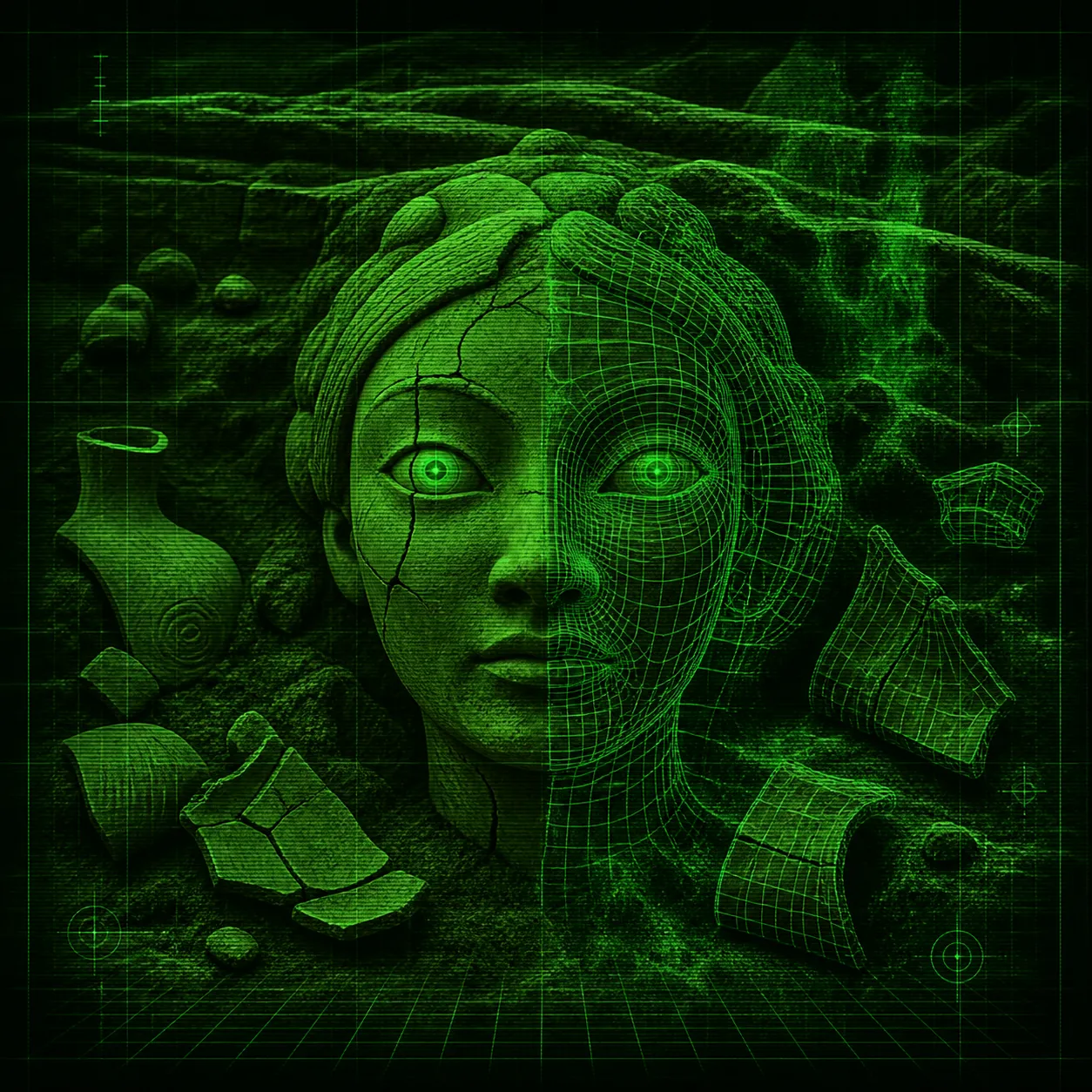
She was not a pocket-size fertility figurine. The surviving clay head was about life size. Green stone or jade eyes stared from a red-painted face; plant fibre strengthened the yellow clay; the mouth still carried ornament. Other fragments belonged to multiple human figures of different sizes, some larger than life. A recovered nose and ear were roughly three times normal size. They had stood inside a purpose-built ritual building that Chinese archaeologists soon gave an unforgettable name: the Goddess Temple.
No inscription preserves her name. What survived is her temple, her body, and her religious office. She was an earth-made female figure honored, on the excavators’ reading, as the ancestor of a people. Around her stood a designed sacred landscape of altars, tombs, precious jades, platforms, and a colossal man-made mound. In the mythology recorded millennia later, the same office belongs to Nüwa: the mother who fashions humanity from yellow earth, establishes human society, and repairs the architecture of the world.
Niuheliang is the best candidate we have for the Neolithic cult behind Nüwa.
Our argument is that the later literary myths descend from a cult of this kind. Beneath them lies a recognizable complex: ancestral mother, manufactured body, turtle cosmology, sacred elevation, elite dead, and a community gathered around an earth-and-stone center. At Niuheliang, that complex has walls, graves, clay, jade, and a great altar mound.
The sacred city of the ancestral mother #
Niuheliang is a monumental Hongshan ritual landscape spread across the hills of western Liaoning and
built in the fourth millennium BCE. Its excavated core joins three forms that Chinese archaeology
condenses into a formula: 坛、庙、冢—altar, temple, and cairn tomb.
The Goddess Temple occupies Locality 1. It contained the painted clay head and fragments assigned to roughly six human images, arranged in a semi-subterranean building unlike an ordinary house. Nearby stone cairns enclosed ranked burials furnished almost exclusively with jades. The dead, the goddess, and the altar were not separate religious departments. They formed a single ancestral order in which sacred bodies, elite lineage, landscape, and communal ceremony reinforced one another.
| Monument | Archaeology | Religious role |
|---|---|---|
| Goddess Temple, Locality 1 | Monumental painted clay humans in a dedicated ritual building | A sanctuary for deities or deified ancestors |
| Stone cairn cemeteries | Ranked burials, stone construction, elite jades, repeated ritual planning | Ancestor cult and elite integration |
| Circular altar, Locality 2 | Three concentric rings of standing stones rising toward the center | Public or supra-household ritual platform |
| Locality 13, the “pyramid” | Wholly artificial stepped round mound of earth and stone, c. 7.5 m high and c. 10,000 m² | Probably an independent great altar (excavators’ preliminary judgment) |
This matters because the meaning of a statue changes with scale. A female figurine in a house may represent fertility, an ancestor, a deity, a toy, or something we have not imagined. A life-size painted woman inside a formal temple, embedded in a landscape of altars, platforms, elite burials, and precious jades, belongs to organized religion.
Before the compass and square were symbols, they were places #
At Locality 2, Hongshan builders planted three concentric rings of red andesite, approximately 11, 15.6, and 22 metres across. Each ring is close to √2 times the one inside it, the ratio produced by alternately inscribing circles and squares. Beside that circular altar stood a nearly square stone cairn, roughly 17.2 by 19.5 metres and set close to the cardinal axes (NCHA/CCTV archaeological reconstruction). At the wider site, the Chinese nomination for UNESCO records a round altar at Locality 2 and a square altar at Locality 5 (UNESCO Tentative List dossier). Circle and square were not abstractions. They were sacred places through which people walked.
The tools came later; the geometry did not. Niuheliang preserves the operations for which a compass and carpenter’s square exist: center, radius, perpendicular, enclosure, orientation, and controlled proportion. The three-ring altar rises toward its center. The great Locality 13 mound repeats monumental circle-making with a rammed-earth core about 40 metres wide. Excavation at Locality 1 since 2017 has shown that the Goddess Temple stood on one of nine planned platforms, raised in a single concentrated campaign and served by drainage works. Its field directors match other remains to the burnt offerings, buried offerings, and libations of later ritual texts, and conclude that rites to heaven, earth, and ancestors were already established (Guo Ming and Jia Xiaobing, People’s Daily, 2024). This was sacred space made correct through measurement.
By the Han dynasty, the old spatial grammar had become an image. Fuxi and Nüwa appear with
serpentine bodies and intertwined tails, holding the 矩 and 規—the square and compass. In the
Mozi, those instruments first make correct forms and then become the model for governing the
world. The Huainanzi says, 天圓地方,道在中央: “Heaven is round, Earth is square, and the Way
is at the center.” The Wu Liang shrine relief
places the tools in the creators’ hands. On our reading, Han art compressed the cosmogram that
Niuheliang had built into the ground into a portable emblem of ancestry, creation, and rule.
A woman made from earth #
In the creation story preserved through the Fengsu tongyi tradition, Nüwa “moulded yellow earth
to make people”: 女娲抟黄土作人. At Niuheliang, ritual specialists made an authoritative female
body from yellow clay mixed with plant fibre. The creator of the texts makes human bodies from
earth; the goddess of the temple was herself an earth-made body.
The even older Tianwen asks a haunting question: 女娲有体,孰制匠之?—“Nüwa had a body;
who fashioned it?” At Niuheliang, prehistoric specialists had done exactly that for their own
goddess. They shaped a sacred woman from earth, painted her flesh red, set green stone into her
eyes, and installed her in a temple.
This inversion gives the comparison its peculiar power. Nüwa makes humanity from clay; humanity made the Niuheliang goddess from clay. Creator and created meet in the same material. Read beside the temple, the myth describes creation as a technology of hands, earth, fibre, moisture, pressure, and form—the same technology that gave the Goddess Temple its bodies.
The common mother of a people #
The goddess was larger than a household spirit. Sun Shoudao and Guo Dashun interpreted her as a
deified ancestor in their foundational 1986 study. On 12 May 1989, Su Bingqi gave the religious
office its most powerful formulation. She was the Hongshan people’s 女祖, their female ancestor,
and therefore a 共祖, a common ancestor. His wording joins religion to political scale: a sacred
mother through whom separate communities could imagine themselves as one people.
Nüwa holds precisely this civilizational office. She creates human beings, orders marriage, repairs the heavens after catastrophe, and restores a habitable world. She is not simply a fertility figure. She is the mother of organized humanity. Niuheliang’s combination of ancestral cult and regional monumentality gives that later myth a plausible social body.
A serpent body coiled in jade #
The Hongshan sanctuary also possessed a bodily language that later attached to Nüwa. A jade dragon excavated in 1984 from Locality 2, Cairn 1, Grave 4 curves inward until its head and tail almost close into a ring. The National Museum of China describes the Niuheliang type as a composite being with a beast’s head and a serpent’s body. It was not jewelry scattered by accident. It came from the elite dead inside the same ceremonial system as the goddess, altars, and measured stone enclosures.
The comparison with the later creator pair is visual as well as structural. Hongshan jade makes primordial power bend back upon itself, enclose a center, and circulate through a body unlike any ordinary animal. Han artists give Nüwa and Fuxi a similar superhuman grammar: human faces above, serpentine bodies below, two ancestors joined into one generative circuit. At Niuheliang, stone supplied the ordered world, clay the ancestral person, and jade the body of transformation.
The turtles beneath the repaired sky #
The Huainanzi says:
女娲炼五色石以补苍天,断鳌足以立四极。
Nüwa refined five-coloured stones to repair the blue heavens and cut off the great turtle’s feet to establish the four limits.
The jade assemblage places turtles inside this ritual world. The elderly man in the central grave of Locality 5, Cairn 1 (N5Z1M1) was buried with seven jades, including a jade turtle held in each hand (Xinhua, 2024). Grave N2Z1M21 at Locality 2, the richest jade burial yet found at Niuheliang with twenty pieces, had a jade turtle on the chest (Liu Guoxiang, UCAS lecture report, 2022). Both graves were published in Wenwu in 1997.
In later Chinese cosmology, the turtle is architectural. Its body carries the world; its limbs can become the supports of heaven. Nüwa’s great act in the Huainanzi is both creation and engineering: she refines five-coloured stones to mend the sky and uses the great turtle to establish the four limits. At Niuheliang, jade turtles accompanied privileged dead within the same ceremonial culture that built the ancestral mother’s temple. The burials do not tell the sky-repair story, but the material cluster joins the elements that story later combines: female ancestry, earth-made sacred bodies, turtles, monumental elevation, and an ordered landscape.
The pyramid at Niuheliang #
Locality 13 lies about 3.7 kilometres southwest of the Goddess Temple, on a rise that local people call Zhuanshanzi. Trial excavations between the late 1980s and 1991 first exposed its structure. Excavation resumed in July 2025 with National Cultural Heritage Administration approval, and in March 2026 Bai Baoyu, director of the Liaoning Provincial Institute of Cultural Relics and Archaeology, described the first results to Liaoning Daily. The “hill” was entirely man-made (Liaoning Daily, 2026).
Builders marked its perimeter with a stone wall, packed stone inside it as a foundation, heaped
earth above, and laid a gravel-and-earth activity surface outside the wall. The structure stands
about 7.5 metres from its top to the stone foundation and covers roughly 10,000 square metres. Its
center is a round mound of rammed, multicoloured earth about 40 metres across, faced with limestone
and rising in steps
(People’s Daily, 24 April 2026).
Chinese reporting calls it a 金字塔式, “pyramid-style,” building. In form it is a stepped round
mound rather than a four-sided Egyptian pyramid. The excavators’ preliminary judgment is that it was
an independent great altar, the same form as the Locality 2 altar on a far larger scale; its finds
are mostly ritual cylinder vessels.
That function makes the monument more important, not less. This was not a dead king’s private mountain. Its scale indicates labor coordinated far beyond a single community; People’s Daily puts the workforce at more than five thousand. Alongside the temple, cairns, jades, and smaller circular altar, the mound shows a society capable of turning collective labor into sacred topography.
The goddess and the altar mound belong to one ritual landscape, although we do not know to whom the mound’s rites were addressed. The institution itself is clear. Hongshan communities gave their ancestry a face, gave that face a house, gathered their dead around precious stone, and raised an artificial mountain for public ritual. Long before Chinese writers described Nüwa restoring the four limits of the cosmos, Niuheliang’s builders were already making a measured religious world out of earth and stone.
Survey and coring since 2017 have raised the number of known Hongshan sites within the 50-square-kilometre Niuheliang protection zone from sixteen to sixty-five and identified habitation there. Niuheliang was not a ceremonial island cut off from life. The people who raised its sacred monuments also inhabited the surrounding world. The sanctuary joined ordinary communities to an extraordinary center.
For a wider map of China’s many unrelated monuments called pyramids, see our survey of Chinese pyramid traditions.
How a Neolithic goddess entered Chinese myth #
Chinese myth scholar Ye Shuxian offers a method developed from within the tradition. His
大传统 / 小传统 model distinguishes a prehistoric “great tradition” of images, ritual objects,
jade, bodies, and built space from the later “little tradition” of writing. Writing does not simply
transcribe the earlier world. It selects, reorganizes, rationalizes, and sometimes hides it. Ye’s
four-evidence method therefore
reads transmitted texts, excavated texts, living traditions, and archaeological images together.
Under that model, the survival mechanism becomes concrete. A religious office outlives the first people who occupy it. Images are remade. Rituals move. New populations inherit old sacred places. Oral stories compress institutions into memorable acts. Earth-making, female ancestry, turtle cosmology, sacred elevation, and the restoration of order eventually gather under one enduring name.
Korean scholarship reached the same terrain from outside the Chinese national narrative. Song
Jung-hwa’s 2004 study,
紅山文化의 신화ㆍ宗教的 의미,
argues that Hongshan archaeology gave material form to female mythology previously studied mainly
through texts and folklore. Russian archaeological reference works likewise describe Niuheliang as
a temple-and-mortuary complex centered on ancestor or fertility worship; the
Russian Great Encyclopedia preserves that
non-Anglophone reading of the site.
On this reading, by the time the written Nüwa appears, the prehistoric religion has been reorganized into narrative. The temple becomes the body of the goddess. The ancestral mother becomes the maker of all people. The turtle cosmology becomes the repair of a collapsed sky. The sacred landscape becomes the four limits of a restored world. The underlying office remains remarkably stable: a female power turns earth into humanity and catastrophe into civilization.
When the ancestral mother received her ancient name #
The modern name followed the archaeology in a short, decisive sequence.
| Date | Chinese interpretation | Religious identity recovered |
|---|---|---|
| 1983–86 | Goddess Temple excavated; Sun Shoudao and Guo Dashun interpret the figure as a goddess and deified ancestor | Sacred woman and ancestral mother |
| 1987 | Lin Xinjian places Hongshan beside traditions of China’s age of ancient legends | Prehistoric cult enters mythic history |
| 12 May 1989 | Su Bingqi calls her 女祖 and 共祖 | Female ancestor of a people; common mother |
| 1993 | Lu Sixian publishes 红山文化裸体女神为女娲考 | Lu proposes that the ancestral mother is Nüwa |
The sequence matters because each description deepens the same identity. The first excavators recognized organized worship. Sun and Guo recognized a deified ancestor. Su Bingqi recognized the common mother of a civilization. Lu Sixian proposed the name that sits at the convergence of those roles: Nüwa.
The identification is a proposal, not a consensus. Chang Jincang judged Lu’s argument unconvincing. Yang Lihui, working from Nüwa’s human-headed serpent image, traced her cult instead to the Wei River valley in the northwest, where salamander-like figures appear on painted pottery about 5,500 years old. A 2024 Xinhua survey of Hongshan’s open questions put “Is the Hongshan goddess Nüwa?” first and judged the link possible but lacking direct written evidence. The 2026 People’s Daily report on Locality 13 likewise lists a local legend tying the mound to Nüwa’s sky repair among the site’s unsolved riddles.
No inscription will settle the question. What Niuheliang offers is a match of office: an earth-made ancestral mother at the center of a monumental cult, with turtle-bearing elite dead and measured circle-and-square architecture around her. Yang’s Wei valley pottery matches Nüwa’s serpent body; Niuheliang matches her religious office, and no other excavated Neolithic site combines the elements of her later myth so completely. That is why we treat it as the best candidate.
Nüwa in the Neolithic #
More than five thousand years ago, and millennia before the surviving literary accounts, people in western Liaoning made a sacred woman from earth. They installed her in a temple, surrounded their honored dead with jade, placed turtles in the hands of an elite ancestor, raised public altars, and built a stepped altar mound large enough to reorganize the landscape.
This, we argue, is the kind of world the Nüwa myths remember.
If so, the later texts preserve something more durable than an excavation report: the office of a civilization’s first mother. She makes bodies from earth because earth once gave her a body. She stands at the beginning of human order because a regional society once assembled around her cult. She repairs the world’s supports because the religious imagination that carried her also placed turtles, sacred elevations, and cosmic order together.
The comparison does not project Nüwa backward into an empty Neolithic. At Niuheliang, the temple, the ancestral mother, and the great altar mound were already there.
Sources #
- Liaoning Provincial Institute of Cultural Relics and Archaeology. “Brief Report on the Excavation of the Hongshan Culture ‘Goddess Temple’ and Cairn Groups at Niuheliang, Liaoning.” Wenwu 1986(8): 1–17, plates 97–101.
- Sun Shoudao and Guo Dashun. “Discovery and Study of the Hongshan Culture Goddess Head at Niuheliang”. Wenwu 1986(8): 18–24.
- Lin Xinjian. “Hongshan Culture and Traditions of Ancient History”. Beifang Wenwu 1987(3). Some citation indexes render the name as 蔺辛建.
- Lu Sixian. “An Investigation of the Hongshan Culture’s Nude Goddess as Nüwa.” Beifang Wenwu 1993(3): 33–36.
- Gan Zhigeng and Sun Shoudao. “Correspondence Concerning a Journey to Niuheliang.” Beifang Wenwu 1992(3).
- Tian Guanglin. “Hongshan Culture’s Altars, Temples, and Cairns and the Origins of Ancient Chinese Ancestral Temples and Mausoleums.” Shixue Jikan 2004(2): 68–73.
- Guo Ping. “在牛河梁进行拉网式排查 为红山文化申遗全力冲刺” [A grid survey at Niuheliang for the Hongshan heritage bid]. Liaoning Daily, reprinted by the Liaoning Department of Culture and Tourism, 5 March 2026. Interview with Bai Baoyu on the 2025 Locality 13 excavation and the Niuheliang surveys.
- Su Bingqi. “写在《中国文明曙光》放映之前.” 中国文物报, 12 May 1989; reprinted in
苏秉琦文集, vol. 3, p. 141. Primary source
for the
女祖/共祖formulation. - Song Jung-hwa. “The Mythological and Religious Meaning of Hongshan Culture”. Journal of Chinese Language and Literature 16 (2004): 47–72. Korean.
- Yang Lihui. “A Hypothesis on the Origin of Nüwa Belief in the Northwestern Weishui Region”. Journal of Beijing Normal University 1996(6).
- Chang Jincang. “红山文化的‘女神像’与神话研究.” In 旅顺博物馆学苑. Changchun: Jilin Wenshi, 2007. Summarized with Lu Sixian’s argument in Cai Ning, “红山文化原始宗教研究综述”.
- Ye Shuxian. “Connecting Myth and Archaeology”, People’s Daily via Xinhua, 7 April 2015.
- Huainanzi, “Lanming”, Nüwa’s sky-repair passage.
- Taiping Yulan, juan 78, quoting the Fengsu tongyi creation-from-earth fragment.
- Chuci, “Tianwen”, “Nüwa had a body; who fashioned it?”
- Liaoning Provincial Institute of Cultural Relics and Archaeology. “辽宁牛河梁第五地点一号冢中心大墓(M1)发掘简报” and “辽宁牛河梁第二地点一号冢21号墓发掘简报.” Wenwu 1997(8): 4–14.
- Xinhua. “何以红山——牛河梁有哪些待解的文化密码?” [Why Hongshan: Niuheliang’s unsolved cultural codes], 23 August 2024. On the Nüwa question and the N5Z1M1 jade turtles.
- School of Humanities, University of Chinese Academy of Sciences. Report of Liu Guoxiang’s lecture on grave ranking and jades in Niuheliang’s upper cairn phase, September 2022. On N2Z1M21.
- Liaoning Provincial Institute of Cultural Relics and Archaeology. 牛河梁:红山文化遗址发掘报告(1983–2003年度). Beijing: Wenwu Press, 2012.
- Liaoning Daily. “A Century of Hongshan Culture: Major Events”, 23 January 2025. Detailed chronology of the 1983 discovery and later scholarship.
- Zhang Shumin. “牛河梁‘金字塔’之谜” [The riddle of the Niuheliang “pyramid”]. People’s Daily, 24 April 2026. Describes a stepped round mound, judges it very probably a special altar, and leaves its local Nüwa legend unresolved.
- Guo Ming and Jia Xiaobing. “牛河梁遗址考古新发现新收获” [New archaeological discoveries at Niuheliang]. People’s Daily, 3 August 2024.
- UNESCO World Heritage Centre. “Sites of Hongshan Culture: The Niuheliang Archaeological Site, the Hongshanhou Archaeological Site, and Weijiawopu Archaeological Site.” Tentative List, 2013.
- National Cultural Heritage Administration / CCTV. Digital reconstruction and archaeological account of Niuheliang’s circular and rectilinear monuments, 7 April 2024.
- National Museum of China. Hongshan jade-dragon exhibition catalogue.
- Vampelj Suhadolnik, Nataša. “The Development and Transformation of the Fuxi and Nüwa Iconography.” Asian Studies 7.2 (2019): 47–86.
- Academia Sinica Museum. “Fuxi and Nüwa,” Wu Liang Shrine relief.
Continue exploring #
Read other posts