Nüwa and Fuxi: The Serpent-Bodied First Couple, the Compass and Square, and Eden
TL;DR
- Nüwa and Fuxi are China’s first couple: human from the waist up, serpents below, their tails twisted together. Han tomb art (1st century BCE–3rd century CE) fixed the image, and Tang-era silk paintings from Turfan carried it to the edge of the Taklamakan.
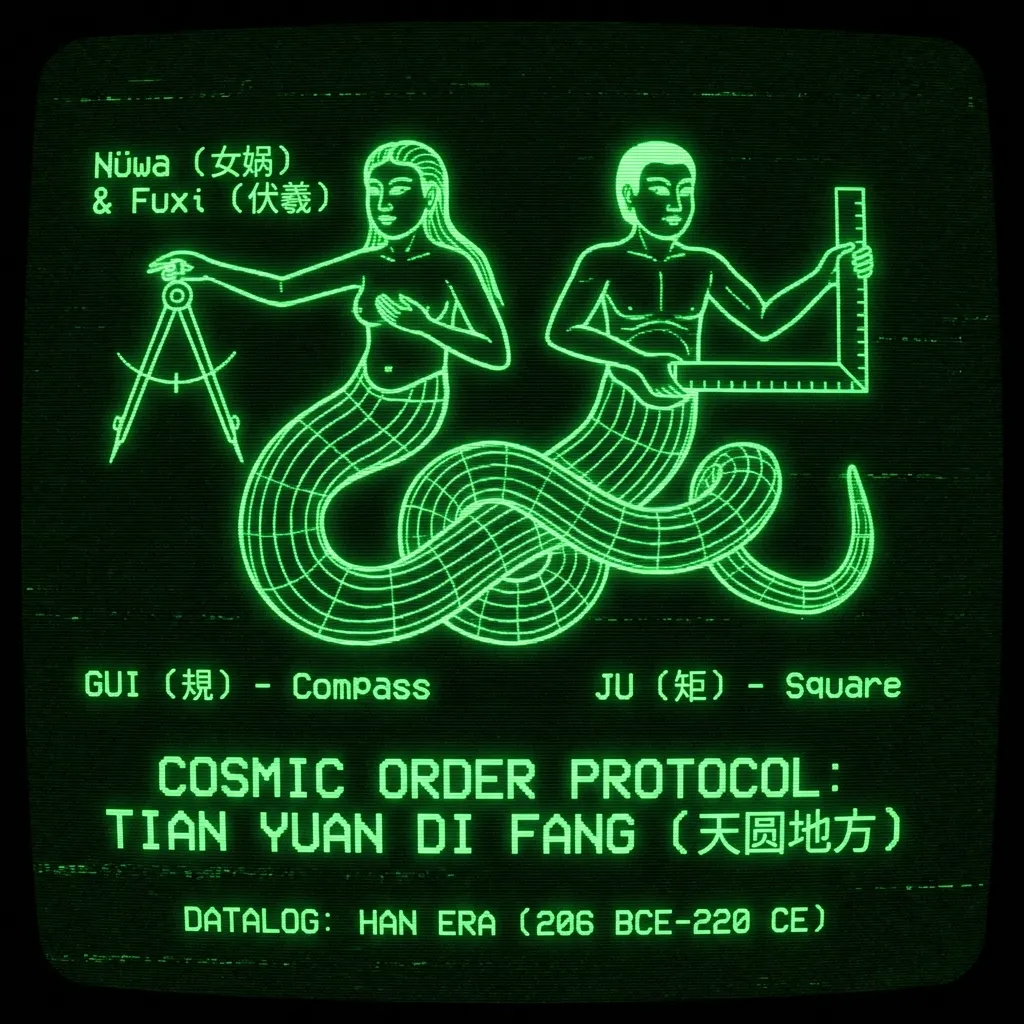
- She holds a compass and he holds a square. The tools draw a round heaven and a square earth, and the word for them together, guiju, means “rules.”
- Nüwa’s own myths are older than the paired image: she makes humans from yellow earth, mends a broken sky, stops a flood, and founds marriage. The sibling-marriage story comes from a southern Chinese flood-and-gourd tradition.
- Next to Eden, Nüwa looks like Eve and the serpent merged into one figure. Serpent-bodied ancestors who found peoples or marriage also appear among the Greeks, the Scythians, and the Khmer.
- The compass and square are a Chinese creation that spread west. The woman-serpent-first-parents cluster is better explained by old Eurasian transmission than by coincidence.
- Beyond Eurasia the serpent keeps the same company: it makes or mothers the first people in Mexico, Guatemala, Dahomey, and Australia, keeps the plant of life in Gilgamesh, and presides over initiation. Nearly every first couple in the old literatures is kin, as Nüwa and Fuxi are.
Some time in the seventh century, a family in Gaochang, the oasis kingdom near modern Turfan, laid a relative to rest in the Astana cemetery and nailed a painted cloth to the ceiling of the tomb. It faced down, toward the dead. On it a man and a woman stand shoulder to shoulder, each with an arm around the other’s waist. Below the waist their bodies become serpents, and the two tails wind around each other in a tight spiral. He raises a carpenter’s square; she raises a compass. A sun blazes above their heads and a moon hangs below their coils, and the rest of the cloth is scattered with stars joined by lines into constellations. Dozens of these paintings have come out of Astana. One excavated in 1965 is now in the Xinjiang Uygur Autonomous Region Museum, still showing the nail holes along its edges. Another, collected by the Ōtani expeditions, is in the National Museum of Korea.
The couple are Fuxi (伏羲) and Nüwa (女媧). By the time these cloths were painted their image was already about seven hundred years old. This article follows how the image was built, from a strange body in a Warring States riddle to a cosmic pair in Han tombs. It then asks the comparative question that has hung over Nüwa since Jesuit missionaries first read about her: why does China’s first couple look so much like a woman, a man, and a serpent at the start of Genesis?
A body that needed explaining #
The oldest mention of Nüwa is a question. In the Tianwen (“Heavenly Questions”), a Chu poem of
the late Warring States period, the poet asks: 女媧有體,孰制匠之? “Nüwa had a body; who
fashioned it?” (Tianwen). The line takes for granted that
listeners know two things: Nüwa made bodies, and her own body was remarkable. It does not say what
that body looked like. The famous answer comes in the commentary. Wang Yi, editing the Chuci in
the second century CE, glossed the line: Nüwa had “a human head and a serpent’s body, and
transformed seventy times in a day.”1
After that the descriptions agree. Guo Pu’s fourth-century commentary on the Shanhaijing calls
Nüwa “an ancient divine woman who was a sovereign, human-faced and serpent-bodied.” Huangfu Mi’s
third-century Diwang shiji says she “inherited the institutions of Fuxi” and was likewise
“serpent-bodied and human-headed” (quoted in Taiping yulan
78). Wang Yanshou’s
Eastern Han rhapsody on the Hall of Numinous Light in Lu describes the hall’s wall paintings in four
characters for each figure: 伏羲鱗身,女媧蛇軀, “Fuxi, scale-bodied; Nüwa, serpent-trunked.” The
Shuowen jiezi (c. 100 CE) defines the character wa in her name as “a divine and sagely woman of
antiquity, who transformed the myriad things” (Shuowen).
So the serpent body belongs first to Nüwa. Fuxi acquires his scales as her partner.
What Nüwa does #
Three myths give Nüwa her standing, and each makes her a maker of the human world rather than a nature spirit.
She makes people. A fragment attributed to Ying Shao’s Fengsu tongyi (c. 195 CE), preserved in the Taiping yulan, reports a popular saying: “When heaven and earth were first opened there were no people. Nüwa kneaded yellow earth and made humans.” The work was exhausting, so she dragged a cord through mud and flung it, and each drop became a person. “Therefore the rich and noble are the yellow-earth people, and the poor and mean are the cord people.”2 The same tradition has her pray at the shrines of the gods to become the divine go-between and establish marriage. The story explains social rank and the rule of marriage together: she makes the human body and the institution that keeps it going.
She repairs the world. The Huainanzi (139 BCE) sets the scene: “In remote antiquity the four poles collapsed and the Nine Provinces split open. Heaven did not cover everything; earth did not hold everything up. Fires raged and would not go out; waters surged and would not stop.” Nüwa “smelted stones of five colors to patch the blue sky, cut off the legs of the great turtle to set up the four poles, killed the black dragon to save Jizhou, and piled up reed ashes to stop the flooding waters” (Huainanzi, “Lanming”). This is a second creation. The world already existed and had fallen apart, and a woman rebuilt it with craft: smelting, propping, killing, damming. The site’s reading of this myth as a memory of the end of the Ice Age starts here.
She founds a lineage. In lists of the Three Sovereigns, Han and later historians rank Nüwa beside Fuxi and Shennong as rulers at the start of history. Chinese archaeologists have gone further back. Since the 1980s they have connected her with the goddess temple at Niuheliang, a Hongshan site of the fourth millennium BCE, where a life-size clay face with inlaid jade eyes was found beside altars and cairns.
Fuxi and the making of a pair #
Fuxi’s early career is separate from Nüwa’s. The Yijing’s “Great Commentary” credits Bao Xi (Fuxi) with looking up at the patterns of heaven and down at the forms of earth, then drawing the eight trigrams and knotting cords to make nets. In the Han he became the first of the sovereigns, the inventor of writing’s precursors, and the ancestor of ritual order.
He appears with a wife surprisingly early. The Chu Silk Manuscript, looted from a tomb at Zidanku near Changsha and dated to around 300 BCE, opens its cosmogony with Bao Xi, who marries a woman named Nü Tian (or Nü Huang). She bears four children, who set the seasons in motion and fix the calendar (Li and Cook 1999). Whether Nü Tian is Nüwa under another name is still debated. Either way, a Fuxi-and-wife creation story was circulating in the same southern kingdom that produced the Tianwen.
The Han court and Han tombs then joined the two. On the west wall of the Wu Liang shrine in Jiaxiang, Shandong (151 CE), a crowned Fuxi holds a square and Nüwa, with her hair in a bun, stands beside him. Their serpent tails knot together. The inscription reads: “Fuxi, essence of Cang, first established royal rule; he drew the trigrams and knotted cords to govern all within the seas.” The standard study is Wu Hung’s The Wu Liang Shrine (1989).
The tomb images #
The image took shape in tomb art over roughly three centuries. The chronology matters for the diffusion question, so it is worth setting out.
| Stage | Example | What appears |
|---|---|---|
| Western Han, 2nd c. BCE | Mawangdui Tomb 1 banner (c. 160s BCE) | A serpent-tailed figure at the top of the heavens; identified variously as Nüwa, Zhulong, or the deceased. No tools |
| Late Western Han, 1st c. BCE | Tomb of Bu Qianqiu, Luoyang | Fuxi with the sun, Nüwa with the moon, both serpent-bodied, flanking the dead couple’s ascent (Google Arts & Culture) |
| Eastern Han, 1st–2nd c. CE | Shandong, Henan (Nanyang), Sichuan reliefs and stone coffins | Tails entwined; sun and moon disks; compass and square; a central third deity in “triad” scenes |
| Wei–Jin, 3rd–4th c. | Hexi Corridor mural tombs, Gansu | Shandong-style pair carried to the western frontier |
| Gaochang and Tang, 6th–8th c. | Astana, Turfan | Silk and hemp ceiling cloths: embrace, spiral tails, compass and square, sun, moon, stars |
A few points from this sequence.
The serpent pair comes before the tools. In the earliest paired images Fuxi and Nüwa carry the sun and the moon. The compass and square become common in the Eastern Han, especially in Shandong, Henan, and Sichuan. Who holds which tool also varies. In many reliefs Fuxi has the square and Nüwa the compass, but examples with the tools reversed, or with only one tool, are common enough that the assignment was clearly not yet a rule. At Astana it became standard: he holds the square, she the compass.
The pair were rarely alone. Yanlong Guo has studied the Han “triads,” in which a large central figure embraces or stands between the two serpent-bodied deities. He shows that Fuxi and Nüwa are the stable part of the composition, always recognizable by their hybrid bodies and their attributes (sun and moon, compass and square, fungus of immortality). It is the central figure whose identity shifts. Guo identifies it as the Grand One, Taiyi (Archives of Asian Art 71, 2021). In Han funerary religion the couple framed a cosmos and kept it running on behalf of the dead.
The image traveled west from the Chinese heartland. Nataša Vampelj Suhadolnik has shown that the Fuxi–Nüwa murals of the Wei–Jin tombs in Gansu follow the Shandong regional model (Asian Studies 7.2, 2019). The Astana cloths continue that line. This matters because Turfan is sometimes cited as evidence that the image came into China along the Silk Road. The archaeology shows the reverse: a Han funerary image moving outward with Chinese settlers and officials.
Why a compass and a square #
The instruments are a statement of cosmology. The Zhoubi suanjing, a Han mathematical and astronomical text, says: “The square belongs to earth, the circle belongs to heaven; heaven is round and earth is square” (Zhoubi suanjing). The compass (gui 規) draws heaven, the square (ju 矩) marks out the earth, and the two words together, guiju 規矩, still mean “rules” or “proper conduct.” When the first couple hold them under the sun and moon, the picture says that the world is measured, cornered, and bounded, and that the same pair who began the human line also set its standards.
The resemblance to the Masonic square and compasses is real but has no historical link. Both come from the builder’s toolkit, and any culture that builds with geometry can make these tools stand for moral order. The site’s survey of the square-and-compass symbol follows the Western line in detail. For the Chinese pair, the tools are the most distinctively local part of the image, and the part least likely to have been borrowed.
Flood, gourd, and sibling marriage #
Han art shows Fuxi and Nüwa as a couple. Tang literature says what kind of couple they were. Li Rong’s Duyizhi (9th century) records: “Long ago, when the universe was first opened, there were only Nüwa and her brother, on Mount Kunlun, and no people anywhere under heaven.” They considered becoming husband and wife but were ashamed, so they climbed the mountain and each lit a fire: “If Heaven sends us two to be husband and wife, let the smoke join; if not, let it scatter.” The smoke joined. The same text says Nüwa then wove grass into a fan to hide her face, which is given as the origin of the bride’s fan (Duyizhi).
The written version is late, but the story itself is much older and very widespread. In the 1930s, the ethnologist Ruey Yih-fu (芮逸夫) collected Miao flood stories in western Hunan and showed that they told the same tale: a flood drowns the world, a brother and sister survive inside a giant gourd, they test Heaven’s will (rolling millstones downhill that come to rest together, or chasing each other around a tree or mountain), and they marry. Their first child is often a lump of flesh or a gourd. They cut it up, and the pieces become the peoples of the earth.3 The poet and scholar Wen Yiduo took the argument further in his essay “Fuxi kao” (“On Fuxi”). He related the names Fuxi and Paoxi to pao 匏, the bottle gourd, and read the pair as personified gourds, the vessel that saves the seed of humanity.4 Versions of the flood-and-gourd siblings are told by Yao, Zhuang, Yi, and other peoples across southern China and into mainland Southeast Asia (Yang, An, and Turner 2005).
Japan preserves another branch. In the Kojiki, the sibling deities Izanagi and Izanami circle the heavenly pillar in opposite directions, meet, and marry. Their first child, Hiruko, is born malformed (“leech child”) and set adrift. The circling ritual, the botched first birth, and the corrected second attempt line up closely with the continental sibling-flood cycle.
The flood-and-gourd version therefore has a clear geography: southern China, the Tai and Austroasiatic worlds, and the Japanese archipelago. It is the direct source of the Chinese sibling marriage. Once this southern cycle attached itself to Nüwa and Fuxi, the Han cosmic pair became flood survivors and first parents as well.
First couples who are kin #
The problem the gourd siblings solve is older and wider than southern China. If humanity descends from one pair, the pair and their children are kin, and the oldest literatures of Eurasia say so openly. Stith Thompson’s Motif-Index of Folk-Literature gives the pattern its own numbers: A1270, “Primeval human pair”; A1273, “Twin first parents”; A1273.1, “Incestuous first parents”; and A1006.2, “New race from incest after world calamity,” with Hindu and Chinese examples.
| Tradition | First pair | Kinship | Source |
|---|---|---|---|
| Vedic India | Yama and Yamī | Twins; she proposes, he refuses | Rigveda 10.10 |
| Vedic India | Prajāpati and Uṣas (Dawn) | Father and daughter | Aitareya Brāhmaṇa 3.33; Śatapatha Brāhmaṇa 1.7.4.1 |
| Purāṇic India | Brahmā and Śatarūpā, also called Sarasvatī | Creator and the woman he made | Matsya Purāṇa 3 |
| Iran | Mashya and Mashyāna | Twins who grow as one plant | Bundahišn 15 |
| Egypt | Osiris and Isis | Brother and sister, children of Geb and Nut | Plutarch, On Isis and Osiris 12 |
| Sumer | Enki and his descendants | Father, daughter, granddaughter | Enki and Ninhursaga |
| Greece | Gaia and Ouranos; Zeus and Hera | Mother and son; brother and sister | Hesiod, Theogony 126–133, 453–457, 921 |
| Norse | Ymir | No partner: giants grow from his body | Snorri, Gylfaginning 5 |
| Japan | Izanagi and Izanami | Brother and sister | Kojiki |
| Israel | Adam and Eve | Woman made from the man’s body | Genesis 2:21–23 |
The Vedic case is closest to the Chinese one. Yama and Yamī are twins and the first mortals. In Rigveda 10.10 Yamī urges her brother to lie with her so that their line will continue, arguing that the divine craftsman Tvaṣṭar made them a couple in the womb. Yama refuses, afraid of the gods' watchers, who see everything. It is the Duyizhi scene turned into a debate: the first pair must decide whether the first marriage is allowed, and heaven is the judge. The Brāhmaṇas push the problem back to the creator. Prajāpati desires his own daughter, Sky or Dawn, and approaches her in the form of a stag. The gods call it a deed never done before and assemble Rudra out of their most fearful forms to shoot him. The Matsya Purāṇa retells the story with Brahmā, who grows a head facing each direction so that he can keep watching the woman he has made, Śatarūpā, also named Sarasvatī, until Śiva cuts off the fifth.
Iran gives twins who begin as a single plant. In the Bundahišn, Mashya and Mashyāna grow from the seed of the first man as a one-stemmed rhubarb, their waists so joined “that it was not clear which is the male and which the female.” Only later do they become two people. Thompson files the idea as A1225.1, “First couple organically united,” and it is the same picture as the Han pair whose tails cannot be pulled apart. After fifty years the Iranian twins produce twins of their own.
Egypt put sibling marriage at the center of kingship. Osiris and Isis are brother and sister, children of the earth god Geb and the sky goddess Nut, and Plutarch reports that they “were enamoured of each other and consorted together in the darkness of the womb before their birth.” Sumer went further. In Enki and Ninhursaga, Enki impregnates his daughter, then his granddaughter, then her daughter, until Ninhursaga intervenes. When he later falls ill, one of the goddesses born to heal him is Ninti, for his rib (ti). Samuel Noah Kramer noticed that ti also means “to live” and saw in the pun a Sumerian ancestor for Eve, the “mother of all living” made from a rib.
Greece is blunt. Gaia bears Ouranos and then lies with him, and Zeus marries his sister Hera. The Norse case is often misreported. Ymir, the first giant, has no mate. While he sleeps, a man and a woman grow under his left arm, and one of his legs begets a son on the other. Bestla, sometimes named as his partner, belongs to a later generation: she is the giant’s daughter who marries Bor and becomes the mother of Odin.
Genesis handles the problem by making the woman from the man. Eve is taken from Adam’s side, “bone of my bones, and flesh of my flesh,” and the wife of Cain is never explained. The kinship is hidden in the body rather than stated in a marriage. Against this list Nüwa and Fuxi are typical. Nearly every first couple in the old literatures is related, and the brother and sister who must ask permission to marry is one of the commonest forms. What the Chinese pair share most closely with Iran and with Genesis is the idea of one body that becomes two. The first marriage always needs a ruling because the rule against incest is itself a human invention, a theme the site treats in the incest prohibition as a human technology.
Eve and the serpent in one #
Western observers have noticed the comparison since the seventeenth century, when Jesuit Figurists tried to read Chinese antiquity as a veiled version of Genesis. The Figurists were wrong about revelation, but the parallel they saw is real.
| Element | Nüwa–Fuxi complex | Genesis 2–4 |
|---|---|---|
| Humans made from earth | Nüwa kneads yellow earth | YHWH forms the human from the dust of the ground (2:7) |
| First mother | Nüwa, ancestress of humanity | Eve, “mother of all living” (3:20) |
| Serpent | Nüwa is serpent-bodied | The serpent speaks to the woman at the tree |
| First couple | Fuxi and Nüwa, entwined | Adam and Eve, “one flesh” (2:24) |
| Institution of marriage | Nüwa becomes go-between and founds marriage | The first pair is made the pattern of marriage (2:24) |
| Kinship problem | Siblings marry with Heaven’s permission | Eve is taken from Adam’s body; Cain’s wife is unexplained |
| Knowledge and order | Compass, square, trigrams, rules | The tree of the knowledge of good and evil |
| Catastrophe | Broken sky, fire, flood, repaired | Expulsion, then the Flood |
The table shows a shared set of parts arranged differently. Genesis divides the parts among separate characters. God works the earth. The woman gives life. The serpent brings knowledge that opens the couple’s eyes. The pair become the first family, and the story treats the serpent as an enemy. Nüwa combines several of these roles. She shapes the earth, she is the mother, and she is the serpent. In the Han images the knowledge and order that Eden forbids are the tools the couple hold up to heaven. Nüwa is, in effect, Eve and the serpent in one figure.
There is also a linguistic trace on the Western side. Eve’s Hebrew name, Ḥawwāh, sounds almost exactly like the Aramaic word for serpent, ḥiwyā. The rabbis noticed. In Genesis Rabbah 20:11, Rabbi Aha puns on it: “The serpent was your serpent, and you are Adam’s serpent” (Sefaria). Nineteenth-century philologists including Wellhausen and Nöldeke took the link as possible etymology rather than wordplay. If they were right, the first woman of Genesis once carried a serpent in her name, as Nüwa carries one in her body. The etymology is still disputed, and the argument below does not depend on it, but it suggests that Genesis separated a figure who had once been single.
The moral valence differs completely. Nüwa is never blamed. She restores the world that others break. Genesis makes the woman and the serpent the cause of the break. That reversal is exactly what one would expect if an older figure honored as the mother and her serpent was taken over by a theology that gave all creative power to a single male god. The site’s longer essay How the Gods Came East sets out that Near Eastern background: Mesopotamian birth goddesses shaping people from clay, Asherah and the sacred tree, and the Genesis editors dividing the old roles among separate characters.
Other serpent-bodied founders #
If Nüwa and Eve were the only examples, coincidence would be a reasonable explanation. They are not. Across Eurasia, beings who are half human and half serpent appear at the start of peoples, cities, and marriage itself.
- Cecrops of Athens. The first king of Attica was earth-born and double-formed, “with a body compounded of man and serpent” (Apollodorus, Library 3.14.1). Clearchus of Soli, quoted by Athenaeus, says Cecrops “was the first to join one woman to one man,” ending an age when “men had their wives in common” (Deipnosophists 13.555d). Later Greek writers explained his double nature by this reform: after Cecrops, a child had both a father and a mother. Here is a serpent-bodied founder who establishes marriage, which is Nüwa’s role in Ying Shao.
- The Scythian ancestress. Herodotus tells how Heracles, searching for his lost mares, found in a cave “a creature of double form, half maiden and half serpent.” She kept the horses until he lay with her, and her three sons founded the Scythian royal line (Herodotus 4.9). Scythian goldwork from the fourth century BCE, such as the horse frontlets from the Tsymbalka kurgan in Ukraine, shows a goddess whose lower body divides into serpent or tendril limbs. The steppe peoples who carried this image ranged as far as the Altai.
- The Khmer and Cham naga bride. Funan’s founding story appears in Chinese annals as the marriage of a foreigner, Huntian, to the local queen Liuye. A Cham Sanskrit inscription of 658 CE tells it as the marriage of the Brahmin Kaundinya to Soma, daughter of the naga king. Southeast Asian royal houses traced their descent to that serpent mother for more than a thousand years.
- Mesopotamian entwined serpents. The libation vase of Gudea of Lagash (c. 2100 BCE, Louvre) shows two serpents twisted around a staff in the emblem of Ningishzida. The motif descends to Hermes’ caduceus. It is a coiled pair of snakes, not human hybrids, but it is the oldest dated image of entwined snakes as a sacred emblem (see Hermes and the serpent).
Greek myth also has Echidna, “half a nymph with glancing eyes and fair cheeks, and half a monstrous serpent” (Hesiod, Theogony 297–299), who with Typhon mothers a line of monsters. That is the same body cast as a villain.
The serpent at the beginning, around the world #
The hybrids above are Eurasian, and known routes connect most of them. The site’s larger claim is that the serpent’s place at the start of human life is global, and that it keeps arriving with the same companions. Five recur. The serpent is present at creation or at the making of the first people. It holds, gives, or steals knowledge, immortality, or the plant of life. It lives in deep water or arches across the sky as a rainbow. It is tied to a first mother or a primal pair. And it presides over initiation, where people are killed and remade. Few traditions keep all five. Most keep three or more.
| Region | Serpent | At the beginning | Knowledge, life, or rite |
|---|---|---|---|
| Mesoamerica | Quetzalcoatl, Cihuacoatl, Q’ukumatz | Makes the present humans from bones or maize | Arts and calendar; first people’s sight limited by the gods |
| West Africa (Fon) | Aido-Hwedo | Carries the creator Mawu as she shapes the world | Python cult on the Slave Coast |
| Australia | Rainbow Serpent | Shapes the land; lives in waterholes and the rainbow | Gives power to “clever men”; swallows initiates |
| India | Śeṣa-Ananta; nāgas | Bed of Viṣṇu between creations | Nāgas keep teachings until humans are ready |
| Egypt | Wadjet, Mehen, Apep, the Ogdoad | Serpent-headed primeval goddesses; Atum ends as a serpent | The royal uraeus |
| Mesopotamia | Snake of Gilgamesh | Dilmun, the land without death | Steals the plant of rejuvenation |
| Iran | Ahriman | Springs into creation like a snake | The first couple’s first lie |
| Greece | Ophion; Chronos; Asclepius | Rules before Kronos; the first principle | Healing, incubation, a herb that raises the dead |
| Norse | Jörmungandr | Encircles the world | Venom that kills Thor |
| Gnostics | The serpent of Eden | Instructs the first pair | Gnosis; a snake at the communion table |
Mesoamerica. In the Nahua Leyenda de los Soles (1558), after the people of an earlier world are destroyed, Quetzalcoatl, the feathered serpent, goes down to Mictlan, the land of the dead, to recover their bones. He drops and breaks them in his escape, and carries the pieces to Tamoanchan. There the goddess Cihuacoatl, “Snake Woman,” also called Quilaztli, grinds them in a jade bowl, Quetzalcoatl bleeds his penis over the meal, and the present humans are formed from the paste. A feathered serpent and a snake woman make people together. Among the Yucatec Maya the feathered serpent was Kukulkan, whose cult centered on Chichen Itza and Mayapan. In the K’iche’ Popol Vuh the makers are Tepew and Q’ukumatz, whose name means “quetzal serpent.” They lie in the primordial water wrapped in green feathers. After failed people of mud and of wood, they make the first true humans from maize ground by the grandmother Xmucane. These people see too much. They understand everything near and far, and the gods, uneasy that their creatures are becoming their equals, cloud their eyes like a mirror fogged by breath. It is the problem of Eden told on the other side of the world: knowledge that makes humans like gods, and a creator who limits it. Coatlicue, “Serpent Skirt,” is a different figure: the Mexica earth mother who conceives Huitzilopochtli on Coatepec, “Serpent Mountain” (Florentine Codex, Book 3), carved with a skirt of snakes and two serpents face to face for a head. The feathered serpent is older than the Aztecs; the site follows it back in The Olmec Mysteries and the Serpent Before Quetzalcoatl and New World Serpent Myths.
West Africa. The Fon of Dahomey, in present-day Benin, begin with Nana-Buluku, a primordial creator who gives birth to twins: Mawu, female and linked with the moon, and Lisa, male and linked with the sun. Mawu-Lisa, the divine pair, then make the world. In accounts recorded by Melville and Frances Herskovits and later ethnographers, Mawu is carried from place to place in the mouth of Aido-Hwedo, the rainbow serpent. Where the two rested, its excrement became mountains. When the finished earth proved too heavy, Aido-Hwedo coiled beneath it in the sea to hold it up. The same coast kept a living snake cult. At Ouidah the python Dangbe had its own temple and priesthood, which the Dutch trader Willem Bosman described around 1700 as the chief object of worship in the kingdom of Whydah. Twin first parents, an androgynous ancestor, and a serpent that makes the land and then carries it: the Fon cosmos holds most of the cluster (see African origin myths).
Australia. A. R. Radcliffe-Brown coined the phrase “rainbow-serpent” in 1926 for a belief he found across the continent under many names: a huge serpent that lives in deep permanent waterholes, is seen as the rainbow, controls rain, and is associated with quartz crystal and pearl shell. Medicine men draw their power from it. In south-eastern accounts recorded by Radcliffe-Brown and A. P. Elkin, a novice is taken to the sky or into a waterhole, killed, and filled with quartz crystals, the substance of the serpent, before he returns as a “clever man.” In Arnhem Land the python Yurlunggur swallows the two Wawilak sisters and their children and then vomits them out, and the men’s ceremonies stage that swallowing as initiation (Warner 1937). Paul Taçon and his colleagues dated the first Rainbow Serpent paintings in western Arnhem Land to about six thousand years ago, when rising seas were reshaping the coast (see Australian snake myths and Snake-bitten and swallowed).
India. Between creations Viṣṇu sleeps on the cosmic ocean, lying on the coils of the serpent Śeṣa, also called Ananta, “endless.” From his navel a lotus rises carrying Brahmā, who begins the next world. Śeṣa means “remainder,” what is left when a world is dissolved. The Viṣṇu Purāṇa (2.5) places him beneath the underworlds, bearing the earth on his hoods, and at the end of an age fire pours from his mouths to consume the worlds. The nāgas, cobra beings who in much Indian sculpture have human upper bodies and serpent tails, are the closest visual match to Nüwa. They guard waters and treasure. In Buddhist tradition the nāga king Mucalinda shelters the meditating Buddha under his hoods during a storm (Udāna 2.1), and later legend says that Nāgārjuna brought Mahāyāna scriptures up from the nāgas’ palace, where they had been kept until humans could receive them. (See also Müller on Serpent Worship.)
Egypt. Wadjet, the cobra goddess of Buto in the Delta, rose on the king’s brow as the uraeus, the emblem of kingship. At Hermopolis the eight primeval gods of the Ogdoad were four couples, the males frog-headed and the females serpent-headed, so that the first pairs in the primordial water were themselves half snake. At night the sun travels through the underworld inside the coils of the protecting serpent Mehen and fights the chaos serpent Apep. In Book of the Dead spell 175 the creator Atum says that he will one day destroy all he has made and return the world to the primeval water. Only he will remain, with Osiris, in the form of a serpent. Like Śeṣa, the serpent is what remains of a world.
Mesopotamia. Enki and Ninhursaga opens in Dilmun, a pure land where “the lion did not slay, the wolf was not carrying off lambs,” and no one yet said “I am an old woman.” Kramer called it a Sumerian paradise myth. The loss of life that never ages belongs to the snake. In Tablet XI of Gilgamesh, Utnapishtim tells the hero of a plant beneath the waters called “The Old Man Grows Young.” Gilgamesh dives for it and brings it up, but while he bathes in a pool a snake smells its fragrance, carries it off, and sheds its skin as it goes. Thompson lists the type as A1335.5, “Origin of death: serpent given immortality instead of man.” The serpent keeps what humans lost, as it does at the tree in Eden.
Iran. In the Bundahišn the Evil Spirit, Ahriman, attacks the good creation and “sprang, like a snake, out of the sky down to the earth,” spreading snakes, scorpions, and other venomous creatures until not a needle’s point was free of them. The first couple’s first sin follows: Mashya and Mashyāna declare that the Evil Spirit made the water, the earth, and the plants. This is the Eden sequence with the serpent fixed permanently on the side of evil, and it is the Iranian end of a long tradition of serpent imagery discussed in Serpents as Control-Surfaces.
Greece. In the Argonautica (1.496–511), Orpheus sings “how first of all Ophion and Eurynome, daughter of Ocean, held the sway of snowy Olympus,” until Kronos and Rhea overpowered them and they fell into the waves. Ophion’s name comes from ophis, “serpent,” and in the sixth century BCE Pherecydes of Syros told of a battle between Kronos and the serpent Ophioneus for rule of the sky. The famous version in which Eurynome dances on the waves, makes the serpent from the north wind, and lays a world egg that Ophion coils around seven times is Robert Graves’s “Pelasgian creation myth” (The Greek Myths, 1955, §1), built from these fragments and his own theory of a prehistoric goddess religion. No ancient text tells it. The Orphic serpent is securely attested. In the Hieronyman theogony the first being is a winged serpent with the heads of a bull and a lion and a god’s face between them, called Unaging Time, and joined to him is Ananke, Necessity, whose arms reach through the whole cosmos (see Orphic cosmogony). Asclepius carries the serpent into healing. Sacred snakes lived in his sanctuaries, where the sick slept in the hope of a healing dream, and when Rome summoned him from Epidaurus during a plague in the early third century BCE, he arrived in the form of a snake (Livy, Periochae 11; Ovid, Metamorphoses 15.622–744). Hyginus says Asclepius learned to raise the dead by watching one snake bring a herb to revive another (Astronomica 2.14), which is the plant of Gilgamesh in the hands of a healer (see The Rod of Asclepius).
Norse. Jörmungandr, the Midgard Serpent, is a child of Loki. Odin throws it into the sea, where it grows until it lies around all the lands, biting its own tail (Gylfaginning 34; Thompson’s motif A876, “A serpent surrounds the earth,” is recorded from Iceland to India and the Aztecs). At Ragnarök Thor kills it, walks nine steps, and falls dead from its venom.
The Gnostics. Some early Christian sects read Genesis the other way round. The Ophites took their name from ophis and the Naassenes from Hebrew naḥash, “serpent.” Irenaeus reports that “some of them assert that Sophia herself became the serpent,” hostile to the creator of Adam, and “implanted knowledge in men, for which reason the serpent was called wiser than all others” (Against Heresies 1.30.15). Hippolytus preserves a Naassene hymn and their teaching at length (Refutation 5.6–11). Epiphanius, a hostile witness, says one group kept a live snake in a basket, spread loaves on a table for it to coil on, then broke the bread for communion and kissed the snake on the mouth (Panarion 37.5.6–7). Here the serpent of Eden is restored as the teacher of the first pair and given a place in the rite (see The Venom Motif in Serpent-Christ Traditions).
Taken one at a time, each of these has a local explanation. Taken together they make a pattern that fear of snakes cannot produce. The serpent is present at the making of humans in China, Mexico, Guatemala, Dahomey, and Australia. It is joined to the first mother or the first pair in China, Israel, Mexico, Dahomey, and Egypt. It holds the plant of life or the knowledge that makes humans godlike in Mesopotamia, Israel, Greece, and the Popol Vuh. It kills and remakes initiates in Australia and heals in Greek incubation, and it sits on the bread at a Gnostic communion. Its moral charge flips. It is a benefactor in China, Australia, and Mesoamerica, an enemy in Iran, Scandinavia, and orthodox Genesis, and a teacher again among the Gnostics. The flips are telling. Where the serpent is demonized, it is usually a serpent that once had power at the beginning, and the hostility reads as a later judgment on something already there. Snake fear explains why people avoid snakes. It does not explain why they credit snakes with first parents, forbidden knowledge, lost immortality, and rites that remake a person. The site’s survey of wise serpents argues that this reputation comes from use: serpents, and their venom, were part of the rites through which people first came to know themselves.
Diffusion or independent invention? #
Snakes are everywhere, frightening, and visibly regenerative, since they shed their skins. People anywhere could have given their first mother a serpent’s tail. That is the strongest argument for independent invention, and for any single motif it is sufficient. The question is whether it covers the evidence taken together. The honest answer depends on which layer of the Nüwa–Fuxi complex one examines.
The compass and square: Chinese, and spread west. The tools are tied to a specifically Chinese cosmology (round heaven, square earth, guiju as rule). They become standard in Eastern Han workshops, and they move west through Gansu to Turfan. Nothing in the Near East puts these tools in the hands of serpent-bodied ancestors. This layer is a local invention.
The sibling flood: regional transmission. The flood-gourd-siblings cycle is dense in southern China and mainland Southeast Asia and has a Japanese branch. It spread through contact among neighboring peoples over a long period, and it attached itself to Nüwa and Fuxi late. The Greek flood couple Deucalion and Pyrrha are cousins, not siblings, and their story belongs to a different branch. Kin first parents, as the list of first couples above shows, are close to universal, so this motif alone proves little.
The serpent mother of humanity: best explained by inheritance. This is where coincidence becomes hard to defend. The comparisons are not isolated snakes. They are clusters: a serpent-bodied or serpent-linked female, at the start of a people, tied to the founding of marriage or lineage, and often next to a male partner who is a craftsman or culture-bringer. The cluster appears in Genesis, Attica, the Pontic steppe, China, and Funan. Several of these regions were demonstrably connected. Scythian and Saka peoples reached the borders of Chinese states in the first millennium BCE. Wheat, horses, chariots, and bronze metallurgy had already come east through the same corridors. A motif does not need a single missionary to cross Asia. It needs many generations of neighbors passing it on, which is how the grain and the chariot traveled.
The comparativists who have tried to measure myth point the same way on this layer. Their methods differ, and so do their estimates of age, but each finds the serpent inside a structured, inherited body of story rather than scattered at random.
Stith Thompson’s Motif-Index was built as a catalogue, not a theory, which makes its distributions useful. The serpent that surrounds the earth (A876) is entered from Iceland, Siberia, western Asia, India, the Arapaho, and the Aztecs. The serpent who receives the immortality meant for humans (A1335.5) and the incestuous first parents (A1273.1) have entries of their own. Motifs this specific do not spread evenly across the map, as they would if every people invented them from the same fear. They cluster along lines of contact.
Michael Witzel’s The Origins of the World’s Mythologies (2012) turns such clusters into a history. He argues that the mythologies of Eurasia, North Africa, Polynesia, and the Americas share one storyline, which he calls Laurasian: the world emerges from chaos, generations of gods succeed one another, a dragon or serpent is fought, humans are created and fall, a flood destroys them, and the world ends and is sometimes renewed. He places its formation in southwest Asia around 40,000 years ago. The older Gondwana mythologies of sub-Saharan Africa, the Andaman Islands, New Guinea, and Australia, in his scheme, have no true cosmogony and begin with a world already there.5 The serpent crosses his line. Australia and West Africa, both Gondwana regions, have the rainbow serpents described above. Either the serpent is older than the Laurasian storyline or it traveled separately from it. On both readings it is a transmitted element, not a local accident.
Phylogenetics has made depth testable. Sara Graça da Silva and Jamshid Tehrani (2016) compared folktales across Indo-European-speaking societies and found that their distribution follows the family tree of the populations better than geographical distance. That is the signature of inheritance from parent culture to daughter culture rather than borrowing between neighbors. They traced “The Smith and the Devil” to the Bronze Age. Julien d’Huy applied the same tools to single myths: Polyphemus, the Cosmic Hunt, and the dragon, which he defines as a hybrid animal with a serpent component tied to water. For the dragon he coded 69 traits across 23 world regions and recovered a tree that follows the major human migrations. These studies show that stories can be carried for thousands of years with measurable fidelity. They do not show where the stories began. D’Huy roots his trees in Africa by assumption and then reads the result as African prehistory, a problem the site sets out in Contra d’Huy on the African Root of World Mythology. The trees establish relatedness. The root has to be found some other way.
The strongest case for independent invention comes from Mircea Eliade and Claude Lévi-Strauss. Eliade’s Patterns in Comparative Religion (1958) ties the serpent to the moon. It sheds its skin and returns as the moon wanes and returns, and so it is linked to women, rain, fertility, and rebirth. He sums up the whole as one pattern, “moon-rain-fertility-woman-serpent-death-periodic-regeneration.” If a single natural observation generates the cluster, no transmission is needed. Lévi-Strauss, in “The Structural Study of Myth” (1955), reads the Theban cycle as a logical operation. Cadmus kills a dragon and Oedipus kills the Sphinx, which he reads as a denial that humans are born from the earth. Oedipus marries his mother, which overrates kinship. The myth as a whole works over the question whether a person is born “from one or from two.” On this reading the serpent, the earth-born first human, and the incestuous first couple recur because every mind that asks where people come from meets the same contradiction.
Both accounts explain why the parts fit together. Neither explains the specific answer that keeps recurring: a serpent that makes or mothers the first humans, gives them knowledge the gods reserve, takes the plant of life, and presides over initiation. The moon also dies and returns, and nobody credits it with forbidden knowledge. Logic poses the problem of one parent or two. It does not require the answer to be a serpent-bodied mother. Joseph Campbell, often cited for universal archetypes, took the historical view on exactly this point. In Occidental Mythology (1964) he argued that the Eden serpent inverts an older Near Eastern goddess and her serpent, “the serpent’s bride” of Bronze Age cult. The site follows that side of Campbell in Campbell the Diffusionist and in its critique of the reflexive rejection of diffusion.
How deep the serpent goes is a separate question from whether it was inherited, and the most famous claim for great depth fails. In 2006 a press release on work by Sheila Coulson announced that people at Rhino Cave, in the Tsodilo Hills of Botswana, had “worshipped the python 70,000 years ago.” The published study (Coulson, Staurset, and Walker 2011) is more careful. It describes a Middle Stone Age deposit of colorful spear points made from distant stone and then burned or smashed, found beneath a rock face carved with hundreds of cupules, and it notes that the outcrop can look, “to modern eyes,” like a snake or a tortoise head. The deposit has no direct date; its age rests on comparison with nearby sites. Lawrence Robbins and colleagues disputed both the age and the interpretation (2007), and the site’s own review of the python rock concludes that the 70,000-year python does not hold up. The Eve Theory does not need it. The serpent evidence that is securely dated, such as the Arnhem Land Rainbow Serpent paintings of about six thousand years ago, fits a spread of the serpent complex at the end of the Ice Age and after, which is where the site places it.
Two cautions keep this conclusion in proportion. First, the Chinese texts that give Nüwa a serpent body are late relative to her name. The Tianwen poses the riddle, and only commentators centuries later answer it. It is possible that the hybrid body was added in the Han, under influences we cannot trace. Second, Korean scholars such as Hong Yunhee, who have argued that the entwined human-serpent pair belongs in Silk Road comparison (Jungguk eomunhak nonjip 78, 2013), are proposing a route, not demonstrating one. What can be defended is this: Nüwa’s local iconography is Chinese, and her core identity as serpent, mother, maker, and founder of marriage is one regional version of a figure much older than the Han, and one that reached far beyond Eurasia.
What the Eve Theory reads in the serpent couple #
The comparison shows that the woman-and-serpent cluster is old and widely shared. The Eve Theory of Consciousness (EToC), developed on this site and at Vectors of Mind, explains why it would be. Recursive self-awareness, the ability to take one’s own mind as an object and to say “I,” was not present from the start in anatomically modern humans. It was discovered, most likely first by women, who have a head start in social modeling. It was stabilized through ritual and spread as a cultural technology, and selection then amplified the capacity over the last several tens of millennia. Snake venom, used in trance rites, is the likeliest early vehicle. Myths in which a woman and a serpent bring the knowledge that makes humans human preserve the memory of that transition. In Genesis 3:7 the couple’s eyes are opened, and shame, naming, and exile follow. The fullest statement of the evolutionary case is Eve Theory and the Wallace Problem.
Nüwa is the test case this theory needs. If the Eden story is a hostile edit of an older tradition, then somewhere the older form should survive unedited. It would be a serpent mother who is not separated from her serpent, whose gift is not a crime, and who creates humans and gives them the rules they live by. That is Nüwa. She makes people, institutes marriage, and repairs a broken cosmos. Her partner holds the square beside her compass: the first measured world, the first rules. Genesis is the later, theologically edited version, in which the same gift becomes the Fall.
This does not require that anyone in Han China remembered the Paleolithic in detail. It requires only that the serpent-mother complex was inherited, that it travelled, and that each culture kept the parts that suited its own cosmology. That is how the site’s Nüwa essay on the end of the Ice Age and How the Gods Came East treat the evidence. The counter-evidence should be stated plainly. Myth cannot date the origin of consciousness by itself, and the Han images are two or three millennia old, not twenty. What they supply is the pattern a theory of human origins has to explain: across Eurasia the first mother keeps turning out to be a serpent, and the serpent keeps standing where knowledge, marriage, and order begin. EToC explains the pattern. Independent invention can only describe it.
The couple on the ceiling #
Go back to the cloth nailed face down in the Astana tomb. It holds nearly every layer of this history. The embrace and the knotted tails are the first couple of southern flood myth. The sun, moon, and stars are Han cosmology. The compass and square are the Chinese rule of a round heaven and a square earth. Beneath all of it is the older figure: a woman who is also a serpent, who made people out of earth and made the rules they would live by. Genesis turned her into a temptress and an enemy. China kept her as a mother and put her on the ceiling above the dead, measuring out the sky.
Sources #
Chinese primary texts #
- 《楚辭·天問》 Tianwen, with Wang Yi’s commentary (2nd c. CE).
- 《淮南子·覽冥訓》 Huainanzi, “Lanming xun” (139 BCE).
- 許慎《說文解字》 entry 媧 (c. 100 CE).
- 《太平御覽》卷七十八 Taiping yulan 78, preserving Ying Shao’s Fengsu tongyi and Huangfu Mi’s Diwang shiji on Nüwa.
- 李冗《獨異志》 Duyizhi (Tang), Nüwa and her brother on Kunlun.
- 《周髀算經》 Zhoubi suanjing, “heaven round, earth square.”
- Wang Yanshou 王延壽, Lu Lingguang dian fu 魯靈光殿賦 (Eastern Han), in Wenxuan 11.
Art and archaeology #
- Guo, Yanlong. “Iconographic Volatility in the Fuxi-Nüwa Triads of the Han Dynasty.” Archives of Asian Art 71, no. 1 (2021): 63–93. doi:10.1215/00666637-8866680.
- Vampelj Suhadolnik, Nataša. “Transmission of Han Pictorial Motifs into the Western Periphery: Fuxi and Nüwa in the Wei-Jin Mural Tombs in the Hexi Corridor.” Asian Studies 7, no. 2 (2019): 47–86. journals.uni-lj.si.
- Wu Hung. The Wu Liang Shrine: The Ideology of Early Chinese Pictorial Art. Stanford University Press, 1989.
- Xinjiang Uygur Autonomous Region Museum. Astana Fuxi and Nüwa silk painting (excavated 1965).
- National Museum of Korea. Painting of Fuxi and Nuwa, Astana, Ōtani collection.
- Tomb of Bu Qianqiu ceiling mural, Luoyang Museum of Ancient Tombs. Google Arts & Culture.
- Li Ling and Constance A. Cook. “Translation of the Chu Silk Manuscript.” In Defining Chu, ed. Constance A. Cook and John S. Major. University of Hawai’i Press, 1999.
- 홍윤희 (Hong Yunhee). 〈人首蛇身 交尾像과 실크로드에 대한 再考〉. 중국어문학논집 78 (2013): 463–484.
Mythology and comparison #
- Yang Lihui and An Deming, with Jessica Anderson Turner. Handbook of Chinese Mythology. ABC-CLIO, 2005.
- Birrell, Anne. Chinese Mythology: An Introduction. Johns Hopkins University Press, 1993.
- Allan, Sarah. The Shape of the Turtle: Myth, Art, and Cosmos in Early China. SUNY Press, 1991.
- Witzel, E. J. Michael. The Origins of the World’s Mythologies. Oxford University Press, 2012.
- Genesis 2–4; Genesis Rabbah 20:11.
- Herodotus, Histories 4.8–10; Apollodorus, Library 3.14.1; Athenaeus, Deipnosophists 13.555d; Hesiod, Theogony 295–305.
- Cutler, Andrew. “Eve Theory of Consciousness v3.0.” Vectors of Mind.
First couples and world serpents: primary texts #
- Rigveda 10.10 (Yama and Yamī), trans. Stephanie W. Jamison and Joel P. Brereton, The Rigveda. Oxford University Press, 2014.
- Aitareya Brāhmaṇa 3.33, trans. Martin Haug, 1863; Śatapatha Brāhmaṇa 1.7.4.1, trans. Julius Eggeling, SBE 12, 1882; Matsya Purāṇa 3; Viṣṇu Purāṇa 2.5, trans. H. H. Wilson, 1840; Udāna 2.1.
- Bundahišn 3.11–15 and 15.1–22, trans. E. W. West, Pahlavi Texts I, SBE 5, 1880.
- Plutarch, On Isis and Osiris 12; Book of the Dead, spell 175.
- Enki and Ninhursaga, Electronic Text Corpus of Sumerian Literature 1.1.1; Kramer, Samuel Noah. Enki and Ninhursag: A Sumerian “Paradise” Myth. BASOR Supplementary Studies 1, 1945.
- George, Andrew R. The Babylonian Gilgamesh Epic. Oxford University Press, 2003 (Tablet XI, the plant and the snake).
- Hesiod, Theogony 126–133, 453–457, 921; Apollonius of Rhodes, Argonautica 1.496–511, trans. R. C. Seaton; Schibli, Hermann S. Pherecydes of Syros. Oxford University Press, 1990; Graves, Robert. The Greek Myths. Penguin, 1955, §1.
- Damascius, De principiis 123–124; Athenagoras, Legatio 18 (Hieronyman theogony).
- Livy, Periochae 11; Ovid, Metamorphoses 15.622–744; Hyginus, Astronomica 2.14 (Asclepius).
- Snorri Sturluson, Edda: Gylfaginning 5, 34, 51, trans. Anthony Faulkes. Everyman, 1987.
- Irenaeus, Against Heresies 1.30.15; Hippolytus, Refutation of All Heresies 5.6–11; Epiphanius, Panarion 37.5.6–7, trans. Frank Williams, 2nd ed. Brill, 2009.
- Leyenda de los Soles (1558), in Bierhorst, John. History and Mythology of the Aztecs: The Codex Chimalpopoca. University of Arizona Press, 1992; Sahagún, Bernardino de. Florentine Codex, Book 3, trans. Arthur J. O. Anderson and Charles E. Dibble.
- Christenson, Allen J. Popol Vuh: The Sacred Book of the Maya. O Books, 2003; University of Oklahoma Press, 2007.
- Herskovits, Melville J. Dahomey: An Ancient West African Kingdom. 2 vols. J. J. Augustin, 1938; Herskovits, Melville J., and Frances S. Herskovits. Dahomean Narrative. Northwestern University Press, 1958; Bosman, Willem. A New and Accurate Description of the Coast of Guinea. London, 1705.
Serpents, myth, and transmission #
- Radcliffe-Brown, A. R. “The Rainbow-Serpent Myth of Australia.” Journal of the Royal Anthropological Institute 56 (1926): 19–25. doi:10.2307/2843596.
- Elkin, A. P. Aboriginal Men of High Degree. Australasian Publishing, 1945.
- Warner, W. Lloyd. A Black Civilization: A Social Study of an Australian Tribe. Harper, 1937.
- Taçon, Paul S. C., Meredith Wilson, and Christopher Chippindale. “Birth of the Rainbow Serpent in Arnhem Land Rock Art and Oral History.” Archaeology in Oceania 31, no. 3 (1996): 103–124. doi:10.1002/j.1834-4453.1996.tb00355.x.
- Wilkinson, Richard H. The Complete Gods and Goddesses of Ancient Egypt. Thames & Hudson, 2003.
- Thompson, Stith. Motif-Index of Folk-Literature. Rev. ed. 6 vols. Indiana University Press, 1955–58 (A876, A1006.2, A1225.1, A1270, A1273, A1273.1, A1335.5).
- Eliade, Mircea. Patterns in Comparative Religion. Sheed & Ward, 1958, §§51–53.
- Lévi-Strauss, Claude. “The Structural Study of Myth.” Journal of American Folklore 68, no. 270 (1955): 428–444.
- Campbell, Joseph. The Masks of God: Occidental Mythology. Viking, 1964.
- da Silva, Sara Graça, and Jamshid J. Tehrani. “Comparative Phylogenetic Analyses Uncover the Ancient Roots of Indo-European Folktales.” Royal Society Open Science 3 (2016): 150645. doi:10.1098/rsos.150645.
- d’Huy, Julien. “Polyphemus (Aa. Th. 1137): A Phylogenetic Reconstruction of a Prehistoric Tale.” Nouvelle Mythologie Comparée 1 (2013): 3–18; “A Cosmic Hunt in the Berber Sky: A Phylogenetic Reconstruction of Palaeolithic Mythology.” Les Cahiers de l’AARS 16 (2013): 93–106; “Le motif du dragon serait paléolithique: mythologie et archéologie.” Préhistoire du Sud-Ouest 21, no. 2 (2013): 195–215, HAL.
- Coulson, Sheila, Sigrid Staurset, and Nick Walker. “Ritualized Behavior in the Middle Stone Age: Evidence from Rhino Cave, Tsodilo Hills, Botswana.” PaleoAnthropology 2011: 18–61. doi:10.4207/PA.2011.ART42.
- Robbins, Lawrence H., Alec C. Campbell, George A. Brook, and Michael L. Murphy. “World’s Oldest Ritual Site? The ‘Python Cave’ at Tsodilo Hills World Heritage Site, Botswana.” Nyame Akuma 67 (2007): 2–6.
Wang Yi’s gloss (
女媧人頭蛇身,一日七十化) is the source of the line often misquoted as if it came from the Tianwen itself. The poem asks only who fashioned Nüwa’s body. The distinction matters for dating: the serpent body is securely attested from the Eastern Han (Wang Yi, Wang Yanshou, tomb art), not from the Warring States text. ↩︎The Fengsu tongyi survives incomplete. The yellow-earth passage (
女媧摶黃土作人) and the go-between passage are known from quotations in the Taiping yulan and later compilations, so they are attributed to Ying Shao rather than read in an intact text. ↩︎Ruey Yih-fu 芮逸夫, “Miaozu de hongshui gushi yu Fuxi Nüwa de chuanshuo” 苗族的洪水故事與伏羲女媧的傳說, Renleixue jikan 1, no. 1 (1938). ↩︎
Wen Yiduo 聞一多, “Fuxi kao” 伏羲考, written in the early 1940s and collected in Shenhua yu shi 神話與詩 (Beijing, 1956). His gourd etymology is suggestive rather than proven. The ethnographic link between the pair and the gourd-flood cycle does not depend on it. ↩︎
Witzel’s model is broad and has been criticized for method. Its value here is to show that comparativists who start from very different premises also find the first-couple-and-serpent sequence as a structured unit across Eurasia. ↩︎
Read other posts