~/archaeology/rock-art
The Neolithic Ankh of Russia’s White Sea
A Neolithic White Sea petroglyph looks uncannily like an Egyptian ankh, and the archaeologist who published it in 1938 noticed the resemblance.
TL;DR
- A Neolithic carving at Old Zalavruga on Russia’s White Sea looks remarkably like an Egyptian ankh.
- The resemblance is not a modern internet discovery: V. I. Ravdonikas noticed the Egyptian parallel when he published the petroglyph in 1938.
- The sign belongs to a three-part group with a three-fingered human and a descending snake, which Ravdonikas read as a single cosmic composition.
- The group was added to the panel after its earliest carvings. On the most detailed recent chronology it is still Neolithic, before about 3800 BC; longer chronologies place it as late as the Early Bronze Age.
“The figure has some resemblance to an Egyptian hieroglyph.”
- V. I. Ravdonikas, Rock Carvings of Lake Onega and the White Sea, part 2 (1938), p. 48, my translation
Is there a Neolithic ankh at Russia’s White Sea? #
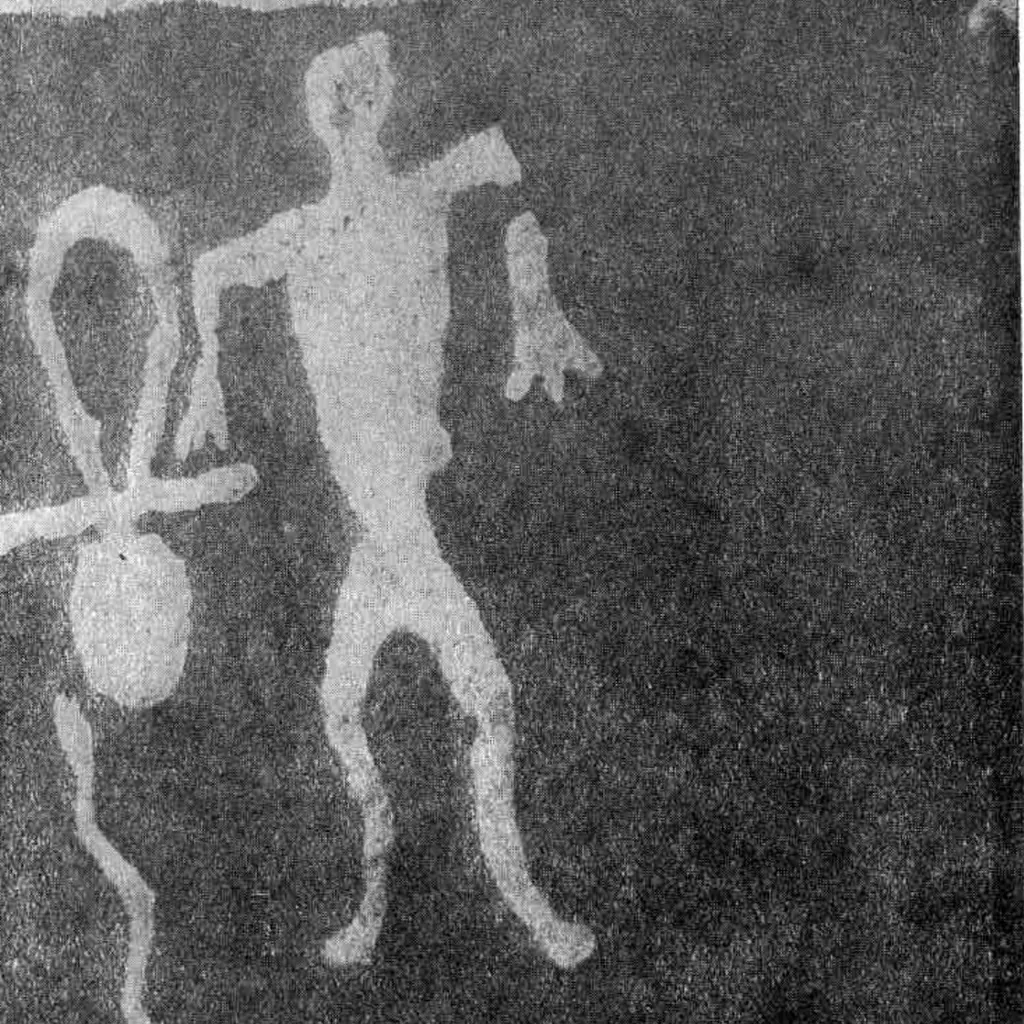
On a dark rock beside the lower Vyg River in northern Russia, a human figure stands beside an enormous looped sign. The sign has the essential visual grammar of an ankh: a tall loop, a horizontal crossbar, and a solid element beneath. A snake descends alongside it.
The resemblance is not subtle. It is the first thing many modern viewers see, but it is also what the first archaeological publisher saw nearly ninety years ago.
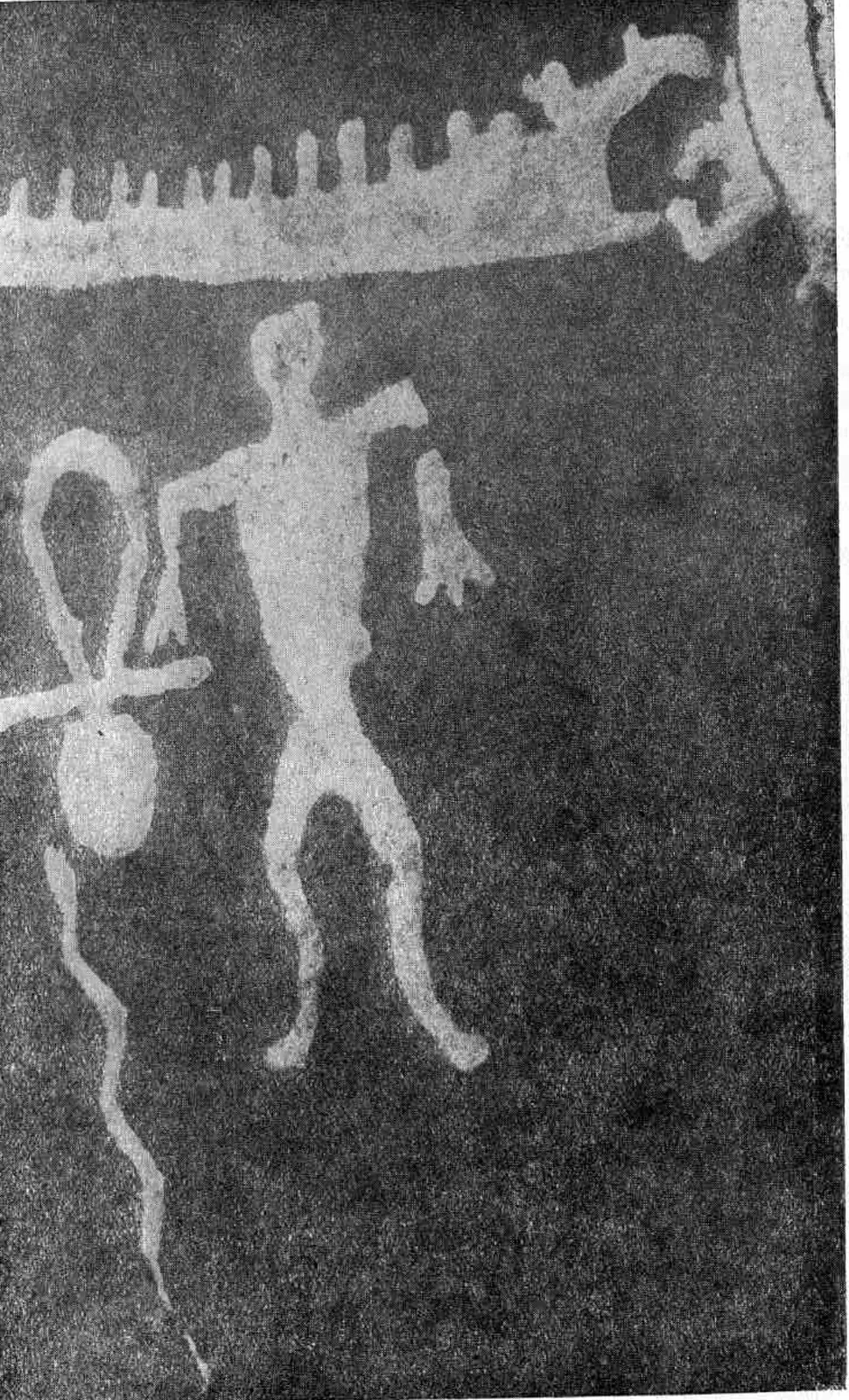
This is Old Zalavruga, a major rock-art panel near Belomorsk in the Republic of Karelia, discovered by Ravdonikas’s expedition in 1936. When the carvings were made, the rock stood within a changing world of islands, channels, rapids, and White Sea shorelines. Whatever its exact age, the sign is no modern graffito: it was recorded as part of the prehistoric panel at the moment of discovery.
How old is the White Sea ankh? #
The panel was not carved in one session. When Nadezhda Lobanova’s Karelian-Cambridge team re-examined Old Zalavruga in 2005, working under black sheeting that throws worn carvings into relief, they found 284 previously unrecorded images, several palimpsests, and at least three phases of carving. Small boats in sea-hunting scenes came first; scenes crowded with people followed; the three giant reindeer came last. Just before those reindeer, Lobanova lists “a serpent, a human front view, an undetermined symbol” among the probable later additions: evidently the group Ravdonikas numbered 142-144. She adds that the interval between phases is unknown and could have been either short or long (Lobanova 2007).
The sign itself cannot be radiocarbon dated. Its age therefore depends on how long the panel stayed in use, and the specialists disagree:
- The short chronology. Lobanova places the whole Karelian rock-art tradition within less than a thousand years, from roughly the second half of the fifth millennium BC into the early fourth, the work of Neolithic Pit-Comb Ware communities. She argues that the Zalavruga rocks were flooded and buried under river sediments as that period ended, and that Early Metal Age settlements later formed in those sediments (Lobanova 2015; 2020). On this account the sign is late, but still Neolithic.
- The long chronologies. Yuri Savvateev, who excavated Zalavruga, and Aleksandr Zhulnikov both placed Old Zalavruga near the end of a sequence running through the fourth and third millennia BC. Liliana Janik extends White Sea carving to about 2000 BC (Janik 2010), and her University of Cambridge project summary assigns the human figure, snake, and solar symbol to the later part of the Early Bronze Age (Cambridge, “Old Zalavruga”).
Lobanova’s is the most recent and most detailed argument, and it rests on excavated sediments and settlement sequences rather than on the height of the carvings alone. This article therefore treats the sign as probably Neolithic. On every chronology discussed here it is securely prehistoric and more than four thousand years old.1
The date also frames the Egyptian comparison. The ankh is attested in Egypt from the First Dynasty, around 3000 BC (Fischer 1972). On Lobanova’s chronology, the White Sea sign is older than any of those Egyptian examples; on the longer chronologies it could be contemporary with early dynastic Egypt. Neither dating makes it an Egyptian import, and neither Ravdonikas nor Lobanova proposes one.
What exactly is carved beside the ankh-like sign? #
Ravdonikas numbered the three neighboring images separately. His Plate 17 makes their relationship much easier to see than later reduced illustrations:
| Catalogue no. | Image | Visible form |
|---|---|---|
| 142 | Looped sign | Tall closed loop, crossbar, and filled circular base |
| 143 | Human | Frontal figure with bent arms and three-fingered hands |
| 144 | Snake | Long undulating body descending toward a damaged patch of rock |
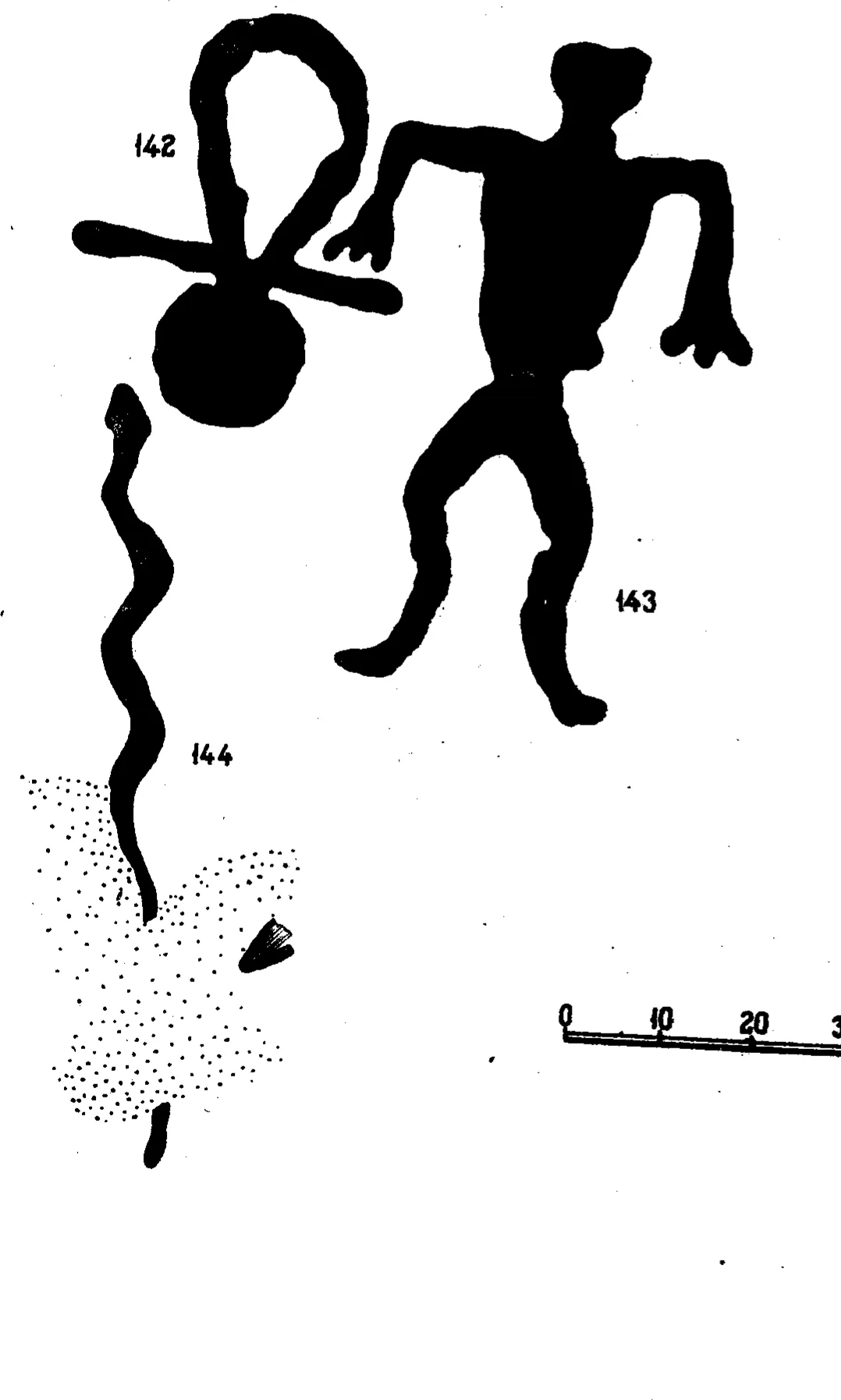
A recent reproduction appears in Satu Koivisto and Antti Lahelma’s study of the wooden snake figurine from Järvensuo, Finland, where the group is labelled simply “White Sea” among northern European Neolithic snake images (Antiquity, 2021, fig. 5f). The reduction makes the looped sign and snake appear almost fused. The original catalogue separates them without making the scene any less strange.
This is therefore not simply a crooked line that someone has decided to call an ankh. It is a carefully formed loop-and-cross sign standing beside a human and a serpent.
The Egyptian resemblance was recognized from the beginning #
Ravdonikas described no. 142 as a circle from which two rays rise at an angle and join in a rounded handle, with a transverse bar cut between the handle and the circle. Set the bar aside, he wrote, and the figure is fully analogous to some of the solar signs carved around Lake Onega, about 300 kilometers to the south.
Then he made the comparison that still arrests the eye. With its transverse line, he wrote, the figure bears some resemblance to an Egyptian hieroglyph denoting “day, light, power.” He did not call it an Egyptian import, and he did not use the word ankh. His gloss is not the ankh’s usual meaning, which Egyptologists give as “life,” but the loop-and-crossbar form he described is the ankh’s. What he recorded was a resemblance of form, noticed at the moment of archaeological discovery, before online image comparison and modern alternative-history enthusiasm could influence the description.
He also read catalogue numbers 142-144 as internally connected, together embodying cosmic symbolism. Lobanova, the leading modern specialist on Karelian rock art, classes no. 142 with the Onega-type solar signs, whose cosmic symbolism she regards as no longer in doubt. She notes that it is the only known handle-shaped sign of this kind with a transverse bar, and that it sits beside the three-fingered human and the writhing snake (Lobanova 2020, p. 198).
Old Zalavruga contains a genuinely ankh-like Neolithic sign, and the resemblance was part of its published archaeological record from the beginning.
Why does the snake matter? #
The sign does not float alone on an empty rock. Ravdonikas read it together with a human being and a serpent, and Lobanova’s stratigraphy supports treating them as a group: she lists all three among the same late additions to the panel. Whatever no. 142 represented - a solar emblem, a ritual object, a cosmic diagram, or several of these at once - our reading is that the snake belongs to the same field of meaning.
That makes Old Zalavruga important beyond the visual resemblance to Egypt. It is a northern European scene in which the serpent stands beside the human and a sign that specialists read as solar. Readers of our survey of the earliest snake art will recognize a pattern we have argued for there: prehistoric snakes keep appearing among the images people used to picture life, death, water, sky, and transformation. Old Zalavruga adds a northern instance to that pattern.
The carving cannot be translated through medieval Russian serpent myths; thousands of years separate them. Its value is older and simpler. Long before texts, northern people placed the serpent beside a human and a sign that both its first publisher and its modern specialist read as cosmic.
The local explanation and the Egyptian resemblance do not cancel each other. The responsible name is an ankh-like solar sign. The unforgettable name is the White Sea ankh. Either way, the shape is there on the rock, in a prehistoric serpent composition at least four thousand years old and, on the best-argued chronology, closer to six thousand - a compact and startling addition to the worldwide history of serpent symbolism.
Footnotes #
Sources #
- Ravdonikas, V. I. Rock Carvings of Lake Onega and the White Sea, Part 2: Rock Carvings of the White Sea. Academy of Sciences of the USSR, 1938. See p. 48 and plates 17 and 54.
- Lobanova, Nadezhda V. “Petroglyphs of the Old Zalavruga: New Data - A New Insight.” Archaeology, Ethnology & Anthropology of Eurasia 1(29) (2007): 127-135. English web version, RockArtBridge.
- Lobanova, Nadezhda V. “Petroglyphs in the Lower Reaches of the Vyg River: Problems of Chronology and Periodization.” Rossiiskaya Arkheologiya 2015, no. 4: 16-33. In Russian.
- Lobanova, Nadezhda V. “Signs and Symbols in Karelia Rock Art: Classification and Issues of Interpretation.” Brief Communications of the Institute of Archaeology 260 (2020): 195-208. In Russian.
- Janik, Liliana. “The Development and Periodisation of White Sea Rock Carvings.” Acta Archaeologica 81 (2010): 83-94.
- Janik, Liliana. “Old Zalavruga.” Visual Perception and Cognition in the Rock Carvings of Northern Russia, University of Cambridge Department of Archaeology, 2003.
- Koivisto, Satu, and Antti Lahelma. “Between Earth and Water: A Wooden Snake Figurine from the Neolithic Site of Järvensuo 1.” Antiquity 95(382) (2021): e19.
- Fischer, Henry G. “Some Emblematic Uses of Hieroglyphs with Particular Reference to an Archaic Ritual Vessel.” Metropolitan Museum Journal 5 (1972): 5-23.
Karelian petroglyphs are dated indirectly, through nearby radiocarbon-dated settlements, ancient shoreline and river levels, sediment cover, and overlapping images. Lobanova (2015) reviews the longer chronologies of Savvateev, Zhulnikov, and Janik and argues against their reliance on the carvings’ elevation; her 2020 paper gives the calendar range for the whole tradition. The Cambridge project page is a short 2003 summary by Liliana Janik and gives the Early Bronze Age attribution without discussion. None of these schemes dates catalogue no. 142 directly. ↩︎