Snake Cult / The making of a person
Neheb-Ka, Binder of Souls
An Egyptian god straight out of the snake cult of consciousness
Enter the argument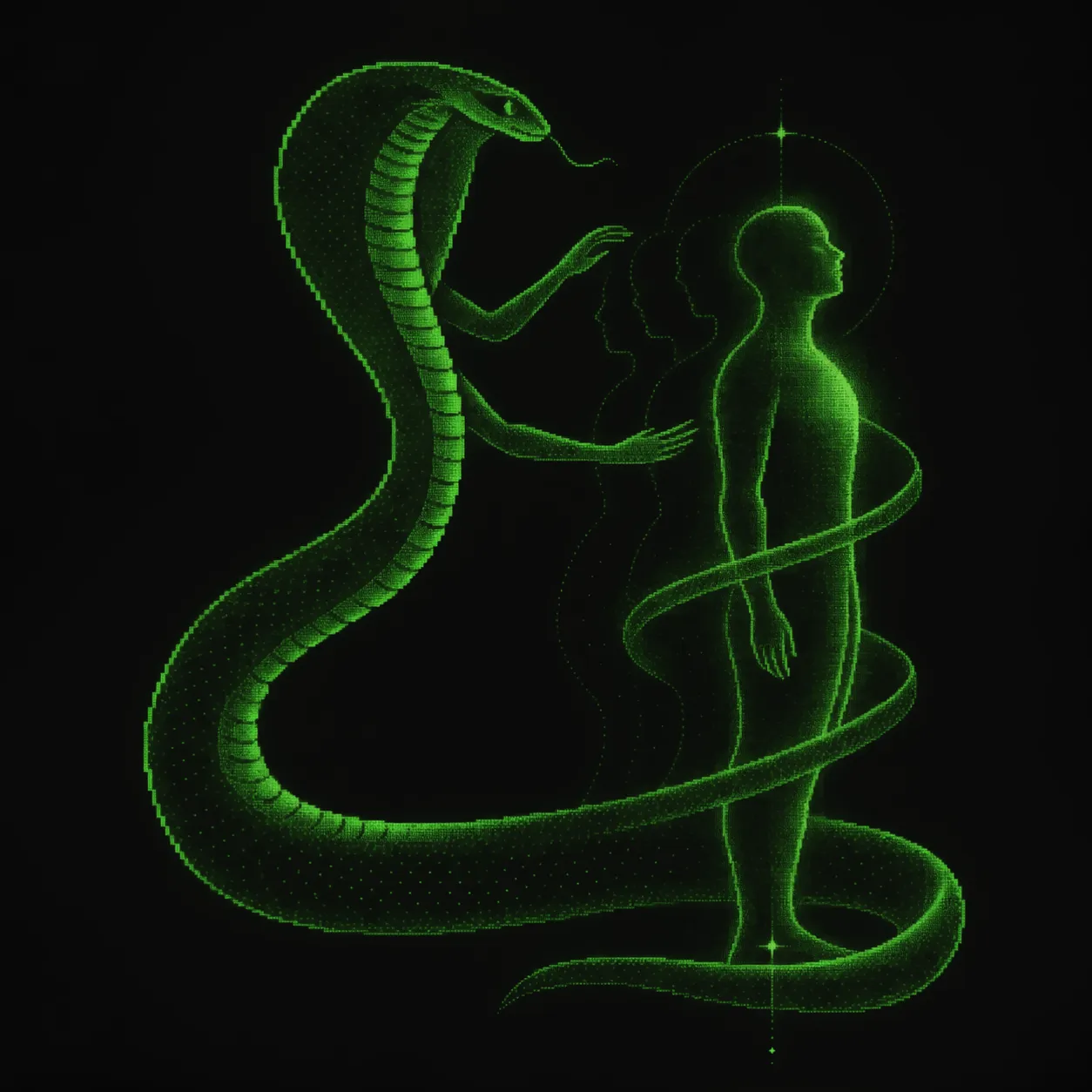
TL;DR
- Neheb-Ka is an Egyptian serpent god whose name joins a verb of endowment or harnessing to ka-powers.
- The Egyptian evidence is richer than the English phrase “binder of souls”: powers can be bestowed, withdrawn, and ritually claimed.
- The SnakeCult reading is that the serpent binds those powers to a person, making a self.
- I read Neheb-Ka, Eden’s serpent, Quetzalcoatl, Nüwa and Fuxi, and serpent initiation as different memories of the same prehistoric transformation.
A snake at the making of the self #
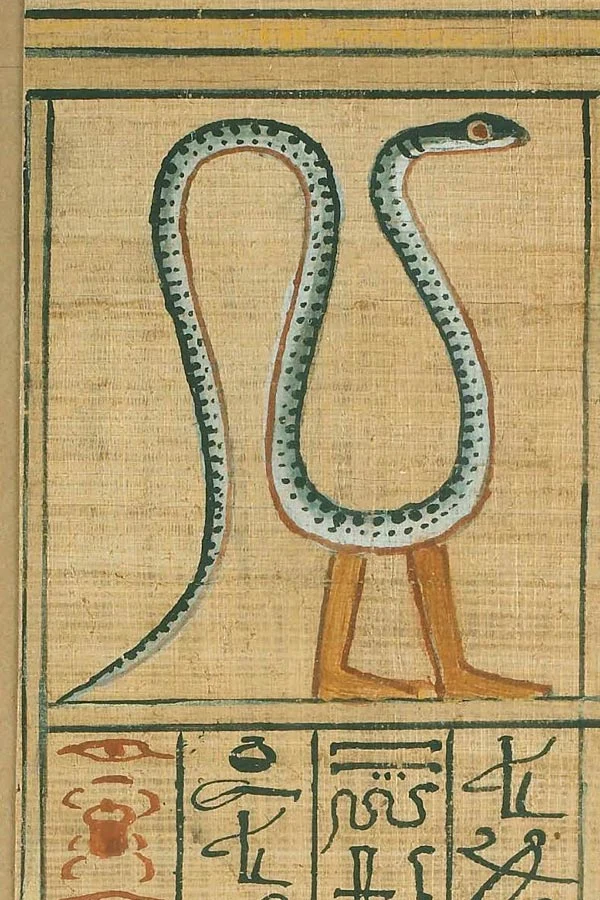
A serpent stands on human legs. Its spotted body rises in a long loop, then turns toward a head held level with the top of the painted frame. This is Nehebkau in the Papyrus of Ani: a snake given the means to walk, painted beside a spell of transformation. The image belongs to a book made to carry a person beyond death. British Museum, EA10470,27
The name is the extraordinary part. Nehebkau—Neheb-Ka in the spelling used here—belongs to the language of equipping, allotting, and harnessing kas: the powers through which a being is alive and effective. “Binder of Souls” is a compelling English title for him. It also opens a question that a title alone cannot answer. What is being bound, and to what?
The SnakeCult answer is that the serpent binds the powers of personhood to the person. He makes the individual a bearer of a self. This is why an Egyptian snake god belongs beside the serpent in Eden, the feathered serpent who helps make humanity, the serpent-bodied Chinese ancestors, and the great serpents that swallow initiates and return them transformed. In the Snake Cult of Consciousness, these are regional memories of one ancient transition: humanity learning to experience itself as selves.
That is the argument of this essay. The proposed prehistoric unity is a historical hypothesis; the Egyptian inscriptions are the evidence we can actually read. They give us a serpent, a cluster of life-powers, and a vocabulary for bringing those powers into an effective relationship.
01 / The painted god
A serpent given human legs

What does Neheb-Ka mean? #
Start with the Egyptian rather than the English epithet. The Thesaurus Linguae Aegyptiae (TLA), the scholarly dictionary and text corpus, lists the divine name as Nḥb.w-kꜣ.w. The familiar spellings Nehebkau, Neheb-Kau, and Neheb-Ka make it pronounceable for modern readers. They should not distract us from its two components: nḥb and kꜣ.w.
The dictionary’s German gloss for the complete name means “the one furnished with ka-powers.” Notice the direction: in that rendering, the god possesses the endowment. He is not grammatically defined as an agent tying souls into someone else. The entry nonetheless associates his name with the same verb used for equipping and assigning. TLA, divine-name entry 86270
This distinction is worth getting right because it lets us make a stronger argument. A name’s grammatical form, a god’s activity, and our interpretation of that activity are three related things. They do not have to be identical. A deity endowed with powers can be a model or source of endowment for others. To establish that relationship, we need the texts surrounding the name.
Harnessing, equipping, allotting #
The verb reaches across several English categories. TLA’s principal entry for nḥb gives German ausstatten; zuteilen and French équiper; attribuer: equip, furnish, allot, assign. Its English field uses “to give; to loan.” A related entry supplies the concrete harnessing sense. These are lexicographic alternatives and related uses, not a list of meanings present simultaneously in every occurrence. TLA 86130
“Harness” is particularly evocative because harnessing does two things at once. It attaches something, and it makes its power available for an organized purpose. A horse in a field has strength. A harness places that strength in a working relationship. “Equip” approaches the relationship from the other end: the recipient acquires what it needs to act.
The concrete sense is real. TLA lists “to harness; to yoke; to appoint with,” including harnessing horses. But its current corpus places that entry’s attestations later than the divine name’s oldest examples. We cannot simply project a chariot image backward and declare that we have recovered the original theology. Harnessing is a plausible interpretive image within the lexical field; equipping and allotting are essential parts of the evidence. TLA 86140
| English rendering | What it emphasizes | What it leaves open |
|---|---|---|
| Furnished with ka-powers | The god’s endowment | How those powers relate to others |
| Allotting or bestowing kas | Assignment and provision | Whether physical attachment is imagined |
| Harnessing kas | Powers brought into a working relationship | The precise direction and object of the action |
| Binder of Souls | The SnakeCult image of constituted personhood | The English “soul” and the implied recipient need explanation |
The last row is the essay’s reading. It gathers the ancient vocabulary into an argument about selfhood; it is not offered as a word-for-word replacement for every Egyptian occurrence.
What is a ka? #
The other half of the name is just as important. Kꜣ is conventionally written ka; kꜣ.w is plural, hence kas or ka-powers. TLA glosses the noun with spirit and essence in English, and life-force in German and French. The familiar hieroglyph is a pair of raised arms. Already we are moving across English compartments: life, power, spirit, the constitution of a being. TLA 162870
“Soul” catches some of this. It also imports an image of a single invisible person tucked inside the visible body. That image can make the name too easy. Egyptian texts distinguish ka from ba, and their language need not describe neatly detachable pieces of a person. When we encounter several kas, we should not automatically imagine several miniature ghosts.
For the argument here, life-powers is the useful working expression. It preserves the sense of animation and capacity without pretending that one English noun exhausts the Egyptian concept. “Binder of Souls” then acquires a more exact question beneath it: how do the powers that make someone a person become theirs?
What the Egyptian texts actually do with kas #
The best way through the uncertainty is to leave the isolated name and watch the vocabulary at work. The examples range from a human official’s standing to the transformation of the dead, ritual invocations of serpents, and a healing text that echoes Nehebkau’s name.
A man whose kas are harnessed #
The treasurer Iti supplies the human example. His stela, Cairo CG 20001, calls him nḥb kꜣw=f: a phrase containing the verb and his kas, plural. In Miriam Lichtheim’s translation, it becomes “a man of standing.” Her footnote gives “one whose kas are harnessed.” The inscription celebrates a capable official, including his provisioning of his town during famine. Lichtheim, Ancient Egyptian Literature, stela of Iti, line 3 and note 11
Both English renderings come from the same translator. One conveys social meaning; the other preserves a difficult underlying image. This is exactly why the etymology deserves more than a dictionary slogan. A human individual has kas, and their harnessed condition can express his effectiveness and standing.
The phrase does not specify that these kas have been harnessed to him: the possessive means “his,” not “to him.” Nor does it say a serpent performed the action. What it contributes is a human counterpart to the divine name’s vocabulary. The SnakeCult reading joins that human image to the serpent’s ritual role; the inscription supplies one part of the argument.
Powers can be given and taken away #
In the Pyramid Texts, nḥb appears beside a verb of removal. Harold Hays collects the paired motif in PT 258 §311a and PT 259 §315b: bestowing kas and taking them away. PT 318 §512d also speaks of bestowing kas, without the paired removal. The pairing favors assignment or endowment here. Whatever else kas are, this ritual language treats them as powers over which authority can be exercised. Hays, motif “Bestow Kas,” p. 499
The connection to the serpent is not something we have to supply entirely from outside. Hays also traces how Coffin Text 374 adapts PT 318 and introduces identification with Nehebkau. In Hays’s translation the speaker addresses the gods: “as I bestow your Kas, for I am Nehebkau,” glossed “Bestower of Kas.” Here is an active reading alongside the TLA’s “one furnished with ka-powers.” The explicit beneficiaries in this passage are gods; the human deceased claims the serpent’s power through identification. Other Coffin Text spells are explicitly framed as transformations into Nehebkau. The deceased can take on the god’s identity and power. The relationship is enacted in ritual speech, rather than left as an abstract item in a pantheon. Hays, discussion of PT 318 and CT 374, pp. 284–86
This is where the SnakeCult reading begins to gain substance. A person’s condition is alterable. Powers can be acquired; a new identity can be spoken and inhabited. The serpent belongs inside that process. Funerary transformation is not the same event as the first emergence of human selfhood, but it supplies a ritual form in which becoming a different kind of being can be imagined and performed.
Seven serpents and the endowment of kas #
In Pabasa’s tomb at Thebes, TT 279, a ritual for the first hour of the day addresses seven uraei, the raised cobras familiar from Egyptian royal and divine imagery. The relevant words are nḥb kꜣ.w[=k]. The possessive ending, “your,” is restored; kas is present in the transcription. The TLA translation understands the serpents as conferring dignity on those kas. Pabasa, first daytime hour, lines 7–8
“Dignity” explains the expression in context. It is not a separate Egyptian noun written beside ka in this clause. TLA treats the combination as a specialized expression of standing or respect, related to the equipping verb. The serpents who equip [your] kas is an etymological rendering I use to bring that relationship into view, rather than a more literal correction of the editor. TLA, collocation 86280
Here the association is striking even without choosing the strongest English verb. Serpents act on the powers of a being. The ancient image already has a recipient and a transformation. We do not need to turn every cobra into a coil of rope to recognize the pattern.
“Your ka … like Nehebkau” #
A healing statue of Djedher, Cairo JE 46341, brings the wordplay into the open:
nḥb(.w) kꜣ=k mj Nḥb-kꜣ
The gods are described as having endowed “your ka,” followed by “like Nehebkau.” TLA renders the action as granting the ka dignity. The name and the action audibly answer one another: nḥb … kꜣ … Nḥb-kꜣ. Here ka is singular. In the preceding clauses, ba-power is named separately. Djedher statue, lines 150–151
The surrounding spell addresses a dangerous serpent; its “you” cannot simply be relabeled “a human infant receiving a soul.” What it establishes is the religious association: endowing a being’s ka is expressed through Nehebkau’s own name. This is an ancient connection between serpent identity and endowment, not a modern pun.
Read together, these passages move the argument beyond a picturesque epithet. The vocabulary can describe the granting of powers, the enhancement of someone’s kas, and a transformation in which the recipient identifies with Nehebkau. “He binds a soul to an individual” is a synthesis of that pattern. Its final psychological meaning comes from the SnakeCult theory, not from a missing Egyptian preposition.
Binding a person together #
What would it mean for a serpent to give you a self?
The question is easier if we separate being alive from having a developed conception of oneself. The proposed transition is not from an unfeeling organism to a feeling one. It is toward a person who can represent their own thoughts, recognize themselves across time, understand that others have an image of them, and take responsibility for a life experienced as their own. This is the sense of consciousness at issue in the Eve Theory of Consciousness.
A self brings disparate things under a possessive: my fear, my intention, my memory, my death. The parts do not have to be new for their relationship to change. Binding is a powerful image because it makes that organization visible. The scattered powers belong to someone; the someone is partly constituted by their belonging together.
This is my reading of Neheb-Ka. The serpent harnesses the soul to the individual—or, more carefully, makes the individual the effective bearer of their life-powers. “Allotting” need not destroy that reading. It can sharpen it. A capacity is assigned, a person is endowed, something becomes theirs that was not theirs in the same way before.
The serpent binds the powers of a person into a self. Initiation repeats that making; creation myth remembers it at the scale of humanity.
This also explains why a god of funerary transformation could preserve the same pattern as a god of beginnings. Once there is a self to lose, death becomes a problem of keeping or recovering that self. A ritual that makes a person whole after death can reuse the image of the power that made persons possible in the first place. That is the proposed continuity: creation, initiation, and resurrection as different applications of the same making.
The bullroarer makes the serpent speak #
The bridge between a creation story and an individual person is initiation. A myth says that humanity was once made. A rite makes someone again.
A bullroarer is a blade on a cord, whirled to produce a deep, pulsing sound. In the serpent initiation traditions assembled in the Bullroarer Atlas, that sound can be the serpent’s voice. The instrument gives an unseen being a bodily presence. A person approaching a rite does not only hear a story about the serpent. They hear the serpent itself, as the ceremony presents it.
The Yolŋu Wägilak narrative gives the transformation a particularly clear form. Wititj, the Rainbow Serpent, swallows the sisters and regurgitates them. The National Museum of Australia’s account of the painting tradition explicitly relates this swallowing and return to initiation: boys go into ceremony and emerge as men. This is a locally grounded example, not a claim that every Australian Rainbow Serpent tradition tells the same story. National Museum of Australia, “The Wägilak Story”
The Atlas’s swallowing dossier gathers the associated ritual and ethnographic evidence. The structure is what matters here: an ordinary identity is interrupted, the initiate passes into a being larger than himself, and a changed person returns. The ceremony confers a standing, knowledge, and relationship to others that were previously withheld. Our essay on the serpent-swallowed initiate follows that pattern in more detail.
The SnakeCult interpretation takes the rite seriously as a model of making persons. An initiate is already awake, intelligent, and socially involved. What changes is the form of personhood the community recognizes and teaches him to inhabit. I propose that such rites preserve, through repeated performance, the memory of a far older transformation in how humans understood themselves.
Neheb-Ka gives that transformation an Egyptian vocabulary. The bullroarer gives it a voice. The names and ceremonies differ; the serpent remains at the passage into a new kind of being.
Eden, Quetzalcoatl, Nüwa and Fuxi #
The creation myths enlarge that passage from one initiate to the first people. Each preserves a different part of the proposed ancestral story.
Eden: people who discover themselves #
Genesis is unusually direct about a change in knowledge. The man and woman exist before the fruit. They speak and act. After the woman eats and gives it to the man, their eyes open and they recognize their nakedness. Later, God acknowledges that the human has acquired knowledge of good and evil. Genesis 3:5–7, 22
The SnakeCult reading follows that sequence closely: the serpent stands at a transformation of existing humans. Nakedness becomes something they can know about themselves, and something that matters in another’s gaze. Their bodies have not just come into existence. A new relationship to those bodies has.
In this reading, Eve and the serpent belong to the same story as the binder of souls. Eden stages the arrival of reflective, morally burdened selfhood; Neheb-Ka names the endowment and organization of a being’s powers. The narratives illuminate one another without requiring the Hebrew text to contain an Egyptian ka.
Quetzalcoatl: humanity assembled from the dead #
In the Nahua Leyenda de los Soles, Quetzalcoatl descends to the realm of the dead to retrieve bones. At Tamoanchan, Quilaztli, also called Cihuacoatl, grinds them; divine blood contributes to the making of the present humans. The feathered serpent is part of a cooperative act of creation, with a female deity indispensable to the work. Leyenda de los Soles, creation of humanity
Its explicit subject is the making of living people. My comparative reading asks why the serpent again mediates that making, and why humanity must be constituted from materials and powers brought into a new relationship. Here the image is bones and blood. In Egypt it is the endowment of kas. Both make the person an achievement rather than a given.
The bones story is a Nahua tradition. It should retain that identity; folding every Mesoamerican serpent into a single blended creation myth would erase the very details that make the comparison worth pursuing.
Nüwa and Fuxi: serpent-bodied makers of the human world #
The Chinese material divides the work differently. The Taiping yulan, in its Nüwa section, preserves an account in which she forms people from yellow earth. It also preserves a separate description of her as human-headed and serpent-bodied. Fuxi receives the same bodily description in his section, alongside the founding of practices that organize human life. Taiping yulan, chapter 78
Nüwa’s clay-making is her action, not automatically a joint episode with Fuxi. Their paired, intertwined iconography is another strand of the tradition. The distinction lets us see the larger pattern more clearly: serpentine ancestors stand behind both the production of people and the ordering of a human world. The site’s Nüwa and Fuxi comparison separates these textual and visual histories.
In the SnakeCult reading, the first human pair and the serpent have become one image. The beings who make humanity carry the serpent in their own bodies. Creation means acquiring the capacities, relations, and order through which human life becomes recognizably ours.
An old story with an Egyptian name #
Calling these “the same” means proposing a common ancestral transformation beneath different religious histories. It does not mean that Egyptian priests told the Leyenda de los Soles, or that Yolŋu people used ka as a term for the initiate. The traditions have their own languages, custodians, purposes, and histories. The claim is that their recurring arrangement preserves a memory older than those particular forms.
That arrangement is more specific than “people thought snakes were impressive.” The serpent occupies a threshold at which humans acquire something constitutive: life, knowledge, an initiated identity, or the powers needed to continue as a person. The human condition is made, and the serpent participates in making it. In the bullroarer and consciousness argument, ritual is the means by which that founding change can be rehearsed across generations.
The Egyptian record gives this hypothesis an unusually precise point of contact. We can go past the shape of an animal and examine the verbs. Equip. Allot. Harness. We can watch the same sound join a god’s name to the endowment of a ka, or place seven serpents over the empowerment of kas. These are not interchangeable translations, but together they show why Neheb-Ka is such a productive figure for thinking about the making of a person.
The proposed common root reaches back into humanity’s prehistoric formation. The surviving Egyptian texts do not date that root, and resemblance by itself cannot establish descent. The historical claim rests on the comparative pattern of serpent, transformation, and personhood—not on treating an English epithet as a decoded Paleolithic inscription.
Return to the painted serpent. Ani carried this image into the grave as part of a book for passing beyond ordinary life. In the SnakeCult reading, its power at that last threshold recalls its power at the first. The serpent could hold a person together because the serpent had helped bring the person into being.
Neheb-Ka, Binder of Souls: the snake at the making of the self.
Sources #
- Thesaurus Linguae Aegyptiae. Nḥb.w-kꜣ.w, divine-name entry 86270; nḥb, equipping and allotting, entry 86130; nḥb, harnessing, entry 86140; kꜣ, entry 162870. Accessed September 24, 2026. German glosses are translated into English in the essay.
- Hays, Harold M. The Organization of the Pyramid Texts: Typology and Disposition. Brill, 2012. Discussion of PT 318 and Coffin Text adaptations, pp. 284–86; motif index, “Bestow Kas”. Complete text mirror.
- Graefe, Erhart, with contributions by Peter Dils. Pabasa, TT 279, first daytime hour, lines 7–8. Thesaurus Linguae Aegyptiae. Square brackets in the essay retain the restored possessive.
- Thesaurus Linguae Aegyptiae. Healing statue of Djedher, Cairo JE 46341, lines 150–151. The ritual’s serpent addressee is material to the interpretation.
- British Museum. Book of the Dead of Ani, sheet 27, EA10470,27. Ancient painted vignette accompanying Spell 87; image provenance and license appear in the figure caption.
- National Museum of Australia. “Central Arnhem Land,” especially Dawidi and “The Wägilak Story.” Old Masters: Australia’s Great Bark Artists.
- Genesis, chapter 3, especially verses 5–7 and 22. King James Version.
- Leyenda de los Soles. Translated by Primo Feliciano Velázquez, in Códice Chimalpopoca, third edition, Universidad Nacional Autónoma de México, 1992, pp. 120–21; digital edition 2019. Quetzalcoatl, the bones from Mictlan, and creation at Tamoanchan.
- Li Fang et al., compilers. Taiping yulan, chapter 78, sections on Fuxi and Nüwa. Tenth-century compilation preserving earlier textual fragments; it is not itself a prehistoric witness.
- Cutler, Andrew. “The Snake Cult of Consciousness.” Vectors of Mind, 2023; “Eve Theory of Consciousness v3.0.” Authorial sources for the interpretive framework.
- Lichtheim, Miriam. Ancient Egyptian Literature. University of California Press, combined edition, 2019. “Stela of the Treasurer Iti of Imyotru,” Cairo CG 20001, line 3 and note 1.
- Bullroarer Atlas. “The Serpent’s Voice” and “Swallowed by a Monster.” Comparative dossiers and their cited ethnographic sources.
Lichtheim, volume I, pp. 88–89 in the original volume; pp. 125–26 in the 2019 combined edition. The phrase and note were checked against the searchable text of the combined edition. Her source is Lange and Schäfer, Grab- und Denksteine des Mittleren Reichs, I, pp. 1–2, IV, plate I. The psychological reading is this essay’s interpretation. ↩︎