TL;DR
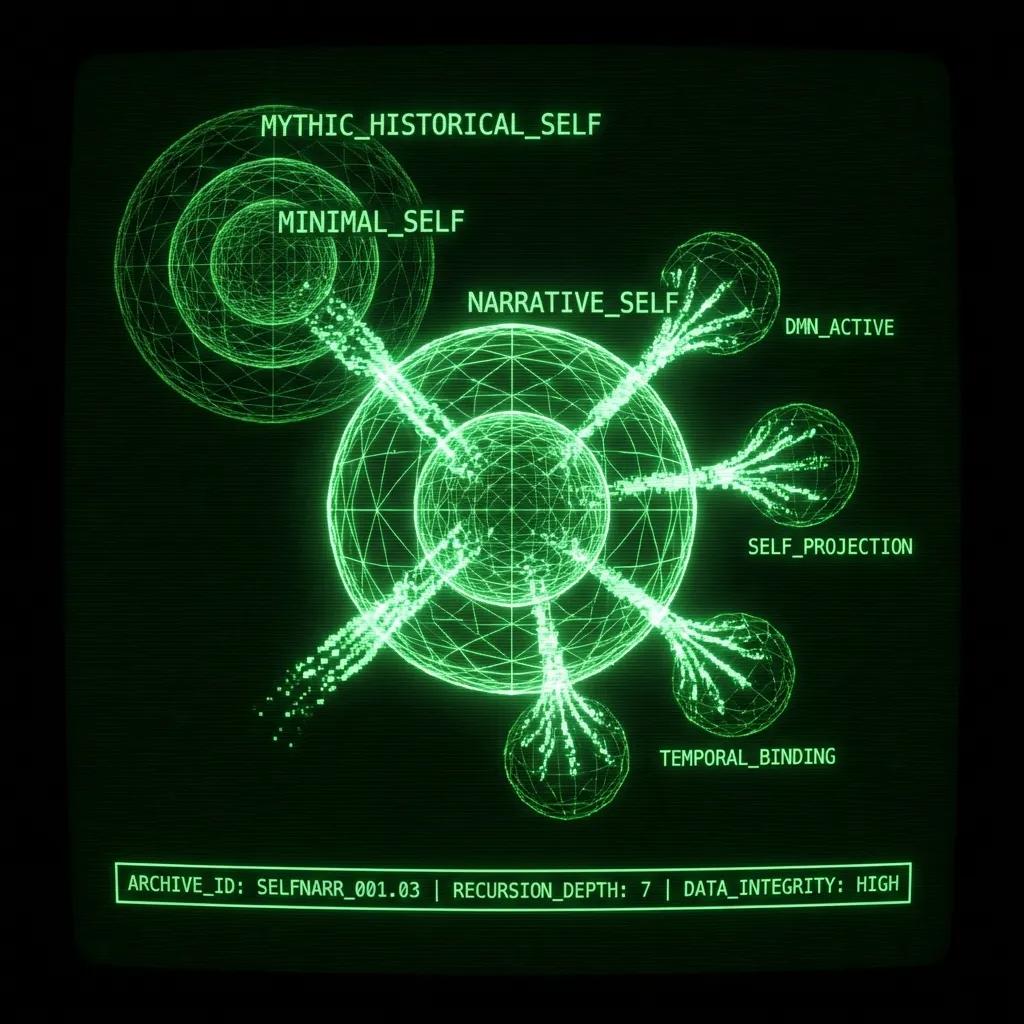
- “Self” is layered: a minimal, pre-reflective subjectivity; a narrative self; and, arguably, a mythic-historical self that extends into shared stories and deep time.
- Narrative identity research shows that life stories support coherence and meaning but are not universal or always beneficial; there are robust anti-narrative temperaments.1
- Neuroscience points to distributed mechanisms—especially the default mode network and memory systems—that implement ongoing self-storying without a homunculus narrator.
- Cross-cultural and clinical data suggest multiple narrative styles, power asymmetries in whose story wins, and both healing and harm from “re-authoring” lives.
- The Eve Theory of Consciousness (EToC) reframes the narrative self as the late-arriving surface of a recursive “I am” technology that evolved relatively recently and is dimly remembered in myth.
The story of a life is not the life itself, but a way of giving unity to the dispersed events of a life.
— Paul Ricoeur, Oneself as Another (1992)
1. Why another article on the narrative self?#
The overview piece on the narrative self sketched a map: philosophers distinguishing minimal and narrative selves; psychologists studying life stories; neuroscientists mapping the brain’s “inner movie”; Strawson grumpily insisting he is not a story. Here I want to zoom in on three things:
- Stratification – how minimal, narrative, and mythic-historical selves stack and interact, rather than compete.
- Mechanism – what a brain that tells stories actually does, in terms of prediction, memory, and the default mode network.
- Genealogy – how narrative selves arise developmentally, culturally, and (speculatively) in evolutionary deep time.
The Eve Theory of Consciousness will come in under (3): not as a replacement for the standard model, but as a way of thinking about when and how the narrative self could have switched on in our lineage.
Where the earlier piece tried to be synoptic and ecumenical, this one is more argumentative: it leans harder on empirical work in narrative identity, gives Strawson and other skeptics sharper edges, and then ties this to a conjectural prehistory where “I am” and “this is my story” are late, fragile inventions rather than eternal furniture of the universe.
2. Layers of self: minimal, narrative, and mythic#
The first useful move is not to pick a favorite notion of “self,” but to admit that we are dealing with different time-scales and formats of selfhood.
Shaun Gallagher’s influential review in Trends in Cognitive Sciences distinguishes a minimal self—a pre-reflective, first-person presence in the here-and-now—from a narrative self that extends across time via memory and anticipation.2 Minimal selfhood is bound to sensorimotor agency and body ownership. Narrative selfhood is bound to autobiographical memory, language, and social recognition.
We can enrich that schema by adding a third layer: a mythic-historical self—the way persons are situated inside collective stories, myths, and cosmologies that predate them and will outlast them.
2.1 A working three-layer model#
| Layer of self | Time-scale | Phenomenology | Cognitive / neural basis (schematic) | Typical questions |
|---|---|---|---|---|
| Minimal self | Milliseconds–seconds | “I am here, acting, sensing this body now.” | Sensorimotor integration, body schema, interoception; midline & parietal systems23 | “Did I just move my hand?” |
| Narrative self | Days–decades | “This is who I’ve been and who I’m becoming.” | Episodic & semantic memory, language, default mode network, self-projection45 | “Why am I like this?” |
| Mythic-historical self | Generations–deep time | “We are this kind of people in this kind of world.” | Shared narratives, rituals, myths; cultural memory and institutions6 | “Where do we come from, and what for?” |
Minimal selfhood shows up in neonates’ body awareness and in sense-of-agency experiments; it is present even when narrative memory is shattered (as in certain amnesias) and is disrupted in schizophrenia and depersonalization disorders.237 Narrative selfhood emerges later, with language and autobiographical memory, and is where most “identity talk” lives.48
The mythic-historical self is less discussed in analytic philosophy but is obvious anthropologically: being “a Hopi farmer,” “a devout Catholic,” or “a member of the Communist Party” is not just a private story—it is a position inside an inherited narrative universe. Paul Ricoeur’s idea of narrative identity already gestures at this: the self is configured by plots and symbols drawn from history, religion, and literature.9
The point of this stratification is not scholastic nitpicking. It matters because debates about the narrative self often conflate layers:
- Critiques like Strawson’s target the claim that every moment of subjectivity is narrative; that is obviously false if minimal selfhood exists.1
- Defenses of narrative identity are usually about meaning and ethics over the life course, i.e., the narrative and mythic layers.489
- Clinical practice taps all three: grounding trauma patients in minimal bodily presence; reworking personal narratives; and sometimes renegotiating mythic belonging (e.g., leaving a cult).
Once you separate time-scales, it stops making sense to ask “Are we really narratives?” and becomes more sensible to ask “At what scales, and for what functions, does narrative structure self-experience?”
3. Brains that tell stories#
If there is no homunculus author in the head, how does the “story of me” emerge?
The short answer from contemporary cognitive neuroscience is: through ongoing predictive integration by distributed networks, especially the default mode network (DMN), in cooperation with memory systems.
3.1 The default mode network and self-projection#
Marcus Raichle and colleagues noticed that a set of regions is reliably more active at rest than during demanding external tasks and dubbed this the default mode of brain function.10 This network includes medial prefrontal cortex, posterior cingulate / precuneus, and angular gyrus—regions routinely implicated in self-referential thought, remembering the past, imagining the future, and understanding others’ minds.[^11]
Buckner and Carroll proposed that the DMN implements a general capacity for self-projection: recombining memory traces to simulate alternative perspectives—remembering, imagining, taking another’s point of view.4 That is nearly a direct cognitive translation of narrative capacity:
- Temporal plot – sequencing remembered and anticipated events.
- Point of view – anchoring scenes to a protagonist (“me”) or to others.
- Thematic coherence – weighting some events as central “turning points” and others as background.
In split-brain research, Michael Gazzaniga famously described a left-hemisphere “interpreter” that spontaneously confabulates reasons for behaviors initiated elsewhere in the brain.[^12] The interpreter is not a liar; it is doing narrative compression—retrofitting a coherent storyline to distributed, sometimes noisy, causes.
At a very rough level, narrative selfhood emerges when:
- A predictive system needs to track a single agent across time to coordinate action and social interaction.
- Memory and self-projection systems stitch together episodes into causally and morally interpretable sequences.
- Language makes those sequences shareable, recap-able, and negotiable.
The “self” is not a node; it is the center of narrative gravity in Dennett’s phrase—a virtual focal point defined by this ongoing compression.[^13]
3.2 Predictive processing and narrative#
In predictive processing models, the brain is a hierarchical prediction machine minimizing error between expected and incoming signals.[^14] Narratives can be read as high-level generative models: hypotheses about who I am and how the world works.
- At the minimal level, predictions govern bodily states: “If I move my arm, proprioception should change like this.”
- At the narrative level, predictions govern identity: “As a conscientious, competent person, I will respond to criticism by improving, not quitting.”
- At the mythic level, they govern cosmologies: “As a chosen people awaiting redemption, we interpret suffering as trial, not random misfortune.”
When prediction errors accumulate—trauma, sudden loss, psychosis—the narrative model can crash or fragment. Therapeutic “re-authoring” is then a form of model revision: adjusting plots and roles so that anomalies make sense without destroying core commitments.[^15][^16]
In this frame, the narrative self is neither mere illusion nor bedrock substance. It is a high-level hypothesis that the system finds useful to keep generating and updating.
4. Development, narrative identity, and well-being#
Dan McAdams’ life-story model of identity is the empirical workhorse here.48 He argues that in modern societies, especially WEIRD ones, people gradually craft an inner autobiography that integrates the reconstructed past and imagined future into a sense of unity and purpose.
4.1 How narrative identity develops#
Longitudinal and cross-sectional research suggests roughly this trajectory:48[^17]
- Childhood: children can recount episodic events (“we went to the zoo”) but these are mostly disconnected vignettes.
- Adolescence: emergence of autobiographical reasoning—linking events to traits and values (“moving schools made me more independent”). Identity themes of agency, communion, redemption, and contamination first become explicit.
- Adulthood: consolidation of a life story with recurring themes, turning points, and anticipated futures. Individuals differ in how coherent, complex, and emotionally integrated these narratives are.
Higher narrative coherence and redemptive framing are modestly associated with better psychological adjustment and generativity, while highly fragmented or contamination-heavy stories track depression and PTSD.[^17][^18]
But there are important caveats:
- These correlations are modest, not fateful; plenty of people with messy narratives cope well, and some with crisp heroic arcs are insufferable.
- Most data come from literate, individualistic societies that valorize self-authorship. The universality of narrative identity is an open question.
4.2 Narrative in therapy: power and risk#
Narrative therapy explicitly treats people as authors of their lives, inviting them to “externalize” problems, identify constraining stories, and craft alternative plots.[^16] Pennebaker’s expressive writing paradigm, where people write about emotionally significant experiences for a few days, yields small but robust improvements in health and well-being, partly by fostering coherent narratives.[^15]
However, Strawson’s warnings are not idle.1 Overzealous narrative work can encourage:
- Confabulation – smoothing over uncertainty with pseudo-memories that fit the preferred plot.
- Moral over-simplification – casting oneself too neatly as hero or victim, flattening genuine ambivalence.
- Normative pressure – implying that those who do not organize their experience narratively are deficient.
A sane middle position is: narrative is a powerful but optional technology. It is a tool many minds reach for; not a compulsory operating system.
5. Variations, critiques, and whose story counts#
Galen Strawson’s “Against Narrativity” targets two theses: a psychological claim that humans generally “live” or experience their lives narratively, and an ethical claim that a good life ought to be narratively unified.1 He argues both are false:
- There are Episodic people who do not experience themselves as persisting subjects with grand life stories.
- Ethical depth does not require narrativity; someone can live fully in the present without narrativizing it.
Subsequent commentators have softened and sharpened this critique. Matti Hyvärinen shows that many narrativist claims in cultural studies indeed overreach, inflating narrative into a totalizing metaphor.[^19] Empirical work has also documented personality and cultural differences in how strongly people endorse narrative identity.[^20]
From a cross-cultural perspective:
- Some traditions emphasize role and ritual over introspective biography: you are your place in kinship, caste, or monastic hierarchy more than your idiosyncratic life story.
- Others encourage polyphonic selves—multiple, context-dependent voices rather than one master plot.
There is also the political question: whose narratives get canonized as reality? Mythic-historical selves—the identities that matter for law, memory, and violence—are always contested. Nations, religions, parties, and families all operate as narrative machines, authorizing some versions of events and erasing others.[^21]
So the question is not just whether brains like stories, but how narrative forms intersect with power, literacy, colonialism, and gender. The narrative self is never purely private.
6. Deep time and the Eve Theory of Consciousness#
All of the above operates at the scale of decades and cultures we can still interview. The Eve Theory of Consciousness (EToC) asks a ruder question: When did any of this become possible at all? And could myths remember that transition?
6.1 Recursion, inner voice, and “I am”#
EToC begins from fairly mainstream premises:
- Recursion—functions that take their own output as input—allows finite systems to generate effectively infinite complexity. In language, this shows up as clause embedding and hierarchical syntax.[^22][^23]
- Many theorists argue that recursion underlies not just language but mental time travel, counterfactual thinking, and introspection.[^23]
- Conscious self-awareness, in higher-order or global workspace theories, is often modeled as self-referential processing: representations representing themselves.[^24]
On this view, consciousness of the familiar human sort requires a capacity for inner recursion: a mind that not only models the world and others, but eventually models its own modeling and identifies with it. The first “I am” is the first moment the map of mind becomes experienced as “me.”[^23]
EToC then adds evolutionary and cultural hypotheses:
- Recursion—and with it, robust “I”-experience—evolved late (on the order of tens of thousands of years), not hundreds of thousands.
- The transition period would have been phenomenologically bizarre: unstable, schizophrenic, full of hallucinatory voices and tenuous boundaries between self and world.
- Once stable enough, recursive selfhood created fitness advantages (planning, deception, shamanism, art), generating selection for earlier and smoother acquisition of “I” in development.
- Myths and ritual complexes may preserve cultural memories of this transition, compressed into the language of gods, serpents, and forbidden knowledge.[^23][^25]
6.2 Myths as taphonomy of consciousness#
One line of argument in EToC uses the Pleiades “Seven Sisters” complex as a proof of concept. Across Eurasia, Australia, and the Americas, the Pleiades are represented as seven sisters, often with a narrative about a missing or hidden one; yet the naked-eye cluster typically shows six prominent stars. This shared discrepancy suggests diffusion from a common source rather than independent invention.[^25] Archaeological depictions of the cluster in Paleolithic and Holocene art line up with plausible windows for such myths to originate and spread.[^25]
If some myths can survive on the order of ~30,000 years, then in principle, creation myths could preserve highly compressed memories of cognitive thresholds, not just local events. EToC reads the Eden story this way:
- Humans begin in a state of unreflective unity (“naked and not ashamed”).
- A transgressive act—eating forbidden fruit at the serpent’s suggestion—opens their eyes, brings knowledge of good and evil, self-conscious shame, and mortality.
- They are expelled from an earlier, pre-reflective mode of being into a world of toil, time, and narrative (they now have a “before” and “after”).
Layered on top of standard theological readings, EToC treats this as an allegory for the birth of recursive self-awareness: the moment a superego-like moral world and a proto-ego lock into a self-referential loop and produce an inner “I” that can be observed and judged.[^23]
6.3 EToC and the narrative self#
How does this interact with the contemporary narrative self literature rather than just floating alongside it as mythography?
- It explains why narrative feels so constitutive. If recursion and inner speech are late and rapidly selected for, the narrative self is not a mild interpretive overlay. It is the front-end of a powerful, recently evolved cognitive niche: living inside stories and symbolic worlds.
- It gives a selectional story for narrative identity: people whose recursive machinery yielded more stable, socially legible narratives (about themselves and their groups) may have enjoyed survival and reproductive advantages.
- It reframes phenomena like schizophrenia, dissociation, and mystic ego-loss as relics of a broader historical spectrum: once, everyone was closer to these extremes.[^23]
Crucially, EToC is a working conjecture. The deep-time claims depend on fragile evidence about myth diffusion and behavioral modernity.[^25] It does not replace cognitive and neuroscientific models of the narrative self; it nests them inside a broader picture in which narrative is not just what we do with consciousness, but a major reason consciousness took its current recursive form at all.
If the narrative self is a late, unstable evolutionary contraption, that also explains its variability and fragility in the present: some people are happily Episodic, some over-narrativize to their detriment, many flip between fragments, scripts, and silences.
7. Where narrative models break (and what we learn there)#
The most illuminating counterexamples to strong narrativity live at the edges:
- Meditative and non-dual states where the narrative stream quiets and minimal selfhood dominates. Practitioners often describe these as revealing something more basic than stories.
- Severe trauma, where experience is too overwhelming to be narrativized; part of the therapeutic task is not to “spin a better story” but to allow any story at all.
- Neurodivergent profiles where language, social imagination, or autobiographical memory work differently, yielding atypical relationships to narrative identity.
- Collective traumas and contested histories, where no single narrative can do justice to the plurality of experiences; attempts at one master plot become violent.
Rather than concluding “there is no narrative self,” these cases suggest:
- Narrative is one mode among several, often layered on top of minimal and mythic structures.
- The ethical task is not to maximize narrative coherence, but to balance truthfulness, flexibility, and pluralism: some things should be left fragmentary; some contradictions should be preserved.
- Understanding the genealogy and mechanism of narrative selves can make us less attached to our current stories—not because they are unreal, but because they are revealed as revisable tools.
In that sense, even a strong narrativist can make peace with Strawson’s “I am not a story.” One might reply: “You are not only a story. But part of what it feels like to be you, in this time and species, is that the brain cannot stop telling stories about you. That faculty has a history, a physiology, and—if EToC is on the right track—a mythic fossil record.”
Recognizing that does not force anyone into a particular narrative. It merely adds another chapter to the story of how stories came to matter.
FAQ#
Q 1. Do all humans have a narrative self? A. No. Many people rely heavily on life stories, but others report little sense of a continuous narrative and still function well; cross-cultural and personality differences here are substantial.
Q 2. Is narrative identity good for mental health? A. Coherent, flexible narratives that integrate adversity without erasing it are modestly linked to well-being, but forced coherence or simplistic “redemption arcs” can backfire.
Q 3. How does the default mode network relate to the narrative self? A. The DMN is active during self-referential thought, remembering, imagining, and theory of mind; it seems to implement the brain’s capacity for self-projection that undergirds narrative.
Q 4. What is distinctive about the Eve Theory of Consciousness? A. EToC treats recursive “I am” awareness as a late, selected-for capacity and suggests that global myth motifs (like Eden or the Seven Sisters) may preserve compressed memories of its emergence.
Q 5. Does accepting the narrative self theory undermine free will? A. It complicates naïve agency by showing how post hoc and constructed our self-explanations are, but it also highlights how revising our stories can reshape future actions and ethical commitments.
Footnotes#
Sources#
- Gallagher, Shaun. “Philosophical Conceptions of the Self: Implications for Cognitive Science.” Trends in Cognitive Sciences 4(1), 2000, 14–21.
- Hafner, Verena et al. “The Mechanisms Underlying the Human Minimal Self.” Frontiers in Psychology 13, 2022.
- Raichle, Marcus E. et al. “A Default Mode of Brain Function.” PNAS 98(2), 2001, 676–682.
- Buckner, Randy L., and Daniel C. Carroll. “Self-Projection and the Brain.” Trends in Cognitive Sciences 11(2), 2007, 49–57.
- McAdams, Dan P. “The Psychology of Life Stories.” Review of General Psychology 5(2), 2001, 100–122.
- McAdams, Dan P., and Kate C. McLean. “Narrative Identity.” Current Directions in Psychological Science 22(3), 2013, 233–238.
- Banks, M. V. “Narrative Identity: The Construction of the Life Story, Autobiographical Reasoning and Psychological Functioning in Young Adulthood.” PhD thesis, Victoria University of Wellington, 2013.
- Ricoeur, Paul. “Narrative Identity.” In Oneself as Another. University of Chicago Press, 1992.
- Dennett, Daniel C. “The Self as a Center of Narrative Gravity.” In Self and Consciousness: Multiple Perspectives, Erlbaum, 1992.
- Gazzaniga, Michael S. “Forty-Five Years of Split-Brain Research and Still Going Strong.” Brain 140(7), 2017, 2051–2053.
- Strawson, Galen. “Against Narrativity.” Ratio 17(4), 2004, 428–452.
- Hyvärinen, Matti. "‘Against Narrativity’ Reconsidered." Partial Answers 6(2), 2008, 1–25.
- Bortolan, Anna. “Affectivity and the Distinction Between Minimal and Narrative Self.” Phenomenology and the Cognitive Sciences 19, 2020, 779–796.
- Clark, Andy. “Whatever Next? Predictive Brains, Situated Agents, and the Future of Cognitive Science.” Behavioral and Brain Sciences 36(3), 2013, 181–204.
- Pennebaker, James W. Opening Up: The Healing Power of Expressing Emotions. Guilford, 1997.
- White, Michael, and David Epston. Narrative Means to Therapeutic Ends. W. W. Norton, 1990.
- McAdams, Dan P. “Identity, Narrative, Language, Culture.” In The Oxford Handbook of Human Motivation, Oxford University Press, 2012.
- Schechtman, Marya. The Constitution of Selves. Cornell University Press, 1996.
- Hafner, Verena et al. “The Mechanisms Underlying the Human Minimal Self.” Frontiers in Psychology 13, 2022.
- Raichle, Marcus E. “The Brain’s Default Mode Network.” Annual Review of Neuroscience 38, 2015, 433–447.
- Assmann, Jan. Cultural Memory and Early Civilization: Writing, Remembrance, and Political Imagination. Cambridge University Press, 2011.
- Hauser, Marc D., Noam Chomsky, and W. Tecumseh Fitch. “The Faculty of Language: What Is It, Who Has It, and How Did It Evolve?” Science 298(5598), 2002, 1569–1579.
- Corballis, Michael C. The Recursive Mind: The Origins of Human Language, Thought, and Civilization. Princeton University Press, 2011.
- Lau, Hakwan, and David Rosenthal (eds.). “Higher-Order Theories of Consciousness.” Stanford Encyclopedia of Philosophy, rev. 2014.
- Cutler, Andrew. “The Eve Theory of Consciousness.” Seeds of Science, 2024; see also the expanded version at Vectors of Mind.
Strawson distinguishes between narrativity as a descriptive thesis about human psychology and as a prescriptive ethical ideal; his objections are strongest against the latter. ↩︎ ↩︎ ↩︎ ↩︎
Shaun Gallagher’s “minimal self” is a phenomenological notion, not a homunculus; it refers to a point-of-view structure implicit in experience. ↩︎ ↩︎ ↩︎
Recent work on the minimal self emphasizes agency and body ownership, showing disruptions in schizophrenia and out-of-body experiences. ↩︎ ↩︎
McAdams uses “narrative identity” to mean an internalized, evolving life story that provides unity and purpose in modern Western contexts. ↩︎ ↩︎ ↩︎ ↩︎ ↩︎ ↩︎
The DMN is not uniquely “the self network”—it participates in many tasks—but its role in self-projection makes it a plausible neural substrate for narrative processes. ↩︎
The “mythic-historical self” here is a heuristic label for how individuals are nested inside shared stories; it overlaps with Ricoeur’s narrative identity and anthropological notions of cultural memory. ↩︎
Cases of amnesia where people retain a sense of presence and agency but lose autobiographical memory are among the cleanest dissociations of minimal and narrative selves. ↩︎
Narrative identity research is methodologically fragile: small samples, coding subjectivity, and cultural biases limit generalization, but the converging patterns are nontrivial. ↩︎ ↩︎ ↩︎ ↩︎
Ricoeur’s account emphasizes that identities are configured through emplotment—linking events into plots—in dialogue with available cultural narratives. ↩︎ ↩︎
EToC’s deep-time claims remain speculative; the archaeological and mythological evidence is intriguing but underdetermined, and alternative explanations (e.g., convergent myth-making) remain live. ↩︎