TL;DR
- “Mitochondrial Eve” and “Y-chromosomal Adam” are lineage most-recent-common-ancestors (MRCAs), not a founding couple, and plausibly sit on the order of ~150k–300k years ago with wide uncertainty tied to mutation rates and sampling Memetic Eve post (2024); NHGRI explainer; (Poznik 2013, PubMed).
- Dual inheritance theory (DIT) formalizes the obvious: humans adapt via two heritable channels—genes and socially transmitted information—whose interaction can drive rapid change (Cavalli-Sforza & Feldman 1981, PDF; Richerson et al. 2010, PNAS PDF).
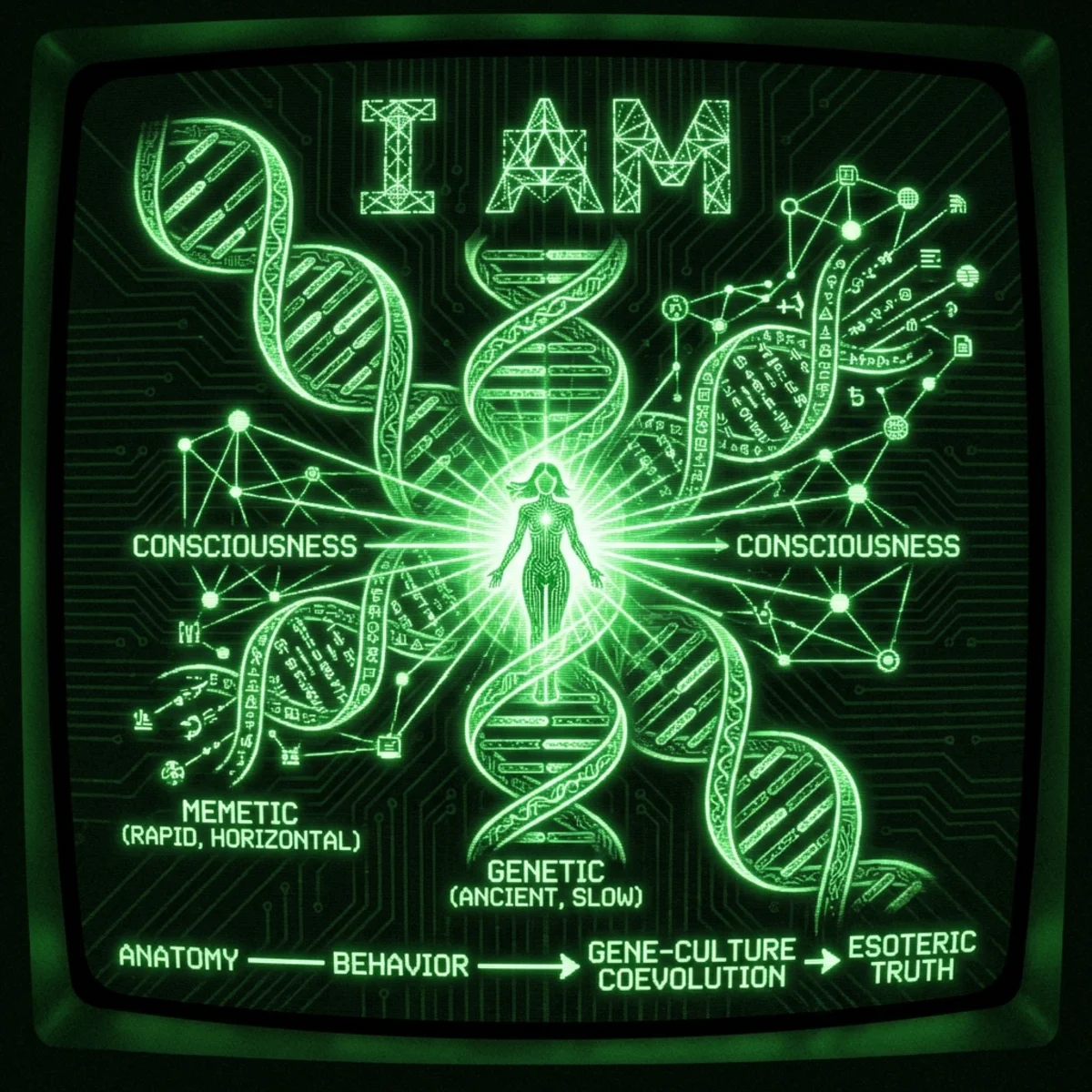
- EToC is not “incomplete without DIT”; it’s better read as a specific, falsifiable DIT of the human condition: psychological modernity is a memetically transmissible cognitive innovation (“I am”/moral agency) that can diffuse across lineages far faster than genes EToC v3; Memetic Eve (2024); Phase-change Eve (2025).
- If you already accept DIT’s core premise—culture is an inheritance system with its own evolutionary dynamics—then “Memetic Eve” becomes a natural question: what was the cognitive meme that became universal, and when did it go pandemic? Memetic Eve (2024).
- EToC’s distinctive move is to treat selfhood as the key transmissible adaptation and to use diffusion to resolve the “Sapient Paradox” timing gap between anatomy and worldwide behavioral modernity Memetic Eve (2024).
“Culture normally evolves more rapidly than genes, creating novel environments that expose genes to new selective pressures.”
— Richerson, Boyd, & Henrich, “Gene–culture coevolution in the age of genomics” (2010) (PDF)
Dual inheritance, stated plainly (without killing the magic)#
Dual inheritance theory is a family of models built around a stubborn empirical fact: humans inherit adaptive information genetically and socially. Both streams can show something like “mutation/variation,” “selection,” “drift,” and “transmission,” and—crucially—the cultural stream can move horizontally across unrelated people and groups, not just parent-to-child (Cavalli-Sforza & Feldman 1981, PDF; Mesoudi, “Studying Cultural Transmission…” 2013, PDF).
DIT’s core claim is not “culture matters” (everyone says that at dinner parties); it’s sharper:
- Culture is heritable information (via social learning).
- Cultural variants evolve (systematically, not just randomly).
- Gene frequencies can respond to culturally constructed environments (feedback and niche construction), yielding gene–culture coevolution (Richerson et al. 2010, PNAS PDF; Gintis 2011, PMC).
Most “human uniqueness” stories either (a) go all-in on genes (slow, constrained) or (b) go all-in on culture (fast, but often hand-wavy about constraints). DIT was invented to keep both honest.
So far, so orthodox. The interesting question is what kind of cultural information mattered most.
Genetic Eve/Adam as a baseline—and why “memetic Eve/Adam” should be younger#
The mitochondrial and Y-chromosome “Eve/Adam” concepts are technical: they refer to single-lineage MRCAs (matrilineal for mtDNA; patrilineal for Y), not “the first woman/man,” and not a primordial couple. They also need not be contemporaries because they ride different genealogical histories (popular explanations: NHGRI explainer; journalistic synthesis: Science News (2013); technical study anchor: Poznik 2013, PubMed).
In the Vectors of Mind framing, this becomes a rhetorical lever:
- If genes give us lineage MRCAs on the rough order of hundreds of thousands of years, then memes—because they transmit horizontally and mutate recombinatorially—should typically have much more recent common-ancestor structure for any meme-class that becomes (near-)universal Memetic Eve (2024).
This isn’t mystical. It’s network theory with babies.
Consider the difference in connectivity:
- A gene requires reproduction.
- A meme requires contact (speech, ritual, imitation, text, now photons and screens).
Once hominin groups are even weakly connected (trade, marriage exchange, boundary conflict, periodic aggregation), memetic spread can outrun genetic replacement by orders of magnitude—especially for “cognitive primitives” (pronouns, recursion, moral agency) that are easy to learn once invented but hard to invent from scratch Memetic Eve (2024).
Subheading A — A compact comparison (why the “Eve” metaphor is not just cute)#
| Property | Genetic MRCA (mtDNA/Y) | Memetic MRCA (foundational cognitive meme) |
|---|---|---|
| Transmission | mostly vertical (parent → child) | vertical + horizontal + oblique (peer/teacher/outsider) (Cavalli-Sforza & Feldman 1981, PDF) |
| Mutation / variation | low per generation; constrained by biology | high; recombinatorial; “innovation” can be discrete |
| Crossing lineages | slow; requires gene flow | fast; requires communication |
| “Selection” | differential reproductive success | attention, prestige, institutional enforcement, coordination advantages (Mesoudi 2013, PDF) |
| Expected MRCA recency (for a universal trait) | deep time (often 100k+ years) | can be surprisingly recent if diffusion is strong |
| Failure mode | “why so slow?” | “why so universal?” (EToC claims universality via diffusion + fitness) |
The punchline is not “memes beat genes.” It’s that for universals of mind, the null hypothesis under DIT should often be “cultural diffusion did this,” unless you have strong reason to think the trait is genetically canalized.
EToC is basically that null hypothesis—applied to the human condition.
What dual inheritance theory explains—and what it leaves oddly under-specified#
DIT is excellent at explaining cases where we can see gene–culture coevolution in action. The canonical example is dairying and adult lactase persistence: a cultural practice creates a selection pressure; alleles responding to that environment rise in frequency (survey framing: Richerson et al. 2010, PNAS PDF).
But when the phenotype is subjectivity—the felt sense of “I,” agency, moral responsibility, and narrative self-modeling—DIT often becomes strangely coy. It says:
- social learning matters,
- norms matter,
- symbolic systems matter,
…yet it rarely commits to a crisp hypothesis about which cognitive innovation was the keystone, and why it should have become universal.
This is where EToC behaves like a completion—not a supplement—because it upgrades DIT from “two inheritances” to a specific target trait: self-awareness as a transmissible adaptation.
EToC as a dual inheritance theory of consciousness (not a vibe, a mechanism)#
EToC’s central claim (in the v3 presentation) is that the “human condition” is not merely the slow flowering of a genetically modern brain, but a cognitive-cultural phase change driven by a transmissible insight (or cluster of insights) centered on selfhood, moral agency, death-awareness, and the social technologies needed to stabilize that mind across generations EToC v3; Phase-change Eve (2025).
Read this through a DIT lens and the structure snaps into focus:
- Genes furnish a latent cognitive substrate (brains capable of the trick).
- A meme furnishes the actual trick (the conceptual operator).
- Institutions/rituals furnish high-fidelity transmission (so the trick doesn’t get lost every generation).
- The resulting minds change social ecology so strongly that the meme becomes hard to dislodge (cultural selection), and perhaps eventually feeds back into genes (long-run coevolution).
That is DIT. But more pointed.
Subheading A — The “memetic Eve” move is a DIT move#
The Memetic Eve argument explicitly uses diffusion to relax genetic constraints and explain why we can have (a) old anatomy and (b) late, global, unmistakable “sapience” signals in the Holocene and late Upper Paleolithic Memetic Eve (2024).
EToC then makes a stronger bet: the critical transmissible package involves self-referential cognition (“I am”) and its ethical/soteriological consequences (guilt, shame, death, rule-following, inner narrative) Phase-change Eve (2025); It’s Hard to Be God.
DIT by itself predicts that some culturally transmitted “operator” could go universal. EToC proposes what that operator is.
Subheading B — Why the “memetic root” should be more recent than the genetic root#
In the Memetic Eve post, the argument is made explicitly:
- It is easier to learn an idea than invent it.
- Ideas can jump lineages by word of mouth.
- Therefore a “foundational meme” can spread after anatomy is already in place—solving the timing gap (“Sapient Paradox”) Memetic Eve (2024).
This is precisely the dual-inheritance distinction between capacity (genetic substrate) and content (cultural information). In other words: DIT gives you the chessboard; EToC proposes the opening that explains the endgame.
The Sapient Paradox becomes legible under DIT—and then EToC dares to resolve it#
A recurring puzzle in human origins is the lag:
- Homo sapiens as an anatomical class is old.
- Yet many of the most conspicuous markers of symbolic culture, intense religiosity, large-scale coordination, rapid technical accumulation, and (in some framings) fully “behaviorally modern” patterns feel late and uneven.
EToC leans into this unevenness rather than trying to smooth it away. The Memetic Eve piece explicitly frames diffusion as the missing causal link: if a core cognitive meme (or suite of them) can spread rapidly, you can get a recent global psychological regime without requiring a recent global genetic sweep Memetic Eve (2024).
Dual inheritance is already the right language for this: cultural traits can spread faster than genes (Richerson et al. 2010, PNAS PDF). EToC’s provocation is to apply that not just to dairying or toolkits, but to the architecture of the self.
What EToC develops beyond “standard DIT”#
DIT can be fully true and still leave you with a shrug about consciousness: “culture shaped cognition somehow.” EToC tries to turn that shrug into a hypothesis with sharp edges.
Here are three development moves EToC makes that a lot of DIT work treats implicitly:
- Targets a specific phenotype: not “culture,” but the self-model as a transmissible adaptation EToC v3.
- Builds in high-fidelity carriers: ritual, myth, initiation, taboo—mechanisms that plausibly increase transmission fidelity across generations (the DIT question of fidelity is central: Cavalli-Sforza & Feldman 1981, PDF).
- Uses diffusion as a primary explanatory engine: universals don’t require independent invention if connectivity exists; the null becomes “invent once, spread everywhere,” which EToC applies to pronouns/recursion/creation myth complexes Memetic Eve (2024).
If you’re Wilber-literate, notice the polarity shift: Wilber tends to map structures of consciousness as if they are developmental inevitabilities unfolding in individuals and cultures. EToC, read through DIT, treats at least one crucial “structure” as a contagious cultural technology—an invention that can be adopted, stabilized, and then experienced as innate.
That’s not a refutation of developmental models; it’s an algorithm for how a “stage” can become universal without being genetically hard-coded.
A working timeline (kept honest)#
EToC does not need a single sacred date, but it does need a plausible ordering:
- Genetic substrate: brains capable of self-referential representation exist before the universal cultural package of selfhood.
- Memetic discovery: one or more foundational cognitive memes are formulated/ritualized and become transmissible at scale.
- Diffusion: connectivity spreads the package across lineages, producing a comparatively recent “memetic MRCA” for key human-universal cognitive content.
The Memetic Eve essay explicitly entertains candidate memes (from “I am” to mortality-awareness, creation myth, recursive grammar, pronouns, etc.) and argues that the “Eve” concept is coherent even if the candidate set remains uncertain Memetic Eve (2024).
EToC v3 pursues the stronger claim: the “I am”/agency package is central—and culturally stabilized—so the “root of being human” can be much more recent than genetic roots EToC v3; Phase-change Eve (2025).
I’ll phrase this as a working theory (because it is): genes made the brain; culture made the person.
FAQ#
Q 1. What is dual inheritance theory in one sentence? A. It’s the claim (and modeling framework) that humans adapt through two interacting inheritance systems—genetic and cultural—where socially transmitted information can evolve and then reshape genetic selection pressures (Cavalli-Sforza & Feldman 1981, PDF; Richerson et al. 2010, PNAS PDF).
Q 2. Why bring up mitochondrial Eve and Y-chromosomal Adam at all? A. They provide an intuition pump: even in genetics, “Eve/Adam” are lineage MRCAs rather than founding couples, so it’s coherent to ask for an analogous “memetic MRCA” for universally shared cognitive content—an MRCA that should often be far more recent due to horizontal transmission Memetic Eve (2024); Science News (2013).
Q 3. Is EToC just “DIT, but with vibes and Genesis”? A. No: the distinctive claim is that selfhood/moral agency is a transmissible cognitive technology whose diffusion explains the timing gap between ancient anatomy and recent, global sapient culture, making EToC a specific dual-inheritance theory of the human condition rather than a general gene–culture slogan EToC v3; Memetic Eve (2024).
Q 4. What would falsify or seriously weaken the EToC framing? A. Evidence that the defining features of self-referential moral agency (as operationalized by its predicted cultural/linguistic/ritual correlates) were stably universal extremely deep in time without a plausible diffusion pathway, or that the proposed correlates show no coherent clustering in space/time as a transmissible package.
Footnotes#
Sources#
- Cavalli-Sforza, L. L., & Feldman, M. W. Cultural Transmission and Evolution: A Quantitative Approach. Princeton University Press, 1981.
- Richerson, P. J., Boyd, R., & Henrich, J. “Gene–culture coevolution in the age of genomics.” PNAS (2010).
- Mesoudi, A. “Studying Cultural Transmission within an Interdisciplinary Cultural Evolutionary Framework.” (2013).
- Gintis, H. “Gene–culture coevolution and the nature of human sociality.” Philosophical Transactions B (2011).
- Poznik, G. D., et al. “Sequencing Y chromosomes resolves discrepancy in time to common ancestor of males versus females.” Science (2013).
- National Human Genome Research Institute. “The X and Y of Human Origins.” (accessed 2025-12-06).
- Yong, E. “Y chromosome analysis moves Adam closer to Eve.” Science News (Aug 1, 2013).
- Cutler, A. “Memetic Eve Solves the Sapient Paradox.” Vectors of Mind (Jun 26, 2024).
- Cutler, A. “Eve Theory of Consciousness (v3).” Vectors of Mind (accessed 2025-12-06).
- Cutler, A. “If Self-Awareness Is a Phase Change, There Was an Eve.” Vectors of Mind (Jul 24, 2025).
- Cutler, A. “It’s Hard to Be God.” Vectors of Mind (accessed 2025-12-06).