TL;DR

  • The Classic of Mountains and Seas (Shanhaijing) gives its gods a fixed formula: they hold snakes, wear snakes at the ears and tread on snakes.
  • The same handful of poses turns up on Bronze Age seals from Iran and Bactria, in Minoan Crete, on a Gotland picture stone, in Bengal, in Taiwan, at Cahokia, in the Andes and in the Hopi Snake Dance.
  • This is a gallery of those poses, sorted by what the body does with the serpent, with a map of where each one is found.
  • In several rites the snake-handler and the bullroarer appear in the same ceremony: the Greek mysteries of Dionysus and Sabazios, the Hopi Snake-Antelope rite, Yolngu python ceremonies and the Dogon Great Mask.

The formula #

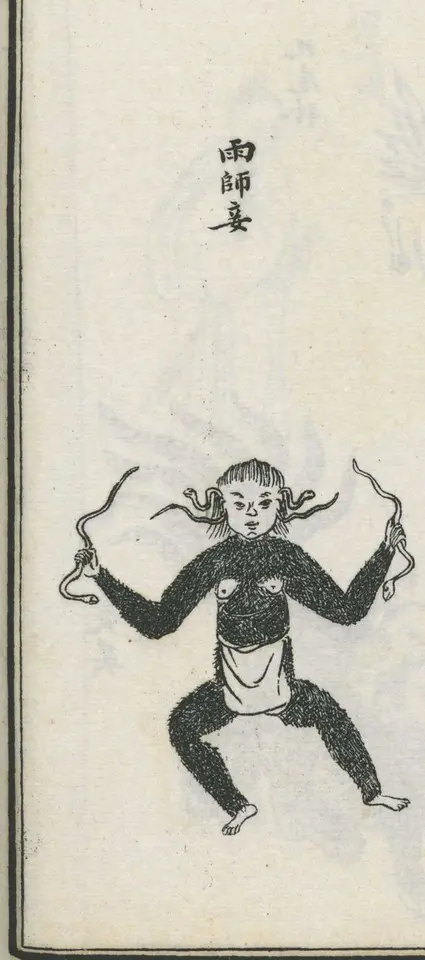
The Shanhaijing is a guide to a world of strange peoples and spirits, compiled between the Warring States and the early Han. When it reaches the four seas at the edge of the earth, it gives each sea a god, and it draws all four the same way. The god of the Northern Sea, Yuqiang 禺彊, has “a human face and a bird’s body; he wears two green snakes at his ears and treads on two green snakes.” The gods of the east, south and west differ only in the colour of their snakes. The Rain Master’s consort, Yushi Qie 雨師妾, is black, “holds a snake in each hand, has a green snake at the left ear and a red snake at the right.” (Shanhaijing, Chinese Text Project)

Three verbs carry the whole image: 操 cao, to grip; 珥 er, to wear as an ear ornament; 踐 jian, to tread. A god who holds, wears and stands on serpents is a god who commands them, and in these texts that command belongs to the powers of sea, rain and the edges of the world.

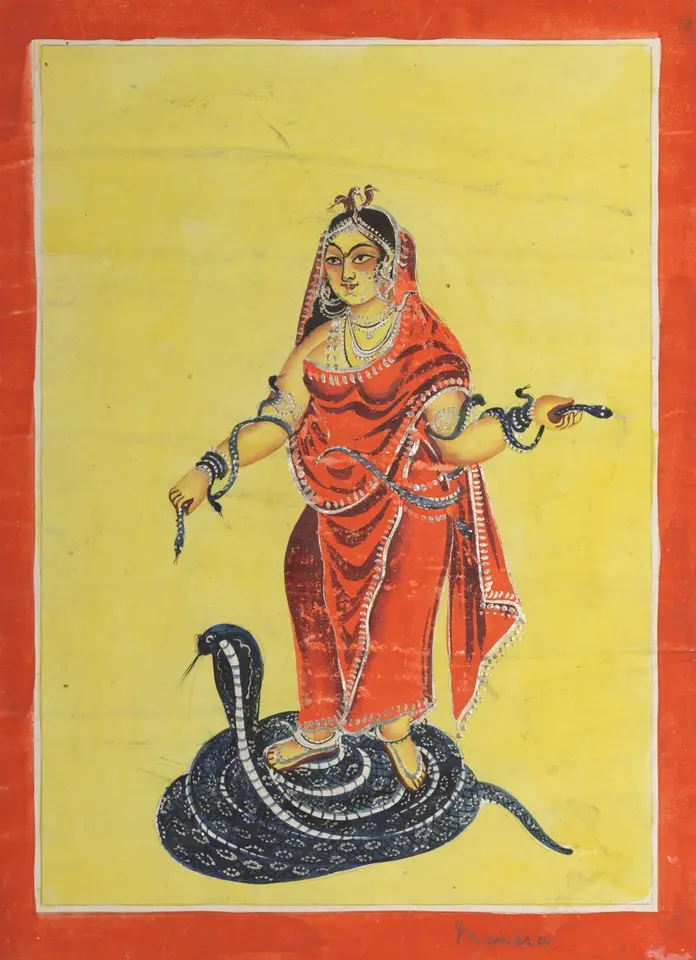
The poses are not Chinese property. A frontal figure gripping a snake in each fist is one of the oldest images of power in western Asia. It is cut into the chlorite vessels of Jiroft and the bronze seals of Bactria around 2500–1700 BCE, and it is the stance of the faience goddess of Knossos. Snakes at the ears reappear on the far side of the Pacific. Treading on the serpent is the posture of Horus on the crocodiles, of Krishna on Kaliya and of the Bengali snake goddess Manasa. I have made the case elsewhere that this whole family of images descends from a cult that handled real snakes; see The Snake Cult of Consciousness. Here the plates are allowed to speak for themselves.

Where the masters of serpents are found #

The map shows each object or rite in the gallery. Switch the poses on and off. Amber discs mark rites in which the bullroarer sounds in the same ceremony as the serpent.

Map / Masters of serpents

Where the serpent is held, worn and heard

World map of the master-of-serpents figure, centred on 60°EA dot-matrix world map centred on the Iranian plateau, with the Americas at the left edge and Japan and Australia at the right. 61 points mark objects and rites in which a figure holds snakes, wears them at the ears or on the body, treads on them, or grows them from the body. 27 bright points mark a snake held in the hand; they run in a band from Crete and Mesopotamia through Iran and Bactria to China. 5 amber points mark rites in which a bullroarer sounds alongside the snake: Athens, the Dogon of Mali, the Hopi at Walpi, and Wadeye and Arnhem Land in northern Australia. Birger figurineMexica: Coatlicue, CoyolxauhquiOlmec, La Venta Monument 19Maya, Yaxchilan Lintels 24–25MocheChavín: Raimondi Stela, LanzónParacas Oculate BeingRomano-British godGallo-Roman godFon, Temple of PythonsFon female figureBenin head for OsunCorfu GorgonOlympias’ Dionysiac ritesScythian snake-legged goddessScythian horse frontletAkkadian sealNingishzidaElamite god at KurangunZahhak (Shahnameh)Bactria-Margiana openwork sealKushan NagarajaKrishna subduing KaliyaPala Manasa bronzeTibetan MahakalaMal’ta plaqueEvenki shaman costumeXuanwu, the Dark WarriorPaiwanPaiwan Nanai shaman robeMiddle Jōmon figurinesMaya, Copán Stela FMami WataGundestrup cauldronEtruscan TuchulchaSmiss picture stoneMinoan snake goddessesKnossos Qetesh stelaHorus on the crocodilesRamesseum figurineLamashtu plaqueKhafajah chlorite boxJiroft chlorite vesselTillya Tepe “Master of Dragons”Bactria-Margiana bird-man sealBactria Bactria-Margiana winged heroBactria-Margiana openwork sealVatuka BhairavaManasa, Kalighat paintingTianhuishan tomb guardianShanhaijing godsShanhaijing Changtaiguan tomb guardianChu dagger-axeLeigudun tomb 2 bellMawangdui tomb 1Huaiyin Gaozhuang bronzesHuaiyin Hopi Snake-Antelope riteWalpi Dogon Great MaskDogon Dionysiac and Sabazian mysteriesAthens Murinbata Karwadi riteWadeye YolnguYolngu
  • Bullroarer in the same rite (5)
  • Snake held in the hand (27)
  • Snakes at the ears
  • Snakes underfoot
  • Snakes from the body
  • Snakes worn or coiled round
  • Other serpent figures
Objects, images and rites in which a figure holds, wears, treads on or grows serpents, from a gallery selection and its research notes; it is not a census. Dots mark approximate findspots or homelands, and unprovenanced objects and texts sit at the centre of their culture. Clusters partly track where museums collected and published, so Mesopotamia, Bactria and Hubei look denser than the record may be.

Download the data (CSV)

Two patterns stand out. Holding a snake in each hand is densest in a band from the Iranian plateau to Bactria in the third and second millennia BCE, the overland road toward China, with outliers in Crete, Egypt and Gotland. Snakes at the ears, the Shanhaijing’s signature, are absent from the Near East; their closest matches are on the Pacific rim, among the Paiwan of Taiwan and the Moche of Peru.

1. A snake in each hand #

The cleanest form of the motif: a frontal figure, arms out, gripping one serpent on each side. It is densest in Iran and Bactria. The Jiroft and Khafajah vessels show it travelling as trade goods into Sumer, a real road for the image.
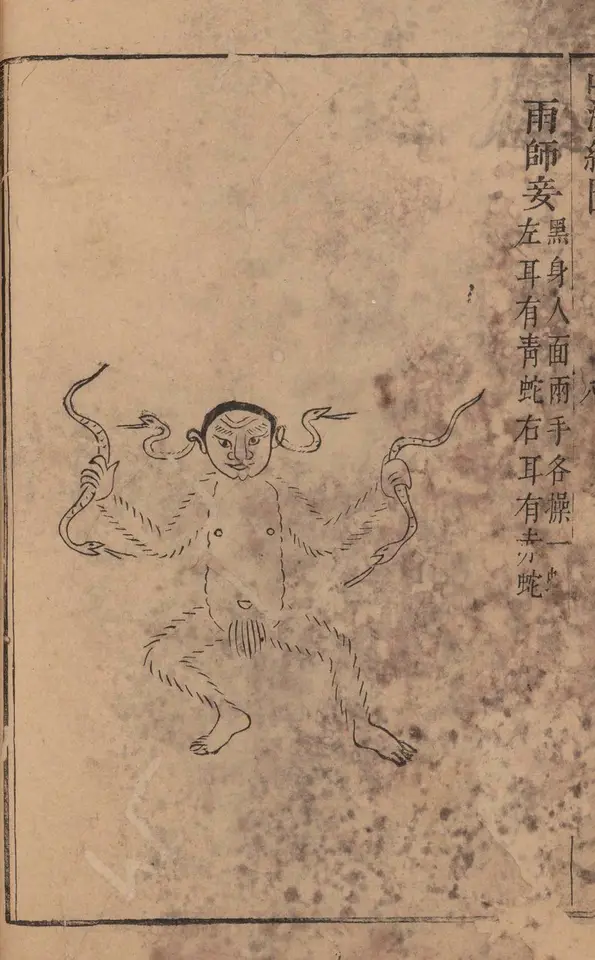
Woodcut of a hairy figure with a snake through each ear and a snake in each hand.
Chinatext c. 3rd c. BCE · print 1667 Yushi Qie 雨師妾, the Rain Master’s consort: “holding a snake in each hand, a green snake at the left ear, a red at the right.” Wu Renchen’s edition.Woodcut, Wu Renchen edition, 1667
Woodcut of a black squatting figure gripping a snake in each hand, snakes at the ears.
Chinaprint 1895 Yushi Qie again, in Wang Fu’s edition.Woodcut, Wang Fu edition, 1895
Round openwork bronze seal: a bird-headed man holding a wavy snake in each hand.
Afghanistanc. 2000–1500 BCE Bird-headed man with snakes, Bactria-Margiana compartmented seal (LACMA). A bird-man with a snake in each hand: the nearest thing anywhere to the Shanhaijing’s bird-bodied snake gods.Los Angeles County Museum of Art · Public domain · Wikimedia Commons
Stone stamp seal carved with a winged nude figure flanked by rearing snakes.
Bactriac. 2300–1700 BCE Nude winged hero dominating snakes, Bactria-Margiana stamp seal (Met 1986.311.2).Metropolitan Museum of Art · Public domain · Wikimedia Commons
Openwork bronze seal: a frontal figure in a ring of snakes, holding them at each side.
Bactriac. 2300–1700 BCE Figure holding snakes, openwork seal (Met 1983.535.107).Metropolitan Museum of Art · Public domain · Wikimedia Commons
Openwork metal seal of a standing figure with wavy forms rising from the shoulders.
Bactriac. 2300–1700 BCE Horned god with serpents, Bactria-Margiana openwork seal (Met 1984.4). A kilted god grips zigzag serpents with arrow heads, and more rise from his shoulders and hang under his arms. The Met allows they may be lightning.Metropolitan Museum of Art · Public domain · Wikimedia Commons
Carved chlorite vessel with a bull-horned figure grasping two spotted snakes that coil around him.
Iranc. 2500 BCE Bull-horned man gripping two spotted serpents, Jiroft (Halil Rud) chlorite vessel. Seized from looters, so it has no findspot.Zereshk · CC BY-SA 3.0 · Wikimedia Commons
Chlorite box carved with a frontal figure on two zebu, arms out, grasping undulating snakes.
Iraq / Iranc. 2600–2400 BCE Khafajah chlorite box (British Museum). Made in the Iranian “intercultural style” and traded to Sumer: a figure astride zebu, grasping snakes (or streams) in both hands.The Trustees of the British Museum · CC BY-SA 4.0 · Wikimedia Commons
Faience figurine of a bare-breasted woman in a flounced skirt raising a snake in each hand.
Cretec. 1600 BCE Snake goddess, Knossos Temple Repositories (Heraklion HM 65). A snake raised in each hand. Head and parts of the arms are restored.Chris 73 · CC BY-SA 3.0 · Wikimedia Commons
Faience figurine with snakes winding over her arms and body and one on her tall headdress.
Cretec. 1600 BCE Her larger companion (HM 63): snakes wind over arms, body and headdress.Jerzystrzelecki · CC BY-SA 4.0 · Wikimedia Commons
Bronze plaque with registers of demons; below, a lion-headed demoness holding snakes, kneeling on a donkey.
Assyria9th–7th c. BCE Lamashtu on the Louvre “underworld plaque”: the lion-headed demoness holds a snake in each hand. An amulet to guard mothers and infants.Rama · CC BY-SA 3.0 fr · Wikimedia Commons
Wooden figurine of a nude woman with a lion mask, holding a bronze snake in each fist.
Egyptc. 1700 BCE Lion-masked woman with snakes, from the Magician’s Tomb under the Ramesseum, Thebes (Manchester Museum 1790). She grips a bronze snake in each fist and was buried with spells, ivory wands and a box of reed pens.Courtney McRae · CC BY-SA 4.0 · Wikimedia Commons
Stone stela: the naked child Horus stands on crocodiles, holding snakes and scorpions in his fists.
Egypt664–30 BCE Horus on the crocodiles (Met cippus). The boy grips snakes and scorpions in both fists and treads on crocodiles. Water poured over the stone was drunk as a cure for bites.Metropolitan Museum of Art · Public domain · Wikimedia Commons
Red-painted picture stone: a splay-legged frontal figure holding a large snake in each hand.
Gotland, SwedenAD 400–600 The Smiss “snake-witch” stone, När parish. A frontal splayed figure, a snake in each hand. Lindquist compared it to the Cretan goddess in 1955.Berig · CC BY-SA 3.0 · Wikimedia Commons
Pair of gold pendants: a crowned figure grasping two S-shaped dragons by the neck.
Afghanistan1st c. CE “Master of dragons”, Tillya Tepe tomb II: a crowned figure grasps two S-dragons by the neck. A late echo on the Silk Road.World Imaging · CC BY-SA 3.0 · Wikimedia Commons
Colour print of a long-haired woman with a huge snake rising over her shoulders, gripped in both hands.
West Africaprint 1880s Mami Wata. A Hamburg circus poster of a snake charmer became the image of the African water spirit. Diffusion by print, not deep time, but it shows how fast the pose is recognised.Public domain · Wikimedia Commons

Read more: Serpents as Control-Surfaces on the Iranian Plateau covers Jiroft’s snake-handling hero; Venom & Valhalla covers the Gotland stone, Qetesh and the Mistress of Animals.

2. Snakes at the ears #

珥兩蛇, “two snakes worn at the ears,” is the Shanhaijing’s signature. It is missing from the Near Eastern record. Its closest matches lie east, across the Pacific: Paiwan ancestors framed by paired vipers at the head, and Moche lords who wore gold snakes in their ears.
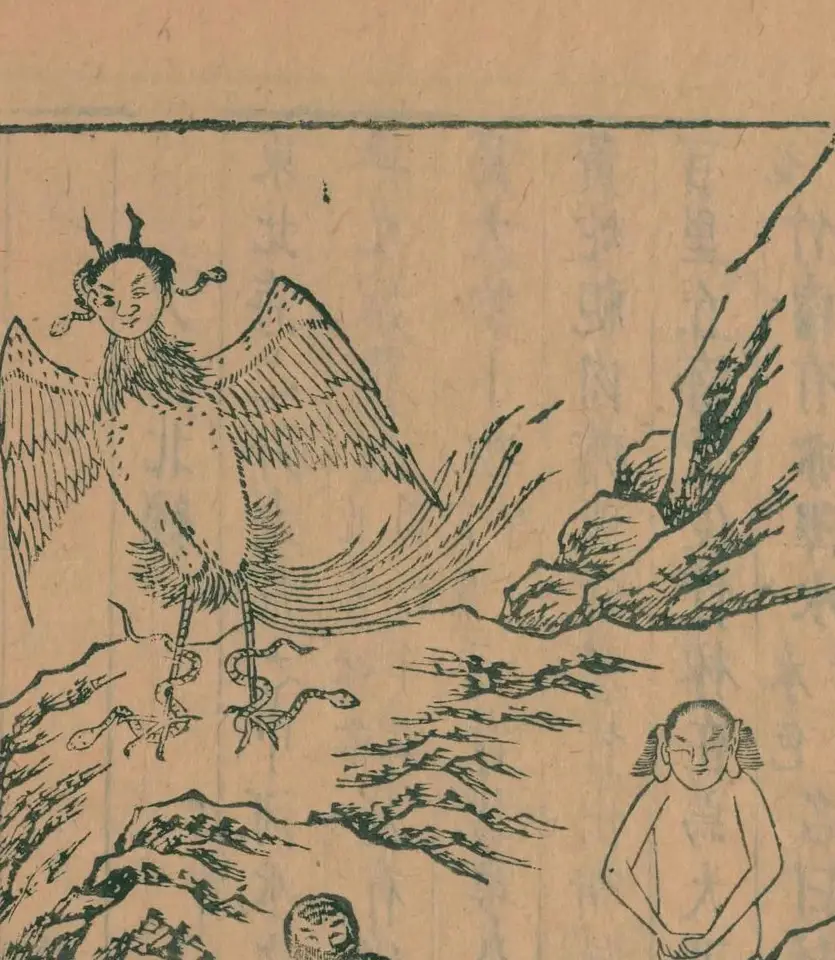
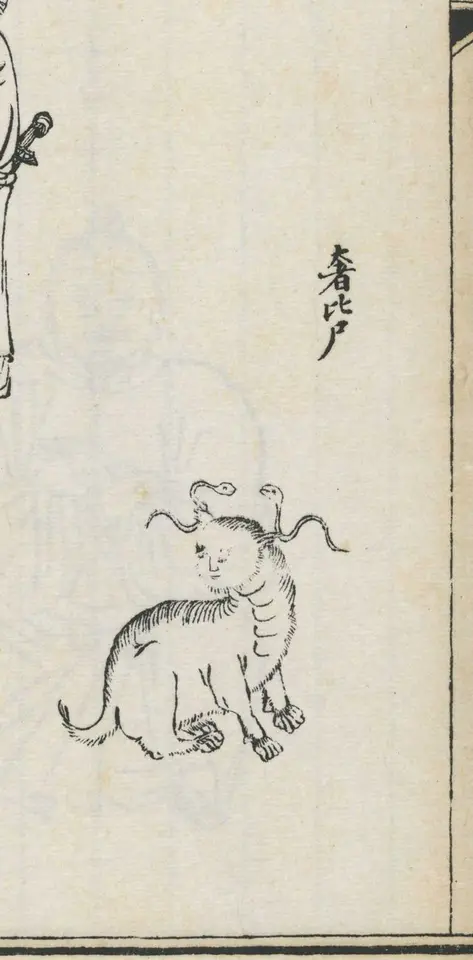
Woodcut of a human-faced bird with snakes at its ears, gripping a snake under each claw.
Chinaprint 1597 Yuqiang 禺彊, god of the Northern Sea: human face, bird body, two snakes at the ears, two underfoot.Woodcut, Jiang Yinghao edition, 1597
Woodcut of a human-faced beast with a snake curling from each ear.
Chinaprint 1895 Shebi Shi 奢比尸, “big ears, two green snakes in the ears.”Woodcut, Wang Fu edition, 1895
Carved wooden pillar: a frontal face with two diamond-backed snakes arching up from the shoulders past the ears to meet at the crown.
Taiwan19th–20th c. Paiwan ancestor pillar (National Taiwan Museum). Two hundred-pacer vipers rise past the ears to meet at the crown. The viper is the ancestor of the Paiwan nobility.氏子 · CC BY-SA 4.0 · Wikimedia Commons
Dark carved panel: a frontal ancestor with a feather headdress, a snake running down each side from head to foot.
Taiwan20th c. Paiwan house-pillar panel (Musée du quai Branly). A pair of vipers runs from beside the head down each flank to the feet.Sailko · CC BY 3.0 · Wikimedia Commons
Wooden box lid carved with two frontal human figures inside a border of diamond-backed snakes.
Taiwan20th c. Paiwan shaman’s box, the kit of a female healer (pulingaw): human figures ringed by vipers.氏子 · CC BY-SA 4.0 · Wikimedia Commons
Gold ear ornament shaped as a snake with an incised head.
Peruc. 100–800 CE Moche gold snake ear ornament (Musée des Amériques, Auch). A real snake for the ear.Didier Descouens · Public domain · Wikimedia Commons
Painted adobe relief of a fanged frontal face in a diamond frame.
Peruc. 100–800 CE Ai Apaec, the Decapitator, Huaca de la Luna: the Moche god with serpent earrings and a snake-headed belt.Tyler Bel · CC BY 2.0 · Wikimedia Commons

Read more: Nüwa and Fuxi gathers the serpent-bodied ancestors of early China.

3. Snakes underfoot #

踐兩蛇, “treading on two snakes.” Standing on the serpent is the gesture of the dragon-tamer. In Egypt and India it carries a specific charge: mastery of venom, and of the water the serpent poisons or withholds.
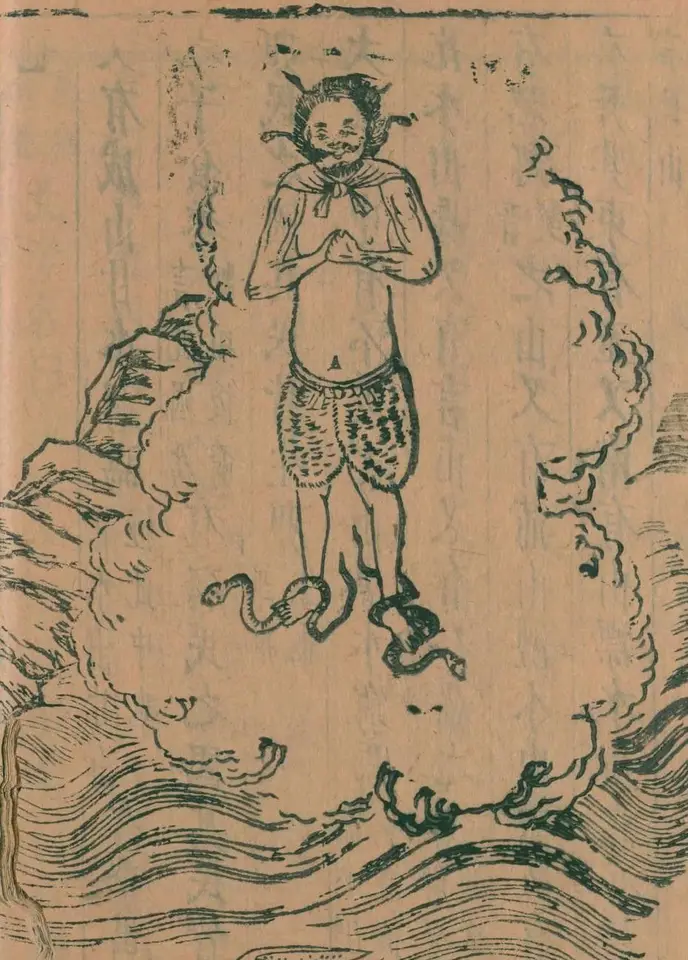
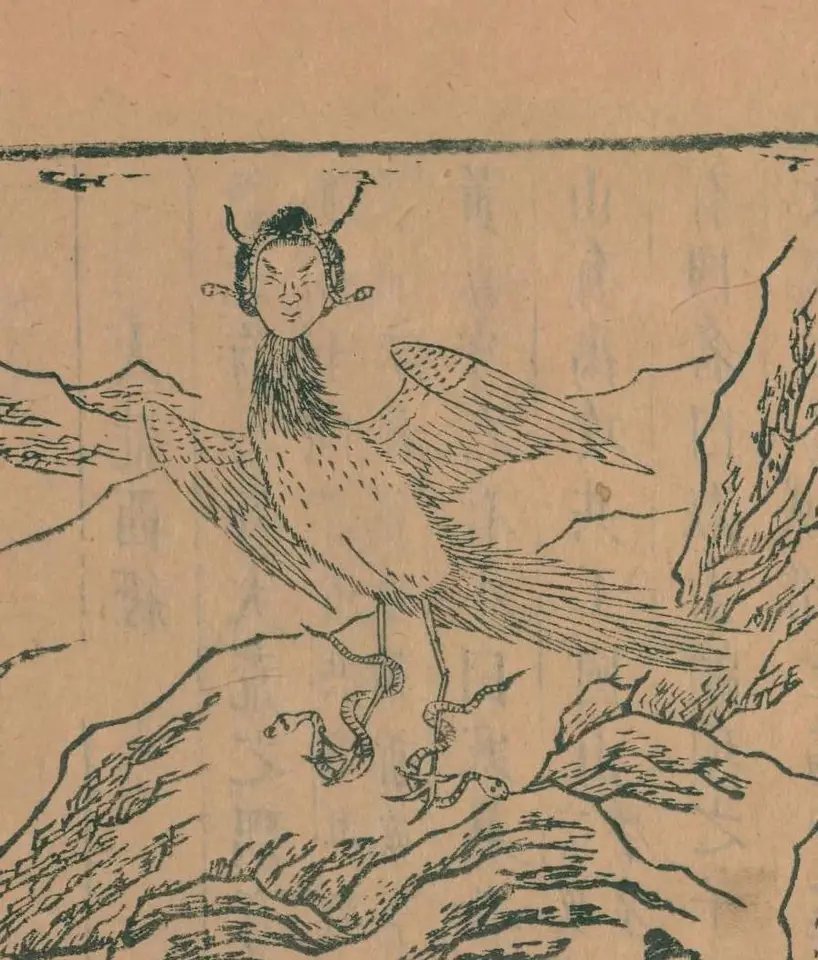
Woodcut of a man on a cloud over the sea, a snake at each ear and a snake under each foot.
Chinaprint 1597 Buting Huyu 不廷胡余, god of the Southern Sea, “treading on two red snakes.”Woodcut, Jiang Yinghao edition, 1597
Woodcut of a long-tailed human-faced bird gripping a snake under each claw.
Chinaprint 1597 Yanzi 弇茲, god of the Western Sea, a snake under each claw.Woodcut, Jiang Yinghao edition, 1597
Watercolour of a goddess in a red sari standing on a coiled black snake, small snakes in her hands.
Bengal, India19th c. Manasa, Kalighat painting (Cleveland). The goddess of snakebite stands on a snake with snakes in her hands. Her puja falls in the monsoon month.Cleveland Museum of Art · Public domain · Wikimedia Commons
Green-patinated bronze shrine: a seated goddess with a child under a canopy of cobra hoods.
Bihar / Bengal10th c. Manasa with her son Astika under a canopy of cobra hoods, Pala bronze (Linden-Museum).KarlHeinrich · Public domain · Wikimedia Commons
Gilded figure of a blue god dancing on the hoods of a many-headed serpent.
India17th c. Krishna subduing Kaliya (Met). He dances on the serpent’s hoods and cleanses the poisoned Yamuna pool.Metropolitan Museum of Art · Public domain · Wikimedia Commons
Red stone figurine of a kneeling woman hoeing the back of a feline-headed serpent.
Illinois, USAc. 1100–1200 CE Birger figurine, Cahokia. A woman kneels on a feline-headed serpent and hoes its back, and its tail turns into squash vines.TimVickers · Public domain · Wikimedia Commons
Egyptian stela: a frontal nude goddess standing on a lion, holding snakes and flowers.
Egypt / Levantc. 1300–1200 BCE Qetesh on her lion (Louvre C 86), holding snakes in one hand and flowers in the other.Rama · CC BY-SA 3.0 fr · Wikimedia Commons

Read more: Snakes That Bestow Beast-Speech on Kaliya’s venom; Herakles, Adam, and Krishna were initiated.

4. Snakes from the body #

Zahhak’s shoulder snakes are the famous case, but the image is two thousand years older than the Shahnameh. A Sumerian god led Gudea of Lagash with serpents rising from his shoulders. In Gaul and on the Black Sea steppe the snakes become the legs themselves.

Stone relief fragment of a god in profile with snake heads rising from his shoulders.
Iraqc. 2150–2100 BCE Ningishzida on a relief of Gudea of Lagash: snake heads rise from both shoulders. Wiggermann groups him with the “Transtigridian” snake gods of the Iranian border.Osama Shukir Muhammed Amin FRCP(Glasg) · CC BY-SA 4.0 · Wikimedia Commons
Blue cylinder seal with gods whose hands and feet end in snakes.
Iraqc. 2350–2150 BCE Akkadian seal: a snake god and deities whose hands and feet are snakes (Met 55.65.5).Metropolitan Museum of Art · Public domain · Wikimedia Commons
Persian miniature detail: an old crowned king in blue between attendants, a snake rising from each shoulder.
IranShahnameh c. 1010 · painting c. 1525–35 Zahhak, attributed to Mir Musavvir, from the Shahnameh of Shah Tahmasp. The devil kissed his shoulders and a snake grew from each, to be fed on human brains. Here the old tyrant sits in his palace on the night of his nightmare.Mir Musavvir · Public domain · Wikimedia Commons
Worn stone relief of a god whose legs are two ram-horned snakes rearing up beside his head.
EnglandRoman period Cirencester relief (Corinium Museum): the god’s legs are two ram-horned snakes that rear up to feed beside his head. “Possibly Cernunnos.”Tony Grist · Public domain · Wikimedia Commons
Gold plaque of a frontal goddess whose lower body ends in two coiling serpent tails.
S. Russia4th c. BCE Scythian snake-legged goddess, gold plaque (Ivanovskaya). Herodotus’ half-maiden, half-snake mother of the Scythians, who bore their ancestor to Herakles.shakko · CC BY-SA 4.0 · Wikimedia Commons
Massive Aztec stone statue: a skirt of woven rattlesnakes, the head formed by two facing serpent heads.
Mexicoc. 1500 Coatlicue, “Snake Skirt”. Where her head was severed, two serpents rise from the neck and meet to form a face.Juan Carlos Fonseca Mata · CC BY-SA 4.0 · Wikimedia Commons

Read more: Serpent Sovereignty on the Iranian serpent grammar behind Zahhak; The Serpents Who Founded the Human World on Herodotus’ snake-bodied mother of the Scythians.

5. Snakes worn, held and carried #

Belts, diadems and live snakes on the shoulders. In Greece this is the dress of the Dionysiac mysteries, the same mysteries whose sacred toys included the rhombos, the bullroarer. In Mesoamerica and the Andes the serpent rises from the headdress or opens its jaws around the seated lord.

Limestone pediment: a running Gorgon with a belt of knotted snakes and snakes at her neck.
Corfu, Greecec. 590–580 BCE Gorgon of the Artemis temple, mistress of animals between lions: a belt of two knotted snakes and a pair at her neck.Dr.K. · CC BY-SA 3.0 · Wikimedia Commons
White-ground cup: a dancing maenad with a snake tied round her head, swinging a panther.
Greece490–480 BCEbullroarer Maenad by the Brygos Painter (Munich 2645), a snake bound round her hair. Euripides’ maenads “girdled their fawnskins with snakes.”Brygos Painter · Public domain · Wikimedia Commons
Silver cauldron plate: a cross-legged antlered figure holds a torc and grasps a ram-horned snake.
Denmarkc. 150–1 BCE Gundestrup cauldron: the antlered god holds a torc in one hand and grips a ram-horned serpent in the other.Bloodofox (derivative of Fuzzypeg) · CC BY-SA 3.0 · Wikimedia Commons
Drawing of an Etruscan tomb painting: a winged demon brandishing a snake at a seated hero.
Etruria, Italyc. 325–300 BCE Tuchulcha, Tomb of Orcus II, Tarquinia: an underworld demon with snakes in its hair, brandishing one at Theseus.Schulz dis. e inc. · Public domain · Wikimedia Commons
Grey stone four-armed deity holding a snake in one upper hand and a drum in the other.
South Indiac. 13th c. Vatuka Bhairava, a form of Shiva: a snake in one upper hand, the damaru drum in the other.SpeakingArch · CC BY-SA 4.0 · Wikimedia Commons
Indian painting of a green-winged bird-man carrying snakes, with gods in his plumage.
Indiac. 1750 Garuda carrying Shiva’s snakes. A bird-man master of serpents, like the Bactrian seal.thesandiegomuseumofartcollection · Public domain · Wikimedia Commons
Red sandstone figure of a serpent king under a hood of cobras.
Mathura, Indiac. 207 CE Nagaraja, serpent king under a cobra hood, worshipped at tanks and wells as a lord of rain.Mary Harrsch from Springfield, Oregon, USA · CC BY 2.0 · Wikimedia Commons
Carved stone stela: a frontal staff-holding god with snakes springing from his towering headdress.
Peruc. 500–200 BCE Raimondi Stela, Chavín: the frontal Staff God, a staff in each hand, snakes springing from his headdress and forming his belt.Ariadnayteseo · CC BY-SA 3.0 · Wikimedia Commons
Olmec relief: a seated man inside the coils of a crested rattlesnake.
Mexicoc. 900–400 BCE La Venta Monument 19, Olmec: a man seated within the coils of a crested rattlesnake.Gary Tod · Public domain · Wikimedia Commons
Maya limestone lintel: a kneeling noblewoman draws a thorned rope through her tongue before a lord.
Mexicoc. 723–726 CE Yaxchilan Lintel 24: Lady K’ab’al Xook’s bloodletting. On Lintel 25 the Vision Serpent rises from her offering bowl.Michel wal · CC BY-SA 3.0 · Wikimedia Commons
Small metal figure of a woman entwined with a long snake, on a tripod base.
Beninlate 19th c. Fon female figure with snakes (Brooklyn 37.366).Brooklyn Museum · CC BY 3.0 · Wikimedia Commons
A man with a royal python draped round his neck and shoulders.
Beninliving practice Temple of Pythons, Ouidah: the royal python worn on the shoulders, the living form of the vodun Dangbe.Ji-Elle · CC BY-SA 4.0 · Wikimedia Commons
Brass head with snakes issuing from the face and crown.
Nigeria18th c. Benin head for Osun, god of medicine (British Museum): snakes eating frogs issue from the eyes, nostrils and ears.Vassil · Public domain · Wikimedia Commons

Read more: The Serpent in the Snuff on Chavín; The Olmec Mysteries and the Serpent Before Quetzalcoatl; The Serpent Is the Road on the Maya Vision Serpent.

6. Early China in bronze and lacquer #

The Shanhaijing is a text. These are objects from the same centuries and earlier.
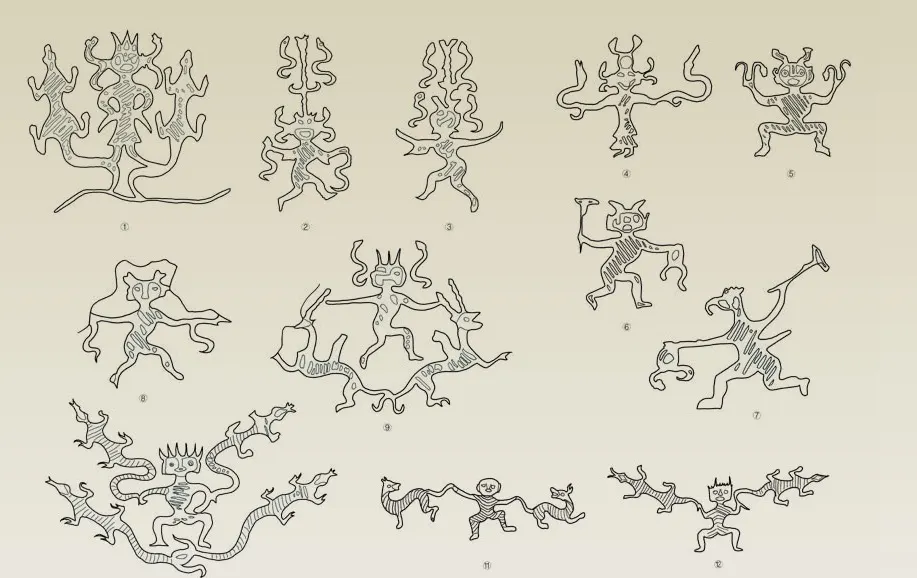
Tracings of twelve small gods engraved on bronze, with snakes at their ears and snakes or lizards in their hands and under their feet.
Jiangsu, China4th c. BCE The Gaozhuang gods, engraved on thin bronze vessels from a Warring States tomb at Huaiyin. They wear snakes at their ears, grip snakes or lizards in both hands, tread on more, or hold an axe and a snake: the Shanhaijing formula in the text’s own century. Tracings after the excavation report.After the excavation report (Kaogu xuebao 1988.2), via Zhang 2025
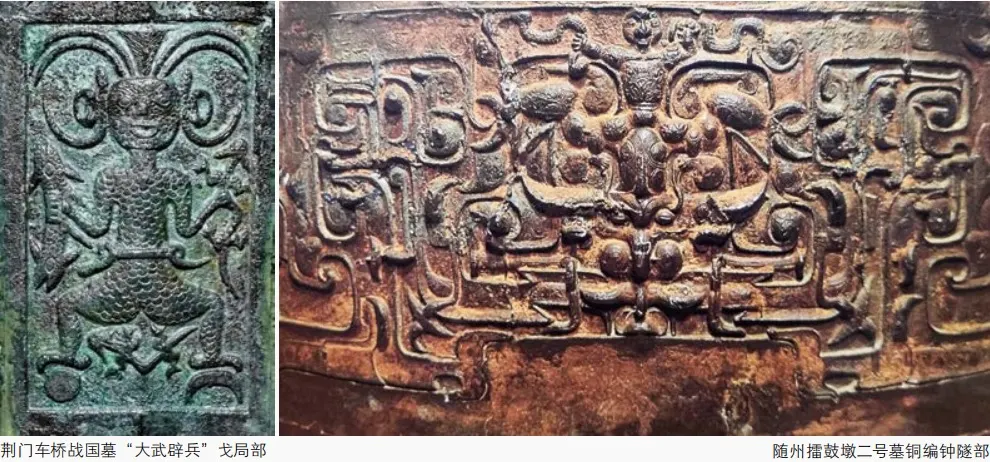
Two details: a frontal god on a dagger-axe gripping creatures, and a god on a bell panel holding a snake in each hand.
Hubei, Chinac. 400 BCE Left: the Chu dagger-axe from Jingmen. A frontal war god wears snakes at his ears, grips a lizard and a two-headed fish, and stands on the sun and moon. Right: a bell from Leigudun tomb 2, Suizhou. An armoured god stands on an ox head and grips a snake in each hand.Details via Zhang 2025
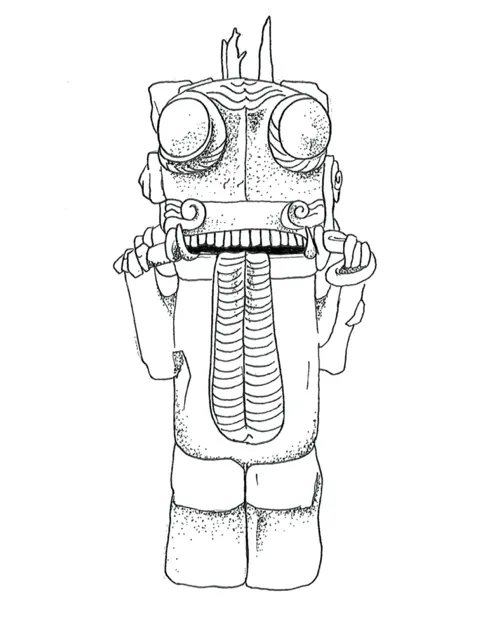
Line drawing of a kneeling antlered beast with a long tongue, clutching a snake in its claws and teeth.
Henan, Chinaearly 4th c. BCE Changtaiguan tomb guardian, tomb 1, Xinyang. An antlered beast with a lolling tongue grips a snake in its claws and bites it.Drawing by Zay Olsen after Xinyang Chu mu pl. 58, in Chaffin 2023
Detail of a painted silk banner: a squat giant holds up a platform astride two great fish, red snakes coiling round him.
Hunan, Chinac. 168 BCE Mawangdui banner giant, tomb 1, Changsha. He holds up the earth astride two great fish, red snakes coiling round him. Some read him as Yuqiang.Public domain · Wikimedia Commons
Red lacquer coffin panel painted with spirit beasts among cloud scrolls.
Hunan, Chinac. 168 BCE Mawangdui tomb 1, the second coffin: guardian spirits among clouds, some grasping and biting snakes.Gary Todd from Xinzheng, China · Public domain · Wikimedia Commons
Small square bronze plaque cast with a frontal face ringed by coiling forms.
ChinaWarring States Yuqiang seal: a Warring States bronze image seal labelled 禺彊 by the Shanghai Museum. A frontal face sits on a bird’s spread wings, ringed by coils: the human-faced bird god of the Northern Sea.Augusthaiho · CC BY-SA 4.0 · Wikimedia Commons
Lacquered wooden tomb guardian with a squared base and real deer antlers.
Hubei, China4th–3rd c. BCE Two-headed Chu tomb guardian (鎮墓獸), Jiangling, Hubei, lacquered wood with real deer antlers (Portland Art Museum). Its cousin from Changtaiguan, below, has the snake.Daderot · Public domain · Wikimedia Commons
Bronze seated Daoist god resting his feet on a tortoise entwined by a snake.
ChinaYuan, 13th–14th c. Xuanwu, the Dark Warrior of the north and lord of water, with the tortoise and snake under his feet (Inner Mongolia Museum). The north again, as with Yuqiang.BabelStone · CC BY-SA 3.0 · Wikimedia Commons

The Gaozhuang tomb was excavated in 1978. Its gods are engraved on hammered bronze less than a millimetre thick, on a dish, a ewer and sieve-shaped vessels, and they fall into three types: gods with snakes in both hands or at the ears, sometimes with snakes underfoot; gods with an axe in one hand and a snake in the other; and gods who grip a beast in each hand. Zhang Lusheng gathers them with the Jingmen and Suizhou gods under the heading “the gods of mountains and seas all hold snakes.”1 The axe-and-snake god survives into the Eastern Han. A tomb guardian from a cliff tomb at Tianhuishan, Chengdu, stood about a metre tall with an axe in one hand, a snake in the other and a tongue hanging below his waist. Only his head is now on display, in the Sichuan Museum.

Farther north and east, Middle Jōmon figurines from the Yatsugatake foothills of Nagano, about 4,700 years old, wear a coiled snake on the crown of the head. Evenki shaman costumes in Siberia hang snake-headed strips down the back for the shaman’s journey through the worlds, and a Nanai robe shows the guide spirit Buchu riding a serpent.

7. The roaring serpent #

In several rites the snake-handler and the bullroarer stand in the same ceremony. These are the plates where the gesture and the sound meet.

Old photograph of a Hopi Snake priest dancing with a live snake held in his mouth.
Arizona, USAphoto c. 1900bullroarer Hopi Snake priest with a live snake in his mouth. In the nine-day Snake-Antelope rain rite at Walpi the Antelope priest whirls the bullroarer at the altar and on the kiva roof, it has its own “whizzer song,” and a whizzer-bearer walks with the novices at the public Snake Dance (Fewkes 1894, pp. 33, 89, 100). atlas recordHartwell & Hamaker · Public domain · Wikimedia Commons_-Hartwell%26_Hamaker,_Phoenix,_Ariz_LCCN90710791.jpg)
Old photograph of the Snake Dance at Walpi with crowds on the rooftops.
Arizona, USA1890bullroarer The Snake Dance at Walpi, photographed by Ben Wittick. Fewkes called it “an elaborate prayer for rain.”Ben Wittick · Public domain · Wikimedia Commons
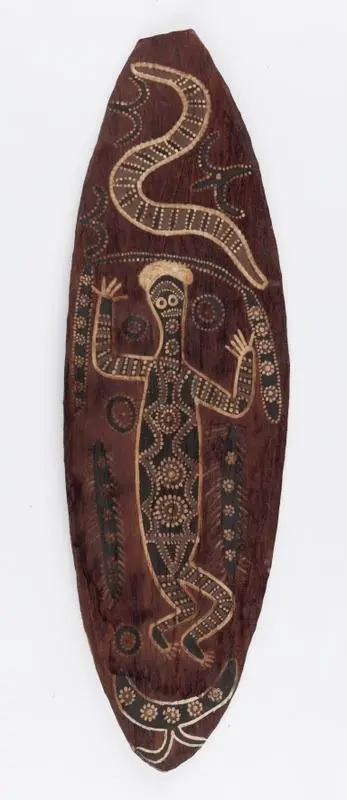
Bark painting: a frontal human figure with arms raised, a dotted snake arching over it, bullroarer shapes at its sides.
NT, Australia1967bullroarer Nym Bunduck, “Figure, snake and bullroarers” (Art Gallery of Western Australia), Wadeye. A frontal figure with a serpent arching over it and bullroarers at its sides. Bunduck was Stanner’s teacher in the Karwadi rite. atlas recordArt Gallery of Western Australia · collection record
Drawing of an ivory plaque engraved with three wavy snakes and a perforation.
Siberia, Russiac. 23,000–19,000 years ago Mal’ta plaque: mammoth ivory engraved with three snakes. No handler, but the serpent is already there at the Ice Age.Robert G. Bednarik · CC BY-SA 3.0 · Wikimedia Commons

Two more cases have no plate. Among the Yolngu of Arnhem Land, the python-painted roarer swung on its cord is the voice of the great snake Yurlunggur, who swallowed the Wagilag sisters and spat the first monsoon clouds into the sky (Bullroarer Atlas record). Among the Dogon of Mali, the Great Mask holds the soul of the first ancestor, who died in the form of a serpent, and its voice is the whirled rhombe (Griaule 1938).

In Greece, Clement of Alexandria quotes the Orphic verses that list the rhombos among the toys of the child Dionysus, symbols of his mysteries. Demosthenes mocks Aeschines for squeezing fat-cheeked snakes and lifting them over his head in his mother’s initiations, crying “euoi saboi” (On the Crown 259–260). The Gurob papyrus puts both in a single rite: a god drawn through the initiate’s robe, and a bullroarer in the sacred basket.

Read more: The Snake, the Roar, and the Mirror; The ‘Snake Venom Entheogen’ Theory in Ancient Mystery Cults; Eve’s Serpents on the Hopi Snake Dance; The God Behind the Rainbow. On the Bullroarer Atlas: The Serpent’s Voice, Live Snakes, Serpents and Bullroarers in Hopi and Greek Ritual, The God Through the Bosom and The Rainbow Serpent.

Who has said it is one type #

Few scholars have put the serpent-holder on one map. These came closest.

  • Balaji Mundkur, “The Cult of the Serpent in the Americas: Its Asian Background,” Current Anthropology 17 (1976), and The Cult of the Serpent (1983). He rejected late contact and argued that the unity of American snake cults points to old Asian roots carried across Beringia.
  • K. C. Chang, Art, Myth, and Ritual (1983). He read the Shanhaijing figures who wear and grasp snakes as shamans with animal helpers, part of a shamanic layer shared around the Pacific.
  • Carl Hentze, Mythes et symboles lunaires (1932) and Objets rituels, croyances et dieux de la Chine antique et de l’Amérique (1936). He set Shang serpent and tongue motifs beside Mesoamerican, Northwest Coast and Andean art.
  • Ling Chunsheng 凌純聲. His “circum-Pacific culture” tied the snake-totem Bai Yue of south China to Taiwan and Oceania.
  • Viktor Sarianidi, Myths of Ancient Bactria and Margiana on its Seals and Amulets (1998). He read the Bactrian snake-master seals as one mythology shared with Elam and Mesopotamia.
  • Philip Kohl (1978) and Pierre Amiet (1986). They traced the snake-and-figure chlorite of Jiroft and Tepe Yahya into Sumer.
  • F. A. M. Wiggermann, “Transtigridian Snake Gods” (1997). He gathered the shoulder-snake gods into one complex on the Iranian border.
  • Nanno Marinatos, The Goddess and the Warrior (2000). She joined the Minoan snake goddess, the Gorgon as mistress of animals and the Levantine Qetesh type.
  • Marija Gimbutas, The Gods and Goddesses of Old Europe (1974). A Neolithic snake goddess running unbroken into Minoan Crete.
  • Michael Witzel, The Origins of the World’s Mythologies (2012). The serpent in the oldest “Laurasian” storyline, from Eurasia into the Americas.

Further reading #

Notes on the plates #

Images come from Wikimedia Commons, museum open-access collections, the Art Gallery of Western Australia, early printed editions of the Shanhaijing and line drawings published with Chinese excavation reports. Each plate links to its source page. Dates are the objects’; for texts and prints both are given. Region labels use modern countries for findspots. The selection is a gallery, not a census: it favours objects with good public images, so it over-represents museum collections in Europe and North America.

Sources #

  1. Shanhaijing 山海經. Chinese Text Project. Haiwai and Dahuang chapters.
  2. Fewkes, J. Walter, A. M. Stephen and J. G. Owens. The Snake Ceremonials at Walpi. Journal of American Ethnology and Archaeology 4, 1894.
  3. Evans, Arthur. The Palace of Minos, vol. 1. Macmillan, 1921, pp. 495–505.
  4. Sarianidi, Viktor. Myths of Ancient Bactria and Margiana on its Seals and Amulets. Moscow: Pentagraphic, 1998.
  5. Wiggermann, F. A. M. “Transtigridian Snake Gods.” In I. L. Finkel and M. J. Geller, eds., Sumerian Gods and their Representations. Cuneiform Monographs 7. Groningen: Styx, 1997, pp. 33–55.
  6. Kohl, Philip L. “The Balance of Trade in Southwestern Asia in the Mid-Third Millennium B.C.” Current Anthropology 19 (1978): 463–92.
  7. Marinatos, Nanno. The Goddess and the Warrior. Routledge, 2000.
  8. Mundkur, Balaji. “The Cult of the Serpent in the Americas: Its Asian Background.” Current Anthropology 17 (1976): 429–55.
  9. Chang, Kwang-chih. Art, Myth, and Ritual: The Path to Political Authority in Ancient China. Harvard University Press, 1983.
  10. Demosthenes. On the Crown 259–260.
  11. Clement of Alexandria. Exhortation to the Greeks 2.17–18, trans. G. W. Butterworth, Loeb, 1919.
  12. Euripides. Bacchae 101–104, 697–698.
  13. Griaule, Marcel. Masques dogons. Institut d’Ethnologie, 1938.
  14. Stanner, W. E. H. On Aboriginal Religion. Oceania Monographs 11, 1966.
  15. Wang Lishi 王立仕. “Huaiyin Gaozhuang Zhanguo mu” 淮阴高庄战国墓. Kaogu xuebao 1988.2: 189–232.
  16. Zhang Lusheng 张露胜. "‘山海神皆执蛇’:‘操蛇’‘衔蛇’图像与神鬼信仰". Dazhong kaogu 2025.1.
  17. Chaffin, Cortney E. “Strange Creatures of Chu.” Arts 12.1 (2023): 3.
  18. Li Xueqin 李學勤. “‘Bing bi Taisui’ ge xinzheng” “兵避太岁"戈新证. Jiang Han kaogu 1991.2.
  19. Quibell, J. E. The Ramesseum. London: Egyptian Research Account, 1898, pl. III.

  1. Zhang Lusheng 张露胜, "‘山海神皆执蛇’:‘操蛇’‘衔蛇’图像与神鬼信仰", Dazhong kaogu 2025.1. The excavation report is Wang Lishi, “Huaiyin Gaozhuang Zhanguo mu,” Kaogu xuebao 1988.2: 189–232. Wu Tong and Yu Ruibo, Yishu sheji yanjiu 2024.3: 19–27, read the engravings as a picture of the underworld rather than a lost Shanhaijing map; either way, the gods share the text’s formula. ↩︎