~/consciousness/etoc
Look at Yourself
In Central Australia an ancestor with no mother looks at himself until he becomes a great teacher, then walks from camp to camp telling the others how.
TL;DR
- Among the Unmatjera of Central Australia, the ancestor Unkurta “continually looked at himself” until he “grew into an oknirabata”, which Spencer and Gillen gloss as “a great teacher” (1904, pp. 155, 400).
- He then tells each ancestor he meets: “if you go on looking at yourself, you will become great in the flesh and an oknirabata” (p. 401). They do it, and it works.
- Their Kaitish neighbours have Illinja, who “looked at his shadow (illinja) and called himself Illinja”, and Atnatu, who “made himself and gave himself his name” and swung the first bull-roarer (pp. 409, 498–499).
- A Dieri ancestor turns serpent and “saw himself as he had never seen himself before” (Howitt 1904, p. 805). In Torres Strait mari means soul, shadow and reflection, and the Mabuiag novice is told “You think yourself” (Haddon 1904, pp. 213, 355).
- This is the Eve Theory of Consciousness told as myth: one being finds the self, and the rest are taught.
“Then, if you go on looking at yourself, you will become great in the flesh and an oknirabata.” — Unkurta to the Qualpa man, in Spencer and Gillen, The Northern Tribes of Central Australia (1904), p. 401
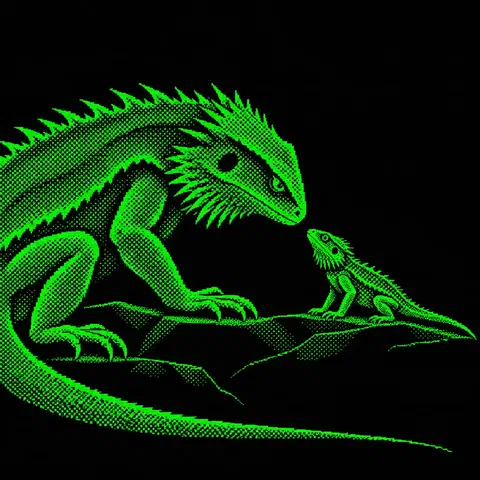
The lizard who looked at himself #
Baldwin Spencer and Frank Gillen crossed Australia from Oodnadatta to the Gulf of Carpentaria in 1901–02. North of the Arunta (Arrernte, Aranda) they worked among the Unmatjera (Anmatyerr) and the Kaitish (Kaytetye) of what is now the Northern Territory. There they wrote down a tradition they thought important enough to print twice, once in summary (p. 155) and once in full (pp. 400–403).1
It begins at Umuli-illa-unquia-inika, in the Harts Range. A man arises there in the Alcheringa, the time of the ancestors. Nobody bears him. At first he is a little lizard, and the first thing he does is look:
then he looked at himself and said “Hullo, I have got bristles like a porcupine.” At first he was stiff and could not walk, but he lay down all day long in the sunlight, and warmed himself and stretched his legs. After a time he looked at himself and saw that he was not a porcupine, but an Unkurta, a jew-lizard. — Spencer and Gillen 1904, p. 400
He looks again. This time there is something on the ground beside him:
another little Unkurta, who had come from him, and he said “Hullo, that is all the same as me”; again and again he looked, with the same result, and each time he said, “Hullo, that is all the same as me,” until finally there were a large number of Unkurtas around him, all of whom had sprung from his body. — p. 400
Then one of the copies dies, and he has to decide what a dead self is owed:
“That is me dead—I will go and bury him in the ground; no, I am too sorry to do that—I will bury him in a tree.” For a long time he remained quietly in the one spot, and continually looked at himself until gradually he increased and became great in the flesh, and grew into an oknirabata—a great and wise man. — p. 400
That is the whole method. He sits still in one spot. He looks at himself, continually, for a long time. He grows.2
What is an oknirabata? #
The word is Arunta, and Spencer and Gillen footnote it: “The name applied by the Arunta to a man old and learned in tribal customs. It means a great teacher” (p. 155 n.).
It is a working title. The order of the Arunta sacred ceremonies is “settled by a few of the leading old men who are present. Men who have had much experience and are looked upon as authorities in these matters are called oknirabata, or great teachers” (p. 179). The Warramunga (Warumungu) equivalent, purntuku, was borne by the Worgaia medicine man who led the great Wollunqua snake ceremonies in front of them (p. 22).
An oknirabata holds the ceremonies and hands them on. The tradition says how the first one got there. He looked at himself.
“If you go on looking at yourself” #
Then the great man gets up and walks.
At Unqurtunga he finds Arilkara, of the Iwuta (nail-tailed wallaby) totem, and gives him the procedure:
First of all, he told him that if he lay down quietly and went to sleep and woke up he would see another Iwuta beside him, all the same as himself, and then another and another, and so on until there were a great number of Iwutas. Then, if he continued to look at himself, he would increase in size and become great in the flesh and an oknirabata just as he, Unkurta himself, had done. — p. 401
The pupil tries it: “the Iwuta did as he had told him to do, and things happened just as he said that they would” (p. 401).
At Intukina he meets a man of the Qualpa (long-tailed rat) totem. Here the lesson is in Unkurta’s own mouth:
“My name is Unkurta; I had no mother; I have seen plenty of Unkurtas sitting down beside me, and said, These are all the same as myself; they came from me. Then for a long time I looked at myself and grew in size, until my flesh became great and I grew into an oknirabata. By and by plenty of picaninnies will come to you, as they did to me, and they will be just the same as you, and when you see them you will say, ‘Hullo, that is me,’ and, again, ‘Hullo, that is me,’ and a big crowd will sit down beside you. Then, if you go on looking at yourself, you will become great in the flesh and an oknirabata.” — p. 401
He gives the pupil the exact words to say.
At Awampana he trades names with Waratah, a small wallaby, who had made a start alone. He “had looked at himself”, seen the black hairs under his arm and concluded, “Oh, I am all the same as a wallaby.” Unkurta confirms it: “Yes, you are a wallaby all right.” The wallaby looks back and tells Unkurta he has prickly spines like a jew-lizard. Each has now been seen by another. Then “Unkurta told him to look at himself, and by and by he would see young ones around him just like himself, and he would increase in the flesh and become an oknirabata” (p. 402).
Last comes a rat man sitting in the porcupine grass: “I jumped up amongst the porcupine grass; I have got no mother.” He is told what all the others were told (pp. 402–403).
Spencer and Gillen close the round flatly. Unkurta goes home “after giving Atnunga the instructions with regard to looking upon himself, and other instructions with respect to burial” (p. 403). Instructions with regard to looking upon himself: the ethnographers heard a technique and wrote it down as one.
He sends his children out in all directions, “telling them that they were to teach all the black-fellows to bury in trees”, and dies an old man, “lying down upon his Churinga” (p. 403).
What the Eve Theory hears in Unkurta #
The Eve Theory of Consciousness claims that recursive self-awareness, the mind turned back on itself and able to say “I am”, was discovered. Someone did it first, and it then spread by being taught. Each part of that claim is in the Unmatjera tradition.
Someone found it. Unkurta has no mother and no teacher. Nobody tells him to look.
It is a practice. He “continually looked”; the pupil must “go on looking”. One glance tells him what creature he is. Greatness takes “a long time”, quietly, “in the one spot”. The theory holds that the early self was fragile and had to be rebuilt constantly before it became today’s “seamless construction of self”. Unkurta’s is built by repetition.
It is taught. Memetic Eve rests on the observation that it is “easier to be taught an idea” than to discover it. The Iwuta, the Qualpa, the wallaby and the rat man are all taught, each in another camp, each of another totem. The lesson crosses every line of descent, and the tradition insists that it works.
It comes with a name and with “me”. “My name is Unkurta.” In the shorter telling his words on seeing his double are “Hullo, that is me” (p. 155). I have argued that the word “I” is as old as the self. Here the first teacher’s first lesson is a first-person pronoun aimed at his own image.
It comes with death. The first copy to die draws the words “That is me dead” and the first grief: “I am too sorry.” From then on looking and burial travel as one package. Genesis ties the same two together: the eyes open, and death enters.
The laboratory test of self-awareness is a mirror (Gallup 1970). Unkurta’s offspring, laid on the ground beside him, are his glass.
One detail fixes his place in the wider tradition. His first body is the amunga-quinia-quinia lizard.3 Among the Arunta that lizard is the last form of the two ungambikula who made the first people. They “with their knives released their half-formed arms and legs, cut open their mouths, bored holes for nostrils, slit the eyelids apart”, circumcised the men, and “changed themselves into little lizards called amunga-quinia-quinia” (p. 150). The Arunta makers who became that lizard slit open the eyes of the first humans. The Unmatjera lizard is the first to turn his eyes on himself.
“I had no mother” #
Unkurta says it, and the rat man says it. The same chapter shows where the boast comes from. Two Parenthie lizard men come up from the south, find the men the old crow has just cut out of shapeless creatures, and “with their teeth” circumcise and subincise them (p. 399). A second telling of the two Parenthies gives their parting order:
When all was over they said to the men, “Do not say anything to the lubras about what has been done to you, because it is Churinga and must not be known by women, and then they will think that you arose just as you are.” The men promised to do as they were told, and, looking at themselves, said that they were like the Parenthies. — p. 405
The men are made by an operation, they look at themselves afterwards, and the women are to be told that they simply arose. “I had no mother” is the voice of the men’s ground. The Eve Theory holds that women had the self first, and here the founders themselves order the men’s making kept from the women.
The women stand at the edge of Unkurta’s story all the same. A company of women who “were supposed to have come from the country beyond the sea” cross Unmatjera country, and “one of them was left with the celebrated Alcheringa man named Unkurta” (p. 403).
Who looked, and what he became #
Unkurta has company. The same act runs through the old books.
| People (region, country) | Being | What he looked at | What he said or became | Source |
|---|---|---|---|---|
| Unmatjera (Anmatyerr), Harts Range, Northern Territory, Australia | Unkurta, jew-lizard man | Himself, and the small Unkurtas beside him | “Hullo, that is me”; an oknirabata, “a great teacher” | S&G 1904, pp. 155, 400–403 |
| Unmatjera, Woodforde River, Northern Territory, Australia | The old crow man | Himself, then his arms | “I think that I must be a hawk; but no—I am too black”; then “I am a crow” | S&G 1904, p. 399 |
| Kaitish (Kaytetye), west of Barrow Creek, Northern Territory, Australia | Illinja, opossum man | His shadow | “called himself Illinja” | S&G 1904, pp. 409–411 |
| Kaitish, Northern Territory, Australia | Arininga, water man | His second self, split off at sunrise | Two “oknirabata (great teachers)” who “meditated for a long time” | S&G 1904, p. 418 |
| Kaitish, Northern Territory, Australia | Atnatu, sky being | Nothing came before him | “made himself and gave himself his name”; first swinger of the Churinga | S&G 1904, pp. 498–499 |
| Arunta (Arrernte), Alice Springs, Northern Territory, Australia | A living man, 1890s | His photograph | “is just the same as me” | S&G 1899, p. 202 |
| Dieri (Diyari), Lake Hope and Cooper’s Creek, South Australia | Ngura-wordu-punnuna | His new skin | “saw himself as he had never seen himself before”; a serpent Kadimarkara | Howitt 1904, pp. 804–805 |
| Dieri and six neighbours, Cooper’s Creek, South Australia | Anti-etya, the Mura-mura Minkani | His rainbow body, after three days blind | Speaks to himself; centre of a blood rite | Howitt 1904, pp. 797–798 |
| Western Islanders, Torres Strait, Queensland, Australia | Singer of the Saw-fish Dance | “my reflection in the pools of the reef” | Mari: soul, shadow, reflection | Haddon 1904, pp. 342–343, 355 |
| Mabuiag, Torres Strait, Queensland, Australia | The novice (kernge) | Told to “turn eyes towards” | “You think yourself … you’re no stone or firewood” | Haddon 1904, pp. 213–214 |
| Western Islanders (told at Mabuiag and Badu), Torres Strait, Australia | Tiai | His own bones round his mother’s neck | “I think I must be a ghost (mari)” | Haddon 1904, p. 61 |
| Tariana and Tucano, Uaupés River, Amazonas, Brazil | Jurupary, lawgiver of the men’s instruments | “la propria immagine riflessa nell’acqua” | Founder of the feasts women may not see on pain of death | Stradelli 1890, p. 835 |
Illinja names himself from his shadow #
West of Barrow Creek, in Kaitish country, two beings come out of a small hole in the ground, unsure what they are. The elder settles his own case at once:
The Thungalla looked at his shadow (illinja) and called himself Illinja. — Spencer and Gillen 1904, p. 409
The younger thinks they may be little birds. “No,” says the elder, “we sit down black-fellows”. Then the younger says the name back to him: “You belong to the Kartwia illinja (shade country), and your name is Illinja” (p. 410). A self-given name holds once a second person has spoken it.
The tale runs straight to the bull-roarer. Over in Unmatjera country the bell bird “used to swing his Churinga all day and all night”. One night, as the two sit listening, “something passed close by their heads with a whizz”: the bell bird’s Churinga, “broken loose from its string and flown right away to the sea” (p. 410).
When they come home from chasing it, two of their own four Churinga are gone and a woman’s tracks lead out of camp. They find her grinding grass seed.
Then she said, “What shall I give you?” but without replying Illinja, who was standing close to her, split her head open with a Churinga, so that she died. The Churinga itself smashed into two. They searched through her camp, and at last found the stolen Churinga, which the lubra had hidden away in a pitchi. — p. 411
The man who named himself from his shadow hears the whirled Churinga, then kills a woman with the sacred board for having the boards in her wooden dish. Self-naming, the roarer and a woman holding the men’s secret sit in one short tale.
The shadow is the soul’s own stuff across the continent. Among the Euahlayi (Yuwaalaraay) of New South Wales, “no man can live without Mulloowil, his shadow” (Parker 1905, p. 29). The Yuin of the New South Wales coast taught at initiation that “it is a man’s shadow which goes up to Daramulun”, the being whose voice is the bull-roarer (Howitt 1904, p. 495). To call yourself Shadow is to call yourself by your soul.
Atnatu made himself, named himself and swung the first roarer #
The Kaitish carry the idea to its limit. Atnatu is “an ertwa oknirra—very great man—with a very black face, who derives his name from the fact that he has no anus.”
He arose up in the sky in the very far back past—further back even than the Alcheringa. He made himself and gave himself his name — Spencer and Gillen 1904, p. 498
His children “gave him no Churinga and did not perform sacred ceremonies for him”, so he dropped them through a hole in the sky into Kaitish country: “I shall all day long sit up here Atnatu, but you will sit down there men, with plenty of flesh” (p. 499).
The self-named one is the origin of the instrument:
Atnatu first of all made the Churinga, and swung them up in the sky when he initiated his offspring, and now he is glad when he hears the natives on the earth making the bull-roarer sound as they initiate the boys, but he is angry if they do not. — p. 499
He enforces it. Tradition says that “once in the far past, at Irribilia, the natives were initiating some boys, and were too tired to swing the Churinga. Atnatu was angry and speared them all, and dragged them up into the sky. He eat one of the ertwakurka boys, but found that the flesh was no good” (p. 499).
The women are kept out: “The lubras know nothing about Atnatu, but think that the roaring of the Churinga is the voice of a spirit whom they call Tumana” (p. 499).
The roarer came down to earth by copying. Two men called Tumana heard Atnatu and “tried to imitate him. At first they used pieces of bark, but were not successful until they tried mulga wood.” Wild dogs killed them, but two neighbours had watched, and “they were able to show the other black-fellows how to make and swing the Churinga” (p. 500).
The chain is Unkurta’s. One self-made, self-named original; hearers who imitate him; watchers who show everyone else. The Kaitish tell the origin of the self and the origin of the bull-roarer as one event, and both as things handed from person to person.
The double beside every living man #
These myths are the charter for what every man was taught about himself. A person’s spirit comes out of his Nanja, the ancestor’s tree or rock, and a second comes with it:
In the Arunta tribe the spirit individual is spoken of as an iruntarinia, and in addition to the latter a second spirit issues from the Nanja, whom the natives call arumburinga. The latter is really a kind of double of the first one. — Spencer and Gillen 1904, p. 450
The Kaitish call it atthamarinia and the Unmatjera arunga. It keeps watch. A hunter “suddenly looks down and sees a snake just where he was about to tread, then he knows at once that his Arumburinga is with him and prompted him to look down” (Spencer and Gillen 1899, p. 514).
And at Alice Springs in the 1890s Spencer and Gillen watched a living man do what Unkurta did:
as a native once said to us when we were discussing the matter with him, “that one,” pointing to his photograph which we had taken, “is just the same as me; so is a kangaroo” (his totem). — Spencer and Gillen 1899, p. 202
Unkurta, looking at the copy on the ground, says “that is all the same as me.” An Arunta man, handed his photograph, says “is just the same as me.” The wording is strikingly close, and the gesture is the same finger pointed at one’s own likeness.
The Dieri serpent who saw himself as he had never seen himself before #
South-east of the Arunta, round Lake Eyre in South Australia, the Dieri (Diyari) told the missionary Otto Siebert the legends of their Mura-mura ancestors, and A. W. Howitt printed them in 1904.
The Mura-mura Ngura-wordu-punnuna tracks a great animal into unknown country. As he lifts his spear it speaks: “If thou comest to me as a friend, lay down thy Kirha and Kalti” (boomerang and spear). He wrestles it and strangles it. He cannot cook it, “because it was Mura to him.” So:
he decided to swallow it whole and raw, and lying down on the ground, opposite to it and face downwards, he began at the head, slowly drawing it into himself. Then he noticed, when he turned himself round, that his body was becoming longer and longer, until at length he had become an animal. When he had swallowed the whole animal, excepting the tail, this suddenly struck him in the eye and blinded him. — Howitt 1904, p. 804
Blind, he smells his way home on the wind, and the bends of Cooper’s Creek “were made by the Mura-mura’s serpentine movements as he travelled.” Then:
Directly the scales had fallen from his eyes, his sight became stronger and clearer, and the markings on his body were brighter and more distinct. Thus it was that at Kalyumaru he became covered with a new skin from head to tail, beautifully marked and shining, and he saw himself as he had never seen himself before. — p. 805
He is “now a Kadimarkara”, and “Kadimarkaras are also spoken of as Womas” (pp. 805, 801). The Woma is the carpet-snake of the Lake Eyre sandhills.4
Run the sequence: a talking animal, an act of eating, a serpent’s body, eyes struck blind and then cleared, a shed skin, and a being who sees himself for the first time. Genesis 3 has a talking serpent, an act of eating, and “the eyes of them both were opened”. The Dieri telling is strikingly close, with one compression: the eater becomes the serpent.
A second legend repeats it. Anti-etya swallows three heaps of rats raw.
Then he suddenly became aware that a tail was growing out of him, longer and longer, until the end of it stuck into one of his eyes and blinded him. For three days he remained sightless, until a film came off his eye, and he could see that his whole body was coloured like a rainbow. — p. 797
His first act with the new sight is to talk to himself about how he will look to others: “Shall I live upon the top of it, where people might be afraid of me, or shall I make a cave in it?” (p. 797). He is the Mura-mura Minkani, “also said to be a Woma” (p. 801).
This serpent has a cult, and it travels. His song is joined to one fetched from “farther to the north”, and his ceremonies “are held periodically by the Dieri, Yaurorka, Yantruwunta, Marula, Yelyuyendi, Karanguru, and Ngameni”. The women stay in camp. The men dig down to the buried Mura-mura, and “the vein of the arm of each being opened, the blood is allowed to fall upon the Mura-mura. The Minkani song is now sung, and the men, in a state of frenzy, strike at each other with weapons” (pp. 797–798).
Soul, shadow and reflection: the Torres Strait word mari #
Cross Cape York to the islands between Australia and New Guinea, where A. C. Haddon’s Cambridge expedition worked in 1898.
The word mari signifies the ghost, or soul, of a person after death, as well as shadow, reflection. — Haddon 1904, p. 355
The Eastern Islanders of Mer have it in the same range: “The word mar, or more frequently lamar, was used to express a shadow, reflection, ghost, or spirit” (Haddon 1908, p. 251). The soul and the image in the water share a name.
They sang it. At the Saw-fish Dance masked men danced two at a time while the spectators chanted. The first line:
Ngai natan he! Dan abai he! Marinaidemi he! he! he! wa!
“I see my reflection in the pools of the reef.” — Haddon 1904, pp. 342–343
The line opens on Ngai, “I”. Its last word, Marinaidemi, which Haddon’s word-for-word gloss renders “they are reflecting”, carries mari inside it. A first person in ng- and the soul-word for one’s own face in still water stand at the head of a ceremony.
“You think yourself”: the Mabuiag lesson #
On Mabuiag the idea is delivered to every boy. When a lad was “close up he get whiskers” he was handed to his mowai, his mother’s brother, and “did not even see his father during this period.” The uncle’s teaching has a name: Sabi kwoda dana tiai, “that is, ‘Law kwod turn eyes towards,’ or ‘make look at’” (p. 213). The kwod is the men’s ground. Its law is called Make Look At.
It begins: “We tell you and you think every year and every day. What word we speak out, you must put it along your heart.” The uncle shows the boy the dirt under his fingernail: “This dirt is outside, you put him inside.” Then:
“You think yourself” (that is you also can think), “you’re no stone or firewood, you’re a man just like me.” — Haddon 1904, p. 213
A stone and a stick of firewood have no inside. A man has one, and the boy is told so by a man who then orders it kept shut: “you no speak out, you keep him inside”. The penalty: “S’pose you’re a bad boy, by and by you dead quick—maidelaig kill you—same too s’pose you speak too much word” (p. 214). The maidelaig is the sorcerer.
Unkurta says sit still and look at yourself. The Mabuiag uncle says turn your eyes, put the outside inside, think, and keep quiet. The two are strikingly close: an inner life taught as a discipline by an older man to a younger.
The islanders also tell what the lesson is like from a mother. Tiai has gone to Boigu and married. His mother Aukum walks the sea-bottom from island to island and seizes him among the men:
she then said, “I have your bones. You have died.” Tiai looked and saw the bones round his mother’s neck, and he stood with downcast head and was ashamed. — Haddon 1904, p. 61
Tiai said nothing aloud but thought and thought, with downbent head, and thus he communed to himself, “I don’t know what I am going to do, I thought I was a man, I had plenty of sweethearts, and have married one wife. Mother now tells me another story. I think I must be a ghost (mari).” — p. 61
The tellers add the rule he broke: “If Tiai had remained silent he would have become a man again, but he lifted up his head and called out” (p. 61).
A woman brings the knowledge. The man looks, bows his head in shame and talks to himself in silence. The word he reaches is mari: ghost, shadow, reflection. And the knowledge is of death. Tiai dances his own funeral dance and goes into the earth (p. 62).
The man who muttered to himself #
Inner speech has to stay inner. The Chepara of south-east Queensland, Australia, enforced the line:
if a man became insane, or was in the habit of idiotically muttering to himself, they killed him, because they thought that it was Wulle’ that was influencing him, and that disaster might happen to the camp. The Headman of the division might kill him while he slept in his camp — Howitt 1904, p. 354
A voice in the head that leaks out of the mouth belongs to someone else, and its owner is killed in his sleep. Where the owned inner voice is still an achievement, the man who cannot hold it is possessed.
Howitt drew the equation himself: “The Murup, Yambo, Bulabong, or by whatever name it is known, represents during life the self-consciousness of the individual” (p. 440). His Wurunjerri (Wurundjeri) friend Berak, of the Yarra in Victoria, gave it from inside: “When I sleep and snore, my Murup goes away … It can talk with some other Murups, for instance, with my father and others who are dead” (p. 435). Soul, shadow, double and reflection are the people’s names for the self that knows itself.
The same gesture on the Vaupés #
One witness from across the Pacific. On the Uaupés River in Brazil, the Tariana and Tucano keep the sacred trumpets of Jurupary, which no woman may see and live. Their legend, compiled from Indian tellers by Massimiano José Roberto and published by Ermanno Stradelli in 1890, has a serpent-boy who chooses his own name, Pinon, “serpente in tucano” (p. 686). It ends with the lawgiver alone at a lake:
«Dopo di che Jurupary si recò alla riva opposta del lago, e seduto su di una pietra, restò a contemplare la propria immagine riflessa nell’acqua.»
“After which Jurupary went to the opposite shore of the lake and, seated on a stone, remained contemplating his own image reflected in the water.” — Stradelli 1890, p. 835
Set beside Unkurta in his one spot, the picture is strikingly close. On both shores of the Pacific the cult that kills women for seeing its instruments keeps a founder whose defining act is self-regard.
One technique, carried from camp to camp #
Spencer and Gillen noticed which way things move in Central Australia: “such things as corrobborees, which are handed on from tribe to tribe … always pass from north to south and never vice versa” (1904, p. 20). The peoples here describe their inheritance the same way. Unkurta walks to four camps and sends his children “out in various directions”. The Tumana copy Atnatu, and their neighbours copy them. The Minkani song is fetched from the north, and seven peoples gather to sing it. The Mabuiag uncle tells his sister’s son.
What is carried fits in a line. Sit still. Look at yourself. Say “that is me.” Keep doing it. The Greek mysteries packed the same kit, a serpent, a bull-roarer and a mirror in one ritual script. The Brihadaranyaka Upanishad (1.4.1) opens creation with it: the Self, alone at the beginning, looks round, finds only itself, and speaks the first-person pronoun.
The Unmatjera version is the plainest. A lizard in the sun looks down and sees prickles. He looks again and sees himself. He keeps looking until he is a great teacher. Then he gets up and walks to the next camp, because a discovery like that does nothing for a species until somebody teaches it. That the self arrived as a phase change and had a first discoverer is the theory. The Unmatjera told it to two travellers in 1901, and their first self is a jew-lizard who says he had no mother.
Among the Aranda’s neighbours self-regard is a technique with instructions. One motherless ancestor finds it, becomes “a great teacher” by it, and hands it to every ancestor he meets with the words “if you go on looking at yourself”.
Related posts #
- Eve Theory of Consciousness v3.0
- Memetic Eve Solves the Sapient Paradox
- If Self-Awareness Is a Phase Change, There Was an Eve
- The Unreasonable Effectiveness of Pronouns
- The Snake, the Roar, and the Mirror
Sources #
- Spencer, Baldwin, and F. J. Gillen. The Northern Tribes of Central Australia. London: Macmillan, 1904. Pp. 20, 22, 150, 155, 179, 399–403, 405, 409–411, 418, 450, 498–500.
- Spencer, Baldwin, and F. J. Gillen. The Native Tribes of Central Australia. London: Macmillan, 1899. Pp. 202, 514.
- Howitt, A. W. The Native Tribes of South-East Australia. London: Macmillan, 1904. Pp. 354, 435, 440, 495; Appendix (legends collected by the Rev. Otto Siebert), pp. 797–798, 801, 804–805.
- Haddon, A. C., ed. Reports of the Cambridge Anthropological Expedition to Torres Straits, vol. V: Sociology, Magic and Religion of the Western Islanders. Cambridge: Cambridge University Press, 1904. Pp. 61–62, 213–214, 342–343, 355.
- Haddon, A. C., ed. Reports of the Cambridge Anthropological Expedition to Torres Straits, vol. VI: Sociology, Magic and Religion of the Eastern Islanders. Cambridge: Cambridge University Press, 1908. P. 251.
- Parker, K. Langloh. The Euahlayi Tribe: A Study of Aboriginal Life in Australia. London: Archibald Constable, 1905. P. 29.
- Stradelli, Ermanno. “Leggenda dell’Jurupary.” Bollettino della Società Geografica Italiana, ser. 3, vol. 3 (1890): 659–689, 798–835. Pp. 686, 835.
- Gallup, Gordon G. “Chimpanzees: Self-Recognition.” Science 167(3914) (1970): 86–87. doi:10.1126/science.167.3914.86
- The Holy Bible, King James Version. Genesis 3:7; Acts 9:18.
- Brihadaranyaka Upanishad 1.4.1.
Peoples are named as the sources print them, with the current name in brackets at first mention: Arunta (Arrernte, Aranda), Unmatjera (Anmatyerr), Kaitish (Kaytetye), Warramunga (Warumungu), Dieri (Diyari), Euahlayi (Yuwaalaraay), Wurunjerri (Wurundjeri). ↩︎
The two printed tellings differ in small words. In the summary he has “prickles just like a porcupine” and says “Hullo, that is me” (p. 155). In the full tradition he has “bristles like a porcupine” and says “Hullo, that is all the same as me” (p. 400). Both end the same way: he looked at himself, became great in the flesh and grew into an oknirabata. ↩︎
“a word derived from amunga, fly, and quinia, to snap up quickly, in consequence of the habit of the animal” (p. 400). Spencer and Gillen identify the jew-lizard as Amphibolurus barbatus (p. 400 n.). ↩︎
“The scales had fallen from his eyes” echoes Acts 9:18, where “there fell from his eyes as it had been scales” and Saul regains his sight; the phrasing belongs to the missionary record and its translator. The blinding by the tail, the cleared eyes, the new skin and the new sight of himself are the legend’s own events, and the Minkani legend gives them in other words: “a film came off his eye” (p. 797). Howitt took the Kadimarkara to be “the fossil animals or reptiles which are found in the deltas of the rivers emptying themselves into Lake Eyre” (p. 798). ↩︎