~/mythology/archaeology
Let the Smith Travel
Smith gods, African iron smelting, and the unequal standards that make diffusion harder to accept than independent invention.
Zeus catches the smith by the foot and throws him out of heaven.
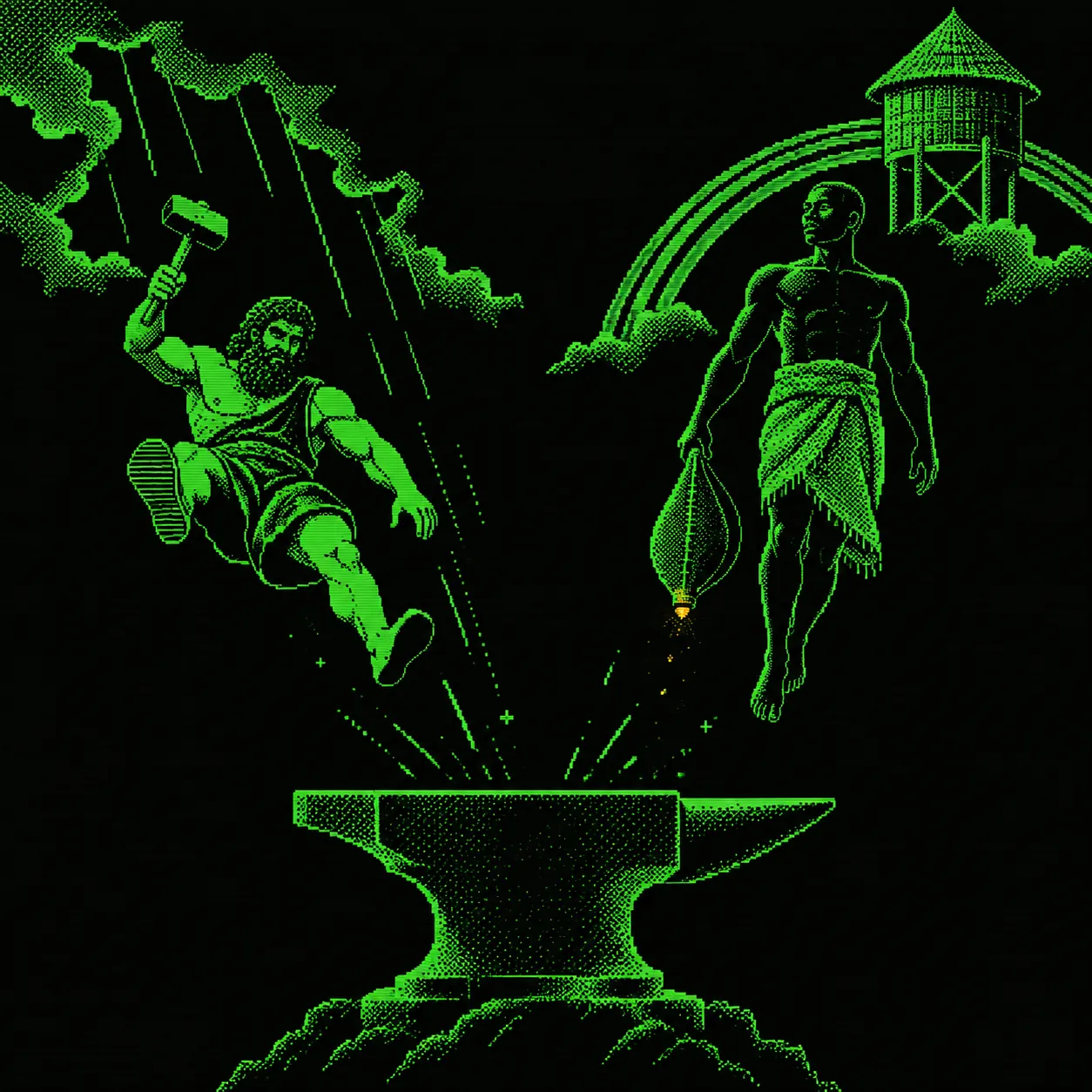
Hephaestus falls all day. At sunset he strikes Lemnos with scarcely any life left in him. The islanders take him in. This is the divine craftsman of the Greeks: the limping god whose hands make the palaces of Olympus, remembered here as a body flung across the boundary between heaven and earth. He tells the story himself in the first book of the Iliad, 1.590–594.
In Mali, another smith comes down from heaven with something the gods would rather have kept.
In the account Ogotemmêli gave Marcel Griaule, the first smith steals an ember and incandescent iron from the celestial forge. He hides them in the skin of his bellows. His granary descends along a rainbow; the powers above hurl burning brands after him, and the bellows skin becomes his shield. On landing, his hammer and anvil strike his limbs. The impact gives him elbows and knees, the joints with which humanity will hammer iron and work the fields. (Griaule, Dieu d’eau, Sixth Day, pp. 38–41.)1
A celestial craftsman. A violent descent. The smith’s body caught up in the passage from divine power to earthly work. Greece places the theft of fire with another figure, Prometheus, who conceals it in a hollow fennel stalk. The Dogon account brings the smith and the fire thief together in one journey. (Hesiod, Theogony, 565–569.)
Two descents
The smith crosses from heaven to earth
It boggles the mind that this whole constellation can be so readily assigned to independent development: heavenly craftsmen, stolen fire, consequential bodies, powerful tools, the origin of ordinary human work. The comparison reaches beyond Greece and the Dogon. Yet many academics still argue that Africa independently invented iron smelting, sometimes with a confidence that makes the alternative sound like an obsolete embarrassment.
I think the better explanation is that metallurgical knowledge traveled, changed hands, and acquired new furnaces, new gods, and new local meanings. The resistance to that explanation reveals a familiar intellectual habit: asking what we have to believe when an idea is unwelcome, and what we can believe when it serves a desirable story.
TL;DR
- Smith myths belong to a larger comparative pattern linking craft, divine power, bodily transformation, and the establishment of human life.
- Diffusionists proposed the movement of skills and specialists, not necessarily conquering populations or identical furnaces transported intact.
- The archaeological case for very early independent iron smelting has substantial dating and contextual problems; newer evidence also requires revising simple Carthage-only explanations.
- Local manufacture and local innovation do not establish independent invention of the original process. Applying that distinction consistently makes diffusion the more persuasive account.
The smith belongs to a larger story #
Among the Ader Hausa of Niger, a smithing clan traces its descent to Lola, a woman who fell from the sky holding a hammer in one hand and a ladle of food in the other. She could handle hot iron without being burned. Sandra Blakely places this tradition alongside Greek divine craftsmen whose powers extend into music, medicine, fertility, and initiation. The Greek Akmon is “anvil”; Damnameneus is “Hammerer.” Tools become persons, and persons become the ancestors of technical knowledge. (Blakely, Myth, Ritual, and Metallurgy in Ancient Greece and Recent Africa, pp. 1–4.)
Ireland gives us Goibniu, whose workshop keeps the gods fighting. In Cath Maige Tuired, the weapons of one army remain broken while those of the Túatha Dé Danann are continually renewed. Goibniu makes weapons with three strokes; Luchta makes their shafts and Crédne their rivets. An enemy infiltrator wounds the smith with the products of this same workshop. Craft, injury, healing, and divine survival meet around the forge. (Cath Maige Tuired, §§122–126.)
Yoruba Ogun gives iron the power to open roads and fields. In a Dahomean account, the creator comes to earth holding Gu as a cutting instrument, clears the forest, and teaches people to build and cultivate. The forge sits at the threshold of an inhabitable world. (Emma George Ross, “The Age of Iron in West Africa”; Barnes and Ben-Amos, “Benin, Oyo, and Dahomey”.)
These examples do not all repeat one plot. They inhabit a recognizable imaginative world in which the specialist who transforms stone into metal also transforms wilderness into human space. The hammer belongs near the ancestor, the god, the healer, and the ruler. The tool that opens a field also opens a social order. The Bullroarer Atlas’s “The God the Smith Made” follows that connection into iron objects through which a community gives its gods a voice.
Such patterns make historical transmission worth pursuing. A craft passes through teaching; teachers have stories, prohibitions, ancestors, and explanations for why the work succeeds. There is no reason to imagine the practical recipe traveling in a sealed compartment while everything that made it meaningful remained behind.
The myths give us a reason to look for connected history. The metallurgical argument must then do its own work.2 As with the western connections of Chinese creation traditions, the persuasive case grows when an imaginative pattern meets a plausible history of transmission.
What actually has to travel? #
Iron smelting extracts metal from ore. Smithing works metal that already exists. A smith can hammer an imported bloom into a spear without knowing how to turn ore into iron; an imported spear can arrive in a community that knows neither process. Keeping these stages distinct prevents a great deal of archaeological confusion.
Smelting also requires more than a sufficiently hot fire. Fuel, airflow, ore preparation, the reaction atmosphere, and the removal of unwanted material have to work together. Bloomery smelting produces a mass of solid iron below iron’s melting point. The achievement lies in controlling a transformation, rather than simply melting a rock. (Killick, “A Global Perspective on the Pyrotechnologies of Sub-Saharan Africa,” pp. 67–69.)
Theodore Wertime’s argument was that iron emerged from a long accumulation of metallurgical experience. Work with other metals, furnaces, and heat supplied the practical world in which the new process became possible. His account joined diffusion to subsequent innovation: expertise circulated, and each receiving tradition could make further discoveries. (Wertime, “The Beginnings of Metallurgy: A New Look”.)
That is an ordinary model of technical progress. We expect a difficult, useful technique to be taught, borrowed, adapted, and taught again. Independent invention requires an additional historical event: another community must discover the crucial process without receiving it. That can happen. It needs evidence of its own.
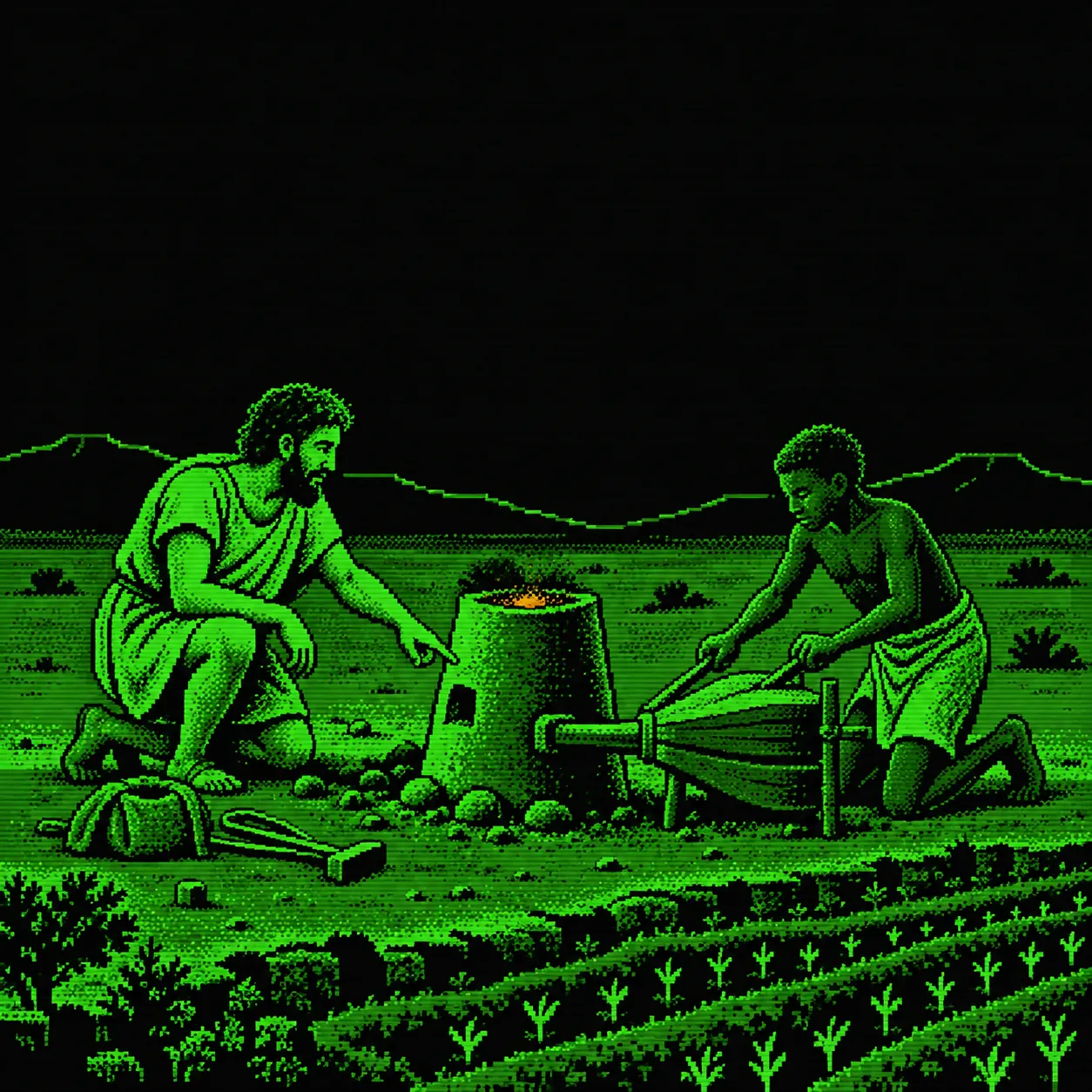
A few people can carry a great deal of knowledge. A craftsperson can marry into another community. An apprentice can return home. A workshop can attract specialists from several places. Knowledge can move through successive neighbors without the first teacher ever meeting the last pupil. None of these mechanisms requires a people to replace another people.
They also explain why furnaces can differ. Ore differs. Fuel differs. Available clay differs. The scale of production differs. People who learn a process can redesign its equipment. Different equipment is evidence of different implementations; by itself it cannot tell us whether the underlying knowledge was independently discovered.
Mobile expertise
A technique can travel with a few people
What the diffusionists actually argued #
Raymond Mauny proposed that Phoenician and Carthaginian expertise passed through Berber and Saharan networks into West Africa. His model included mobile artisans and movement toward places with suitable resources. It was a proposed social mechanism, not a requirement that one invading population bring an entire civilization south. (Mauny’s argument documented in Alpern, pp. 45–48.)
R. F. Tylecote compared technological traditions. His 1975 reconstruction proposed a northern, probably Carthaginian, source for Nigerian ironworking while associating Meroitic production with Roman influence through Egypt. The important point is that an external-origin argument could distinguish routes and traditions. Showing that Meroe was too late to supply a particular region would defeat that proposed connection, rather than every possible history of transmission. (Tylecote, “The Origin of Iron Smelting in Africa,” substantive abstract.)
François Kense considered the spread of metallurgical ideas as an explanation for the variety of African traditions. Borrowing the decisive knowledge need not mean reproducing the teacher’s entire material culture. His formulation is quoted in Alpern’s review, which also considers the movement of skilled practitioners. (Alpern, pp. 88–89, 93.)3
Danilo Grébénart made the mobility argument particularly clearly in discussing Saharan copper. A person possessing a technique can travel a great distance before practising it again. Intermediate production sites need not mark every stage of the journey. His proposed connections among Saharan copper traditions remained hypotheses, but the mechanism answers a real objection: the absence of a continuous trail of furnaces cannot, on its own, make transmission impossible. (Grébénart, “Cuivre,” §§9–12.)
These arguments fit together without becoming a single proven itinerary:
| Argument | What it contributes |
|---|---|
| Accumulated metallurgical experience | A reason to expect difficult techniques to emerge within connected craft traditions |
| Traveling specialists and apprentices | A mechanism for transmitting expertise without population replacement |
| Local redesign | An explanation for technological diversity after borrowing |
| Separate entry routes | A reason one failed route cannot dispose of diffusion as a whole |
| Metal-exchange networks | A material setting in which people and technical knowledge could meet |
The networks are not imaginary. A 2026 chemical and isotopic study identifies copper from Akjoujt in Mauritania among objects at Walaldé in Senegal dating to the later first millennium BCE. Other Walaldé objects came from across the Sahara, probably in the first millennium CE. The dates matter: the later imports cannot prove an earlier iron-smelting transmission. The findings establish the connected world within which transmission hypotheses belong. (Stephens and colleagues, 2026.)
The archaeological objection has teeth #
The strongest archaeological argument against confident independent invention is that a strikingly early date may fail to date metallurgy at all.
This has happened. In Niger, materials once taken as evidence of early furnaces or forges were subjected to chemical and microstructural analysis and identified as vitrified soil that could not positively be associated with metallurgy. The same investigation exposed problems with old charcoal. These are not philosophical objections to African ingenuity; they concern what was excavated and what was measured. (Killick and colleagues, 1988; Mitchell, Loftus, and Babalola, 2024, p. 5.)
At Ôboui in the Central African Republic, very early charcoal dates have been associated with an ironworking installation. Accepting the association would transform the history of iron. Augustin Holl’s case for independence rests on those early workshop contexts, which he argues are coherent and well controlled. He also disputes the indiscriminate use of the old-wood objection in tropical environments. His argument requires answering the actual contexts, rather than rejecting an early date because it is inconvenient. (Holl, “The Origins of African Metallurgies,” pp. 12–13.)
Bernard Clist challenged the site’s stratigraphy and the relationship between the dated samples and metallurgical activity. His wider 2012 reassessment placed the more robust evidence after approximately 800 BCE. That was an assessment of the evidence then available, not a permanent limit on what future excavation could discover. (Clist, “Vers une réduction des préjugés…,” 2012.)
Newer discoveries deserve their own examination. At Sodohomé 1 in southern Benin, excavators reported an iron spearhead in a context dated by short-lived palm nutshells to around 1020 BCE, alongside other evidence they interpret as production. This is considerably better than assigning a workshop the age of whatever old charcoal happens to be nearby. Stephen Dueppen’s recent synthesis rightly treats the early southern evidence as a reason to retain local invention among the possibilities. (Merkyte and colleagues, “Urbanizing Forest,” 2019; Dueppen, 2025, “Early Metallurgy and Population Expansions”.)
That discovery puts pressure on a Carthage-only explanation. It does not place West African iron before the development of iron metallurgy elsewhere: a major review identifies limited Anatolian production in the early second millennium BCE and a much wider expansion in the late second and early first millennia. The relative chronology still leaves room for transmission, while requiring its advocates to do better than repeat an old route. (Erb-Satullo, “The Innovation and Adoption of Iron in the Ancient Near East”.)
A 2024 review by Peter Mitchell, Emma Loftus, and Abidemi Babalola nevertheless urges caution even about the better-contextualized Sodohomé evidence. Questions about the association of dates and production continue to affect the very early claims. The technical disagreement is real, current, and substantive. (“Archaeological Science in Africa,” p. 5.)
That is a strong archaeological case against presenting independent invention as an accomplished fact. It does not discover the missing teacher. It removes an unwarranted certainty, leaving transmission to compete on its actual explanatory merits.
When “made here” becomes “invented here” #
The step from local production to independent invention is where the standards become especially revealing.
In their 2023 overview, Foreman Bandama and Abidemi Babalola point to the interior location of early African metallurgical sites and conclude that this makes the technology indigenous. Their sentence ends: “making this an indigenous technology.” (“Science, Not Black Magic,” section “What We Know: Science in Metalworking”.)
An interior workshop establishes where people worked. Its location cannot establish where the knowledge originated. A borrowed technique does not have to remain on the coast. The first surviving workshop is not necessarily the first workshop, and the oldest excavated example is not necessarily the site of invention.
If “indigenous” means embedded in local life, the description is straightforward. If it means invented independently of outside instruction, the conclusion requires another argument. Moving between those meanings turns a cultural description into a historical finding without supplying the missing evidence.
Nor can the diversity of African technologies finish that argument. Diverse furnace designs can emerge after the underlying process has been learned. Indeed, this is exactly the kind of inventiveness that makes a received technology productive. Diffusion and African creative achievement belong in the same account.
Killick, who remains explicitly undecided about initial origins, has documented African technical invention while questioning both confident external-origin narratives and confident independent-origin claims. That combination is useful because it separates two questions too often bundled together: who first discovered the process, and what later craftspeople discovered while making it their own. (Killick, 2015; Killick, 2016, p. 69.)
The same distinction matters in the African creator stories. A local tradition can be thoroughly local in its language, institutions, and emotional life while containing elements received through a much larger history.
What can I believe, and what do I have to believe? #
There are two very different questions an interpreter can bring to incomplete evidence.
What can I believe? Is there a possible reading under which this early date belongs to the forge? Could the technological differences represent separate invention? Could an interior location be consistent with an indigenous origin?
What do I have to believe? Must I accept diffusion unless someone produces the exact route, the intermediaries, the teaching event, the missing coastal workshop, and the right sequence of furnace designs?
The first question admits a favored hypothesis through any available opening. The second keeps an unwelcome hypothesis outside until every possible escape has been closed.
Scott Alexander calls this problem “isolated demands for rigor”. His point is that a demand for stronger evidence can be locally reasonable and still distort the larger inquiry when it is applied selectively. The problem is the isolation: one account must meet a standard that its rival is never asked to meet. I am applying that principle to African iron origins; Alexander’s essay is not about African metallurgy.
If diffusion needs a securely reconstructed chain of instruction, independent invention needs a securely reconstructed independent discovery. If the absence of intermediate furnaces counts against transmission, the absence of a demonstrated local developmental sequence must also count. If geographical proximity cannot establish borrowing, geographical distance cannot establish independence.
The standard should be comparative explanation. Which account requires fewer additional discoveries? Which fits the accumulated expertise needed for the process? Which accommodates both contact and local transformation? How much does each interpretation depend on giving ambiguous evidence its most convenient reading?
On that comparison, I find transmission more persuasive. People possessed an exceptionally useful technique elsewhere in the connected Old World. Specialists could move it without moving an entire population. African workshops could develop distinctive practices afterward. The associated mythic world gives us an additional reason to investigate shared histories, even though it cannot date the original transfer.
The alternative asks us to add another initial discovery, then treats the lack of a complete transmission itinerary as a reason to prefer that additional event. That reverses the burden at precisely the point where borrowing is most ordinary.
Why the standard moves #
The political stakes are stated openly in the literature. Alpern describes a debate in which skepticism about independent invention could be treated as an insult, and in which the wish to correct old depictions of Africa affected historical interpretation. (Alpern, pp. 89–93.)
Killick’s 2015 discussion goes further into the problem. He examines how the claim that Africa invented iron became an answer to Europeans who portrayed Africans as people without technological achievements. Once invention becomes the desired rebuttal, a question about ancient workshops starts carrying the weight of modern dignity. (Killick, pp. 310–311.)
There were ugly reasons for older scholars to deny African achievement. Correcting that history was necessary. But it does not make independent invention the correct answer to a particular archaeological question. A morally attractive conclusion still needs the evidence its unattractive rival is required to supply.
This is why bias is the best explanation for the asymmetry. It explains why the possibility of local invention can become a confident account, while a plausible transmission mechanism is held responsible for every missing link. The charge concerns that distribution of confidence, rather than the mere existence of disagreement. Ordinary uncertainty explains why good archaeologists keep arguing. It does not explain why uncertainty repeatedly becomes permission for the same preferred conclusion.
The inconsistency can run through the literature without dividing its authors into permanent camps. Babalola coauthored both the confident 2023 educational account and the cautious 2024 technical review. That juxtaposition makes the issue more concrete: caution available in the technical discussion can disappear when the public story is told. We should ask for the same standard in both settings.
Africa does not need isolation #
Treating borrowing as a loss of dignity leaves the oldest prejudice intact. It accepts that the only achievement worth celebrating is an invention with no teachers.
The smith who learns a technique must still find ore, judge fuel, build equipment, train others, organize labor, and make things people can use. Generations of such work produce discoveries. They also produce institutions, ritual authority, artistic forms, and stories. Receiving knowledge is an invitation to make history.
The Greek smith does not stop belonging to Greece because Greek life belonged to a connected Mediterranean. African smiths do not become less African because their craft may belong to a connected history of the Old World. The relationship between Prometheus and the biblical bringers of technical knowledge already makes sense within that wider world of stories and skills.
The better account gives African craftspeople their full intelligence: the ability to learn, to travel, to recognize a useful discovery, to alter it, and to teach it again. It gives the myths a history spacious enough for gods and techniques to change together. It gives the archaeology one standard of evidence.
Let the smith travel. Let him carry his tools, acquire another language, teach an apprentice, and find a new name for the fire. Africa’s history grows larger when we allow it to be connected.
Notes #
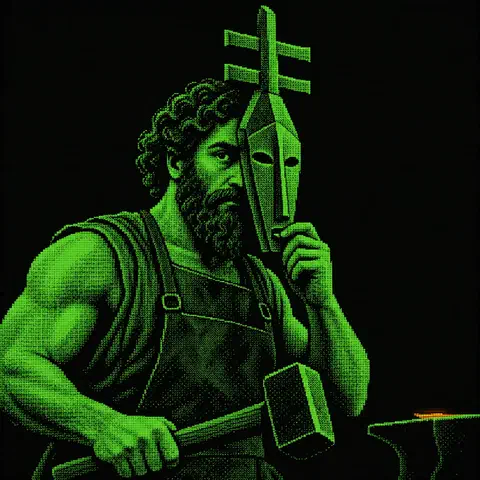
The cover’s Greek smith and Dogon-inspired mask are an artistic metaphor for a craft acquiring another cultural form, rather than a proposed identification of the people who transmitted it.
Sources #
- Homer. Iliad, Book 1, 1.590–594; Book 18, 18.394–405. Translated by A. T. Murray.
- Griaule, Marcel. Dieu d’eau: entretiens avec Ogotemmêli. 1948. Sixth Day, original pp. 38–41. University-hosted transcription.
- Hesiod. Theogony, 565–569.
- Blakely, Sandra. Myth, Ritual, and Metallurgy in Ancient Greece and Recent Africa. Cambridge University Press, 2006. Introduction, pp. 1–11.
- Gray, Elizabeth A., trans. Cath Maige Tuired: The Second Battle of Mag Tuired. Irish Texts Society, 1982. §§122–126. University College Cork CELT edition.
- Ross, Emma George. “The Age of Iron in West Africa.” Metropolitan Museum of Art, 2002.
- Barnes, Sandra T., and Paula Ben-Amos. “Benin, Oyo, and Dahomey.” Expedition 25(2), 1983. “The Sacralization of Iron.”
- Alpern, Stanley B. “Did They or Didn’t They Invent It? Iron in Sub-Saharan Africa.” History in Africa 32 (2005): 41–94.
- Tylecote, R. F. “The Origin of Iron Smelting in Africa.” West African Journal of Archaeology 5 (1975): 1–9. Link to bibliographic abstract.
- Wertime, Theodore A. “The Beginnings of Metallurgy: A New Look.” Science 182 (1973): 875–887.
- Grébénart, Danilo. “Cuivre.” Encyclopédie berbère 14 (1994): 2153–2157. §§9–12.
- Stephens, Jay, et al. “Chemical and Isotopic Analyses Reconstruct Multi-Scalar Copper Circulation Networks in West Africa.” Archaeological and Anthropological Sciences 18, article 72 (2026).
- Killick, David, Nikolaas J. van der Merwe, Robert B. Gordon, and Danilo Grébénart. “Reassessment of the Evidence for Early Metallurgy in Niger, West Africa.” Journal of Archaeological Science 15 (1988): 367–394.
- Clist, Bernard-Olivier. “Vers une réduction des préjugés et la fonte des antagonismes: un bilan de l’expansion de la métallurgie du fer en Afrique sud-saharienne.” Journal of African Archaeology 10(1) (2012): 71–84.
- Merkyte, Inga, et al. “Urbanizing Forest: Archaeological Evidence from Southern Bénin.” Journal of African Archaeology 17(2) (2019): 95–120. doi:10.1163/21915784-20190012.
- Dueppen, Stephen. “Reconnecting the Forest, Savanna, and Sahel in West Africa: The Sociopolitical Implications of a Long-Networked Past.” Journal of Archaeological Research 33 (2025): 337–404. First published online in 2024.
- Mitchell, Peter, Emma Loftus, and Abidemi Babatunde Babalola. “Archaeological Science in Africa: Twenty-One Papers for the Twenty-First Century.” Journal of Archaeological Science 163 (2024): 105933.
- Erb-Satullo, Nathaniel L. “The Innovation and Adoption of Iron in the Ancient Near East.” Journal of Archaeological Research 27 (2019): 557–607.
- Bandama, Foreman, and Abidemi Babatunde Babalola. “Science, Not Black Magic: Metal and Glass Production in Africa.” African Archaeological Review 40 (2023): 531–543.
- Killick, David. “Invention and Innovation in African Iron-Smelting Technologies.” Cambridge Archaeological Journal 25(1) (2015): 307–319.
- Killick, David. “A Global Perspective on the Pyrotechnologies of Sub-Saharan Africa.” Azania 51(1) (2016): 62–87.
- Alexander, Scott. “Beware Isolated Demands for Rigor.” Slate Star Codex, August 14, 2014.
- van Beek, Walter E. A. “Dogon Restudied: A Field Evaluation of the Work of Marcel Griaule.” Current Anthropology 32(2) (1991): 139–167.
- Holl, Augustin F. C. “The Origins of African Metallurgies.” Oxford Research Encyclopedia of Anthropology, 2020. Especially “Objections and Refutation.”
The Homeric versions must be kept distinct. In Iliad 1, Zeus throws Hephaestus to Lemnos; the passage does not say this caused his lameness. In 18.394–405, Hera rejects him because he is already lame. The Dogon landing creates new joints rather than permanent disability. Griaule’s story is specifically Ogotemmêli’s recorded account. Walter van Beek’s later restudy challenged the representativeness and production of Griaule’s elaborate cosmology; it cannot be treated as an independently dated ancient Dogon text. (“Dogon Restudied,” 1991.) ↩︎
Blakely documents the comparisons but argues against deriving the Greek and African technological and ritual complexes from one another (introduction, p. 11). Her evidence for the traditions and her historical conclusion are separate contributions. The comparative inference here is mine. Mircea Eliade’s The Forge and the Crucible, chapter 9 supplies a broader older comparison, but examples repeated from Griaule are not independent witnesses to the antiquity of the Dogon account. ↩︎
Mauny’s proposed mechanism and Kense’s 1983 passage are cited through Alpern’s documented quotations and references; their complete originals were not available for this essay. Tylecote’s position is verified through the substantive bibliographic abstract. These sources establish the arguments their authors made, rather than a demonstrated historical itinerary. Alpern’s final conclusion leaves initial origins unresolved. ↩︎