TL;DR
- The Eve Theory of Consciousness (EToC) treats Golden Man as a sophisticated control system without an explicit self-model; language exists, but mostly as external coordination and myth.
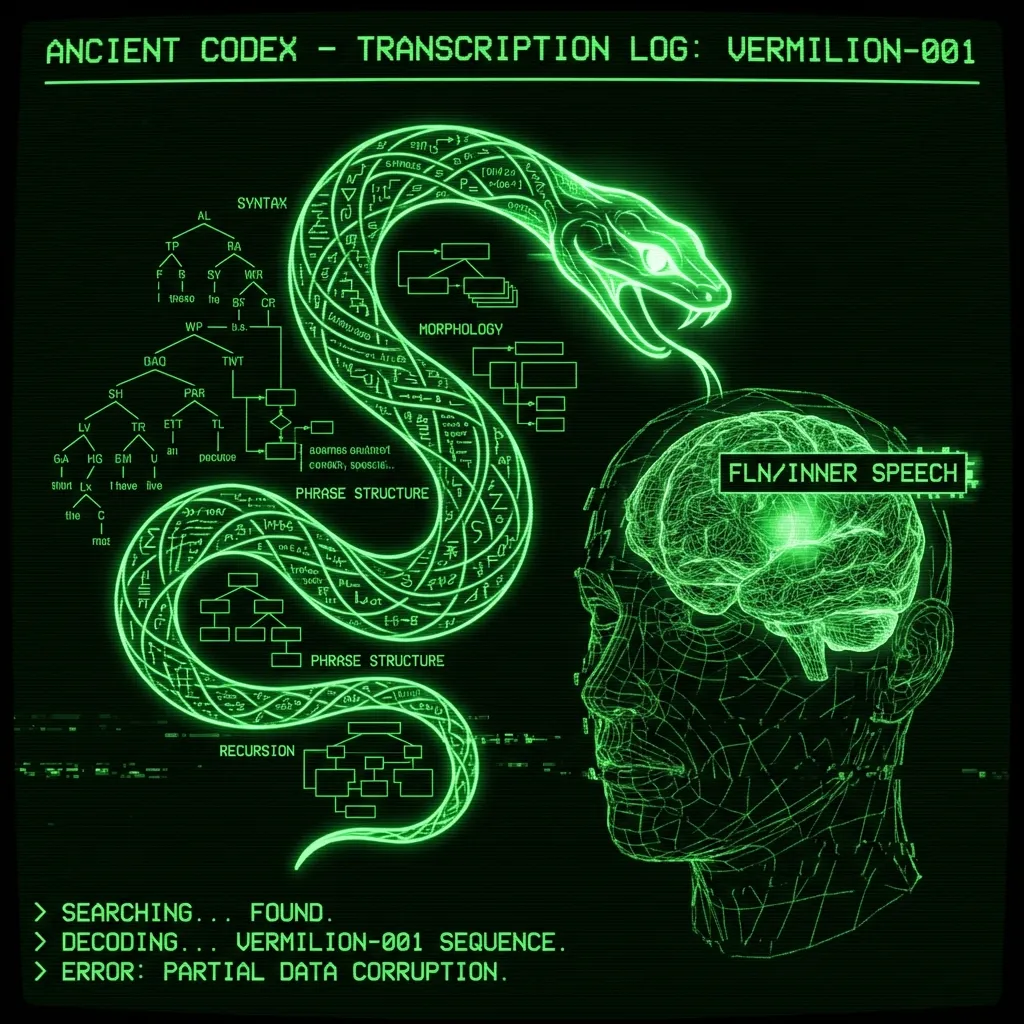
- When recursive syntax becomes powerful and internalized, “I think that I am thinking” appears. This is the snake in the Garden: a grammatical hack that forces subject–object separation.
- Genetic and regulatory data (FOXP2, HAQERs) show recent, human-specific changes tightly linked to language circuitry, suggesting a sharp evolutionary kink rather than a slow blur.
- Developmentally, Vygotsky’s path from social speech to inner speech turns language from a social tool into a device for self-regulation and self-observation. The serpent migrates from the air into the skull.
- Once you have a system that can parse “I know that I will die,” the Garden is burned. The same syntax that makes law, science and theology possible also makes guilt, anxiety and psychosis almost inevitable.
Companion articles: For a deeper exploration of Golden Man as a control system before self-consciousness, see “Golden Man as Control System”. For the broader evolution of consciousness, see “Ten Papers that Push EToC Toward Science”.
“Thought is not merely expressed in words; it comes into existence through them.”
— Lev Vygotsky, Thought and Language (1934)
1. The Serpent as Grammar#
In EToC, the Garden is Golden Man’s world: myth-saturated, ritualized, guided by gods rather than introspective selves. There is language, but it is centripetal. Speech flows outward:
- To coordinate hunts and rituals
- To sing, curse, bless, and gossip
- To tell stories about gods, animals, ancestors
Inside the head, there is mostly sensorimotor flow plus affect. No continuous inner narrator, no “I” as an object of inspection. Golden Man is conscious, but not self-conscious in Eve’s sense.
The Eve move is simple and lethal:
Take the same language that once narrated the gods and turn it on the one thing it had never fully described: the mind doing the narrating.
The serpent in Genesis is the first linguist. It does not introduce fire or agriculture. It introduces meta-language:
“Did God really say…?” “You shall be as gods, knowing…”
That “knowing” is the problem. Not sensory knowledge, but knowledge-of-knowing, the second-order concept that requires a syntax tree with a self in it. Once you can form sentences like
“I know that I am naked.” “I wish I had not done that.” “I will die.”
the Garden cannot survive.
To make that more than literary cuteness, we need to show three things:
- Recursion and syntax really are a special, dangerous piece of the language faculty.
- There is biological evidence for a recent and rapid tuning of language circuitry.
- Developmentally, external language really does move inward and become a tool for self-regulation and self-torment.
EToC then slots in as the story of what happens when all three align in a population that has already built Golden Man.
2. Recursion: The Snake Hidden in the Grammar#
Hauser, Chomsky and Fitch famously split the “faculty of language” into a broad faculty (FLB) shared widely across species and a narrow faculty (FLN), for which they proposed a single candidate: recursion.
- FLB includes perception, motor control, conceptual systems, and lots of animal-ish communication.
- FLN, if it exists, is the capacity to generate an unbounded set of hierarchical expressions from a finite set of elements.
Recursion is the syntax tree: phrases inside phrases, clauses inside clauses. It is what lets you say:
“I think that she knows that he lied about wanting to help us.”
You can tear this apart into nested shells: [I think [she knows [he lied [about X]]]]. The key for EToC is that recursion gives you:
- Self-embedding: “I think that I am wrong.”
- Mental-embedding: “I believe that you hate me.”
- Modal-embedding: “I could have done otherwise.”
As soon as a mind can form and understand such structures, it has the formal machinery to:
- Treat its own mental states as objects
- Represent counterfactual selves (“the me who did not sin”)
- Represent future selves (“the me who will suffer for this”)
Recursive syntax is a kind of serpent that coils back on its own tail.
Critics of the HCF program are right to say that language evolution is messier than “one mutation for recursion and we’re done.” But even in more nuanced accounts, hierarchical structure and clause embedding remain central. A Jackendoff-style view still treats combinatorial syntax as the core innovation that lets language hook tightly into conceptual structure.
From the EToC perspective:
- FLB is Golden Man’s toolkit.
- FLN—however exactly implemented—is the snake that turns that toolkit inward.
Without recursion, you can point, label, exclaim, gossip, chant. With recursion, you can build a self.
3. DNA in the Tree: FOXP2 and HAQERs#
A myth is good. A myth backed by molecular data is better. Language is not simply software; it is constrained and enabled by hardware and firmware. Two lines of work matter here: FOXP2 and HAQERs.
3.1 FOXP2: The Forkhead at the Root#
FOXP2 is a transcription factor expressed in brain circuits for motor control and speech. The KE family’s famous inherited speech disorder put FOXP2 on the map: a single dominant mutation produced severe verbal dyspraxia and grammar problems.
Key points:
- Comparative genomics shows a burst of accelerated evolution in the FOXP2 coding sequence on the human lineage.
- Humanized FOXP2 introduced into mice alters corticostriatal plasticity and speeds up certain learning tasks, suggesting it tunes vocal-sequence and action learning.
- Regulatory elements around FOXP2 (enhancers) show human-specific changes, indicating selection on when and where this factor is expressed.
FOXP2 is not a “language gene” in the cartoon sense, but it is part of a forkhead-domain transcriptional network that shapes vocal learning and sequencing. When you look at Casten et al.’s HAQER paper, the serpent tightens.
3.2 HAQERs: Human Ancestor Quickly Evolved Regions#
Casten et al. (2025) analyze “Human Ancestor Quickly Evolved Regions” (HAQERs): stretches of DNA that accumulated substitutions unusually fast after the human–chimp split. They then test whether variants in these regions predict language or nonverbal cognition.
Their headline:
- HAQER variants specifically influence individual differences in language abilities, not general intelligence.
- These regions modulate binding sites for Forkhead transcription factors, including FOXP2.
- Some language-associated HAQER variants are more prevalent in Neanderthals than in modern humans, and show convergent evolution in other vocal learners (songbirds, etc.).
So:
- There is a network of rapidly evolving regulatory regions.
- They are hooked to FOXP2 and other Forkhead factors.
- Their phenotypic footprint is language-specific.
If you want a biological substrate for “the snake in the syntax tree,” this is it: a serpent of regulatory DNA coiled around transcription factors, tuning how cortical and striatal circuits handle sequences of sound and meaning.
EToC’s claim that consciousness is a late, actively selected overlay gets support here: the components that make Eve’s internal monologue possible are not ancient static relics. They are recent, tweaked and still under constraint.
4. How Language Crawled Inside: Vygotsky and Inner Speech#
So far we have:
- A grammar that supports recursion.
- Genetic and regulatory tweaks that sharpen language circuits.
But Golden Man still speaks mainly outward. For Eve to arise you need a developmental story where speech migrates inside and becomes a tool for self regulation.
Lev Vygotsky gave us that map almost a century ago.
4.1 From Social Speech to Private Speech to Inner Speech#
Vygotsky argued that language starts as social regulation: adults using words to guide children’s behavior (“don’t touch,” “come here,” “good job”). Over time, children internalize this guidance. The path is:
- Social speech – child-oriented but other-directed; caregiver’s commands and explanations.
- Private speech – the child talking aloud to themselves while acting (“now I put this here,” “no, that’s wrong”), especially during difficult tasks.
- Inner speech – silent, compressed verbal thought used for planning, problem solving, and self-regulation.
Modern work confirms:
- Private speech correlates with better task performance and executive control in children.
- Inner speech is heavily involved in self-regulation, working memory, planning, and emotion regulation in adults.
The serpent, developmentally, is not a mystical voice. It is your caregiver’s words, turned into your own whispers, turned into your internal monologue.
4.2 The Self as a Grammar Device#
Once inner speech is recursive, it can:
- Bind pronouns to a long-lived entity (“I,” “me,” “myself”).
- Embed mental verbs (“think,” “know,” “believe”) to point at its own operations.
- Build temporal operators around the same referent (“I used to…,” “I will…”).
Vygotsky writes that thought does not merely find expression in words, but “comes into existence through them.” EToC adds: the self as Eve experiences it comes into existence through a particular kind of word—a recursive, pronoun-saturated inner speech.
Golden Man can say “the god is angry” or “the clan is ashamed.” Eve can say “I am ashamed of the person I am becoming,” which is a very different computational object.
5. Why Language Had to Break the Garden#
Putting the pieces together:
- Golden Man already has a rich world-model, social emotions, myth, and non-recursive or weakly recursive language.
- Regulatory evolution (FOXP2, HAQERs) sharpens vocal and sequencing circuits, making powerful hierarchical syntax available.
- Cultural dynamics (storytelling, ritual, law) select heavily for individuals and lineages that can use this syntax for finer social prediction and norm navigation.
- Developmentally, Vygotskian internalization turns social speech inward. Children begin to talk to themselves the way adults once talked to them.
- At some point, this internal, recursive speech begins to talk about itself.
At that moment, you get:
- Persistent autobiographical time (“my life,” not just “this season”).
- Guilt and shame tied not just to acts but to character (“I am a bad person”).
- Explicit fear of death as the end of a narrative self, not just biological cessation.
- New psychiatric failure modes: rumination, obsessive thought, voices that sound like one’s own but are misattributed.
The Garden is not a place; it is a cognitive regime:
- The regime where experience is thick, gods are loud, and the self is thin or absent.
- Once syntax can embed selves in their own propositions, that regime collapses.
The fruit of knowledge is meta-language. The serpent is recursion, coiled in the syntax tree and flicking its FOXP2-ish tongue at cortical circuits. God’s prohibition (“do not eat of this tree”) reads, on EToC’s telling, as a warning about the cost of the upgrade:
“If you gain this faculty, you will know your nakedness, your mortality, and your separation from the world. You will lose Golden Man’s unbroken field.”
6. Before and After: A Comparative Sketch#
Here is one way to summarize the shift:
| Dimension | Golden Man (pre-snake) | Eve (post-syntax tree) |
|---|---|---|
| Language use | External coordination, myth, ritual | External + dense inner monologue |
| Grammar | Limited hierarchy, few deeply nested clauses | Full recursion, mental-state and temporal embedding |
| Reference to self | Role- and kin-based (“hunter of X”) | Psychological (“I am the sort of person who…”) |
| Time | Cyclical, seasonal, episodic | Linear autobiography, narrative arcs |
| Norms | Enforced via ritual and external sanction | Internalized conscience, guilt, confession |
| Emotion | Action-oriented (fight, flee, appease) | Emotions-about-emotions (shame about anger, anxiety about fear) |
| Mythic agents | Gods and spirits as external voices | Mix of gods and an inner voice that can turn against itself |
| Typical suffering | Physical hardship, loss, ostracism | Existential dread, identity crises, obsessive guilt |
From the outside, both Golden Man and Eve hunt, mate, raise children, tell stories. From the inside, they live in different universes.
7. Language, Psychosis, and the Edge of the Tree#
A final twist: the same circuitry that gives Eve her internal story also gives her psychosis.
- FOXP2 and related pathways are implicated not just in normal language, but in language disturbances in schizophrenia and other psychiatric conditions.
- Recent evolutionary work shows that regions under selection for language and cognition are enriched for psychiatric risk variants, especially schizophrenia.
- Inner speech is ground zero for both healthy self-regulation and auditory verbal hallucinations; phenomenologically, “the voices” often feel like inner language gone rogue.
EToC’s suggestion is that:
- Psychosis is not an alien intrusion into a stable mind.
- It is what happens when the syntax tree becomes too serpentine: when the self-referential machinery that lets Eve narrate her life overfits, misattributes, or decouples from sensorimotor reality.
In other words, the tree of knowledge has an unstable crown. The same recursion that lets you write theology also lets you be persecuted by sentences that no longer feel like yours.
8. What This Tells Us About Being Human#
If EToC is roughly right, then:
- We are not “language animals” in general; we are recursive, inner-speech animals.
- The fundamental break from our last animal ancestor is not having words, but having words that can speak about themselves, inside.
- The Garden was a real cognitive possibility: a world of gods and sensations without a narrating self.
- The fall was not a moral lapse but an evolutionary and developmental transition in which language turned its power on the mind that had created it.
The snake in the syntax tree is still there. Every time a child goes from babble to private speech to that first “I” that means “me” across time, the Garden closes again. Every time your inner voice says “I should have…,” you are replaying the original scene: language tempting a control system to step outside itself and look back in judgment.
The cost is guilt and madness. The payoff is everything you care about as a person: memory, promise, story, meaning. Eden without the serpent is Golden Man, and Golden Man never writes anything down.
FAQ#
Q1. Are FOXP2 and HAQERs really “the serpent genes”?
A. No single gene or region “is” language, but FOXP2 and HAQER networks are concrete places where rapid, human-specific regulatory changes shape vocal sequencing and language abilities, exactly where a theory like EToC expects action.
Q2. Didn’t animals already have some recursion and self-awareness?
A. Some animals show limited hierarchical structure and mirror self-recognition, but there is no evidence of a fully developed, linguistically mediated autobiographical self. The argument here is about degree and architecture: Eve’s self is a product of recursive inner speech, not just richer perception.
Q3. Could we have had language without breaking the Garden?
A. You could plausibly have rich communication without deep recursion or inner speech, but once a species evolves grammar that can embed mental states and that grammar is internalized, a thin, narrating self seems almost inevitable. The Garden is not compatible with “I know that I will die.”
Q4. How would you test any of this?
A. Empirically you would look for tight couplings between: (1) individual differences in recursive inner speech, (2) language-related genetic/regulatory variants, and (3) measures of metacognition, guilt, and psychosis risk. Longitudinal developmental work and polygenic analyses can, in principle, probe that triangle.
Sources#
- Hauser, M. D., Chomsky, N., & Fitch, W. T. “The faculty of language: What is it, who has it, and how did it evolve?” Science 298 (2002): 1569–1579.
- Zhang, J. “Accelerated protein evolution and origins of human-specific features.” Molecular Biology and Evolution 19 (2002): 1460–1463. (FOXP2 analysis)
- Fisher, S. E. “Human genetics: The evolving story of FOXP2.” Current Biology 29 (2019): R65–R67.
- Caporale, A. L. et al. “Transcriptional enhancers in the FOXP2 locus underwent accelerated evolution in the human lineage.” Molecular Biology and Evolution 36 (2019): 2432–2443.
- Schreiweis, C. et al. “Humanized Foxp2 accelerates learning by enhancing transitions from declarative to procedural performance.” PNAS 111 (2014): 14253–14258.
- Casten, L. G. et al. “Rapidly evolved genomic regions shape individual language abilities in present-day humans.” bioRxiv / forthcoming (2025).
- Castro Martínez, X. H. et al. “FOXP2 and language alterations in psychiatric pathology.” Salud Mental 42 (2019): 255–263.
- Vygotsky, L. S. Thought and Language. MIT Press (English ed. 1986). See overviews in McLeod (2024) and Jones (2009).
- Alderson-Day, B. & Fernyhough, C. “Inner speech: Development, cognitive functions, phenomenology, and neurobiology.” Psychological Bulletin 141 (2015): 931–965.
- Wikipedia contributors. “Private speech.” (accessed 2025). Summary of Vygotskian and later work on private speech.
- Jackendoff, R. “The nature of the language faculty and its implications for the evolution of language.” Cognition 97 (2005): 211–225.