~/archaeology/prehistory
Kiln Mother Goes East
Venus figurines and East Asian pottery share a deeper history: clay, fire, and the transmission of a craft that learned to make bodies before bowls.
TL;DR
- Paleolithic figurine-making developed ceramic skills long before the earliest surviving pots. Farbstein and Nowell.
- East Asian vessel-making can be understood as a local invention built partly on transmitted western knowledge of clay and fire. Yanshina.
- Early pottery belonged to hunter-gatherers; cooking gave ceramic knowledge a new field of application. Wu et al..
Long before the first surviving cooking pots, someone made a woman out of earth and put her in the fire.
At Dolní Věstonice, in what is now Czechia, the result was a small female body with heavy breasts, an incised navel, and a face reduced to a few marks. She belongs to a Moravian tradition of modeled humans and animals flourishing around thirty thousand years ago. Clay had become a material for making bodies. The famous Venus is its most memorable face. Farbstein and Nowell, “Sites” and “Size”.
Across Eurasia, much later, the body acquired an inside.
The oldest widely cited pottery contexts at Xianrendong Cave in southern China date to about 20,000–19,000 calendar years before present. Their makers hunted and gathered during the Last Glacial Maximum. Pottery was already part of human life more than ten millennia before agriculture. Wu et al..1
These two beginnings belong in the same history. The ceramic branch of the Venus-figurine tradition helped establish the knowledge from which East Asian pottery emerged. The argument for its eastward transmission is strongest when we follow the craft: preparing earth, building a form, managing moisture, and transforming it with heat. Those operations could travel between people who made very different objects and wanted very different things from them.
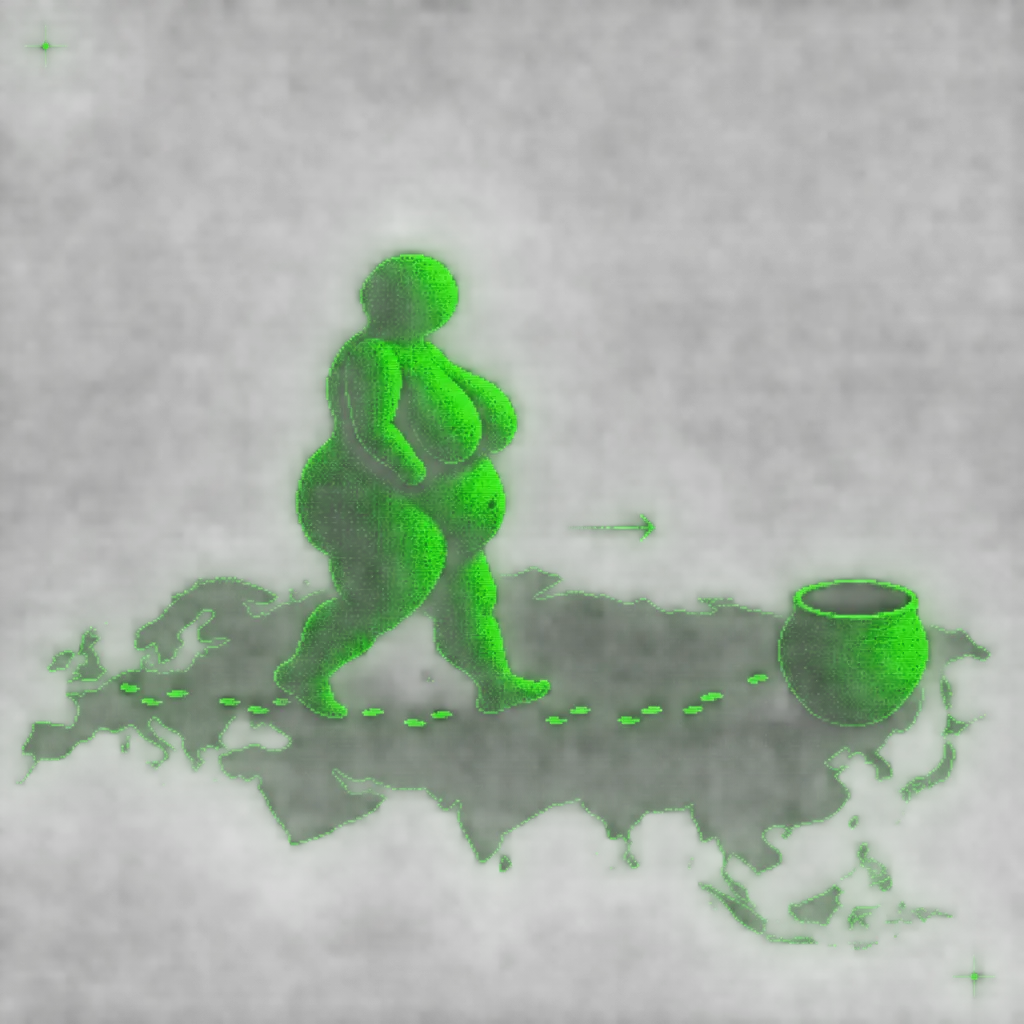
Call her the Kiln Mother: the female image that carries a history of material invention inside her apparent stillness. Give her legs, let her walk east, and the picture captures a serious historical proposition. A tradition can move farther than any surviving artifact. It can also arrive somewhere new before anyone discovers its most consequential use.
What did the first ceramic figurines teach the hand? #
A carved figure starts with something already solid. A modeled figure starts with something that will accept almost any shape. That difference changes the maker’s relationship to matter. The sculptor can add a limb, press in a hollow, join separate pieces, or begin again. Fire then makes the arrangement permanent.
Pamela Vandiver and her colleagues reconstructed this sequence at Dolní Věstonice through microscopy, radiography, and experiments. Makers wetted and kneaded local loess, formed bodies and appendages, and joined the pieces. The researchers estimated firing temperatures of 500–800°C. Their experiments also distinguished a crucial operation: loess fired without wetting remained friable, whereas material first worked with water could become durable ceramic. Vandiver et al., pp. 1004–1005.
This is a recipe in the broadest sense: an ordered relationship between material, gesture, and heat. Knowing that fire hardens earth is only the beginning. A successful object stores the consequences of decisions that a spectator cannot necessarily see. How wet was the material? How were the parts joined? What happened before it entered the fire? A finished figurine is portable; the ability to make another one is more portable still.
In her later comparative work, Vandiver reports making experimental pots from local resources at Dolní Věstonice, Kostenki, Maina, and Mas d’Azil. She identifies additive forming, drying, and firing as capabilities already present in the earlier crafts. The experiment establishes a technical possibility, rather than prehistoric vessel production at those sites: people could possess much of the necessary knowledge without making cooking pots. Vandiver, introduction.
The distinction matters because it restores a past to the invention. The first potter did not have to discover every relevant property of earth in the same afternoon. An older activity could have done much of that work for generations, for reasons of its own.
The learning itself has left traces. Rebecca Farbstein and April Nowell’s study of 489 objects from five Moravian sites identifies small, uneven, experimental pieces consistent with novice production. Fingerprints strengthen the case for children’s participation. Their interpretation places ceramic work within a community in which people learned through practice and play. Farbstein and Nowell, “Discussion”.
That is how the Kiln Mother gets her legs. She moves when a learner becomes a maker and teaches someone else. The crucial continuity is an activity people can repeat.
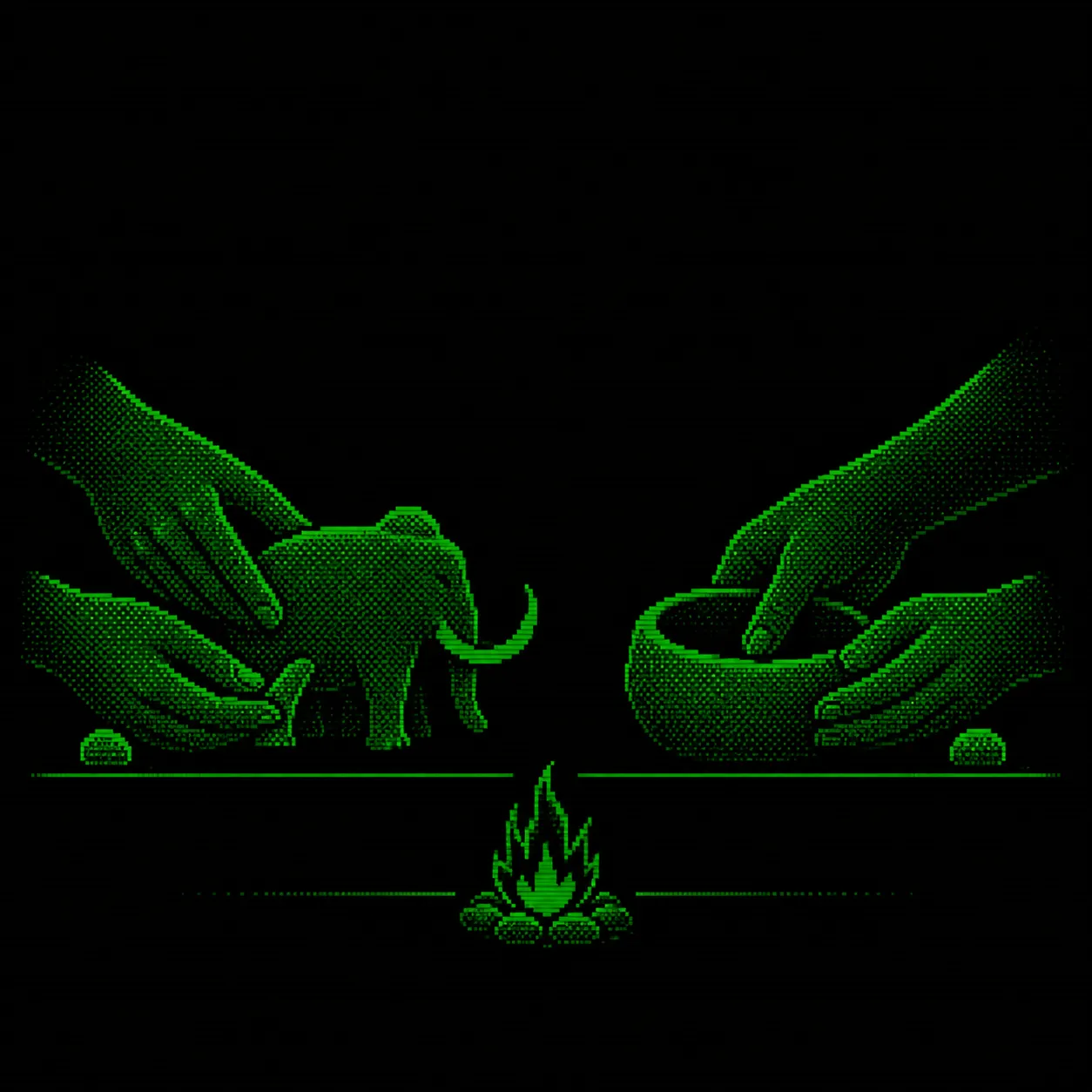
Clay, gesture, and fire: a conceptual illustration of skills shared by figurine-making and vessel-making.
How can ceramic knowledge travel before pottery? #
Oksana Yanshina gives this argument its most explicit archaeological formulation. In “Could the Early Pottery of East Asia Have Western Roots?” she proposes that skills developed in western Eurasia reached the east and supplied prerequisites for the local invention of vessels. She draws attention to the missing local sequence of preliminary clay experiments and to wider Upper Paleolithic connections through Central Asia and southern Siberia. Her proposal concerns inherited technical resources, rather than European pots carried into China. Yanshina, introduction and conclusion, pp. 56–59, 94–95.
The most useful feature of this model is that it separates ancestry from application. A craft can have an inherited history and still undergo a decisive local invention. East Asian makers could receive ways of manipulating clay and develop something their predecessors had never made. Their achievement becomes more intelligible when we can see the resources they transformed.
Kuzmin makes the technological connection from another direction. His review treats familiarity with clay for figurines as part of the background to pottery, while favoring independent vessel origins in several East Asian regions. The two positions can share a premise: more than one local invention can draw on an older repertoire of skills. Kuzmin supplies that premise; he does not establish a European-to-Chinese route. Kuzmin, abstract.
Nor was northern Eurasia an empty expanse between sealed cultural worlds. Feng Li and colleagues identify technological and geographical relationships between blade industries in Siberia, Mongolia, and northern China. They distinguish different episodes and methods, rather than treating every blade as evidence of one migrating population. Their findings establish a history of connections across the relevant regions. Li et al..
Stone tools document connections; they cannot identify the contents of a potter’s knowledge. The ceramic transmission argument therefore remains a historical inference. There is no excavated sequence of workshops running continuously from Moravia to southern China.2
Yet a chain of teaching is a different object from a chain of traded vessels. A person can learn a technique while visiting another group. A household can move. A familiar material can be worked occasionally, leaving few recognizable objects. Several such transfers could carry part of a tradition much farther than its original products ever traveled. This is the mechanism the evidence invites us to consider.
It also explains why descendants need not resemble ancestors. If what arrived was a practice of joining and firing clay, a new bowl would preserve its history in its manufacture. It would not need to look like a woman.
What does the Siberian figurine connect? #
Maina, on the Yenisei, gives the argument a material foothold in Siberia. Vandiver and Sergey Vasil’ev analyzed a ceramic human figurine there and compared it with local clay-loam. Here was another community making a human form in fired earth, far east of Moravia. Its subject is not securely identifiable as female. The relevant connection is ceramic figure-making. Vandiver and Vasil’ev.
Its date requires care. The original paper’s “16,000 Year-Old” title refers to radiocarbon chronology. A published recalibration places the associated dates at approximately 20,200–18,900 calendar years before present, overlapping the earliest Xianrendong contexts. Maina shows ceramic experimentation in Siberia around this time; it is not an earlier surviving station from which we can simply draw an arrow to China’s first pots. Farbstein et al., “Discussion”.3
The sequence is easier to grasp when the different kinds of evidence remain visible:
| Place and tradition | Approximate calendar age | Contribution to the argument |
|---|---|---|
| Moravian ceramic figurines | 30,000 years ago | A developed craft of making bodies from earth. Study. |
| Maina, Siberia | 20,200–18,900 years ago | Fired-clay human representation beyond Europe. Recalibration. |
| Xianrendong, China | 20,000–19,000 years ago | Early ceramic vessels among foragers. Dating study. |
| Yuchanyan, China | As early as 18,300 years ago | An independently dated early pottery context. Dating study. |
| Ōdai Yamamoto I, Japan | About 16,000 years ago | Vessel-making established in the archipelago. Dating study. |
| Aitani Kumahara, Japan | About 13,000 years ago | An early clay female figure within an existing pottery tradition. Excavation account. |
These are surviving occurrences, not dates for the birth of every practice. Their force is cumulative: ceramic figuration has a substantial western history, an occurrence deep in Siberia, and a technical relationship to the vessels that appear in East Asia. The proposed connection runs through the transmission of ceramic practice, with each community giving that practice new forms and uses.
Why did East Asian hunter-gatherers make pots? #
Knowledge supplies possibilities. A way of life supplies reasons to pursue them.
At Yuchanyan, radiocarbon work on associated charcoal and bone established an early pottery context reaching back about 18,300 years. The chronology rests on close sampling of the cave’s deposits, with careful attention to the relationship between samples and sherds. Boaretto et al..
Subsequent research by Ilaria Patania and Yitzchak Jaffe reconstructs cooking practices involving bone soup and grease rendering. Their interpretation emphasizes the labor and cooperation required to prepare food. Pottery enters a setting of people working together around heat, animal remains, and meals. Patania and Jaffe.
Japanese residues make the culinary connection more direct. Oliver Craig and colleagues examined charred deposits on pottery dating to roughly 15,000–11,800 calendar years ago. Lipids and stable isotopes indicated substantial processing of freshwater and marine foods. A ceramic container was already a means of exploiting the animal life of rivers, lakes, and coasts. Craig et al..
Food answers a different question from fire. These studies help explain why a container was valuable. The earlier figurines help explain how people could have acquired some of the knowledge needed to make one. Put the two together and the invention gains both a technical ancestry and a local purpose.
A body of solid clay and a vessel are still different engineering problems. The potter must make a useful hollow form and a wall suited to holding its contents and undergoing repeated heating. Being able to fire a figure does not automatically solve those problems. It gives the inventor somewhere to begin.
The new thing is the controlled interior. An image presents a body to the world. A vessel encloses a small part of the world and allows people to do something to it. In a cooking pot, water, food, and heat can be brought into a sustained relationship. A practice once devoted to making a recognizable form has become a way of organizing a transformation.
This is the eastward journey at its most consequential. The inherited knowledge changes its job. East Asian communities make ceramic technology answer to their own foods, seasonal lives, and collective work. The innovation belongs to them precisely because they turn an available possibility into a new practice.
How do Venus figurines connect with Jōmon dogū? #
Japan adds another strand: the possibility that images traveled as well as techniques.
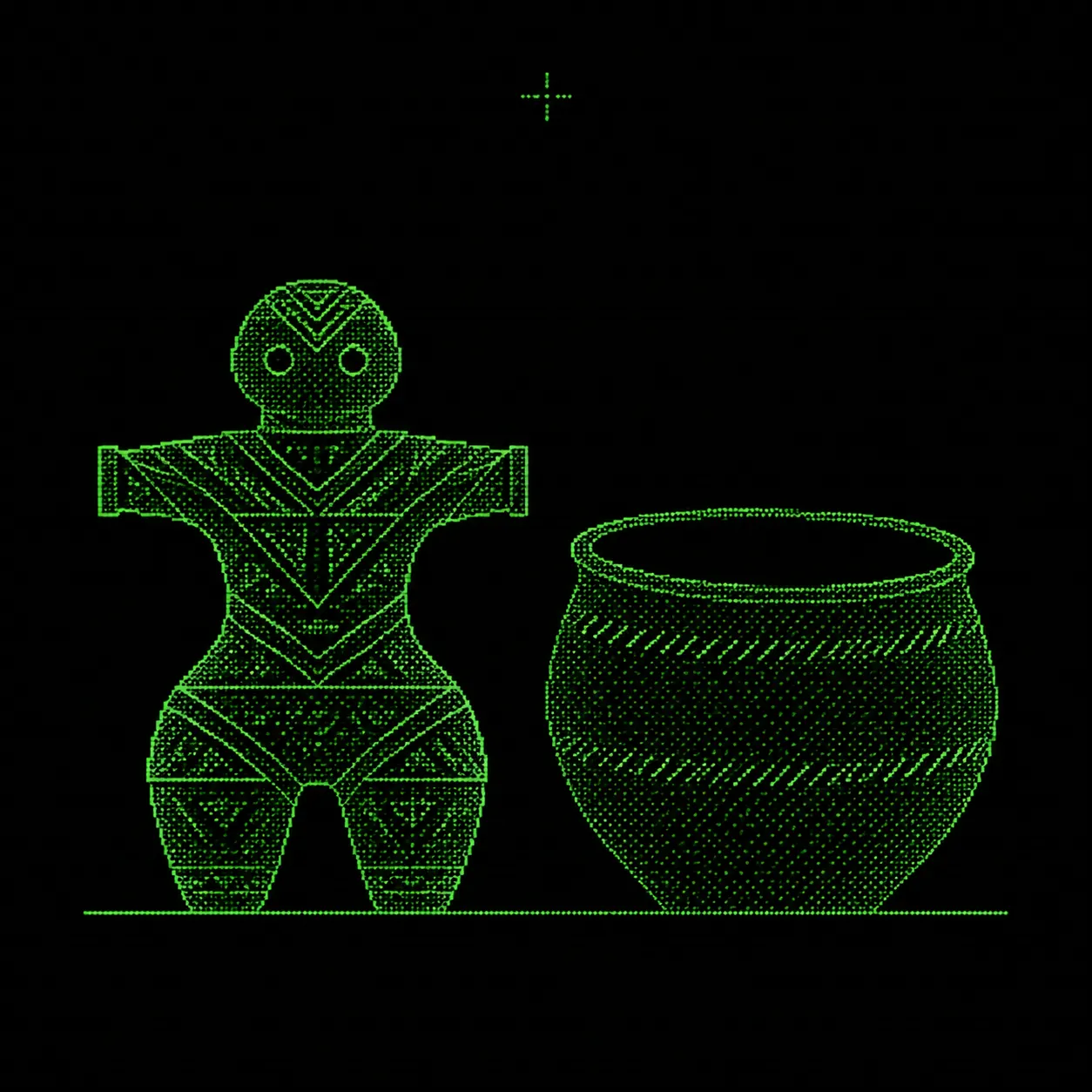
Jōmon-inspired forms in a conceptual illustration of the shared ceramic tradition.
Hitoshi Watanabe argued for a northern Eurasian ancestry of Jōmon figurines through the Paleolithic traditions around Lake Baikal and the later Amur region. Yōko Takashima’s doctoral study presents that genealogy explicitly. The comparison concerns patterned bodies, including the reduction of limbs and rectangular or tapering torsos, rather than a general observation that different peoples made female images. Takashima, pp. 242–243, discussing Watanabe.4
The comparison crosses materials. An ivory body can transmit an idea of a body even though carving it teaches a different operation from modeling clay. This gives us two distinguishable inheritances: how to make an image and what an image should be. They can move together, separately, or meet again in a later craft.
The timing matters. Pottery at Ōdai Yamamoto I dates to about sixteen thousand years ago. One of Japan’s earliest dogū, from Aitani Kumahara, belongs to a context about thirteen thousand years old. Nakamura et al., p. 1137; Shiga excavation account.
The Lake Biwa Museum describes the figure’s prominent breasts and waist, and its absence of arms and legs. Museum object record. In Japan, ceramic vessels precede the surviving clay figurine tradition by millennia.
Takashima records a particularly suggestive development in Watanabe’s argument: many distinctive Jōmon figures fall outside his proposed inherited patterns. Their constricted-waist form developed alongside pottery-manufacturing technology. Here the local craft helps transform the image. Takashima, note 49, pp. 282–283.
That is a richer connection than a row of identical goddesses crossing a continent. The western ceramic image offers an early setting for technical discovery. The eastern pottery tradition offers a later setting in which the human image can be remade. Bodies and vessels belong to a history of mutual transformation.
The female figure also gives that history an unusually persistent center of attention. The question of who made Venus figurines becomes more interesting when placed beside a second question: what did making them teach? We cannot identify the makers’ sex from the sex of a depicted body. We can recognize that representing women was one of the activities through which people explored an extraordinary material.
Our discussion of female agency in emergence myths approaches the creative body through stories. Here it has a physical counterpart: earth is handled, shaped, and made to endure. The image participates in creation because making it is already an act of creation.
The mother of a new material #
The Venus invites interpretation as a representation. Who is she? What did her body mean? Those questions have occupied generations of scholars. Her material poses another question: what had people learned in order to make her?
Follow that question and the figurine becomes part of the history of technology. Her manufacture requires a relationship with earth that can be taught. That relationship can outlive a particular image, cross a boundary, and acquire an unforeseen use. The historical connection between Venus and pot lies in this capacity of making to exceed its original purpose.
The strongest account joins three things: an early ceramic tradition centered on figures, the movement of skills through connected Eurasian communities, and East Asian invention of vessels for new practical ends. Jōmon figuration extends the story by showing how a ceramic world could give old bodily forms a new life. The evidence is uneven across that long span, but the connection supplies a coherent explanation for the relationship between its beginnings.
It also changes the status of symbolic work. Making an image can develop knowledge that later feeds people. A cherished or compelling form can keep a technique in use before its wider possibilities become apparent. Culture does not have to foresee the cooking pot to prepare for it.
Much later, Eurasian creation stories would make the shaping of earth into bodies an act of divine power, a theme pursued in “How the Gods Came East”. The figurine belongs to an older and more tangible history. A human hand had already performed the transformation that a myth could give to a god.
The Kiln Mother goes east carrying that accomplishment. Across the intervening generations, the form changes, the uses multiply, and the makers become people her first maker could never have imagined. What travels is the ability to give earth a body. In East Asia, that body learns to hold a meal.
Sources #
- Yanshina, Oksana V. (2023). “Could the Early Pottery of East Asia Have Western Roots?” Multidisciplinary Studies in Archaeology 1:56–128. DOI: 10.24412/2658-3550-2023-1-56-128.
- Vandiver, Pamela B., Olga Soffer, Bohuslav Klíma, and Jiří Svoboda (1989). “The Origins of Ceramic Technology at Dolní Věstonice, Czechoslovakia.” Science 246:1002–1008.
- Vandiver, Pamela B. (2022). “Upper Paleolithic Ceramic Figurines and Similarities to Some Late Pleistocene Pigment and Pottery Materials and Technologies of Eurasia.” Quaternary International 608–609:8–32. Institutional abstract.
- Farbstein, Rebecca, and April Nowell (2024). “Children at Play: The Role of Novices in the Production of Europe’s Earliest Upper Paleolithic Ceramics.” PLOS ONE 19:e0309107.
- Kuzmin, Yaroslav V. (2013). “Origin of Old World Pottery as Viewed from the Early 2010s: When, Where and Why?” World Archaeology 45:539–556.
- Li, Feng, FuYou Chen, YingHua Wang, and Xing Gao (2016). “Technology Diffusion and Population Migration Reflected in Blade Technologies in Northern China in the Late Pleistocene.” Science China Earth Sciences 59:1540–1553.
- Vandiver, Pamela B., and Sergey A. Vasil’ev (2002). “A 16,000 Year-Old Ceramic Human-Figurine from Maina, Russia.” MRS Proceedings 712:II6.9.
- Farbstein, Rebecca, Dinko Radić, Dejana Brajković, and Preston T. Miracle (2012). “First Epigravettian Ceramic Figurines from Europe (Vela Spila, Croatia).” PLOS ONE 7:e41437.
- Wu, Xiaohong, et al. (2012). “Early Pottery at 20,000 Years Ago in Xianrendong Cave, China.” Science 336:1696–1700. Indexed abstract.
- Boaretto, Elisabetta, et al. (2009). “Radiocarbon Dating of Charcoal and Bone Collagen Associated with Early Pottery at Yuchanyan Cave, Hunan Province, China.” PNAS 106:9595–9600. Open full text.
- Patania, Ilaria, and Yitzchak Jaffe (2021). “Collaboration, Not Competition: A Geoarchaeological Approach to the Social Context of the Earliest Pottery.” Journal of Anthropological Archaeology 62:101297. Institutional abstract.
- Craig, Oliver E., et al. (2013). “Earliest Evidence for the Use of Pottery.” Nature 496:351–354.
- Nakamura, Toshio, Yasuhiro Taniguchi, Sei’ichiro Tsuji, and Hirotaka Oda (2001). “Radiocarbon Dating of Charred Residues on the Earliest Pottery in Japan.” Radiocarbon 43:1129–1138.
- Takashima, Yōko (2014). A Comparative Study of Yamauba and Hag Fairies: Goddesses and Their Origins in the Folk Beliefs of Japan and the British Isles. Doctoral dissertation, Osaka City University. Full text.
- Shiga Prefectural Association for Cultural Heritage (2010). “Aitani Kumahara Site: Public Excavation Briefing.” June 6. Japanese excavation announcement.
- Hommel, Peter (2018). “What’s the Point? Globalization and the Emergence of Ceramic-Using Hunter-Gatherers in Northern Eurasia.” In Globalization in Prehistory, edited by Nicole Boivin and Michael D. Frachetti.
- Yanshina, Oksana V., and Alexander E. Sobolev (2018). “The Earliest Pottery of Xianrendong Cave: What Do We Know about It?” Journal of Ancient Technology Laboratory 14(3):9–21.
- Lake Biwa Museum. “One of Japan’s Oldest Clay Figurines.” Object record, exhibition collection.
Calendar ages here use the archaeological convention of years before 1950. They are rounded and generally date archaeological contexts, rather than the clay itself. The Xianrendong range follows Wu et al. (2012). Yanshina and Sobolev’s 2018 reassessment challenges aspects of the stratigraphy and chronology. The argument does not require every earliest Xianrendong attribution to stand: independently dated Yuchanyan pottery also places vessel-making among Pleistocene foragers, much later than the Moravian ceramic tradition. ↩︎
Peter Hommel identifies the geographical and chronological discontinuities in “Evaluating Alternatives” in “What’s the Point?”. He is not an advocate of an established western-figurine ancestry for East Asian pots. His discussion nevertheless distinguishes several ways ceramic knowledge can spread. This essay argues for transmission of prerequisite skills without treating technological resemblance as proof of a migration by a single identifiable population. ↩︎
The Maina range follows the explicit recalibration in Farbstein et al. (2012), “Discussion”: associated determinations of 16,540 ± 170 to 16,176 ± 180 radiocarbon BP were calibrated there to 20,221–18,863 cal BP. Vandiver’s 2022 review retains a different, younger age while explaining that it largely reproduces dates from earlier publications. These chronologies should not be silently merged. Neither supports using Maina as a securely earlier waypoint leading to the oldest claimed Chinese vessels. ↩︎
Watanabe’s Jōmon Clay Figurines and Goddess Belief (2001) is cited through Takashima’s inspected dissertation, rather than as a book consulted in full. Her notes 48–49 refer to Watanabe p. 136 and pp. 194–256. Formal descent and continuity of religious meaning are separate propositions. “Venus” is a conventional modern label; “Kiln Mother” is this essay’s metaphor, not an excavated divine name or a claim that these makers all used specialized kilns. ↩︎