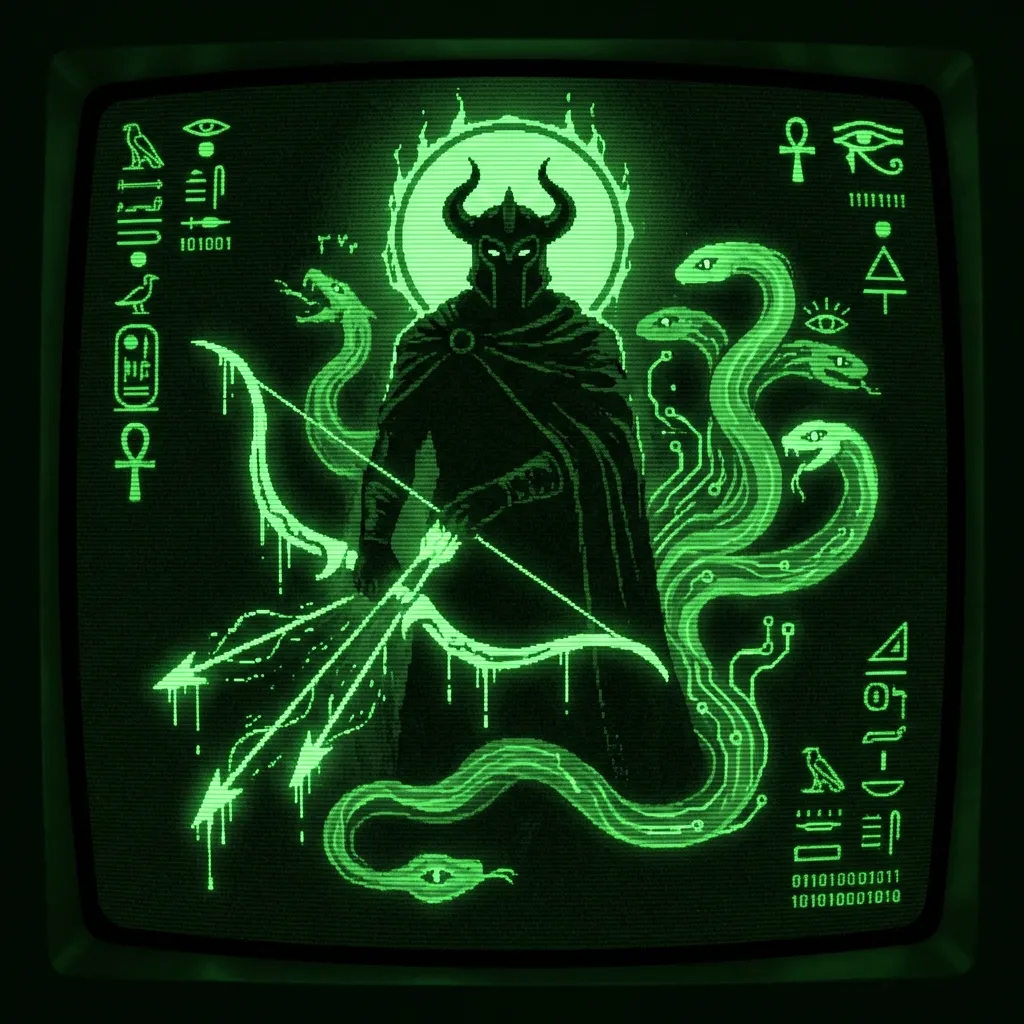
TL;DR
- Herakles’ second labor arms him with arrows dipped in the Hydra’s blood, turning the serpent into a portable, chthonic weapons system that recurs across his mythic life.1
- In Herakles, Euripides shows the hero killing his own family in a divinely induced madness sent by Lyssa, a personified rabies-spirit often depicted with canine headgear.2
- While the play doesn’t narrate the toxic mechanics, the wider tradition insists those arrows are always Hydra-poisoned, so “the toxin of his own arrows” is serpent venom as psychic contagion.3
- Greek wolf-symbolism (Lyssa, lykos, Lycaon, Mt. Lykaion) links madness, tyranny, and ritual boundary-crossing to a “wolf phase” of the human mind.4
- In Cutler’s Snake Cult model, serpent myths preserve memories of venom-based death/rebirth initiation rites; Herakles looks like an initiate who turns sacrament into weapon—and the wolfish breakdown is the ritual failure mode (Cutler, Snake Cult of Consciousness; “Herakles… initiated… at Göbekli Tepe”).
- Eve Theory frames the social stakes: the “snake-tech” requires a container (ritual, pedagogy, antidote); when it’s appropriated as domination hardware, it rebounds as madness and kin-slaughter (Cutler, Eve Theory of Consciousness v3.0).
“You see me and do not see my madness; but this plague of the mind is a god’s.”
— Euripides, Herakles (tr. via public-domain tradition)5
1. The Herakles People Think They Know#
In the standard pop version, Herakles is the guy with:
- twelve labors,
- a lion skin and big club,
- some anger issues.
But the ancient sources are much stranger and more psychologically charged.
In Euripides’ Herakles (ca. 416 BC), the hero returns from Hades after fetching Cerberus, only to be hit by a god-sent psychotic break. Hera, still hostile, sends Iris and Lyssa, the goddess of raging madness, to strike him once his labors are done.6
Lyssa explicitly appears onstage as the personified force of frenzy, at Hera’s command, targeting not the city but “the house of one man only.”6 In his delusion, Herakles believes he is carrying out yet another heroic feat; in reality, he is slaughtering his own wife Megara and their children with bow and arrows.7
The act is so horrific that even Lyssa resists it, protesting that Herakles has long labored for Zeus and doesn’t deserve this fate; but divine hierarchy wins, and she does it anyway.8 The result is a uniquely Greek horror: a god-induced state where the hero sincerely believes he is saving his family while he is annihilating them.
This is where the serpent walks back onstage.
2. Hydra’s Gift: Turning a Serpent Into Technology#
Herakles’ second labor is the battle with the Lernaean Hydra, a many-headed water-serpent living in a swamp near Lerna. After he and Iolaus finally dispatch the regenerating heads, the myth takes a crucial, often under-theorized turn:
“He cut up the Hydra’s body and dipped his arrows in its venom.”
— Pseudo-Apollodorus, Library 2.5.29
Other sources agree: Herakles uses the Hydra’s blood as a poison reservoir, coating his arrows with its lethal fluid.1011 The serpent is no longer just a monster; it has been harvested and turned into techne—a piece of transferable, repeatable technique.
This has consequences:
- Biological weapon: Modern commentators openly describe these arrows as a kind of ancient “biological weapon.”12
- Persistent contamination: Any wound from those arrows continues the Hydra’s work, infecting landscapes and bodies; one centaur’s blood mixed with Hydra venom is said to pollute the river Anigrus.13
The Hydra is now a distributed serpent, smeared onto every shaft in Herakles’ quiver.
3. When the Serpent Comes Back: Nessus, the Tunic, and Slow-Burn Venom#
The most famous reappearance of Hydra venom is Herakles’ death.
Years after the labors, the centaur Nessus tries to abduct Deianeira. Herakles shoots him with a Hydra-poisoned arrow; dying, Nessus convinces Deianeira to save his blood as a love charm.1415 She soaks a robe in it and later sends it to Herakles to “win him back.” As Sophocles and later mythographers tell it, heat activates the toxin and the robe fuses to his skin, burning him alive.1617
Scholars note that:
- the robe story presupposes the earlier Hydra-weaponization;
- the poison is always, explicitly Hydra’s, propagated via blood and fabric.1417
The arrow poison is thus temporalized:
- First: immediate battlefield lethality.
- Later: slow, domestic, “accidental” destruction via an intimate garment.
The serpent has become a time-released catastrophe, woven into the fabric (literally) of the hero’s oikos.
This same logic haunts Euripides’ Herakles even when venom isn’t spelled out. The wider mythic dossier tells you what those arrows always carry.
4. Lyssa, Rabies, and the Wolf Without Fur
4.1 Who is Lyssa?#
Ancient mythographers define Lyssa (Lytta) as the daimon of “mad rage, fury, crazed frenzy and, in animals, rabies.”18 In vase-painting she appears beside the doomed hunter Actaeon as he’s torn apart by his own dogs, dressed like a Thracian huntress with a fox- or dog-head cap that visually encodes rabid animal madness.19
She’s not a vague mood; she is the personified outbreak of animal ferocity inside the human sphere.
In Herakles, Euripides uses her as the direct agent:
- Hera orders Herakles’ destruction;
- Iris delivers the message;
- Lyssa reluctantly obeys, descending to “hunt” Herakles’ mind.6
One modern study notes that Lyssa is the clearest Greek literary model of a character who inflicts madness at the behest of another deity, a proto-“demonic technician” of altered consciousness.[^cullick]
4.2 Wolves, tyrants, and lycanthropy#
The ancient term lykanthropia literally means “wolf-man” and originally referred to a form of madness where someone believed they had become a wolf.20 Classical sources link wolves with:
- sacrificial transgression and human flesh (Lycaon at Mt. Lykaion, turned into a wolf for serving human meat to Zeus);2122
- ritual transformation around Zeus Lykaios, where a participant who tasted human flesh at the sacrifice “became a wolf” for nine years.22
- symbols of tyranny and predatory power in later political and cultural analysis.2324
Lyssa’s connection to rabid dogs and her canid headgear plug her straight into this wolf-madness orbit. She is the force that “de-civilizes” the domesticated dog back toward the wolf; in Euripides, she does something analogous to Herakles:
She regresses the hero into his own inner predator.
The tragedy never says “Herakles is now a literal werewolf,” but structurally he enters a wolf-phase:
- He no longer recognizes kin;
- He experiences the home as a battlefield;
- He becomes a kind of intra-house tyrant, annihilating his own line.
That is, mythically, lycanthropy without fur.
5. Arrows, Venom, and Madness: How Literal is This?#
Strictly speaking, Euripides does not narrate a pharmacological poisoning. Lyssa is a goddess; the madness is a divine affliction. But when later writers (and modern paraphrasers) say Lyssa drives “the toxin of his own arrows” into Herakles, they are compressing several solid mythic facts:
- Herakles’ arrows are canonically dipped in the Hydra’s venomous blood.91011
- Those arrows later contaminate Nessus’ blood, Deianeira’s robe, Herakles’ body, and even rivers.1413
- Some versions explicitly say Herakles kills his family with his bow and arrows during the frenzy.7
So when Lyssa “turns his own weapons against him,” the larger mythic system tells you that the Hydra is in those weapons. The play doesn’t show a neat toxicology case; it stages a symbolic internalization of serpent power:
- First Herakles externalizes the Hydra as a weapon.
- Then the weapon’s logic turns inward: the serpent gets into the mind.
This is perfectly in line with how Greek myth often works: physical substances (blood, venom, wine) are also moral and psychological vectors. Poison is never just chemistry; it is contagious fate.
6. Serpent Moments in Herakles’ Life (and What They Signal)#
To see the pattern, it helps to lay out Herakles’ serpent-touch points:
Table 1 – Serpent episodes in Herakles’ myth and their psychic motifs#
| Episode / text cluster | Serpent / poison element | Psychological theme |
|---|---|---|
| Infant in cradle vs. snakes | Hera sends snakes; baby strangles them25 | Proto-hero proves strength against chthonic threat |
| 2nd Labor: Lernaean Hydra | Multi-headed water-serpent; blood harvested for arrows1011 | Turning monster into technology; instrumentalized death |
| Hydra-arrows in later battles | Arrows cause incurable wounds, pollute landscapes1326 | Hero carries portable underworld contamination |
| Nessus & Tunic of Nessus | Centaur’s blood saturated with Hydra venom on robe1417 | Domestic love → slow, intimate destruction |
| Euripides’ Herakles madness | Lyssa weaponizes “his own arrows”; implied Hydra poison | Serpent logic internalized as divine madness |
| Death and apotheosis on the pyre | Hydra poison burns away mortal flesh16 | Serpent as agent of painful transformation/divinization |
Notice the arc:
- From outside to inside. Snakes begin as external threats; by the end they’re in his blood and garments.
- From battlefield to bedroom to brain. The Hydra’s venom moves from warfare → marriage → mental breakdown.
- From monster to mechanism to metaphysics. The serpent goes from an enemy to kill, to a technology to use, to a pattern of being that the hero cannot escape.
Herakles is the man who can kill the snake’s body but not its logic.
7. Wolf, Snake, and the Unintegrated Hero#
Greek myth repeatedly links:
- Wolf: boundary-breaking, tyrannical, liminal (Lycaon, Zeus Lykaios, werewolf cults).212223
- Snake: chthonic depth, poison, underworld knowledge, ambiguous wisdom.
- Madness: god-sent disruption of the ordinary psyche (Lyssa, Dionysus, Erinyes).
Herakles’ tragedy sits at their intersection:
- He is lion-clad but serpent-armed.
- The serpent’s power is externalized as lethal tech;
- The wolf’s power appears as an internal phase of consciousness: the hero as his own pack of hounds.
Lyssa is the hinge: a rabies-daemon who turns Herakles’ own weapons inward, “regressing the domestication” of both dogs and hero. In vase-painting, she literally drives the hounds of Actaeon insane.19 In Euripides, she drives Herakles’ hunting apparatus (bow, arrows, warrior self-image) into his household.
From a consciousness angle: we’re watching a failure of integration. Herakles can wield serpentine power, but he can’t contain it. The wolf-phase erupts when the serpent-tech blows back through the psyche.
8. Herakles Through the Snake Cult of Consciousness and Eve Theory#
Cutler’s Snake Cult of Consciousness is not (primarily) a “snakes are symbols because humans fear snakes” story. It’s a much more aggressive claim: snakes are everywhere in myth because snake venom was everywhere in ritual—specifically in ritualized death-and-rebirth initiations that helped catalyze (and then spread) a new form of reflective, recursive selfhood near the end of the Ice Age.2728
In that frame, the serpent is not metaphor first. The serpent is tech first—a pharmacological lever cultures learned to pull carefully (dose + antivenom + setting + fasting + choreography) to produce controlled brushes with ego death. The myths are then what you’d expect humans to do with experiences that feel like: “I died, and yet something in me remained.” Cutler’s core compression is brutally simple:
- “There was a time when we were not self-aware.”
- Then “the discovery of self” was taught/triggered by “an early ritual that used snake venom as a psychedelic,” later packaged with antivenom well enough to diffuse.27
- Those rituals plausibly look like the intense puberty rites anthropologists already know: seclusion, fear, ordeal, altered states—“to the edge of death”—except here the “psychedelic” payload is venom.2829
Once you take that seriously for five minutes, Herakles stops being a Marvel strongman and becomes something else:
Herakles is an initiate who never stopped carrying the sacrament.
8.1. The Labors as an initiation curriculum (not a “quest list”)#
Cutler explicitly proposes that the Heraklean cycle preserves the shape of an initiation program: early feats as qualification trials, culminating in Mysteries and an underworld descent.30 On this telling, the “labors” are less about civic heroism and more about manufacturing a mind—the kind of mind that can withstand contact with the underworld without dissolving.
Euripides puts Herakles in the most initiation-adjacent place possible: he returns from Hades with Cerberus and immediately undergoes a catastrophic alteration of consciousness. That’s not a random plot twist. It’s structurally what you’d expect if the myth remembers a tradition where “going down” had consequences and required containment.
Cutler also ties the cycle to broader initiation institutions (Eleusinian Mysteries, bullroarer cult diffusion, Göbekli Tepe as a ritual rendezvous), and notes the intriguing “animal pelts / canid” motif—initiates visually marked, liminal, half-civilized—exactly the aesthetic you’d expect around controlled regression and rebirth.30
So: labors as training, Mysteries as the gate, Hades as the ordeal.
8.2. Hydra venom as the mis-handled entheogen#
Inside Snake Cult logic, the Hydra episode becomes the turning point where venom is introduced as a ritual technology.
In the usual mythic reading, Herakles kills the Hydra and then “upgrades” his arrows: dip in Hydra blood, get permanent poison damage. But in Snake Cult terms, that move is psychologically and ritually explosive: he converts the entheogen into a weapon. He takes something that should be administered in a tightly controlled rite—dose, context, guide, antivenom—and makes it portable, casual, and instrumental.
Cutler’s broader argument already insists that venom rituals required learned dosing and antivenom packaging to become stable enough to spread.27 That’s the whole point: the venom is not “symbolic”; it’s dangerous, and cultures had to engineer the container. If so, Herakles’ Hydra-arrows are what it looks like when you rip the payload out of the ritual container and start using it for ordinary domination.
That’s the myth’s moral physics:
- Venom inside rite → death/rebirth → increased reflective capacity.
- Venom outside rite → contamination → tragedy.
Herakles becomes the vector of uncontrolled spread: the sacrament leaks into warfare, into marriage, into the household. (The Nessus/Deianeira robe tradition is the domestic version of that leak; Euripides’ madness is the psychic version.)
8.3. Apples as antivenom and the logic of “safe poisoning”#
Cutler’s most concrete (and intentionally provocative) reconstruction is that the original initiation may have involved both venom and an effective antivenom “countermeasure,” with “apples” serving as mythic residue of that antidote technology: initiates “gorging on apples” and then “tripping on snake venom.”30
Whether one buys “apples specifically” or not, the structure matters: a paired technology (poison + remedy) that allows safe passage through a controlled near-death. This is exactly why serpents so often unify opposites—poison and cure, death and rebirth—because the rite literally couples them.
In that light, the late labors that braid together:
- a woman’s garden,
- apples of immortality,
- a serpent guarding the prize,
- and the hero’s heel/foot on the serpent motif
stop reading like random folktale flourishes and start reading like initiation iconography: the candidate approaches immortality through a serpentine gate, survives the bite (or the “poisoning”), and returns transformed.30
8.4. Lyssa as the ritual “failure mode”: rabies, hounds, and regression#
Now return to Euripides’ Herakles.
In the play’s theology, Lyssa is not “a metaphor for PTSD.” She is an agent—a personified madness unleashed into a human mind. If Snake Cult is right that venom rites were a motor of consciousness evolution, then Lyssa maps cleanly onto what every culture with high-intensity initiations eventually discovers:
There is a phase change where the candidate can flip from “rebirth” into “break.”
Lyssa is the name for that flip.
Notice how Euripides stages the madness: Herakles believes he is performing an additional labor—still inside “heroic initiation mode”—but the target is wrong. The rite has inverted. Instead of killing the old self, he kills the new generation. The intended death/rebirth becomes kin-murder—the most obscene possible parody of renewal.
This is also where the canid imagery matters. In visual tradition Lyssa is tied to rabid hounds; in Cutler’s Göbekli/initiatory speculation, initiates are marked by animal pelts (fox/canid), symbolizing controlled de-civilization on the way to a higher integration.30 Euripides gives you the same regression without the guidance. The “pack” is no longer your ritual container; it’s what hunts you from inside your skull.
In other words: Herakles undergoes the rite without the rite. He gets the payload without the containment.
8.5. Eve Theory: who builds the container, and why Herakles breaks it#
Eve Theory adds a social and evolutionary claim: the “Snake Cult” is not an abstract meme that floated in from nowhere; it’s a cultural invention—and Cutler argues women were central early founders/propagators of the self-reflection breakthrough (“Women discovered ‘I’ and founded the Snake Cult”).31
That matters for Herakles, because he represents something like a later masculine appropriation of the serpent-tech:
- He does not enter the serpent as teacher.
- He conquers the serpent as resource.
- He carries its power forward as domination hardware (poisoned arrows).
In Eve Theory terms, that is exactly how a cognitive technology goes unstable: the payload (altered states that produce recursive self-models) detaches from the original social scaffolding (ritual pedagogy, the container, the ethic). Once detached, it becomes a generalized amplifier—rage, power, paranoia—rather than a disciplined tutorial in subject-object separation.
So Euripides’ Herakles is not “a strong man who gets unlucky.” He’s what you get when serpent-tech is treated as weapon rather than initiation: the venom returns as the collapse of the self’s boundary-maintenance. The hero becomes wolfish not because “wolves are cool,” but because regression is what happens when the container fails.
8.6. A cleaner way to say it: the labors are the Snake Cult, and the madness is the botched rebirth#
Put the pieces together:
- The Snake Cult model predicts that the oldest serpent myths encode initiation-grade altered states driven by venom and bounded by antidote + choreography.2728
- Cutler explicitly reads Herakles’ labors as an initiation arc, culminating in Mysteries and the descent with Cerberus.30
- Euripides stages Herakles’ climactic altered state not as illumination but as catastrophic inversion: the rite collapses into domestic slaughter.
- The Hydra-poisoned arrows are the myth’s way of saying: the entheogen has become portable, externalized, and therefore morally/psychically radioactive.
So the “snake” tie-in is not a decorative motif. It’s the engine. Herakles is the man who took serpent death/rebirth technology and tried to carry it as a permanent upgrade. The tragedy is what happens when you try to live forever in initiation mode: the mind loses its bearings, and the poison that was meant to kill the old self kills what you love.
If you want a single sentence thesis for the whole section:
Herakles’ madness is the mythic memory of an initiation payload (venom) escaping its ritual container—turning death-and-rebirth into rabid regression.
FAQ#
Q 1. Did Hydra venom literally “cause” Herakles’ madness in Euripides?
A. Euripides attributes the madness to Lyssa at Hera’s command, not to pharmacology; but because Herakles’ arrows are canonically Hydra-poisoned, the tragedy reads as serpent-tech turning inward—divine madness expressed through the hero’s own venomous apparatus (Euripides, Heracles; Theoi: Hydra).
Q 2. Why do wolves show up in a “snake” story?
A. Lyssa is rabies/frenzy personified—madness that regresses domestication into predatory canid mind—so the wolf imagery names the behavioral mode that emerges when the serpent payload escapes its ritual container (Theoi: Lyssa).
Q 3. What’s the simplest way to understand the labors in this lens?
A. Treat them as an initiation curriculum: staged ordeals culminating in underworld contact; the Hydra episode introduces venom as a power-source, and the later disasters show what happens when that power is instrumentalized rather than integrated (Cutler, “Herakles… initiated… at Göbekli Tepe”).
Q 4. How does the “Shirt of Nessus” connect to the madness scene?
A. Both are the same leakage pattern: Hydra venom migrates from monster → weapon → household; the robe is venom in fabric, the madness is venom in perception—two ways the serpent enters the oikos and turns love and kinship into the site of annihilation (Sophocles, Women of Trachis).
Q 5. Where do Snake Cult and Eve Theory actually change the interpretation?
A. They shift “snake” from symbol to remembered practice: venom used in death/rebirth rites produces an experiential basis for serpent myths; Eve Theory then explains why the container matters—once the technique is detached from its pedagogy and ethics, it rebounds as pathological regression (madness, tyranny, kin-killing) (Cutler, Snake Cult of Consciousness; Cutler, Eve Theory v3.0).
Footnotes#
Sources#
Pseudo-Apollodorus. The Library. Trans. J.G. Frazer. Loeb Classical Library, 1921.
Euripides. Herakles. In Euripides, Volume II, Loeb Classical Library. Greek text and English translation.
Sophocles. Women of Trachis. In Sophocles II, Loeb Classical Library; see also open-access translations.
“Lernaean Hydra.” Theoi Greek Mythology.
“Lyssa.” Theoi Greek Mythology and associated vase-painting notes.
Rose, H.J. “Deianira.” Oxford Classical Dictionary (2015).
Blanco, C. “Heracles’ Itch: An Analysis of the First Case of Male Uterine Displacement in Greek Literature.” Classical Quarterly 70 (2020): 1–21.
“These ancient Greek weapons were quite literally toxic.” National Geographic (25 May 2023).
Romano, D.G., and Mt. Lykaion Excavation Project reports (2016) summarized in coverage such as LiveScience on possible human sacrifice to Zeus at Mt. Lykaion.
Cid Martín, A. The Construction of Madness in Hercules (BA thesis, 2024).
Cullick, R. Maximae Furiarum: The Female Demonic in Augustan Epic (PhD diss., 2016).
“Lycanthropy.” Encyclopaedia Britannica and related etymological notes.
Secondary syntheses on wolf symbolism and tyranny in Greek culture, including “The Wolf’s Gaze: Three Stages in the History of Europe” (Academia.edu) and Kunstler, B., “The Werewolf Figure and Its Adoption into the Greek World” (Folklore, 1991).
Cutler, Andrew. The Snake Cult of Consciousness. Vectors of Mind (Substack), Jan 16, 2023. oai_citation:5‡vectorsofmind.com
Cutler, Andrew. The Snake Cult of Consciousness Two Years Later. Vectors of Mind, Jan 29, 2025. oai_citation:6‡vectorsofmind.com
Cutler, Andrew. Eve Theory of Consciousness v3.0. Vectors of Mind, Feb 28, 2024. oai_citation:7‡vectorsofmind.com
Cutler, Andrew. Herakles, Adam, and Krishna were initiated in the snake cult at Göbekli Tepe. Vectors of Mind, Mar 12, 2024. oai_citation:8‡vectorsofmind.com
Froese, Tom. “The ritualised mind alteration hypothesis of the origins and evolution of the symbolic human mind.” Rock Art Research (2015). (Linked via Cutler’s “Two Years Later” essay.) oai_citation:9‡vectorsofmind.com
On the Lernaean Hydra and Herakles dipping his arrows in its blood, see Pseudo-Apollodorus, Bibliotheca 2.5.2 and the summary at Theoi: Lernaean Hydra. oai_citation:0‡Theoi ↩︎
Lyssa is described as the daimon of mad rage and rabies, often depicted with a dog- or fox-head cap, in Theoi: Lyssa and the associated vase-painting commentary. oai_citation:1‡Theoi ↩︎
Hydra venom on Herakles’ arrows is central to the Nessus/Deianeira storyline and later biowarfare readings; see the Oxford Classical Dictionary entry on Deianira, the Women of Trachis tradition, and modern synthesis such as the National Geographic piece on toxic Greek weapons. oai_citation:2‡Oxford Research Encyclopedia ↩︎
For wolf-cult and lycanthropy around Mt. Lykaion and Zeus Lykaios, see Pausanias as summarized in recent discussions of the Lykaion excavations and modern overviews of werewolf cults in Arcadia. oai_citation:3‡Wikipedia ↩︎
Text and English translation of Herakles are conveniently accessible via open collections such as ToposText and MIT’s classics project, which show Lyssa and Iris discussing their orders and Herakles’ impending madness. oai_citation:4‡ToposText ↩︎
Euripides, Herakles 822–874, in which Iris introduces Lyssa as “Madness, daughter of Night” and explains that Hera has kept her from Herakles until he completed his labors. oai_citation:5‡ToposText ↩︎ ↩︎ ↩︎
Standard summaries (e.g., teaching guides on Greek tragedy) and commentaries agree that in the madness Herakles kills Megara and their children with his bow and arrows, mistaking them for enemies. oai_citation:6‡Fiveable ↩︎ ↩︎
See Cid Martín, “The Construction of Madness in Heracles” (2024), which analyzes Lyssa’s role as an agent executing Hera’s will and the dramaturgy of Heraklean insanity. oai_citation:7‡addi.ehu.eus ↩︎
Pseudo-Apollodorus, Bibliotheca 2.5.2, as summarized and quoted at Theoi and other mythographic compilations: after killing the Hydra, Herakles “cut up its body and dipped his arrows in its venom.” oai_citation:8‡Theoi ↩︎ ↩︎
Theoi’s Hydra entry collects the key ancient passages on Herakles’ use of Hydra venom. oai_citation:9‡Theoi ↩︎ ↩︎ ↩︎
See also the synthesis at Mythopedia: Hydra, which emphasizes that the Hydra-tipped arrows accompany Herakles in many subsequent exploits. oai_citation:10‡Mythopedia ↩︎ ↩︎ ↩︎
National Geographic’s “These ancient Greek weapons were quite literally toxic” discusses the Hercules–Hydra story as an early mythic reflection on the ethics and uncontrollability of biological weapons. oai_citation:11‡National Geographic ↩︎
For the hydra-poisoned centaur’s blood polluting the river Anigrus, see discussion in Blanco (2020) on Heracles’ poisoned victims and the river’s stench. oai_citation:12‡Cambridge University Press & Assessment ↩︎ ↩︎ ↩︎
H.J. Rose, “Deianira” in the Oxford Classical Dictionary recounts the Nessus episode and explicitly notes that Herakles’ arrow was poisoned with Hydra blood. oai_citation:13‡Oxford Research Encyclopedia ↩︎ ↩︎ ↩︎ ↩︎
The “Nessus (centaur)” entry summarizes the story: Herakles shoots Nessus with a Hydra-poisoned arrow; the centaur betrays Deianeira with the false love-charm claim. oai_citation:14‡Wikipedia ↩︎
Sophocles’ Women of Trachis is the classic tragic treatment of the poisoned robe, where the Hydra-tainted blood sears Herakles as the garment clings to his body. oai_citation:15‡Wikipedia ↩︎ ↩︎
For a compact modern summary of the Nessus robe and its metaphorical afterlife, see the “Shirt of Nessus” article in mythographic encyclopedias. oai_citation:16‡Grokipedia ↩︎ ↩︎ ↩︎
Theoi: Lyssa provides a concise dossier: Lyssa as the spirit of mad rage and rabies, appearing in Aeschylus and Euripides, and iconographically linked to rabid dogs. oai_citation:17‡Theoi ↩︎
Theoi’s gallery entry on the “Death of Actaeon” vase describes Lyssa as a Thracian huntress with fox-head cap, driving the hounds into rabid frenzy. oai_citation:18‡Theoi ↩︎ ↩︎
Etymologies of “lycanthropy” and early descriptions of it as a madness where sufferers believed themselves wolves are collected in standard references such as Etymonline and encyclopedic articles on lycanthropy. oai_citation:19‡etymonline.com ↩︎
On Mt. Lykaion, Zeus Lykaios, and the werewolf cult, see recent syntheses in archaeological and popular accounts that draw on Pausanias and others. oai_citation:20‡Wikipedia ↩︎ ↩︎
Pausanias 8.2.6 (via modern commentary) recounts the tradition that at the sacrifice to Zeus Lykaios, a man could become a wolf for nine years if he tasted human flesh, reverting only if he abstained. oai_citation:21‡baringtheaegis.blogspot.com ↩︎ ↩︎ ↩︎
For the wolf as symbol of tyranny and predatory power in Greek political imagination, see discussions like “The Wolf’s Gaze: Three Stages in the History of Europe,” which synthesizes literary and archaeological data. oai_citation:22‡Academia ↩︎ ↩︎
B. Kunstler’s article on the werewolf figure in Greek tradition connects wolf imagery to questions of political legitimacy and tyranny. oai_citation:23‡JSTOR ↩︎
The infant Herakles strangling Hera’s serpents is a standard element in myth summaries; see, e.g., comprehensive overviews of Herakles’ biography in classical reference works. oai_citation:24‡www.dl1.en-us.nina.az ↩︎
Many modern summaries of the Labors (including encyclopedic entries) emphasize that after the Hydra, Herakles’ arrows remain permanently poison-tipped, shaping later episodes. oai_citation:25‡www.dl1.en-us.nina.az ↩︎
Andrew Cutler, The Snake Cult of Consciousness (Jan 16, 2023): summarizes the hypothesis that snake venom was used ritually as a psychedelic-like catalyst for self-awareness, and that the ritual package (including antivenom) diffused widely near the end of the Ice Age. oai_citation:0‡vectorsofmind.com ↩︎ ↩︎ ↩︎ ↩︎
Andrew Cutler, The Snake Cult of Consciousness Two Years Later (Jan 29, 2025): reiterates “venom is a drug, is used ritually,” and frames initiation as brush-with-death altered states linked to the emergence/spread of reflective consciousness, engaging Tom Froese’s ritualised-mind hypothesis. oai_citation:1‡vectorsofmind.com ↩︎ ↩︎ ↩︎
Tom Froese, “The ritualised mind alteration hypothesis of the origins and evolution of the symbolic human mind,” Rock Art Research (2015), excerpted/discussed by Cutler in the Two Years Later essay as a mainstream-adjacent analogue emphasizing puberty rites, seclusion, hardship, and psychedelic ingestion as scaffolds for subject–object dualism. oai_citation:2‡vectorsofmind.com ↩︎
Andrew Cutler, Herakles, Adam, and Krishna were initiated in the snake cult at Göbekli Tepe (Mar 12, 2024): explicitly maps the labors onto initiation logic (qualification feats → Mysteries → death/rebirth underworld sequence), and proposes venom + antivenom (mythically encoded as apples) as the ritual payload/containment pair. oai_citation:3‡vectorsofmind.com ↩︎ ↩︎ ↩︎ ↩︎ ↩︎ ↩︎
Andrew Cutler, Eve Theory of Consciousness v3.0 (Feb 28, 2024): outlines EToC and explicitly links it to “the Snake Cult of Consciousness,” including the claim that women were central to founding/spreading the cult and the discovery of “I.” oai_citation:4‡vectorsofmind.com ↩︎