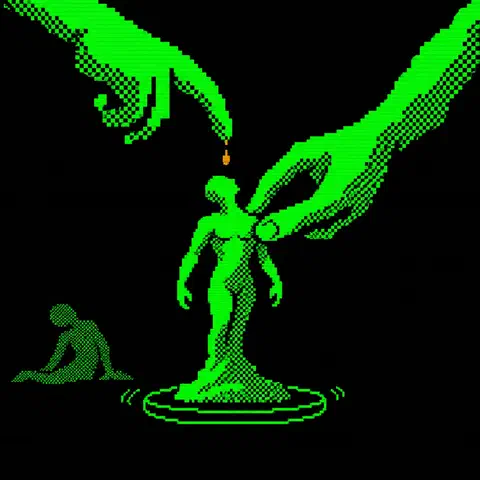
~/snake-cult/people-of-clay
Humans Made from Clay: The Creation Myth Around the World
From Sumer to the Shilluk, Nüwa to the Popol Vuh, gods shape the first people out of mud. Seventy tellings, the flawed batches, the blood in the clay, and where the story is missing.
The god's hands. The god's blood. The batch that came out wrong.
TL;DR
- Gods make the first people from clay, mud or earth in Sumer, Babylon, Egypt, Genesis, Greece, Rome, the Qurʾān, China, West Africa and the Nile, Siberia, tribal India, Borneo, Polynesia and the Americas; breath, blood, spittle or a soul brings the body to life.
- The oldest texts are Sumerian and Akkadian, on tablets of about 1800 BC: Nintu mixes clay “from his flesh and his blood”, the blood of a slain god, and the gods spit on it.
- Seventy tellings are mapped below, each cited to its earliest record: thickest across Eurasia and Africa, thinner in the Americas, rare in Australia, New Guinea and the Amazon.
- A third make the first people badly: drunk makers in Sumer, Rome and among the Yoruba; mud people who melt in Guatemala, Mexico and Arizona.
- In a Eurasian family of tellings a dog guards the clay bodies. In Siberia it is bribed with a fur coat and the devil spits on them; in India it drives off the horses that trample them.
- Clay sorts people: rich from poor in China, good from bad among the Ewe, white, red and black among the Shilluk and in a hadith of Abū Mūsā.
- It is a potter’s story, densest where people fired pots and bricks; the Hebrew, Greek and Latin words for the maker are potters’ words.
“He was well pleased with his work, and he looked at the men a long time, and he danced round about them.”
— The Kulin of Melbourne on Pund-jel, in R. Brough Smyth, The Aborigines of Victoria (1878), vol. I, p. 424
Map / People of clay
Where the gods made people from clay
Tab to the map, then use arrow keys to move between points.
- A flawed batch (21)
- Blood mixed into the clay
- Figures spoiled by a rival, often with a dog
- Different clays for different people
- Other tellings
Frazer’s Census and the Five Variants #
J. G. Frazer opened Folk-Lore in the Old Testament (1918) with the question of which peoples made man from clay. He set the clay Adam of Genesis 2:7 beside Babylon, Egypt and Greece, then ran through some forty tellings from Australia, Polynesia, Indonesia, India, Russia, Africa and the Americas (Frazer 1918, I, pp. 3–29). He concluded that such “rude conceptions of the origin of mankind, common to Greeks, Hebrews, Babylonians, and Egyptians, were handed down to the civilized peoples of antiquity by their savage or barbarous forefathers” (p. 8).
Frazer’s census is still the backbone. The map adds the Sumerian and Akkadian originals, Nüwa, the Qurʾān and hadith, the Andaman Islands, the Ainu, the Māori woman made from her mother’s pubic earth, the Pima and the Popol Vuh, and Yuri Berezkin’s survey of the dog-and-horse tellings from Algeria to Mongolia (Berezkin 2014). The full list, with maker, material and source for each, is in the table at the end.
| Variant | What happens | Where it is told |
|---|---|---|
| The potter god | A god models people like pots, often still makes each child that way | Egypt, Ewe, Yoruba, Sea Dayak, Natchez |
| Blood in the clay | A god’s blood, or an animal’s, goes into the mix | Atrahasis, Berossus, Māori, Palau, Sakarran Dayak |
| The flawed batch | The first figures are botched, broken, mute or melt | Sumer, Rome, Yoruba, Volga and Siberia, Borneo, Pima, Popol Vuh, Purépecha |
| The spoiled figures | A rival attacks the drying figures; a dog guards or fails | Algeria, Caucasus, Volga, Siberia, Hindu Kush, India, Halmahera |
| Kinds of clay | Different earths make different peoples, ranks or characters | China, Ewe, Shilluk, hadith, Palau, Kulin, Tiahuanaco |
Sumer and Babylon: Clay, Blood and Spittle #
The oldest are Mesopotamian. Two compositions known from Old Babylonian copies of about 1800 BC both make people from clay so that they can do the gods’ work.
Enki and Ninmah (Sumerian). The gods complain of digging canals. Enki’s mother Namma rouses him, and he tells her how to make a substitute:
šag₄ im ugu abzu-ka u₃-mu-e-ni-in-šar₂
“Mix the heart of the clay that is above the Abzu.”
— Enki and Ninmah, line 31 (ETCSL 1.1.2)
The birth goddesses “nip off” the clay, Namma gives it shape, and Ninmah stands over the birth. The scene is the delivery room: the Abzu is the sweet water under the earth, and its clay is the womb’s.
Atrahasis (Akkadian). The lesser gods strike against their labour and burn their tools. Enki proposes to kill one god and make man from him:
i-na ši-ri-šu ù da-mi-šu / ᵈnin-tu li-ba-al-li-il ṭi-iṭ-ṭa
“From his flesh and his blood let Nintu mix clay.”
— Atrahasis I 210–211 (Lambert & Millard 1969, pp. 58–59)
The victim is We-ila ša išû ṭēma, “We-ila, who had ṭēmu”, reason or a plan of his own (I 223). They slaughter him in their assembly. From the god’s flesh comes an eṭemmu, a ghost or spirit, so that “we may hear the drum for the rest of time”: the heartbeat (I 214–215). The Akkadian plays on its own sounds: ṭiṭṭu “clay”, ṭēmu “reason”, eṭemmu “ghost”. When she has mixed it, “the Igigi, the great gods, spat upon the clay” (I 233–234). Then the mother goddess nips off fourteen pieces, seven for males and seven for females, with a birth brick between them (I 256–259).
The Standard Babylonian Gilgamesh uses the same verb for the wild man Enkidu. The goddess Aruru “washed her hands, pinched off clay (ṭiṭṭa iktariṣ) and threw it into the wilderness” (I 101–102). Job says the same of himself in Hebrew: mē-ḥōmer qōraṣtî gam-ʾānî, “I too was pinched off from clay” (Job 33:6). Akkadian karāṣu and Hebrew qāraṣ are the same potter’s word.
In Babylon’s own epic, the Enūma eliš, Ea makes mankind from the blood of the rebel god Kingu and the clay drops out (VI 31–33). The priest Berossus, writing in Greek about 280 BC, has it both ways: Bel has his own head cut off, and the other gods mix his blood with earth and shape men, who are wise because they share the god’s mind (Eusebius, Chronicon, ed. Schoene 1875, I, col. 16; Frazer, p. 6). In Atrahasis the clay people multiply until their noise keeps Enlil awake, and he sends the flood.
The Flawed Batch #
About a third of the mapped tellings give the first people a defect, and the defect is the point of the story. It explains why people are blind, lame, barren, weak, mortal, or desire the wrong sex.
Drunk on beer: Ninmah’s six #
After the making, Enki and Ninmah sit down to drink: “Enki and Ninmah drank beer, their hearts became elated” (kaš im-na₈-na₈-ne šag₄-bi ul mu-un-te, line 52). Ninmah boasts that she can make a body good or bad as she pleases, and Enki bets he can find a fate for whatever she makes. She takes clay from above the Abzu and makes, one after another, a man who cannot bend his outstretched hands, a blind man, a man with broken feet, a man “who could not hold back his urine”, a woman who could not give birth, and
lu₂ su-ba ĝiš₃ nu-ĝar gal₄-la nu-ĝar
“a person on whose body no penis was set and no vagina was set.”
— Enki and Ninmah, line 75 (ETCSL translation)
Enki gives each a place: the man with stiff hands serves the king; the blind man stands before the king; the barren woman goes to the queen’s household; the sexless one he names “Nibru eunuch” and decrees it will “stand before the king” (lines 56–78). Ninmah throws down the clay. Then Enki makes a creature of his own, Umul, sick in head, eyes, neck, lungs and heart, which Ninmah cannot help: “The man you have fashioned is neither alive nor dead.” It is the first old man.
Drunk on wine: Prometheus swaps the genitals #
The Roman fabulist Phaedrus, a freedman of Augustus, tells the same joke about Prometheus. In one fable Prometheus, having made the human body, used the same clay to make “the tongue of the woman from the moulding of the penis; from that, obscenity drew its kinship” (a fictione veretri linguam mulieris. Adfinitatem traxit inde obscaenitas, 4.15). In the next, someone asks what made tribades and molles mares, women who rub women and soft men who take men. Aesop answers:
Idem Prometheus, auctor vulgi fictilis, … naturae partes veste quas celat pudor cum separatim toto finxisset die, aptare mox ut posset corporibus suis, ad cenam est invitatus subito a Libero; ubi inrigatus multo venas nectare sero domum est reversus titubanti pede. Tum semisomno corde et errore ebrio adplicuit virginale generi masculo, et masculina membra adposuit feminis. Ita nunc libido pravo fruitur gaudio.
“That same Prometheus, maker of the earthenware crowd, which breaks the moment it knocks against fortune, had spent the whole day moulding separately the parts that modesty hides under clothing, so that he could fit them to their bodies later. Suddenly Liber invited him to dinner. There he watered his veins with plenty of nectar and came home late on staggering feet. Then, half asleep and in drunken error, he fitted the virgin’s part to the male sex and put male members on women. So now lust enjoys a perverse pleasure.”
— Phaedrus, Fables 4.16 (Latin text)
Drunk on palm wine: Obatala #
The Yoruba god Obatala is called “Owner of the best clay” and “the Orisha who kneads clay”, wrote A. B. Ellis in 1894, because “Obatala made the first man and woman out of clay”. He still forms the child in the womb, and “albinoism and congenital deformities are regarded as his handiwork, done either to punish some neglect towards him on the part of the parents, or to remind his worshippers of his power” (Ellis 1894, pp. 39–40). Twentieth-century tellings make him drunk on palm wine when he shaped the crippled and the hunchbacked, which is why his worshippers do not drink it.1 Three makers, three fermented drinks, one result: the disabled are the clay of a god who was drunk at the wheel.
People who melt #
The Americas tell the flawed batch as a failure of material. In the Popol Vuh of the K’iche' Maya, after the animals fail to speak, the Framer and the Shaper try again:
“Of earth and mud was its flesh composed. But they saw that it was still not good. It merely came undone and crumbled. It merely became sodden and mushy. It merely fell apart and dissolved. … At first it spoke, but without knowledge. Straightaway it would merely dissolve in water, for it was not strong.”
— Popol Vuh, trans. Christenson 2007, p. 65
The gods break it up and make people of wood, who have no hearts and no minds, and only then the people of maize. The Purépecha of Michoacán said the first clay couple fell to pieces when they bathed in a river; Tucapacha made them again of ashes, and at last of metal (Herrera, in Frazer, p. 27). The Plains Ojibwa say Wisakejak’s first man was of stone, a bear rubbed against it and broke it, and the next was of mud, which is why people are weak (Simms 1906, pp. 338–339, in Berezkin 2014, p. 35).
The Pima of Arizona told J. William Lloyd in 1903 that three gods sat back to back, each making clay dolls in secret. Juhwerta Mahkai’s had no “sitting-down parts”, so they could not “get rid of the waste of what he eats”, and had only one leg; Toehahvs’s had webbed fingers. Elder Brother threw Toehahvs’s dolls in the water, where they became ducks and beavers, and smashed the others (Lloyd 1911, pp. 47–48).
In Borneo the order runs the other way. The Sea Dayak god Salampandai made a man of stone, but he could not speak; one of iron, who could not speak either; and at last one of clay, who could. The Dayaks hear him still, in the clinking of a night insect, hammering out clay babies at his anvil (Gomes 1911, p. 197, in Frazer, p. 14).
Blood in the Clay #
Atrahasis needs a god’s blood because clay alone makes a body, not a person. The blood brings the slain god’s ṭēmu, his reason, and leaves a ghost in every human. Berossus says the same: men are wise because the clay was tempered with Bel’s blood.
The idea recurs far from Babylon. Among the Māori, in Frazer’s summary of Gudgeon and Taylor, Tu (or Tiki, or Tāne) “took red riverside clay, kneaded it with his own blood into a likeness or image of himself”, breathed into its mouth and nostrils, and “the clay effigy at once came to life and sneezed”. Hence the Māori say, when someone sneezes, “Sneeze, O spirit of life” (Gudgeon 1905, pp. 125–126, in Frazer, p. 9). The Palauans said a brother and sister kneaded clay with the blood of animals, and people still carry the animal; in Frazer’s words, “men who have rat’s blood in them are thieves, men who have serpent’s blood in them are sneaks, and men who have cock’s blood in them are brave” (Kubary 1888, in Frazer, pp. 11–12). The Sakarran Dayaks of Sarawak said two birds moulded a man of damp earth and put the red gum of the kumpang tree in his veins; in Frazer’s words, “they cut him and blood flowed from his wounds”, and they named him “moulded earth” (Roth 1896, in Frazer, p. 14).
The Aztecs kept the blood and dropped the clay. In the Legend of the Suns (1558) Quetzalcoatl steals the bones of the earlier dead from the underworld, grinds them, and bleeds his penis on them to make the people of this age.2
The other Māori telling is the one John White printed in 1887. After Rangi and Papa, Sky and Earth, are pushed apart, their sons need wives. “They made the female power on the pubes of their mother Papa. They formed it by kneading the soft and damp soil of the land at Kura-waka.” They built the vulva first and the rest of the body round it, took the lungs from the clouds and the blood by prayer. Tāne “put his producing power” to the earth-formed woman, Hine-hau-one. Their daughter, whom he also took to wife, learned that her husband was her father, killed herself for shame and went down to the world of darkness (White 1887, I, pp. 131, 162–163).
The Dog Who Guards the Clay Man #
Across northern Eurasia the first bodies are spoiled while they dry. The Mari (Cheremiss) of the Volga told it to Jean Smirnov:
“God moulded man’s body of clay and then went up to heaven to fetch the soul, with which to animate it. In his absence he set the dog to guard the body. But while he was away the Devil drew near, and blowing a cold wind on the dog he seduced the animal by the bribe of a fur-coat to relax his guard. Thereupon the fiend spat on the clay body and beslavered it so foully, that when God came back he despaired of ever cleaning up the mess and saw himself reduced to the painful necessity of turning the body outside in. That is why a man’s inside is now so dirty.”
— Smirnov 1898, p. 200, in Frazer 1918, I, p. 22
Berezkin found the same tale among Russians, Ukrainians, Komi, Udmurt, Mordvins, Chuvash, Mansi, Khanty, Nenets, Evenki, Yakuts, Altai, Khakas and Buryats (Berezkin 2014, pp. 37–38). The Siberian versions of the dog and the fur coat carry the Fall into the making of the body itself.
South of the steppe the dog is the hero. The Kumi of the Chittagong Hills said God made a man and woman of clay, but every night a great snake came and ate the figures while he slept; at last he made a dog, which barked the snake away. “That is why to this day, when a man is dying, the dogs begin to howl” (Lewin 1870, pp. 224–226, in Frazer, p. 18). Among the Munda and Korku of central India the enemy is a winged horse that tramples the drying figures, afraid of what men will do to it; the Korku god takes red earth from an ant-hill (Russell 1916, III, pp. 551–552; Roy 1916, pp. 201–202). In the Hindu Kush the Kho say the horses owned the world before Adam and tried to trample his mud figure; the dog stopped them, and the navel is the print of a hoof (Jettmar 1986, p. 444). Armenians, Abkhaz and the Arabs of Tiaret in Algeria tell versions in which the dog is made from the clay itself, or from the devil’s spittle wrung out of it (Berezkin 2014, pp. 28–30).
Berezkin dates this southern form by the Munda languages: it is known to the northern Munda, Korku included, but not to the southern Munda, so it reached them after the two branches split and before Korku left, between about 1700 and 900 BC. The horse, which did not reach India until then, points to the Bronze Age steppe as its source (pp. 31–34, 39–40).
Different Clays for Different Peoples #
Several tellings use the clay to explain why people differ, and the explanation is as old as the Han dynasty.
China. Ying Shao’s Fengsu tongyi (c. AD 195), quoted in the Taiping yulan, records a popular saying:
俗說天地開闢,未有人民,女媧摶黃土作人,劇務,力不暇供,乃引繩於泥中,舉以爲人。故富貴者黃土人也,貧賤凡庸者縆人也。
“The common saying is that when heaven and earth were opened up there were no people yet. Nüwa kneaded yellow earth and made people. The work was hard and her strength was not equal to it, so she drew a cord through the mud and lifted it out to make people. So the rich and noble are the yellow-earth people, and the poor, the lowly and the common are the cord people.”
— Taiping yulan 78
The handmade people are the nobility; the mass-produced spatter is everyone else. The same serpent-bodied Nüwa mends the broken sky and founds marriage.
The Ewe. Jakob Spieth, a missionary of the North German Mission in German Togo, collected the Ewe tradition in their own language and printed it with a German translation:
“Man sagt, Gott bilde den Menschen aus Ton. Wenn von dem Wasser, mit dem er den Töpferton befeuchtet, etwas übrig bleibt, so gießt er dasselbe auf die Erde und bildet die schlechten und die ungehorsamen Menschen daraus. Will Gott einen guten Menschen bilden, so bildet er ihn aus gutem Ton; will er aber einen bösen Menschen bilden, so verwendet er schlechten dazu.”
“They say God makes man from clay. If some of the water he moistens the potter’s clay with is left over, he pours it on the ground and makes the bad and disobedient people from it. If God wants to make a good person he makes him from good clay; if he wants to make a wicked one he uses bad clay.”
— Spieth 1906, p. 828
The first man and woman, set on the earth, “looked at each other and began to laugh, whereupon God sent them into the world”. A second Ewe town told Spieth that God makes some people from the jawbones of the long dead, which is why a man can look just like his brother; and that when God means to make a woman he sends her to fetch the clay herself. If another woman asks her to bring some back for her too, God makes industrious women from the first woman’s clay and lazy ones from the clay she carried for the other (p. 840). Mawu is a potter, and the Ewe potters Spieth describes were women, who had to be ritually “clean” to work the clay (p. 782).
The Shilluk. On the White Nile the creator Juok “moulded all men out of earth”. In the land of the whites he found white earth and made white men; in Egypt he made red or brown men from Nile mud; in the land of the Shilluk he found black earth and made black men (Hofmayr 1911, pp. 128–129, in Frazer, pp. 22–23).
Islam. A hadith of Abū Mūsā al-Ashʿarī says God created Adam “from a handful which He took from all of the earth, so the children of Adam came according to the earth: among them the red, the white and the black and what is between, the smooth and the rough, the bad and the good” (Abū Dāwūd 4693; al-Tirmidhī 2955). The rabbis of Babylon had already gathered Adam’s dust from the whole world: his trunk from Babylon, his head from the Land of Israel, his limbs from other lands, and his buttocks, said Rav Aḥa, from Akra de-Agma. In the second hour of the first day he was a golem, a shapeless mass (Sanhedrin 38a–b).
In the Andes, the Creator made “one of each nation of clay” at Tiahuanaco after the flood, “painting the dresses that each one was to wear”, and gave each its language, songs and seeds before sending them under the earth to come up in their own lands (Molina, c. 1575, trans. Markham 1873, p. 4). In Melbourne Pund-jel gave one of his clay men straight hair and the other curly (Smyth 1878, I, p. 424).
Genesis, the Qurʾān, Egypt and Greece #
Genesis. “The LORD God formed the man of dust from the ground, and breathed into his nostrils the breath of life” (Genesis 2:7). The verb wayyîṣer is the potter’s: a yôṣēr is a potter, and Jeremiah watches one at his wheel to learn how God deals with Israel (Jeremiah 18). The man, ʾādām, is named for the ground, ʾădāmâ. Islamic commentators later made the clay body lie empty for forty years before the spirit went in, and had Iblis go in at its mouth and out of its anus to test it.
The Qurʾān. God made man min ṣalṣālin min ḥamaʾin masnūn, “from ringing clay, from black mud moulded” (15:26), “from ringing clay like pottery” (ka-l-fakhkhār, 55:14), and the jinn from smokeless fire. Iblis refuses to bow: “You created me from fire and created him from clay” (38:76).
Egypt. Khnum, the ram god of Elephantine and Esna, shapes bodies on the potter’s wheel. On Hatshepsut’s birth colonnade at Deir el-Bahari (c. 1470 BC), Khnum moulds the queen and her double, her ka, while the frog goddess Heqet holds out life (Naville 1896, Part II). The Roman-period hymns of Esna call him the maker of gods and people on his wheel (Lichtheim 1980, pp. 111–115). The Instruction of Amenemope has the moral: “Man is clay and straw, the god is his builder; he tears down, he builds up daily” (ch. 25).
Greece. Prometheus made men from earth and water (Apollodorus 1.7.1). At Panopeus in Phocis, by a mud-brick shrine, Pausanias was shown two stones, each big enough to fill a cart, beside a ravine:
χρῶμα δέ ἐστι πηλοῦ σφισιν … παρέχονται δὲ καὶ ὀσμὴν ἐγγύτατα χρωτὶ ἀνθρώπου· ταῦτα ἔτι λείπεσθαι τοῦ πηλοῦ λέγουσιν ἐξ οὗ καὶ ἅπαν ὑπὸ τοῦ Προμηθέως τὸ γένος πλασθῆναι τῶν ἀνθρώπων.
“They have the colour of clay … and they also give off a smell very like a human being’s skin. They say these are what is left of the clay from which the whole human race was moulded by Prometheus.”
— Pausanias 10.4.4 (Perseus)
Frazer walked down into the same glen on 1 November, some 1,750 years later, and found “a reddish crumbling earth, perhaps a relic of the clay out of which Prometheus modelled our first parents” (p. 7). Hesiod has Zeus order Hephaestus to mix earth with water, gaian hydei phyrein, and put in it a human voice, to make the first woman, Pandora (Works and Days 60–61). The Roman mythographer Hyginus ends the Greek line with a pun: Care saw “chalky clay” in a river and shaped a man; Jupiter gave it spirit, Earth claimed it because it was made of her body, and Saturn ruled it should be called homo “because it seems to be made from humus”, earth (Fabulae 220).
African Potter Gods #
African peoples told the story in forms that owe nothing to Genesis. The Ewe god pours out leftover water to make the wicked and reuses the jawbones of the dead. The Fang said God made man of clay “at first in the shape of a lizard, which he put in a pool of water and left there for seven days”, and on the seventh day a man came out (Tessmann 1913, II, p. 18, in Frazer, p. 23). The Shilluk Juok thinks out each organ by its use: legs like a flamingo’s to walk to the fields, two arms, one for the hoe and one to pull weeds, a tongue to “dance and speak and sing and shout”, ears to hear “the speech of great men”. Obatala kneads the Yoruba. Khnum’s wheel turns in Upper Egypt.
The African tellings cluster in the potting belt of West Africa and the Nile. In the south and east of the continent the first people more often come out of a reed bed, a hole in the ground or a tree, as in the Zulu story of Unkulunkulu, who came out of the reeds.
Where the Clay Myth Is Missing #
The gaps are as clear as the clusters.
- Australia. Only the Kulin of Melbourne have a clear clay creation. Elsewhere the ancestors rise from the ground, or are cut out of shapeless beings. Smyth’s informant in Melbourne, watching a brickmaker smooth clay in a mould by the Yarra, said: “like ’em that Pund-jel make ’em Koolin” (Smyth 1878, I, p. 424 n.).
- New Guinea and the Amazon. The clay creation is absent from both. The Lengua of the Paraguayan Chaco, whose creator is a beetle throwing up clay from its burrow, are the only South American lowland case (Grubb 1911, pp. 114–115).
- Vedic India. The Sanskrit texts make the world from the dismembered giant Puruṣa, not from clay. Berezkin found the dog-and-horse tale among the Munda, Dravidian, Tibeto-Burman and Dardic hill peoples but in no Indo-Aryan text or folklore (Berezkin 2014, pp. 26, 32).
- Northern Europe and Iran. The Norse gods make Ask and Embla from driftwood; the Iranian first pair grow from a rhubarb plant. Clay comes north only with Christian and Islamic Adam.
- Japan. The Kojiki has no maker of human bodies. The Ainu do: “When God made man in the beginning, He formed his body of earth, his hair of chickweed, and his spine of a stick of willow. When, therefore, a person grows old, his back bends in the middle” (Batchelor 1901, p. 4).
Some tellings on the map were plainly touched by missionaries. The Tahitian woman made from the man’s bone ivi, the Tokelau woman given a rib, and the Kumeyaay First Woman made from a rib all echo Genesis 2; the Natchez priest who told Le Page du Pratz that God kneaded “clay, such as that which potters use” had no story for the woman until Du Pratz gave him Eve’s rib (Du Pratz 1774, p. 330, in Frazer, p. 27). The clay itself, as the Māori, Maidu and Hopi tellings show, is older than the missions.3
A Potter’s Story #
The clearest reading is that the clay creation is a potter’s story, and most of it travelled with pottery and farming. The earliest texts come from the oldest brick-and-pot civilisation, Sumer. The verbs that name the maker are potters’ verbs: Akkadian karāṣu and Hebrew qāraṣ, “to pinch off clay”; Hebrew yāṣar, “to shape as a potter”; Greek plassein, “to mould”; Phaedrus’s “maker of the earthenware crowd”. The god at the wheel is Egyptian, the god who forms each child in the womb is Ewe and Yoruba, and the people who still hear the creator hammering babies are Dayak. The story is densest along the belt of early farmers and potters from the Mediterranean to China and down the Nile into West Africa, and weakest among hunters who did not fire clay.
Two of the variants can be traced as single stories. Berezkin’s dog-and-horse tale is shared in too much detail across the Caucasus, the Hindu Kush, Munda India and Mongolia to be invented twice; he places it in the Bronze Age steppe. The Mesopotamian blood-in-the-clay line runs through Atrahasis, the Enūma eliš and Berossus, and on to the Greek idea that men are akin to the gods.
The American tellings are thinner and mostly recorded late. Some are plainly borrowed. But the mud people who dissolve, in the Popol Vuh, among the Purépecha and the Ojibwa, belong to an American set of stories in which a creator tries durable and fragile materials and people end up made of the weak one (Berezkin 2014, p. 35). That is the reason Americans gave for death, and it looks independent of the Old World potter.
What the Clay Man Lacks #
In nearly every telling the clay body is not yet a person. It needs breath (Genesis, Pund-jel breathing into “their mouths, their noses, and their navels”), a soul fetched from heaven (the Mari), wind weighed on a scale (Nias), ginger blown on its skull and ears before it can speak (Minahasa), or a god’s blood. The failed batches fail the same test: the Dayak men of stone and iron cannot speak, and the Popol Vuh’s mud person “spoke, but without knowledge”. The making of the body is the easy part. The story is about what has to be added before the figure can answer its maker. That is the gap the Eve Theory of Consciousness puts at the start of the human story: a body that was already human, waiting for the self.
In Atrahasis the added thing is a dead god’s reason and the ghost that keeps the drum of the heart beating. In Siberia it is spoiled before it arrives, by spittle on the clay while the dog looks away in its new fur coat. In Genesis, the next chapter gives the clay man a second gift from the serpent, and with it shame and death, while the snake keeps the renewal of the cast skin.
Every telling at a glance #
| People | Region | Maker | Material | Flaw or variant | Earliest source |
|---|---|---|---|---|---|
| Sumerians (Enki and Ninmah) | Nippur, southern Iraq | Namma, Ninmah, Enki | Clay from above the Abzu | Drunk on beer, Ninmah makes six disabled people | ETCSL 1.1.2, lines 24–82 (Old Babylonian copies, c. 1800 BC) |
| Babylonians (Atrahasis) | Sippar, Iraq | Nintu (Mami) | Clay, flesh and blood of the slain god We-ila | Gods spit on the clay; 7 male, 7 female | Atrahasis I 208–260; Lambert & Millard 1969: 56–61 |
| Babylonians (Berossus) | Babylon, Iraq | The gods, at Bel’s order | Earth and Bel’s blood | Wisdom comes from the god’s blood | Berossus, in Eusebius, Chronicon (Schoene 1875 I: col. 16) |
| Babylonians (Gilgamesh) | Uruk, Iraq | Aruru | A pinch of clay | Enkidu, the wild man | Standard Babylonian Gilgamesh I 101–103; George 2003 |
| Egyptians (Khnum) | Upper Egypt | Khnum | Clay on the potter’s wheel | Shapes each child and its ka | Naville 1896 II (birth reliefs, c. 1470 BC); Esna hymns, Lichtheim 1980: 111–115 |
| Israelites (Genesis) | Judah | YHWH | Dust of the ground (ʾădāmâ) | Breath in the nostrils | Genesis 2:7; compare Job 33:6 and Jeremiah 18 |
| Babylonian rabbis (Talmud) | Babylonia, Iraq | God | Dust from the whole world | Buttocks from Akra de-Agma | Babylonian Talmud, Sanhedrin 38a–b |
| Arabs (Qurʾān) | Mecca, Arabia | God | Ringing clay of black mud | Iblis, made of fire, refuses to bow | Qurʾān 15:26–33; 55:14–15; 38:71–76 |
| Arabs (hadith of Abū Mūsā) | Medina, Arabia | God | A handful of every earth | Red, white, black; good and bad | Abū Dāwūd 4693; al-Tirmidhī 2955 |
| Greeks (Prometheus at Panopeus) | Phocis, Greece | Prometheus | Clay | Leftover lumps smell of human skin | Pausanias 10.4.4 (c. AD 170); Apollodorus 1.7.1 |
| Greeks (Pandora) | Boeotia, Greece | Hephaestus | Earth and water | The first woman | Hesiod, Works and Days 60–82; Theogony 570–591 |
| Romans (Phaedrus) | Rome, Italy | Prometheus | Clay | Drunk, swaps the genitals | Phaedrus, Fables 4.15–16 (1st century AD) |
| Romans (Cura) | Italy | Cura (Care) | Chalky river clay | Earth claims the body; homo from humus | Hyginus, Fabulae 220 |
| Arabs of Tiaret | Tiaret plateau, Algeria | God | Mud | Satan’s spittle: navel and dog | Aceval 2005: 10–11, via Berezkin 2014: 30 |
| Armenians | Lori, Armenia | God, angels | Mud | Horses, devils’ spittle, dog | Zhamkochian 2012: 138–140 (recorded 1941), via Berezkin 2014: 29 |
| Abkhaz | Abkhazia, Caucasus | God | Mud | Horses trample; mud turns to dogs | Bartsyts and Kogonia (1990s), via Berezkin 2014: 29 |
| Mari (Cheremiss) | Middle Volga, Russia | God | Clay | Dog bribed; Devil slavers; body turned inside out | Smirnov 1898: 200, via Frazer 1918 I: 22 |
| Setu | Southeast Estonia | God | Clay figure | Devil spits or pokes: pain | Masing 1998: 64, via Berezkin 2014: 37 |
| Russians | Central and northern Russia | God | Earth | Dog bribed with fur; spittle | Belova 2004: 226–227, via Berezkin 2014: 37–38 |
| Mordvins | Mordovia, Russia | God | Earth | Dog bribed; spittle | Devyatkina 1998: 169, 297–298, via Berezkin 2014: 37–38 |
| Mansi | Ob basin, western Siberia | Creator | Earth | Dog bribed; spittle | Berezkin 2014: 37–38 |
| Altai | Altai, Russia | Ülgen | Earth | Erlik spits; dog bribed | Verbitski 1893: 92–93, via Berezkin 2014: 38 |
| Buryats | Lake Baikal, Russia | Creator | Earth | Dog bribed; spittle | Gomboev 1890: 67–69, via Berezkin 2014: 37–38 |
| Yakuts | Lena basin, Russia | Creator | Earth | Dog bribed; spittle | Berezkin 2014: 37–38 |
| Dörbet Oirats | Uvs, western Mongolia | God | Mud | Cow gores a figure; fragments become the dog | Skorodumova 2003: 51–52, via Berezkin 2014: 30 |
| Kho | Chitral, Pakistan | God | Mud | Horses trample; dog guards; navel a hoofprint | Jettmar 1986: 444, via Berezkin 2014: 28 |
| Wakhi | Wakhan, Pamir | God | Clay | Horse kicks the half-made man | Lashkarbekov 2005 (oral), via Berezkin 2014: 28 |
| Barela-Bhilala | Madhya Pradesh, India | A goddess | Clay figures | Eagle queen attacks | Kapp 1977: 46, via Berezkin 2014: 28 |
| Korku | Betul, Madhya Pradesh, India | Mahadeo (Shiva) | Red earth of an ant-hill | Indra’s horses trample; dog guards | Russell 1916 III: 551–552 |
| Munda | Chota Nagpur, Jharkhand, India | Singbonga | Clay | Winged horse tramples; spider guards | Roy 1916: 201–202 |
| Santal | Santal Parganas, India | Malin Budhi | Stiff clay | Day-horse tramples; given birds’ life | Campbell 1916: 15–17 |
| Kumi | Arakan and Chittagong Hills | God | Clay | A snake eats the figures; dog guards | Lewin 1870: 224–226 |
| Khasi | Meghalaya, India | God | Earth | Evil spirit destroys; dog guards | Gurdon 1914: 106 |
| Mizo (Lushei) | Mizoram, India | The creator | Earth | Destroyed until a dog guards | Shakespear 1909: 399, via Berezkin 2014: 28 |
| Aka-Bo (Andaman Islanders) | North Andaman, India | Jutpu | Termite-nest clay | The first woman, Kot | Radcliffe-Brown 1922: 192 |
| Han Chinese (Nüwa) | Central China | Nüwa | Yellow earth; mud flung from a cord | Rich from earth, poor from the cord | Fengsu tongyi (c. AD 195), in Taiping yulan 78 |
| Ainu | Hokkaido, Japan | God | Earth, chickweed, willow stick | Backs bend in old age | Batchelor 1901: 4 |
| Bila-an | Davao, Mindanao, Philippines | Melu | Skin scurf (also wax, dirt) | Noses upside down | Cole 1913: 135–137 |
| Bagobo | Davao, Mindanao, Philippines | Diwata | Two lumps of earth | Spit gives life | Benedict 1913: 15 |
| Minahasa | North Sulawesi, Indonesia | Wangi | Earth | Mute until ginger is blown | Graafland 1869 I: 96–97 |
| Sea Dayak (Iban) | Sarawak, Malaysia | Salampandai | Clay (after stone, iron) | Stone and iron men cannot speak | Gomes 1911: 197 |
| Sakarran Dayak | Sarawak, Malaysia | Two birds | Damp earth, red tree-gum | Wood and rock men fail | Horsburgh in Roth 1896 I: 299 |
| Nias | Nias, Indonesia | Luo Zaho | Earth the size of an egg | Wind weighed for breath | Sundermann 1905: 65 ff. |
| Kei Islanders | Kei Islands, Indonesia | Dooadlera | Clay | Breath | Pleyte 1893: 564 |
| Loda and Galela | Halmahera, Indonesia | Creator | Mud | Evil spirit breaks them; dogs from his dung | Baarda 1904: 442–444, via Berezkin 2014: 28 |
| Palauans | Palau | A brother and sister | Clay and animals’ blood | Character from the animal’s blood | Kubary 1888: 3, 56 |
| Mota (Banks Islanders) | Vanua Lava, Vanuatu | Qat | Red marsh clay | Men and pigs alike at first | Codrington 1891: 158 |
| Malekula | Malekula, Vanuatu | Bokor | Clay | First man and woman | Leggatt 1893: 707–708 |
| Kulin (Wurundjeri) | Melbourne, Victoria, Australia | Pund-jel (Bunjil) | Clay on bark | Straight and curly hair; breath in navel | Smyth 1878 I: 424 |
| Māori | Aotearoa New Zealand | Tāne, Tu | Soil of Kura-waka; red clay and blood | Vulva shaped first; the clay sneezes | White 1887 I: 131, 162–163; Gudgeon 1905: 125–126 |
| Tahitians | Tahiti, French Polynesia | Taaroa | Red earth | Woman from a bone (ivi) | Ellis 1832 I: 110–111 |
| Tokelauans | Fakaofo, Tokelau | The first man | Earth and a rib | The woman Ivi | Turner 1884: 267–268 |
| Nui islanders | Nui, Tuvalu | Aulialia | Earth | First man and woman | Turner 1884: 300–301 |
| Ewe | Ho, Volta Region, Ghana | Mawu | Good and bad clay | Bad people from leftover water | Spieth 1906: 828, 840 |
| Yoruba | Ile-Ife, Nigeria | Obatala | Clay | Albinos and deformed people | Ellis 1894: 39–40 |
| Shilluk | White Nile, South Sudan | Juok | White sand, Nile mud, black earth | Colour from the clay | Hofmayr 1911: 128–129, via Frazer 1918 I: 22–23 |
| Fang | Gabon and Equatorial Guinea | God | Clay lizard | Seven days in a pool | Tessmann 1913 II: 18, via Frazer 1918 I: 23 |
| Iñupiat | Point Barrow, Alaska | A spirit | Clay | Dried on the shore | Ray 1885: 47 |
| Yup’ik | Bering Strait, Alaska | Raven | Clay | The first woman | Nelson 1899: 454 |
| Acjachemen (Juaneño) | San Juan Capistrano, California | Chinigchinich | Lake-shore clay | First man and woman | Boscana 1846: 247 |
| Maidu | Sierra Nevada, California | Earth-Initiate | Dark red earth | Hands left unfinished | Dixon 1902: 39–42 |
| Kumeyaay (Diegueño) | San Diego, California | Tcaipakomat | Light-coloured clay | Woman from the man’s rib | Waterman 1910: 338–339 |
| Hopi | Arizona | Huruing Wuhti | Clay | Woman first, then man | Voth 1905: 1–2 |
| Akimel O’odham (Pima) | Gila River, Arizona | Elder Brother and two others | Clay dolls | Dolls without anus, one-legged, web-fingered | Lloyd 1911: 47–48 |
| Natchez | Lower Mississippi, Louisiana | God | Potter’s clay | Breath | Du Pratz 1774: 330 |
| Purépecha | Michoacán, Mexico | Tucapacha | Clay, then ashes, then metal | Clay dissolves in the river | Herrera, via Frazer 1918 I: 27 |
| K’iche’ Maya (Popol Vuh) | Highland Guatemala | Framer and Shaper | Earth and mud | Dissolves, speaks without knowledge | Popol Vuh, Christenson 2007: 65–66 |
| Andean peoples (Tiahuanaco) | Lake Titicaca, Bolivia | The Creator | Painted clay | One of each nation, with dress and language | Molina c. 1575, Markham 1873: 4 |
| Enxet (Lengua) | Chaco, Paraguay | A beetle | Clay from its burrow | Man and woman joined | Grubb 1911: 114–115 |
| Plains Ojibwa | Saskatchewan, Canada | Wisakejak | Stone, then mud | Mud people are weak | Simms 1906: 338–339, via Berezkin 2014: 35 |
FAQ #
Q1. Which cultures say humans were made from clay?
A. The Sumerians and Babylonians, the Egyptians, the Israelites (Genesis 2:7), the Greeks and
Romans, the Qurʾān, the Chinese (Nüwa), the Ewe, Yoruba, Shilluk and Fang of Africa, the Mari,
Altai and Buryats of Russia, the Munda and Santal of India, the Dayaks of Borneo, the Māori, the
Kulin of Victoria, and in the Americas the Maidu, Hopi, Pima, Natchez, Purépecha and the K’iche'
Maya of the Popol Vuh.
Q2. What is the oldest myth of humans made from clay?
A. The Sumerian Enki and Ninmah and the Akkadian Atrahasis, both on Old Babylonian tablets
of about 1800 BC. In Atrahasis the goddess Nintu mixes clay with the flesh and blood of the slain
god We-ila, and the gods spit on the clay.
Q3. How did Nüwa make humans from yellow earth?
A. In a saying preserved from Ying Shao’s Fengsu tongyi (c. AD 195), Nüwa kneaded yellow
earth into people; tired out, she dragged a cord through the mud and flung the drops. The rich and
noble are the yellow-earth people, the poor and lowly the cord people.
Q4. Why do some creation myths have a failed batch of clay people?
A. The botched making explains human defects. Ninmah, drunk on beer, makes the blind, the
barren and a person with neither penis nor vagina; Phaedrus’s Prometheus comes home drunk and puts
“male members on women”; Obatala’s clay makes albinos and the deformed; the Popol Vuh’s mud people
dissolve in water.1
Q5. Why is the god’s blood mixed into the clay?
A. Clay makes a body, not a person. In Atrahasis the slain god’s blood brings his ṭēmu,
reason, and leaves a ghost in every human; Berossus says men are wise because their clay was
tempered with Bel’s blood, and the Māori Tu kneads red clay with his own blood.
Q6. Did African peoples tell the clay story before the missionaries?
A. Yes. The Ewe god pours out leftover water to make the wicked and reuses the jawbones of the
dead, the Fang clay man begins as a lizard left seven days in a pool, and Khnum’s wheel turned in
Upper Egypt by 1470 BC; none of this comes from Genesis.
Q7. Did the clay creation myth spread from one place?
A. Mostly it travelled with pottery and farming, from Sumer outward, and two variants can be
traced as single stories: the Mesopotamian blood in the clay and Berezkin’s Bronze Age
dog-and-horse tale. The American mud people who dissolve look independent of the Old World potter.
Sources #
Primary texts #
- Enki and Ninmah. Electronic Text Corpus of Sumerian Literature 1.1.2 (translation) and transliteration.
- Lambert, W. G., and A. R. Millard. Atra-ḫasīs: The Babylonian Story of the Flood. Oxford: Clarendon Press, 1969.
- George, A. R. The Babylonian Gilgamesh Epic. 2 vols. Oxford: Oxford University Press, 2003.
- Eusebius. Chronicorum libri duo, ed. A. Schoene, vol. I. Berlin, 1875 (Berossus).
- Naville, Édouard. The Temple of Deir el Bahari, Part II. London: Egypt Exploration Fund, 1896.
- Lichtheim, Miriam. Ancient Egyptian Literature, vols. II–III. Berkeley: University of California Press, 1976–1980.
- Genesis 2:7; Jeremiah 18:1–6; Job 33:6; Babylonian Talmud, Sanhedrin 38a–b. Sefaria.
- Qurʾān 15:26–33, 55:14–15, 38:71–76.
- Abū Dāwūd, Sunan, 4693; al-Tirmidhī, Jāmiʿ, 2955.
- Pausanias. Description of Greece 10.4.4, Perseus. Apollodorus, Library 1.7.1. Hesiod, Works and Days 60–82; Theogony 570–591.
- Phaedrus. Fabulae 4.15–16, The Latin Library.
- Hyginus. Fabulae 220, The Latin Library.
- Ying Shao 應劭, Fengsu tongyi 風俗通義, in 《太平御覽》卷七十八 Taiping yulan 78.
- Christenson, Allen J., trans. Popol Vuh: Sacred Book of the Quiché Maya People. Mesoweb, 2007.
- Molina, Cristóbal de. “The Fables and Rites of the Yncas” (c. 1575). In C. R. Markham, ed., Narratives of the Rites and Laws of the Yncas. London: Hakluyt Society, 1873.
Ethnographies #
- Spieth, Jakob. Die Ewe-Stämme: Material zur Kunde des Ewe-Volkes in Deutsch-Togo. Berlin: Reimer, 1906.
- Ellis, A. B. The Yoruba-Speaking Peoples of the Slave Coast of West Africa. London: Chapman and Hall, 1894.
- Hofmayr, Wilhelm. “Die Religion der Schilluk.” Anthropos 6 (1911): 128–129 cited.
- Tessmann, Günter. Die Pangwe. 2 vols. Berlin: Wasmuth, 1913.
- Smyth, R. Brough. The Aborigines of Victoria, vol. I. Melbourne: Government Printer, 1878.
- Radcliffe-Brown, A. R. The Andaman Islanders. Cambridge: Cambridge University Press, 1922.
- Batchelor, John. The Ainu and Their Folk-Lore. London: Religious Tract Society, 1901.
- White, John. The Ancient History of the Maori, vol. I. Wellington: Government Printer, 1887.
- Gomes, Edwin H. Seventeen Years among the Sea Dyaks of Borneo. London: Seeley, 1911.
- Playfair, A. The Garos. London: Nutt, 1909.
- Dixon, Roland B. Maidu Myths. Bulletin of the American Museum of Natural History 17 (1902): 33–118.
- Lloyd, J. William. Aw-aw-tam Indian Nights: The Myths and Legends of the Pimas. Westfield, NJ, 1911.
- Grubb, W. Barbrooke. An Unknown People in an Unknown Land. London: Seeley, 1911.
Surveys #
- Frazer, J. G. Folk-Lore in the Old Testament, vol. I. London: Macmillan, 1918. Ch. 1, “The Creation of Man”, pp. 3–44. The source of most of the Indonesian, Melanesian, Indian, Russian and American tellings on the map, with his references to Lewin, Gurdon, Russell, Roy, Campbell, Smirnov, Cole, Benedict, Graafland, Roth, Sundermann, Pleyte, Kubary, Codrington, Leggatt, Turner, Ellis, Gudgeon, Ray, Nelson, Boscana, Waterman, Voth, Du Pratz and Herrera.
- Berezkin, Yuri. “The Dog, the Horse and the Creation of Man.” Folklore: Electronic Journal of Folklore 56 (2014). doi:10.7592/FEJF2014.56.berezkin
Ellis (1894) gives clay, the womb and the deformities, but not the drink. The palm-wine episode appears in later Yoruba collections and in E. Bolaji Idowu, Olódùmarè: God in Yoruba Belief (1962), which was not checked for this essay; Ellis’s own wording ties the deformities to Obatala’s anger, not to drink. ↩︎ ↩︎
Leyenda de los Soles (1558), in the Codex Chimalpopoca; English in John Bierhorst, History and Mythology of the Aztecs: The Codex Chimalpopoca (Tucson, 1992). ↩︎
The Garo of Meghalaya are often listed as a clay-creation people, with a beetle bringing the clay. In Playfair’s account the beetle brings clay from under the water to make the earth, not people; the first humans are placed on it later (Playfair 1909, pp. 82–84). They are left off the map. ↩︎