~/dionysus/philosophy
How to Become Dionysus
The mirror, the Fall, and the problem of being someone.
TL;DR
- The Neoplatonists read Dionysus’s mirror and dismemberment as an account of embodied existence: divine life becoming particular lives.
- Philosophy and initiation addressed the corresponding return, gathering the soul from its divided condition.
- Damascius explicitly says that we become Dionysoi and that Plato joins philosophy and sacred practice by naming the philosopher a Bacchus.
- The human capacity to know ourselves carries both divine possibility and the danger of estrangement. The Fall and the return concern what kind of self we become.
Damascius, one of the last heads of the Platonic school in Athens, described the human condition in the language of a murdered god. When we live divided from our own nature and our place in the whole, we are Titans. When we recover that unity, he writes, “we become Dionysoi.” The Greek is plural: we become Dionysuses. Damascius, Commentary on the Phaedo I.9.
The god in the mirror #
Dionysus is born to Zeus and Persephone, a divine child destined to inherit his father’s rule. Often called Zagreus, he climbs onto Zeus’s throne and grasps the thunderbolt in his small hand. Hera, furious at the child, sends the Titans against him.
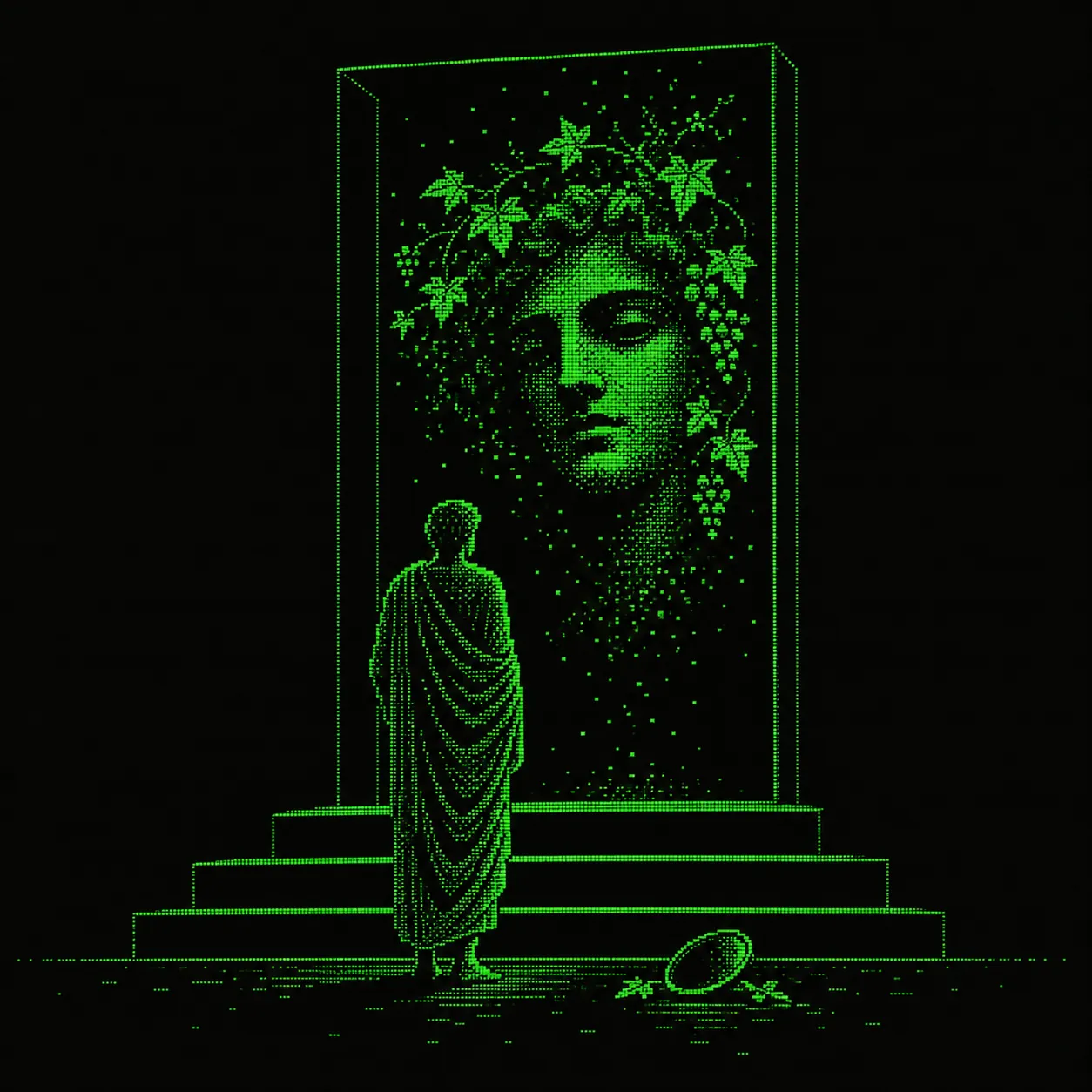
The Titans conceal their faces beneath white chalk and approach with toys: a spinning top, knucklebones, golden apples, a mirror. The child becomes absorbed in his own reflection. While he looks, they seize him and cut him apart. They boil his limbs, roast the pieces, and eat his flesh. Athena rescues his heart.
Zeus strikes the Titans with lightning. From the smoking remains of the killers, who have consumed the god, humanity comes into being. Divine life has entered the human condition through an act of dismemberment.
But Dionysus’s dispersion is followed by a return. Apollo gathers the scattered god and brings him back to heaven. The child who was many becomes whole again. His passage through death and renewal supplies the sacred pattern that the initiate hopes to share.1
This story belonged to the mysteries. Its toys served as sacred symbols of the rites; its sufferings and renewal concerned the people undergoing initiation. Writing in the first century BCE, Diodorus places Dionysus’s dismemberment within the initiatory tradition attributed to Orpheus. Pausanias credits the poet Onomacritus with composing Dionysian rites and making the Titans responsible for the god’s sufferings. Story and ceremony were articulated together. Diodorus 5.75.4; Pausanias 8.37.5.
The Platonists inherited this sacred symbolic language and unfolded its account of being. The god’s dispersion expressed the passage into divided existence; his recovery expressed the corresponding return. Their philosophical explanations developed the teaching of a religious tradition whose rites promised a changed relation to divine life. To become Dionysus was to participate in the wholeness his dismemberment appeared to destroy.
Plotinus makes the mirror’s meaning explicit in the third century. Human souls see their own images in it and descend into embodied life. Damascius later states the movement with extraordinary economy: Dionysus projects his reflection, follows it, and becomes dispersed throughout the universe. Apollo gathers him and leads him upward again. Plotinus, Enneads IV.3.12; Damascius I.128–129.
The reflected image is at once oneself and something encountered outside oneself. Following it makes a single life appear as a multitude of lives distributed through the world. Dismemberment gives this differentiation a body: the one becomes many, and each part has a place, a boundary, and a fate.
The myth speaks at the scale of both the cosmos and the individual soul. Plutarch, around 100 CE, describes Dionysus’s dismemberment through divinity’s distribution into water, earth, stars, plants, and animals. The god’s story made the world’s multiplicity intelligible. He also writes from inside the religious world he explains: addressing Clea, leader of the inspired women at Delphi, he invokes their knowledge of sacred rites and leaves their secrets unspoken. Plutarch, On the E at Delphi 9, 388e–389a. Plutarch, On Isis and Osiris 35, 364e–365a.
What falls when the soul descends? #
Plotinus understood himself as an interpreter of Plato. The name Neoplatonism came much later. Writing in the middle decades of the third century CE, he placed the visible world within a hierarchy of dependence. The One is the ultimate source, beyond even being and thought. From it comes Intellect, Nous, in which the Forms are living objects of understanding. Soul expresses that intelligible order through the life of the cosmos. Plotinus V.2.1–2.
Human thought belongs within this order. Our ability to understand reality reflects a kinship between the knowing soul and what makes reality intelligible. To reason is to exercise a power whose source exceeds the individual thinker. The highest self-knowledge occurs in Intellect, where knowing and being known coincide. Plotinus V.3.4–5.
The emergence of a world is therefore a manifestation of divine power. Estrangement arises when a particular soul becomes absorbed in its particular expression. Plotinus asks why souls forget their divine father and themselves. His answer includes self-will and the desire for self-ownership. The soul’s assertion of independence can become an ignorance of what sustains it. Plotinus V.1.1.
This is the philosophical force of the mirror. The soul recognizes something of itself in an image, then becomes preoccupied with the life represented there. In Plotinus, its higher activity continues even while embodied concerns occupy its awareness. Return remains possible because the source has never been wholly lost. Plotinus IV.8.8.
Read through the Eve Theory of Consciousness, this approaches the human problem dramatized in Eden. Adam and Eve acquire knowledge and discover their nakedness. They become visible to themselves in a new way, and hide. Genesis connects their estrangement with a genuine acquisition: God acknowledges that humanity has become like the divine in knowing good and evil. Genesis 3:7–10, 22.
The comparison concerns the structure of selfhood. The power to make oneself an object of thought opens a distance within experience. A person can judge, remember, and imagine the one who lives. That power makes possible both an understanding of our place in reality and a conviction that we exist apart from it. The divine possibility and the estrangement belong to the same human predicament.2
Philosophy as initiation #
The mysteries addressed what could be done about our condition. Their promise of transformation was already ancient when the Neoplatonists explained it. A chorus in Euripides’ Cretans, preserved by Porphyry, describes consecration and receiving the name bakchos. A gold tablet from Thurii addresses the dead initiate with the astonishing announcement: “from a human being you have become a god.” Euripides, Cretans fr. 472.9–15; Thurii tablet, OF 487, lines 3–4.
Plato put philosophy inside this initiatory horizon. In the Phaedo, Socrates describes purification as gathering the soul together from its involvement with the body. Philosophers practise that gathering during life. He then invokes the mystery saying that there are many wand-bearers but few bacchoi, identifying the latter with those who have genuinely practised philosophy. Socrates says he has spent his life trying to become one of them. Plato, Phaedo 67c–d, 69c–d.
The genuine philosopher and the accomplished initiate converge in a transformed relation to being. Both must pass beyond the bodily appearances that ordinarily govern belief and desire. Purification prepares the soul to know what endures. The philosophical argument and the initiatory promise concern the same destination: life in the company of the gods.
This language remained concrete in the later schools. Marinus describes Proclus’s education under Syrianus as a progression from Aristotle’s preparatory “lesser mysteries” into the greater mysteries of Plato. A philosophical curriculum could be narrated as initiation because its intended result was a change in the soul’s capacity to see. Marinus, Life of Proclus 13.
Plotinus likewise compares ascent to the Good with entering a sacred sanctuary, undergoing purification and removing acquired garments. The soul puts off what it took on during descent. Thought participates in the return by turning toward the realities from which its own power derives. Plotinus I.6.6–7.
Why the philosopher becomes a Bacchus #
Damascius makes the connection explicit. In his early-sixth-century commentary, the soul’s passage into bodily life corresponds to Dionysus following his reflection. Purification gathers what has become dispersed. The explanatory myth and the philosophical practice describe opposite directions of the same journey. Damascius I.128–130.
He identifies the first Bacchus as Dionysus. Someone consecrated to the god, assimilated to him, shares his name. The person living a Dionysian life has been released from a constricted existence; Damascius identifies that person with the philosopher at the stage of purification. Becoming a Bacchus names an achieved divine likeness within a further ascent. Damascius I.171.3
He then addresses a disagreement within his own tradition. Plotinus and Porphyry gave priority to philosophy; Iamblichus, Syrianus, and Proclus emphasized sacred practice. Plato, Damascius argues, brought their claims into “one single truth” by calling the philosopher a Bacchus. Philosophy and theurgy meet in the person who has been freed from confinement to becoming. Damascius I.172.
Iamblichus gives sacred practice a causal role in this restoration. In On the Mysteries, he describes theurgy as purifying the soul, preparing its rational power for a vision of the Good, and finally uniting it with the gods. The order of being supplies the possibility of return; divine action and the soul’s preparation accomplish it. Iamblichus, On the Mysteries X.5–6.
The correspondence extends to the stages of initiation. Damascius aligns ritual purifications, initiation, and vision with successive virtues and intellectual activities. He gives initiation’s purpose as returning souls to the starting point of their descent, where Dionysus established them in divine life. The rites answer the condition depicted in the god’s fragmentation. Philosophy undertakes the corresponding return through the soul’s purification and understanding. Damascius I.165–168.
For these Platonists, becoming Dionysus was a serious description of philosophical achievement. It joined an account of what we are to a practice intended to change how we exist.
Undoing the Fall #
The Snake Cult of Consciousness asks how the human self could be discovered and communicated through initiation. The Platonists make the next question unavoidable: what becomes possible once a mind can understand its own participation in something greater than itself?
The mirror stands at the hinge. It makes the self appear as something separate; philosophical understanding can recover the relation between the appearance and its source. In the ritual world of the serpent, bullroarer, and mirror, divine life could be encountered through the body. In the philosophical reading, the initiate’s own being belongs to what the rite reveals.
To undo the Fall, in this comparison, is to carry knowledge through estrangement into a fuller understanding of being. Human intelligence can recognize the order in which it participates. Its divine possibility is fulfilled when it knows that its particular life does not explain itself.
Dionysus supplies both movements. He follows his image into the many, and his scattered life is gathered again. Philosophy becomes part of that gathering. The person who completes the purification shares the god’s name because the human life has come to resemble the divine life it sought to understand.
The mirror gives a mythic form to the descent into particular existence. Becoming Dionysus names the return: the soul gathering itself into the divine life from which it came.
Sources #
- Clement of Alexandria. Exhortation to the Greeks 2.17–18, translated by G. W. Butterworth.
- Damascius. Commentary on Plato’s Phaedo, I.9, 128–130, 165–172. Greek text; English excerpts, pp. 5–6. Edition and translation: L. G. Westerink, 1977.
- Diodorus Siculus. Library of History 5.75.4, translated by C. H. Oldfather.
- Genesis. Chapter 3, King James Version.
- Iamblichus. On the Mysteries X.5–6, translated by Thomas Taylor.
- Marinus. Life of Proclus 13, translated by Kenneth Sylvan Guthrie.
- Nonnus. Dionysiaca 6.169–175, translated by W. H. D. Rouse.
- Olympiodorus. Commentary on Plato’s Phaedo I.3, quoted and discussed in Radcliffe G. Edmonds III, “Recycling Laertes’ Shroud: More on Orphism and Original Sin”.
- Pausanias. Description of Greece 8.37.5, translated by W. H. S. Jones.
- Plato. Phaedo 67c–d, 69c–d, translated by Benjamin Jowett.
- Plotinus. Enneads, I.6.6–7; IV.3.12; IV.8.8; V.1.1; V.2.1–2; V.3.4–5. Translated by Stephen MacKenna and B. S. Page.
- Plutarch. On the E at Delphi 9, translated by A. O. Prickard (1918), with online adaptations.
- Plutarch. On Isis and Osiris 35, translated by Frank Cole Babbitt.
- Porphyry. On Abstinence III.2–8, translated by Thomas Taylor. IV.19 preserves Euripides, Cretans, fr. 472; Greek and translation by Roger T. Macfarlane.
- Thurii gold tablet, OF 487, lines 3–4. Text and translation quoted in Spyridon Rangos, “The Role of Contraries in the Orphic Life”.
The narrative follows the ancient accounts used in this essay: Zeus, Persephone, Hera, the throne, and mirror in Nonnus, Dionysiaca 6.155–175; the toys, cooking, and saved heart in Clement, Exhortation 2.17–18; humanity’s birth from the blasted Titans in Olympiodorus, Commentary on the Phaedo I.3; and Apollo’s gathering and upward return in Damascius I.129. The complete sequence is presented here in its late Platonist horizon. The humanity episode is explicit in Olympiodorus; it is not a claim that humans inherit the Titans’ guilt. ↩︎
Logos can mean speech or reasoning, while the logoi of nature are formative principles. The human question concerns our conscious relation to intelligibility, not a world otherwise devoid of it. Porphyry also argues explicitly for animal reason and communication in On Abstinence III.2–8. Neither his argument nor the mirror myth establishes a modern account of when reflective selfhood evolved. ↩︎
References follow L. G. Westerink, The Greek Commentaries on Plato’s Phaedo, II: Damascius (1977). The linked Greek transcription uses older numbered headings; the passages corresponding to I.171–172 begin with the first Bacchus and the comparison of philosophy with sacred practice. Bacchos can designate an initiate; Damascius expressly explains the shared name through assimilation to Dionysus. This essay follows the late Platonists’ interpretation of initiation, rather than attributing one philosophical system to every earlier mystery cult. Becoming a Bacchus denotes the purificatory stage, not the final disappearance of the distinction between human and god. ↩︎