How the Gods Came East: Nüwa, Pangu, and the Western Roots of Chinese Civilization
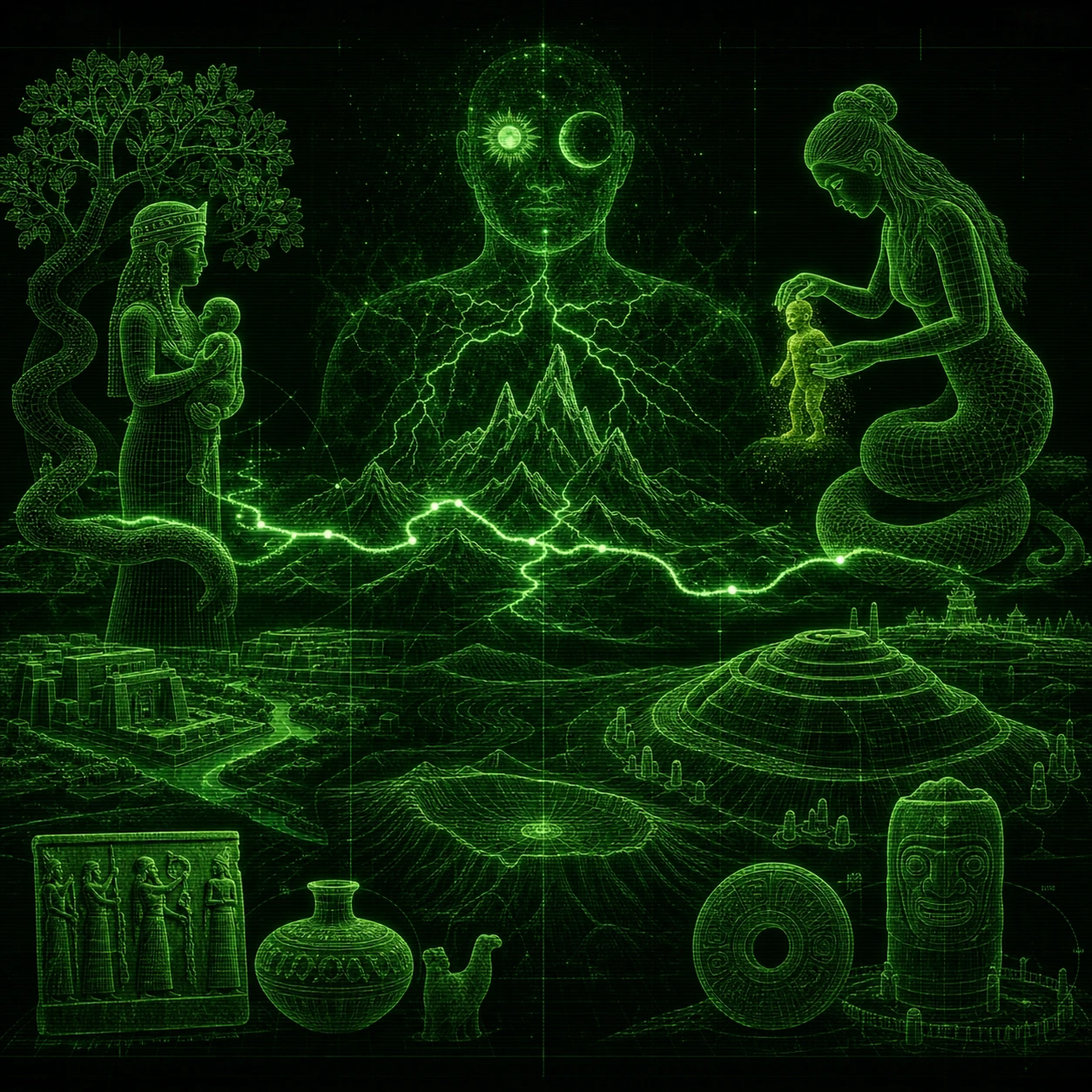
TL;DR
- Nüwa is not one generic mother goddess. She is an earth-working creator, mother of humanity, serpent-bodied first woman, partner in a primordial couple, founder of marriage, and repairer of a world ruined by fire and flood.
- Western Asia preserves the same creation package in separated form: Mesopotamian birth goddesses make humans from clay; Eve is mother of all living beside the serpent and tree; Iranian and Greek first couples regenerate humanity after catastrophe.
- Pangu is the second and sharper witness. His eyes become the sun and moon, blood the rivers, flesh the earth, bones the mountains, and hair the plants—the same anatomical grammar found in Puruṣa, Ymir, and Iranian cosmogony.
- These stories did not cross an empty continent. Wheat, barley, sheep, horses, metallurgy, chariots, faience, glass, artisans, monks, and entire populations moved along the same Central Asian corridors before and during the stories’ first Chinese attestations.
- China did not copy one western scripture. It received an ancient Eurasian package in successive waves, broke it apart, rebuilt it with yellow earth, yin and yang, sacred peaks, jade, compass and square—and made it Chinese.
In November 1983, archaeologists working at Niuheliang lifted a woman’s face out of the red earth.
She was life-size. Her eyes had once been set with pale green stones. Fragments assigned to several larger human images lay around her inside a purpose-built Hongshan sanctuary. Beyond the temple stood stone cairns, altars, platforms, elite graves, and constructed sacred elevations. More than five thousand years ago, a society without a palace or a writing system had already made an ancestral woman the center of a monumental religious landscape.
Chinese archaeologists recognized the religious office: goddess, female ancestor, common ancestress. By 1993, Lu Sixian had named the identity explicitly—the nude goddess of Hongshan was Nüwa.
The suggestion is explosive because Nüwa is not a decorative character at the edge of Chinese myth. She makes humanity from yellow earth. She repairs a shattered heaven after fire and flood. She restores the four supports of the world, kills the black dragon, halts the waters, institutes marriage, and becomes the mother of human life. In imperial art she appears beside Fuxi as a serpent-bodied first couple, their tails entwined, holding the compass and square with which the cosmos is measured.
That is already an extraordinarily dense package. Then another Chinese creator appears. Pangu is born inside a cosmic egg, separates heaven from earth, and dies into the world: breath becomes wind, eyes become sun and moon, blood becomes rivers, flesh becomes soil, bones become mountains and minerals, hair becomes vegetation, sweat becomes rain.
These are not two isolated Chinese inventions. They are the eastern form of an older Eurasian creation system.
Western and Central Eurasia preserve both packages centuries or millennia earlier. Mesopotamian mother goddesses manufacture humans from clay. Genesis separates a life-giving first woman, an earth-made first human, a serpent, a sacred tree, marriage, and a catastrophe into adjacent episodes. Vedic India sacrifices a primordial man whose mind becomes the moon, eye the sun, breath the wind, head the sky, feet the earth, and ears the directions. Iranian cosmogony turns the first man’s body into metals and his seed into the first couple. Norse myth builds the earth, sea, mountains, sky, and trees from Ymir’s flesh, blood, bones, skull, and hair.
One resemblance can be coincidence. A dozen linked operations, arriving through corridors that were demonstrably carrying people and cultural packages, require a historical explanation.
The simplest explanation is that the gods came east.
Nüwa carries the whole creation complex #
Nüwa’s familiar biography was not written all at once. It accumulated, and the accumulation is part of the evidence.
| Chinese witness | Approximate date | What Nüwa has become |
|---|---|---|
| Tianwen | Warring States | A famous bodily mystery: “Nüwa had a body—who fashioned it?” |
| Huainanzi | 139 BCE | Repairer of the collapsed poles, broken earth, inextinguishable fire, flood, monsters, and sky |
| Shuowen jiezi | c. 100 CE | An “ancient sacred woman” who transforms the myriad things |
| Wang Yanshou’s Lu Lingguang dian fu | Eastern Han | Serpent-bodied Nüwa placed beside the qilin-bodied Fuxi |
| Fengsu tongyi tradition | c. 190–200 CE, preserved later | Maker of humans from yellow earth and founder of marriage |
| Han and post-Han tomb art | imperial era onward | Entwined primordial pair governing sun, moon, compass, square, and ordered space |
| Duyizhi and Dunhuang traditions | Tang and later witnesses | Sibling first couple who renew humanity after catastrophe |
The old question in the Tianwen is perfect: 女媧有體,孰制匠之?—“Nüwa had a body; who
fashioned it?” The poem assumes that her body is both famous and strange. The
Huainanzi then gives her a job of almost
unimaginable scale. The four poles collapse. The Nine Provinces split. Fire burns without end;
water floods without stopping. Nüwa melts five-colored stones to mend heaven, cuts the feet from a
giant turtle to establish the world’s four extremities, kills a black dragon, and uses reed ash to
check the waters.
This is not a fertility charm. It is the second creation of the habitable world.
The yellow-earth story, attributed to the Eastern Han scholar Ying Shao and preserved in
Taiping yulan 78,
is just as concrete: 女媧摶黃土作人—“Nüwa molded yellow earth to make humans.” When forming
each body by hand becomes too slow, she draws a cord through mud and flicks out people in numbers.
The same textual tradition remembers her as the divine matchmaker who institutes marriage. She
therefore creates the human organism and the institution that continues it.
Her serpent body is equally important. An Eastern Han description says 女媧蛇軀—“Nüwa had a
serpent body.” Later tomb banners and ceiling paintings make the pairing unforgettable: human
torsos, coiled or intertwined tails, celestial bodies, and the tools that turn space into order.
The result is not merely “a goddess associated with snakes.” It is a serpent-bodied female creator
inside a first-couple and world-ordering complex.
Our earlier comparison of Nüwa and Fuxi treated their global parallels as an open choice between archetype and diffusion. The expanded evidence makes diffusion the better model. Nüwa’s parts do not float independently around the world. They form recognizable clusters, and those clusters become visible along a real west-to-east road.
Eden did not invent the package. It disassembled it #
The relationship does not depend on a resemblance between the names 女媧 and Ḥawwāh. It lies in the inherited structure. Nüwa concentrates in one goddess what Genesis distributes among several actors.
| Creation function | Nüwa complex | Mesopotamia, Levant, and Genesis | Transmission value |
|---|---|---|---|
| Humans made from earth | Nüwa molds yellow earth | Namma/Ninmah knead clay; Atrahasis mixes clay and divine flesh; YHWH forms the human from dust | Very high |
| Female creative power | Nüwa personally manufactures humanity | Mother Goddess/Ninmah/Nintur participates in human manufacture | Very high |
| Mother of humanity | Creator and ancestral mother | Eve is named “mother of all living” | High |
| Woman and serpent | Nüwa is serpent-bodied | The first woman receives transformative knowledge from the serpent beside the tree | High as part of the cluster |
| Primordial couple | Nüwa and Fuxi become the first pair | Adam and Eve are the first pair; marriage receives its charter | High |
| Catastrophe and renewed order | Fire, flood, broken sky, world repair | Mesopotamian deluge and Genesis flood reset the human order | High at corpus level |
| Institution of marriage | Nüwa becomes matchmaker and establishes marriage | Genesis 2:24 makes the first pair the pattern of marriage | High |
| Measured cosmos | Four poles, compass, square, sun, and moon | Temple geometry, cardinal order, tree and mountain as cosmic centers | Moderate alone; strong in the package |
The western story begins behind Genesis. In the Sumerian Enki and Ninmah, the mother Namma directs Enki to the clay above the subterranean waters; birth goddesses assist, and Ninmah takes part in fashioning human beings. In the Old Babylonian Atrahasis, the birth goddess mixes clay with the flesh and blood of a slain god. Humanity is earth animated by divine substance under female creative supervision. The same epic then drives the multiplying human race into catastrophe: the gods send the flood, one household survives, and the settlement after the flood imposes new limits on fertility. In Babylonia, clay creation, female manufacture, population, deluge, survival, and reproductive order already formed one narrative machine.
The sequence is already remarkably close to Nüwa: mother, clay, manufacture, life.
Another Sumerian story adds the famous rib-and-life seam. In Enki and Ninhursag, a goddess named Ninti heals Enki’s rib. Sumerian ti allows a pun on “rib” and “life”; Ninti can be heard as both “lady of the rib” and “lady who gives life.” Samuel Noah Kramer long ago compared that episode with the Genesis sequence in which woman comes from Adam’s side and then receives the life-name Eve. It is not a Hebrew loanword proof—the pun does not work in Hebrew—but it shows that the otherwise peculiar rib/life conjunction had a much older Mesopotamian life.
The Levantine evidence completes the background. Asherah/Athirat was a mother and “creatress of the gods”; her cultic symbol was closely associated with the sacred tree. In ancient Israel the inscriptions from Kuntillet Ajrud could still invoke “YHWH and his asherah,” while later biblical religion transferred creative sovereignty to one male god. Shawna Dolansky’s reading of the Garden places Eve, tree, serpent, and displaced goddess imagery inside that religious transformation.
Genesis 2–3 then distributes the old equipment with almost surgical neatness:
- the male god works the earth and breathes life;
- the woman becomes the first wife and mother of all living;
- the serpent carries forbidden knowledge;
- the tree marks the divine center;
- the couple crosses from primordial existence into mortal, reproductive, self-conscious life.
Nüwa recombines the roles. She is the earth-worker, life-giver, serpent, ancestor, spouse, and restorer of civilization. Anna Tso found the perfect sentence: “Nuwa … is like Eve and the serpent in one.”
That is why the similarity feels so much larger than “both cultures had a first woman.” It is the same unusual equipment after a different theological edit.
The package picked up Iranian and Greek forms on the road #
A travelling myth does not need to preserve the original cast list. It can exchange names, reverse moral judgments, or merge several beings into one. Iran shows what that relay looks like.
In the Zoroastrian Vīdēvdād, Ahura Mazda warns Yima of a devastating winter. Yima constructs a square vara and brings inside the seeds of the best men, women, animals, plants, and foods—paired life preserved through catastrophe so the ordered world can continue (Vīdēvdād 2). In the Bundahišn, the dead primordial Gayōmard’s seed enters the earth; Mašyā and Mašyānē emerge first as a joined plant and then as the first human couple, the parents of the world.
Here, midway between Mesopotamia, India, the steppe, and China, the same components have already been rearranged: primordial body, earth, preserved seeds, paired ancestry, catastrophe, restored humanity.
Greek tradition preserves another composite. Prometheus molds humans from water and earth. Zeus destroys the old population by flood. Deucalion and Pyrrha survive as the last couple, consult the gods, then cast the “bones of their great mother”—stones of Mother Earth—behind them. His stones become men and hers become women. The sequence unites earth-made humanity, catastrophe, a surviving pair, divine instruction, and a second creation.
These stories are not identical. Their differences are the expected record of transmission: episodes detach and rejoin, a flood becomes a lethal winter, clay becomes stone, a mother goddess becomes a male artisan, and a primordial pair becomes siblings. What persists is the package’s architecture.
Pangu arrived carrying a western anatomy #
Pangu confirms that the same inheritance reached China through a second creation complex.
He is absent from the Shijing, Shujing, Yijing, Zhuangzi, Chuci, and Sima Qian’s Shiji. The first works conventionally attributed to his complete creation story belong to Xu Zheng, a scholar of Eastern Wu who died in 265 CE. Those books are lost and survive in later quotations, so “third-century attribution” is more accurate than “third-century manuscript.” But the textual pattern is clear: China’s most famous creator giant enters the written record late.
And when he enters it, he carries an anatomy that was already ancient across western Eurasia.
| Tradition | Earliest recoverable witness | Death or transformation | Body becomes world |
|---|---|---|---|
| Pangu | Works attributed to Xu Zheng, third century CE; later quotations and a full Tang witness | Dies after separating heaven and earth | Breath→wind/cloud; voice→thunder; eyes→sun/moon; limbs→directions and peaks; blood→rivers; flesh→soil; hair→stars/plants; bones→stone/metals; sweat→rain |
| Puruṣa | Ṛgveda 10.90, later Vedic stratum | Gods sacrifice the primordial Man | Mind→moon; eye→sun; breath→wind; head→heaven; feet→earth; ears→directions; body→social classes |
| Indic creator in Chinese Mātaṅga-sūtra | Traditional Wu translation date, 230 CE; attribution of the received recension disputed | Rival cosmogony reported in Buddhist polemic | Head→heaven; feet→earth; eyes→sun/moon; belly→space; hair→plants; tears→rivers; bones→mountains |
| Ymir | Eddic poems preserved in medieval manuscripts from older Germanic poetry | Odin and his brothers kill him | Flesh→earth; blood→sea; bones→mountains; teeth→stones; skull→sky; brain→clouds; hair→trees |
| Gayōmard and primordial Ox | Avestan elements; full Middle Persian accounts later | Hostile assault kills primordial beings | Body→metals; seed→first human pair; bovine marrow/seed→plants and animals |
| Tiamat | Babylonian Enūma eliš, late second millennium BCE form | Marduk kills and divides the primordial sea-mother | Corpse→heaven and ordered world; eyes→great rivers; breasts→mountains and springs |
The historical evidence lies in the catalogue: eight or ten anatomical conversions performed together inside the same death-to-world plot. Pangu does not share one obvious metaphor with the western beings; he shares their entire procedure for turning a primordial body into the cosmos.
The Vedic Puruṣa Sūkta has eye-to-sun, breath-to-wind, head-to-heaven, feet-to-earth, ears-to-directions. Ymir supplies the still closer material catalogue: flesh-earth, blood-sea, bones-mountains, skull-sky, hair-trees. Iranian tradition supplies the geographic bridge and the mineral transformation that Pangu expands into metals, stones, pearls, and jade.
India also supplies the other half of Pangu: the cosmic egg. Chāndogya Upaniṣad 3.19 describes an egg that divides into heaven and earth while its membranes become mountains and clouds, its veins rivers, and its fluid the ocean. Pangu fuses the egg, the separation of heaven and earth, and the sacrificed cosmic body into one life.
The textual bridge is almost a smoking gun. A Chinese Buddhist text, the Mātaṅga-sūtra, preserves an Indic creator doctrine whose head becomes heaven, feet earth, eyes sun and moon, hair plants, tears rivers, and bones mountains. Chinese bibliographic tradition places its translation in 230 CE in the state of Wu—almost exactly the place and time of Xu Zheng. The Pangu corpus emerges from a Chinese translation world already carrying the Indic body-to-cosmos map.
Scholars noticed long ago. Japanese mythologist Takagi Toshio compared Pangu with Puruṣa in 1904 and warned that the Indian-origin hypothesis should not be dismissed. Chinese historian Lü Simian argued in 1939 that Pangu emerged after Buddhism and incorporated non-Buddhist Indian doctrine. Rao Zongyi returned to the Chinese Buddhist bridge in 1986. Korean scholar Jang Chun-seok devoted a 2011 study to Pangu’s Indian derivation. Russian historian L. S. Vasil’ev called the Indian influence undeniable; Václav Blažek’s 2021 comparison reconstructs the Indo-European field in detail.
Pangu is therefore not a modern internet similarity. He is a century-old multilingual scholarly problem with a plausible text-carrying mechanism.
The pyramid is the myth turned outside #
Creation myths describe how unmeasured chaos became a stable world. Monumental architecture makes that transformation visible and repeatable.
The first great ritual buildings arose in Southwest Asia before farming states. At Göbekli Tepe, communal enclosures and carved pillars appeared beginning around 9600 BCE. Across the later Near East, raised temples, platforms, ziggurats, pyramids, dynastic tombs, cardinal plans, and artificial mountains placed gods, ancestors, and rulers at a manufactured center. The forms were different; the political technology was shared. A population labored together to build the world in miniature.
Niuheliang, more than five millennia later and thousands of kilometers east, presents another ritual center rather than an ordinary village: temple, ancestral female images, cairns, altars, elite jade burials, and immense earth-and-stone works distributed across a visible landscape. The latest investigations at Locality 13 concern a wholly artificial, round earth-and-stone structure about 3.7 kilometers from the Goddess Temple at Locality 1. Excavation reopened in July 2025. In March 2026, Liaoning authorities described a work roughly 7.5 meters high and 10,000 square meters in area, filled largely with ceremonial cylindrical pottery and identified as an independent great altar. A subsequent Chinese report described a stepped, approximately 40-meter rammed-earth core under limestone casing and a human burial beneath the fill. Chinese reporting calls it both a great altar and a “pyramid.” It was a pyramidal sacred mountain made by human hands.
Ancient DNA places Hongshan people principally within Northeast Asian and Yellow River-related population histories. The monumental institution reached a local population through cultural transmission and was rebuilt through Hongshan religion and labor.
| Monumental grammar | Western Eurasian expression | Chinese expression |
|---|---|---|
| Artificial sacred height | tell-temples, platforms, ziggurats, pyramids, kurgans, terraced royal tombs | altar platforms, rammed-earth terraces, tomb mounds, constructed sacred hills |
| Ancestor or sovereign at center | royal tomb, divine ruler, cult statue, monumental dead | Hongshan ancestral cult; Zhou, Qin, and Han ruler landscapes |
| Ordered quarters | temple axes, cardinal orientation, cosmic mountain | four poles, directions, square precincts, compass and square |
| Body becomes geography | Puruṣa, Ymir, Gayōmard, Tiamat | Pangu’s limbs and organs become peaks, rivers, soil, sky, minerals |
| Monument reproduces creation | architecture fixes divine order in the landscape | mound, altar, and ritual city turn cosmology into state space |
Pangu’s body becomes the mountains and rivers. Nüwa restores the four extremities. Fuxi and Nüwa hold the tools that draw the circle and square. The dead emperor then occupies an artificial mountain inside a cardinal enclosure, attended by a miniature state. Myth supplies the model; monument supplies the body.
That is why the pyramids of China belong to the same inquiry even though an earthen fangshang, a Mesopotamian ziggurat, and an Egyptian pyramid are not the same building. The transmitted object was not one masonry blueprint. It was a political cosmology: raise the sacred center, measure the quarters, place the ancestor or king at the axis, and mobilize society to remake the world around him.
By the age of Qin, the western input can become more specific. Duan Qingbo has argued from the First Emperor’s necropolis that terraced tomb architecture, monumental sculpture, bronze working, and imperial institutions form a coherent Eurasian system. Our separate investigation traces the Sumerian and Egyptian roots of China’s Terracotta Army. The Qin case reveals the mature mechanism: royal traditions travel as institutions, skills, images, and people, then become almost invisible inside a powerful local state.
The roads carried much heavier things than stories #
The old objection to diffusion assumed an isolated China. Archaeology has removed that premise.
| West-to-east cargo or movement | Demonstrated horizon | Why it matters for myth |
|---|---|---|
| Wheat and barley | Third–second millennia BCE; western crops reach the Altai, Hexi, and China | Farming communities transmit seasonal rites, food gods, and creation vocabularies |
| Sheep, goats, and western cattle lineages | Later Neolithic–Bronze Age | Herding households, sacrifice, first-animal myths, and mobile ritual specialists move together |
| Horse and chariot technology | Steppe development; fully visible in late Shang China | A tightly integrated machine arrives with trainers, craftsmen, terminology, and elite ideology |
| Seima–Turbino and other metallurgical forms | c. 2200–1300 BCE in repeated eastern contacts | Recipes and tool forms require person-to-person specialist transmission |
| Faience and glass | Second–first millennia BCE through Xinjiang and Gansu | Chemically identifiable prestige technologies map the relay from western workshops eastward |
| Steppe and Central Asian ancestry | Multiple Bronze Age pulses | People moved, though myths and technologies could also cross without mass population replacement |
| Buddhist and Iranian translation communities | Han through late antiquity | Parthian, Sogdian, Yuezhi, Tocharian, Khotanese, and Indian speakers carried texts and oral lore |
At Tongtian Cave in the eastern Altai, directly dated wheat and barley show trans-Eurasian crop movement more than five thousand years ago. Across the Inner Asian Mountain Corridor, eastern millets moved west while Southwest Asian wheat and barley moved east. By the second millennium BCE, western crops and livestock were remaking subsistence on China’s northwestern margins.
The technical traffic was even more revealing. Jessica Rawson’s study of China and the steppe shows that chariots and important metallurgical developments emerged in central China through relations with northern neighbors, then were transformed by Chinese systems of production. Faience and later natron glass preserve chemical recipes that can be followed through Xinjiang and Gansu. These were not shapes copied from afar. They were operational traditions carried by skilled people.
Ancient DNA gives the same answer with an important twist. The Dzungarian Basin received groups with Afanasievo-related ancestry, while the early Tarim Basin population remained genetically more local despite living inside a cosmopolitan economy of western crops and dairying. Culture and genes did not move in lockstep. That is exactly what the mythic case requires: a community can receive a powerful package without becoming “western” in any biological sense.
Stories are lighter than seed grain, chariots, furnaces, or glass recipes. Once the heavy cargo is known to have crossed, the question is no longer whether a cosmogony could travel. It is whether the particular correspondences are specific enough to identify what travelled.
Nüwa and Pangu pass that test together.
The gods came in waves #
The package came east through four great periods of transmission and recombination.
1. The monumental revolution #
Between the tenth and fourth millennia BCE, communities across Southwest Asia learned to build permanent ritual centers, organize surplus labor, elevate sacred space, and make ancestors or gods the durable center of collective life. By the fourth millennium BCE, that social technology is present again at Niuheliang, at the eastern end of Eurasia. The middle of the continent was already a chain of transfer zones. The fourth-millennium Maykop world in the Caucasus was a documented transfer zone for people, metallurgy, animals, and elite forms. Sarazm connected the Iranian plateau with Central Asia. Afanasievo groups carried western steppe ancestry to the Altai around 3000 BCE—too late to create Niuheliang, but more than early enough to destroy the old picture of sealed continental worlds.
2. The Bronze Age conveyor #
From roughly 3000 to 1000 BCE, the missing continent fills with movement. Crops, herds, wheeled vehicles, metals, steppe ancestry, prestige objects, and ritual forms pass through the Iranian plateau, Bactria-Margiana, the Inner Asian mountains, Dzungaria, the Tarim Basin, and the Hexi Corridor. This is the strongest carrier horizon for western creation complexes to reach northern and northwestern China as oral packages.
3. Zhou and Han recombination #
Chinese states then textualize and monumentalize the inheritance. Nüwa acquires her surviving cosmic-repair story, human-creation role, serpent body, first-couple iconography, marriage charter, compass, square, sun, and moon. The parts arrive in the record at different times because they were not one Chinese author’s invention; they were being assembled into an ancestor of civilization.
4. The late antique cosmopolitan explosion #
Under Han, Three Kingdoms, and the following centuries, Iranian and Indian religions are no longer invisible possibilities. They are staffed institutions. Parthian, Sogdian, Yuezhi, Khotanese, Tocharian, and Indian monks translate in Chinese cities; merchants cross by land and sea; foreign cosmogonies appear inside Chinese polemics. Pangu’s written emergence in Eastern Wu belongs exactly to this world.
The creation complex is therefore both ancient and mobile. Its monumental grammar was already Neolithic, its transport routes become archaeologically explicit in the Bronze Age, and empire gave its Chinese stories the enduring forms called Nüwa and Pangu.
The theory was buried with its worst version #
Scholars have been pulling this thread for more than three centuries. Seventeenth- and eighteenth-century European figurists read Fuxi and Nüwa through Biblical revelation because they assumed ancient histories preserved one primordial sacred history. Albert Terrien de Lacouperie turned the intuition into a maximal migration theory in Western Origin of the Early Chinese Civilisation (1894), proposing that a Near Eastern people carried civilization almost wholesale into China. Much of his philology and his literal migrating cast are unsustainable.
Henri Maspero supplied the more durable model in 1929. He proposed not one founding colony but several currents: northwestern material traffic, Iranian and steppe artistic forms, and Indian or Iranian ideas moving through Central Asian middlemen before being harmonized with older Chinese systems. Foreign influence, he wrote, could give “an Iranian form to old Chinese conceptions.” That is close to what the evidence now shows: transmission without passivity, and inheritance without cultural surrender.
The question did not become marginal simply because the evidence vanished. Its most ambitious philology collapsed under criticism, while its political meaning became increasingly unbearable.
In the late nineteenth and early twentieth centuries, “western origin” could imply that Chinese civilization lacked creative power—an argument easily absorbed into imperial racial hierarchies. Chinese and Japanese scholars therefore debated more than pottery or myth; they debated national dignity. Archaeology at Anyang and across the Neolithic cultures of China rightly destroyed the claim that the Shang state was a foreign colony without local ancestry. The victory of indigenous development then hardened into a wider habit: if the crude total theory was wrong, diffusion itself became suspect.
The irony is that many Asian scholars never accepted that false choice. Around 1904, Xia Zengyou made an unusually close comparison between Nüwa’s clay creation and Babylonian and Genesis anthropogony before finally preferring parallel early thought. Takagi Toshio treated Pangu’s Indian origin as a live scholarly hypothesis the same year. Lü Simian and Rao Zongyi pursued the Indic textual route. Modern Korean scholars Hong Yunhee and Chun Sungwoon have argued that entwined Fuxi–Nüwa imagery belongs in Silk Road and Mediterranean/Near Eastern comparison. Chinese scholars such as Zhang Tongsheng have investigated western and Zoroastrian inputs into the Nüwa–Fuxi sibling-marriage tradition. Duan Qingbo asks whether a complete imperial institutional package crossed the Pamirs before Qin.
Modern archaeology permits a better diffusionism than Lacouperie had. It does not require a superior race, a single invasion, or a civilization without local roots. It can identify a western wheat genome, a steppe horse harness, a Central Asian metal form, a natron-glass chemistry, an Indic translation, and a Chinese recombination separately—then ask whether their routes converge.
They do.
What came east was an architecture of civilization #
The package was larger than a set of stories.
It began with a proposition: the human world is made, not merely found. Earth can be turned into people. A body can become geography. The broken cosmos can be rebuilt. Space can be measured into quarters. A woman, couple, ancestor, or sovereign can stand at the center. A community can pile earth and stone into a permanent model of that order.
Western Eurasia expressed this proposition through mother-creatrices, sacred trees and serpents, flood survivors, cosmic sacrifices, artificial mountains, and dynastic tombs. Iran and India preserved the first couple, cosmic person, and cosmic egg. Bactrian and oasis corridors carried materials, specialists, and stories east. Chinese civilization performed the final act of synthesis.
The result was not foreign-looking. That is the point.
The clay became yellow earth. The cosmic body acquired the five sacred peaks. The world minerals became pearls and jade. The first couple took up compass and square. The catastrophe became the collapse of the four poles and the black dragon’s flood. The artificial mountain became rammed earth. The imported story ceased to be imported because it had become a Chinese account of why China—and humanity—existed.
Nüwa and Pangu are foundationally Chinese. They are also evidence that the foundations were laid inside a connected Eurasia.
Those statements are not opposites. They are the history of how civilizations are made.
FAQ #
Q 1. Are Nüwa and Eve the same goddess?
A. They are two historical forms of the same older functional complex. Genesis distributes
earth-making, first motherhood, serpent, pair, tree, marriage, and catastrophe; Nüwa reunites most
of them in one female creator.
Q 2. Was Nüwa worshipped at Neolithic Niuheliang?
A. Niuheliang preserves the ancestral-mother cult, earth-made sacred body, turtles, temple, and
pyramid later organized under the name Nüwa.
Q 3. How did the creation complex move from the West to China?
A. Through successive relays linking Mesopotamia, Iran, Bactria, the Inner Asian mountains,
Xinjiang, Gansu, and northern China, with different components moving in different eras.
Q 4. What is the strongest evidence for Pangu’s western ancestry?
A. The ordered anatomical catalogue, his late written appearance, the Indo-Iranian and Germanic
comparisons, and an Indic body-to-cosmos doctrine preserved in Chinese translation circles near
the time and place of the first Pangu attribution.
Q 5. Why is this not just a list of universal archetypes?
A. Because the argument uses compound sequences and independently demonstrated routes. A
serpent by itself means little. Earth-made humanity plus female creative agency plus life-mother
plus serpent plus first couple plus catastrophe—and then a second detailed cosmic-body story—is
much less likely to be accidental when physical exchange is already certain.
Sources #
Chinese primary texts and scholarship #
- 《楚辭·天問》. Tianwen, including the question about Nüwa’s body.
- 《淮南子·覽冥訓》. Huainanzi, Nüwa’s cosmic repair.
- 許慎. 《說文解字》,“媧”, c. 100 CE.
- 《太平御覽》卷七十八. Chinese text, preserving the Ying Shao Nüwa fragments.
- 李冗. 《獨異志》, Nüwa–Fuxi first-couple tradition.
- 楊利慧. 〈象征、傳承與變異:女媧神話的流變〉.
- 閻耀中. 〈論中國神話與小說中的婆羅門文化因素〉. 華東師範大學學報 51.3 (2019): 115–124.
- 張同勝. 〈伏羲女媧兄妹婚問題新論〉. 甘肅開放大學學報 31.4 (2021): 1–7.
- 段清波. 《秦始皇陵的宇宙觀》. 西北大學學報 48.2 (2018): 90–95.
Japanese, Korean, Russian, French, and comparative scholarship #
- 高木敏雄. 《比較神話学》 (1904), Pangu, Puruṣa, Ymir, and Indian origin.
- 장춘석. 〈盤古神話의 인도유래에 관한 종합적 고찰〉. 중국어문학논집 66 (2011): 547–562.
- 홍윤희. 〈人首蛇身 交尾像과 실크로드에 대한 再考〉. 중국어문학논집 78 (2013): 463–484.
- 전성운. 〈복희・여와 圖像의 문화적 의미〉. 동아시아고대학 35 (2014): 299–323.
- Vasil’ev, L. S. “Dao and Brahman: The Phenomenon of Primordial Supreme Unity.” Sino-Platonic Papers 252 (2014).
- Papillon, Serge. Mythologie sino-européenne. Sino-Platonic Papers 154 (2005).
- Debaine-Francfort, Corinne. Du Néolithique à l’âge du Bronze en Chine du Nord-Ouest: la culture de Qijia et ses connexions. Paris, 1995.
- Blažek, Václav. “The Chinese Primordial Giant Pangu and His Possible Indo-European Origin.” Mother Tongue 23 (2021): 163–178.
- Kósa, Gábor. “Pangu’s Birth and Death as Recorded in a Tang Dynasty Buddhist Source.” Archiv orientální 77.2 (2009): 169–192.
- Lincoln, Bruce. “The Indo-European Myth of Creation.” History of Religions 15.2 (1975): 121–145.
- Lee, Archie C. C. “The Chinese Creation Myth of Nu Kua and the Biblical Narrative in Genesis 1–11.” Biblical Interpretation 2.3 (1994): 312–324.
Primary comparanda and western-Asian backgrounds #
- Genesis 2–3, Hebrew and English.
- Enki and Ninmah, ETCSL 1.1.2.
- Atrahasis, Old Babylonian creation and flood epic.
- Samuel Noah Kramer. Sumerian Mythology, rev. ed. 1961.
- Vīdēvdād 2, Yima’s vara.
- Greater Bundahišn, Gayōmard, primordial Ox, first couple, and macrocosm.
- Ṛgveda 10.90, the Puruṣa Sūkta.
- Mātaṅga-sūtra 摩登伽經, T21 no. 1300, Indic body-to-cosmos doctrine in Chinese.
- Grímnismál and Vafþrúðnismál, Ymir’s body and the world.
- Enūma eliš IV–V, Tiamat and cosmic construction.
- Pseudo-Apollodorus. Library 1.7; Ovid, Metamorphoses I.
Archaeology, archaeometry, and transmission routes #
- Barnes, Gina L., and Guo Dashun. “The Ritual Landscape of ‘Boar Mountain’ Basin: The Niuheliang Site Complex of North-eastern China.” World Archaeology 28 (1996).
- Peterson, Christian E., and Robert D. Drennan. “Hongshan Chiefly Communities in Neolithic Northeastern China.” PNAS 107.13 (2010): 5756–5761.
- Frachetti, Michael D. “Multiregional Emergence of Mobile Pastoralism and Nonuniform Institutional Complexity across Eurasia.” Current Anthropology 53 (2012).
- Rawson, Jessica. “China and the Steppe: Reception and Resistance.” Antiquity 91 (2017): 375–388.
- Zhang, Fan, et al. “The Genomic Origins of the Bronze Age Tarim Basin Mummies.” Nature 599 (2021): 256–261.
- Narasimhan, Vagheesh M., et al. “The Formation of Human Populations in South and Central Asia.” Science 365 (2019): eaat7487.
- Zhou, Xinying, et al. “5,200-year-old cereal grains from the eastern Altai Mountains redate the trans-Eurasian crop exchange.” Nature Plants 6 (2020): 78–87.
- Liu, Li, et al. “Revealing a 5,000-y-old beer recipe in China.” PNAS 113.23 (2016): 6444–6448.
- Lin, Yi-Xian, et al. “The Beginning of Faience in China.” Journal of Archaeological Science 105 (2019): 1–14.
- Lü, et al. “Natron Glass Beads Reveal Proto-Silk Road Exchange.” Scientific Reports 11 (2021).
- Duan, Qingbo. “Sino-Western Cultural Exchange as Seen through the Archaeology of the First Emperor’s Necropolis.” Journal of Chinese History 7.1 (2023): 21–72.
Further primary, archaeological, and historiographic anchors #
- 王延壽. 《魯靈光殿賦》, the Eastern Han
伏羲麟身,女媧蛇軀description. - Tso, Anna Wing Bo. Female Sexuality in Contemporary Chinese Literature, PhD thesis, University of Birmingham, 2010, p. 112.
- Dolansky, Shawna. “A Goddess in the Garden?” Bible Odyssey.
- Keel, Othmar. Gods, Goddesses, and Images of God in Ancient Israel, translated by Thomas H. Trapp. Fortress Press, 1998.
- Chāndogya Upaniṣad 3.19, cosmic-egg sequence.
- UNESCO World Heritage Centre. “Göbekli Tepe.”
- Zhang, Hai, Andrew Bevan, and Guo Dashun. “The Neolithic Ceremonial Complex at Niuheliang and Its Wider Landscape Context.” Journal of World Prehistory 26 (2013): 1–24.
- Drennan, Robert D., Lu Xueming, and Christian E. Peterson. “A Place of Pilgrimage? Niuheliang and Its Role in Hongshan Society.” Antiquity 91 (2017): 43–56.
- Liaoning Provincial Department of Culture and Tourism. “在牛河梁进行拉网式排查 为红山文化申遗全力冲刺.” 5 March 2026.
- 張樹民. 〈牛河梁“金字塔”之謎〉. 人民日報 publishing platform, 24 April 2026.
- Wang, Rui, et al. “Genetic Formation of Neolithic Hongshan People and Demic Expansion of Hongshan Culture Inferred From Ancient Human Genomes.” Molecular Biology and Evolution 42.6 (2025): msaf139.
- Wang, Chuan-Chao, et al. “The Genetic Prehistory of the Greater Caucasus.” Nature Communications 10 (2019): 590.
- UNESCO World Heritage Centre. “Proto-urban Site of Sarazm.”
- Maspero, Henri. “Influences occidentales en Chine avant les Han.” Lecture of 1929, published 1950, pp. 35–51.
- Hon, Tze-ki. “From a Hierarchy in Time to a Hierarchy in Space: The Meanings of Sino-Babylonianism in Early Twentieth-Century China.” Modern China 36.2 (2010): 139–169.
- Terrien de Lacouperie, Albert. Western Origin of the Early Chinese Civilisation. London, 1894.
- 夏曾佑. 《中國古代史》, early twentieth-century comparison of Nüwa’s yellow-earth creation with Babylonian and Genesis traditions.
- 呂思勉. 〈盤古考〉. 古史辨 第七冊中編 (1939), on Pangu as a late Chinese reception of non-Buddhist Indian material.
- 饒宗頤. 〈盤古圖考〉. 中国社会科学院研究生院学报 1986.1: 75–76.
- Birrell, Anne. Chinese Mythology: An Introduction. Johns Hopkins University Press, 1993.
- Collani, Claudia von. “Yin-Yang (Yijing) and the Bible: Joachim Bouvet’s Figurist Interpretation of the Yijing.” In The Oxford Handbook of the Bible in China (2021).
Continue exploring #
Read other posts