TL;DR
- The “hocker” (squatting figure) motif is not a universal biological inevitability but a highly specific iconographic complex with recurring traits: flanking animals, joint marks, and apotropaic function.
- Göbekli Tepe (c. 9500–8000 BCE) provides a “zero point” with a squatting female figure in the Lion Pillar Building and bone objects potentially functioning as bullroarers.
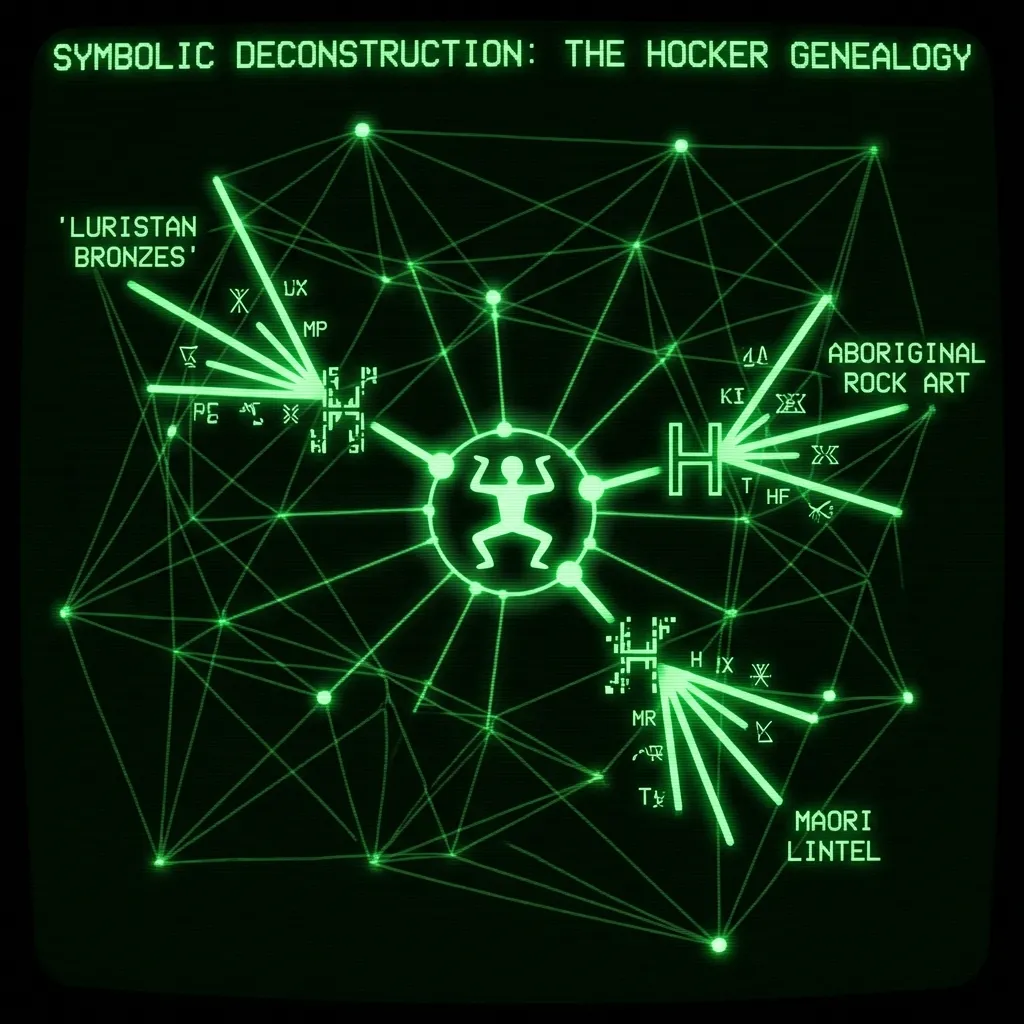
- The motif appears across Luristan bronzes, Greek Potnia Theron, Etruscan childbirth stamps, Maori lintels, and Aboriginal Australian rock art—too complex and specific for independent invention.
- Carl Schuster and Edmund Carpenter’s “genealogical lattice” theory explains the hocker as a diagram of ancestry, not a portrait.
- The bullroarer (Tjurunga) may have served as a portable vector for transmitting this cult package from the Neolithic Near East to Australia and the Americas.
1. Introduction: The Geometry of Ancestry#
The interpretation of prehistoric iconography operates within a persistent tension between two epistemological poles: the theory of independent invention, often summarized by Adolf Bastian’s concept of Elementargedanken (elementary ideas arising from a shared psychic unity), and the theory of diffusion, which posits that complex, arbitrary symbolic forms have specific historical origins and travel through time and space via migration, trade, and cultural interaction. In the study of the “squatter” or “hocker” motif—a figure depicted in a frontal, bilaterally symmetrical crouch with splayed legs—mainstream archaeology has largely favored the former. The squatting posture is viewed as a universal human physiological habit, a natural birthing position, or a simple artistic solution to spatial constraints, arising spontaneously in the Neolithic Near East, Iron Age Europe, Pre-Columbian America, and Indigenous Australia.
However, a rigorous “steelmanning” of the diffusionist perspective reveals that the “hocker” is rarely a generic representation of a sitting human. Rather, it is a highly specific, standardized, and recurrent iconographic complex often integrated with flanking animals, specific joint markings, and apotropaic functions. When one examines the specific morphological parallels between the Potnia Theron of Archaic Greece, the Heraldic Woman of the Luristan bronzes, the Pare lintel figures of the Maori, and the controversial graffiti of Göbekli Tepe, the probability of independent convergence diminishes.
This report synthesizes archaeological data from the Pre-Pottery Neolithic (PPN) of Anatolia, ethnographic records from Aboriginal Australia and Melanesia, and the theoretical frameworks of art historians Carl Schuster, Edmund Carpenter, and Douglas Fraser. It argues that the hocker motif is not a biological inevitability but a “cultural fossil”—a remnant of a Paleolithic “social symbolism” that codified genealogy, ancestry, and the continuity of life into a replicable graphic system that diffused out of the Old World to the Antipodes and the Americas.
2. The Anatolian Zero Point: Göbekli Tepe and the Pre-Pottery Neolithic#
The site of Göbekli Tepe in southeastern Turkey (c. 9500–8000 BCE) serves as the chronological anchor for this analysis. As the oldest known monumental ritual complex, it offers a glimpse into the symbolic world of the Pre-Pottery Neolithic (PPN), a period that arguably generated the “neolithic package” of myths and motifs that would later radiate across Eurasia.1
2.1 The “Graffiti” of the Lion Pillar Building#
Central to the diffusionist argument is a specific image found within the so-called “Lion Pillar Building” (Structure F, Layer II), dating to the PPNB (c. 8800 BCE). This structure is distinct for its rectangular architecture and the presence of pillars adorned with relief carvings of fierce lions.1 Within this context, archaeologists discovered a stone slab bearing a carved graffito of a naked woman.4
The figure is depicted in a specific, stylized manner:
- Frontal Symmetry: The figure faces the viewer directly.
- The Squatting Posture: The legs are splayed wide, knees drawn up to the level of the torso in a classic hocker position.6
- Genital Emphasis: The vulva is explicitly detailed and arguably enlarged, a trait often associated with “display” figures intended to ward off evil or signify fertility.5
- Contextual Anomaly: The iconography of Göbekli Tepe is overwhelmingly male; the pillars depict ithyphallic men and male animals. This female figure stands as a singular exception.8
Mainstream interpretation, exemplified by Jens Notroff of the German Archaeological Institute, classifies this figure as “graffiti,” implying it is an unofficial addition, perhaps scratched into the stone long after the building’s primary use, and thus disconnected from the site’s “official” theology.5 However, the steelman argument posits that “graffiti” often represents the persistence of a “Little Tradition”—the domestic or folk religion that operates beneath the “Great Tradition” of the priesthood. The presence of a squatting, displaying female in a building dedicated to lions establishes a prototype for the “Heraldic Woman” (a woman flanking or flanked by lions) that Douglas Fraser identified as a key diffusion marker in later Eurasian art.9 The association of the female figure with the “Lion Pillar” suggests an early Neolithic antecedence for the Potnia Theron (Mistress of Animals), linking the generative female power with the apex predator.3
2.2 The Bone Spatula: Instrument of the Bullroarer?#
A second critical artifact is a decorated bone object found at Göbekli Tepe, cataloged as a “spatula”.11 The object is carved with geometric lines and two T-shaped forms that mimic the monumental pillars of the site.12
While the functional designation “spatula” is neutral, comparative analysis suggests this object may be a bullroarer—a flat, aerophonic instrument swung on a cord to produce a low-frequency roaring sound.13
- Acoustic Ritual: Bullroarers are known from the European Paleolithic and are ethnographically ubiquitous in contexts of male initiation, particularly in Aboriginal Australia (Tjurunga) and Melanesia.10
- The “H” Symbol: The bone object and several pillars (notably Pillar 18) feature an “H” symbol, sometimes bracketed by “C” shapes.14 Researchers Manu Seyfzadeh and Robert Schoch have argued that this symbol is cognate with a logogram in the Luwian hieroglyphic script (used in Bronze Age Anatolia millennia later) meaning “God” (Massani) or “Gate”.14
- Implication: If the “spatula” is indeed a bullroarer, and if it carries the “God” symbol, Göbekli Tepe evidences a “ritual package” involving the hocker motif (the graffiti), the bullroarer (the spatula), and specific symbolic logograms (the H). The probability of these three elements—visual, acoustic, and linguistic—co-occurring by chance is significantly lower than the probability that they represent a coherent cultural system that could be transmitted.
**Table 1: Comparative Morphology of the Göbekli Tepe Symbolic Complex#
| Feature | Göbekli Tepe Context | External Parallel (Diffusion Target) | Diffusionist Implication |
|---|---|---|---|
| Squatting Female | “Graffiti” in Lion Pillar Building 4 | Sheela na gig (Europe) 16; Djanggawul (Australia) 17 | Persistence of the “Birthing/Displaying” apotropaic female. |
| Flanking Lions | Pillars in Lion Building (Structure F) 1 | Potnia Theron (Greece) 18; Luristan Bronzes 19 | The “Heraldic Woman” complex originates in the PPN interaction sphere. |
| “H” Symbol | Pillar 18 Belt Buckle; Pillar 28 14 | Luwian “God” Logogram 14; Aboriginal Chest Motif 20 | Survival of a logographic system for “divinity” or “connection.” |
| Bone “Spatula” | Carved rib bone with T-shapes 11 | Australian Tjurunga; Papuan Bullroarer 10 | Diffusion of acoustic technology for initiation rituals. |
3. The Antipodean Connection: Australia and the “Out of Eurasia” Hypothesis#
The diffusionist model faces its most rigorous challenge in explaining the presence of these motifs in Australia, a continent traditionally viewed as isolated from the Neolithic transitions of Eurasia. However, specific anomalies in the rock art of Arnhem Land and the ritual objects of Central Australia suggest a transmission event, potentially during the mid-Holocene (coinciding with the arrival of the dingo and new stone tool technologies).
3.1 The “Shaman” Chest Motif Controversy#
A focal point of the debate is the visual identity between the “H” symbol on Göbekli Tepe’s Pillar 28 and a motif painted on the chest of an Aboriginal elder, documented in a 19th-century photograph by Spencer and Gillen.5
- The Skeptical View: Notroff dismisses this as a superficial convergence of basic geometric forms. He notes that the Aboriginal symbol represents “two men sitting” or an exchange, while the GT symbol is an architectural or abstract “H”.5
- The Steelman View: The diffusionist argument does not rely on the form alone but on the semantics. In Aboriginal iconography, the “H” or bracketed line represents “two persons communicating” or an exchange of knowledge.20 Göbekli Tepe is interpreted as a site of aggregation, ritual exchange, and knowledge transfer between hunter-gatherer groups.21 If the symbol denotes “connection/exchange” in both contexts, the form-function match is precise. Carl Schuster’s theory of “social symbolism” posits that the “hocker” figure itself is often reduced to geometric abbreviations—brackets, lines, and dots—that represent the relationship between kin rather than the individuals themselves.22 The “H” is not a letter; it is a diagram of social connection.
3.2 Yingarna and the Djanggawul Sisters#
The “squatter” motif appears explicitly in the high-status rock art of Arnhem Land.
- Yingarna: The “Creator Mother” or Rainbow Serpent is frequently depicted in a squatting, anthropomorphic form with splayed legs.23 This figure is the source of all life, carrying the “dilly bags” of culture.24
- The Djanggawul Sisters: These fertility ancestors are central to the Dhuwa moiety. They are depicted with splayed legs, explicitly giving birth to the first humans.17 This imagery mirrors the Göbekli Tepe “graffiti” and the Etruscan childbirth stamps 26 with high fidelity.
- Maliwawa Figures: The recently defined Maliwawa rock art style (dated 6,000–9,400 BP) features large, naturalistic human figures, often in “back-to-back” compositions.27 This dating aligns with the Neolithic period in Eurasia. The “back-to-back” figure is another specific genealogical pattern identified by Schuster as a marker of the “hocker” complex, representing the fission of kin groups.22
3.3 The Bullroarer (Tjurunga) as a Vector#
The bullroarer (Tjurunga or Churinga) provides the physical mechanism for diffusion. In Australia, these objects are the literal bodies of the ancestors.10 They are often engraved with the same geometric motifs (concentric circles, tracks, “H” shapes) found in the Near Eastern Neolithic. The fact that the bullroarer is used for male initiation and is taboo to women in Australia, Melanesia, and Ancient Greece (the rhombos) suggests it was part of a diffused “cult package” of secret-sacred knowledge that traveled alongside the iconographic system.10
4. The Global Tapestry: Fraser, Schuster, and Carpenter#
To explain the distribution of these motifs without resorting to “universal archetypes,” we must employ the theoretical frameworks of diffusionist art history.
4.1 Douglas Fraser and the “Heraldic Woman”#
Douglas Fraser identified a circum-Pacific distribution of the “Heraldic Woman”—a specific iconographic type where a squatting female is flanked by symmetrical animals.9 Fraser argued that this motif was too complex to be invented independently in so many locations. He traced its spread from a theoretical center (possibly Bronze Age China or the Near East) to:
- Luristan (Iran): Iron Age bronze pins depict a female “Mistress of Animals” grasping two beasts.19
- Etruria (Italy): Ceramic stamps from Poggio Colla show a squatting woman in childbirth, sometimes flanked by animals, linked to the Potnia Theron tradition.26
- New Zealand (Maori): The pare (door lintels) feature a central female figure (tupuna) with splayed legs, flanked by manaia (monsters).30
- Northwest Coast America: The “splayed figure” on Chilkat blankets and totem poles fits this morphological template.31
4.2 Schuster & Carpenter: The Genealogical Lattice#
Carl Schuster and Edmund Carpenter provided the deep-structural explanation. They argued that the “hocker” is not a portrait but a diagram of ancestry.22
- Birth from the Knee: They documented a global mythological motif of “birth from the knee” (or joints), which is visually represented by hocker figures linked limb-to-limb.22 The squatting posture is the necessary geometry to allow figures to interlock in endless repeating patterns (a “genealogical lattice”).
- Joint Marks: A critical diagnostic trait is the “joint mark”—the placement of eyes or faces on the knees, elbows, and shoulders of the figure. This is found in the art of the Northwest Coast (Haida/Tlingit), Melanesia, and in the “Rosenstock Hocker,” a bone carving from Maryland (USA).31 The presence of “joint marks” is a highly specific, arbitrary cultural trait that strongly supports a diffusionist model over independent invention.
5. The European Leg: Gorgons and Sheelas#
In the West, the squatting female motif evolved into specific apotropaic (protective) icons, maintaining the “gatekeeper” function seen in the “H” symbol.
5.1 The Gorgon (Medusa)#
The Archaic Greek Gorgon is frequently depicted in the Knielauf pose—a stylized running/squatting kneel that emphasizes the frontal display.32 Like the “Heraldic Woman,” she is often flanked by animals (Pegasus and Chrysaor) or lions.32 Her function is to ward off evil (the Gorgoneion). The visual parallel to the Maori lintel figure—protruding tongue, staring eyes, squatting posture—is striking and was noted by early diffusionists as evidence of a shared “Pacific-Mediterranean” link via Asia.30
5.2 The Sheela na Gig#
The Sheela na gig of medieval Britain and Ireland—stone carvings of naked women displaying their genitalia—represents a late survival of this motif.16 While often dismissed as “grotesques” or warnings against lust, their placement over church doorways mirrors the Gorgon’s placement on temple pediments and the Maori figure on meeting house lintels.34 They all serve as “threshold guardians.” The Göbekli Tepe graffiti, located in a ritual enclosure, can be seen as the earliest known antecedent of this specific “threshold guardian” function.10
6. The “Hocker” in the Americas: The Rosenstock Bone#
The presence of the hocker in the Americas provides a crucial data point for trans-oceanic or circumpolar diffusion. The Rosenstock Hocker, a bone carving found in a Late Woodland context (ca. 1460 AD) in Maryland, depicts a headless human figure in the squatting posture with drilled holes at the joints.31
- Interpretation: While local explanations focus on Iroquoian cosmology, Schuster and Carpenter classified this as a classic “genealogical hocker” with “joint marks”.31
- Context: Its rarity in the region and its specific stylistic traits (joint marks) link it to the circum-Pacific artistic tradition, suggesting that the “hocker” motif entered the Americas either across the Bering Strait or via trans-Pacific contact, carrying the same “ancestral” symbolism found in Asia and Oceania.
7. Mechanisms of Diffusion: The “Thread-Spirit”#
How did this motif travel? The diffusionist model proposes that it was not just an image but a doctrine that spread.
- The Sutratman: The “Thread-Spirit” doctrine (Sanskrit sutratman) posits that all life is connected by a spiritual thread.36 The artistic manifestation of this is the continuous line or the interlocked hocker pattern found in textiles and pottery.
- Portable Technology: The motif was carried on portable, high-value ritual objects: bullroarers, bone spatulas, textiles, and tattoos. The Göbekli Tepe “spatula” 11 and the Maryland bone carving 31 demonstrate that these motifs were carved onto small, mobile objects that could easily travel thousands of miles with a single carrier.
8. Conclusion: Steelmanning the Narrative#
The “Null Hypothesis” of independent invention relies on the assumption that the “squatter” posture is generic. However, the evidence demonstrates a recurring, complex constellation of traits:
- Morphology: Bilateral symmetry + Squatting + Genital Display + Flanking Animals.
- Function: Apotropaic “Threshold Guardian” + Ancestral Genealogy + Fertility.
- Technology: Association with the Bullroarer (Acoustic Initiation).
From the limestone pillars of Göbekli Tepe to the rock shelters of Arnhem Land, and from the bronze pins of Luristan to the lintels of New Zealand, the “squatter” appears not as a random doodle but as a coherent symbol of the generative force—the “Great Mother” who births the ancestors and guards the gate between the living and the dead. The graffiti at Göbekli Tepe is not an anomaly; it is the “Rosetta Stone” linking the monumental Neolithic to the persistent, global folk tradition of the Heraldic Woman.
**Comparative Data Tables
**Table 2: The “Heraldic Woman” Trait Matrix#
| Trait | Luristan (Iran) | Etruria (Italy) | Maori (NZ) | Northwest Coast (USA) |
|---|---|---|---|---|
| Squatting Posture | Yes 19 | Yes 26 | Yes 30 | Yes 31 |
| Flanking Animals | Lions/Beasts 19 | Lions/Birds 26 | Manaia 30 | Totemic Animals 9 |
| Protruding Tongue | No | Yes (Gorgon) 32 | Yes 30 | Yes 9 |
| Function | Ritual/Votive | Votive/Birth | Lintel (Guardian) | Totem/Ancestral |
**Table 3: The “H” Symbol and Logographic Parallels#
| Symbol Context | Visual Form | Proposed Meaning | Source |
|---|---|---|---|
| Göbekli Tepe (Pillar 18) | H bracketed by C’s | God / Gate / Connection | 14 |
| Luwian Hieroglyphs | Massani (God) / Gate | Divinity / Portal | 14 |
| Aboriginal Art (Central) | Bracketed Line | Two Men Sitting / Exchange | 20 |
| Tjurunga (Australia) | H-shapes / Concentric Circles | Ancestral Body / Spirit | 10 |
Note on Citations: The citations used in this report refer to the provided research snippets. For example, 1 refers to the first snippet in the source material provided.
**Works cited#
- Göbekli Tepe - Wikipedia, accessed December 9, 2025, https://en.wikipedia.org/wiki/G%C3%B6bekli_Tepe
- The Site - The Tepe Telegrams - WordPress.com, accessed December 9, 2025, https://tepetelegrams.wordpress.com/the-research-project/
- The lion pillar (Schmidt, 2007: 289, Fig. 102). Picture No:… - ResearchGate, accessed December 9, 2025, https://www.researchgate.net/figure/The-lion-pillar-Schmidt-2007-289-Fig-102-Picture-No_fig1_358576439
- Göbekli Tepe, engraving of a female person from layer II (foto Dieter Johannes, DAI). … - ResearchGate, accessed December 9, 2025, https://www.researchgate.net/figure/Goebekli-Tepe-engraving-of-a-female-person-from-layer-II-foto-Dieter-Johannes-DAI_fig5_270030960
- iconography – Tepe Telegrams, accessed December 9, 2025, https://www.dainst.blog/the-tepe-telegrams/tag/iconography/
- EMERGENCE AND EVOLUTION OF THE EARLY NEOLITHIC ANTHROPOMORPHIC FIGURINES IN THE NEAR EAST A THESIS SUBMITTED TO THE GRADUATE SCH - Open Metu, accessed December 9, 2025, https://open.metu.edu.tr/bitstream/handle/11511/108288/10613658.pdf
- pseudoarchaeology – Tepe Telegrams, accessed December 9, 2025, https://www.dainst.blog/the-tepe-telegrams/tag/pseudoarchaeology/
- A Short Note on a New Figurine Type from Göbekli Tepe, accessed December 9, 2025, https://www.dainst.blog/the-tepe-telegrams/2017/08/09/a-short-note-on-a-new-figurine-type-from-goebekli-tepe/
- The Role of Shamanism in Mesoamerican Art, accessed December 9, 2025, https://www.mdcarrasco.com/courses/arha_291/klein.pdf
- accessed December 31, 1969, https://drive.google.com/open?id=1r27-1y49RHseH6XSZdQZVXpS_ZDC1N5CwBY1o20lgxA
- (PDF) A Decorated Bone ‘Spatula’ from Göbekli Tepe. On the Pitfalls of Iconographic Interpretations of Early Neolithic Art - ResearchGate, accessed December 9, 2025, https://www.researchgate.net/publication/314299328_A_Decorated_Bone_‘Spatula’_from_Gobekli_Tepe_On_the_Pitfalls_of_Iconographic_Interpretations_of_Early_Neolithic_Art
- Fragments of decorated bone ‘spatulae’ from Göbekli Tepe. (drawings: DAI, Orient Department, K. Schmidt) … - ResearchGate, accessed December 9, 2025, https://www.researchgate.net/figure/Fragments-of-decorated-bone-spatulae-from-Goebekli-Tepe-drawings-DAI-Orient_fig5_314299328
- A functional investigation of southern Cape Later Stone Age artefacts resembling aerophones - ResearchGate, accessed December 9, 2025, https://www.researchgate.net/publication/331558496_A_functional_investigation_of_southern_Cape_Later_Stone_Age_artefacts_resembling_aerophones
- World’s First Known Written Word at Göbekli Tepe on T-Shaped Pillar 18 Means God, accessed December 9, 2025, https://pdfs.semanticscholar.org/6b9e/ec318796b27213b3342e2b80b9105b2acb5e.pdf
- Writing at Göbekli Tepe - Robert M. Schoch, accessed December 9, 2025, https://www.robertschoch.com/gobekli_tepe_writing.html
- Sheela na gig - Wikipedia, accessed December 9, 2025, https://en.wikipedia.org/wiki/Sheela_na_gig
- Djang’kawu - Wikipedia, accessed December 9, 2025, https://en.wikipedia.org/wiki/Djang%27kawu
- Potnia Theron - Wikipedia, accessed December 9, 2025, https://en.wikipedia.org/wiki/Potnia_Theron
- Women in Combat: “Mistress of Animals” in Luristan Iconography - ArchéOrient – Le Blog, accessed December 9, 2025, https://archeorient.hypotheses.org/33244
- Making headlines: Was Göbekli Tepe built by Aboriginal Australians?, accessed December 9, 2025, https://www.dainst.blog/the-tepe-telegrams/2017/11/28/making-headlines-was-goebekli-tepe-built-by-aboriginal-australian/
- Echo from the Past: How Göbekli Tepe is Reshaping Our Understanding of the Neolithic, accessed December 9, 2025, https://popular-archaeology.com/article/echo-from-the-past-how-gobekli-tepe-is-reshaping-our-understanding-of-the-neolithic-2/
- Birth from the Knee - Path to the Maypole of Wisdom, accessed December 9, 2025, https://maypoleofwisdom.com/wp-content/uploads/2023/09/birth_from_the_knee.pdf
- Beauty Is More Than Skin Deep - X-Ray Art Of North Australia Including Kakadu National Park - Scandinavian Society for Prehistoric Art, accessed December 9, 2025, https://www.rockartscandinavia.com/images/articles/a16tacon.pdf
- Williams Gallery West Press Release - Spirit of Yingarna Works from Aboriginal Australia by Jonathan Bock August 17th through 20th 2006 at the Jammin’ Tree Didgeridoo Festival, accessed December 9, 2025, https://galwest.com/news/old_news/2006/didgefest_pressrelease.htm
- AUSTRALIAN ABORIGINAL RELIGION - Brill, accessed December 9, 2025, https://brill.com/downloadpdf/display/title/185.pdf
- The bucchero childbirth stamp on a late Orientalizing period shard from Poggio Colla - SciSpace, accessed December 9, 2025, https://scispace.com/pdf/the-bucchero-childbirth-stamp-on-a-late-orientalizing-period-3624nb2zwv.pdf
- Arnhem Land’s Maliwawa rock art a remarkable glimpse into Indigenous life almost 10000 years ago - The Guardian, accessed December 9, 2025, https://www.theguardian.com/artanddesign/2020/oct/01/arnhem-lands-maliwawa-rock-art-a-remarkable-glimpse-into-indigenous-life-10000-years-ago
- Rock Art of Western Arnhem Land, Australia, accessed December 9, 2025, https://www.bradshawfoundation.com/rockartnetwork/western_arnhem_land.php
- The Art: Iconography, Style and Illumination - Brill, accessed December 9, 2025, https://brill.com/downloadpdf/display/book/9789004301726/B9789004301726-s007.pdf
- Catalogue of the Mayer Collection, accessed December 9, 2025, https://cdstar.eva.mpg.de/bitstreams/EAEA0-A97F-00CF-4CF5-0/1879_Gatty_Catalogue_of_the_Mayer_Collection.pdf
- May 2010 - Jefferson Patterson Park, accessed December 9, 2025, https://jefpat.maryland.gov/Pages/mac-lab/curators-choice/2010-curators-choice/2010-05-a-carved-bone-figure.aspx
- Olga A. Zolotnikova1 A hideous monster or a beautiful maiden? Did the Western Greeks alter the concept of Gorgon? - DOI, accessed December 9, 2025, https://doi.org/10.2307/j.ctvbj7gjn.23
- INTERPRETING THE POTTERY RECORD FROM GEOMETRIC AND ARCHAIC SANCTUARIES IN THE NORTHWESTERN PELOPONNESE, accessed December 9, 2025, https://austriaca.at/0xc1aa5576%200x003f21a9.pdf
- Sacred Display: New Findings - Sino-Platonic Papers, accessed December 9, 2025, https://sino-platonic.org/complete/spp240_sacred_display.pdf
- EXCAVATIONS AT THE ROSENSTOCK VILLAGE SITE (18FR18), FREDERICK COUNTY, MARYLAND: A PRELIMINARY REPORT, accessed December 9, 2025, https://mht.maryland.gov/Documents/archaeology/currentresearch/rosenstock.pdf
- The Thread-Spirit Doctrine - Fons Vitae Publishing, accessed December 9, 2025, https://fonsvitae.com/wp-content/uploads/2016/07/The_Thread_Spirit_Doctrine_An_Ancient_Me-2.pdf