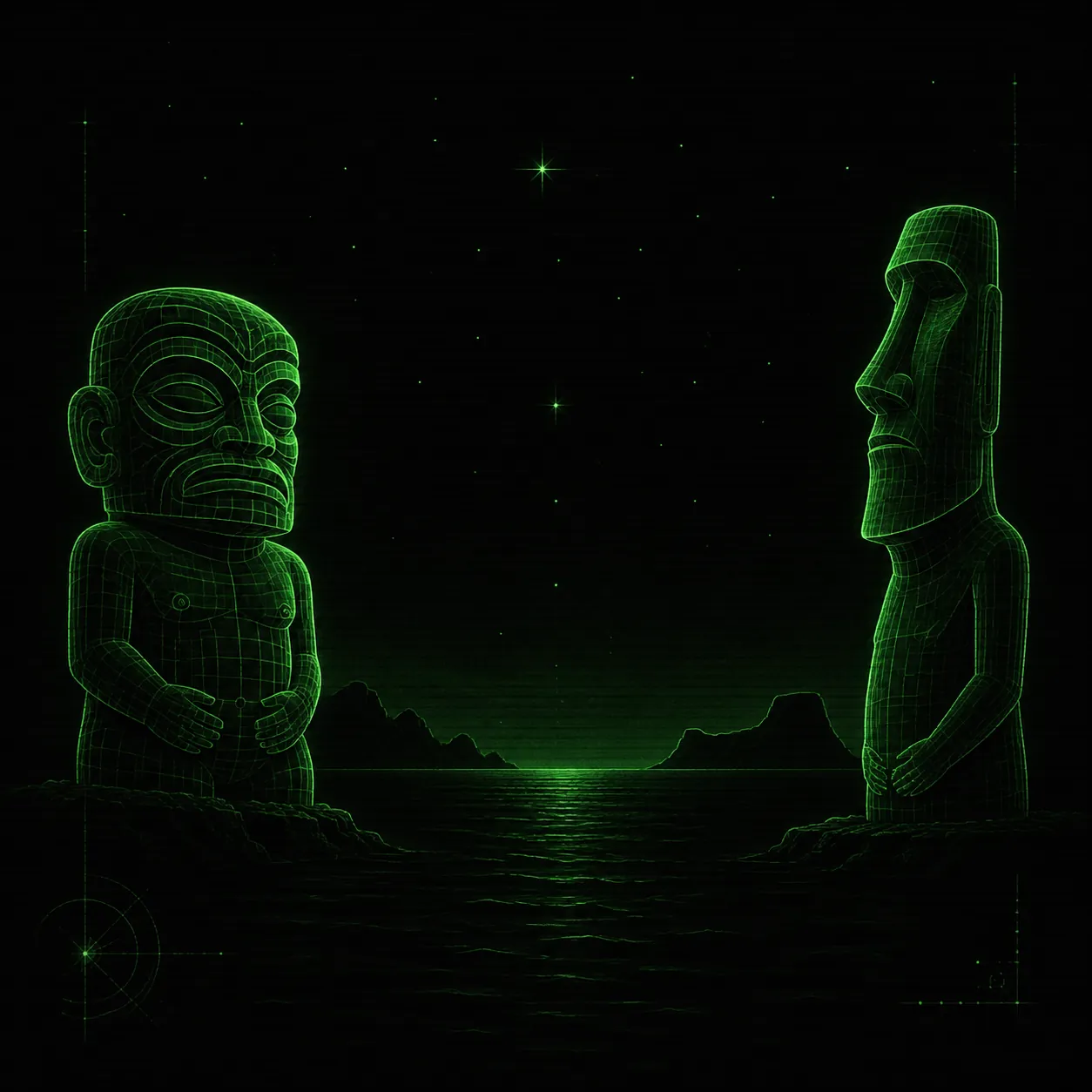
~/anthropology/cultural-diffusion
The Hands That Remember: Hiva Oa and Rapa Nui
Hiva Oa’s tiki and Rapa Nui’s moai share a striking hand gesture—and a Polynesian history illuminated by oral tradition, archaeology, and DNA.
TL;DR
- Hiva Oa’s tiki and Rapa Nui’s moai share a recognizable pose: arms beside the torso, hands turning inward across the abdomen.
- Their resemblance fits a real Polynesian family history. Genetic research traces the statue-building populations of the Marquesas and Rapa Nui to a common source in the Tuamotus.1
- Rapa Nui remembers Hiva as an ancestral homeland; in 1999 the mayor of Puamau, on Hiva Oa, told visiting voyagers that his valley was the point of departure.2
- The most illuminating connection is ancestral presence: both traditions made the remembered dead into enduring bodies among the living.
Why do the statues of Hiva Oa and Rapa Nui look related? #
Look below the face.
The eyes of a Marquesan tiki demand attention: enormous, rounded, pressed into a head that seems almost too large for its body. A Rapa Nui moai commands attention differently, through its long nose, heavy brow, and extraordinary vertical presence. But follow the shoulders down. The arms descend along the sides. The elbows turn. The hands return toward the centre of the body.
Across roughly 3,700 kilometres of Pacific Ocean, stone ancestors hold a recognizable pose.3
The comparison becomes especially vivid in a photograph published in F. W. Christian’s Eastern Pacific Lands in 1910. A compact basalt figure stands with bent legs and fingers spread across its belly. The original caption supplies the location: “From Atuona, Hiva-Oa Island.” The photograph preserves the island’s version of a gesture that becomes monumental on Rapa Nui. (Christian, plate facing p. 140.)

Set beside it an excavated moai photographed during Katherine Routledge’s expedition to Rapa Nui. The fingers are longer, the torso taller, the stone more massive. Yet the movement is immediately legible. Here too the arms bring the eye back to the lower body. Routledge published this image specifically to show the hands. (The Mystery of Easter Island, fig. 72.)
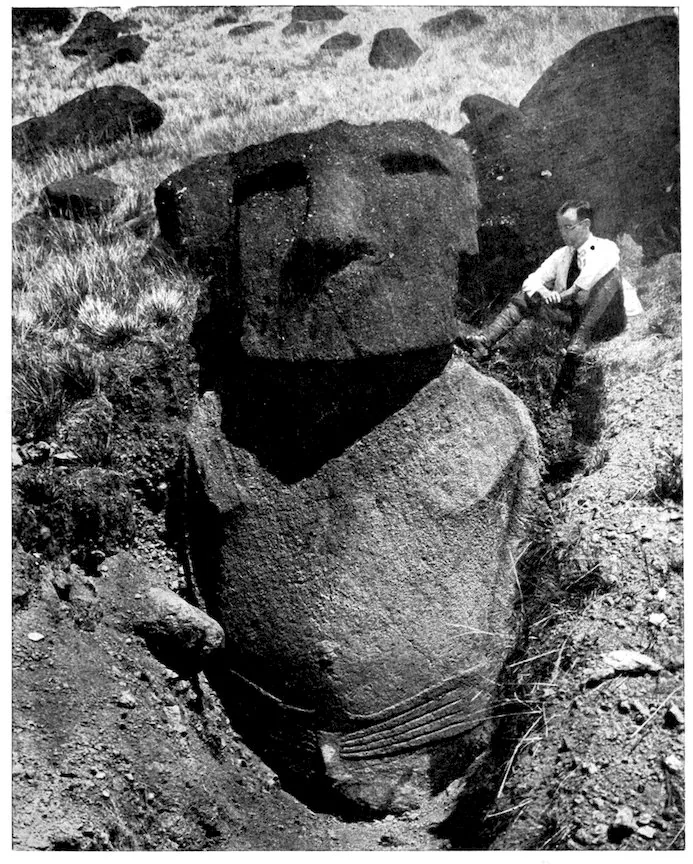
The best explanation for this family resemblance is a shared Polynesian inheritance, developed into distinct island traditions. The pose belongs beside voyaging, genealogy, and the power of ancestors. It is a small bodily detail with an unusually large historical setting.
What are Hiva Oa’s tiki? #
The figures on Hiva Oa are tiki. The famous statues on Rapa Nui are moai. Their shared gesture can be described simply as the hands-on-abdomen pose. Small Marquesan stone images are also described as tiki ke‘a. The British Museum’s catalogue uses that term for a basalt statuette with hands on its stomach, and connects such objects with offerings and healing. (British Museum, Oc1899,-.155.)
Hiva Oa gives the comparison unusual weight because its sculpture forms part of substantial sacred landscapes. At Iʻipona, in Puamau Valley, tiki stand among the stone structures of a me‘ae, a religious complex. French Polynesia’s Direction de la culture et du patrimoine describes tiki as images that commonly embody deified ancestors—chiefs, warriors, or priests—while also allowing for heroes and manifestations of gods. The human figure extended across Marquesan art, from monuments to tattooing and everyday objects. (DCP, “L’art marquisien”.)

Takaiʻi is the monumental expression of this tradition: a broad, commanding figure, with the hands resting against the swelling torso. In the 1980s survey summarized by archaeologist Sidsel Millerstrom, Hiva Oa held about two-thirds of the 81 recorded Marquesan stone figures. Large eyes, arms over the abdomen, and bent knees emerged as recurring features of the sculptural repertoire. (Millerstrom, “Venerated Ancestors”.)
That repetition changes how we should look at the little Atuona statue. It participates in a visual language that could be spoken at different scales. The body remained recognizable whether the carver worked on an intimate devotional object or a figure dominating a sacred platform. The Metropolitan Museum’s account likewise describes Marquesan sculpture as ranging from large temple ancestors to small images for private devotion. (Adorning the World.)

Was Hiva Oa the Hiva remembered on Rapa Nui? #
Rapa Nui’s founding tradition begins elsewhere.
In the account shared by Ma‘u Henua, the Indigenous community administering Rapa Nui National Park, Haumaka dreams of a distant island while his homeland, Hiva, faces destruction by the sea. His spirit travels there, recognizes places, and returns with the knowledge needed for a voyage. Hotu Matu‘a sends explorers and subsequently arrives with the founding company. At Haŋa Rau, his wife Vakai gives birth to Tu‘u Maheke. Arrival, birth, and the beginning of a people belong to the same remembered event. (Ma‘u Henua, “El sueño de Haumaka”.)
Hiva Oa offers an arresting echo of that homeland’s name. More significantly, the connection has also been articulated on Hiva Oa itself. During the Hōkūleʻa voyage in 1999, Puamau mayor Bernard Heitaa guided crew members around Iʻipona. The expedition dispatch of August 13 reports him saying that the people of Puamau believe Rapa Nui’s settlers migrated from their valley. It is a local belief connecting the islands, voiced in the presence of the tiki themselves. (“Departing Atuona,” Wayfinders.)
Hiva Oa thus contributes more than a suggestive place-name. A 1999 dispatch records a Puamau belief in departure, voiced at a sacred site whose figures evoke Rapa Nui’s ancestors. The connection lives in stories as well as in stone, even if the story’s age cannot be measured.2

What does DNA add to the connection? #
The striking development is that an independent line of evidence has converged on the same broad relationship between the islands, though not on the pose itself.
In 2021, Alexander Ioannidis and colleagues analyzed genetic data from 430 people representing 21 Pacific island populations. Their reconstruction explicitly connected the monumental statue-building cultures of the Marquesas, Raivavae, and Rapa Nui. It placed the Marquesas and the lineage leading to Rapa Nui within a branching settlement history extending through the Tuamotu archipelago, with Rapa Nui reached through Mangareva around 1200 CE. (Ioannidis et al., Nature; open manuscript.)
This supplies a population history in which the resemblance makes sense. Communities separated by immense distances were descendants of interconnected voyaging populations. The statues belong to different branches of a real oceanic family tree.1
Our reading is that the sculptural convention travelled through teaching: people showed other people how an ancestor should be given form. No record traces this particular pose from island to island, and genetics cannot do so. What genetics does recover is the set of relationships among the communities through which such knowledge could pass. Shared ancestry and related sacred images together make cultural inheritance the strongest explanation for the resemblance. The ocean between the statues was a space their ancestors had learned to cross.

The chronology points toward inheritance followed by development. Jo Anne Van Tilburg places Rapa Nui’s more remote ancestral roots in the Marquesas and Austral Islands, and notes that their monolithic statues hold postures similar to those of the moai. She also notes that those statues are later than the moai. The surviving monumental tiki therefore cannot be the moai’s models; what the islands would share is a convention older than either set of monuments. (Remote Possibilities, p. 10.)4
A tradition can be older than its surviving monuments. Its continuity can lie in an idea of the body, a relationship to ancestors, or a learned way of making an image. Later carvers can enlarge, compress, or transform that inheritance. Hiva Oa and Rapa Nui are especially revealing when viewed as two accomplished developments within this shared history.
Why place the hands on the abdomen? #
The Marquesan evidence offers a compelling way to read the gesture. The stomach was understood as a repository of ancestral and ritual knowledge. The Bowers Museum invokes that association when explaining a tiki holding its belly. Millerstrom similarly connects ritual knowledge and oral tradition with the stomach, and proposes that the surrounding hands could protect those memories. In this reading, the ancestor visibly holds the knowledge that gives the living their place in the world.5 (Bowers Museum; Millerstrom.)
An ancestral figure understood in this way carries knowledge bodily. Its belly gives that knowledge a place; its hands draw attention there. The image becomes a powerful expression of continuity because the person represented is also a source of what the living know about themselves.
On Rapa Nui the same attention to the lower body takes a distinct sculptural form. The hands often sit very low, close to the carved hami, or loincloth. Van Tilburg describes their elongated fingers, upturned thumbs, and sweeping curves as a distinctive sculptural convention. (Remote Possibilities, pp. 15–16.)

The hands belong to bodies constructed through different artistic choices:
| Feature | Hiva Oa tiki | Rapa Nui moai |
|---|---|---|
| Overall impression | Compact body, broad head, frequently bent knees | Elongated head and tall, column-like torso |
| Eyes and face | Large, rounded eyes and broad mouth | Heavy brow, long nose, strongly defined facial planes |
| Arms and hands | Bent arms; relatively short fingers against the abdomen | Arms close to the sides; long fingers sweeping across the lower torso |
| Sacred relationship | Ancestors and other powerful beings embodied in images | Ancestral figures associated with ceremonial platforms |
The table compares the photographed examples and the museum and archaeological descriptions cited above; individual sculptures vary.
There is also a practical sculptural advantage to keeping arms close to the body: a figure can remain one coherent mass. That observation helps explain how the design works. The painstakingly distinguished fingers give it expressive force, inviting attention to a place that the sculptor could have left as an undifferentiated block.
How did ancestral images connect the two islands? #
The fullest connection joins the pose to the identity of the being represented.
Moai are remembered as aringa ora, the living faces of ancestors. Their significance depends on relationships between the dead, the community, and its land. The British Museum’s account preserves that description, while CyArk’s documentation places Rapa Nui’s ceremonial architecture within the wider East Polynesian tradition of sacred platforms, courtyards, and human images. (British Museum, “Moai”; CyArk, “What Do the Moai Statues Represent?”.)
On Hiva Oa, ancestors likewise acquired durable bodies within places where communities assembled and sacred authority was expressed. The resemblance therefore involves several things together: the human form, the emphasized head, the returning hands, and an image’s continuing relationship with the living. The gesture is most persuasive inside that larger pattern.

One detail in Routledge’s collected account of Hotu Matu‘a makes the relationship unusually vivid. His ancestral gods came with him in the boat. Other people could not see them, but he knew they were there. (The Mystery of Easter Island, p. 280.)
That is a remarkable image of migration. A people can leave a shore without leaving its ancestors. The crossing carries a remembered world into a new landscape. There, in local stone and through local invention, ancestral presence can become visible again.
This is what makes the connection between Hiva Oa and Rapa Nui worth dwelling on. Their statues show how a shared inheritance could endure through enormous voyages and emerge in strongly different forms. A Marquesan tiki compresses its force into a broad, watchful body; a moai extends it into a towering presence. In both, the hands return to the body from which human continuity comes. Across the ocean, the ancestors still have somewhere to stand.
Sources #
- Christian, F. W. Eastern Pacific Lands: Tahiti and the Marquesas Islands. London: Robert Scott, 1910. Atuona statuette, plate facing p. 140.
- Routledge, Katherine. The Mystery of Easter Island. First published 1919; Project Gutenberg reproduces the 1920 second edition. Figure 72, p. 192; founding traditions, pp. 277–282; use of hiva, p. 265.
- Direction de la culture et du patrimoine, Polynésie française. “Découvrir les Marquises”. Sections on Marquesan art and Hiva Oa.
- Millerstrom, Sidsel (Cecilia). “Venerated Ancestors: Stone Sculptures of the Marquesas Islands, French Polynesia”. Online version of research presented in 1997 and published in the Fourth International Conference on Easter Island and East Polynesia proceedings, 1998.
- The Metropolitan Museum of Art. Adorning the World: Art of the Marquesas Islands. Exhibition overview, 2005.
- British Museum. Marquesan basalt tiki ke‘a, Oc1899,-.155; “Moai”.
- Comunidad Indígena Ma‘u Henua. “Te Tomo Haŋa o te ꞌAriki”. Living Rapanui account of the founding voyage, especially “El sueño de Haumaka.”
- Kawaharada, Dennis. “Departing Atuona”. Hōkūleʻa expedition dispatch, August 13, 1999, hosted by PBS Wayfinders. Records the preceding day’s visit to Puamau. The Polynesian Voyaging Society’s leg 2 archive credits the Marquesas reports to Kawaharada.
- Ioannidis, Alexander G., et al. “Paths and Timings of the Peopling of Polynesia Inferred from Genomic Networks”. Nature 597 (2021): 522–526. Open author manuscript, discussion, fig. 2, and extended data fig. 5.
- Van Tilburg, Jo Anne, with drawings by Cristián Arévalo Pakarati. Remote Possibilities: Hoa Hakananaiʻa and HMS Topaze on Rapa Nui. British Museum Research Publication 158, 2006. Open PDF via the British Museum research repository. Comparative chronology, p. 10; hands and loincloth, pp. 15–16.
- Bowers Museum. “Tiki Figures: Reflections of Gods and Men”. April 27, 2023.
- CyArk. “What Do the Moai Statues Represent?”. Site documentation presented through Google Arts & Culture.
Related essays: Joseph Campbell and the transmission of cultural forms and traditions of the soul’s survival and return.
Image credits and licenses are given with each photograph. Modern photographs retain their individual licenses; the article’s text license does not replace them. Archival captions identify collection or publication provenance, not a scientifically determined carving date.
The study’s Marquesan samples came from Nuku Hiva and Fatu Hiva, not Hiva Oa. Its results support the connection at the archipelago level; the routes and dates are demographic model estimates, not evidence identifying a particular canoe voyage or the transmission of an individual artistic motif. ↩︎ ↩︎
The Puamau account documents a local tradition of direct migration. An exact identification of Rapa Nui’s Hiva with Hiva Oa has not been established. Ma‘u Henua’s account names Hiva without equating it with Hiva Oa; Routledge records Juan Tepano locating the homeland in the Paumotu (Tuamotu) group, p. 282, and translates hiva as “the world outside” in a bird-release formula, p. 265. The 1999 dispatch does not establish the antiquity of the Puamau account. ↩︎ ↩︎
Approximately 3,658 km by a great-circle calculation using the island coordinates in Te Papa’s Hiva Oa record and the Smithsonian Global Volcanism Program’s Rapa Nui record. Rounded to 3,700 km; this is geographical separation, not a reconstructed sailing distance. ↩︎
Individual tiki are difficult to date. Millerstrom distinguishes dates for occupation of a sacred site from dates for the carving of its statues. Her discussion includes a genealogical estimate placing Iʻipona’s construction around 1700–1750. The broad chronological comparison is more useful here than assigning a precise prehistoric year to any photographed figure. ↩︎
The stomach’s association with knowledge and the interpretation of hands as protecting it concern Marquesan evidence. Applying precisely the same meaning to all moai would go beyond the evidence. The argument here joins related bodily conventions to their shared ancestral context. ↩︎