TL;DR
- Horses evolved in North America ~55–50 million years ago as small forest browsers, then became large grassland grazers and spread into Eurasia via Beringia.1
- All native American horses went extinct near the end of the Pleistocene, likely from a mix of climate whiplash and human hunting, not a single “overkill” event.2
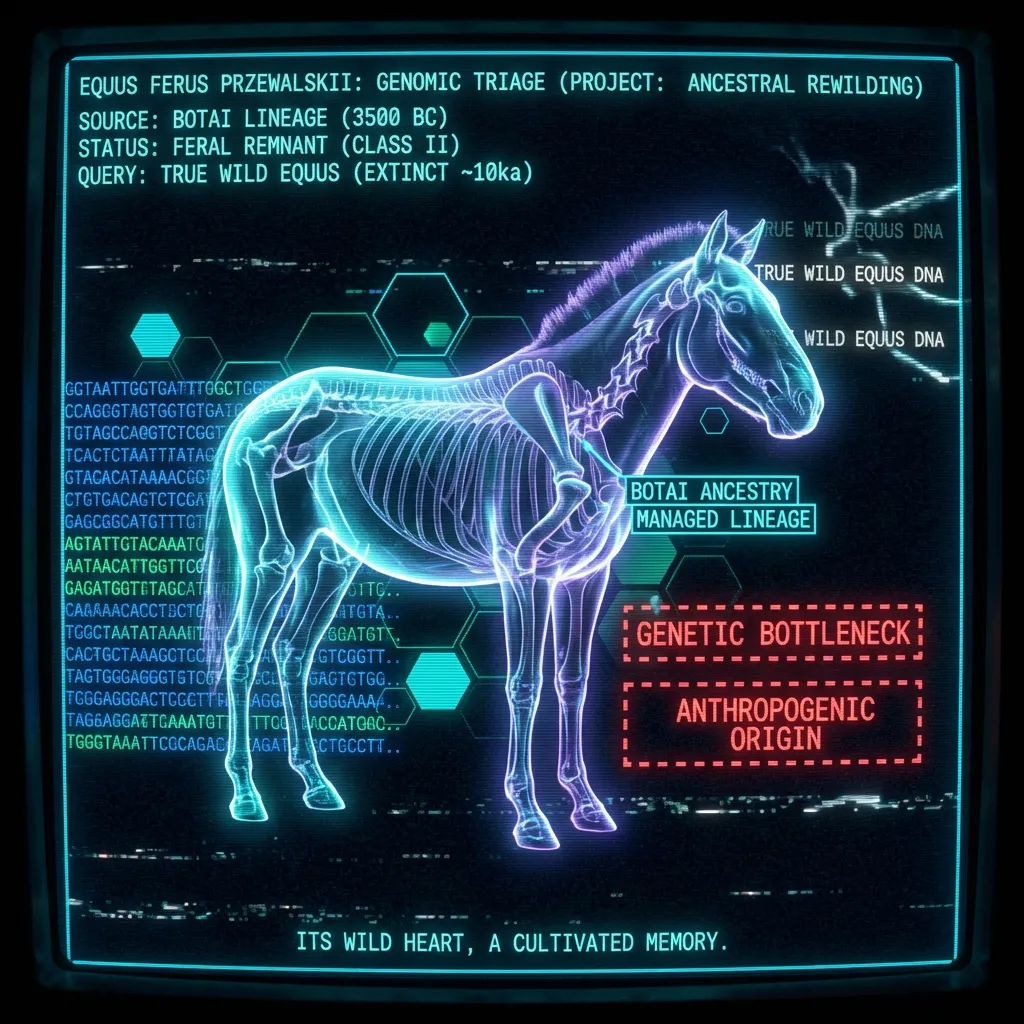
- Early horse husbandry at Botai (~3500 BC) produced the line that became Przewalski’s horse, not modern domestic horses.3
- Genomic work now pins the main domestication that gave rise to modern horses to the western Eurasian steppes near the lower Volga–Don ~2200 BC, with a rapid expansion across Eurasia.4
- Spaniards reintroduced horses to their evolutionary homeland in the 1500s; Indigenous networks spread them through the North American West faster and earlier than colonial documents admit.5
- Today’s “wild” horses are mostly feral; the only surviving truly wild lineage, Przewalski’s horse, is itself the feral remnant of an ancient managed stock and survives via intensive genomic triage.6
“The horse, with beauty unsurpassed, strength immeasurable, and grace unlike any other, still remains humble enough to carry a man upon his back.” — Amber Senti
The Horse as Deep-Time Experiment#
If evolution ever kept a lab notebook, the horse would be the page that got the most marginalia.
Equids start as cat-sized, many-toed leaf-eaters in Eocene forests of North America and end up as single-toed, high-speed grazers flung across continents.1 The family Equidae has one of the best fossil records of any mammal; paleontologists have been obsessively tracing their teeth and toes for over a century.[^macfadden]
In the classic story, this was portrayed as a neat, ladder-like march from Hyracotherium to Equus. Modern work replaces the ladder with a tangled bush: multiple lineages, branching, converging, experimenting with different body sizes and diets.[^macfadden]7
By the late Miocene and Pliocene (10–3 million years ago), the genus Equus appears: big-bodied, single-toed, high-crowned-tooth grazers adapted to open grasslands.7 They radiate across North America, then spill into Eurasia and Africa over the Bering land bridge.
From Forest Sprites to Grassland Engines#
You can think of horse evolution as a long-running experiment in how to turn cellulose into velocity.
Key shifts include:
- Teeth: Low-crowned teeth for browsing leaves give way to high-crowned, ever-wearing teeth suited to abrasive grasses laden with silica and dust.[^macfadden]8
- Limbs: Multiple small toes become a single load-bearing central digit with elongated distal bones and a stiffened limb, trading maneuverability for stride length and speed.[^macfadden]
- Guts and lungs: Horses become large hindgut fermenters with big aerobic capacity—high-oxygen engines designed to float a brain on top of a running GI tract.
A nice consequence: horse fossils double as paleo-climate loggers. Carbon isotopes in fossil horse teeth track the rise of C4 grasses and the spread of open habitats across the Cenozoic of North America.8
Timeline in Miniature#
Here’s an aggressively oversimplified timeline just to keep the story straight:
| Phase | Approx. Age | Key Equid Story |
|---|---|---|
| Early Equids | 55–45 million years ago | Small, multi-toed browsers (Hyracotherium and kin) in NA forests.1 |
| Grassland Transition | 25–10 Ma | Larger, longer-legged forms; shift toward grazing; multiple lineages.[^macfadden] |
| Equus Emergence | ~4–5 Ma | True horses appear; single-toed grazers in North America.7 |
| Global Spread | ~3–1 Ma | Equus crosses Beringia into Eurasia/Africa; multiple species on both continents.7 |
| Late Pleistocene | 50–12 ka | Widespread horses in North & South America and Eurasia; hunted by humans.2 |
| American Extinction | ~12–10 ka | All native American equids vanish.29 |
| Domestication (Botai) | ~3500–3000 BC | Early managed horses in Central Asia (Botai); not ancestors of modern domestic horses.3 |
| Domestication (Volga–Don) | ~2300–2000 BC | Modern domestic horses emerge from western Eurasian steppe stock.4 |
| Return to Americas | AD 1493–1600s | Spaniards reintroduce horses to their evolutionary homeland; feral and Indigenous horses spread.5 |
“Ma” = million years ago, “ka” = thousand years ago.
Extinction on the Home Continent#
By the Last Glacial Maximum, horses are a normal part of American megafauna. They show up in kill sites and butchery assemblages from Canada to Patagonia.29
Then they vanish.
What Killed the American Horse?#
The late-Pleistocene extinctions wiped out ~80% of North American megafaunal genera, including all native horses.2 The usual suspects: For a comprehensive exploration of megafaunal extinctions across continents, see our article on Megafaunal Extinctions and the Human Factor.
- Climate whiplash: Rapid warming, vegetation shifts, and habitat fragmentation near the Pleistocene–Holocene transition.[^climate-pleist]
- Humans with projectiles: Modern humans arrive across Beringia and spread south; some sites show clear horse and camel hunting with weapon impact marks and patterned butchery.10
The causal mix is still contested. Some argue that climate alone explains the timing and pattern of extinctions better than simple “overkill,” while others find evidence for human contributions at least in some regions.[^climate-pleist]11 South American data tell a similar story: multiple horse genera disappear amid overlapping signals of climate change and human arrival.9
The safest summary is boringly plural: late Pleistocene horses probably died from many causes at once—shrinking habitats, unstable climates, human hunting pressure, and ecological knock-on effects. What matters for the later story is the outcome: by ~10,000 years ago, wild horses are gone from the Americas.712
A Continent Without Its Prototype#
For several millennia, the continent that invented Equus has none. Bison, deer, and camelids persist; horses do not. North American cultures develop without mounted travel, cavalry, or traction animals. Plains hunters build entire cultures around the foot-borne bison hunt.
Then the Old World does something very strange with the horse, and the story loops back.
Domestication: Twice Tried, Once Global#
For decades, archaeologists pointed to the Botai culture of northern Kazakhstan (ca. 3500–3000 BC) as the cradle of horse domestication. Botai villages are seas of horse bones, with evidence for corrals, bit wear, and even mare’s milk in pottery residues.13 For broader context on domestication processes and human-animal relationships, see our article on Consider the Chicken: The Deep History of Domestication.
Ancient DNA cheerfully wrecked that tidy story.
Botai: The First Draft#
Genome data from Botai horses show that they were indeed a managed, intensively used horse population.3 But when you compare their genomes with those of modern domestic horses and Przewalski’s horses, something unexpected pops out:
- Botai horses are not the main ancestors of modern domestic horses.
- Instead, Botai horses are ancestral to Przewalski’s horse—the stocky, dun-colored horses of the Mongolian steppe, long touted as the “last wild horse.”3
In other words, the line we thought was “truly wild” is actually the feral remnant of an early domestication episode that never went fully global.314
Botai people likely rode, milked, and perhaps corralled horses, but their horse economy did not give rise to the later wave of chariots, cavalry, and global diffusion.
The Volga–Don Explosion#
A second, more consequential domestication took place further west.
By stitching together 273 ancient horse genomes from across Eurasia, Librado and colleagues pinpointed the main source population of modern domestic horses to the western Eurasian steppes, especially the lower Volga–Don region, around 2200–2000 BC.4
This later steppe population has several telling features:
- It rapidly replaces other local horse lineages across Europe and Asia in just a few centuries.
- It spreads in lockstep with archaeological evidence for spoke-wheeled chariots and later mounted groups.4
- It appears to have been strongly selected for traits useful for traction and riding—endurance, temperament, and perhaps specific body conformation.
In genomic terms, modern domestic horses are basically a population bottleneck with a saddle: a single successful lineage from the western steppes that steamrolls regional diversity.
The Return: Horses Come Home the Long Way Around#
The reintroduction of horses to the Americas is usually framed as a Spanish technology story. It’s also an evolutionary homecoming.
From Caribbean Landfall to Continental Diffusion#
Spaniards begin shipping horses to the Caribbean soon after 1493; Hernán Cortés brings them onto the mainland in 1519 during the invasion of Mexico.5 These animals are descendants of that Volga–Don lineage, already intensively selected and culturally embedded in European warfare and transport.
They do three things in the New World:
- Serve as colonial shock weapons: Armored men on horses are a terrifying, novel combination against pedestrian armies.
- Go feral: Escaped and abandoned animals breed on their own, especially in the grasslands and shrublands of northern Mexico and the Southwest.12
- Enter Indigenous networks: Horses move along trade routes faster than Spanish records acknowledge.
For a long time, historians assumed that widespread horse use by Plains societies followed the Pueblo Revolt (1680), when Indigenous groups seized Spanish horses and spread them north. Recent work with radiocarbon-dated horse remains, ancient DNA, and Indigenous oral histories has pushed that date earlier: some northern groups were using horses well before 1680.155 For broader context on Indigenous cultural networks and trade systems across the Americas, see our article on Deep Roots of Pan-American Culture.
In other words, the “horse frontier” advances through Indigenous trade as much as through Spanish garrisons.
Are Mustangs “Native”?#
Ecologically, mustangs are feral descendants of Old World domestic horses. Evolutionarily, though, they belong to a clade that originated here. Conservation biologists argue about what that should mean for management—especially on public lands where horses compete with livestock and native species.12
The simplest and least bureaucratically satisfying answer: mustangs are returning émigrés. They are not the same populations that went extinct at the end of the Pleistocene, but they are part of the same long experiment.
Wild, Feral, and Manufactured: The Modern Horse#
Today’s horses live in three overlapping ontological categories: companion/tool, feral nuisance/heritage icon, and conservation subject.
Przewalski’s Horse: The Feral “Wild” Horse#
Przewalski’s horse (Equus ferus przewalskii) is the last surviving truly wild-living horse population—except genomics says it isn’t truly wild in the deep sense.
Gaunitz et al.’s 2018 Science paper shows that Przewalski’s horses descend from the managed Botai horse population, not from untouched wild stock.3 They later went feral, and then almost went extinct in the 20th century; all living individuals descend from a tiny captive founder group.14
New, high-quality reference genomes and conservation genomics efforts aim to manage inbreeding, track deleterious variants, and even resurrect lost genetic diversity via cloning.1617 Cloned individuals from cryopreserved cells have already been born and integrated into breeding programs.17
So the last “wild horse” is a feral descendant of an early domestic line, resurrected using frozen cells and surrogate domestic mares. The ontology is convoluted, but evolution rarely honors our categories.
Domestic Horses as Genomic Artifacts#
Modern domestic horses also carry the scars of our selective tinkering:
- Strong sex-biased breeding (a few stallions, many mares) shapes Y-chromosome and mitochondrial patterns.4
- Industrial breeding for racing, show traits, and niche uses (gaited horses, draft giants, miniature ponies) creates sharp genomic islands of selection.
- Many traditional landraces are disappearing, replaced by a handful of cosmopolitan breeds.
In that sense, the horse is now as much a cultural artifact as a biological species: a genetically edited tool we maintain because we like it, not because the grassland demands it.
FAQ#
Q 1. Are horses “native” to North America?
A. Yes in origin, no in continuity. Equids evolved and diversified in North America for ~50 million years, but all native populations went extinct ~10,000 years ago; today’s mustangs descend from Old World domestic horses reintroduced by Europeans.712
Q 2. Where were modern horses first domesticated?
A. Genomic data point to the western Eurasian steppes near the lower Volga–Don as the homeland of modern domestic horses around 2200–2000 BC, not Botai; Botai horses instead gave rise to Przewalski’s horse.34
Q 3. Did Paleoindian hunters cause horse extinction in the Americas?
A. They likely contributed, but not alone. Radiocarbon and paleo-climate work suggest a mix of rapid climate change, habitat shifts, and human hunting pressure, with exact contributions varying by region.2109
Q 4. Did Native Americans have horses before Columbus?
A. No surviving horses bridged the Pleistocene extinction gap. However, Indigenous peoples adopted reintroduced horses very quickly; some groups in the West were using them earlier than colonial written records suggest.155
Q 5. Are Przewalski’s horses really wild?
A. They live wild now, but genomically they’re the feral descendants of an early managed population (Botai), rescued from extreme bottleneck and now propped up by intensive conservation and cloning.31417
Footnotes#
Sources#
- MacFadden, B. J. “Fossil Horses, Orthogenesis, and Communicating Evolution in Museums.” Evolution: Education and Outreach 5 (2012): 184–193.[^macfadden]
- MacFadden, B. J. Fossil Horses: Systematics, Paleobiology, and Evolution of the Family Equidae. Cambridge University Press, 1992.
- Wikipedia editors. “Evolution of the horse.” (accessed 2025-11-18).
- Wang, Y. et al. “Fossil horses and carbon isotopes: new evidence for Cenozoic dietary, habitat, and ecosystem changes in North America.” Palaeogeography, Palaeoclimatology, Palaeoecology 107 (1994): 269–279.
- Stewart, M. et al. “Climate change, not human population growth, correlates with Late Quaternary megafaunal extinctions in North America.” Nature Communications 12 (2021): 965.
- Villavicencio, N. A. et al. “Assessing the Causes Behind the Late Quaternary Extinction of Horses in South America Using Species Distribution Models.” Frontiers in Ecology and Evolution 7 (2019): 226.
- Waters, M. R. et al. “Late Pleistocene horse and camel hunting at the southern margin of the North American ice-free corridor.” PNAS 112 (2015): 823–828.
- Solís-Torres, Ó. R. et al. “A critical review of Late Pleistocene human–megafaunal interactions in Mexico.” Quaternary Science Reviews (2025).
- Wikipedia editors. “Botai culture.” (accessed 2025-11-18).
- Gaunitz, C. et al. “Ancient genomes revisit the ancestry of domestic and Przewalski’s horses.” Science 360 (2018): 111–114.
- Librado, P. et al. “The origins and spread of domestic horses from the Western Eurasian steppes.” Nature 598 (2021): 634–640.
- Colorado University Museum. “Horses in the North American West.”
- PBS Nature. “Horses in North America: A Comeback Story.” (2022).
- Taylor, W. T. T. et al. “Early dispersal of domestic horses into the Great Plains and northern Rockies.” Science 379 (2023): 277–281.
- Smithsonian Magazine. “New Research Rewrites the History of American Horses.” (2023).
- University of Minnesota. “U of M maps genome of the last living wild horse species.” (2024).
- Novak, B. J. et al. “Endangered Przewalski’s Horse, Equus przewalskii, Cloning for Genetic Rescue.” Animals 15 (2025): 613.
See overviews of the equid fossil record in MacFadden’s work on fossil horses and museum communication.[1] ↩︎ ↩︎ ↩︎
Late Quaternary megafaunal extinctions in North America removed ~80% of large mammal genera near the Pleistocene–Holocene transition.[5] ↩︎ ↩︎ ↩︎ ↩︎ ↩︎ ↩︎
Gaunitz et al. (2018) used ancient genomes to show Botai horses are ancestral to Przewalski’s horses, not to modern domestic horses.[10] ↩︎ ↩︎ ↩︎ ↩︎ ↩︎ ↩︎ ↩︎ ↩︎
Librado et al. (2021) traced the main domestication of modern horses to the lower Volga–Don region and a rapid expansion across Eurasia.[11] ↩︎ ↩︎ ↩︎ ↩︎ ↩︎ ↩︎
For a readable summary of that work, see the Smithsonian coverage of early horse dispersal into the Plains.[15] ↩︎ ↩︎ ↩︎ ↩︎ ↩︎
Przewalski’s horse is the last surviving truly wild horse lineage, though genomic evidence shows it’s actually a feral descendant of the ancient Botai managed population, preserved through intensive conservation efforts. ↩︎
The standard summary: horses evolved largely in North America, went extinct there ~10 ka, and were reintroduced by Europeans.[3] ↩︎ ↩︎ ↩︎ ↩︎ ↩︎ ↩︎
Carbon isotope work on fossil horse teeth tracks dietary shifts from browsing to grazing and associated habitat changes.[4] ↩︎ ↩︎
South American equids (including Equus and Hippidion) also disappear at the end of the Pleistocene, with timing tied to both climate and human arrival.[6] ↩︎ ↩︎ ↩︎ ↩︎
Wally’s Beach in Alberta provides clear evidence of human hunting of horses and camels, including kill sites and butchery traces.[7] ↩︎ ↩︎
For a recent critical review of megafauna–human interactions in Mexico, see Solís-Torres et al. 2025.[8] ↩︎
Outreach pieces from museum and media groups summarize the American extinction and Spanish reintroduction story.[12][13] ↩︎ ↩︎ ↩︎ ↩︎
Botai sites show corrals, dense horse bone assemblages, bit-wear on premolars, and mare’s-milk residues in pottery.[9] ↩︎
Gaunitz et al. reclassify Przewalski’s horses as feral descendants of Botai stock.[10] ↩︎ ↩︎ ↩︎
Taylor et al. (2023) combined archaeology, ancient DNA, and radiocarbon dating to show early Indigenous adoption of horses in the North American West.[14] ↩︎ ↩︎
Recent work has produced a high-quality reference genome for Przewalski’s horse, improving conservation genetics.[16] ↩︎
Cloning projects have produced Przewalski’s foals from cryopreserved cells, aiming to restore lost founder genetics.[17] ↩︎ ↩︎ ↩︎