~/mesopotamia/religion
Herodotus Was Right: The Sacred Prostitution Edition
For two thousand years everyone who wrote about Babylon agreed that Ishtar’s temples kept women who had sex with strangers. Then, from the 1980s, scholarship took the sex out.
TL;DR
- Herodotus says that every Babylonian woman had to sit once in the temple of Aphrodite, whom the Assyrians called Mylitta, until a stranger threw silver into her lap and had sex with her; the silver became sacred. Strabo, Lucian, the Letter of Jeremiah and an inscription from Tralles report the same kind of thing from Babylon, Byblos, Corinth, Comana, Armenia and Tralles.
- The Hebrew Bible calls the woman Judah pays with a kid both zonah, “whore”, and qedeshah, “holy one”, and bans the qedeshah in the same breath as the whore’s fee brought into the house of YHWH.
- The cuneiform texts put sex inside Ishtar’s cult. Inana owns “prostitution” among her divine powers. Uruk is “the city of kezertus, šamḫatus and ḫarimtus, whom Ištar deprived of husbands and called her own”. Shamhat the ḫarimtu has sex with Enkidu for a week, and Ishtar is her patron.
- From the 1970s to 2008, Fisher, Hooks, Gruber, Westenholz, Assante and Budin rebuilt each word as something chaste: priestess, midwife, wet-nurse, single woman. Budin’s verdict: “Sacred prostitution never existed.”
- The revision rests on an argument from silence and a narrow definition, and its own authors concede the core: Ishtar’s women had “a special relationship to a female deity” and a sexuality that “was unregulated”. Herodotus was right.
What did Herodotus see at the temple of Mylitta? #
In the fifth century BC Herodotus described a law of Babylon he thought the most shameful of all:
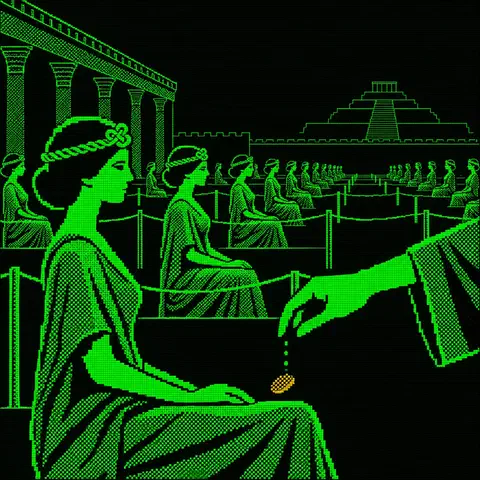
“The foulest Babylonian custom is that which compels every woman of the land to sit in the temple of Aphrodite and have intercourse with some stranger once in her life. … Once a woman has taken her place there, she does not go away to her home before some stranger has cast money into her lap, and had intercourse with her outside the temple; but while he casts the money, he must say, ‘I invite you in the name of Mylitta’ (that is the Assyrian name for Aphrodite). It does not matter what sum the money is; the woman will never refuse, for that would be a sin, the money being by this act made sacred. So she follows the first man who casts it and rejects no one. After their intercourse, having discharged her sacred duty to the goddess, she goes away to her home.”
— Herodotus 1.199 (Godley, Loeb 1920)
The Greek is plainer still. Every native woman must, once in her life, μιχθῆναι ἀνδρὶ ξείνῳ, “be mixed with a foreign man”: have sex with a stranger. The women sit in the precinct “with crowns of cord on their heads”, and roped lanes run through the crowd “by which the men pass and make their choice”. The money “becomes sacred” (γίνεται γὰρ ἱρὸν τοῦτο τὸ ἀργύριον). Afterwards she has “discharged her duty to the goddess” (ἀποσιωσαμένη τῇ θεῷ). Herodotus adds the detail no moralist would invent: “the women that are fair and tall are soon free to depart, but the uncomely have long to wait … some of them remain for three years, or four.” And he notes “a custom like this in some parts of Cyprus”.
Herodotus was not a man who believed everything he was told about Babylonian women and gods. Eighteen chapters earlier he describes the shrine on top of the ziggurat of Bel, with “a great and well-covered couch” where “one native woman, chosen from all women by the god” spends the night. The Chaldaean priests told him the god himself came to lie on the couch. Herodotus writes that he does not believe them, and passes on what he was told: that neither this woman nor the god’s woman at Egyptian Thebes, “it is said”, “has intercourse with men” (1.181–182, Godley). He knew the difference between a woman kept for a god and a woman who sat in the god’s precinct until a stranger paid for her body. He reported both.
Who else said it? #
Four hundred years later the geographer Strabo, who had travelled in Asia Minor and was born in Pontus, gives the Babylonian custom again: “in accordance with a certain oracle all the Babylonian women have a custom of having intercourse with a foreigner”, going to a temple of Aphrodite, “each woman … wreathed with a cord round her head”; the man takes her away from the precinct “and then has intercourse with her; and the money is considered sacred to Aphrodite” (16.1.20, Jones, Loeb, p. 227).
Strabo then adds what Herodotus did not. At Corinth, “the temple of Aphroditê was so rich that it owned more than a thousand temple slaves, courtesans, whom both men and women had dedicated to the goddess” (8.6.20, Jones). At Comana in Pontus, his own country, “there is a multitude of women who make gain from their persons [that is, who sell sex], most of whom are dedicated to the goddess, for in a way the city is a lesser Corinth” (12.3.36, Jones). In Armenia, at the temple of Anaïtis in Acilisenê, “the most illustrious men of the tribe actually consecrate to her their daughters while maidens; and it is the custom for these first to be prostituted in the temple of the goddess for a long time and after this to be given in marriage; and no one disdains to live in wedlock with such a woman” (11.14.16, Jones).
Lucian of Samosata, a Syrian writing in Greek in the second century AD, says he learned the secret rites of Adonis at Byblos. After the mourning for the dead god, the people shave their heads:
“The women who refuse to be shaved have to submit to the following penalty, viz., to stand for the space of an entire day in readiness to expose their persons for hire [to sell their bodies]. The place of hire is open to none but foreigners, and out of the proceeds of the traffic of these women a sacrifice to Aphrodite is paid.”
— Lucian, De Dea Syria 6 (Strong and Garstang 1913, p. 46)
The same treatise describes what the Syrian goddess’s men did. At the spring festival of Hierapolis, “any young man who has resolved on this action, strips off his clothes, and with a loud shout bursts into the midst of the crowd, and picks up a sword … He takes it and castrates himself and then runs wild through the city, bearing in his hands what he has cut off. He casts it into any house at will, and from this house he receives women’s raiment and ornaments” (§51, pp. 84–85). These are the galli, the eunuch priests whom Rome knew from the cult of Cybele.
A Jewish writer of the Hellenistic period, mocking the idols of Babylon, gives the Mylitta custom from another angle, with Herodotus’ cord:
“And the women, with cords about them, sit along the passageways, burning bran for incense; and when one of them is led off by one of the passers-by and is lain with, she derides the woman next to her, because she was not as attractive as herself and her cord was not broken.”
— Letter of Jeremiah 43 (Baruch 6:43, RSV)
The sitting women, the cords, the stranger who picks one, the plain one left behind: a Jewish polemic and a Greek ethnographer agree on the details.
The last witness is a stone. At Tralles in Caria, in the second or third century AD, Aurelia Aemilia set up a dedication to Zeus recording that she came “from an ancestry of pallakides [concubines]” and had herself served as a pallakē, “according to an oracle, to Zeus” (translated in Budin 2008, pp. 194–195). James Frazer read it as proof that “she herself served the god in the capacity of a harlot at his express command” and that “her mother and other female ancestors had done the same before her”, engraved in public on a marble column, so that “no stain attached to such a life and such a parentage” (Adonis, Attis, Osiris I, 1914, p. 38).
What do the Hebrew texts call her? #
The Hebrew Bible has a word built on the root q-d-š, “holy, set apart”: qedeshah, plural qedeshot, with a masculine qadesh, plural qedeshim. It appears in three places, and in two of them it stands beside the ordinary word for a whore, zonah.
In Genesis 38 the widowed Tamar veils herself and sits at the entrance of Enaim, by the road. “When Judah saw her, he thought her to be a whore (zonah), because she had covered her face” (38:15). He asks to “come in unto” her, she asks what he will pay, and he promises a kid from the flock and leaves his seal, cord and staff as pledge. When his friend Hirah comes back with the kid, he asks the men of the place: ayyeh ha-qedeshah, “Where is the qedeshah, the one at Enaim by the road?” They answer: “There has been no qedeshah here” (38:21, Hebrew). The woman who takes a kid for sex at the roadside is called a whore by the narrator and a “holy one” by the man paying her.
Deuteronomy puts the two words side by side as law:
“There shall be no qedeshah among the daughters of Israel, and there shall be no qadesh among the sons of Israel. You shall not bring the fee of a whore (etnan zonah) or the price of a dog into the house of YHWH your God for any vow, for both of them are an abomination to YHWH your God.”
— Deuteronomy 23:18–19 (Hebrew numbering; our translation from the Masoretic text)
The first verse bans the holy women and holy men. The next bans the money a whore earns, and the “price of a dog”, from being paid into the temple as a vow. Someone was bringing sex money to the sanctuary, or the law would not need to forbid it.
Hosea, in the eighth century BC, makes the same pairing in verse:
“I will not punish your daughters when they whore, nor your brides when they commit adultery; for the men themselves go aside with the whores (zonot), and sacrifice with the qedeshot; and a people that does not understand shall fall.”
— Hosea 4:14 (our translation from the Masoretic text)
And when Josiah purged the Jerusalem temple in about 622 BC, “he broke down the houses of the qedeshim that were in the house of YHWH, where the women wove hangings for Asherah” (2 Kings 23:7, Hebrew). The holy men lived in the temple of YHWH, next to the women who served the goddess.
What do the cuneiform texts say? #
The Babylonians did not need Greeks to tell them that sex belonged to Ishtar. Sumerian Inana is the goddess of it, and her own texts say so without euphemism.
In the myth Inana and Enki, Inana gets the god of wisdom drunk and carries off the me, the divine powers of civilisation, to Uruk. The list includes, in Sumerian, ĝiš₃ dug₄-dug₄ ĝiš₃ su-ub nam-kar-ke₄: literally “doing the penis, kissing the penis, prostitution”, and two lines later the amalu and “the holy tavern” (ETCSL 1.3.1, Segment F 29–31). The Oxford corpus prints the first two as “sexual intercourse, kissing”, and the amalu as “the cultic prostitute”. Gwendolyn Leick gives “the wielding of the penis, the kissing of the penis, the art of prostitution” and explains that “nam-kar-kid is the standard term for prostitution” (Sex and Eroticism in Mesopotamian Literature, 1994, p. 151). Prostitution is one of the gifts the goddess brings to her city.
Inana herself plays the part. A Sumerian lament addresses her as “the prostitute (kar-kid), setting out for the éš-dam [the tavern], who makes the bed delicious”, and she says of herself: “When I sit by the gate of an inn, I am indeed a prostitute who makes love” (Leick 1994, p. 152, after Volk 1989).
Her city was full of such women. The Babylonian Erra epic, from the late second millennium, describes Uruk as “the dwelling of An and Ištar, the city of kezertus, šamḫatus, and ḫarimtus, whom Ištar deprived of husbands and called her own” (Erra IV 52–53, Foster’s translation, quoted in Budin 2008, p. 27). The next lines name Ishtar’s men in Uruk:
“They rouse Eanna, the kurgarrus and assinnus
Whose masculinity Ištar has turned to femininity to make the people reverend,
The carriers of dagger, razor, scalpel and flint blades,
Who regularly do [forbidden things] to delight the heart of Ištar”
— Erra IV, the lines after 53 (Leick 1994, p. 168)
Uruk, Ishtar’s city, had women the goddess took from husbands and made her own, and men the goddess turned into women who carried razors and flint blades. Lucian’s galli at Hierapolis are the same institution a thousand years later, and Lucian tells us what the blades were for.
The Babylonian lexical lists give the vocabulary. The Neo-Assyrian synonym list malku = šarru equates šamḫatum, ḫarimtum, kezretum and their variants with Sumerian KAR.KID, “prostitute”, and elsewhere equates šamḫatu with the nadītu and qadištu, the titles of women dedicated to gods (Budin 2008, p. 28, after Lambert 1992). Leick summarises: the Sumerian words for women in temple service “were translated in the bilingual lexical and other texts by Akkadian expressions for ‘common prostitute’ (kezertu, harimtu, šamḫatu) as well as on occasion by titles for temple employees (nadītu, kulmašītu, qadištu)” (p. 150). The ancient scribes made the equation that modern scholars were later accused of inventing.
The ḫarimtu was also a legal category, and the law kept her visible. The Middle Assyrian Laws order wives and daughters to veil in the street, but “the prostitute is not to be veiled”. A ḫarimtu caught veiled is to have “[her] garments seized and 50 blows inflicted”, with “bitumen poured on [her] head” (the translation has “their”; the law speaks of the prostitute) (MAL A 40, Fordham sourcebook). Her uncovered head announced what she was.
Who was Shamhat? #
The fullest portrait of one of Ishtar’s women is in the Epic of Gilgamesh. The gods make Enkidu to match Gilgamesh, and he lives with the gazelles until a trapper complains that he frees the animals from the traps. Gilgamesh’s answer:
“Go, hunter, take with you Shamhat the harlot!
When the herd comes down to the water-hole,
she should strip off her raiment to reveal her charms.
He will see her, and will approach her,
his herd will spurn him, though he grew up amongst it.”
— Standard Babylonian Gilgamesh I (George, Penguin, 2003, p. 7)
The Akkadian calls her Šamḫat ḫarimtu. Her name comes from the verb šamāḫu, “to flourish, be luxuriant”, and means “the lush one”, “the voluptuous one” (Leick 1994, p. 164; Budin 2008, pp. 30–31). The scene at the waterhole is told twice, as instruction and as act:
“Shamhat unfastened the cloth of her loins,
she bared her sex and he took in her charms.
She did not recoil, she took in his scent:
she spread her clothing and he lay upon her.
She did for the man the work of a woman,
his passion caressed and embraced her.
For six days and seven nights
Enkidu was erect, as he coupled with Shamhat.”
— Gilgamesh SB I 188–194 (George 2003, p. 8)
When he is sated, the gazelles run from him and he cannot keep up. “Enkidu was weakened, could not run as before, / but now he had reason, and wide understanding.” He sits at her feet, his ears open to her words, and she tells him to come “to Uruk-the-Sheepfold, / to the sacred temple, home of Anu and Ishtar” (pp. 8–9). There, she promises, “there are harlots, most comely of figure, / graced with charm and full of delights. / Even the aged they rouse from their beds!” (p. 9). The harlot leads the wild man to the goddess’s temple, where the harlots live.
Ishtar claims these women in the epic too. When Gilgamesh and Enkidu kill the Bull of Heaven, “Ishtar assembled the courtesans, prostitutes and harlots” (in Akkadian the kezrētu, šamḫātu and ḫarīmātu) and led them in mourning over the bull’s haunch (VI 158; George 2003, p. 53; Leick 1994, p. 166). And when the dying Enkidu curses Shamhat, the Sun-god rebukes him, and Enkidu turns the curse into a blessing:
“No soldier shall [be slow] to drop his belt for you,
obsidian he shall [give you], lapis lazuli and gold! …
Ishtar, [the ablest] of gods, shall gain you entrance
to the man whose home [is established] and wealth heaped high!”
— Gilgamesh SB VII 156–160 (George 2003, p. 59)
Men drop their belts for her and pay her in gold and lapis, and Ishtar is the goddess who opens doors for her. Sex, payment and the goddess in three lines: Budin’s own definition of sacred prostitution.
The editor of the epic has no doubt what Shamhat was. Andrew George’s glossary reads: “SHAMHAT A cultic prostitute from Uruk, whose task was to entice Enkidu into the ways of man” (George 2003, p. 225). In 2018, ten years after Budin’s book, publishing a new Old Babylonian fragment of the scene, he called her “Šamkatum, a temple prostitute (‘harlot’)”, and showed that all the extant sources share a narrative with “two separate week-long episodes of sexual congress between Enkidu and the prostitute” (George, ZA 108, 2018, pp. 10, 19).
What does the Hittite Gilgamesh add? #
The epic travelled. Scribes at Hattusa, the Hittite capital in central Anatolia, copied it in Akkadian and adapted it into Hittite in about the fourteenth century BC. The Hittite song tells the harlot episode in its own words, and it does not soften it. In our line-by-line translation from the tablets, Gilgamesh answers the hunter: “[Bri]ng [a harlot]!”, and a duplicate manuscript adds the order “let her have sex” with him. The woman is written with the Sumerian sign MUNUS KAR.KID, “woman-prostitute”, and named Šanḫatu, the Hittite form of Shamhat. The verb used of her and Enkidu, šeš-, means both “to sleep” and “to have sex” (Hittite Song of Gilgamesh).
A Hittite scribe of the Late Bronze Age, at the far edge of the cuneiform world, understood the scene as Herodotus would have: the king sends a prostitute, and her sex makes the wild man human.
How did “temple prostitute” become “harlot”? #
For most of the twentieth century this was the ordinary reading. W. W. How and J. Wells’ standard commentary on Herodotus (1912) says of 1.199 that “H. is obviously writing as an eyewitness, and his account is of great value anthropologically”, objecting only that he made universal the rites “of the goddess Nana at Erech”, that is, Uruk (How and Wells). They compare Strabo, Lucian and the Letter of Jeremiah. Frazer gathered the reports into the third edition of The Golden Bough (1914): “at Babylon every woman, whether rich or poor, had once in her life to submit to the embraces of a stranger at the temple of Mylitta, that is, of Ishtar or Astarte, and to dedicate to the goddess the wages earned by this sanctified harlotry” (Adonis, Attis, Osiris I, pp. 36–37). He took it “not as an orgy of lust, but as a solemn religious duty” (p. 36). In Pritchard’s standard anthology of Near Eastern texts, Hammurabi’s law 181 still concerns a daughter dedicated “to a deity as a hierodule, a sacred prostitute, or a devotee” (1958, p. 159, as quoted by Budin, p. 16).
The turn came in the 1970s and 1980s. Eugene Fisher argued in 1976 that the silence of the temple archives was decisive. Stephen Hooks’ 1985 dissertation, Sacred Prostitution in Israel and the Ancient Near East, called the old consensus “a pattern of reasoning that is circular and self-supporting with surprisingly little data to confirm it” (quoted in Budin, p. 16). Mayer Gruber (1986) argued that the Hebrew qedeshah was a plain secular whore, and later compared the sacred prostitute to a computer virus “copied from book to book” (Budin, p. 17). Joan Goodnick Westenholz, in “Tamar, Qĕdēšā, Qadištu, and Sacred Prostitution in Mesopotamia” (Harvard Theological Review 82, 1989), showed that the qadištu of the Babylonian texts was a woman who handled births, wet-nursing and purifications. Julia Assante, in “The kar.kid/ḫarimtu, Prostitute or Single Woman?” (Ugarit-Forschungen 30, 1998), argued that even the ḫarimtu was not a prostitute but a woman outside any man’s household. Stephanie Budin’s The Myth of Sacred Prostitution in Antiquity (Cambridge, 2008) collected the case and opened with the verdict:
“Sacred prostitution never existed in the ancient Near East or Mediterranean. This book presents the evidence that leads to that conclusion. … I hope that this will end a debate that has been present in various fields of academia for about three decades now.”
— Budin 2008, p. 1
For Herodotus 1.199 her conclusion is that it “is not real. Rather than a historical reality, it is an almost poetic description of the current, conquered state of Babylon”, a “form of religiously mandated rape” that Herodotus imagined as a symbol of Persian conquest (p. 87).
It is the same move that postwar Egyptology made with the hieroglyphs. Every ancient witness agreed that the sacred script guarded the priests’ mysteries; Egyptology took the secrecy out, and the testimony became something the Greeks “imagined”. Here every ancient witness put sex in Ishtar’s cult, the Babylonians’ own words included, and the testimony became Greek fantasy, Victorian prurience and Christian polemic.
What is the revisionists’ best case? #
It deserves to be put at full strength.
The words are titles, not trades. Several of the women once called “sacred prostitutes” were nothing of the kind. The entu was a high priestess, often a king’s daughter, and the omens treat her having sex as a disaster. The nadītu of Sippar were cloistered businesswomen dedicated to Shamash, rich and usually chaste. The qadištu delivered and nursed babies and performed purifications; the Assyrian Dictionary says “There is no evidence of her being a prostitute” (Budin, pp. 21–25). The Babylonian scholars who called them all “hierodules” were, Leick says, “familiar with Herodotus” and read him into the tablets (p. 150).
There is no paperwork. Mesopotamian temples left hundreds of thousands of tablets: ration lists, personnel lists, receipts. Fisher put it in 1976: if sacred prostitution “had such a central place in the ancient cult, one would expect that the law codes, the records of temple administration, and the lists of temple personnel … would make fairly explicit if not frequent mention of it”. Budin concedes this is an argument from silence and calls it “a deafening silencio” (p. 32).
Babylonian society guarded paternity. Wives caught in adultery could be killed, and inheritance law tracked every child’s father. A once-in-a-lifetime duty of sex with a stranger, Budin argues, would have produced “an entire potential class of bastards functioning invisibly”, which the documents do not show (p. 32).
The Hebrew evidence is rhetoric. The prophets call idolatry “whoring”, so Hosea’s men who “sacrifice with the qedeshot” are sacrificing with priestesses, not sleeping with them: “They are priestesses, not prostitutes, after all” (Budin, p. 38). In Genesis 38 Hirah may simply be using a polite word, as an Englishman says “courtesan” for “whore” (Phyllis Bird, quoted by Budin, p. 40).
The Greek sources copy each other. Strabo condenses Herodotus, Lucian and the Letter of Jeremiah may echo him, and the reports serve Greek ideas about barbarian women. Martha Roth complained that no modern scholar credits any of Herodotus’ other “Babylonian customs”, yet “his story about the ritual defloration and sexual accessibility of common women in the sacred realm … remains stubbornly embedded as an accepted fact in the literature” (Budin, p. 15).
Why are the ancients still right? #
The silence is a silence about one shape of the institution. The temple archives are silent about many things everyone agrees existed, because they record rations and debts, not rites. The revision proves that no Babylonian payroll lists a “sacred prostitute”, a title that was never in question. It does not touch the women Erra describes, whom Ishtar “deprived of husbands and called her own”. Those women were not on a payroll because they were not wives, daughters or employees. They belonged to the goddess.
The revisers concede the core. Westenholz, in her 1989 article, divides Babylonian women into two classes. The nadītu, kulmašītu and ugbabtu had “a special relationship to a male deity” and a sexuality “controlled by celibacy or marriage”. Against them stand “the ḫarimtu, šamḫatu, and kezertu who has a special relationship to a female deity and whose sexuality was unregulated” (Westenholz 1989, p. 251, quoted in Budin, p. 25). Women with no husband, belonging to the goddess of sex, whose sexuality no one regulated: that is the old reading in new words. Budin herself grants that the ḫarimtu women “certainly may have been prostitutes, or even merely promiscuous” (p. 26). W. G. Lambert, the leading Akkadian philologist of his generation, wrote that while “most of these titles have etymologically some implication of religious office … some [women bearing them] at least, and in some areas and period, served as common prostitutes” (quoted by Leick, p. 151).
The definition does the work. Budin defines sacred prostitution as sex sold where “some portion (if not all) of the money … belongs to a deity” (p. 3), and then requires a cuneiform document showing the money reaching the temple. By that test even Shamhat falls out. Yet every ancient report has the money. Herodotus: the silver “becomes sacred”. Strabo: “the money is considered sacred to Aphrodite”. Lucian: from “the proceeds of the traffic of these women a sacrifice to Aphrodite is paid”. Deuteronomy: do not bring “the fee of a whore … into the house of YHWH your God for any vow”. The law that bans the fee proves the fee was being brought.
The Babylonians made the equation themselves. It was not a Victorian who wrote šamḫatum = KAR.KID, but an Assyrian scribe. It was not Frazer who put “prostitution” among Inana’s divine powers, but a Sumerian poet. Shamhat is a ḫarimtu, and if the ḫarimtu is only a “single woman”, the epic becomes absurd: Gilgamesh, to tame a wild man, sends an unmarried woman to strip at a waterhole and have sex with him for a week, and Enkidu blesses her with soldiers who drop their belts and pay in gold, under Ishtar’s patronage. The lexical list, the myth, the epic and the law of the veil all agree on what she was.
Herodotus is a careful witness. The same chapter-run that gives the Mylitta custom tells us that Herodotus disbelieved the priests’ story of the god on the couch and passed on, as hearsay, that the god’s own women have no intercourse with men. That is the discrimination of a reporter, not the fantasy of a man projecting Greek anxieties. The Letter of Jeremiah, written by a Jew with every reason to despise Babylon and none to copy a Greek, adds the cord broken by the man who chooses. Stephanie Dalley, the Oxford Assyriologist, listed “Herodotus on sacred prostitution” first among the reports whose challengers had been shown by Assyriology to be “ill-informed and wrong” (2003, quoted in Budin, p. 16). Edward Lipiński wrote that “sacred prostitution was certainly practised in certain Phoenician and Punic sanctuaries” (1995, quoted in Budin, p. 16).
The euphemism argument gives the game away. If Hirah, looking for the woman he owes a kid for sex at the roadside, can ask for “the holy one” and be understood, then in Canaanite speech the holy woman by the road was the woman who took payment for sex. That is the sacred prostitute in one verse.
The eunuchs prove the cult’s sexual centre. The assinnu and kurgarrû “whose masculinity Ištar has turned to femininity”, carrying razors and flint blades, are the Mesopotamian galli, and their existence is not disputed, only their sex lives. A cult that made its men into women with flint knives to “delight the heart of Ištar” did not keep its women chaste for her.
Why did the sex go out? #
The revisers have a story about the old consensus: classically trained men read Herodotus into the tablets, and Victorians who could not imagine a respectable woman with a religious office turned every priestess into a whore. Assante describes nineteenth-century Mesopotamia as a “forum of naive and primitive sexual freedom” imagined “as an exclusively male preserve” (Assante 1998, p. 6, quoted in Budin, p. 287). Part of that is true. The nadītu were not prostitutes, and freeing the priestesses, midwives and businesswomen of Babylon from the label was a real correction, much of it made by women scholars who had reason to make it.
But the correction did not stop at the women it fitted. It went on to the ḫarimtu, then to Shamhat, then to Herodotus, until a woman who strips at a waterhole and has sex with a stranger for a week on the king’s orders became, in the vocabulary of the field, a “single woman”. Budin is candid that the motive was not only evidence. She writes “Sarcasm definitely implied” in her own footnotes (p. 4), and she rejects the opposite charge, that denying sacred prostitution is itself “the last gasp of the Victorian striving to blot out” sexual religion (Johansson, quoted p. 288). Bonnie MacLachlan, who kept the institution, found it “not surprising perhaps to find Victorian divines and classical scholars simply unable to contemplate the idea; it is more surprising to find scholars of our own time continuing this resistance” (quoted p. 289). Two overlays compete: the Christian and Victorian disgust that wanted the goddess’s women to be sinners, and the modern discomfort that wants them to have been priestesses with nothing to do with sex. The ancient witnesses wanted neither. They said the women sat in the goddess’s precinct, had sex with strangers, and gave the money to the goddess, and that this was a duty and no disgrace.
Why does the harlot give understanding? #
The epic says what the sex is for. After the week with Shamhat, Enkidu “had reason, and wide understanding”. The Old Babylonian fragment George published in 2018 is more vivid: “Enkidu [had] reason, excelling in understanding”, [i-š]u uz₄-na-am Enkidu wa-tar ḫa-sí-sà-am, and then “[his] ears began hearing the harlot’s talk” (George 2018, p. 14). The Akkadian for reason, uznu, is the word for “ear”. The animal-man has sex with Ishtar’s woman, his ear opens, he understands speech, he knows he is not a gazelle, and he follows her to the temple and the city. George reads the second week of sex as the moment Enkidu becomes an awīlum, a human being in the mythological sense (p. 19).
Mesopotamia here tells, in its own register, the story told in Genesis: a woman gives the first man knowledge, and with it the loss of his innocence and his place among the animals. Enkidu says it himself when he curses her: she made him weak, “who was undefiled”. This is the pattern the Eve Theory of Consciousness puts at the root of human self-awareness, where women first grasped the “I” and taught it to men through rites; Enkidu belongs with the many first humans who had to be taught to speak, most often by a woman. Hosea gives the mirror image. For the prophet, the men who go aside with whores and sacrifice with the qedeshot are “a people that does not understand”. In Uruk the same act was what made a man understand.
The cult of Ishtar kept women whose sex was the goddess’s, at her temples and by her roads, and the oldest epic in the world made one of them the teacher of the first man. Herodotus saw the silver fall into the laps of the women at Mylitta’s temple, and wrote down what he saw. The Babylonians had already written it down themselves. Herodotus was right.
Sources #
- Herodotus. Histories, book 1. Trans. A. D. Godley. Loeb Classical Library. Cambridge, MA, 1920. Greek: Perseus canonical text.
- How, W. W., and J. Wells. A Commentary on Herodotus. Oxford: Clarendon, 1912.
- Strabo. Geography. Trans. H. L. Jones. Loeb Classical Library, 1917–32. Book 8; book 11; book 12; book 16.
- Lucian. The Syrian Goddess. Trans. Herbert A. Strong, ed. John Garstang. London: Constable, 1913.
- Letter of Jeremiah (Baruch 6). Revised Standard Version.
- Hebrew Bible, Masoretic text: Genesis 38; Deuteronomy 23:18–19; Hosea 4:14; 2 Kings 23:7. Sefaria.
- Inana and Enki. Electronic Text Corpus of Sumerian Literature 1.3.1. Oxford, 1998–2006.
- Middle Assyrian Laws, A 40. In Internet Ancient History Sourcebook, Fordham University.
- George, Andrew. The Epic of Gilgamesh: The Babylonian Epic Poem and Other Texts in Akkadian and Sumerian. London: Penguin Classics, 1999; 2003 printing.
- George, A. R. “Enkidu and the Harlot: Another Fragment of Old Babylonian Gilgameš.” Zeitschrift für Assyriologie 108 (2018): 10–21.
- Hittite Song of Gilgamesh: Enkidu, Huwawa and Death. SnakeCult Sacred Texts, translated from the TLHdig transliteration of the Hattusa tablets.
- Frazer, James George. The Golden Bough, part IV: Adonis, Attis, Osiris, vol. I. 3rd ed. London: Macmillan, 1914.
- Leick, Gwendolyn. Sex and Eroticism in Mesopotamian Literature. London: Routledge, 1994.
- Budin, Stephanie Lynn. The Myth of Sacred Prostitution in Antiquity. Cambridge: Cambridge University Press, 2008.
- Westenholz, Joan Goodnick. “Tamar, Qĕdēšā, Qadištu, and Sacred Prostitution in Mesopotamia.” Harvard Theological Review 82 (1989): 245–265. Quoted from Budin 2008.
- Assante, Julia. “The kar.kid/ḫarimtu, Prostitute or Single Woman? A Reconsideration of the Evidence.” Ugarit-Forschungen 30 (1998): 5–96. Quoted from Budin 2008.
- Gruber, Mayer I. “Hebrew Qedešah and Her Canaanite and Akkadian Cognates.” Ugarit-Forschungen 18 (1986): 133–148.
- Lambert, W. G. “Prostitution.” In V. Haas (ed.), Außenseiter und Randgruppen. Xenia 32. Konstanz, 1992: 127–157. Quoted from Leick 1994.
- Hooks, Stephen M. Sacred Prostitution in Israel and the Ancient Near East. PhD diss., Hebrew Union College, 1985. Quoted from Budin 2008.
- Dalley, Stephanie. “Why Did Herodotus Not Mention the Hanging Gardens of Babylon?” In P. Derow and R. Parker (eds.), Herodotus and His World. Oxford, 2003. Quoted from Budin 2008.