~/comparative-mythology/ancient-greece
Hercules Before the Greeks
Ninurta, the Seven-Headed Serpent, and the Making of a Hero
TL;DR
- A seal impression from Tell Asmar depicts combat with a seven-headed serpent around 2500 BCE.
- Sumerian poems give Ninurta a catalogue of conquered monsters, including a seven-headed snake.
- Mediterranean trade carried images and stories between cultures; bilingual worshippers explicitly identified Melqart with Heracles.
- Heracles took shape within this connected world, gathering older heroic traditions into a distinctly Greek life of service, suffering, and eventual immortality.
A Hydra before Heracles #
The serpent has already lost two heads. Five remain, spreading from its coiled body toward the small human figure confronting it. The severed heads are in the figure’s hands. Above the struggle, scorpions fill two horizontal bands. Behind the monster stands another fantastic animal. A whole dangerous world has been compressed into a few centimeters of clay.
The scene comes from Tell Asmar, ancient Eshnunna, in modern Iraq. It was made around 2500 BCE, long before the surviving Greek accounts of Heracles and the Hydra. The object is an ancient cylinder-seal impression: a design rolled onto clay, reconstructed from fragments. Its lowest register preserves one of the earliest images of a hero confronting a seven-headed serpent. Frankfort 1955, no. 497, plate 47; Uehlinger 2024, pp. 15–16, fig. 2.
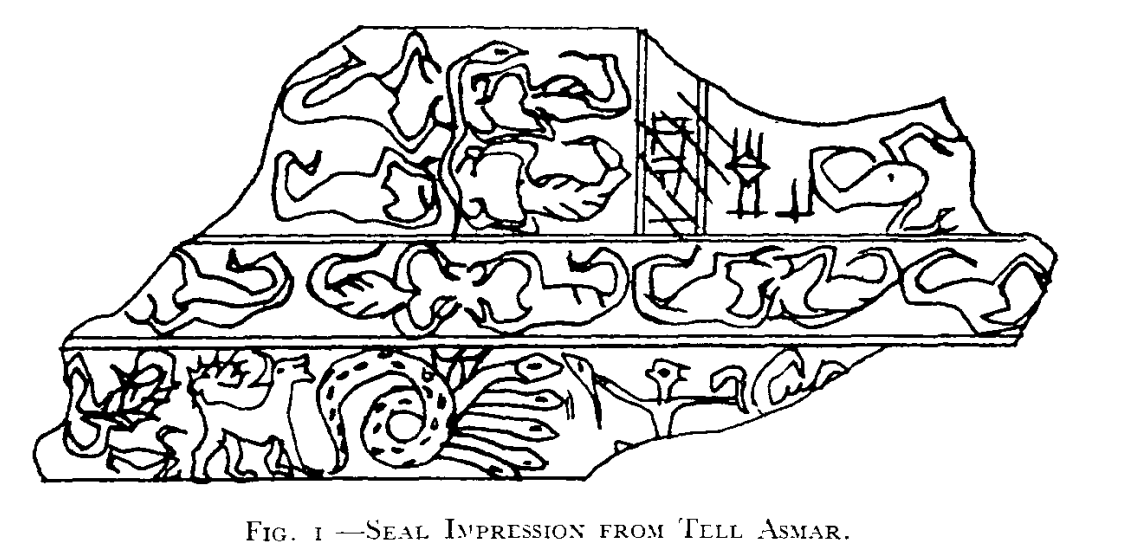
In 1934, G. Rachel Levy placed this drawing at the beginning of an article called “The Oriental Origin of Herakles.” Her opening comparison still has its force. Here was a scene familiar to anyone raised on Greek mythology, recovered from a much older Mesopotamian setting. Levy read the figure as a man or god who had already removed two of the serpent’s heads. She also noted that the damaged inscription could not explain the artist’s intention. Levy 1934, p. 40.
The surviving image therefore gives us a recognizable action before it gives us a name. That is an excellent place to begin. Stories can survive a change of hero. A monster can cross a language boundary more easily than the theology that once explained it. The familiarity of this encounter invites us to follow the older world behind Heracles.
The Greek hero belongs to a history of exchange. His stories gathered force in a Mediterranean where images, goods, worshippers, and storytellers moved between societies with very unequal depths of written memory. Mesopotamia had been recording divine warriors and their monstrous opponents for centuries before the Greek epics took their surviving form. Heracles’ achievement was to give parts of that inheritance a new life.
Ninurta and the catalogue of monsters #
The most useful Mesopotamian comparison is Ninurta, son of Enlil, whose exploits survive in Sumerian poetry. His world is immediately vivid. Mountains harbor rebellious powers. Extraordinary creatures challenge divine authority. The god carries a weapon that speaks to him, advises him, and warns him when courage is turning into recklessness.
In Lugal-e, conventionally translated as Ninurta’s Exploits, the talking mace Šarur recites its master’s earlier victories before a new battle. Its list includes a bison bull, an Anzud bird, a six-headed wild ram, and a seven-headed snake. There are eleven named opponents in this passage, ranging beyond animals to such strange adversaries as Strong Copper and the Palm-tree King. Ninurta’s Exploits, lines 122–134.
That peculiar inventory matters. We have a hero whose identity is accumulated through successive encounters, each opponent adding another demonstration of strength. The creatures differ, but the victories belong together. They can be named, remembered, and recited as the career of one exceptional being.
Another poem, Angim, or Ninurta’s Return to Nibru, turns those victories into a procession. The defeated beings hang from the god’s chariot. The seven-headed serpent occupies its shining crossbeam; other trophies decorate the seat, yoke, and guards. Ninurta rides home in a vehicle that displays his biography. Ninurta’s Return, lines 30–63.
Anyone who knows Heracles can recognize the appeal of such a hero. His fame is portable. A short episode can stand on its own, while also contributing to a larger career. An artist can show one victory on a small object. A poet can expand it into a performance. A patron can surround himself with the hero’s exploits and borrow their prestige. This arrangement gives heroic traditions room to grow: another opponent can become another episode without requiring the whole life to be reinvented.
The resemblance is often flattened into a claim that Ninurta already performed the twelve labors of Hercules. The texts give us something more revealing: an older practice of assembling a warrior’s identity from a catalogue of victories. There is no fixed twelve-task correspondence in the passages above. The underlying storytelling form is the important inheritance.
Nor does Ninurta’s violence end at killing. After defeating Asag in Lugal-e, he rearranges the landscape, gathers waters, and directs them into the Tigris so that fields can flourish. The conqueror becomes an organizer of the inhabited world. His strength makes agriculture possible. Ninurta’s Exploits, lines 334–367.
That connection between monstrous disorder and a livable landscape also runs through dragon-slaying and flood-control traditions. For the present comparison, its significance is concrete: a successful champion brings back more than a corpse. He returns land, water, or security to the people who depend on his victory.
The serpent survives its first conqueror #
The seven-headed enemy was already part of the public language of divine victory in the time of Gudea, ruler of Lagash in the late third millennium BCE. His temple-building inscriptions describe images of Ningirsu’s defeated enemies installed around the sanctuary. Ningirsu was the warrior god of the Lagash region, closely associated with Ninurta in Mesopotamian tradition. Kechagias 2025, p. 80. Among them stands the seven-headed serpent. The text explains that these beings had been slain by the god; their mouths face places where libations were made. Gudea cylinders, lines 696–721.
Here a defeated monster becomes part of an institution. People entering the temple encounter the god’s victories in visible form. The story can be carried by a building as well as a poem. It can endure in a recognizable body: one serpent, several necks, an extravagant multiplication of danger.
This helps explain why images deserve an independent place in the history of myth. An image can outlive the particular account once told about it. It can prompt a new explanation when it reaches a new audience. A viewer need not pronounce the original god’s name to understand that the combatant is extraordinary and that the many-headed creature requires an extraordinary defeat.
The geographical record also extends beyond Mesopotamia. A stamp seal excavated at Hazor depicts a hero fighting a coiled seven-headed serpent. In his 2024 study, Christoph Uehlinger places it within a history of combat traditions in images and texts, stretching from third-millennium southern Mesopotamia through second-millennium northern Syria into first-millennium Phoenicia and Israel. His immediate subject is the relationship between Near Eastern images and biblical traditions. For the Heracles question, the important point is that the motif circulated through the lands between Mesopotamia and the Mediterranean. Uehlinger 2024, pp. 14–19.
The Ugaritic poems give that intervening world a voice. Anat recalls defeating a twisting serpent with seven heads; another passage addresses Baal as the conqueror of a similarly described enemy. The monster’s distinctive form could belong to more than one divine career. KTU 1.3 III 34–42 and 1.5 I 1–3, translated in Uehlinger 2024, pp. 16–17.
The Greek Hydra belongs in this larger field of comparison. In Hesiod’s Theogony, Heracles and Iolaus kill the Hydra with Athena’s assistance. In the much later Library attributed to Apollodorus, the action becomes an elaborate problem of cutting, regrowth, and cauterization: Iolaus burns the severed necks so that fresh heads cannot sprout. That account gives the monster nine heads, including one immortal head. Hesiod, Theogony 313–318; Apollodorus, Library 2.5.2.
A shared monster need not retain a fixed head count. Once a tale enters a new tradition, its memorable difficulty can survive while details vary. A many-headed serpent presents the hero with more than an oversized animal; it makes victory a problem that strength alone may not solve. The Greek version develops that problem into one of mythology’s most memorable demonstrations of cooperation and technique.
| Evidence | What it contributes |
|---|---|
| Tell Asmar impression, approximately 2500 BCE | An early image of combat with a seven-headed serpent |
| Ninurta’s poems and Gudea’s temple inscriptions | Named divine conquerors, catalogued enemies, and displayed trophies |
| Hazor and the wider Syrian-Levantine record | Evidence that the serpent-combat motif circulated west of Mesopotamia |
| Hesiod and later Greek accounts | A Greek Hydra story developed within Heracles’ own family and heroic career |
| Melqart–Heracles bilingual dedications | Direct evidence that ancient people identified gods across languages |
The Tell Asmar figure remains unnamed. The regional sequence does not supply a complete chain of storytellers linking that particular impression to Lerna. What it establishes is the older repertoire from which a Greek serpent-fighter could draw, and a cultural world in which such material was repeatedly reused.
How a hero crosses the sea #
Between Mesopotamia and Greece lay societies with their own gods, workshops, ports, and ambitions. They actively remade the material passing through them. A story reaching the Aegean could already have been translated, condensed, attached to a different divinity, or given a new setting several times.
The Phoenician cities were central to these connections. Tyre, Sidon, Byblos, and Arwad participated in maritime networks that extended across the Mediterranean. By the late eighth century BCE, Phoenicians and Greeks had established trading posts throughout that sea. Phoenician craftsmen combined Egyptian, Syrian, Assyrian, Cypriot, and Aegean elements in objects that traveled with their owners. Metropolitan Museum, “The Phoenicians”.
Greek artists participated in the same exchanges. The period conventionally called “Orientalizing” saw them adopt and reshape eastern floral designs, fantastic animals, and other motifs. Metalwork, ivories, reliefs, and textiles supplied models across different materials. The borrowing was selective and productive: an imported form could become part of a new local composition. University of Colorado Art Museum, “The Orientalizing Period in Ancient Greece”.
A small object makes the point tangible. A bronze fibula in the British Museum, made in Boeotia around 680 BCE, carries a scene the museum tentatively identifies as Heracles fighting the Hydra. Like the much earlier Tell Asmar impression, it places a fantastic combat on a portable surface among other figures and animals. The two objects are separated by an enormous span of time, but both show how easily a heroic encounter could travel on something a person owned or wore. British Museum, 1898,1118.1.
Portable images make possible a kind of transmission that leaves relatively few written records. A craftsman can copy a composition. A customer can recognize a favorite monster. A local storyteller can explain what the pictured hero is doing. None of those acts requires a library to import a complete foreign epic. Each can preserve part of a story while changing the rest.
This is the historical force of the comparison. Similarity becomes more informative when the societies involved are demonstrably exchanging objects, techniques, and religious ideas. The sea between them was full of crossings. The question is which elements traveled on those crossings, and what happened when they arrived.
Melqart and Heracles: two languages on one stone #
We do not always have to infer these connections from pictures. Sometimes ancient worshippers wrote the equivalence down.
A marble dedication from Malta, now in the Louvre, bears inscriptions in Phoenician and Greek. The Phoenician text addresses Melqart, lord of Tyre. The Greek addresses Heracles Archegetes, the founding or leading god. The dedicants identify themselves as Tyrians in the Greek inscription. The Louvre dates the object to the second century BCE. Louvre, AO 4818.
On one stone, one act of devotion speaks through two divine names. The people making the dedication evidently expected the relationship to be intelligible. Melqart and Heracles could meet within the same religious act without every detail of their stories becoming identical.
Several centuries earlier, Herodotus had already encountered the problem. In the fifth century BCE he traveled to Tyre to investigate a temple he called the temple of Heracles. Its priests told him that the sanctuary had been founded with the city, 2,300 years before his visit. He also visited Thasos, where he attributed a sanctuary of Heracles to Phoenician founders. His investigation led him to distinguish an ancient divine Heracles from the later Greek hero. Herodotus, Histories 2.44.
The priests’ enormous chronology is their claim, not a securely dated foundation record. The crucial evidence is Herodotus’ encounter itself: a Greek visitor could recognize “Heracles” in an older foreign religious setting and then struggle to reconcile the different histories attached to the name. Ancient people were already doing comparative mythology, prompted by travel and worship.
The Malta inscription documents an explicit identification long after the Greek hero was established. It cannot by itself explain his beginnings. It does show the cultural practice that makes a composite history intelligible. Divine identities could overlap; communities could translate the recipients of worship as well as the words of a prayer.
Megan Daniels’ study of Heracles and Melqart places their relationship within these long-running Mediterranean interactions. The convergence developed through what people did together: traveling, settling, claiming ancestry, and making their gods intelligible to their neighbors. Daniels 2021.
This gives us three processes to follow: stories move, images move, and gods are identified with one another. Their histories need not coincide perfectly. A serpent battle can be borrowed without a god’s name. A god can receive a Greek name without receiving every Greek adventure. Over generations, repeated encounters make a familiar hero available to more people, places, and purposes.
What the Greeks made of their inheritance #
Heracles’ Greek life gives the inherited strength a particularly painful setting. The greatest fighter must serve someone weaker. In the Iliad, Hera manipulates the births of Eurystheus and Heracles so that Zeus’ promise of sovereignty falls to the wrong descendant. Heracles’ suffering follows from an arrangement made before he could act. His power cannot release him from his place in a divine family and a human hierarchy. Homer, Iliad 19.95–133.
This changes the experience of the heroic catalogue. Every victory displays an almost unlimited ability to act, while the obligation to perform it displays a limit on the hero’s freedom. The strongest person in the story keeps receiving orders. His labors make that contradiction visible again and again.
Even the Hydra’s defeat carries a future cost. Heracles takes its poison for his arrows. Later, after he shoots the centaur Nessus, the creature’s blood becomes the means by which the poison returns to Heracles’ own body. Deianira, deceived into treating the blood as a love charm, applies it to a garment. The victor’s weapon becomes his agony. Library 2.7.6–7.
The monster therefore survives inside the consequences of its defeat. What Heracles masters in one episode returns in another. His strength gives him possession of a danger he cannot finally control. Our separate discussion of Heracles’ serpent encounters explores their later interpretive possibilities; here the narrative itself supplies the force. The Hydra remains part of the hero’s life after its body has been destroyed.
In the Library, the suffering ends on a funeral pyre. A cloud carries Heracles to heaven, where he becomes immortal and is reconciled with Hera. His arrival among the gods completes a life marked by vulnerability as well as force. Library 2.7.7.
The older Mesopotamian warrior, too, carries danger home. In Ninurta’s Return, his approach threatens to overwhelm the sanctuary. Enlil’s minister Nuska meets him and asks him to moderate his terrifying presence. Ninurta puts away the whip and goad and sets his weapon aside. The victorious fighter has to become fit for the community he is returning to. Ninurta’s Return, lines 76–101.
These stories recognize a lasting problem of heroic power: the force that defeats enemies can endanger the people it protects. Greek poets and mythographers developed that tension through Heracles’ family, service, mistakes, and suffering. The older warrior tradition offered material of enormous imaginative value. Greek storytelling made it intimate.
A hero made by many worlds #
The search for a “Sumerian Hercules” is most productive when it follows these separate inheritances. Ninurta supplies an older divine champion with a memorable inventory of monsters. The seven-headed serpent has a regional history in images and texts. Phoenician connections help explain how eastern traditions could enter the Greek world. Melqart shows divine identities meeting in the practice of worship.
Modern scholarship continues to explore the combination. Asterios Evangelos Kechagias, in a substantial 2025 study, argues that Heracles gathered features associated with Ninurta, Nergal, and Melqart. His proposed links differ in evidentiary strength, but the composite approach captures something essential: a hero can acquire several histories without having a single foreign original. Kechagias 2025.
The distinction between the antiquity of an image and the ancestry of a whole character keeps the story clear. We can recognize an older combat motif without assigning every later detail to its first surviving representation. We can document worshippers equating two gods without assuming that the gods began as one. Those distinctions allow the connections we can see to remain substantial.
Heracles grew through this capacity to absorb. His Greek identity could accommodate older enemies, new landscapes, foreign divine counterparts, and increasingly elaborate interpretations. Much later, thinkers would even give his name a role in Orphic cosmic speculation. A figure with such strength could carry more than one civilization’s stories.
Return to the little combatant on the Tell Asmar clay. His name has gone; the action remains. A many-headed creature confronts him, and two of its heads are already in his hands. Across the intervening centuries, other artists and storytellers would give such encounters new settings, new meanings, and new heroes. Heracles emerged from that long human work of remembering and remaking. His world was larger than Greece before Greece made him its own.
Notes #
The Tell Asmar image and the Sumerian poems are different kinds of chronological evidence. Frankfort places impression no. 497 in an Early Dynastic III context; Uehlinger (2024) dates the image approximately 2500 BCE. The Louvre dates the surviving Gudea Cylinder A to 2120–2110 BCE. Angim and Lugal-e are preserved in Old Babylonian manuscripts and later copies; their original composition dates are disputed. The antiquity of their traditions does not mean every line can be dated to the Tell Asmar impression. See the ETCSL manuscript bibliography for Angim and for Lugal-e. The often-reproduced Akkadian seal with two attacking gods and a four-legged monster is a different object, Frankfort no. 478, plate 45. Levy discusses both; the image reproduced here is her fig. 1, not her plate II.1.
Sources #
- Levy, G. Rachel. “The Oriental Origin of Herakles.” The Journal of Hellenic Studies 54.1 (1934): 40–53. Opening image: p. 40, fig. 1.
- Frankfort, Henri. Stratified Cylinder Seals from the Diyala Region. Oriental Institute Publications 72. Chicago, 1955. No. 497, plate 47; discussion p. 42.
- Uehlinger, Christoph. “Mastering the Seven-Headed Serpent: A Stamp Seal from Hazor Provides a Missing Link between Cuneiform and Biblical Mythology.” Near Eastern Archaeology 87.1 (2024): 14–19.
- Ninurta’s Exploits: A šir-sud (?) to Ninurta. Electronic Text Corpus of Sumerian Literature, University of Oxford, composition 1.6.2. Especially lines 122–134 and 334–367.
- Ninurta’s Return to Nibru: A šir-gida to Ninurta. ETCSL, composition 1.6.1. Especially lines 30–63 and 76–101.
- The Building of Ningirsu’s Temple: Gudea, Cylinders A and B. ETCSL, composition 2.1.7, lines 696–721.
- Hesiod. Theogony. Translated by H. G. Evelyn-White, 1914. Hydra episode, lines 313–318.
- Apollodorus. Library, Book 2. Translated by J. G. Frazer, 1921. Especially 2.5.2 and 2.7.6–7.
- Homer. Iliad, Book 19. Translated by A. T. Murray, 1924. Heracles and Eurystheus, lines 95–133.
- Herodotus. Histories 2.44. Translated by G. C. Macaulay. Heracles at Tyre and Thasos; god and hero distinguished.
- Musée du Louvre. “Cippe de Malte,” AO 4818. Second-century BCE Phoenician–Greek dedication; KAI 47, IG XIV 600.
- British Museum. Boeotian bronze fibula, 1898,1118.1. Approximately 680 BCE; possible Heracles–Hydra scene.
- Department of Ancient Near Eastern Art, Metropolitan Museum of Art. “The Phoenicians (1500–300 B.C.).” Heilbrunn Timeline of Art History, 2004.
- University of Colorado Art Museum. “The Orientalizing Period in Ancient Greece.” Published online by the Department of Classics, 2018.
- Kechagias, Asterios Evangelos. “Heracles and the Ancient East: Between Similarity and Equivalence.” Cuadernos de Filología Clásica. Estudios griegos e indoeuropeos 35 (2025): 61–107.
- Daniels, Megan. “Heracles and Melqart.” In Daniel Ogden, ed., The Oxford Handbook of Heracles. Oxford University Press, 2021, pp. 464–488. The framing cited here is stated in the publisher’s abstract.