~/archaeology
The Great White Pyramid of China
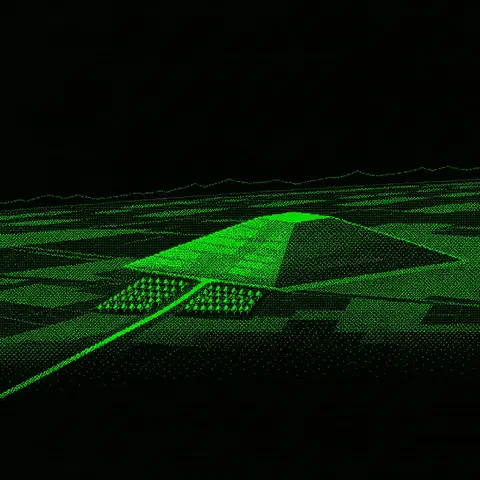
The ‘Great White Pyramid’ photo shows Maoling, Emperor Wu of Han’s tomb mound near Xi’an: built for 53 years, crammed with treasure, and ringed by a field of pyramids.
TL;DR
- The famous “Great White Pyramid” photograph of 1947 shows Maoling (茂陵), the tomb mound of Emperor Wu of Han (died 87 BC), 40 km west of Xi’an. It is a real pyramid: 46.5 m of rammed earth on a base about 240 m square.
- Emperor Wu spent 53 years building it, and a third of the empire’s tribute went into the Han tombs. When he died, the Jin shu says, Maoling “could hold nothing more”.
- He buried with him live animals, 190 kinds of goods and his palace women, settled the empire’s richest families in a tomb town of 277,000 people, and was said to go on sleeping with his concubines in the tomb park after death.
- In AD 26 the Red Eyebrows army dug open the Han mounds, violated the corpse of Empress Lü and committed “much obscene lechery” on the jade-suited dead.
- Maoling stands among dozens of companion mounds: Huo Qubing’s tomb, shaped like the Qilian Mountains and strewn with China’s oldest monumental stone sculpture, Wei Qing’s, Lady Li’s, and that of a captive Xiongnu prince.
- Westerners who saw an Egyptian pyramid in China got the scale wrong and the instinct right. The Qin and Han mounds are the eastern end of an Old World tradition of the king’s tomb as an artificial mountain, and Emperor Wu’s own reign faced west.
“The Han emperor began his tomb one year after taking the throne. The tribute of the empire was divided in three: one part for the ancestral temples, one for guests, and one to fill the mountain tomb.” — Suo Lin, answering the emperor of Jin, c. AD 315 (Jin shu 60)
Maoling, a Pyramid at the End of a Long Road #
The aerial picture behind the legend of the Great White Pyramid shows a square, flat-topped mound with a road running straight at it between two blocks of trees. That mound is Maoling, the tomb of Liu Che, Emperor Wu of Han, on the loess plateau north of the Wei River near Xingping.1
It is a pyramid in every sense but stone. Maoling is a truncated pyramid of rammed earth, a shape Chinese archaeologists call an “upturned grain measure” (覆斗形). The mound stands 46.5 metres high, with a summit about 39 by 41 metres and base sides of 234 to 243 metres. About 850,000 cubic metres of earth were pounded into it layer by layer (Wang Zhijie, Maoling Museum, 2012). Medieval topographers already knew it was the giant of its dynasty: “the Han tombs are all twelve zhang high and 120 paces square; only Maoling is fourteen zhang high and 140 paces square” (Guanzhong ji). The ancient figures still match the mound.
The Westerners who looked at photographs of it in 1947 and thought of Egypt were noticing something true. The idea of the king’s tomb as an artificial mountain runs across the Old World, from the ziggurats of Sumer and the pyramids of Egypt to the stepped tomb of Cyrus and the pyramid-roofed Mausoleum at Halicarnassus. It reached China with the First Emperor. Under the outer skin of his mound at Lishan, geophysical survey has found a buried nine-level terraced structure about 30 metres high, and the excavator Duan Qingbo has argued that the terraced tomb, the life-size sculpture and the bronze techniques of Qin form one package of western royal art that travelled east through Persia and Central Asia. The Han emperors inherited the form and made it a dynastic landscape: a row of square earthen pyramids along the plateau north of their capital, each with its walls, pits, temples and town. The pyramid idea reached China in more than one wave, and Maoling, the largest Han mound, is the high point of the last. Emperor Wu stands at the end of the line, and he spent his reign looking back along it.
Emperor Wu and the Road West #
Liu Che took the throne in 141 BC at fifteen and ruled for fifty-four years, longer than any Han emperor. He broke the Xiongnu confederation on the steppe, pushed Han garrisons out along the Gansu corridor and sent Zhang Qian west to find allies, which opened China to the oases and kingdoms of Central Asia. He wanted the “heavenly horses” of Ferghana (Dayuan) badly enough to send an army across the Pamirs for them. In 101 BC, the Han shu records, “the Ershi general Li Guangli cut off the head of the king of Dayuan and brought back blood-sweating horses”, and the emperor wrote a “Song of the Heavenly Horses of the Western Limit” (作西極天馬之歌; Han shu 6).
He also spent heavily on immortality: alchemists, magicians, journeys to the sea to meet the immortals. His tomb was part of the same project. Work on Maoling began in 139 BC, the second year of his reign, and went on until his death 53 years later. The tomb was set in the township of Mao in Huaili county, and gave its name to the hill and the town around it.
The money was legendary even to people who saw what was left. In about AD 315 robbers broke into two Han tombs near the starving capital and came out with great treasure. The emperor of Jin asked why there was so much in them. Suo Lin answered with the passage quoted above, and went on:
“Emperor Wu of Han enjoyed a long reign, and by the time he died Maoling could hold nothing more; its trees were already a full arm’s span thick. The Red Eyebrows took what was in the tomb and could not reduce it by half. To this day there is still rotten silk piled up, and the pearls and jade are not exhausted. Those two tombs [that were robbed] were the frugal ones.” (Jin shu 60, biography of Suo Lin)
Under the mound lies the “square centre” (方中), the burial pit that the notorious jurist Zhang Tang supervised as Maoling’s commandant. Han ritual texts describe the imperial chamber as a pit about 39 metres deep, with ramps on all four sides wide enough for a six-horse chariot and hidden blades and crossbows set at the doors. The emperor lay in five nested coffins of catalpa and nanmu inside a chamber of 15,880 polished cypress logs laid with their ends facing in, the huangchang ticou (“yellow intestines, heads inward”) reserved for the Son of Heaven.2
What Went into the Tomb #
The fullest list comes from a critic. In about 44 BC the Confucian minister Gong Yu complained to Emperor Yuan that Emperor Wu had taken several thousand girls into his palace, and that at his death the regent Huo Guang, who “did not know the proper rites”,
“lavishly stored away gold, coins, goods and treasure, birds, beasts, fish, turtles, oxen, horses, tigers and leopards, live creatures, a hundred and ninety kinds of things in all, and buried every one of them. He also placed all the women of the rear palace in the tomb park.” (Han shu 72, biography of Gong Yu)
The Han Wu gushi (Stories of Emperor Wu), a collection of tales about the emperor from the early centuries AD, says what happened to those women. After the burial a strange fragrance hung over the tomb “like a thick fog”, and the women the emperor had used were all lodged in the Maoling park:
“From the jieyu consorts down there were more than two hundred of them. The emperor had sex with them as he had in life [上幸之如平生], but no one else could see him. When Huo Guang heard of it, he sent out more palace women, raising the number to five hundred, and after that it stopped.” (Han Wu gushi)
The same book says the grave goods leaked out almost at once. In 85 BC officials caught a man selling imperial objects in the market, and their labels showed they were “spirit goods from inside Maoling”. A year later a man selling a jade cup in Ye vanished when the clerks tried to seize him; the cup was from Maoling too, and the seller, by the description, looked exactly like the dead emperor. Then the ghost complained to the tomb’s keeper that soldiers were sharpening their swords on his mountain, and a whetstone was found beside the mound.
Han emperors were buried in suits of jade. The commentary to the Hou Han shu quotes the Han regulations: “from the waist down, plaques of jade a foot long and an inch and a half wide, made into a casing down to the feet and sewn together with gold thread” (Hou Han shu 11). The Xijing zaji puts it more simply: “When Han emperors were buried, all wore pearl jackets and jade casings; the casing is shaped like armour and joined with gold thread” (Xijing zaji 1).
The Outer Pits and the Gilt-Bronze Horse #
The central chamber has never been excavated, but the ground around it has been mapped. Drilling by the Shaanxi Provincial Institute of Archaeology found more than 400 burial pits around Maoling. About 150 lie inside the emperor’s walled precinct, the longest 98.5 metres. Another 244 are laid out in four groups outside the walls, most of them 120 to 170 metres long and up to 7.5 metres deep (Wang Zhijie 2012). These are the storerooms of a buried state: offices, stables, kitchens and arsenals for the dead emperor, like the pits that held the Terracotta Army at Lishan.
The best single object came from a companion tomb. In May 1981 villagers levelling a field east of Maoling broke into a pit beside the first companion mound and, over two days and nights, 236 objects were cleared from it. Among them were a gilt and silvered incense burner on a bamboo-jointed stem and a gilt-bronze horse 62 cm high, 76 cm long and 26 kg in weight, the largest gilt object known from the Western Han. Bronzes in the find are marked for the household of Yangxin, the title of Emperor Wu’s elder sister, the princess of Pingyang (Tian Hui, Maoling Museum, in China News, 2025). The horse stands with its small head high and its ears pricked, lean and long-legged. It is a portrait of the Ferghana breed the emperor fought a war to get: a heavenly horse from the western limit, cast in gold for his sister’s tomb.
The Red Eyebrows in the Imperial Tombs #
Wang Mang seized the Han throne in AD 9, and in the civil wars that followed his fall the peasant army called the Red Eyebrows took Chang’an. In the winter of AD 26 they burned the palaces, marched west, were driven back by snow, and turned on the imperial tombs. The Hou Han shu says what they did:
“They dug open the imperial tombs and took the treasure, and then they violated the corpse of Empress Lü. Wherever the bandits dug, those who had been laid in jade suits were nearly all as if alive, and so the Red Eyebrows committed much obscene lechery [with the corpses].” (發掘諸陵,取其寶貨,遂汙辱呂后屍。凡賊所發,有玉匣殮者率皆如生,故赤眉得多行婬穢; Hou Han shu 11, biography of Liu Penzi)
Empress Lü, the widow of the dynasty’s founder, had been dead for more than two hundred years. She lay under her own pyramid beside Changling, farther east along the same plateau. The jade suits that were meant to keep the bodies whole kept them fresh enough to rape.3
Maoling was among the tombs plundered: Suo Lin’s “the Red Eyebrows took what was in the tomb” is about Maoling by name. Three centuries later there was still rotting silk inside.
Maoling Town and the Forced Rich #
A Han emperor’s tomb had a town. In 139 BC Emperor Wu “first established the town of Maoling” (初置茂陵邑), and the next year he paid every household that moved there 200,000 cash and two qing of land (Han shu 6). Then he stopped asking. The adviser Zhufu Yan told him that “Maoling has just been founded: all the powerful men of the empire, the families who swallow up land, and the troublemakers can be moved to Maoling. That fills the capital and drains away the wicked; it is what is called removing harm without executing anyone” (Han shu 64). In 127 BC the court moved “the powerful men of the commanderies and kingdoms, and everyone worth three million cash or more” to Maoling, and in 96 BC it moved more.
The knight-errant Guo Jie was caught in the sweep. He was too poor to qualify, but the officials were too frightened of him to leave him off the list. The great general Wei Qing spoke up: “Guo Jie’s family is poor; he does not meet the standard.” The emperor answered: “A commoner whose power can make a general speak for him: this family is not poor!” Guo Jie went, and the men who saw him off gave him more than ten million cash (Han shu 92).
By the census of AD 2 Maoling had 61,087 households and 277,277 people, more than Chang’an itself (Han shu 28). The poet Sima Xiangru retired there; the Xijing zaji remembers its rich man Yuan Guanghan, with “eight or nine hundred household slaves”, and its young men racing hounds and hawks. A dead man’s tomb had become the richest city in China.
Huo Qubing’s Mountain and the Field of Mounds #
Emperor Wu’s court went into the ground around him. His generals, consorts and ministers lie in dozens of companion mounds, most of them east of Maoling, and the people of the villages still call them by nicknames: Lady Li’s is the Millstone, Wei Qing’s the Winnowing Basket, Jin Midi’s the Scorpion. Huo Qubing’s is simply the Mountain (Xi’an Daily via China News, 2012).
Huo Qubing led the cavalry that broke the Xiongnu in Gansu in 121 BC, captured the Xiutu king’s “golden man used to worship Heaven” (祭天金人), and died at about twenty-four in 117 BC. “The emperor mourned him. He called out the black-armoured troops of the dependent states [surrendered Xiongnu] and lined them up from Chang’an to Maoling, and he made the tomb in the image of the Qilian Mountains” (為冢象祁連山; Han shu 55). The mound is the only one in the field built as a landscape rather than a pyramid. It is heaped irregularly and strewn with about 150 great stones, and among them lie sixteen large granite sculptures carved with as little cutting as possible: a crouching tiger, a recumbent elephant, a fish, a toad, a foreigner wrestling a bear, and the famous Horse Trampling a Xiongnu, 1.68 metres high, a standing warhorse over a bearded barbarian sprawled on his back with a bow in his hand. They are the earliest large group of stone sculpture in China, and like the life-size figures at Lishan they appear suddenly, beside a royal tomb, with little before them.4 Victor Segalen photographed them in 1914; the Maoling Museum is built around them now.
Wei Qing, Huo’s uncle, began as a horseman in the household of the princess of Pingyang (“he came out of my household; he used to ride behind me as an escort,” she laughed), rose to supreme general, and married her. “He was buried together with the princess, and the mound was raised in the image of Mount Lu” (與主合葬,起冢象廬山; Han shu 55).
Lady Li was the dancer whose brother sang “In the north there is a beauty … one glance and a city falls, a second glance and a kingdom falls.” She died young and would not let the emperor see her wasted face. He buried her with the rites of an empress and had a magician from Qi raise her ghost behind a lamplit curtain; he saw a beautiful woman at a distance and wrote, “Is it she, or is it not? I stand and gaze: why does she come so slowly?” (Han shu 97). Her brother was Li Guangli, the general who brought back the Ferghana horses. When Emperor Wu died, Huo Guang had her honoured as Empress Xiaowu and given her place beside him in the sacrifices.
Jin Midi was the crown prince of the Xiutu king, taken as a boy of fourteen when his father was killed and set to work in the palace stables. He became one of the emperor’s closest guards and a regent for his heir. His surname, Jin (“gold”), was given to him “because the Xiutu king had made a golden man as the lord of the sacrifice to Heaven”; when he died the troops lined the road to Maoling again (Han shu 68). The emperor who sought the west kept a Xiongnu prince at his side in death.
From the air the field looks much as it did in 1947. Square, flat-topped mounds rise out of wheat and orchards along the plateau, Maoling at the west end and Yangling at the east, with Pingling, Yanling, Kangling, Weiling, Yiling, Changling and Anling between, each with its empress mound and its scatter of courtiers. The five that had towns of resettled rich (Changling, Anling, Yangling, Maoling and Pingling) gave the plateau its name, the Plain of the Five Tombs (五陵原).
How Maoling Compares #
| Monument | Builder, date | Height | Base | Built over |
|---|---|---|---|---|
| Great Pyramid of Giza | Khufu, c. 2560 BC | 146.6 m (original) | 230 m | about 20 years |
| Qin Shi Huang’s mound | First Emperor, 246–210 BC | about 51 m today; planned 50 zhang (about 115 m) | about 350 × 345 m | 37 years |
| Maoling | Emperor Wu of Han, 139–87 BC | 46.5 m | 234–243 m | 53 years |
Giza is three times as tall and built of stone; Qin covers more ground. Maoling was built for longer than either, and nothing in the Han world came close to it.5
The Great White Pyramid of 1947 #
In March 1947 Maurice Sheahan, the Far Eastern director of Trans World Airline and an old China hand, told a United Press reporter in Shanghai that during the war he had flown over a gigantic pyramid in the mountains southwest of Xi’an, perhaps 1,000 feet high and 1,500 feet at the base, with smaller mounds around it. The New York Times ran the story on 28 March. The next day American papers printed a wire photograph headed “First Picture of Great Chinese Pyramid”. It showed Maoling. Within two weeks Science News-Letter explained that Shaanxi was “a land of pyramids”, mounds of earth rather than stone, and that the height had been overestimated.6
The story went quiet for thirty years and came back in the pyramid-power boom of the 1970s. In 1976 the newsletter Pyramid Guide gave it a pilot, James Gaussman, who flew the Hump in 1942, lost an engine, and came down into a hidden valley where a white pyramid stood with a crystal capstone; its channelled source “Kronos” gave the full height as 1,925 feet. In 1983 the grid theorist Bruce Cathie printed Gaussman’s first-person account beside the Maoling photograph, and in 1994 Hartwig Hausdorf’s Die weisse Pyramide added visitors from space. The photograph has been called “Gaussman’s photo” ever since.7
The white pyramid grew in the telling. The real one was already there, at the end of a road from Egypt, Persia and the steppe, holding an emperor, his horses, his women and two thousand years of robbers’ stories.
FAQ #
Q1. Is the Great White Pyramid of China real?
A. The photograph shows a real pyramid: Maoling, Emperor Wu’s tomb, 46.5 metres of rammed earth
near Xi’an. The 1,000-foot white pyramid with a crystal capstone does not exist.
Q2. Where is the Great White Pyramid?
A. Maoling stands on the Xianyang plateau at Xingping, Shaanxi, about 40 km west of Xi’an, at
34°20′17″ N, 108°34′11″ E. The Maoling Museum is about a kilometre east, at Huo Qubing’s tomb.
Q3. Who was buried in Maoling?
A. Liu Che, Emperor Wu of Han, in 87 BC, with five coffins inside a chamber of cypress logs. His
generals Huo Qubing and Wei Qing, his consort Lady Li and the Xiongnu prince Jin Midi lie in
companion mounds around him.
Q4. Has Maoling been opened?
A. Not by archaeologists. The Red Eyebrows plundered it in AD 26, but the central chamber has
never been excavated; drilling has mapped about 400 pits around the mound, and China keeps the
great imperial tombs sealed.
Q5. Who was James Gaussman?
A. The pilot of the 1970s version of the story. He first appears in the pyramid-power newsletter
Pyramid Guide in 1976, which dated his flight to 1942.7
Q6. What is the biggest pyramid in China?
A. The First Emperor Qin Shi Huang’s mound near Xi’an, about 350 metres a side and roughly 51
metres high today. Maoling is the largest Han mound. Around Xi’an stand
about forty imperial pyramids, almost
all still sealed.5
Sources #
- Ban Gu. Han shu 6, Annals of Emperor Wu. 1st century AD.
- Ban Gu. Han shu 28, Treatise on Geography.
- Ban Gu. Han shu 55, biographies of Wei Qing and Huo Qubing.
- Ban Gu. Han shu 64A, biography of Zhufu Yan.
- Ban Gu. Han shu 68, biographies of Huo Guang and Jin Midi.
- Ban Gu. Han shu 72, biography of Gong Yu.
- Ban Gu. Han shu 92, biography of Guo Jie.
- Ban Gu. Han shu 97A, biography of Lady Li.
- Fan Ye. Hou Han shu 11, biography of Liu Penzi, with Li Xian’s commentary. 5th century.
- Fang Xuanling et al. Jin shu 60, biography of Suo Lin. 648.
- Han Wu gushi (Stories of Emperor Wu of Han).
- Xijing zaji (Miscellaneous Records of the Western Capital), chapter 1.
- Wang Zhijie. Maoling wenwu (茂陵文物). Xi’an: Sanqin, 2012. Excerpts at the Shaanxi Provincial Library: “Maoling jishi” and “Maoling lingyuan de dianxingxing”.
- Tian Hui. “揭秘两千多年前的’汗血宝马’”. China News Service, 23 February 2025.
- He Xilin. "‘祁连山’的迷雾:西汉霍去病墓的再思考". The Paper, 18 August 2022.
- Jin Shi. “汉武帝茂陵传说”. Xi’an Daily via China News, 28 November 2012.
- “秦始皇陵墓看起来像’金字塔’?” Guangzhou Daily, via Ifeng, 13 June 2015.
- Duan, Qingbo. “Sino-Western Cultural Exchange as Seen through the Archaeology of the First Emperor’s Necropolis.” Journal of Chinese History 7.1 (2023): 21–72.
- United Press. “U.S. Flier Reports Huge Chinese Pyramid in Isolated Mountains Southwest of Sian.” New York Times, 28 March 1947, p. 3.
- Science Service. “Shensi Pyramid Estimated To Be 2,000 Years Old.” Science News-Letter 51, no. 15 (12 April 1947): 232–233.
- Fortean Society. Doubt no. 21 (1948), pp. 323–324.
- “China’s Great Crystal-Capped Pyramid.” Pyramid Guide 4, no. 5 (no. 23), May–June 1976, pp. 1, 6.
- Tiede, Vance R. Letter on Chinese pyramid tombs. Pyramid Guide no. 42, July–August 1979, p. 1.
- Cathie, Bruce. The Bridge to Infinity: Harmonic 371244. Auckland: Quark Enterprises, 1983. Gaussman passage reprinted in Journal of Borderland Research 40, no. 1 (Jan.–Feb. 1984): 22.
- Easton, Robert. Guns, Gold, and Caravans: The Extraordinary Life and Times of Fred Meyer Schroder. Santa Barbara: Capra Press, 1978.
- Hausdorf, Hartwig. Die weisse Pyramide: Ausserirdische Spuren in Ostasien. Munich: Langen Müller, 1994.
- Wells, Mark, and Richard Wells. “The Xianyang Pyramids.” EarthQuest, 2001 (archived 2006).
- Hain, Walter. “White Pyramid Discovered: It Is Maoling.” 25 October 2006, reprinted 2009.
- Marshall, Steve. “The White Pyramid.” Fortean Times 164 (December 2002).
- Alvin portal. “Mamen, Oscar, 1885–1951.” Authority record.
- Diaries of Henry Morgenthau, Jr., vol. 245, 1940.
The identification was made from satellite images. In 2001 Mark and Richard Wells matched the 1947 photograph’s flat summit, notched sides, road and tree plots, down to the diagonal edge of the left-hand plot, to a mound near Xianyang (EarthQuest, archived 2006). In 2006 Walter Hain named it as Maoling and set the print beside a satellite view at 34°20′17″ N, 108°34′11″ E (Hain 2006, reprinted 2009). Chris Maier’s 2004 satellite search is also credited; its archived copy breaks off before its conclusion. Survey dimensions: Wang Zhijie, Maoling wenwu (2012); Guangzhou Daily via Ifeng (2015). The Guanzhong ji passage is quoted in The Paper (2024). ↩︎
The chamber description follows Wei Hong’s Han jiuyi and the Han shu commentaries as summarised by Wang Zhijie of the Maoling Museum (Maoling wenwu, 2012); the log count of 15,880 is the figure given there for an imperial huangchang ticou. Zhang Tang’s appointment as “commandant of Maoling, in charge of the square centre” is in his Han shu biography (ch. 59). ↩︎
汙辱 means to befoul and dishonour, and in Chinese it is the ordinary word for sexual violation; the next sentence, with its 婬穢 (“lewd filth”) committed on the jade-suited dead, shows what kind. Empress Lü (d. 180 BC) was buried with Emperor Gaozu at Changling. The commentary on jade suits quoted above is Li Xian’s note to the same passage, citing the Han yi zhu. ↩︎
Which mound is Huo Qubing’s was fixed by tradition and by a stele that the governor Bi Yuan set up in 1776; the Shiji and Han shu give only the Qilian likeness. The sculptures themselves are accepted as Western Han. See He Xilin, “The fog over ‘Qilian Mountain’”, The Paper, 18 August 2022 (from Dutu guanshi, Peking University Press, 2022). The count of sixteen large carvings and the dimensions of the Horse Trampling a Xiongnu are the Maoling Museum’s (China Daily via chinaservicesinfo, 2026). On the sudden appearance of monumental sculpture at Qin, see Nickel (2013) and Duan (2023), cited in the Terracotta Army essay. ↩︎
Giza from Encyclopaedia Britannica; Qin from the Handian entry for 秦始皇陵 and the survey figures in the overview of China’s pyramids. Published heights for Qin Shi Huang’s mound vary with the survey baseline: 51 to 52 metres in recent measurements, 76 metres in older ones taken from a lower datum. Sima Qian and later writers gave a planned height of fifty zhang. ↩︎ ↩︎
Sheahan’s account: United Press in the New York Times, 28 March 1947. His standing as a transport adviser to the Chinese government appears in the Morgenthau diaries, vol. 245 (1940). The photograph ran in the Los Angeles Daily News on 29 March as an “Acme telephoto”, with no photographer named, as the Fortean Society’s Doubt no. 21 (1948, pp. 323–324) recorded at the time; Doubt also quotes an Associated Press dispatch of 31 March reporting that the Shaanxi provincial government had found the discovery “groundless”. Later printings followed in the New York Sunday News (30 March) and Rocky Mountain News (31 March); see Cassiopaea (2012). Science Service: Science News-Letter 51.15, 12 April 1947, pp. 232–233. Steve Marshall (Fortean Times 164, 2002) reports that Sheahan revised his estimate to about 500 feet in a letter of 1961. ↩︎
“China’s Great Crystal-Capped Pyramid”, Pyramid Guide no. 23 (May–June 1976), pp. 1, 6. The same article attached Sheahan’s 1,000-foot figure to the trader Fred Meyer Schroder, said to have ridden to “seven pyramids” in 1912 with “Oscar Maman”, probably the Norwegian trader Oscar Mamen (Alvin authority record); Robert Easton told Schroder’s life in Guns, Gold, and Caravans (1978). In 1979 the archaeoastronomer Vance Tiede asked the newsletter for its Gaussman source (Pyramid Guide no. 42). Cathie’s passage is reprinted in the Journal of Borderland Research, Jan.–Feb. 1984, p. 22. The 1976 article itself kept Gaussman’s 1942 pyramid apart from the 1947 photograph; Wikipedia’s Maoling article (checked November 2026) still runs them together. ↩︎ ↩︎