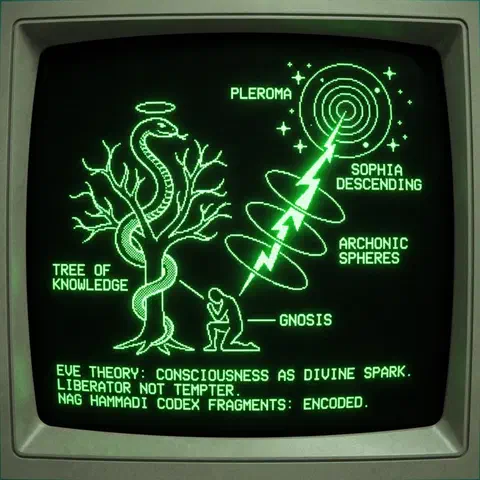
~/gnosticism/etoc
Gnosticism and the Eve Theory of Consciousness
An exploration of the surprising parallels between Andrew Cutler’s Snake Cult/Eve Theory of Consciousness and ancient Gnostic reinterpretations of the Eden myth, focusing on the serpent as liberator and Eve as wisdom-bearer.
TL;DR
- Cutler’s theories and Gnostic myths both re-cast the Eden serpent as a liberator, not a tempter, who offers gnosis (knowledge) to awaken humanity.
- The Eve Theory’s claim that women discovered consciousness first is mirrored in Gnostic texts where Eve, as an embodiment of Sophia (Wisdom), acts as the spiritual initiator for Adam.
- The Gnostic Demiurge, a false creator who wants to keep humanity ignorant, serves as a mythological parallel to the blind, pre-conscious state that the Snake Cult/Eve Theory suggests was overcome.
- Both frameworks interpret the “Fall” as a positive, transformative event—an awakening or “fall upward” into self-awareness, driven by a female-serpent-knowledge triad.
Eden, Gnosis, and the Snake Cult of Consciousness #
Introduction. Modern theory and ancient myth converge in the curious figure of a serpent offering forbidden wisdom. Andrew Cutler’s provocative “Snake Cult of Consciousness” and “Eve Theory of Consciousness” posit that human self-awareness arose from a primordial venomous encounter – a snakebite-induced initiation, remembered in myth as the Garden of Eden story. In Cutler’s retelling, Eve is not a hapless sinner but the first psychonaut, “Mother of All Living” in a deeper sense: the first to discover the inner voice of the “I,” who then “literally initiated Adam into what we now call living,” with the help of a serpent’s mind-altering venom. This startling hypothesis finds uncanny precedents in the ancient Gnostic scriptures of the Nag Hammadi library. These 2nd-century texts boldly reimagined Genesis: the Eden serpent emerges as liberator, Eve as secret wisdom-bearer, and the Creator (Demiurge) as a deluded warden keeping mankind in ignorance. What follows is an esoteric exploration of Cutler’s evolutionary psycholinguistic narrative in light of Gnostic myth – a syncretic synthesis one might imagine pulled from a clay jar in the Egyptian desert, blending modern insight with ageless gnosis.
The Serpent as Liberator: From Eden to Gnosis #
A serpent coiled around a sacred tree – an ancient symbol of guarded wisdom. In Gnostic and esoteric thought, the Eden snake is recast as a bringer of divine knowledge, not a tempter of sin.
In Genesis, the snake tempts Eve to eat the Tree’s fruit, promising “your eyes will be opened.” Orthodox tradition demonized this serpent, but both Cutler and the Gnostics rehabilitate its role into that of an enlightener. Cutler speculates that snake venom might have been humanity’s first entheogen, catapulting a woman (an “Eve”) into self-awareness – in his words, “she ‘became as the gods, knowing good and evil’” after a fateful venom-induced vision. The Gnostic texts affirm this daring inversion: the serpent is not Satan at all but an agent of the true God or Wisdom, trying to free Adam and Eve from the Demiurge’s deception. In the Hypostasis of the Archons (also called The Reality of the Rulers), we read that a divine Spirit hid itself in the snake and “then teaches Adam and Eve to defy the evil Archons, to partake of the fruit of the Garden, and to gain knowledge.” By eating the forbidden fruit, the first humans indeed awaken from blind obedience. The Gnostic author of Testimony of Truth goes so far as to identify the Eden serpent with Christ himself, come in disguise to reveal the fraud of the false creator. In Cutler’s narrative, the primordial woman’s encounter with the serpent’s “venom of knowledge” is a positive, transformative event – a view the Gnostics would heartily applaud. Both envision the serpent as a sacred initiator, one who shatters ignorance and opens the human mind’s eye. What orthodoxy called the “Fall” was, from this alternate perspective, the uplifting of humanity by forbidden gnosis.
Indeed, the Apocryphon of John (Secret Book of John) deepens this notion by explaining that the “tree of knowledge of good and evil” is the Epinoia of the Light – the divine Insight or Wisdom meant to illuminate Adam. The dark Archons (rulers) of the world “stayed in front of it in order that [Adam] might not…recognize his nakedness”, i.e. his spiritual ignorance. But a higher providence ensured the liberation: “It was I who brought about that they ate,” says the Savior in the Apocryphon, indicating that the true God wanted humanity to attain this knowledge. The serpent’s deception, on one level, tricked Adam and Eve into physical procreation (the Gnostics often accuse the serpent of stirring up lust). Yet on a higher level, the serpent’s act was the very catalyst by which the divine insight – the Epinoia – entered into them and awakened their minds. Cutler’s metaphor of a “Snake Cult” initiating selfhood finds a striking parallel here: the Gnostic serpent is an occult teacher, coiled around the Tree of Knowledge, administering not poison but medicine. As one modern commentator notes, “the serpent was often considered one of the wisest animals, being (close to the) divine”, associated with entheogens that “provide expanded consciousness… and immortality through divine intoxication.” The very symbols Cutler highlights – snakes and psychoactive fruits – were long ago linked by Gnostics and mystics to the idea of expanding human consciousness. The serpent in both stories is a midwife of the soul, inducing the painful yet illuminating birth of the reflective self.
Sophia and Eve: The Feminine Catalyst of Knowledge #
Cutler’s Eve Theory boldly declares that “women discovered ‘I’ first and then taught men about inner life.” In his retelling of prehistory, Eve (representing early women) partook of the mind-altering “fruit” and became the first self-aware human, then initiated Adam in the same experience. This narrative uncannily channels ancient Gnostic veneration of the feminine divine. In Gnostic cosmology, it is a fallen female aeon – Sophia (Greek for Wisdom) – whose story sets the stage for humanity’s enlightenment. Sophia, longing to create without her partner, gave birth to the flawed Demiurge and thus fell from the Pleroma (the divine fullness). Yet far from portraying feminine error as damning, the texts cast Sophia as the secret savior of humanity. The Apocryphon of John pointedly notes that it was Sophia’s misguided act, not the woman Eve’s disobedience, that was the ultimate origin of evil in the world. And Sophia immediately seeks to correct her mistake: she imbues a spark of her Spirit into Adam and Eve to awaken them. In Gnostic Eden narratives, Eve herself is often identified with an extension of Sophia, a beneficent presence rather than a source of sin.
One Nag Hammadi text recounts that the true God “sent a helper to Adam – the luminous Epinoia which comes out of him, who is called Life.” Epinoia, meaning foresight or insight, is a feminine spiritual principle secretly embedded in Adam as his guide. Tellingly, this “helper” is explicitly called Life, which in Hebrew is Eve. In other words, Eve personifies the divine Wisdom sent to humanity. She is a teacher: the Epinoia “restores [man] to his fullness… teaching him about the descent of his seed and the ascent” back to the divine. The Gnostic Eve’s mission is to awaken Adam to his true spiritual nature. Thus, one text has Eve (or the Spirit in her) speak directly into Adam’s soul: “I entered into the midst of the dungeon which is the body… I cried out, ‘He who hears, let him arise from the deep sleep’.” Eve is not a passive rib-wife, but an initiator of gnosis.
Cutler’s view aligns perfectly with this secret Eve. He writes that in his scenario “Eve… bestowed consciousness on man,” serving as the master of ceremonies in the primordial initiation. Just as Cutler imagines a woman guiding the first man into a snake-induced trance of self-discovery, the Gnostic mythos has a female figure (Eve/Sophia) mediating the revelation of inner self or soul to Adam. In the Hypostasis of the Archons, after the Archons split Adam to make Eve, the Spirit (Sophia’s essence) remains in the woman. The Archons later try to rape Eve, but “the Spirit passes from Eve into a serpent… [and] this spiritual serpent… teaches them to partake of the fruit…and gain knowledge.” The knowledge-flow is: from Sophia to Eve to serpent to Adam. Eve is the crucial link in this liberation chain – the bearer of the gnosis that will be transmitted. Little wonder that the Apocryphon of John honors Sophia in Eve’s title: “our sister Sophia… was called Life, the mother of the living, by whom they have tasted the perfect Knowledge.” In Gnostic interpretation, Eve is Sophia in disguise, mother of the living not in a mundane biological sense but as mother of spiritual awakening. Through her, Adam and his offspring receive the gift of insight that the jealous Demiurge tried to withhold.
This theme resonates with what Cutler calls the “gender aspect” of the primal consciousness event. Gnostic cosmology is built on syzygies – male/female dyads that together reflect the divine whole. The original human, Adam Kadmon, was often imagined as an androgynous being, later split into male and female. The Gospel of Philip delivers a striking aphorism: “When Eve was in Adam, death did not exist. When she was separated from him, death came into being. If he enters again and takes her back into him, death will disappear.”. On one level this refers to reuniting the feminine and masculine into a restored spiritual unity – a state of wholeness that overcomes mortality. In Cutler’s narrative we see a similar polarity and reunion: humanity only becomes fully “alive” and self-aware when woman (Eve) and man (Adam) share in the forbidden insight, each contributing to the other. Woman brings the initial spark; man partakes and completes the circuit. The “death” that is overcome could well be the spiritual death of ignorance. Gnostic Eve and Cutler’s Eve both suggest that the feminine principle ignited the flame of awareness, which then had to be integrated universally. The polarity of genders becomes a creative tension driving humanity’s awakening. Where orthodoxy blamed the feminine for the Fall, Gnosticism and Cutler’s thesis both restore honor to Eve: she is the heroine of the human story, the first knower, the first giver of wisdom.
The Demiurge and the Archons: Lords of the Blind World #
Standing in opposition to the serpent and Eve in these narratives is the Demiurge – the arrogant pretender God – and his minions, the Archons (rulers). In Genesis, God forbids the fruit and curses the transgressors; in Gnostic retellings, this jealous figure is unmasked as Yaldabaoth, a cosmic impostor who wants his creations to remain spiritually ignorant. Andrew Cutler’s work does not explicitly speak of a Demiurge, yet his account implies an establishment to be subverted: the “common opinion” of the tribe, the unthinking animal-state of early humans, and perhaps patriarchal authority that needed overturning. The Demiurge can be seen as a metaphor for any force – biological, social, or spiritual – that would keep humans “in a deep sleep” of unawareness. Gnostic texts vividly describe how the Archons tried to enslave humanity in ignorance. After fashioning Adam’s body, the Archons could only animate him with base psyche, not the divine spark. When a higher spark did secretly enliven Adam, the Archons became alarmed: discovering that the human “could think better than they… and was free from wickedness,” they cast Adam down into the lowest matter. They then placed him in a phony paradise to stupefy him with pleasures: “Their luxury is deception… their fruit is deadly poison… and their tree of life… is death.” In the Apocryphon of John’s radical twist, the true Tree of Knowledge is the one thing the Archons warn Adam not to touch – for it is the Epinoia, the very insight that would reveal their inferiority. This is archontic deception at its peak: the rulers invert reality, calling ignorance “life” and calling divine knowledge “death,” to keep Adam trapped.
When Eve and the serpent move to enlighten Adam, the Demiurge’s fury is palpable. The moment Adam and Eve awaken and “their eyes were opened” (Genesis 3:7), the chief Archon realizes his hold is slipping. Gnostic lore describes Yaldabaoth casting forgetfulness over Adam to subdue his mind once more. He then splits Adam and tries to draw out the Epinoia from Adam’s rib, creating Eve’s physical form as a decoy to capture Wisdom – but he fails. The Epinoia cannot be seized or contained; as Hypostasis of the Archons relates, the Spirit in Eve eluded the rapacious rulers by slipping into the snake. Every time the Archons attempt to rape the bringer of spirit (first Eve, then her daughter Norea), the divine Light escapes their grasp and tricks them again. The Gnostic message is clear: the tyrants of the world – the Demiurge and his Archons – rely on keeping humanity ignorant of its true origin and power. “Prevent humankind from attaining gnosis” is their prime directive. They cloud our perception, as the Apocryphon says: “I will make their hearts heavy, that they may not pay attention and may not see.”
Cutler’s framework can be seen as identifying a kind of evolutionary archon: perhaps the internalized “voice of society” – our proto-superego – that originally kept early humans in line with brute tribal norms. The birth of introspection was a rebellion against this blind authority of instinct and custom. In biblical terms, one could say humans dared to “become like gods knowing good and evil,” setting their own internal moral compass instead of simply obeying an external command. This is precisely how Cutler describes the aftermath of the venom ritual: the newly conscious human must navigate the tension between her animal id and the tribe’s demands, having now eaten of the knowledge of good and evil. In Gnostic terms, she has acquired the spark of spirit that makes her capable of discerning and defying the false god. Adam and Eve’s expulsion from Eden thus symbolically marks the beginning of the human condition: no longer mindlessly compliant in paradise, we become self-aware exiles, challengers of the Demiurge’s dominion. As Cutler wryly notes, once I is born, “there is no rest for the wicked nor the righteous” – a sentiment the Gnostics would recognize as the soul’s uneasy state in this world, caught between the oppression of the Archons and the call of the divine mind. Yet that exile is holy, for it carries the chance of return to pleroma (fullness of truth) through gnosis. The Gospel of Philip reminds us that the world’s rulers only have power while we remain ignorant: “As long as the root of wickedness is hidden, it is strong. But when it is recognized, it is dissolved… When it is revealed, it perishes.” To recognize the hidden ruler – the counterfeit god or, by analogy, the blind evolutionary forces within us – is to rob it of authority. Both the Gnostic myth and Cutler’s theory emphasize this epistemological emancipation: by knowing the truth about good and evil, we topple the blind tyrant (be it Yaldabaoth or mere primal ignorance) and assume the burden and freedom of conscious life.
Gnosis as Awakening: “Your Eyes Shall Be Opened” #
For Gnostics, gnosis – direct experiential knowledge of spiritual truth – is the key to salvation. It is an awakening from ignorance, often described as rising from sleep or darkness into light. The Genesis story already contains this motif: upon eating the fruit, “the eyes of both of them were opened” (Gen 3:7). Cutler’s evolutionary spin reinterprets this as the moment when humans first looked within and realized their naked interiority – the birth of subjective consciousness. He even suggests Genesis and similar creation myths are “remarkably good phenomenological accounts of the first man to think, ‘I am.’” Rather than a literal fall from grace, the Eden narrative encodes a prehistoric psychological revolution – a point Cutler makes to frame “how humans evolved an irreducible self-referential ‘I’”. This is a stunning convergence with Gnostic thought, which also reads the Eden story as the awakening of the human spirit from blind material existence. The Orthodox notion of a Fall is turned on its head: the Gnostics saw the “Fall” as in fact the rise of wisdom in humanity (albeit obtained against the creator’s will), just as Cutler sees the trauma of suddenly becoming self-aware as a necessary liberation from our purely animal state.
In the Apocryphon of John, after Eve (the Epinoia) lifts the veil from Adam’s mind, “he became sober from the drunkenness of darkness…and recognized his counterpart”, rejoicing in their reunion. The savior figure appears “in the form of an eagle on the tree of knowledge… to teach them and awaken them out of the depth of sleep”, and “the Epinoia appeared to them as a light; she awakened their thinking.” Gnosis is portrayed as remembrance – the soul recalling its true origin and nature, dispelling the induced amnesia of the Archons. Likewise, Cutler imagines the proto-human after the snakebite ritual gazing inward and, for the first time, seeing the seer: perceiving the mind itself. This reflexive clarity is akin to the Gnostic insight that one’s innermost self (the divine spark) is of the same essence as the True God, not the counterfeit one. To “know thyself,” in both frameworks, is to know the divine element within and to awaken from the world’s illusions. The Gospel of Philip teaches that when we recognize the illusions and “dig down after the root of evil within us and pluck it out,” we liberate ourselves. Cutler’s suggestion that consciousness arose as a side effect of an initiatory ritual – “See yourself and be!” as he poetically envisions it – aligns with the idea that enlightenment (in the literal sense of bringing light into) often comes in sudden, blinding flashes. No wonder both serpent venom and forbidden fruit have been compared to psychedelic sacraments, the sacred medicines that induce a breakthrough of perception. Gnosis might well be called the ultimate psychotropic: once tasted, “you shall be like gods knowing good and evil,” awakened into a higher reality of mind.
Cutler’s evolutionary narrative and the Gnostic myths thus both present knowledge as the tool of transcendence. This knowledge is not mere information, but an experiential realization that changes what it means to be human. The anthropologist of religion Mercia Eliade spoke of “archaic techniques of ecstasy” – rituals and substances used by ancient cultures to alter consciousness. Cutler’s snake cult is exactly such an archaic technique, and its fruit is what the Gnostics called gnosis. The outcome of Eve’s first forbidden experiment, in both tellings, is the advent of the inner voice, the conscience, the self-reflective soul that can navigate moral dualities. Humanity, once “innocent” (read: ignorant), becomes a creature haunted by mind and capable of spiritual insight and error in equal measure. This ambiguous gift is celebrated by Gnostics, who argue that the pain of awakening is preferable to the bliss of ignorance. The Gnostic Gospel of Thomas has Jesus say, “When you come to know yourselves… you will realize that you are children of the living Father. But if you do not know yourselves, you dwell in poverty.” The real poverty is unconsciousness – the vegetative stupor of Adam before the serpent’s intervention. Cutler’s theory concurs: better the anguished, meaning-seeking modern human than a hundred millennia of static tool-making without innovation or art. Once the lights of mind switched on ~50,000 years ago, there was no going back. History began. In Gnostic language, Eve’s and Sophia’s gnosis ensured that we would forever be homesick for a higher reality, driven by an inner divine spark that won’t let us rest in the dull circuits of survival.
Conclusion: A Syncretic Revelation #
It is eerie, and perhaps sublime, that a 21st-century theory about psycho-linguistic evolution revives themes from 2nd-century mystic scriptures. Andrew Cutler’s Snake Cult of Consciousness posits an ancient feminine-led, serpent-assisted rite as the dawn of the human soul – and the Gnostics nod knowingly across the ages. They too told of a woman and a serpent who defied a jealous god to gift humanity self-knowledge. They too honored Eve as the illuminator of her mate and Sophia as the wisdom of God reaching down to raise the human creature back up. Cutler’s work and Gnostic myth alike portray our awakening as an act of rebellion against cosmic tyranny – whether that tyranny is a literal Demiurge or the dull determinism of evolution without insight. In both, knowledge is a sword that slays illusion: the serpent’s bite and the Gnostic gnosis both poison the false paradise of unawareness, forcing an expulsion into reality. Far from a fall into sin, this is a fall upward – a difficult birth into the fullness of consciousness.
Such a synthesis of modern science-fringe speculation with esoteric lore feels not at all out of place in an ancient jar of secret writings. The serpent on the Tree, the woman who heeds it, and the forbidden knowledge that changes the world – these motifs recur from Eden to Blombos Cave, from the Nag Hammadi codices to Substack essays. They speak to something deep and perennial: the sense that our minds were ignited by a transformative encounter, that awakening is an ancient sacred story we keep retelling. In Cutler’s narrative, the “snake cult” eventually spread and was forgotten, leaving only symbolic traces – but those symbols (snakes, apples, knowing good and evil) still vibrate with power. The Gnostics, writing in the early Christian era, preserved one strain of this primeval memory: that a Snake and a Woman conspired to open humanity’s eyes, and that in this opening lies our hope of deliverance from all that would keep us spiritually blind.
In the end, both the evolutionary and Gnostic perspectives urge us to seek that secret knowledge for ourselves. As the Gospel of Philip intimates, when the male and female reunite – when the dualities in us are reconciled and we reclaim the wisdom that was divided – then death (ignorance) will disappear. To read Cutler’s Eve theory alongside the Apocryphon of John is to be struck by the recurring intuition that consciousness is a hard-won divine spark, and that somewhere coiled in our collective unconscious is a Serpent of Wisdom still whispering, “Eat, and your eyes shall be opened.” The task of the modern gnostic (in the broad sense of a seeker of knowledge) remains what it always was: to awaken fully, to see through the lies of the tyrant (be it ego, archon, or algorithm), and to remember the luminous Life within. In synthesizing Cutler and the Gnostics, we rediscover our oldest story – the fall that made us truly alive – and perhaps catch a glimpse of our destiny: to carry Eve’s secret flame of insight out of Eden’s shadows and into a new dawn of consciousness.
FAQ #
Q1. Who are the Gnostics? A. The Gnostics were a diverse set of early Christian and Jewish religious groups from the 1st-3rd centuries AD who believed salvation came through gnosis (secret spiritual knowledge). They often reinterpreted mainstream scriptures, viewing the Old Testament creator god as a flawed or evil “Demiurge” and the serpent in Eden as a heroic figure sent by a higher, true God.
Q2. What is the core similarity between Gnostic myth and the Eve/Snake Cult theories? A. Both narratives invert the traditional Eden story, casting the serpent as a liberator who brings knowledge and Eve as a wise initiator. They see the “Fall” not as a sin, but as a necessary and positive awakening into self-awareness and moral consciousness.
Q3. Who is Sophia in Gnostic thought? A. Sophia (Greek for “Wisdom”) is a divine feminine emanation from the true God who, through a mistake, creates the flawed material world and its ruler, the Demiurge. She then works secretly to embed a divine spark in humanity and guide them back to spiritual truth, often acting through figures like Eve.
Q4. Did the Gnostics practice snake rituals? A. Some Gnostic sects, like the Ophites (from the Greek ophis, “snake”), reportedly venerated the serpent as a symbol of wisdom and Christ. While direct evidence of venom rituals is lacking, their reverence for the serpent as a bringer of gnosis aligns symbolically with Cutler’s Snake Cult hypothesis.
Sources #
- Ancient texts from the Nag Hammadi library (Apocryphon of John, Hypostasis of the Archons, Gospel of Philip) are quoted via modern translations.
- Andrew Cutler’s writings on Vectors of Mind and Seeds of Science inform the contemporary perspective.
- These diverse threads – separated by millennia – reveal a surprising continuity in humanity’s understanding of the serpent’s gift of knowledge and the sacred role of Eve in our conscious evolution. The dialogue between Cutler and Gnosis suggests that the cult of the serpent was never truly extinguished; it lives on in every questing mind that hungers for the fruit of enlightenment.