From Time Immemorial: What the Ancients Said About the Deep Origins of the Greek Mysteries
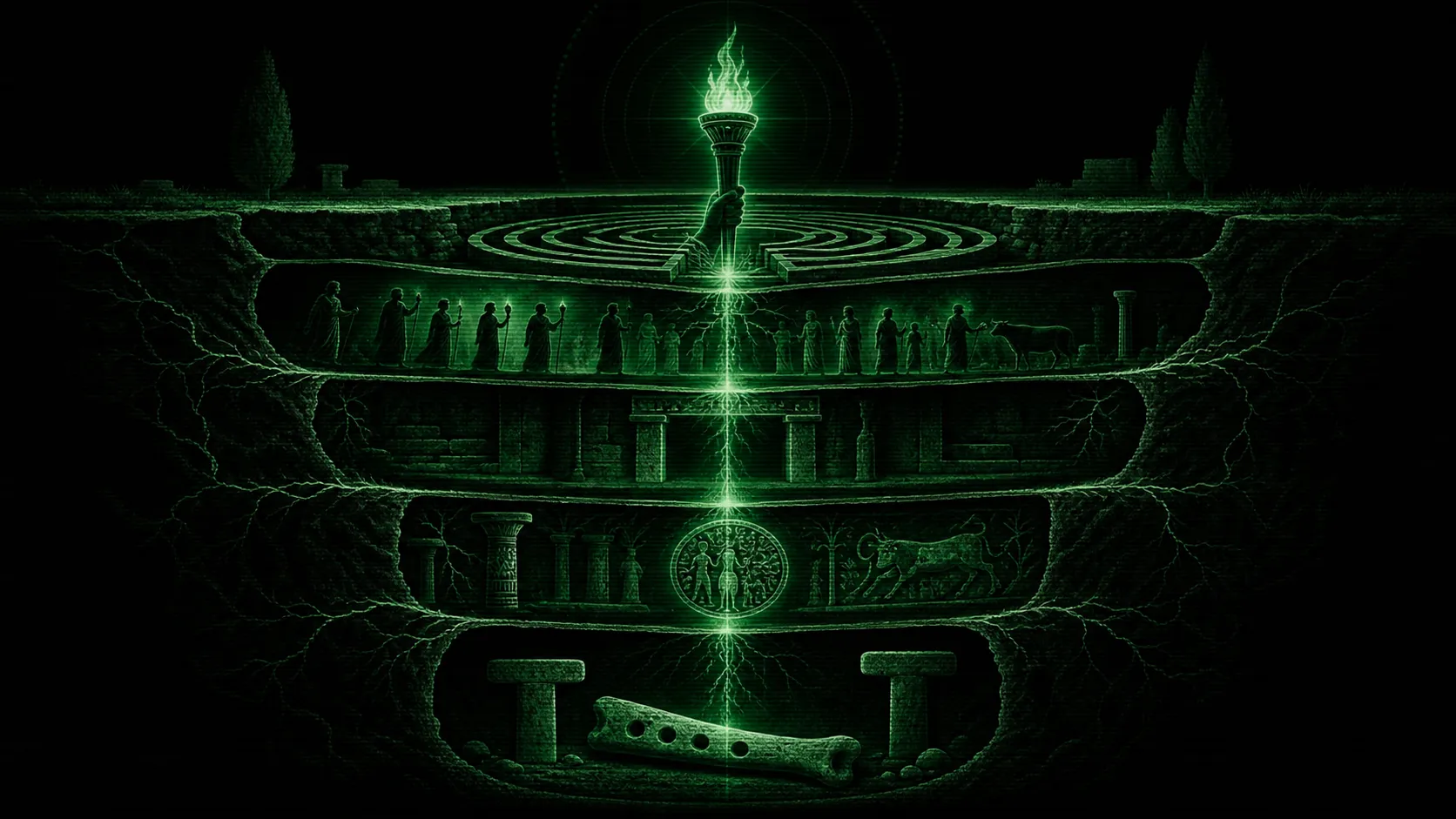
TL;DR
- Ancient writers usually described the Greek mysteries as inheritances, not inventions: ancestral transmissions, divine foundations, and rites handed down from older peoples and older lands (Euripides, Bacchae 200-203; Homeric Hymn to Demeter 473-482).
- Diodorus says the Cretans claimed that the sacrifices and mystery initiations of Eleusis, Samothrace, and Orpheus’ Thrace were handed down from Crete (Diodorus 5.77).
- Herodotus traced certain Dionysian cult elements through Cadmus and Phoenicia; he and Diodorus linked Orphic, Bacchic, and Demeter-type rites more broadly with Egypt (Herodotus 2.49, 2.81, 2.171; Diodorus 1.23, 1.96).
- Diodorus reports that Egyptian priests placed Osiris and Isis more than 10,000 years before Alexander, and then says Orpheus learned Dionysian mysteries in Egypt and adapted them for Greece (Diodorus 1.23.1-2).
- Modern scholarship supports that depth: Bronze Age Eleusis, Mycenaean Dionysus, and a long line of scholarship locating Greek religious survivals in the Minoan-Mycenaean world (Cosmopoulos 2015; Nilsson 1950; Kerényi 1996).
“We do not reason away the gods. The ancestral transmissions we possess, as old as time itself, no argument will overthrow.”
Euripides, Bacchae 200-203, translated from the Greek
The Mysteries as Ancestral Transmissions #
Ancient writers did not all tell the same origin story. Some looked to divine time, some to heroic time, some to Crete, some to Thrace, some to Phoenicia, some to Egypt. But across those differences the pattern is stable: the mysteries are not presented as novelties. They are presented as inheritances.
The sharpest formulation comes in Euripides’ Bacchae. Tiresias does not defend Dionysus by saying the rite is fashionable, persuasive, or intellectually modern. He defends it by appealing to antiquity:
“We do not reason away the gods. The ancestral transmissions we possess, as old as time itself, no argument will overthrow, not even if wisdom is discovered at the furthest reach of thought.” (Euripides, Bacchae 200-203, my translation)
The phrase is πατρίους παραδοχάς (patrious paradochas): ancestral transmissions or
inherited traditions. Euripides then calls them ὁμήλικας χρόνῳ (homēlikas chronōi),
the same age as Time. That is not modern chronology. It is a statement about authority. It
tells us what kind of weight a mystery tradition was supposed to have.
James Diggle and some other modern editors bracket Bacchae 199–203 as a possible interpolation. The lines nevertheless belong to the ancient manuscript tradition, and their language matches the same pattern in hymn, inscription, Herodotus, and Diodorus (textual discussion).
Ancient writers normally grounded the authority of the mysteries in transmission from a sacred past, not in recent invention.
Eleusis Begins in Divine Time #
The foundational text of Eleusis, the Homeric Hymn to Demeter, sends the rites back to the time of the goddess herself. After Demeter’s reunion with Persephone, she reveals the rites to the first rulers of Eleusis:
“Then she went to the kings who guard justice, to Triptolemus and Diocles, to mighty Eumolpus and Keleos, leader of the people. She showed them the conduct of the rites and revealed to them all the sacred ceremonies, holy things which it is in no way possible to transgress, inquire into, or publish; for a great reverence for the gods restrains the voice. Blessed among earthly men is he who has seen these things; but the uninitiated, who has no share in them, never has an equal lot once dead in the murky dark.” (Homeric Hymn to Demeter 473-482, my translation)
Here Eleusis is not a late Athenian invention. It is a divine trust placed in primordial Eleusinian houses.
That same self-understanding survives in historical documents. A fifth-century BCE decree on the Eleusinian first-fruits orders observance kata ta patria, “according to ancestral custom,” and assigns the hierophant and dadouch to exhort Greeks to continue the ancestral rite (I Eleusis 28a). Even inside the machinery of the classical polis, Eleusis still presents itself as something received.
Archaeology carries the sanctuary itself back into the Bronze Age. Michael Cosmopoulos argues that the prehistoric settlement and cultic complex at Eleusis formed the predecessor of the later sanctuary (Cosmopoulos 2015; review in American Journal of Archaeology 120.4). The ancient memory of an immemorial Eleusis was rooted in a genuinely ancient sacred landscape.
Crete as the First Home of the Mysteries #
Diodorus says that the Cretans claimed not just old religion in general, but the transmission of mystery religion in particular:
“They also assert that the honours accorded to the gods and their sacrifices and the initiatory rites observed in connection with the mysteries were handed down from Crete to the rest of men. … The initiatory rite which is celebrated by the Athenians in Eleusis, the most famous, one may venture, of them all, and that of Samothrace, and the one practised in Thrace among the Cicones, whence Orpheus came who introduced them, are all handed down in the form of a mystery; whereas at Cnosus in Crete it has been the custom from ancient times that these initiatory rites should be handed down openly to all.” (Diodorus 5.77.3-4)
Modern scholarship has often found that Cretan claim plausible at the level of religious substrate. In his history of the debate, George Mylonas reports that Axel Persson and Charles Picard argued specifically for a Cretan or Minoan origin of the Eleusinian Mysteries (Mylonas 1961, pp. 15–18). Martin P. Nilsson’s The Minoan-Mycenaean Religion and Its Survival in Greek Religion made continuity the organizing problem of the field and argued that major parts of later Greek cult preserve Minoan-Mycenaean survivals (Nilsson 1950).
Karl Kerényi’s Dionysos presents “the religion of Dionysos from its beginnings in the Minoan culture,” which is not a stray remark but the architecture of the book itself (Kerényi 1996). In Eleusis, Kerényi likewise treats the mother-daughter mystery against a deep preclassical background rather than as a purely late civic construction (Kerényi 1991).
Mircea Eliade is more useful for the broader case than for a single-file migration from Knossos. Following Nilsson, he placed later Greek sanctuaries and mystery religion inside a long history of Minoan-Mycenaean religious survival. The title of his first volume makes the chronological argument visible: From the Stone Age to the Eleusinian Mysteries (Eliade 1978).
The Cretan-origin theory therefore has a substantial scholarly pedigree, while the archaeological and textual evidence establishes a deep Bronze Age Aegean substrate. Diodorus preserves the ancient Cretan priority claim; Mycenaean Eleusis and a Cretan Linear B tablet widely read as naming Dionysus place the religious world behind the later mysteries deep in the Aegean Bronze Age.
The Phoenician and Egyptian Lines of Transmission #
Herodotus gives one version of the story through Melampus and Cadmus. In Book 2 he says Melampus explained to the Greeks the name of Dionysus, his sacrifices, and the phallic procession, and he links that knowledge to older eastern transmission (Herodotus 2.49). In the same Egyptian book he adds one of the bluntest lines in the whole dossier:
“These practices agree with those called Orphic and Bacchic, though they are really Egyptian and Pythagorean.” (Herodotus 2.81)
And at 2.171 he says that the daughters of Danaus brought the Demeter rite called the Thesmophoria out of Egypt and taught it to Pelasgian women (Herodotus 2.171). That is not strictly the Eleusinian initiation, but it belongs to the same family of Demeter religion and shows the same habit of thought: major Greek rites were often explained as received from an older sacred civilization.
Diodorus makes the Egyptian connection even stronger. First he gives the famous chronology:
“The number of years from Osiris and Isis, they say, to the reign of Alexander, who founded the city which bears his name in Egypt, is over ten thousand, but, according to other writers, a little less than twenty-three thousand.” (Diodorus 1.23.1)
Then, without changing topic, he says:
“For they say that Orpheus, upon visiting Egypt and participating in the initiation and mysteries of Dionysus, adopted them and as a favour to the descendants of Cadmus … transferred the birth of the god to Thebes.” (Diodorus 1.23.2)
Later in the same book he states the thesis more directly:
“Orpheus, for instance, brought from Egypt most of his mystic ceremonies, the orgiastic rites that accompanied his wanderings, and his fabulous account of his experiences in Hades. For the rite of Osiris is the same as that of Dionysus, and that of Isis very similar to that of Demeter, the names alone having been interchanged.” (Diodorus 1.96.4-5)
The statement could hardly be clearer: the Orphic-Dionysian and Demeter-Isis mysteries were inheritances from a far older ritual world.
Egypt’s Ten-Thousand-Year Sacred History #
Diodorus is reporting a sacred chronology measured backward from Alexander. In the same context he records an even larger span, roughly 23,000 years from Helius to Alexander’s crossing into Asia (Diodorus 1.26.1). Within this history, Egyptian priests located Osiris and Isis in a past of immense antiquity, and Diodorus placed Orpheus’ Greek mysteries downstream from it. The rites came from beyond ordinary human memory—from time immemorial in the fullest ancient sense.
Archaeology Reaches Back into the Bronze Age—and Beyond #
| Evidence | Historical depth |
|---|---|
| Bronze Age Eleusis | The later sanctuary rises from a much older sacred and settlement landscape (Cosmopoulos 2015) |
| Linear B Dionysus | di-wo-nu-so-jo at Pylos and a Cretan form read as di-wo-nu-so attest Dionysus in Mycenaean Greece (Palaima 1998) |
| Cretan continuity scholarship | Major scholars locate the roots of Eleusis and Dionysus in Minoan-Mycenaean religion (Nilsson 1950; Kerényi 1996) |
| Gurob Papyrus rhombos | A bullroarer appears among the sacred tokens of a third-century BCE Bacchic-Orphic ritual text (Hordern 2000) |
| Early Neolithic perforated objects | A regional class carries the form and acoustic power of bullroarers into the Early Neolithic (Dietrich and Notroff 2016) |
The classical mysteries were crystallizations of much older sacra, cult places, divine figures, and ritual technologies. Their classical forms belong to history; their roots descend through the Bronze Age and into the older ritual worlds that preceded it.
Ritual Technologies Outlive Texts #
The bullroarer makes that survival audible.
The bullroarer is a slat or lozenge tied to a cord and whirled through the air, producing a pulsing roar. Its Greek name was rhombos. Its place in the Orphic-Dionysian complex is not merely a comparison invented by modern anthropologists: a surviving ritual text actually lists it.
The Gurob Papyrus, copied in Egypt probably around the middle of the third century BCE, preserves part of a Bacchic-Orphic ritual script. Near the bottom of its first column comes a list of sacred tokens:
“… cone, rhombos, knucklebones, mirror.”
—P. Gurob 1, col. i.29–30
James Hordern’s re-edition glosses the rhombos here as a bullroarer and gathers its other attestations in Bacchic rites. Clement of Alexandria later includes it in a closely related list of the toys of Dionysus—the objects used to distract the divine child before his dismemberment. The Bullroarer Atlas Gurob record maps that source chain. This is the secure classical anchor: a whirled sound instrument appears among the material tokens of an Orphic-Dionysian initiation.
The most provocative archaeological case lies far earlier, in Pre-Pottery Neolithic Anatolia. The Bullroarer Atlas entry on Göbekli Tepe summarizes Oliver Dietrich and Jens Notroff’s study of thirteen pierced, elongated bone objects from Göbekli Tepe, Körtik Tepe, Hasankeyf Höyük, and Nahal Hemar. The narrow ends are perforated for a cord, many examples are elaborately decorated, and related pieces at Körtik Tepe occur as grave goods. A full-sized experimental reconstruction “serves its function very well and produces a deep vibrato sound.”
Göbekli Tepe stands near the emergence of the earliest farming communities in Upper Mesopotamia, at the transition between hunter-gatherer ritual worlds and the first agricultural societies (UNESCO). A whirled sound instrument at that threshold reveals a concrete mechanism of transmission: sacred tools preserve sacred sounds, and sacred sounds preserve performances across transformations that erase names, languages, and creeds.
For the larger interpretive argument—that the bullroarer’s recurring links to restricted initiation, divine or ancestral voice, and symbolic death and rebirth preserve a very old ritual complex—see Andrew Cutler’s The Bullroarer: a history of man’s most sacred ritual object. The archaeological paper supplies the Neolithic objects; the Greek papyrus supplies the mystery context; the Atlas and essay trace the much longer history of transmission that joins them.
An Inheritance from the Deep Past #
The people themselves did say that the mysteries were extremely old. They said this in tragedy, hymn, ethnography, and universal history. They said the rites were ancestral transmissions. They said Eleusis was founded by the goddess for the first kings. They said Orpheus brought mysteries from Egypt. They said the rites of Eleusis, Samothrace, and Orpheus’ Thrace were handed down from Crete. They said Bacchic and Orphic observances were really Egyptian. They said Osiris and Isis belonged to an age more than ten thousand years before Alexander.
Greek mystery religion was understood in antiquity as an inheritance from the deep past, and modern archaeology gives that memory a material foundation. Beneath the classical sanctuaries stand Bronze Age cult places; behind the Greek names stand Cretan and Egyptian genealogies; within the rites survive instruments whose history reaches toward the first ceremonial centers of the Neolithic.
If you ask what the ancients thought the mysteries were, the answer is not obscure. They thought the rites came down from before them: from the gods and first kings, from Crete and Egypt, with certain Dionysian practices carried through a Phoenician culture hero—from a past so deep that ordinary memory gave out and sacred lineage took over.
For related reading, see The Death and Rebirth of Dionysus, Orphic Cosmogony, and Sages Who Sought Wisdom in Egypt.
Sources #
- Euripides. Bacchae. Greek text in Scaife Viewer.
- Anonymous. Homeric Hymn to Demeter. Greek text in Scaife Viewer.
- Herodotus. Histories, Book 2. Public-domain translation at LacusCurtius. See also 2.171 and 2.81.
- Diodorus Siculus. Library of History, Book 1. Public-domain translation by C. H. Oldfather at LacusCurtius.
- Diodorus Siculus. Library of History, Book 1, chapters 96-97. Public-domain translation by C. H. Oldfather at LacusCurtius.
- Diodorus Siculus. Library of History, Book 5. Public-domain translation by C. H. Oldfather at LacusCurtius.
- Lambert, Stephen, and Robin Osborne, trans. I Eleusis 28a: On the first-fruits at Eleusis. Attic Inscriptions Online.
- Cosmopoulos, Michael B. Bronze Age Eleusis and the Origins of the Eleusinian Mysteries. Cambridge University Press, 2015.
- Nilsson, Martin P. The Minoan-Mycenaean Religion and Its Survival in Greek Religion. 2nd ed. Lund, 1950.
- Kerényi, Karl. Eleusis: Archetypal Image of Mother and Daughter. Princeton University Press, 1991.
- Kerényi, Karl. Dionysos: Archetypal Image of Indestructible Life. Princeton University Press, 1996.
- Eliade, Mircea. History of Religious Ideas, Volume 1: From the Stone Age to the Eleusinian Mysteries. University of Chicago Press, 1978.
- Mylonas, George E. Eleusis and the Eleusinian Mysteries, introduction. Princeton University Press, 1961.
- Palaima, Thomas G. “Linear B and the Origins of Greek Religion.” In La Crète mycénienne, 1998, 205–224.
- Hordern, James H. “Notes on the Orphic Papyrus from Gurôb.” Zeitschrift für Papyrologie und Epigraphik 129 (2000): 131–140.
- Dietrich, Oliver, and Jens Notroff. “A Decorated Bone ‘Spatula’ from Göbekli Tepe: On the Pitfalls of Iconographic Interpretations of Early Neolithic Art.” Neo-Lithics 1/16 (2016): 22–29.
- UNESCO World Heritage Centre. “Göbekli Tepe.”
- The Bullroarer Atlas. “Gurob papyrus Orphic Dionysian rhombos lead.”
- The Bullroarer Atlas. “Göbekli Tepe decorated bone spatulae.”
- Cutler, Andrew. “The Bullroarer: a history of man’s most sacred ritual object.” Vectors of Mind, July 24, 2024.
Read other posts