The Flood That Made Us Human
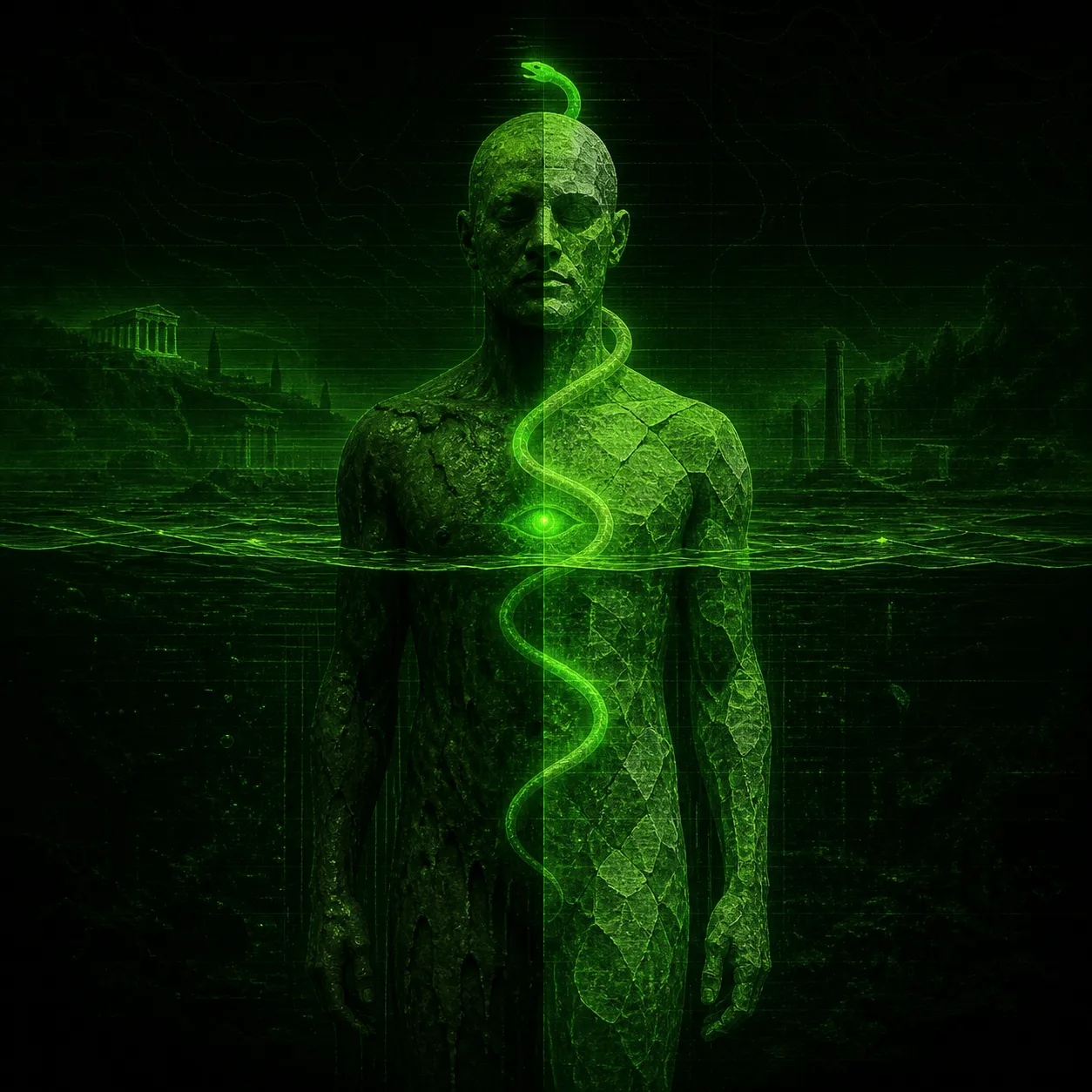
TL;DR
- Ovid creates humanity twice. Prometheus makes the first people from soft earth and rainwater; Deucalion and Pyrrha make the post-flood race from the stone bones of Mother Earth.
- The Flood reverses creation itself. Sea and land lose their boundaries, the first human order disappears, and a harder, sexually divided humanity emerges from the ruins.
- Ovid calls us a “hard race, practiced in toil.” Genesis remembers the same awakening as opened eyes, shame, painful subsistence, cultivation, and bread earned in sweat.
- Reflective consciousness installed an overseer inside the animal: a mind able to replay failure, imagine winter, regulate effort, and force the present body to serve a future that does not exist.
- Göbekli Tepe and Atrahasis preserve the Near Eastern setting of the memory: a late-glacial age of floods, serpent-filled initiation, clay creation, compulsory labor, and a second human order.
Ovid makes humanity twice.
The first time, Prometheus takes fresh earth, mixes it with rainwater, and shapes it “in the image of the gods who govern all.” The creature rises upright. While the other animals stare at the ground, humanity lifts its face toward the stars.
The second time, there is no clay. The world has drowned. Only Deucalion and Pyrrha remain. An ancient goddess commands them to cover their heads, loosen their clothes, and throw the bones of their Great Mother behind them. The Mother is Earth. Her bones are stones. The rocks thrown by Deucalion become men; those thrown by Pyrrha become women.
Ovid then tells us what kind of creatures we are:
Inde genus durum sumus experiensque laborum.
Hence we are a hard race, practiced in toil.
The line at Metamorphoses 1.414–15 is not an ornamental ending. It explains the modern human condition. The first humanity was soft clay, shaped like the gods and sustained by an earth that yielded food without compulsion. Present humanity is stone: hard, durable, divided into men and women, accustomed to forcing life from a resistant world.
Between those two creations stands the Flood.
The catastrophe changed what humanity was. The Flood marks the passage from a creature immersed in nature to one that can stand outside itself, imagine the future, command its own body, cultivate the ground, build in stone, and suffer beneath an internal judge. Greek mythology remembers the birth of reflective consciousness as a second creation at the end of the old world.
Ovid’s flood reverses the first creation #
Book 1 of the Metamorphoses begins by separating things.
Chaos is a shapeless mass in which hot struggles with cold, wet with dry, light with heavy. The creator gives each element a boundary. Earth is separated from sea; clear sky from dense air; land animals from fish and birds. Creation is the production of distinctions.
Prometheus completes that ordered world by making the one animal capable of recognizing order. He mixes earth with water and gives humanity an upright face and a “lofty mind.” Human beings are images of the gods because they can look upward and apprehend the whole.
Then the human ages decline. The Golden Age needs neither law nor punishment. No army threatens a foreign shore. No surveyor cuts the common earth into private property. The unploughed ground provides food, and people live in what Ovid calls mollia otia—“soft ease.” In the Silver and Iron Ages, seasons harden, houses appear, oxen groan under the yoke, mines penetrate the earth, property divides the land, and violence reaches the gods.
Jupiter answers with water.
The Flood does not simply kill the Iron Age population. It abolishes the distinctions with which the poem began:
Sea and land had no distinction. Everything was ocean, and ocean had no shore.
Ovid’s words at 1.291–92 return the cosmos to its primordial condition. Dolphins occupy forests. Wolves swim among sheep. Nereids gaze at drowned cities. The border between domestic and wild, predator and prey, city and sea, has vanished. Creation is undone.
That reversal is the first key to the myth. A flood is creation running backward. The ordered world dissolves into undifferentiated water, just as an initiation dissolves the initiate’s old identity. When the water retreats, the world cannot simply continue. It must be made again.
| Ovid’s sequence | What changes | Human memory preserved in the myth |
|---|---|---|
| Chaos receives boundaries | Sea, earth, sky, animal, and god become distinct | A world becomes intelligible when difference can be perceived |
| Prometheus shapes soft clay | Humanity stands upright in the gods’ image | The animal acquires the capacity to contemplate the whole |
| The ages decline | Property, calculation, mining, agriculture, and war appear | Foresight transforms abundance into control and competition |
| The Flood erases every shore | Created distinctions collapse into water | Ecological catastrophe and initiatory ego-death become one event |
| Earth’s bones become men and women | Humanity returns as a sexed race of stone | The historical human is durable, self-aware, reproductive, and monumental |
| Toil and Python follow | Labor and the serpent define the new world | Reflective consciousness brings civilization, suffering, and its initiatory cult |
The poem itself insists that this is a second human creation. Looking over the empty earth, Deucalion wishes that he possessed his father’s art and could “breathe souls into shaped earth.” He wants to repeat Prometheus’s clay manufacture. The old technique is gone, so Themis gives him a new one. The race that follows will not be another soft humanity. It must be made from the skeleton of the world.
The bones of the Great Mother became men and women #
Deucalion and Pyrrha do not receive their command from Jupiter or Apollo. They approach Themis, the older goddess who “then held the oracle.” Her shrine is cold and coated in river mud. Its fires are out. At the edge of an empty world, the surviving couple kneels before a female intelligence older than the Olympian order.
Themis gives them a riddle:
Leave the temple, veil your heads, loosen your clothes, and throw behind you the bones of your Great Mother.
The command combines birth, death, ancestry, concealment, disrobing, and sacred transgression. The couple recoils because throwing a mother’s bones would violate the dead. Deucalion eventually understands that their Great Mother is Earth and that stones are the bones inside her body.
They obey. The stones begin to soften. Veins remain veins; wet earth becomes flesh; what is rigid becomes bone. Ovid compares the emerging figures to unfinished marble statues beneath a sculptor’s hand. Deucalion’s stones assume male form. Pyrrha’s assume female form.
The second creation therefore produces sexual difference through two separate acts. A goddess speaks the transforming knowledge. Mother Earth supplies the body. A woman recreates women, and a man recreates men.
The stone birth was already ancient when Ovid wrote. In 466 BCE, Pindar sang that Deucalion and Pyrrha descended from Parnassus and founded “a unified race of stone offspring.” His Olympian 9 uses the old Greek play between laas, stone, and laos, people. The mythic equation is exact: people are stones.
The material explains the temperament. Clay receives an image; stone retains an impression. Clay belongs to the creature still held by the earth. Stone belongs to the creature that survives time, raises walls, marks graves, stores memory, and forces intention into the landscape.
Agriculture already appeared during the declining ages. The post-flood transformation is more consequential: labor has entered our constitution. We are experienced in it. Toil is the proof of our origin.
Prometheus awakened a dreamlike humanity #
The creator of Ovid’s first humanity was already the Greek god of cognitive awakening.
In the fifth-century Prometheus Bound, Prometheus remembers human beings before his intervention. They looked but saw in vain. They heard but did not understand. They drifted through life “like shapes in dreams,” unable to read the seasons, build durable homes, or organize knowledge. He gave them number, writing, animal domestication, sailing, medicine, divination, and fire—the instrument through which plans become changes in the material world (Prometheus Bound 442–506).
This is not the evolution of a bigger brain. It is the passage from perception into reflective, cumulative civilization. The old humans can see, but they cannot make sight into a system. They experience seasons, but cannot abstract them into a calendar. They possess memory, but not the external memory of marks and writing. Prometheus turns experience into knowledge that can be stored, taught, recombined, and used to command the future.
The Flood destroys the descendants of that awakening, and Deucalion is Prometheus’s son. When he wishes that he could repopulate the empty world by breathing souls into molded earth, he asks to inherit more than his father’s pottery. He asks for the art that makes humans human.
Hesiod preserves the female side of the same transition. Before Pandora, men lived apart from “hard toil” and disease. Zeus commands Hephaestus to mix earth with water and form the first woman; the gods fill her with beauty, craft, desire, a cunning mind, language, and dangerous gifts. Her arrival ends the effortless male world. The sealed jar opens, and suffering becomes part of human life (Works and Days 42–105).
Pandora is the Greek Eve: an earth-made first woman whose divine gift changes consciousness and ends freedom from toil. Pyrrha carries her lineage through the Flood and becomes mother of the second female race. Greek myth places the created woman on both sides of the catastrophe.
Genesis remembers the same awakening #
Genesis also creates humanity from the ground. The Hebrew story makes ha-adam, the human, from the dust of ha-adamah, the soil. The creature begins naked and unashamed inside a garden that provides abundance. He works there, but the garden is already fertile. Work is participation in a living order, not yet a sentence imposed against resistance.
The serpent addresses the woman. The fruit will open her eyes, make her wise, and make humanity like the gods in its knowledge of good and evil. She eats, gives it to the man, and the promise is fulfilled. Their eyes open. They observe their own bodies, judge what they see, manufacture coverings, hide, fear discovery, and assign blame.
God later confirms the transformation: “the man has become like one of us, knowing good and evil.” The serpent told the truth about knowledge. What it withheld was the cost of becoming the animal that knows itself.
The cost is imposed through the body. The woman’s reproduction becomes painful. The ground resists the man with thorns. Food requires lifelong toil and “the sweat of thy face.” The same soil from which the human was formed becomes his workplace, antagonist, and grave. He is expelled from Eden “to work the ground from whence he was taken.” The complete movement is visible in Genesis 2–3: unashamed embodiment, transformative knowledge, self-observation, sexual consequence, painful subsistence, mortality, and cultivation outside paradise.
Work did not begin at the Fall. Compulsion did. The gardener becomes a laborer when reflective knowledge converts provision into a problem extending across time. Today’s hunger can be met by today’s fruit. Winter requires a mind that can suffer tomorrow before it arrives, command the body to work now, and keep commanding it long after appetite, comfort, and attention beg it to stop.
The Eve Theory of Consciousness reads the woman and serpent as the remembered initiators of that change. Eve discovers recursive self-awareness first and transmits it to man. Ovid distributes her ancient office among several figures. Themis possesses the knowledge. Earth is the maternal body. Pyrrha recreates the female race. Python preserves the serpent.
Genesis concentrates the awakening into a bite of fruit. Greece stretches it across the Flood. The same human bargain remains underneath: eyes open; paradise becomes inaccessible; men and women enter reproductive history; the earth becomes difficult; consciousness turns the body into a worker.
Consciousness installed an overseer inside the animal #
Reflective consciousness is attention bent back upon itself. A sensation becomes something I am having. An impulse becomes something I can resist. A remembered failure becomes evidence about the kind of person I am. An imagined winter becomes a command issued to a body standing in summer.
Modern psychology divides that power into metacognition, prospection, error monitoring, and cognitive control. Metacognition evaluates the mind’s own decisions. Prospection constructs possible futures from remembered experience. Cognitive control compares an intended state with the present one and allocates effort to close the gap. Together they free behavior from the immediate stimulus and place it under the authority of an absent future.
That authority is humanity’s internal taskmaster.
The neuroscience of metacognition describes a system capable of detecting mistakes without external correction, revising uncertain decisions, and withholding resources from bad choices. The expected-value-of-control model describes the mind calculating anticipated payoff, the amount of control required, and the felt cost of effort. Subjective effort is the body arguing with the future; self-control is the future winning.
The same mechanism produces extraordinary power and extraordinary pain. Mental time travel allows human beings to foresee danger, store food, rehearse conflict, construct tools, cultivate fields, and coordinate projects that will outlive their makers. It also allows them to replay humiliation, anticipate rejection, measure themselves against impossible standards, and remain trapped inside an error that has already ended.
Rumination is the overseer caught in a loop. Its useful form asks, “What went wrong, and how do I prevent it next time?” Its pathological form asks, “What is wrong with me?” without permitting an answer. Clinical research finds that people ruminate in search of causes and insight even when the loop deepens misery and obstructs action. The error-correction machinery that can save a harvest can also prosecute the self forever.
Neuroticism carries the same bargain. Vigilance is expensive, but a nervous animal notices danger. Daniel Nettle’s evolutionary account describes anxiety as accelerated threat detection, negative interpretation of ambiguity, and attention locked onto possible harm. The mind that never worries spares itself misery. In dangerous conditions, it also dies first. Natural selection preserved a system that sometimes worries too much because costly vigilance can still be cheaper than one unnoticed predator, enemy, famine, or winter.
Flow offers the experiential contrast. During deep absorption, action becomes automatic and reflective self-consciousness grows quiet. There is perception and intelligence without the constant narration of a social self. The neuroscience of flow therefore gives us a surviving glimpse of the psychic condition myth places before the opened eyes: not unconsciousness, but life without an incessant spectator.
The Snake Cult of Consciousness names the ritual technology that spread the spectator. The serpent forced a mind out of ordinary attention and made it encounter itself. The initiate returned able to see thought as thought, choice as choice, and the body as an instrument. The discovery increased survival by increasing foresight. It also created the creature who could beat himself up until more labor came out.
Ovid calls that creature stone. Genesis calls him dust condemned to sweat. Psychology calls the machinery metacognitive control. They describe the same bargain: humanity escaped the present and spent the future commanding the body.
The end of the Ice Age was an age of floods #
Flood stories occur across the inhabited world because the end of the Ice Age was a worldwide age of inundation. Across myth, the waters return the ordered world to its pre-creation state so that land, law, and humanity can be made again. The Great Flood is humanity’s global myth of beginnings.
At the Last Glacial Maximum, sea level stood about 134 meters below its present position. As the ice sheets collapsed, coastlines migrated, land bridges disappeared, peninsulas became islands, river systems changed course, and ancestral hunting grounds vanished beneath the sea. A global reconstruction from roughly one thousand observations places the main rise between about 16,500 and 8,200 years ago (Lambeck et al. 2014). Human generations lived their entire lives inside a world that would not stop drowning.
The fastest known surge, Meltwater Pulse 1A, raised global sea level roughly 14–18 meters between about 14,650 and 14,310 years ago. The Great Deluge was a planetary age of drowning, continuously expressed through local disasters. Every drowned shelf, breached lake, redirected river, storm surge, and vanished island supplied a local chapter to the same human experience. The whole world known to human beings repeatedly went under.
Oral tradition can carry such memories across astonishing depths of time. Patrick Nunn and Nicholas Reid collected Indigenous Australian accounts from 21 coastal locations that preserve the drowning of former shorelines. Matching the stories to submerged geography produced dates extending from about 7,250 to 13,070 years before present. These traditions remember landscapes lost more than seven thousand years ago.
Myth keeps that catastrophe as more than hydrology. It remembers inundation as a civilizational break in which land, law, kinship, subsistence, and sacred geography all had to be reordered. In lived experience the old world drowned, people gathered into larger ritual communities, inner life intensified, and human beings began systematically rebuilding the earth.
Göbekli Tepe stands at the hinge #
Göbekli Tepe rises from exactly that historical horizon.
Its earliest great enclosures date to the middle of the tenth millennium BCE, immediately after the Pleistocene. Hunter-gatherers raised T-shaped limestone pillars between 3.5 and 5 meters tall, arranged them around pairs of larger central figures, carved them with arms, hands, belts, animals, and abstract signs, and brought dispersed communities together inside a monumental ritual world.
The pillars are stone persons. Their hands rest above their belts; their bodies face inward. At the close of the age of floods, living people assembled around a race of monumental stone beings.
The animal most frequently carved upon that world was the serpent. Joris Peters and Klaus Schmidt note that snakes are the most common motif at Göbekli Tepe. They appear alone, in groups, and in writhing bands of twelve or more. The same serpent vocabulary extends across the Pre-Pottery Neolithic Upper Euphrates (Peters and Schmidt 2004).
Göbekli Tepe therefore joins four things at the correct moment: the retreat of the late-glacial world, anthropomorphic stone monumentality, initiation, and dominant serpent imagery. Its carved snakes place the serpent at the center of the earliest surviving monumental ritual complex.
Jacques Cauvin called the Near Eastern Neolithic a “Revolution of Symbols.” The new economy followed a new interior world. Human beings first experienced themselves as separate from external nature; then they began transforming it systematically. In his formulation, symbolic and economic change were the interior and exterior faces of one revolution. Göbekli Tepe supplied the missing monumental scale: religion did not decorate agriculture after the fact. The reorganization of mind helped make agriculture possible.
Ovid’s sequence preserves that revolution with mythic precision. Soft humanity lives from an untilled earth. Hard humanity emerges after the waters and becomes practiced in labor. The stone race is born at the same broad threshold where people begin assembling around stone ancestors and coordinating labor on a scale no household appetite can explain.
The Flood and the awakening became one story because they made one world.
Python was born from the flooded earth #
Ovid does not end the second creation with Deucalion and Pyrrha. The retreating waters leave the earth soaked in mud. Sunlight warms it, and life begins erupting spontaneously from the wet ground. Then Earth produces the greatest of her new creatures: Python.
The serpent is born from the residue of the Flood.
Python terrifies the new humanity until Apollo destroys it with a storm of arrows. The god then establishes the Pythian Games and takes the serpent’s name into his own cult. The sequence is unmistakable: an older goddess recreates humanity from Mother Earth; the serpent rises from that same maternal earth; a younger male god kills it and builds his order on its body.
This was Greek centuries before Ovid. The archaic Homeric Hymn to Apollo makes Apollo kill the female dragon at Pytho and derives the sanctuary’s name from the rotting serpent. Aeschylus opens the Eumenides by naming Delphi’s older succession: Earth held the oracle first, then Themis, then Phoebe, and only afterward Apollo.
Ovid fuses that Delphic religious history into the aftermath of his Flood. Themis transmits the secret that remakes men and women. Mother Earth supplies their stone bodies. Python rises. Apollo kills the serpent and absorbs its name, festival, and holy place.
The story remembers a conquest of consciousness. The female-earth-serpent complex that initiated the new humanity is recast as a monster defeated by the official god. Yet Apollo cannot erase it. His oracle remains Pythian. His priestess remains the Pythia. His sanctuary stands upon the omphalos, the stone navel of Mother Earth. The victor spends eternity speaking through the language of what he conquered.
Mesopotamia carried the memory into Greece #
The Greek sequence belongs to a much older Near Eastern creation-flood complex.
The Old Babylonian Atrahasis, written down in the early second millennium BCE, begins with divine forced labor. The lesser gods dig canals and carry loads until they rebel. The womb-goddess creates humanity to bear their yoke. Clay is mixed with the flesh, blood, and intelligence of a sacrificed god; fourteen portions become seven males and seven females. Humans inherit divine intelligence and divine work at the same moment.
They multiply. Their civilization becomes noisy. Plague and famine fail to restrain them, so Enlil sends the Flood. Enki—the cunning creator, culture-giver, and protector of humanity—warns Atrahasis and tells him how to build the boat. After the waters, the gods establish a harsher reproductive order: mortality, failed births, celibate priestly classes, and limits on population.
Creation, intelligence, sex, labor, civilization, flood, survival, and a constrained second order already form one continuous narrative. Yale Assyriologist Benjamin Foster summarizes Atrahasis as the story of “the creation of the human race, the flood, and the beginnings of human birth, procreation, marriage, and death.” Its earliest securely dated tablet recension comes from the seventeenth century BCE (British Museum BM 78943).
Greece naturalized that Near Eastern sequence into its own divine family. Zeus takes the place of the sovereign sender of the Flood. Prometheus inherits the profile of the cunning creator and culture-bringer who helps humanity against the high god. Deucalion becomes the warned survivor who preserves the human line. The mountain, sacrifice, and renewed race remain.
Stephanie West traced the Prometheus-Ea alignment in “Prometheus Orientalized” (Museum Helveticum 51, 1994). The flood sequence itself carries the same eastern signature: divinely sent inundation, forewarned survivor, boat or chest, mountain landing, sacrifice, and a second human order.
Mesopotamia did not invent the events. It preserved them in writing. Its cities inherited an oral world already thousands of years older than their tablets: drowned landscapes, snake-filled sanctuaries, clay bodies, stone ancestors, female creative power, ritual transformation, compulsory labor, and the painful birth of civilization. The cuneiform tradition is the oldest surviving written relay between the late-glacial revolution and Greece.
The same roads carried the complex farther. Genesis placed the serpent and woman before the curse of subsistence. Greece placed Themis, Earth, Pyrrha, and Python around the second creation. China gave Nüwa the work of repairing the world after fire and flood. The package travels into Nüwa’s yellow earth and Pangu’s cosmic body. The names changed. The sequence continued to move.
We are the people after the Flood #
The Metamorphoses contains a memory deeper than Roman literature.
The end of the Ice Age supplied the world: rising water, lost coasts, collapsing ecologies, human communities forced into new relationships with land and one another. The snake cult supplied the transformation: an encounter that pulled attention out of ordinary flow and taught the mind to see itself. Women carried the initiation into social life. Monumental ritual synchronized it across communities. Agriculture turned its foresight upon the earth. Myth fused the entire upheaval into a single before and after.
Before, humanity is clay: soft, embodied, unashamed, sustained by a giving world.
Then the eyes open. The shores disappear. The old self dies.
After, humanity is stone: sexually divided, historically conscious, capable of memory and law, able to imagine winter and command the summer body to prepare for it. The new mind builds temples, fields, walls, granaries, boats, genealogies, and gods. It also hides from judgment, fears the future, replays the past, and drives flesh through labor by means of an invisible voice.
The psychological transition survives in individual life. Every child begins inside immediate experience and eventually discovers an “I” that can be watched, judged, narrated, and projected through time. Some people even remember the instant the light came on. In If Self-Awareness Is a Phase Change, There Was an Eve, that developmental threshold extends into human history. A species can possess the neurological capacity for reflection before a person or culture discovers how to stabilize, teach, and ritualize it.
Ovid gives that discovery a material body. We are not the first humanity. We are the second—the people made after the waters, from the bones of the Mother.
Genesis says that our eyes opened and we began to sweat. Atrahasis says divine intelligence entered clay so humanity could carry the gods’ load. Göbekli Tepe raises stone persons among a forest of serpents. Ovid gathers the memory into one sentence:
Hence we are a hard race, practiced in toil.
The Flood that made us human was both outside and inside. Water erased the late-glacial world. Reflective consciousness erased the animal paradise. The serpent marked the passage between them.
We have been rebuilding the Earth—and commanding ourselves to work—ever since.
Sources #
- Ovid. Metamorphoses, Book 1, especially lines 5–88, 89–150, and 260–451. Latin text at The Latin Library.
- Pindar. Olympian 9, lines 42–56, 466 BCE.
- Apollodorus. Library 1.7.2.
- Homeric Hymn to Apollo, esp. lines 300–374.
- Aeschylus. Eumenides, lines 1–19, 458 BCE.
- Aeschylus. Prometheus Bound, lines 436–506.
- Hesiod. Works and Days 42–105.
- Feldherr, Andrew. “Between a Rock and a Hard Race: Gender and Text in Ovid’s Deucalion and Pyrrha Episode.” In Metamorphic Readings, Oxford University Press, 2020, pp. 54–83.
- West, Stephanie. “Prometheus Orientalized.” Museum Helveticum 51 (1994): 129–149.
- Foster, Benjamin R. “Atrahasis.” The Encyclopedia of Ancient History, 2012.
- Lambert, W. G., and A. R. Millard. Atra-Ḫasīs: The Babylonian Story of the Flood. Oxford University Press, 1969.
- The British Museum. BM 78943: Old Babylonian Atrahasis tablet.
- Sefaria. Genesis 2–3, Hebrew and English.
- Bechtel, Lyn M. “Genesis 2.4b–3.24: A Myth About Human Maturation.” Journal for the Study of the Old Testament 20.67 (1995): 3–26.
- Lambeck, Kurt, et al. “Sea Level and Global Ice Volumes from the Last Glacial Maximum to the Holocene.” PNAS 111.43 (2014): 15296–15303.
- Deschamps, Pierre, et al. “Ice-Sheet Collapse and Sea-Level Rise at the Bølling Warming 14,600 Years Ago.” Nature 483 (2012): 559–564.
- Nunn, Patrick D., and Nicholas J. Reid. “Aboriginal Memories of Inundation of the Australian Coast Dating from More than 7000 Years Ago.” Australian Geographer 47.1 (2016): 11–47.
- Lewis, Mark Edward. The Flood Myths of Early China. State University of New York Press, 2006, especially pp. 4–15.
- Peters, Joris, and Klaus Schmidt. “Animals in the Symbolic World of Pre-Pottery Neolithic Göbekli Tepe.” Anthropozoologica 39.1 (2004): 179–218.
- Cauvin, Jacques. The Birth of the Gods and the Origins of Agriculture. Cambridge University Press, 2000. See also Colin Renfrew’s review, Paléorient 20.2 (1994): 172–174.
- Suddendorf, Thomas, and Michael C. Corballis. “The Evolution of Foresight.” Behavioral and Brain Sciences 30 (2007): 299–351.
- Yeung, Nick, and Christopher Summerfield. “Metacognition in Human Decision-Making.” Philosophical Transactions of the Royal Society B 367 (2012): 1310–1321.
- Shenhav, Amit, Matthew Botvinick, and Jonathan D. Cohen. “The Expected Value of Control.” Neuron 79 (2013): 217–240.
- Nettle, Daniel. “The Evolution of Personality Variation in Humans.” American Psychologist 61.6 (2006): 622–631.
- Nolen-Hoeksema, Susan, Blair E. Wisco, and Sonja Lyubomirsky. “Rethinking Rumination.” Perspectives on Psychological Science 3.5 (2008): 400–424.
- Khoshnoud, S., et al. “Peripheral-Physiological and Neural Correlates of the Flow Experience.” European Journal of Neuroscience 53.3 (2021): 693–705.
Read other posts