~/rock-art/australia
The First Rainbow Serpents
The oldest Rainbow Serpent paintings cluster on the Arnhem Land plateau. They were painted while the sea swallowed the plain to the north.
The oldest paintings of the Rainbow Serpent, mapped against the sea that drowned the north.
TL;DR
- 139 Rainbow Serpent rock paintings are known in western Arnhem Land. The 70 oldest are in the Yam style (Taçon et al. 2026).
- The Yam style dates to about 9,400–6,000 years ago, by its link with radiocarbon-dated paintings of the same period (Taçon et al. 2022).
- An older giant snake, in the Dynamic Figure style, is painted among nine running people at Deaf Adder Creek. Brandl called it the Rainbow Snake.
- In the same centuries the sea rose from about 30 m below its present level to its present level, drowning a coastal plain the width of a small country (Sloss et al. 2018).
- In the ethnography the Rainbow Snake causes the great flood. In the Gunabibi, the bullroarers are its symbols.
“Certainly Rainbow Snakes first appear in the rock art continuum among forms of painting thought to date to the [time of] world changes in sea levels and climate. … The rainbows were associated with the widespread flooding and dramatic changes to the land.” — Paul Taçon, From Rainbow Snakes to ‘X-ray’ Fish (1989), pp. 310–11
Where are the oldest Rainbow Serpents? #
On the Arnhem Land plateau, the sandstone “stone country” that rises over Kakadu and western Arnhem Land. Paul Taçon, Meredith Wilson and Christopher Chippindale analysed 107 Rainbow Serpent paintings from the region in 1996 and sorted them by style. Sixty-one were in the Yam style, named for the yams that sprout from figures painted in it. These are the oldest images of the being anywhere in Australia (Taçon, Wilson and Chippindale 1996, p. 105).
Thirty years on, the count has grown to 139: 70 in the Yam style, 17 transitional and 52 recent (Taçon, May, Jalandoni and Mungulda 2026). The Yam serpents share a fixed form: a snake’s body, a head like a kangaroo’s or a flying fox’s, recurved spines, and cross-hatching at the neck and tail.
They are not spread evenly. The densest cluster is on Upper Twin Falls Creek, where 22 serpents are painted, 11 on each bank, about two-thirds of them Yam (1996, pp. 110–12). The two banks differ in the shape of the tail, and the difference runs from the Yam period into the present. Of one adjacent pair, each 128 cm long, “Aboriginal elders claim male and female versions are shown side by side” (Fig. 11). The second cluster is at Awunbarna (Mount Borradaile) in Amurdak Country, where 29 serpents are painted at 21 sites, nine of them Yam. Not far away the serpent almost vanishes: two at Namunidjbuk among 352 recorded sites, and two at Injalak among 232 (Taçon et al. 2026).
Map / The first Rainbow Serpents
Painted as the sea came in
Tab to the map, then use arrow keys to move between places.
- Yam-style serpents, 9,400–6,000 years old (27 placed)
- All Rainbow Serpents at a place (72)
- Giant snake, Dynamic style, ~10,000 years
- Land drowned ~10,000–7,700 years ago
- Land drowned earlier, dry 20,000 years ago
How old are they? #
Older than first thought. In 1996 Taçon’s team put the Yam style at about 6,000–4,000 years, after the sea had settled. That was an estimate from the order in which styles overlie each other. Since then, Tristen Jones and colleagues have dated the mineral skins over the Northern Running Figures at Red Lily Lagoon, a style painted in the same phase as the Yam figures. The results give “a minimum age of 9400 cal. BP”, with the style “in circulation from 9400 cal. BP through to 6000 cal. BP” (Jones et al. 2017). They add that the style “may still be significantly older”.
Taçon’s group now places three regional styles, Maliwawa in the north, Yam in the centre and south, and Northern Running Figures in between, “in the same time period, 6000–9400 years ago” (Taçon et al. 2022). No Yam serpent has been dated directly. Their age comes from the company they keep.
The giant snake before them #
Older still is a single snake in the Dynamic Figure style, the style of fine running hunters that Taçon’s team dates to about 12,000 years. At Deaf Adder Creek, Site 6, it stretches across a panel of nine men and women. The rock-art recorder Eric Brandl published it in 1973 as “The Rainbow Snake surrounded by human beings”.
01 / Deaf Adder Creek, Site 6
The Rainbow Snake surrounded by human beings
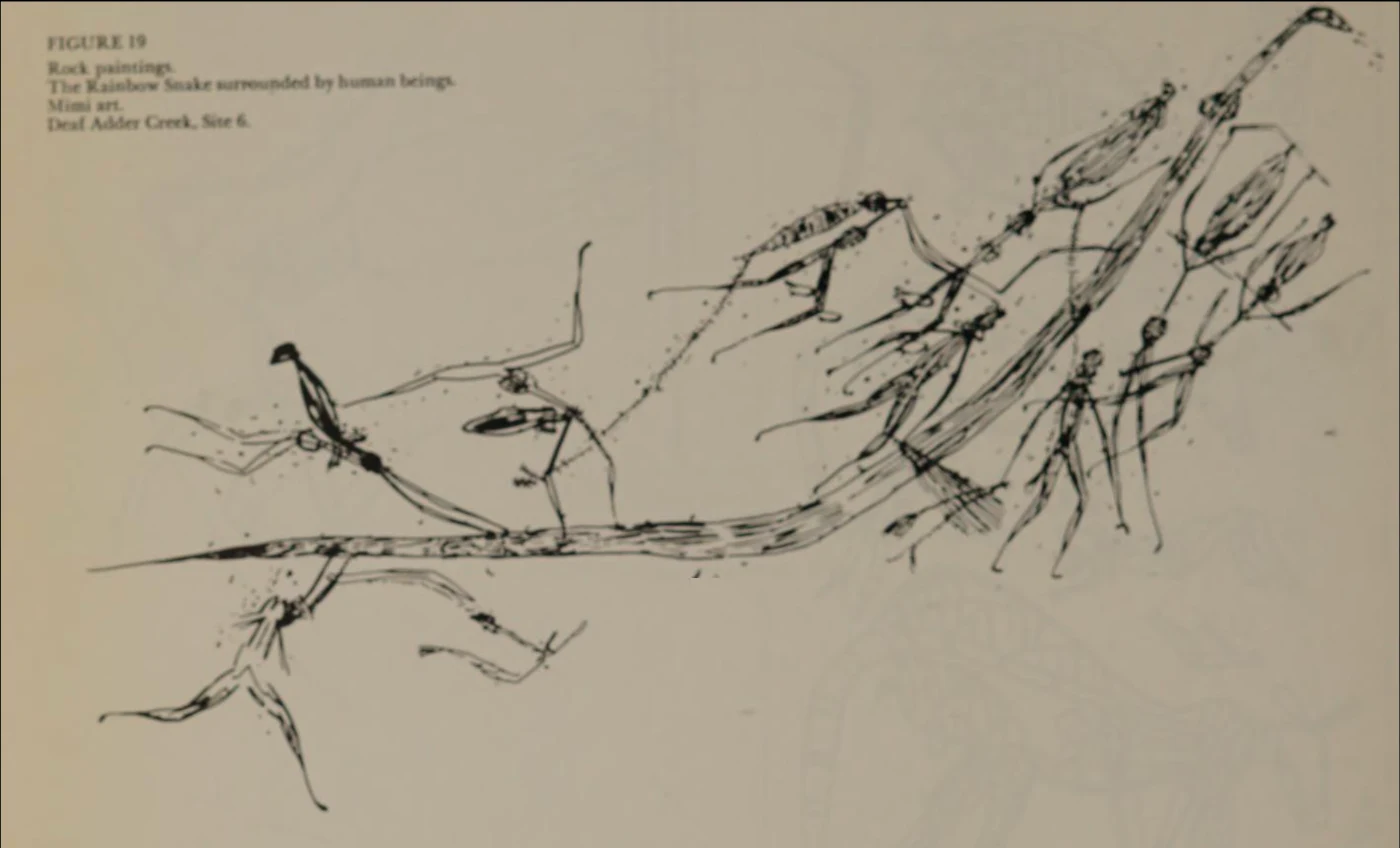
Not everyone accepted Brandl’s name. The 1996 study ran the painting through the same measures as the later serpents and found it “the most ‘snake-like’” of all (p. 115). The authors concluded that “it was more likely a snake rather than a Rainbow Serpent”. George Chaloupka read the swelling at its neck as skin being shed and thought it “probably is a large python” (p. 106). The team still gave it weight: “even if it does represent a snake, not a Rainbow Serpent, it is still an important image, as the snake itself has long been considered a powerful being with special properties for the people of greater Arnhem Land. That it was so during the Dynamic Period is signalled by its exaggerated size when compared to the human figures interacting with it” (p. 115).
So the sequence runs from a giant snake among running people, about 10,000 years ago or more, to the composite serpents of the Yam style soon after.
Painted as the sea came in #
At the end of the last Ice Age, northern Australia lost a plain. The Arafura Sea and the Gulf of Carpentaria were dry land at the glacial low, joining Australia to New Guinea. In the southern Gulf, Craig Sloss and colleagues found that the rising sea “breached the Arafura Sill ca. 11,700 cal. yr BP. Sea levels continued to rise to ca. -30 m by 10,000 cal. yr BP … By 7,700 cal. yr BP sea-level reached present mean sea-level” and went on to stand 1.5–2 m higher until about 4,000 years ago (Sloss et al. 2018, p. 1411).
The amber dots on the map are the land lost in the last stage, between 30 m below present and today. That stage falls inside the Yam period. All of Van Diemen Gulf was dry when the first Yam serpents were painted, and the shelters at Awunbarna stood well inland. By the end of the period the sea had reached today’s coast and risen a little past it.
Taçon drew the connection himself. The 1996 paper opens with it: “at about this time the first depictions of Rainbow Serpents, great composite beings with supernatural significance, appeared on rock shelter walls and ceilings” (p. 103). His thesis put the rainbow at the centre. The monsoon arrived with the new climate, rainbows “would have been seen much more frequently in the sky”, and they “ultimately … became a symbol of this destruction and creation and a complex belief system arose incorporating this image” (Taçon 1989, pp. 310–11). Darrell Lewis had argued in 1988 that composite Rainbow Snake beliefs arose “to counteract tensions caused by the effects of rising sea level” (Lewis 1988, p. 109).
The stories carry the flood. In western Arnhem Land, Taçon recorded that creation “resulted from the action of water”, and that “the Rainbow Snake is said to have been the ultimate cause of the great flood and continues to cause flooding today” (Taçon 1989, p. 247). Elders said most of the serpents were painted by no human hand: those at Ubirr and in Deaf Adder Gorge “are said to have been placed on the rock by the Being itself in the Dreamtime” (p. 311).
What the serpents do #
The early paintings are crowded with flying foxes. Sixteen of the 107 serpents in the 1996 sample have them, 50 bats in all, many hanging from lines that trail off the serpent (p. 117). On Jim Jim Creek, one Yam serpent trails 13 of them.
The Badmardi tell why. Gulinj, the flying-fox man, sent his two sons to an initiation ceremony among the Jawoyn. On their way home the Rainbow Serpent swallowed them. The story is painted at Djuwarr in Deaf Adder Gorge: a serpent with breasts, the two boys inside its loops (1996, pp. 117–18, after Chaloupka et al. 1985, p. 80). The Awunbarna serpents swallow too. One holds a woman inside its body. Two have breasts. The largest, 6.1 m long with a crocodile’s head and teeth, covers a ceiling where stories were told to young men. Nearby, 124 m of laid stones form a Rainbow Serpent on the old Morak initiation ground, and the “Rainbow” would punish anyone who broke the law (Taçon et al. 2026).
Kenneth Maddock traced the same pairing of serpent and bat across the Top End and found the two always opposed, “sky and water, above and below, upward movement and downward movement”. He gave the bullroarer its place in the scheme: “in the Gunabibi, further to the east in Arnhem Land, rainbow-serpent imagery is predominant and flying foxes appear to women at a moment when bull-roarers (rainbow-serpent symbols) are sounding in concealment” (Maddock 1978, p. 6, quoted in Taçon et al. 1996, p. 119). In north-east Arnhem Land the identification is complete. A Yolngu roarer painted with a python is the voice of the great snake Yurlunggur, and women were told that any who came near would be swallowed (Bullroarer Atlas, AUSIN-017).
Beyond Arnhem Land #
No other region has a dated sequence like this. The Kimberley has the nearest rival: at Wonalirri, a snake with three horns lies beneath a reclining Wandjina 7 m long, its body carrying seven Wandjina heads (Lommel 1955). It is undated and has been repainted many times. The 1996 study found no variation in the Yam serpents between language groups or regions within Arnhem Land and argued for “an early origin and an in situ development” (p. 120). For the place of the Rainbow Serpent among the world’s earliest snake images, see the earliest snake art by continent. For the languages spoken around the Gulf in the same millennia, see the cradle of Pama-Nyungan.
Sources #
- Brandl, Eric J. Australian Aboriginal Paintings in Western and Central Arnhem Land: Temporal Sequences and Elements of Style in Cadell River and Deaf Adder Creek Art. Canberra: Australian Institute of Aboriginal Studies, 1973. Fig. 19.
- Jones, Tristen, Vladimir A. Levchenko, Penelope L. King, Ulrike Troitzsch, Daryl Wesley, Alan N. Williams and Alfred Nayinggul. “Radiocarbon age constraints for a Pleistocene–Holocene transition rock art style: the Northern Running Figures of the East Alligator River region, western Arnhem Land, Australia.” Journal of Archaeological Science: Reports 11 (2017): 80–89.
- Jones, Tristen. Disentangling the Styles, Sequences and Antiquity of the Early Rock Art of Western Arnhem Land. PhD thesis, Australian National University, 2017.
- Lewis, Darrell. The Rock Paintings of Arnhem Land, Australia: Social, Ecological and Material Culture Change in the Post-Glacial Period. BAR International Series 415. Oxford, 1988.
- Lommel, Katharina. “The rock painting site at Wonalirri.” In Rock Painting Sites in the Kimberley Region, records of the 1955 Frobenius Institute expedition.
- Maddock, Kenneth. “Introduction.” In I. Buchler and K. Maddock (eds), The Rainbow Serpent: A Chromatic Piece. The Hague: Mouton, 1978.
- Sloss, Craig R., et al. “Holocene sea-level change and coastal landscape evolution in the southern Gulf of Carpentaria, Australia.” The Holocene 28(9) (2018): 1411–1430. Open copy.
- Taçon, Paul S. C. From Rainbow Snakes to ‘X-ray’ Fish: The Nature of the Recent Rock Painting Tradition of Western Arnhem Land, Australia. PhD thesis, Australian National University, 1989.
- Taçon, Paul S. C., Meredith Wilson and Christopher Chippindale. “Birth of the Rainbow Serpent in Arnhem Land rock art and oral history.” Archaeology in Oceania 31(3) (1996): 103–124.
- Taçon, Paul S. C., Sally K. May, Joakim Goldhahn, et al. “Extraordinary back-to-back human and animal figures in the art of western Arnhem Land, Australia: one of the world’s largest assemblages.” Cambridge Archaeological Journal 32(4) (2022): 707–720.
- Taçon, Paul S. C., Sally K. May, Andrea Jalandoni and Ronald Mungulda. “Paintings of Rainbow Serpents and other big creatures of Awunbarna, Northern Territory, Australia.” Australian Archaeology 92 (2026): 167–184.