~/anthropology/cultural-diffusion
The First Canoe: When Was Easter Island Settled?
When was Easter Island first inhabited? A timeline of settlement dates, from ancient banana remains to the strongest evidence around 1200 CE.
TL;DR
- Around 1200 CE is the strongest answer for permanent Polynesian settlement of Rapa Nui.
- Earlier published suggestions include 450 BCE, 50–100 CE, and the familiar 300–400 and 800–1000 CE chronologies. Their evidence varies substantially.
- Banana remains associated with dates around 1730–800 BCE are a striking dating problem: the bananas themselves were not dated.
- Genetic evidence establishes American–Polynesian contact before European arrival. Its dates concern encounters between populations, rather than the first habitation of Easter Island.
When did the first canoe reach Easter Island? #
A banana is a strange place to begin the history of Easter Island.
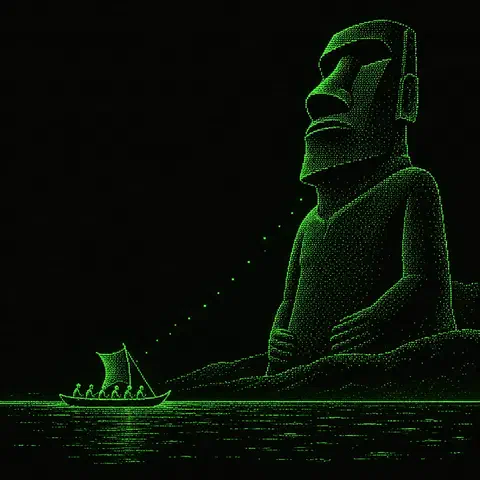
The statues usually get there first. Long faces, heavy brows, stone ancestors standing against an enormous ocean. They make the island look like the last surviving room of a much older world. But a cultivated plant asks a more intimate question. Somebody had to bring it.
In 2013, researchers studying sediment from Rano Kau, one of the island’s volcanic craters, reported microscopic banana remains in layers containing plant material thousands of years old. The associated dates reached back to roughly 1730–800 BCE. If those dates securely dated banana gardening, the island’s history would begin far earlier than the familiar Polynesian settlement story. They do not securely date it. The distinction is small enough to disappear in a headline and large enough to move the first canoe by three thousand years. (Horrocks et al., 2013.)
The best-supported settlement date is around 1200 CE. Excavated occupation deposits, careful selection of radiocarbon samples, and a separate genetic reconstruction converge on this general period. The uncertainty concerns the edges of that settlement window and the possibility of earlier human presence. (Hunt and Lipo, 2006; Ioannidis et al., 2021.)
There is a substantial scholarly history behind the other dates. Some were once standard archaeology. Others come from pollen, charcoal, and crops preserved in crater sediments. The useful way to read them is as a timeline of proposals, keeping the evidence attached to each date.
What settlement dates have researchers proposed? #
The dates below run from the earliest suggested human activity to the modern settlement estimates. BCE means before the common era; CE corresponds to AD. Dates in the first column belong to the proposed event. Publication years identify the researchers’ work.
RAPA NUI / CHRONOLOGY
The first canoe, and everything after
○ Proposed early presence◆ Historical milestone
- c. 1730 BCE
The oldest banana-associated sediment date
Rano Kau deposits contain banana microfossils alongside other, dated plant remains.
- c. 900 BCE
Lapita voyagers reach Tonga
Settlement reaches western Polynesia, far to the west of Rapa Nui.
- c. 450 BCE
An early arrival proposed
Weed pollen, burning, and forest change at Rano Raraku suggest people to one research team.
- c. 100 CE
Another possible human footprint
Charcoal and forest disturbance at Rano Kau underpin an early-presence proposal.
- c. 400 CE
The familiar early settlement date
Older charcoal dating helps establish a fourth-century arrival in accounts of the island.
- c. 600 CE
A plant from America enters the picture
Sisyrinchium pollen in crater sediments supplies another proposed early introduction.
- c. 900 CE
An earlier archaeological consensus
A synthesis of excavation evidence favors settlement around this period.
- c. 1200 CE
BEST-SUPPORTED SETTLEMENT
The Polynesian community that stayed
Excavated occupation deposits and genetic reconstruction converge on permanent settlement.
- c. 1250 CE
American and Polynesian ancestors meet
The ancestry-mixing window in ancient Rapanui genomes begins around this time.
- c. 1300 CE
Monument building expands
Ahu construction accelerates as communities develop the island’s monumental landscape.
- 1722
Europeans reach Rapa Nui
Roggeveen’s expedition sights the island on Easter Sunday, 5 April.
- 1862
The slave raids begin
Peruvian slave traders deport islanders, beginning a catastrophic chapter.
- 1877
About 110 people remain
Deportations, disease, and departures have devastated the island’s population.
- 1888
Chile annexes Rapa Nui
An agreement with island leaders precedes annexation on 9 September.
| Proposed date | Published suggestion | What the evidence gives us |
|---|---|---|
| c. 1730–800 BCE | Horrocks et al., 2013: banana phytoliths in Rano Kau layers containing other plant remains with unexpectedly old dates. | A botanical anomaly. The bananas were not directly dated; sediment movement or carbon-related dating effects could explain the association. Paper |
| c. 450 BCE | Cañellas-Boltà et al., 2013: weed pollen, burning, and vegetation change at Rano Raraku were interpreted as human arrival. | An explicit early-settlement hypothesis based on environmental evidence. An inhabited site of this age has not been established. Paper |
| c. 50–100 CE | Butler and Flenley, 2010: forest disturbance and charcoal at Rano Kau suggested possible human activity. | The authors also considered natural causes and described the evidence as equivocal. Paper |
| c. 300–400 CE | Older environmental and archaeological chronologies. The Norwegian expedition’s charcoal dating supported the familiar fourth-century estimate; a third-century date circulated widely too. | Historically influential dates. The early charcoal’s connection to first habitation was insecure. The 1995 ICOMOS assessment still repeated 300 CE. Archaeological review; ICOMOS |
| c. 420–636 CE | Horrocks et al., 2015: pollen of the American plant Sisyrinchium occurred through a Rano Aroi Iti core with unexpectedly old basal ages. | Another clue to possible early introduction, rather than a securely dated settlement. Paper |
| 800–1000 CE | Martinsson-Wallin and Crockford, 2001: an archaeological synthesis favored this interval, including early occupation at Anakena. | A substantial older proposal behind familiar dates around 800 or 900. Subsequent dating work reduced support for the early endpoints. Paper |
| 1000–1300 CE | Wallin et al., 2010; Berenguer et al., 2024: a broader bracket for Anakena’s early occupation deposits. | A range still used in crop research. It should not be shortened into a demonstrated arrival in 1000 CE. Dating discussion |
| 1150–1280 CE | DiNapoli et al., 2020: statistical modeling of archaeological radiocarbon evidence. | A modern settlement interval centered on the period around 1200. Paper |
| c. 1200 CE | Hunt and Lipo, 2006: Anakena excavations and reassessment of earlier radiocarbon dates. | The central modern estimate for permanent Polynesian settlement. Paper |
| 1200–1253 CE | Wilmshurst et al., 2011: a regional analysis using selected, high-reliability radiocarbon dates. | A refined estimate within the thirteenth-century chronology. Paper |
| c. 1210 CE | Ioannidis et al., 2021: reconstruction of Polynesian founding populations from genetic relationships. | Separate support for settlement in the same period. The calendar estimate depends on demographic assumptions. Paper |
| 1221–1268 or 1245–1280 CE | Schmid et al., 2018: alternative statistical models, excluding or including wood-charcoal dates. | Two estimates reinforcing a thirteenth-century settlement. Their narrow intervals should not be mistaken for certain boundaries.1 Paper |
The modern dates cluster because they are looking at much the same historical development. An island enters the archaeological record as an inhabited Polynesian landscape around the turn of the thirteenth century. Differences of a few decades within that cluster matter less than the gap separating it from the proposed BCE arrivals.
Why did Easter Island’s settlement date change? #
A radiocarbon date is a date for a specimen. Turning it into the date of a voyage requires another step: showing how the specimen belongs to the people whose arrival we want to date.
Wood is an obvious trap. The carbon in a piece of timber can have been fixed long before somebody burned it. An old tree can therefore produce old charcoal in a younger campfire. Where that charcoal lies matters too. A sample beneath material dug from a ditch does not automatically date the first people who lived on the island. Hunt and Lipo’s reassessment made the reliability of these associations central to the settlement chronology. (Hunt and Lipo, 2006.)
This was more than a debate over which numbers to keep in a spreadsheet. Researchers could return to the collections and date better material. In 2021, a study revisited residential sites near Rano Kau that had helped support an early chronology. New dates placed their early use in the thirteenth to fifteenth centuries. A particular piece of the older settlement story could be tested, and its calendar changed. (Mulrooney et al., 2021.)
The resulting history is compressed. Settlement around 1200 leaves roughly five centuries before the Dutch expedition of 1722. The famous monuments belong within the history of those Polynesian communities. Modeling of their stone platforms, the ahu, finds a major expansion of construction between the early fourteenth and mid-fifteenth centuries, with construction continuing beyond European contact. The island’s monumental landscape could grow within centuries of its settlement. (DiNapoli et al., 2020.)
The family resemblance between Marquesan tiki and Rapanui moai fits that wider Polynesian history: related traditions carried across the ocean and developed into distinct island forms.
What do the ancient bananas actually tell us? #
Crater lakes preserve a different kind of history from a house or a cooking place. Pollen, charcoal, and fragments of plants accumulate in them, recording changes across the surrounding landscape. A garden can leave traces in a lake even when the garden itself has disappeared.
Rano Kau also contains floating vegetation and material washed or slumped from its slopes. The banana-bearing layers mixed clayey soils with wetland debris. Their dated specimens were remains of other plants. The authors considered both younger gardening material entering older deposits and effects that could make carbon dates appear too old. (Horrocks et al., 2013.)
The distinction preserves the discovery’s interest. Banana cultivation is part of the island’s human history; its connection to these very early dates needs an explanation. Calling the remains ancient does not finish the job of dating the garden.
The 450 BCE proposal at Rano Raraku makes a different connection. There, researchers linked a weed associated with disturbed ground to burning and forest change. They argued that people had arrived. The debate concerns whether those environmental signals establish human introduction and occupation at that time. A later published criticism challenged that inference. These are real disagreements over evidence, rather than a choice between accepting every early date and pretending nobody proposed one. (Cañellas-Boltà et al., 2013; Larsen and Simpson, 2014.)
An early landing, a short stay, and a lasting settlement would also leave different amounts of evidence. The first canoe might leave very little. A population raising children, planting crops, cooking meals, and burying its dead has many more opportunities to enter the record. The settlement date describes the establishment of that community. It need not be the date when the island first appeared above somebody’s horizon.
Where does Rapa Nui fit in the history of Polynesian contact? #
Rapa Nui sits near the end of a long eastward expansion. Lapita settlement reached Tonga around 900 BCE. Much later, voyagers explored and settled the archipelagos of eastern Polynesia. One regional reconstruction places settlement of the Society Islands in 1025–1120 CE, followed by a major outward expansion in 1190–1290. Research on islands such as Atiu also shows why exploration, colonization, and establishment can have different dates. (Burley et al., 2012; Wilmshurst et al., 2011; Sear et al., 2020.)
The ocean connected people to America as well. A 2020 genetic study found evidence of American–Polynesian contact around 1200 CE and favored an encounter elsewhere in eastern Polynesia before Rapa Nui’s settlement. A 2024 study of ancient Rapanui genomes dated American–Polynesian ancestry mixing to approximately 1250–1430 CE. Neither result identifies the beach where the encounter happened. (Ioannidis et al., 2020; Moreno-Mayar et al., 2024.)
This gives the trans-Pacific contact story a firm genetic foundation. It also gives us a useful separation of questions. The ancestry of a population can record an encounter that happened elsewhere. Dating that encounter does not automatically date the settlement of every island its descendants reached.
| Date | Milestone |
|---|---|
| c. 900 BCE | Lapita settlement reaches Tonga in western Polynesia. Study |
| c. 900–1300 CE | Exploration and establishment spread through eastern Polynesia, with different dates for different islands. Study |
| c. 1200 CE | The strongest archaeological evidence places permanent settlement of Rapa Nui in this period. Study |
| c. 1200 CE | Genetic reconstruction places American–Polynesian contact around this time, probably elsewhere in eastern Polynesia. Study |
| c. 1250–1430 CE | Ancient Rapanui genomes date American–Polynesian ancestry mixing in the ancestors of the sampled individuals. Study |
| Early 1300s–mid-1400s, continuing later | Ahu construction expands strongly; modeled construction sequences extend beyond European arrival. Study |
| 5 April 1722 | Roggeveen’s expedition sights the island on Easter Sunday, its first documented European encounter. Chronology |
| 1770, 1774, 1786 | Spanish, British, and French expeditions visit, led respectively by González de Haedo, Cook, and La Pérouse. Chronology |
| 1862–1863 | Peruvian slave traders raid the island. Chronology |
| 1877 | About 110 inhabitants remain on the island, following the nineteenth century’s slave raids, deportations, disease, and departures. Historical account |
| 9 September 1888 | Chile annexes Rapa Nui following an agreement with island leaders. Biblioteca Nacional de Chile |
Rapanui tradition remembers the founding voyage through Hotu Matu’a and an ancestral homeland called Hiva. That memory belongs beside the archaeological history, without forcing it into a calendar year the tradition cannot independently supply. (Rull, 2019.)
The first canoe remains beyond our view. What comes into focus around 1200 is the community that stayed: people carrying an agricultural world across the sea, establishing families, and making a new island into home. Their descendants gave its ancestors stone bodies. The moai are the most visible part of that history. The plants brought in the canoes are among its smallest and most revealing witnesses.
Sources #
- Horrocks, M., et al. “Pollen, phytoliths, arthropods and high-resolution ¹⁴C sampling from Rano Kau, Easter Island.” Journal of Paleolimnology 50 (2013): 417–432.
- Cañellas-Boltà, N., et al. “Vegetation changes and human settlement of Easter Island during the last millennia.” Quaternary Science Reviews 72 (2013): 36–48.
- Butler, K. R., and J. R. Flenley. “The Rano Kau 2 pollen diagram: palaeoecology revealed.” Rapa Nui Journal 24(1) (2010): 5–10.
- Martinsson-Wallin, H., and S. J. Crockford. “Early Settlement of Rapa Nui (Easter Island).” Asian Perspectives 40(2) (2001): 244–278.
- ICOMOS. “Rapa Nui National Park: World Heritage Evaluation.” 1995. Used here as a record of an older chronology.
- Horrocks, M., et al. “A plant microfossil record of Late Quaternary environments and human activity from Rano Aroi and surroundings, Easter Island.” Journal of Paleolimnology 54 (2015): 279–303.
- Berenguer, P., et al. “Identification of breadfruit (Artocarpus altilis) and South American crops introduced during early settlement of Rapa Nui (Easter Island), as revealed through starch analysis.” PLOS ONE 19(3) (2024): e0298896. Includes the earlier Anakena dating discussion.
- Hunt, T. L., and C. P. Lipo. “Late Colonization of Easter Island.” Science 311 (2006): 1603–1606.
- Wilmshurst, J. M., et al. “High-precision radiocarbon dating shows recent and rapid initial human colonization of East Polynesia.” PNAS 108(5) (2011): 1815–1820.
- Schmid, M. M. E., et al. “How ¹⁴C dates on wood charcoal increase precision when dating colonization: The examples of Iceland and Polynesia.” Quaternary Geochronology 48 (2018): 64–71.
- DiNapoli, R. J., et al. “A model-based approach to the tempo of ‘collapse’: The case of Rapa Nui (Easter Island).” Journal of Archaeological Science 116 (2020): 105094.
- Mulrooney, M. A., et al. “Refining the Chronology of Rapa Nui (Easter Island) Rectangular Houses.” Journal of Pacific Archaeology 12(1) (2021): 72–83.
- Larsen, A., and D. F. Simpson Jr. “Comment to Rull et al. (2013)—Challenging Easter Island’s Collapse: the need for interdisciplinary synergies.” Frontiers in Ecology and Evolution 2 (2014): 56.
- Burley, D., M. I. Weisler, and J.-x. Zhao. “High Precision U/Th Dating of First Polynesian Settlement.” PLOS ONE 7(11) (2012): e48769.
- Sear, D. A., et al. “Human settlement of East Polynesia earlier, incremental, and coincident with prolonged South Pacific drought.” PNAS 117(16) (2020): 8813–8819.
- Ioannidis, A. G., et al. “Native American gene flow into Polynesia predating Easter Island settlement.” Nature 583 (2020): 572–577.
- Ioannidis, A. G., et al. “Paths and timings of the peopling of Polynesia inferred from genomic networks.” Nature 597 (2021): 522–526.
- Moreno-Mayar, J. V., et al. “Ancient Rapanui genomes reveal resilience and pre-European contact with the Americas.” Nature 633 (2024): 389–397.
- Boersema, J. J. The Survival of Easter Island: Dwindling Resources and Cultural Resilience. Cambridge University Press, 2015. Historical timeline, pp. ix–x.
- Biblioteca Nacional de Chile. “Incorporándola al territorio chileno.” Memoria Chilena.
- Rull, V. “Human Discovery and Settlement of the Remote Easter Island (SE Pacific).” Quaternary 2(2) (2019): 15.
Published ranges use different conventions. Wilmshurst et al.’s 1200–1253 CE gives earliest and latest likely ages under their method. DiNapoli et al.’s 1150–1280 CE is a 95.4% modeled interval. Schmid et al.’s 1221–1268 and 1245–1280 CE estimates are 68% posterior intervals, respectively excluding and including wood charcoal (Tables 3–4). In the banana paper, 3,680–2,750 cal BP means calibrated years before 1950, approximately 1730–800 BCE. It dates associated specimens rather than the bananas. ↩︎