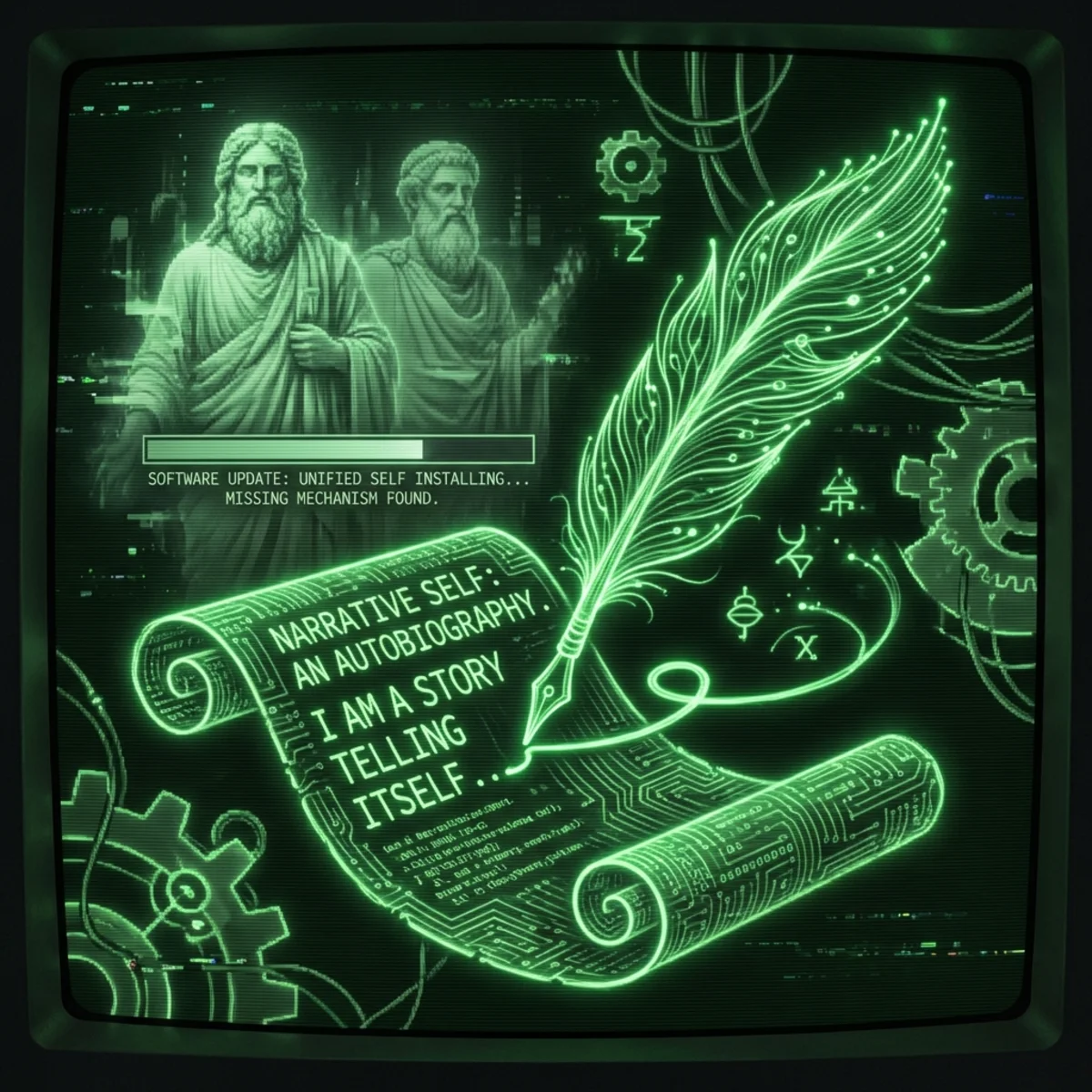
TL;DR
- Dennett views the self as a “center of narrative gravity”—a cultural construct rather than a biological given—but leaves the specific timeline and mechanism of its origin vague.
- Julian Jaynes proposed a radical “software revolution” (the breakdown of the bicameral mind) to explain this, but his ~1200 BCE date contradicts archaeological evidence of earlier complexity.
- The Eve Theory of Consciousness (EToC) provides the missing link: it posits a specific, plausible window (Late Paleolithic/early Neolithic) and mechanism (recursive self-modeling taught as a meme) for the birth of the narrative self.
- EToC fits Dennett’s requirement for a cultural origin story while solving Jaynes’s timing problem, effectively offering a “dual inheritance” model where a memetic software update eventually shaped genetic hardware.
“We are all virtuoso novelists… And that story is our autobiography. The chief fictional character at the centre of that autobiography is one’s self.”
— Daniel Dennett
Dennett’s Account of Consciousness and the Self#
Daniel Dennett’s theory of consciousness famously rejects any mysterious inner observer or immaterial soul. In works like Consciousness Explained (1991), Dennett portrays consciousness as the emergent outcome of numerous parallel mental processes – a “multiple drafts” with no single central experiencer. The self, in this view, is not a fixed essence but a construct that our brains generate through narrative. Dennett describes the self as a “center of narrative gravity” – a useful but abstract fiction, much like the center of gravity in physics 1 2. We become the stories we tell about ourselves. In his vivid phrase, “we are all virtuoso novelists… And that story is our autobiography. The chief fictional character at the centre of that autobiography is one’s self.” 3 The brain acts as author, spinning a coherent narrative to make sense of the flood of experiences, with the self as the protagonist in that personal story.
A key feature of Dennett’s account is the emphasis on memes and cultural evolution in shaping human minds. Building on Richard Dawkins’ concept of memes (units of cultural replication), Dennett argues that human consciousness is largely a product of culture and language, not solely a hard-wired biological program. In fact, he suggests that human consciousness “is too recent an innovation to be hard-wired into the innate machinery” of our brains and “is largely the product of cultural evolution” – essentially a suite of memes installed during development 4. He even goes so far as to call human consciousness “a huge complex of memes” residing in the brain 5. In Dennett’s narrative, once our ancestors acquired language and other “mind tools,” a cognitive revolution ensued: memes (like words, stories, and other culturally transmitted ideas) enabled new recursive thinking. Humans learned to talk to themselves (internally), creating what Dennett calls the “Joycean machine” of conscious thought – an internal narrator that evolved through cultural interactions and linguistic “infections” 6 7. This aligns with his view that you “can’t have consciousness without having the concept of consciousness,” much like one cannot literally have money without the concept of money 8. In short, our ability to reflect and to conceive of a self may have arisen as a learned ability, bootstrapped by language and shared narratives.
Despite the richness of Dennett’s model, one unresolved question is the precise origin and timing of this narrative self. Dennett implies that as soon as language and culture reached sufficient complexity, the stage was set for an autobiographical, narrating self to emerge – but he gives only broad strokes of how this happened. He does not pinpoint when in human prehistory this transition took place, other than that it was after language and memetic culture evolved. In fact, Dennett has acknowledged that the evolution of full human self-awareness was a gradual cultural process whose exact course is an empirical question outside mere philosophy. As he notes, we know humanity “had to have travelled from point A to point B” (from a mind lacking an introspective self to a mind like ours) “by some route – where and when the twists come is an interesting empirical question.” 9. In other words, the timeline and specific mechanism by which the narrative, autobiographical self arose are left somewhat vague in Dennett’s account. He offers a compelling vision of what the self is (a narrative fiction shaped by memes) and why culture would favor such self-models, but not a detailed story of how and when in history this capacity first crystallized. This is where other thinkers’ ideas, and ultimately the Eve Theory of Consciousness, enter the picture.
Julian Jaynes and the Bicameral Mind#
One bold attempt to answer the “when and how” of consciousness is Julian Jaynes’ bicameral mind theory. In his 1976 book The Origin of Consciousness in the Breakdown of the Bicameral Mind, Jaynes proposed that human self-consciousness – the introspective mind with an “inner voice” – is not only learned and cultural (as Dennett would later agree), but also a relatively recent development in history. According to Jaynes, humans as late as the Bronze Age did not subjectively experience having an internal mental space or a narrative self. Instead, their brains operated in a “bicameral” mode: decision-making was guided by auditory hallucinations (experienced as the voices of gods or ancestors) emanating from the right brain, which commanded the left brain 10 11. These ancient people followed whatever the commanding voice told them, rather than deliberating introspectively as modern minds do. As Jaynes dramatically put it, “The characters of the Iliad do not sit down and think out what to do. They have no conscious minds such as we say we have, and certainly no introspections.” 12 In historical texts like the Iliad or early portions of the Bible, Jaynes noted, people never discuss their own mental processes; instead, gods literally tell them what to do 12 13. The bicameral mind, by Jaynes’s definition, lacked a concept of “I” and an internal narrative – those features only appeared after the bicameral system “broke down.”
What caused the breakdown of the bicameral mind and the birth of conscious selfhood? Jaynes hypothesized that increasing societal complexity around the second millennium BCE (c. 1200 BCE, during the Late Bronze Age) forced a change. Crises and novel situations (such as the collapse of Bronze Age civilizations) made the old hallucinated gods unreliable; humans had to become more flexible and introspective to cope 14 15. In Jaynes’s telling, this transition was essentially a cultural revolution – a learned change in mentality. People began to include the self in the cognitive loop, effectively “speaking to themselves” internally rather than hearing divine commands. Over a few centuries, the narrative, self-reflective mode of mind spread and became common, ushering in the dawn of subjective consciousness as we know it. Jaynes even pinpointed historical markers of this change: for example, by the time of Homer’s Odyssey (a few centuries after the Iliad), characters exhibit introspection and guile, suggesting the authors themselves had conscious minds.
Jaynes’s theory was undeniably radical – he was effectively claiming that consciousness, in the strong sense of introspection, is a cultural invention only ~3,000 years old. He wrote that “consciousness is a learned process based on metaphorical language,” not an innate biological given 16 17. The proposal drew fascination and criticism in equal measure. (Richard Dawkins quipped that Jaynes’s book “is either complete rubbish or a work of consummate genius” 18.) Most scientists found the late date implausible – after all, humans had art, toolmaking, and civilizations long before 1200 BCE, which would seem to require creative insight and planning. However, the spirit of Jaynes’s idea – that consciousness is a cultural and linguistic construction rather than a timeless neurological fact – struck a chord with many, including Daniel Dennett.
Dennett has repeatedly praised Jaynes for asking the right questions, even if his specific answers were questionable. Rather than dismiss Jaynes, Dennett endorsed the broad framework of a culturally emergent consciousness. He argued that Jaynes’s bold, “top-down” approach – studying consciousness as an evolving narrative capability – was on the right track 19. In a 1986 commentary, Dennett suggested that Jaynes “may have been wrong about some of his supporting arguments… but these things are not essential to his main thesis.” 19 What matters is the core thesis that our kind of conscious mind had to come from a prior mindlessness via some cultural evolutionary path. Dennett puts it succinctly: even if Jaynes “doesn’t have the details just right, then some other story which is in very important respects rather like it must be true.” 9 There had to be some sequence of developments by which humans acquired a self that they previously lacked – a journey from essentially “mindless” behavior to narrated, self-aware thought. In Dennett’s view, Jaynes offered a daring sketch of that journey. The exact timeline might be off (Dennett suspects the transition began much earlier than 1200 BCE), and the mechanism might not hinge so much on hallucinations, but something like Jaynes’s cultural evolution of mind must have happened to produce the modern self 9.
Crucially, Dennett shares Jaynes’s intuition that language and culture were the drivers of this change. The difference is mostly a matter of when and how gradually it occurred. Jaynes imagined a relatively abrupt “breakdown” a few millennia ago; Dennett leans toward a more gradual emergence starting further back (potentially tens of thousands of years ago, as soon as complex language appeared). But because Dennett did not commit to a specific historical scenario, his work leaves open the question of what cultural innovations, at what point in prehistory, gave rise to the narrative self. He acknowledges that answering this requires interdisciplinary evidence (archaeology, anthropology, linguistics) beyond philosophy – exactly the sort of evidence Jaynes marshaled, even if imperfectly.
This is where the Eve Theory of Consciousness (EToC) enters. EToC can be seen as a contemporary elaboration of the Jaynes-Dennett view, one that aims to “get the details right” by combining biology, culture, and history. As Dennett might say, EToC is the “other story” – the clarified version of how an earlier human mind turned into a self-aware mind.
Eve Theory of Consciousness: The “Something” That Was Missing#
The Eve Theory of Consciousness (EToC) is a recent proposal that builds on the groundwork laid by thinkers like Dennett and Jaynes, updating their ideas with modern evidence from genetics, archaeology, and anthropology. The central claim of EToC is that conscious self-awareness was a late cultural innovation – much as Jaynes argued – but that it arose earlier than 1200 BCE and in a way that meshes with what we know about prehistoric culture. In broad outline, EToC suggests that one particular human (or group) made a cognitive breakthrough – essentially discovering introspective self-consciousness – and that this new mental skill spread memetically (like a mind-virus) through the population, becoming the norm and even altering our genetic makeup over time. The name “Eve” in EToC is evocative: it implies a memetic Eve, analogous to a Mitochondrial Eve, meaning the first teacher of the consciousness “meme” from whom the knowledge was passed to all humans (the theory also sometimes speaks of a “memetic Adam” as the male counterpart in the spread). EToC positions itself as “that something” which Dennett alluded to – the concrete scenario by which culture and biology together produced the narrative self.
Let’s break down how EToC addresses the unresolved pieces in Dennett’s account:
Integrating Genes and Culture – Dual Inheritance#
A major strength of EToC is its explicit integration of biological evolution and cultural evolution (a dual inheritance model). Dennett had noted that consciousness is like software running on the hardware of our brains 20. But if a new “mental software” (the self) arose culturally, might it eventually get “hardwired” into our biology? EToC answers yes. According to EToC, early humans lived in a mainly bicameral (non-introspective) state for hundreds of thousands of years. Then, once the self-awareness meme was introduced and spread culturally, it conferred huge survival advantages – those who internalized a self could plan, imagine, and strategize better than those who did not. Over subsequent millennia, this created selection pressure on genes: individuals whose brains were more amenable to acquiring a self (i.e. who could learn language, imagination, and empathy more readily in childhood) had more success. In other words, culture drove genetic evolution. As the EToC author puts it, after the advent of conscious minds, “for thousands of years there has been strong genetic selection for brains amenable to the seamless construction of ego.” 21 Today, human children automatically develop a self-concept early on, essentially “downloading” the self from culture during normal development. This feels easy now because our brains have evolved to support it. In EToC’s colorful summary, once consciousness spread, “Bicameral Man could not compete with the power of abstractions” and was driven extinct both culturally and genetically 21. This dual inheritance idea tightens Dennett’s meme-based view by explaining how an initially memetic innovation could become a universal human trait: culture taught the self, then genes reinforced it.
A Clear Mechanism and Plausible Timeline for Self-Awareness#
Unlike Dennett (who left the timeline open) or Jaynes (who many argue chose a too-recent date), EToC proposes a more plausible timeframe for the origin of the narrative self: roughly around the end of the last Ice Age, circa 10,000 BCE. This era was a time of dramatic change – humans were developing agriculture, building megaliths, and generating rich mythologies. It’s also a period for which we have archaeological evidence of what some researchers call the “Sapient Paradox” – the puzzling lag between anatomically modern humans (which existed by 200k–50k years ago) and full-fledged “modern” behavior and culture, which blossoms much later 22. EToC suggests that the missing ingredient that ignited the cultural explosion was the meme of introspective consciousness itself.
The mechanism proposed by EToC begins with “Eve” – a metaphorical first conscious human (or a small group) who learns to hear her own thoughts as thoughts. In the mythic language EToC sometimes employs, “Eve first creates ruminative space between hearing and doing – a self with which to wrestle hypotheticals, a land of symbols. She becomes like god, able to judge between good and evil… She is the mother of what we now call living.” 23 In plain terms, this first innovator (envisioned as female, hence “Eve”) internalized what had been external voices, realizing they emanated from her own mind. This gave her an unprecedented ability to reflect, imagine alternatives, and make choices – essentially, the birth of recursive self-modeling (thinking about one’s own thoughts). With this came new emotions and existential insights: “This birth also brought death,” notes the EToC account, meaning Eve’s tribe became aware of mortality and meaning in a way no animal or bicameral human had before 24. Such awareness spurred changes like planning for the future and even proto-morality (since imagining oneself in another’s shoes is a form of recursion). EToC posits that women were likely the first to cultivate this introspective faculty (perhaps via social communication or lullabies or teaching children), and they then initiated men into it through guided experiences (rituals or rites of passage) 25. This idea interestingly ties in with the anthropological observation that many cultures have female-led shamanic traditions or that language development in children is often advanced by mothers.
Importantly, EToC provides a step-by-step narrative for the spread of the conscious mind. After the first individuals achieved this self-referential insight, they shared it – not by explaining (since language itself was only just adequate for it), but likely by demonstration, storytelling, and ritual. The theory envisions a prehistoric “Great Awakening”: once the innovation caught on, perhaps within a few generations it “spread to the whole of humanity, like wildfire; a Great Awakening recorded in creation myths worldwide.” 25 By the dawn of the Neolithic age, multiple societies had transitioned to essentially modern thought, which might explain the near-simultaneous rise of agriculture and complex religion in different regions (e.g. the Middle East, Asia, the Americas). In contrast to Jaynes’s abrupt late breakdown, EToC’s timeline (end of Ice Age) fits better with what we see: significant cultural creativity was already underway by ~10k BCE (Göbekli Tepe and other ancient sites suggest organized thought in that period). EToC argues that Jaynes’s error was timing – “The fatal flaw is Jaynes’s date. It simply has to be more distant and aligned with the documented psychological revolution of our species.” 26 In other words, the self likely arose thousands of years earlier than Jaynes thought, coinciding with the great florescence of symbolic art, religion, and societal complexity at the end of the Paleolithic. By anchoring the narrative self’s emergence to this plausible window, EToC strengthens the Jaynesian framework with a timeline that makes sense in light of archaeological evidence.
Mythic Diffusion and the Memetic “Eve/Adam” in World Myths#
One of the most intriguing aspects of EToC is how it connects the rise of consciousness to ancient myths and legends. If a “Great Awakening” of selfhood really occurred, one might expect it to be reflected in the stories that survived from antiquity – albeit in symbolic form. EToC points out that creation myths and religious stories from around the world share certain themes that align uncannily well with the idea of a sudden acquisition of knowledge (and its consequences). The most obvious is the Genesis story of Adam and Eve: Eve eats from the Tree of Knowledge, gains the knowledge of good and evil, becomes self-aware (and aware of her nakedness, i.e. self-conscious), and as a result, she and Adam are expelled from the blissful ignorance of Eden. This, EToC suggests, is not a coincidence or merely an allegory of sexual awakening (as often interpreted), but a distant cultural memory of the real psychological event – the “fall” into consciousness 27 28. In EToC’s retelling, Eve (the first mind to know itself) “becomes like god” in her newfound ability to reflect and choose, and she shares this fruit of knowledge with Adam (representing the rest of humanity) 23 25. The result is humanity’s exile from the unreflective paradise of the bicameral state into the challenging but fruitful world of conscious thought (with its moral anxieties, freedom, and burdens).
Furthermore, EToC notes that many cultures have myths of a First Woman or First Shaman who brought wisdom or light to humanity – these could be echoing the original “Eve.” There are also widespread flood myths or catastrophe myths that might metaphorically encode the tumult of the consciousness transition (e.g. the world before vs. after a great change). The theory also leans on Carl Jung’s idea of myths as “psychic phenomena that reveal the nature of the soul” 29, suggesting that shared mythic images (like serpents, forbidden fruit, or heavenly knowledge) are collective memories of how consciousness came to be. Even Jaynes had pointed out that oracles, prophets, and the sudden silence of gods in ancient records hint at humans losing their external divine voices and seeking new ways to access guidance – which fits the idea of a conscious era supplanting a bicameral era 30 31.
In EToC, “memetic Eve” and “memetic Adam” are shorthand for the first innovators and the first converts in this process. The theory doesn’t imply there was literally one single woman who single-handedly taught the world; rather, it could have been a discovery made in one culture that then diffused across groups (through migration, intermarriage, or imitation). Over generations, this diffusion would leave traces in the form of similar stories and religious practices. EToC finds it significant that after the proposed awakening period, we see a bloom of complex mythology, ancestor worship, and spiritual practices – as if societies everywhere were grappling with newfound inner lives and the concept of an enduring self. For example, some of the earliest writings from Sumer and Egypt already show a preoccupation with the soul, the afterlife, moral judgment, etc., in a way earlier prehistoric art does not. EToC interprets this as cultures incorporating the “software update” of selfhood into their worldviews. Thus, the theory provides a coherent account of why global myth-themes (from Eden to Pandora’s Box to Prometheus’s stolen fire) often involve transgressive attainment of knowledge or selfhood followed by a drastic change in human existence 23 24. These myths would be the memetic record of humanity’s first steps into consciousness.
A Better Fit with Archaeological and Linguistic Evidence#
One key motivation for EToC was to match the empirical record more closely than Jaynes’s original thesis did. Critics of Jaynes often noted that a late Bronze Age origin of consciousness fails to line up with various data points – for instance, why do we see signs of human ingenuity and planning much earlier (cave paintings, elaborate burials, long-distance trade), and why is there no clear “before and after” evidence around 1200 BCE of a drastic mental shift? EToC addresses these concerns by aligning the origin of the narrative self with the earlier “psychological revolution” in human prehistory. By positing the awakening around the end of the Ice Age (circa 10k BCE), EToC places it near the time of the Neolithic revolution – when real, tangible changes in human behavior did occur: the invention of agriculture, the rise of permanent settlements, the first large-scale architecture, and so on. It stands to reason that a new cognitive toolkit (self-reflection, internal dialogue, future-planning) might have catalyzed these developments. The theory elegantly explains the so-called Sapient Paradox: why there was a lag of tens of millennia between anatomically modern humans and full behavioral modernity. The arrival of introspective consciousness could have been the critical tipping point that finally unleashed humans’ creative potential on a civilizational scale 26 32.
EToC actively seeks corroboration from many disciplines. It’s “harder to build a castle in the sky if [a theory] makes contact with archaeology, linguistics, neuroscience, philosophy, population genetics, developmental psychology, comparative mythology, and anthropology,” notes the theorist 33. For example, archaeologically, EToC points to the sudden global appearance of trepanation (drilling holes in skulls) in the Neolithic era as suggestive – perhaps early humans associating mental disturbances with spirits or pressures in the head, trying to literally “let the demons out” once they had the concept of a mind 34. Linguistically, one might expect changes or innovations in language to accompany the advent of self-consciousness. Indeed, pronouns and reflexive language (“I”, “me”, “myself”) are an interesting case: some linguists note that certain languages’ pronoun systems took shape relatively late, but even earlier, the very idea of referring to oneself in the first person could have been a novelty. (Jaynes himself highlighted the evolution of words for mental processes in ancient texts.) EToC’s timing would imply that proto-writing and early scriptures might have emerged after people became self-aware, which fits the fact that the earliest writings (c. 3300 BCE) already show a sense of self and narration. If consciousness had only begun around 1200 BCE, as Jaynes claimed, we’d expect big differences between texts of 2000 BCE and 1000 BCE, which we do not see; but if it began earlier, by the time writing was invented, the narrative self was already well-established.
In summary, EToC strengthens the Jaynes-Dennett paradigm with a more compelling when and how. It proposes a specific window in which recursive self-modeling emerged and backs it up with evidence from multiple fronts: the timing dovetails with known cultural shifts, the mechanism (inner voice as social tool turned inward) is plausible, and the dual inheritance aspect accounts for why today consciousness feels second-nature to us. EToC essentially claims to “resolve many seemingly unrelated mysteries” by providing a unifying event – a genesis of the self – that connects the dots between mythology, prehistoric archaeology, genetic evolution, and the modern mind 35.
Comparing Jaynes, Dennett, and EToC#
How do Julian Jaynes’s theory, Dennett’s perspective, and the Eve Theory of Consciousness stack up against each other? The table below summarizes the key differences and similarities across several dimensions:
| Aspect | Julian Jaynes (Bicameral Mind) | Daniel Dennett (Cultural/Evolutionary Mind) | Eve Theory of Consciousness (EToC) |
|---|---|---|---|
| Mechanism of the Self | Bicameral mechanism: No introspective self; behavior guided by auditory hallucinations (“gods”). Conscious self arises when this bicameral guidance collapses 14 30. The self is essentially a learned narrative that replaces external voices. | Narrative construct: The self is a “center of narrative gravity,” an abstract fiction created by the brain’s storytelling 1 3. It emerges from language and social interaction (no Cartesian ego; the self is an interpretation, not a thing). | Discovered meme: The self is a cultural invention – initially, humans lacked an introspective “I”. One innovator (Eve) figured out self-reflection, creating an internal narrative voice, and this meme of selfhood was taught to others 23 25. The self is a mental tool that spread memetically and became universal. |
| Timeline of Emergence | Late and sudden: ~1200 BCE (Bronze Age). Jaynes argues that prior to ~1000 BCE, humans were not self-conscious. The breakdown of bicameral mind happened within historical times (Late Bronze Age collapse) 14 15. | Gradual and older: Dennett doesn’t give a precise date. Consciousness is “too recent to be innate,” but likely began tens of thousands of years ago, evolving gradually after language 4. The narrative self probably emerged in the Upper Paleolithic or earlier Neolithic era, though Dennett leaves it open 9. | Post-Ice Age revolution: ~10,000 BCE (Neolithic). EToC places the awakening at the end of the last Ice Age when symbolic culture blossomed 25. This timing aligns with the rise of agriculture, complex rituals, and myths – a “Great Awakening” in the early Neolithic across different regions. |
| Role of Language | Essential trigger: Language (especially metaphor and narrative language) is the basis of consciousness 16. Jaynes says consciousness arose from learning language – e.g. hearing stories/epics taught humans to narrate internally 36 37. Writing also weakened the bicameral hallucinations. | Crucial medium: Language is the “tool” that allowed memes to restructure the brain. Dennett argues that language enabled humans to talk to themselves and develop higher-order thoughts (the “Joycean machine”) 38 39. Words are memes that infect our brain, making complex thought possible 6. | Catalyst and conveyance: Inner speech became thought. EToC suggests the inner voice began as internally mimicking the commands/warnings of others (language turned inward). Complex language was a prerequisite for conceiving the self, and the newfound self-mode was transmitted through language (stories, teachings, rituals). Thus, language both sparked the insight and carried it memetically to others. |
| View of Memes/Culture | Implied culture change: Jaynes didn’t use “meme” terminology (coined in 1976), but his theory is inherently cultural – consciousness is a learned cultural overlay on the brain. He viewed narrative storytelling, religion, and social complexity as drivers for the new mindset 15 36. | Memetic evolution at core: Dennett explicitly sees ideas as replicators. Culture is an evolutionary force that shaped our minds. The self is “a huge complex of memes” 5, and human behavior is governed by meme-gene coevolution (though Dennett emphasizes memes’ autonomy in shaping minds). He often uses examples like songs, tools, or games as memes that require minds to host them. | Dual inheritance: EToC places equal weight on cultural and genetic evolution. The initial spread of consciousness was 100% memetic – a behavioral contagion. But once it spread, it conferred survival advantages, feeding back into genetic selection for those who could adopt the self readily 21. Culture (myths, rituals) acted as the transmission for the consciousness trait, effectively “programming” minds generation after generation until the trait became instinctual. |
| Integration with Genetics | Minimal/none in timeframe: Jaynes’s late date doesn’t allow time for genetic change; he saw the shift as too recent to be reflected in genome. He did speculate a “modicum of natural selection” might have occurred during the transition 40, but this wasn’t central. Bicameral mentality was a neural possibility that culture changed without genetic modification. | Acknowledges gene-culture coevolution: Dennett accepts that if a cognitive skill is useful, evolutionary pressures can make it easier to acquire. For example, once language exists culturally, genes may adapt for language acquisition. However, he mostly describes consciousness as learned software running on fairly general-purpose brain hardware 41 42. The brain’s plasticity is key, and any genetic tuning (via Baldwin effect) is seen as fine-tuning rather than a wholesale new brain module for “self.” | Central to theory: EToC explicitly combines memetic and genetic evolution. After the memetic origin of the self, thousands of years of breeding and selection favored those with brains wired to internalize a self seamlessly 21. This explains why all neurotypical humans today develop a narrative self early in life. In effect, the software (consciousness) that spread in the Neolithic gradually influenced the hardware (genome) of subsequent generations, locking in the gains. |
Sources: Jaynes 1976; Dennett 1991; EToC (Cutler 2023) 16 4 9 25 21 (and others as cited above).
Conclusion#
Daniel Dennett once remarked that if Julian Jaynes’s bold narrative of consciousness wasn’t exactly right, “something rather like it must be true” 9. The Eve Theory of Consciousness proposes to be that “something” – a refined narrative of how our minds came to house a narrative self. By synthesizing Dennett’s memetic theory with Jaynes’s historical insight, EToC offers a compelling resolution to the puzzle of the origin of the self. It anchors the emergence of the autobiographical “I” in a real moment in prehistory, gives that moment a mechanism (the shared discovery of introspection), and shows how that change would reverberate through culture, mythology, and even our genes. In doing so, EToC not only answers the question Dennett left open – when and how did our inner narrator arise? – but also ties together threads from many domains: the abrupt flourishing of human creativity, the ubiquity of certain mythic motifs, and the delicate interplay of biology and culture in making us who we are.
In the end, whether one fully accepts the specifics of the Eve Theory or not, it stands as a powerful illustration of the approach Dennett champions: treating consciousness as an evolving construct, a product of natural and cultural history that can be analyzed rather than mystified. The origin of the narrative self may never be pinpointed with absolute certainty, but theories like EToC push the discussion forward, showing that the gap between “mindless” and “mindful” need not be a mystery – it can be explored with the tools of both science and storytelling. And as our understanding evolves, we find ourselves, perhaps, coming closer to the truth of our own beginnings: a species that taught itself to think, and in doing so, truly became Homo sapiens – the being that knows it knows.