TL;DR
- Europe’s first oceanic empires were not launched by secular technocrats but by military-religious orders that directly inherited Templar capital, symbols, and rule-books, most clearly in Portugal’s Order of Christ.
- Spanish expansion grew out of crusading orders like Calatrava and Santiago; Columbus then wrapped the whole enterprise in an apocalyptic hermeneutic, reading his voyages as steps toward the restoration of Jerusalem.
- Hermetic Neoplatonism and millenarian theology formed a shared “esoteric groundwater” that later surfaced in the Rosicrucian manifestos and, eventually, speculative Freemasonry.
- In England, John Dee fused angelic magic, mathematics, and imperial strategy, while Puritans framed New England as an almost eschatological “city upon a hill,” turning colonization into a sacred experiment rather than a mere land-grab.
- By the 18th and 19th centuries, formal Masonic lodges did not create colonialism, but they became key infrastructures for elite networking and independence movements built atop the world those older esoteric lineages had already helped generate.
“In truth, whoever has made a voyage up the Nile can in some measure believe himself to have seen all that is most ancient in the world.”
— Athanasius Kircher, Oedipus Aegyptiacus (1652–54)
What I Mean by “Esoteric Lineage”#
If you say “Freemasons built America,” you get two equally unsatisfying responses:
- Conspiracy maximalism: they did everything.
- Pedantic minimalism: actually, the Grand Lodge of England is 1717, checkmate.
Both miss the interesting part, which is that esoteric lineages are evolutionary, not corporate. Institutions die, but their symbols, rule-forms, and cosmologies survive into new host bodies.
In this piece I’ll use “esoteric lineage” in a deliberately lumped way to cover:
- Medieval military-religious orders: Templars, the Portuguese Order of Christ, Spanish orders like Calatrava, Santiago, and Alcántara.
- Hermetic and Neoplatonic Christianity: the late-medieval and Renaissance fusion of Scripture, Platonism, and “ancient wisdom,” plus apocalyptic readings of history.
- Early modern esoteric fraternities: the Rosicrucian imaginary and, later, speculative Freemasonry.
The claim is not that some continuous, corporate “secret society” planned colonialism. The claim is that the social technologies of secrecy, initiation, and sacred violence developed in these orders were carried straight into the age of oceanic empire—and only later rebranded as Freemasonry, Rosicrucian orders, and the like.
Colonialism did not begin as a secular, rational project. It began as an extension of crusade, carried by men trained in quasi-monastic brotherhoods, and justified by a mystically inflated reading of Scripture and history.
Templars at the Edge of the Ocean: Portugal’s Order of Christ#
If you want a clean genealogical line from medieval knight-monks to global empire, you start in Portugal. For a detailed exploration of Templar succession and their role in Atlantic exploration, see our article on Ports, Not Secrets: Templar Succession and Rumors of the New World.
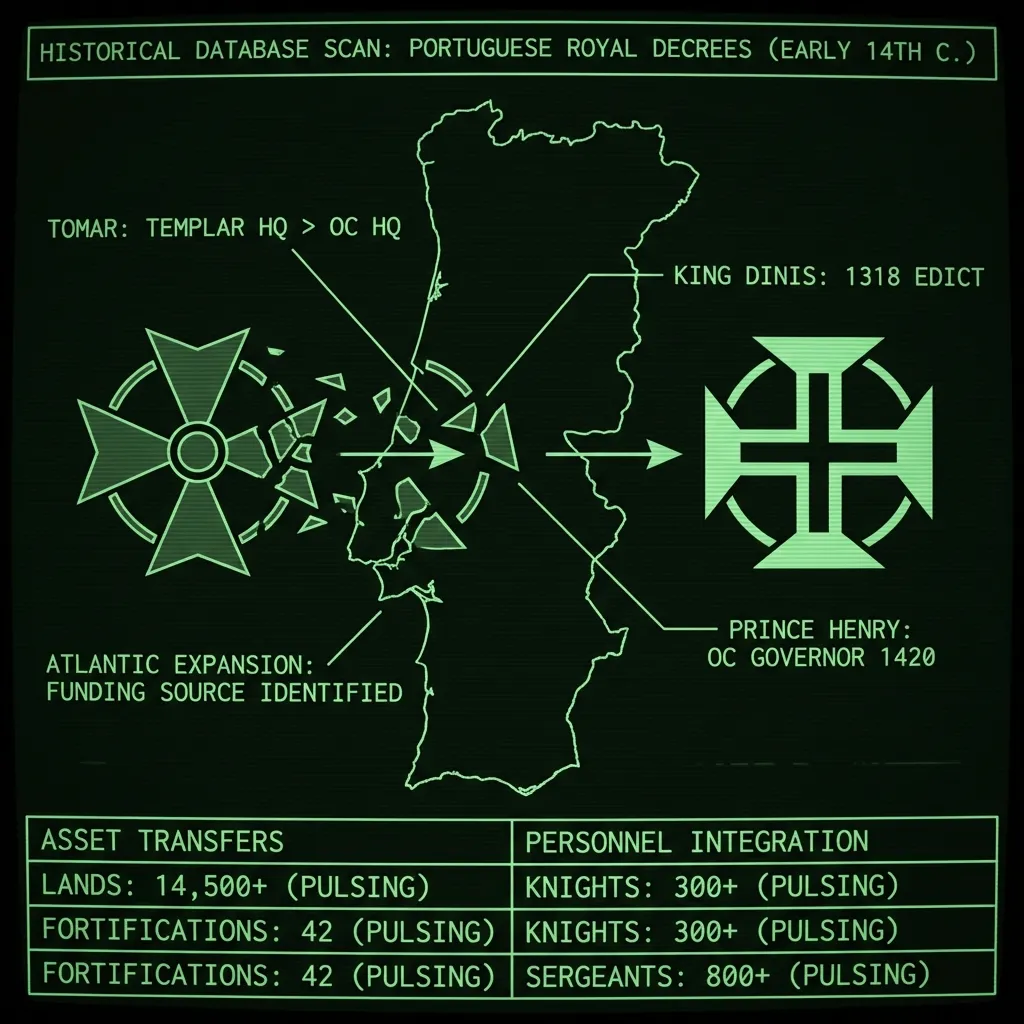
When the Knights Templar were suppressed in the early 14th century, Portugal simply re-housed them:
- In 1318, King Dinis secured papal approval for a new order, the Order of Christ, which effectively absorbed Templar property and personnel in Portugal.1
- The order was headquartered in Tomar, the old Templar stronghold, and continued their economic and territorial functions under a new brand.2
Standard reference works and monographs are blunt about continuity: the Order of Christ “in every sense” carried on Templar operations within Portugal.3 The medieval conspiracy theorist’s fever dream is, in this narrow case, just…how statecraft worked.
The more interesting part is what happens next.
Henry the Navigator and the monetization of a rule#
On 25 May 1420, Prince Henry of Portugal, later nicknamed “the Navigator,” was appointed governor of the Order of Christ.[^4] The position came with:
- control over the order’s landed wealth and tithes,
- authority to direct its resources toward new ventures, and
- prestige as head of a quasi-sacred brotherhood tied into crusader mythology.
Historians of navigation and empire have long noted that Henry used the Order of Christ’s revenue to fund:
- shipbuilding and navigational experiments on the Atlantic coast,
- voyages along the West African coast,
- the progressive mapping of winds and currents that made the carreira da Índia (route to India) possible.[^4]
By the late 15th century, the Order of Christ cross is stamped on Portuguese sails from West Africa to India and, eventually, Brazil. Tomar, the old Templar convent, becomes both symbol and administrative node of this expansion.[^5]
This is not an esoteric side-hobby. It is the financial and symbolic infrastructure of Portugal’s early colonial push.
Table 1. From Templars to Brazil: a compressed genealogy#
| Date | Institution / Event | Esoteric Lineage Element | Colonial Effect |
|---|---|---|---|
| 1312 | Papal suppression of Templars | Templar assets seek new legal host | Portuguese crown negotiates local workaround |
| 1318 | Order of Christ founded in Portugal | Direct Templar successor at Tomar | Preserves knightly rule, property, symbols |
| 1420 | Henry made governor of the Order | Prince at head of quasi-monastic order | Order revenue funds navigation & voyages |
| mid-1400s | Atlantic & African voyages expand | Crusader cross on sails, order’s patronage | Builds cartographic & commercial Atlantic web |
| 1500 | Cabral reaches Brazil | Order’s cross still central insignia | Atlantic empire now bicontinental |
The point is not that a cabal of Templars “secretly” ran colonialism; the point is that the form of a knightly brotherhood—vows, hierarchy, sacred violence, a shared eschatological story—became a core operating system of the early Portuguese imperial state.
The very style of action—risk-bearing, collective, bound by rule and sign—comes straight out of the cloistered fortress and onto the ocean.
Crusade Across the Sea: Spanish Military Orders and the Columbus Problem#
Spain’s version of the story is messier but rhymes with Portugal’s.
The Reconquista as a training ground#
From the 12th century, Spanish kings chartered military orders like:
- the Order of Calatrava,
- the Order of Santiago, and
- the Order of Alcántara,
to fight on the moving frontier against Muslim polities.[^6][^7] These orders were:
- monastic (vows, rule, communal property),
- military (permanent frontier garrisons, cavalry),
- feudal-capitalist (holding lands, towns, and rights in exchange for service).
Andrew J. Forey’s classic study of the military orders in the Reconquista stresses that their institutional purpose was precisely “to fight against the infidel” and secure newly conquered territories for Christian rule.[^8] Over time, these orders accumulated enormous landed wealth and political influence.
By the late 15th and early 16th centuries, the Spanish crown had largely brought them to heel. Papal bulls in the early 1500s vested the grand masterships of Santiago, Calatrava, and Alcántara in the Crown, turning them into royal instruments.[^9]
This matters because:
- It normalized the idea that semi-autonomous religious-military corporations would conquer, administer, and spiritually police frontier regions.
- It provided a bureaucratic template for grants of land, rights, and labor (encomiendas, seigneuries, etc.) in new territories.
The same monarchy that absorbed the orders—Ferdinand and Isabella—then turned outward, sponsoring westward exploration.
Columbus the mystic, not the spreadsheet#
Christopher Columbus is the point where the colonial project most obviously entangles with explicit esoteric theology. For a deeper exploration of Columbus’s esoteric ties and the rumors that shaped his voyages, see our article on Christopher Columbus’s Esoteric Ties and New World Rumors.
Toward the end of his life, Columbus compiled the Libro de las profecías (“Book of Prophecies”), a bizarre and revealing anthology of biblical passages and patristic texts, stitched together to prove that his voyages fulfilled prophecy.[^10] Modern scholars like Delno West and August Kling have shown just how central this prophetic reading was to Columbus’ self-understanding.[^11]
In the Book of Prophecies and in letters, Columbus writes things like:
- God made him the “messenger of the new heaven and the new earth” mentioned in Revelation and Isaiah.[^12]
- His discoveries would provide the wealth necessary to reconquer Jerusalem, thereby triggering end-times events.[^10][^11]
This is not a man motivated primarily by trade routes and spices; this is a man who reads Isaiah and the Apocalypse as a personal mission statement.
The standard narrative that Columbus “ushered in the age of exploration” misses that he understood himself as an eschatological agent. He was not simply exploring; he was, in his own mind, repositioning Christendom on the prophetic timeline.
From crusade to colonization#
Put the pieces together:
- A monarchy thoroughly shaped by crusader orders and a recently concluded holy war in Iberia.
- Military-religious corporations that had spent centuries conquering “infidel” lands and reorganizing them under Christian rule.
- An admiral whose self-conception is that of a prophetic tool in a grand apocalyptic drama.
The early Spanish colonial project is not cleanly separable from this matrix. Even before there are formal encomiendas in the Americas, there is a mental template of holy conquest, land grants, and spiritual tutelage lifted from the Reconquista and its military orders.
If we’re lumping lineages, the Spanish case looks like this:
Templar-adjacent Iberian military orders → royal control of those orders → outward projection of crusader logic across the Atlantic, under the guidance of a self-consciously prophetic navigator.
The fact that later Masonic rites will play dress-up as “Templar” is almost an afterthought. The actual Templar-descended institutions were already out there, building forts and counting silver.
Hermetic Christianity, Rosicrucian Phantoms, and the “Universal Reformation”#
By the time Iberian and then English colonization are in full swing, another layer of esoteric lineage is developing in the background: Hermetic Neoplatonism and Rosicrucianism.
Hermetic and Neoplatonic overlays#
The 15th and 16th centuries saw the Christian reception of newly translated Greek and “Hermetic” texts—Plato, Plotinus, the Corpus Hermeticum—through figures like Ficino and Pico della Mirandola. For a comprehensive overview of key hermetic thinkers and their influence, see our article on Hermeticists of Fame: Key Figures in Western Esotericism. The resulting stew taught that:
- there was an ancient, prisca theologia, a primordial revelation underlying all traditions;
- history could be read as a sequence of dispensations or ages, often mapped onto biblical prophecy;
- knowledge of nature (including alchemy and astrology) had salvific or at least theurgic implications.
This worldview fit neatly on top of crusader-apocalyptic politics: the same God who guided Israel could now be seen as guiding Christendom into a new age of knowledge, empire, and perhaps reconciliation.
The Rosicrucian manifestos as a bridge#
Between 1614 and 1616, three anonymous German texts appeared:
- the Fama Fraternitatis (1614),
- the Confessio Fraternitatis (1615),
- and the Chymische Hochzeit (Chymical Wedding) of Christian Rosenkreutz (1616).[^13][^14]
They announced or imagined a secret brotherhood of enlightened Christian sages, the Fraternity of the Rosy Cross, committed to a “universal reformation of the whole wide world.”
Whatever one makes of the historicity of an actual fraternity, historians generally read these manifestos as programmatic propaganda for a certain vision of Christian hermetic reform:
- a call for learned, pious elites to reshape politics and religion,
- a fusion of alchemical, mystical, and apocalyptic motifs,
- an insistence that there already is a hidden chain of adepts guiding things behind the scenes.
The manifestos do not directly direct colonial ventures. But they:
- presuppose a world already knit together by global exploration;
- imagine Christian Europe as a field for covert transformative work by semi-organized esoteric elites.
In other words, by the early 17th century, the idea that history is quietly steered by hidden brotherhoods is itself part of the esoteric imaginary. Later Freemasons will eagerly trace their lineage back to these phantom Rosicrucians, who in turn look back to even older lineages.
From a lumping perspective, this is less about institutional continuity and more about narrative continuity: crusade and conquest are retrofitted into a larger myth of providential, semi-secret guidance of world history.
John Dee’s Angelic Empire and the Puritan “City upon a Hill”#
The English story picks up these threads and does something stranger with them.
John Dee: mathematics, angels, and “British Empire”#
John Dee (1527–1609) was many things at once:
- mathematician and navigator,
- court astrologer to Elizabeth I,
- cabalist and angel-magus.
Modern scholarship has emphasized that Dee was not just a crank in a robe; he was deeply involved in advising English voyages and articulating a theory of overseas expansion.[^15] In fact, he is often credited as the first to systematically use the phrase “British Empire” in political discourse.[^15][^16]
Crucially:
- Dee’s angelic “conversations” (mediated by scryers) were, in his mind, not occult parlor tricks but access to primordial Adamic wisdom, a lost ur-language and ur-knowledge about nature and politics.[^17][^18]
- Recent work by historians like Glyn Parry and Deborah Harkness has argued that Dee’s imperial program—including navigation, colonial charters, and claims over newly contacted lands—is explicitly entangled with his angelic and cabalistic speculations.[^18]
Dee, in this reading, is not a scientist who also happens to be a magician; he is a magician whose theology of history directly informs his imperial geopolitics.
We are back in the same pattern:
esoteric lineage (cabalistic, hermetic, angelic) → fused with Christian providential history → used to rationalize and script empire.
Puritan New England as eschatological stage#
A generation later, English Puritan colonists carry a more biblicist but still apocalyptic worldview across the Atlantic.
On the ship Arbella in 1630, John Winthrop famously preached that Massachusetts Bay would be “a city upon a hill,” an exemplary Christian commonwealth watched by the eyes of the world.[^19][^20] This phrase, drawn from the Sermon on the Mount, has been endlessly recycled in American civil religion, but in context it was:
- a covenantal claim: the colony has a special relationship with God, like Israel;
- an eschatological hint: history is bearing down, and failure will be publicly disastrous.
Scholars of Puritan theology and colonial ideology—Perry Miller, Sacvan Bercovitch, and their successors—have shown how New England’s elites saw themselves as participants in a spiritual drama, an “errand into the wilderness” with world-historical stakes.[^20][^21]
The Puritans were not alchemists or magi. They were, on the surface, doctrinally hostile to the sort of hermetic Christianity Dee loved. But they share with him—and with Columbus—a sense that colonization is not just practical but providential, part of a scripted transformation of the world.
The English case therefore adds another type to our lineage:
- From Dee’s angelic British Empire to Calvinist covenantal experiments in New England, different stripes of Christian esotericism (cabalistic vs. apocalyptic-biblicist) converge on the same action: cross the ocean, build a new order, and see history consummated.
When the Lodges Crystallize: Freemasonry and the Colonial World#
By the time speculative Freemasonry consolidates in the early 18th century, the basic colonial infrastructure of the Atlantic is already in place. For a detailed exploration of Masonic symbols and their esoteric meanings, see our article on Square, Compasses, and the Great G: a field guide to the Masonic emblem.
Freemasonry as late crystallization of earlier forms#
On 24 June 1717, representatives of four London lodges met at the Goose and Gridiron tavern in St Paul’s Churchyard and constituted themselves the Grand Lodge of London and Westminster, the first Grand Lodge of Freemasons.[^22][^23] The United Grand Lodge of England today traces its origin to that moment.
Key points:
- These early lodges drew on older operative stonemason guilds but reinterpreted their tools and myths symbolically.
- The 1723 Constitutions of James Anderson retrofitted a mythic history for Masonry back through biblical times and medieval builders, in exactly the kind of backward-projected lineage one would expect from a culture already steeped in Templar and Rosicrucian lore.[^24]
Freemasonry, in other words, is a self-conscious formalization of the sort of elite, oath-bound brotherhoods that had been operating for centuries, now dressed up in Enlightenment universalism.
Lodges in the colonies#
In the British colonies, lodges appear rapidly:
- The first chartered lodge in North America was established in Boston in 1733, under authority from the Grand Lodge in London.[^25][^26]
- By the mid-18th century, there were lodges in most major colonial towns; Masonic membership among colonial elites (including many “Founding Fathers”) is well documented.[^26]
The function of these lodges was not to plan colonization—that ship had literally sailed centuries earlier—but to:
- provide networks of trust among merchants, lawyers, officers, and officials;
- inculcate a mythic self-understanding of elites as heirs to ancient wisdom and guardians of a universal moral law;
- serve as semi-private spaces where political ideas could be circulated under the cover of fraternal ritual.
Historians of Freemasonry and empire like Jessica Harland-Jacobs have argued that lodges became imperial social technologies, weaving together far-flung colonial subjects along shared ritual lines.[^24]
Lodges and independence: the Latin American mirror#
The same is true, with an ideological inversion, in Latin America.
- Revolutionary Lautaro Lodges in Buenos Aires, Santiago, and elsewhere acted as secret networks of independence leaders—San Martín, O’Higgins, and others—combining Masonic-style ritual with explicitly anti-colonial agendas.[^27][^28]
- Studies of Freemasonry in Latin America emphasize that lodges were both vehicles for Enlightenment political ideas and vectors for business and print networks, linking local elites to transatlantic circuits.[^28][^29]
Here, the esoteric lineage turns on its maker: a form originally honed in crusader orders and colonial elites is redeployed as a weapon against the old imperial order.
But the deeper pattern remains: rule-bound, ritualized, symbol-heavy fraternities interlace colonial and postcolonial elite life, sitting on top of older hermetic and crusader imaginaries.
What “Intertwining” Actually Means#
If you’re looking for a smoking gun—a memo from the Grand Master of the Templars ordering the discovery of America—you will be disappointed. History rarely obliges that way.
What we can say, with decent confidence, is that:
- Portugal’s early oceanic expansion was structurally and financially rooted in a Templar-successor order, the Order of Christ, whose rule and symbolism were explicitly crusader and monastic.
- Spain’s colonial project emerged from a society saturated in military-religious orders, whose institutional logic was directly transferable to overseas conquest, and was spearheaded by an admiral who interpreted his voyages in frankly prophetic, apocalyptic terms.
- England’s imperial imagination was partially scripted by a cabalist-magus (Dee) and then enacted by Puritans who understood their settlements as covenantal, eschatologically charged experiments.
- Rosicrucianism and Freemasonry codified and retrofitted these older forms into self-conscious “mystery fraternities”, which then played important roles in both imperial cohesion and anti-imperial revolutions.
If we collapse these into a single through-line, it looks something like:
Monastic-knightly orders → hermetic and apocalyptic Christian speculation → early colonial projects → Rosicrucian and Masonic fraternities → imperial and revolutionary elite networks.
The word “intertwined” here doesn’t mean “controlled”; it means co-produced. Colonial empires were never just military and economic projects; they were cosmological projects, and the technologies of secrecy, initiation, and sacred violence that esoteric lineages perfected were part of how those cosmologies were enacted.
The Atlantic world was, from the beginning, not only a network of trade routes and plantations, but also a ritual space in which European elites tried to act out their myths about God, history, and themselves.
FAQ#
Q 1. Did the Knights Templar themselves directly run colonial expeditions?
A. No. The Templars were suppressed in the early 14th century, but in Portugal their assets and personnel were folded into the Order of Christ, which then bankrolled early Atlantic voyages, effectively transmitting Templar structures into the colonial era.
Q 2. Was Columbus a Freemason or Rosicrucian?
A. There is no evidence he belonged to any such formal fraternity; those institutions crystallized later. Columbus was, however, deeply shaped by apocalyptic and prophetic readings of Scripture that later esoteric movements eagerly claimed as part of their broader lineage.
Q 3. How directly did John Dee influence English colonization?
A. Dee advised on navigation, territorial claims, and imperial ideology at Elizabeth’s court, and he explicitly framed “British Empire” in quasi-prophetic terms; his angelic magic and cabala were woven into his geopolitical writings, not merely hobbies on the side.
Q 4. Were colonial Freemasons mainly imperial loyalists or revolutionaries?
A. Both, depending on context: in the British Empire, lodges often buttressed imperial networks, while in Spanish America Masonic-style lodges like Lautaro became key vehicles for independence movements and postcolonial state-building.
Q 5. Is it accurate to say “the Masons colonized the Americas”?
A. It’s more precise to say that colonialism grew out of a long evolution of crusading and esoteric brotherhoods, and that Freemasonry later became a prominent formal expression of those lineages within an already-colonial world.
Footnotes#
Sources#
This is a non-exhaustive selection of works used or alluded to above, mixing primary sources, scholarly studies, and curated reference material.
- Forey, Andrew J. “The Military Orders and the Spanish Reconquest in the Twelfth and Thirteenth Centuries.” Traditio 40 (1984): 197–234.
- “Military Order of Christ.” In Encyclopedic Reference (e.g. Encyclopædia Britannica / major online encyclopedias). See also the official Portuguese Convento de Cristo site for institutional history.
- “History of the Order of Christ.” Wikipedia entry (useful as a pointer to primary citations and secondary literature).
- “Henry the Navigator Leads Order of Christ.” Research starter summary, EBSCOhost (overview of Henry’s governorship of the order and its role in navigation).
- “Order of Alcántara.” Encyclopædia Britannica.
- “Order of Calatrava.” Reference entries in standard encyclopedias, plus official Spanish royal orders site (“Las Órdenes Españolas”) for institutional continuity.
- West, Delno C., and August Kling, eds. The Libro de las profecías of Christopher Columbus: An En Face Edition. University of Florida Press, 1991. (Primary edition and analysis of Columbus’ Book of Prophecies.)
- West, Delno C. “Scholarly Encounters with Columbus’ Libro de las Profecías.” In conference proceedings on Columbus and prophecy (PDF widely circulated online).
- “Later Years: the Book of Prophecies and the Final Voyage.” In Christopher Columbus: A Latter-day Saint Perspective. Religious Studies Center, BYU. (Accessibly summarizes themes and key scriptural citations in the Libro.)
- Birzer, Bradley. “Christopher Columbus, Mystic.” The Imaginative Conservative (2025). (Popular but source-heavy essay on Columbus’ prophetic self-understanding.)
- Rebisse, Christian. “The Rosicrucian Manifestos.” Rosicrucian Digest 2 (2013). (Historical overview of the Fama, Confessio, and Chymical Wedding.)
- English translations collected in Rosicrucian Trilogy: Modern Translations of the Three Founding Documents (various modern publishers; see WorldCat listings).
- Parry, Glyn. “John Dee and the Elizabethan British Empire in Its European Context.” The Historical Journal 49, no. 3 (2006): 643–675.
- Harkness, Deborah. John Dee’s Conversations with Angels: Cabala, Alchemy, and the End of Nature. Cambridge University Press, 1999.
- “Mathematics, navigation and empire: reassessing John Dee.” Royal Museums Greenwich online essay (2019). (Good short companion to scholarly work on Dee’s imperial role.)
- Wilsey, John D. “America as the ‘City upon a Hill’: An Historical, Philosophical, and Theological Critique.” PhD diss., 2009. (Traces Winthrop’s phrase and its afterlives.)
- “Higher Callings: Religious Movements in America since Colonial New England.” Brewminate (2024). (Accessible summary of Puritan covenantal ideology and “city upon a hill”.)
- “Premier Grand Lodge of England.” Wikipedia and the United Grand Lodge of England’s own history pages (for dates and context of 1717 foundation).
- Hebbeler, Arthur F. “Colonial American Freemasonry and its Development to 1770.” M.A. thesis, University of North Dakota, 1988. (Detailed archival work on early American lodges.)
- “Boston Masons Organize First Grand Lodge in America.” Mass Moments (Massachusetts Foundation for the Humanities). (Short narrative of the 1733 Boston lodge.)
- Reynolds, K. J. “The Lautaro Lodges.” Journal of the History of Ideas 28, no. 4 (1967): 583–592.
- Cambridge University Press, The Cambridge Companion to Latin American Independence, esp. Chapter 6, “Brothers in Arms,” on Masonic networks and independence leaders.
- Harland-Jacobs, Jessica. Builders of Empire: Freemasonry and British Imperialism, 1717–1927. University of North Carolina Press, 2007.
- Various official sites of the Spanish royal orders and the Portuguese Convento de Cristo for institutional self-descriptions, timelines, and iconography.
On the suppression of the Templars and the foundation of the Order of Christ in Portugal, see standard summaries in major encyclopedias and specialized monographs on the order’s history. ↩︎
Tomar’s role as both Templar and Order of Christ headquarters is visible in architectural, archival, and royal charter evidence; the convent’s own official history underlines this continuity. ↩︎
Several historians and reference works explicitly describe the Order of Christ as a direct continuation of the Templars in Portugal, differing mainly in papal paperwork and royal oversight. ↩︎