~/mythology/comparative-mythology
Entwined Serpents: A Visual History of the Sacred Pair
An illustrated tour of intertwined serpent pairs, from Nüwa and Fuxi and Indian nāgas to Egyptian gods, Haitian Vodou, and a Mexican painted history.
TL;DR
- Two serpent bodies can turn a relationship into a visible knot: ancestry, marriage, divine partnership, or the binding of sacred power to a place.
- Nüwa and Fuxi, Indian nāga couples, and Egyptian human-headed serpents make the closest visual comparisons. Haitian Vodou supplies an explicitly named serpent marriage.
- Ritual cloth, a Mexican painted history, Gudea’s vessel, and the caduceus show how widely artists developed the possibilities of the paired body.
Nüwa and Fuxi: the ancestors beneath the stars #

Their faces are human. Their hands hold tools. Below their robes, two long bodies cross, separate, and cross again, making a braid that almost reaches the bottom of the silk. Each figure remains distinct all the way through the embrace.
This painting from Astana, near Turpan in present-day Xinjiang, is an unusually complete statement of the image. Sun, moon, and constellations surround the pair. The compass and square bring measurement into the same field as ancestry: these are beings through whom human life belongs within an ordered universe.
Astana’s versions were made for tombs. A separate banner in the National Museum of Korea retains nail holes around its edges, evidence that it was probably fixed to a tomb ceiling. Imagine the change in viewpoint. The ancestors stand above the dead, among the celestial bodies, their entwined tails joining the upper human figures into a single descending form. The museum explains their instruments through the traditional relationship of the round heavens and square earth. Its banner is a different object from the painting shown here, but it preserves the same funerary setting and visual vocabulary (National Museum of Korea, Bongwan4027).
The image has a history much longer than this Tang silk. Nüwa and Fuxi appear in Han funerary art, and their representations changed as they traveled through regional workshops. Nataša Vampelj Suhadolnik’s study follows Han compositions into the Wei–Jin tombs of the Hexi Corridor, where serpent bodies, celestial discs, measuring tools, and other attributes were recombined. The Astana painting belongs to a developed artistic tradition rather than the first appearance of the pair (Suhadolnik 2019, pp. 47–86).
Their relationship gathers several kinds of origin into one image. They are ancestral siblings and, in later accounts, marriage partners. Nüwa has her own traditions of making people and repairing the world; Fuxi supplies techniques and institutions. The paired image brings these powers into a bodily relationship.1 Our separate study of Nüwa and Fuxi follows those stories in more detail.
The most memorable feature needs little explanation: two recognizable persons become an interdependent shape. The tails give the artist an extraordinary way to show union without erasing either member of the pair.
Nāga and nāginī: the embrace becomes architecture #
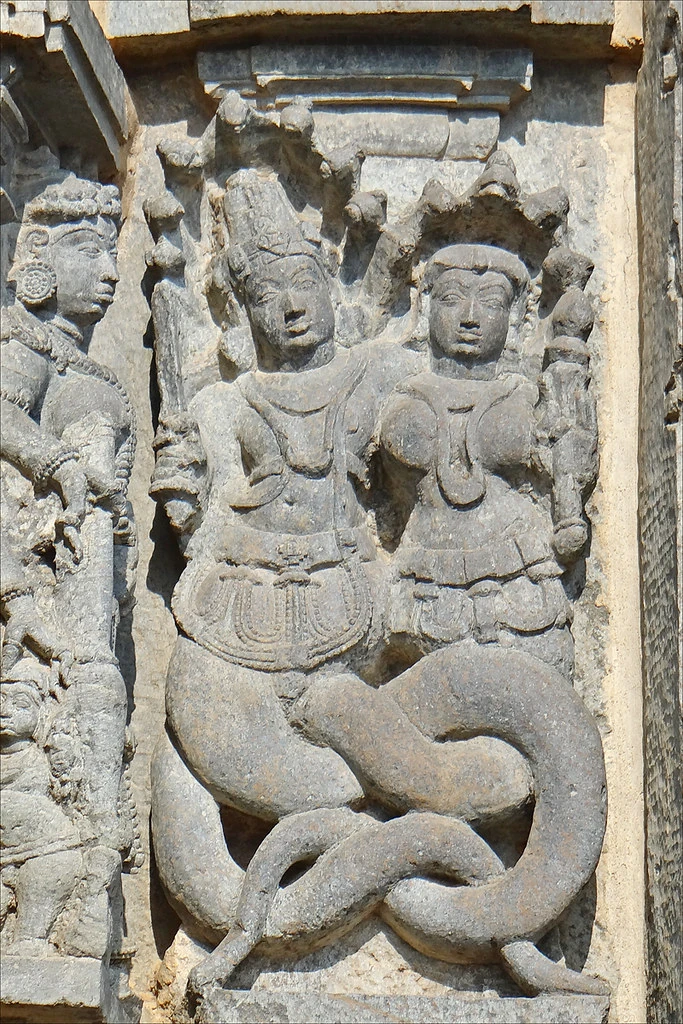
At Belur, the human embrace and the serpent knot occupy two levels of the same carving. The upper figures turn toward one another beneath cobra hoods. Below, their heavy tails make an elaborate interlace. The stone gives the bodies weight: the coils press together as convincingly as the shoulders and arms above them.
Nāga and nāginī identify kinds of serpent beings. These two are an anonymous couple, rather than two uniquely named gods called Naga and Nagini. Across South and Southeast Asian religious art, nāgas inhabit a world of water, fertility, and guardianship. Their ability to appear in human and serpentine forms gives artists a vocabulary for showing powers that are at once personal and embedded in the living landscape (Kossak and Watts, glossary, p. 118).
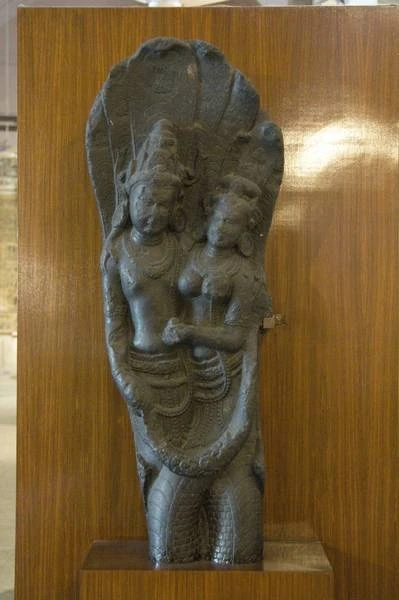
The Bihar sculpture draws the pair even closer. Their human bodies lean into the embrace; the serpent forms continue beneath it. A museum catalogue published in 1911 describes this very object as a nāga and a nāgī together, richly ornamented and human above, serpentine below. It also identifies the thick garland in the male figure’s hands, a useful distinction when following the loops through the photograph (Bloch, p. 92, no. 4220).
These couples belong within a wider architectural art of auspicious pairing. At Chaurasi and Konark in Odisha, Adalbert Gail describes nāga couples wrapping around entrance pilasters. Their serpentine bodies clasp the support while the upper figures clasp each other. An embrace becomes a way to inhabit the building (Gail 2012, p. 15, figs. 14–15).
Compared with the Astana banner, the intimate gesture comes forward. The Chinese pair measures and inhabits a celestial order. These nāgas make the meeting of two bodies physically persuasive, with the waters and fertility of their wider religious world behind them. The correspondence is strongest in the anatomy itself: two human upper bodies, two serpent lower bodies, one continuous interlace.
Isis and Dionysos: human faces on an Egyptian serpent knot #
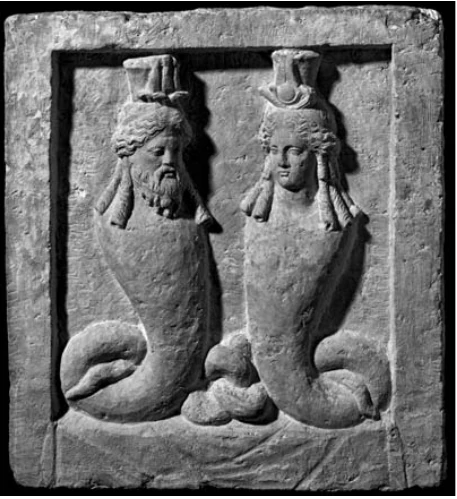
Here the human body has almost disappeared. Two faces rise above upright, swelling serpent forms. At the bottom, the bodies fold into an interlocking knot. Crowns and faces preserve the gods’ identities; the snakes provide the substance of their union.
The British Museum identifies the pair as Isis and Dionysos. The male’s hairstyle and pointed beard favor Dionysos, although his resemblance to Serapis has made the identification a matter of interpretation. That distinction belongs beside this particular relief: it is one reason to look closely at the faces before treating every Egyptian pair as the same two gods (British Museum, EA1539).
There was an ancient religious basis for the overlap. Plutarch discusses Osiris in relation to Dionysos and connects Serapis with Osiris. Such comparisons helped Greek and Egyptian divine worlds become mutually intelligible. They also made images capable of carrying more than one association. Plutarch’s discussion explains why the names can draw together; the relief’s attributes help decide which names best describe this object (On Isis and Osiris, 28 and 35).
The image is particularly powerful after the Indian carvings. At Belur the lovers have human arms with which to embrace. Here the relationship is carried almost entirely by the serpent bodies. The coils do the work of arms.
Isis-Thermoutis and Serapis: abundance in two bodies #
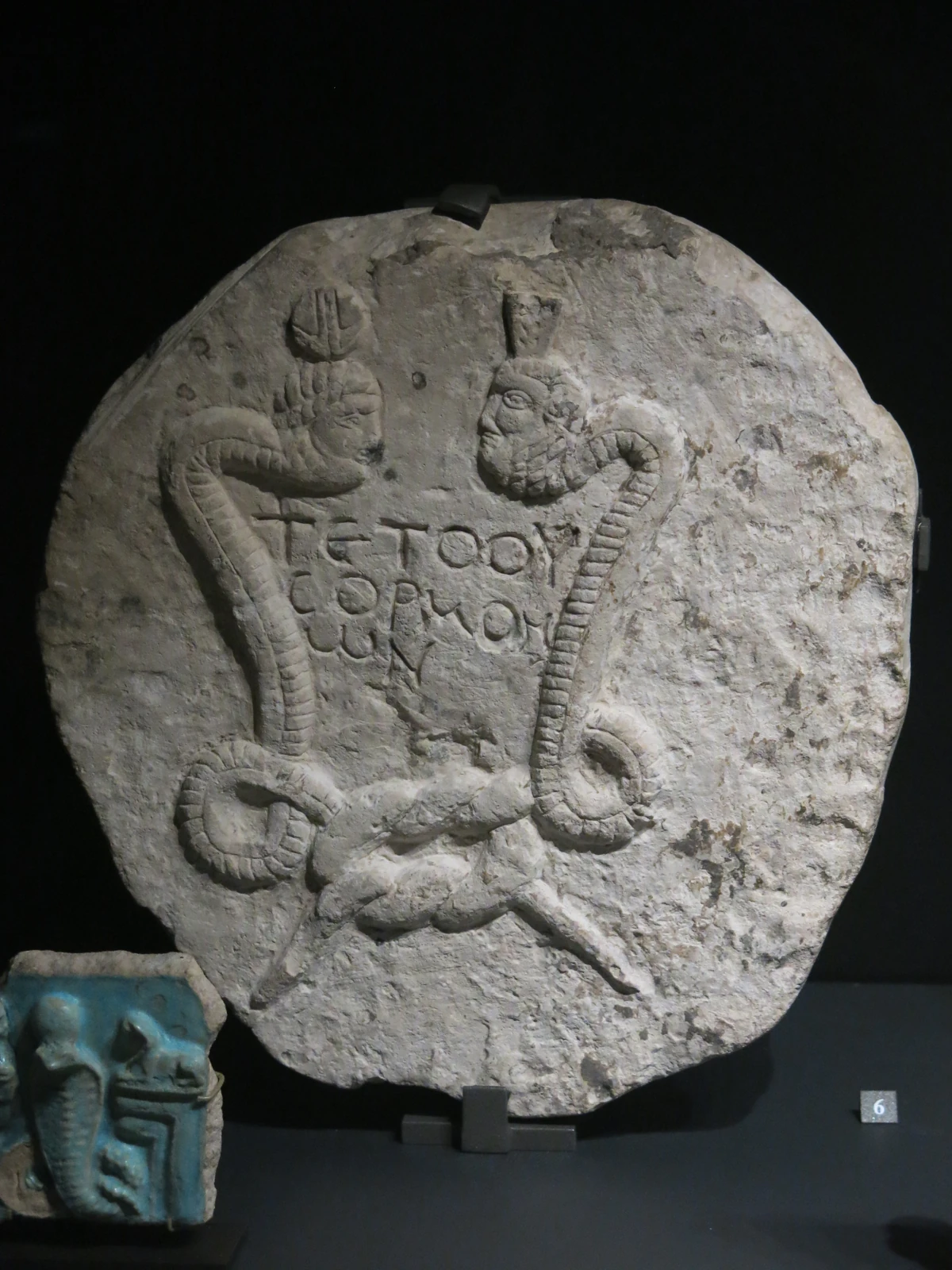

The Louvre stela gives us the related Isis–Serapis pairing. The two scaled necks bend toward one another above a Greek inscription, while their lower bodies cross beneath it. Their encounter encloses the written dedication within a frame made from living forms (Louvre, E21162).
Isis-Thermoutis brings Isis into relationship with Renenutet, the Egyptian serpent goddess associated with nourishment and fertility. On the male side, Serapis takes a serpent form associated with Agathodaimon, the beneficial protective power. These are overlapping divine identities, with local histories behind them.2
The devotional language is wonderfully concrete. At Medinet Madi, Isidorus addresses Hermouthis, Isis, and Good Fortune together, praising the goddess for the Nile’s rising and the crops it brings. At Maroneia, another inscription explicitly describes Isis and Serapis as marriage partners whose radiance illuminates the world. The pair could therefore join intimate relationship to the abundance on which whole communities depended (Isidorus I.1–13; Maroneia aretalogy, lines 15–20).
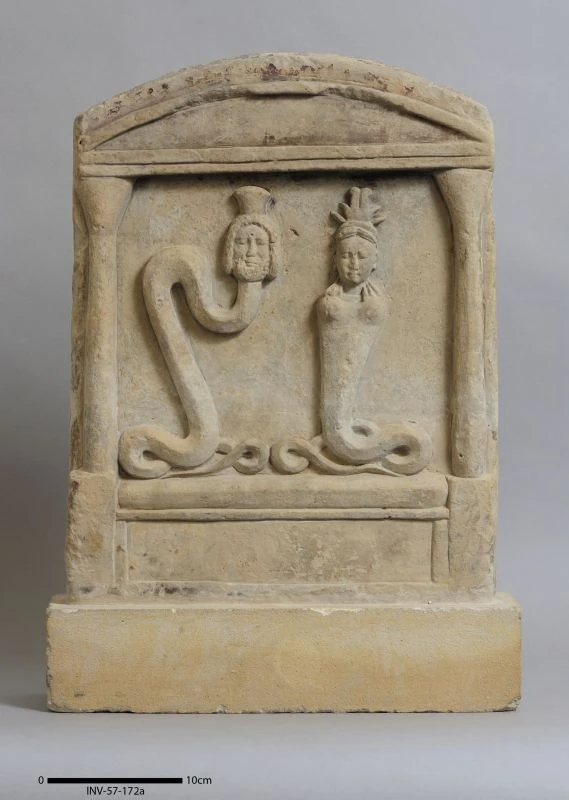
The BnF relief changes the composition. Here the two gods stand beneath a pediment, almost as occupants of a tiny temple. Their tails loop separately along the ground. The pairing survives without the knot: it can be expressed through a shared sacred space as well as through interlocking flesh.
That variation is revealing. The serpent form belongs to each divinity, and the artist can choose how tightly to join them. The BnF image makes companionship and corresponding power visible; the British Museum relief makes the bodily union much harder to disentangle.
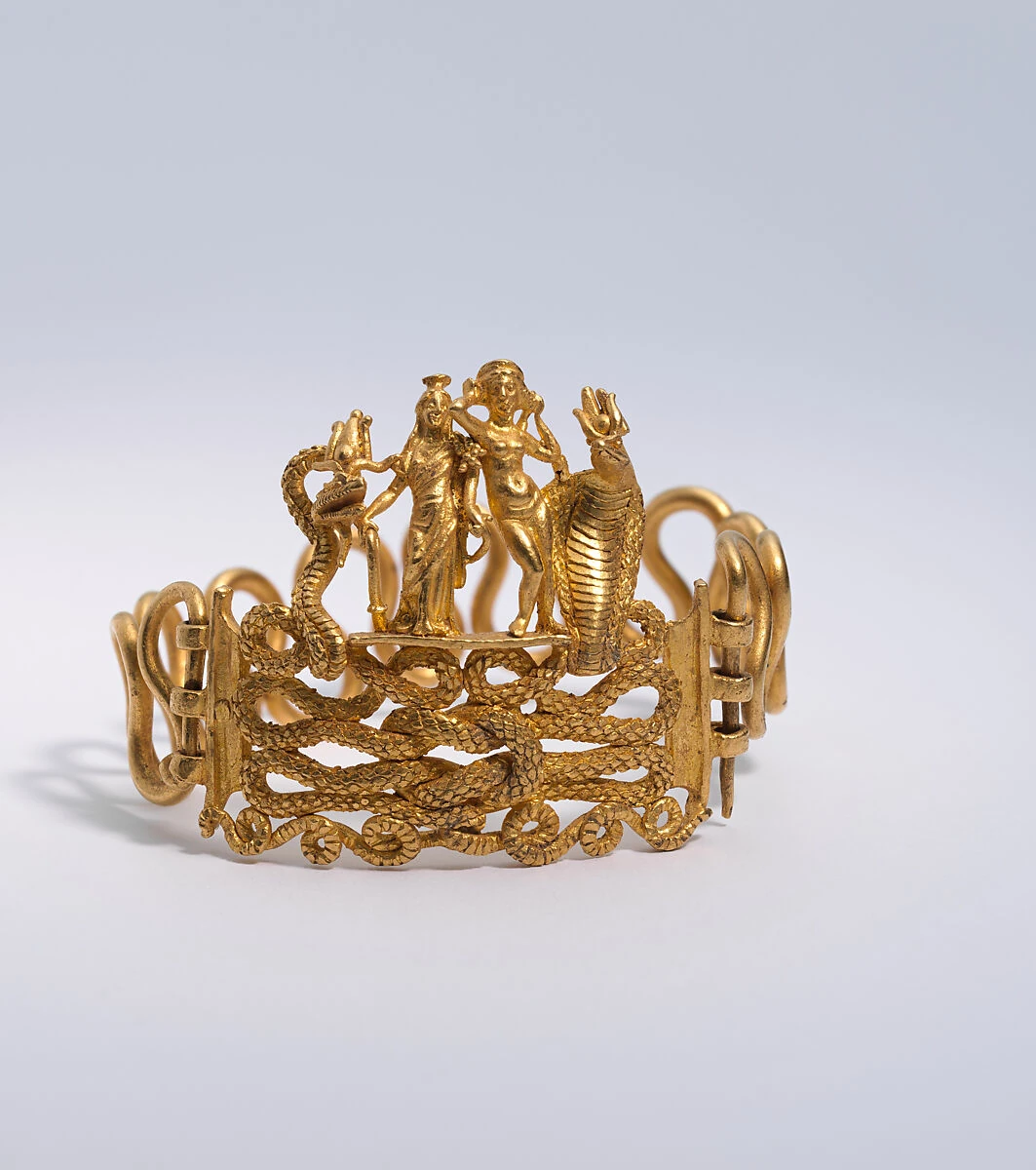
The gold bracelet takes the knot onto a human wrist. The Met identifies its snakes as Agathodaimon and Thermouthis, associated with Serapis and Isis, and relates the ensemble to fertility and favorable destiny. Two additional goddesses stand above the serpents. The powers are accumulated into something a person could wear (Met, 23.2.1).
The change of scale matters. In stone, the serpent pair can occupy a shrine. In gold, its protective promise can encircle the body of a worshipper.
Bali: a serpent braid drawn on unbroken cloth #
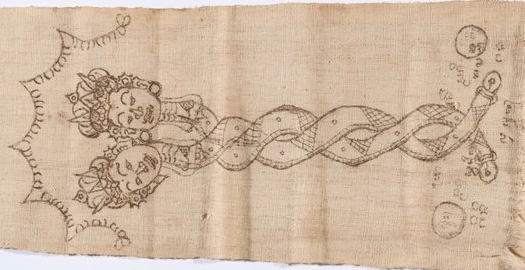
The Balinese textile is quieter than the stone carvings. Fine black lines describe two crowned, human-faced serpents. Their bodies pass through one another’s curves in a repeated braid beside sacred letters or syllables. The image sits on a strip of undyed cloth, its apparent simplicity concentrating attention on the paired line.
Siobhan Campbell’s museum account connects the nāgas with Balinese cosmology, including the world-serpent Antaboga and the turtle that supports the world. The two pictured beings are not individually named. Their force comes partly from the larger cosmological life of serpents and partly from the kind of object on which they appear (Australian Museum, E097463).
The warp was deliberately left uncut. Urmila Mohan explains that continuous-warp textiles can be understood as containing power: for an offering, a loom may be dismantled so that the cloth can be removed whole. Cutting is consequently a meaningful act, rather than simply the last mechanical step in finishing a piece of fabric (Mohan 2017).
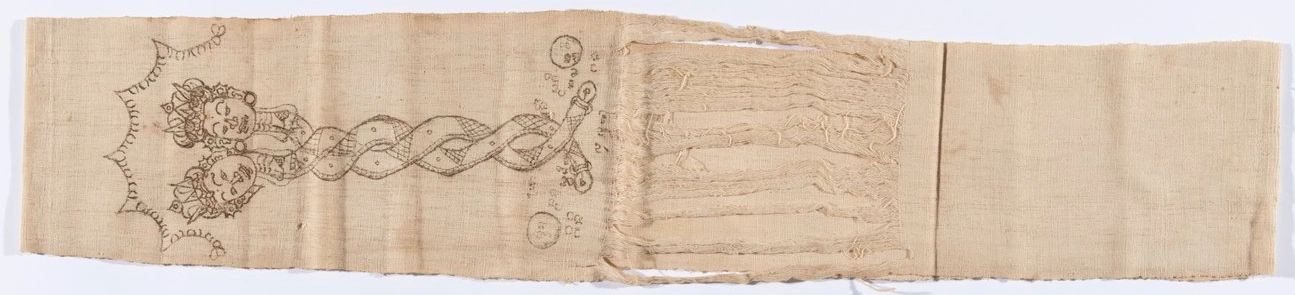
Balinese ritual cloth also participates in the making and protection of persons. A field account from Payangan documents uncut-warp textiles wrapping objects associated with an infant’s four birth guardians during a three-month ceremony. That is a different textile and ceremony, but it helps recover the active world to which such cloth belongs (Threads of Life, 2021).3
The drawing and its material now reinforce one another. Long bodies remain continuous through the braid; threads remain continuous through the cloth. That correspondence is visible even where the particular ceremony of this museum object is no longer recorded. The work presents a serpent pair through a material whose own integrity mattered.
Dambala and Ayida Wedo: the serpent marriage in Haitian Vodou #
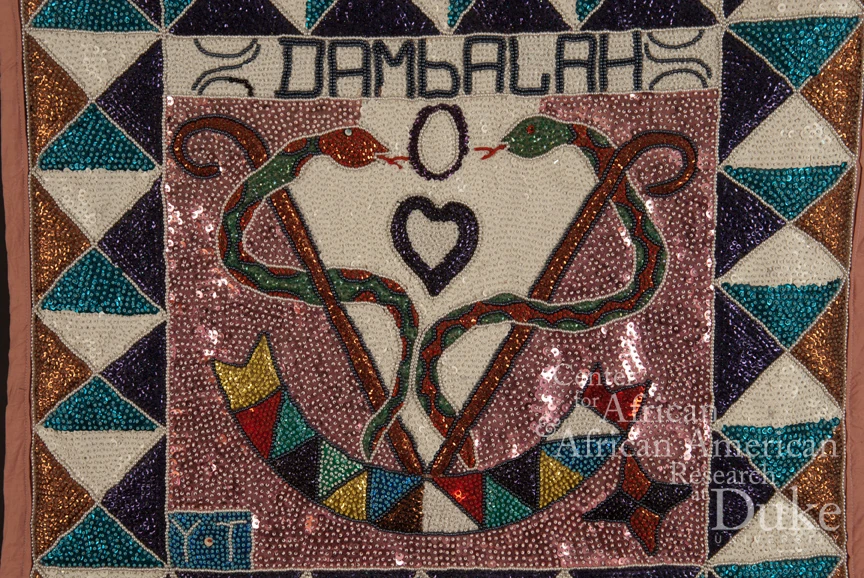
On Yves Telemak’s flag, the relationship is declared through several signs at once. There are two snakes, a heart above them, an egg, and a rainbow below. Duke’s catalogue identifies Dambala and his wife Ayida Wedo and interprets the heart through their love. The record also notes that this flag was used ritually. It belonged to a performed religious life, with salutes, offerings, music, and the arrival of spirits.
The marriage is documented beyond the flag. In his 1947 account, Haitian ethnographer Émile Marcelin describes Ayida as Dambala’s wife, associated with the rainbow and fresh water and represented, like him, as a snake. He records paired possession in which devotees crawl beside one another, two painted snakes lowering their heads toward a temple basin, and spring basins consecrated to both. The pair can be pictured, encountered through water, and embodied together in ritual (Marcelin 1947, pp. 71–72).
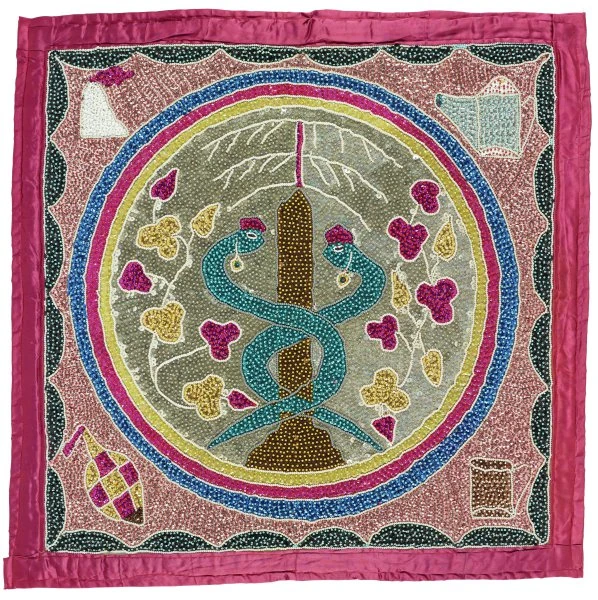
The Birmingham flag gives their entwining a central support. Two green snakes ascend around a post, crossing repeatedly beneath the rainbow. The museum identifies that axis as the poteau-mitan, the central post of the ceremonial space.4
Maya Deren describes the post as an avenue by which the lwa enter, with dance around it and offerings at its base. Her account connects the vertical post with tree imagery. Around such an axis, the serpent braid can participate in the meeting of different levels of existence. Deren reads Dambala and Ayida through the relationship between celestial waters, the rainbow, and the waters below (Divine Horsemen, pp. 36–37, 115–116).
Songs address the two in parallel. In a recorded Rasin Figuier song, singers approach a water source, salute flags, and name Dambala and Ayida in turn. The cloth is therefore part of the action through which the pair is honored, as well as a place where the pair can be seen (transcription and translation, song 3.b, p. 5).
The sequins give this relationship a changing surface. As the flag moves, light travels over the bodies. After the stillness of the Egyptian reliefs, the serpent marriage has become something that can shine, move, and receive a salute.
Mexico: the mount of intertwined serpents #
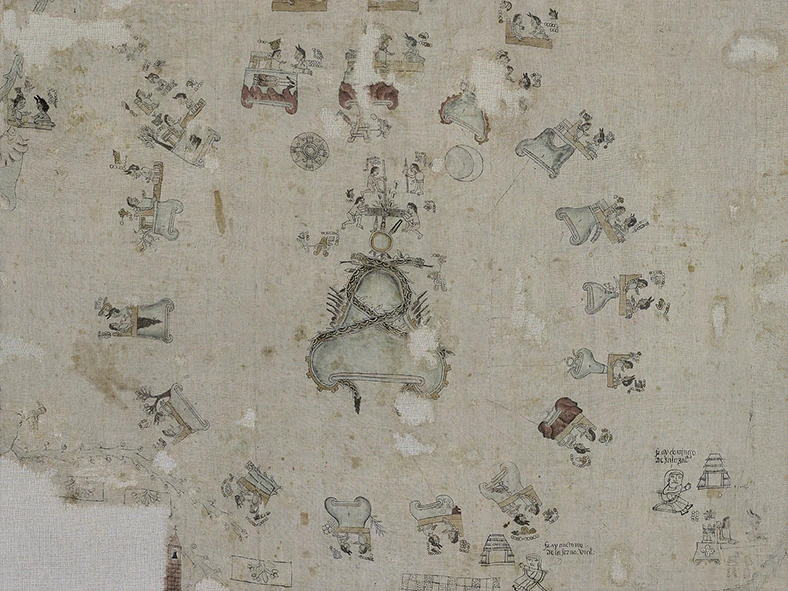
Look near the center of this painted field. Two snakes surround the outline of a mountain. Their bodies cross around an open loop below a scene of fire drilling. Seated figures, places, and lines of connection spread outward across the cloth.
Elizabeth Hill Boone identifies two intertwined rattlesnakes here, one feathered and the other flint-marked. The difference between them is part of the image’s information. The pair qualifies a place associated with a foundational New Fire ceremony and royal lineages. Viola König develops a proposed identification with Cholula and interprets the two as Quetzalcoatl and Mixcoatl. Those divine names belong to her reading of the place sign; the scene securely supplies the distinctive two-serpent configuration (Boone, p. 40; König, pp. 139–141).5
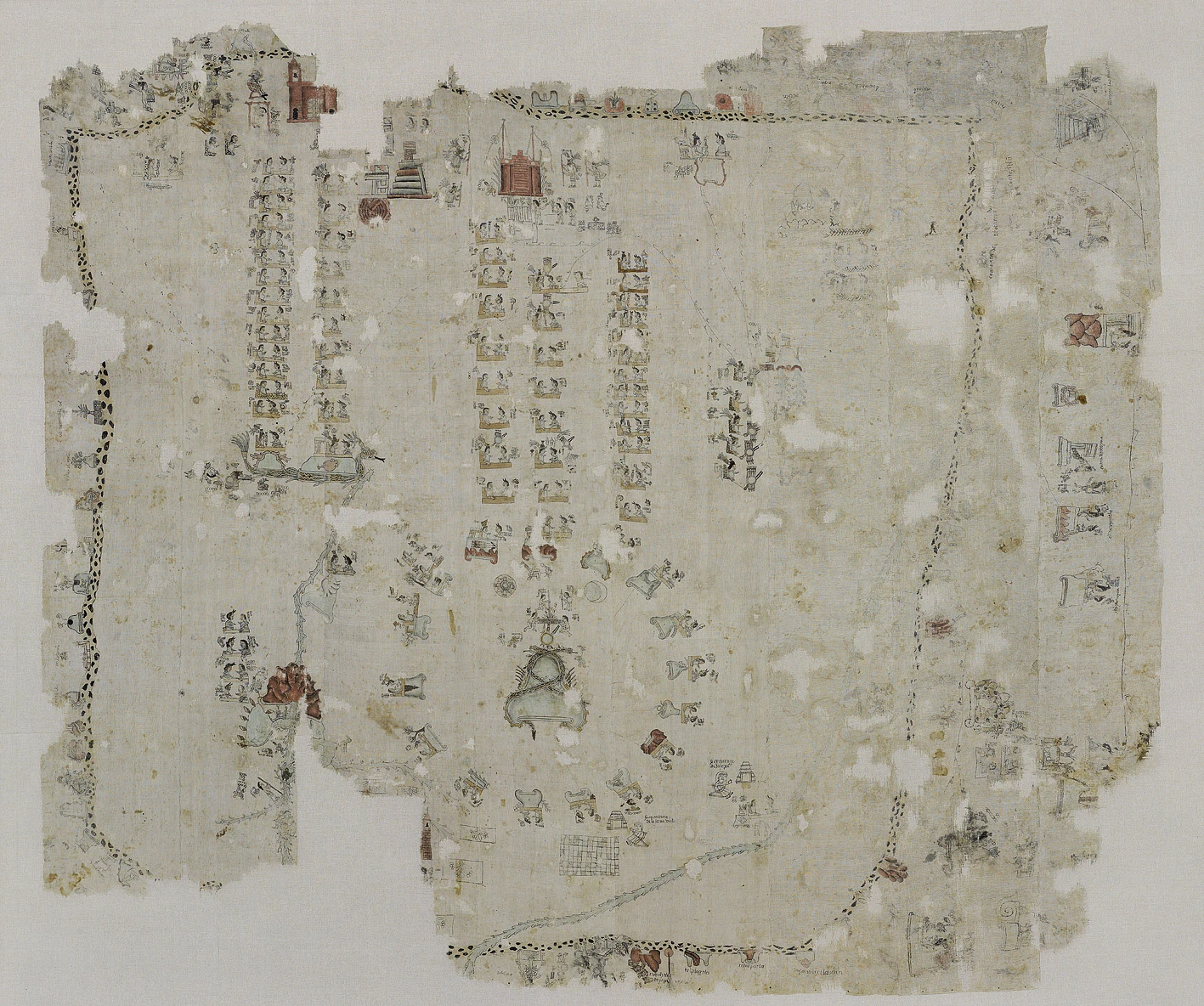
The whole cloth changes the scale of the encounter. It is nearly four meters high and more than four meters wide. The little serpent knot sits within a densely populated pictorial history of territory, descent, and power (Ethnologisches Museum, IV Ca 46178).
The snakes have become a way to identify and remember a consequential location. Their relationship is built into a place, and that place helps organize human history. This makes the image an especially rewarding companion to the divine couples: the same interlacing that binds two persons can also mark a foundation around which lineages gather.
The feathered and flint-marked bodies remain distinguishable inside the knot. As at Astana, difference is maintained through union. Here, however, the surrounding pictorial world directs attention toward named places and political memory.
Gudea’s vessel: a serpent braid more than four thousand years old #
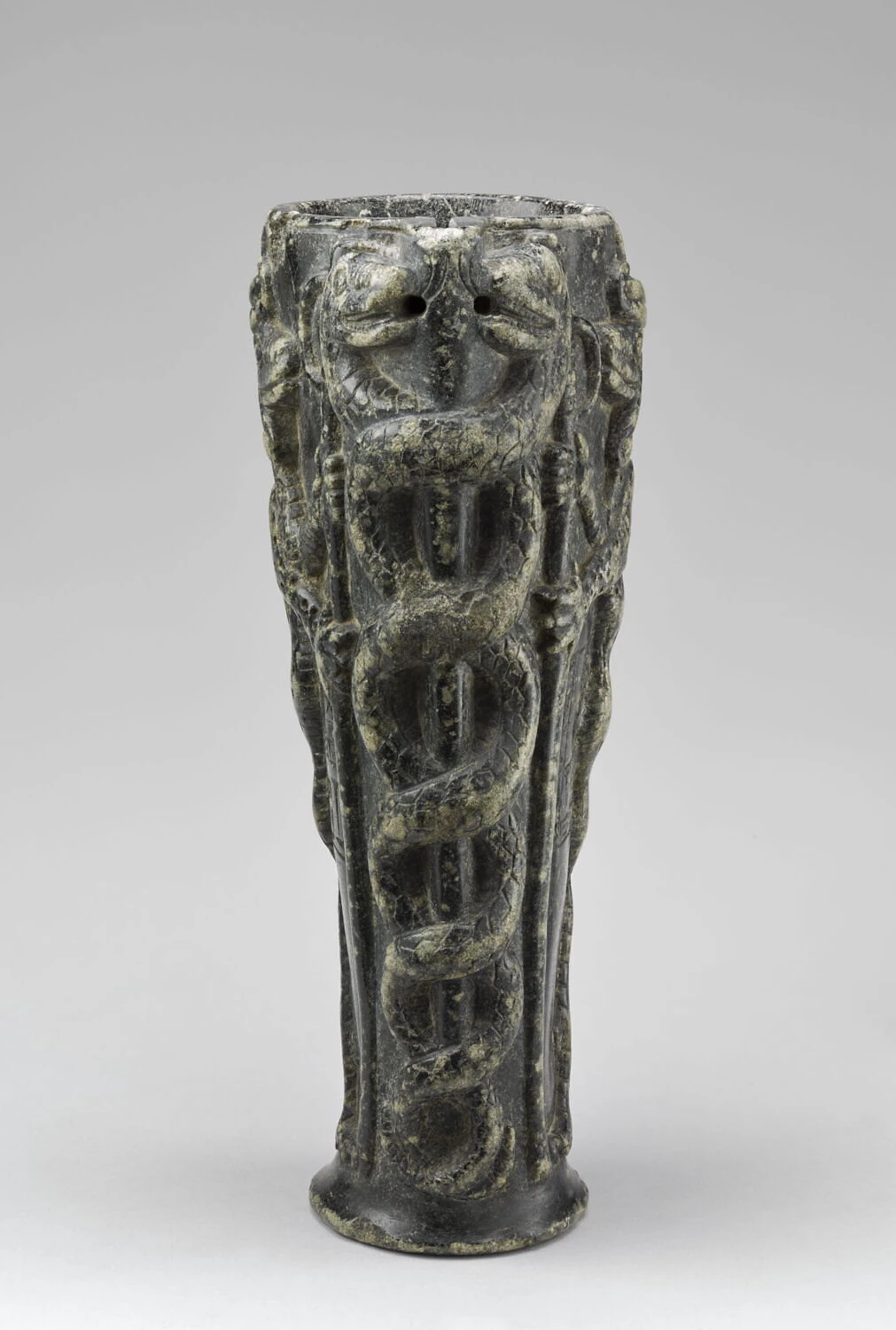
The chronological depth of this object is extraordinary. Gudea, ruler of Lagash, dedicated the vessel to Ningishzida near the end of the third millennium BCE. At its center, two snakes form a vertical braid. Two horned, legged dragons flank them.
The inscription supplies the divine dedication. The two snakes themselves are not individually named as marriage partners (Louvre, AO190).
Ningishzida belonged to a religious world in which vegetation, serpents, and the underworld could draw together. Adam Stone’s specialist account describes his connections with the growth and disappearance of plant life, his underworld role, and his importance as Gudea’s personal god. Life’s emergence and withdrawal were both within his field of power (Oracc, “Ningišzida”).
The Louvre identifies it as a libation vessel, bringing its image into an act of offering. Gudea’s other commissions help recover that devotional setting. In a Getty interview, Timothy Potts describes statues of the ruler with hands clasped in prayer, expressing devotion especially to his tutelary god Ningishzida. The vessel belongs within this larger relationship between ruler, divine patron, and commissioned art (Getty interview and transcript, 2021).
This is an early masterpiece of the braid as a sacred emblem. Its narrow central axis would look familiar beside a much later staff, but the object has its own named recipient, dedicator, and ritual use. Those details make it more compelling: the serpent interlace was already capable of carrying concentrated divine presence in a ruler’s offering.
The caduceus: two snakes and the possibility of peace #
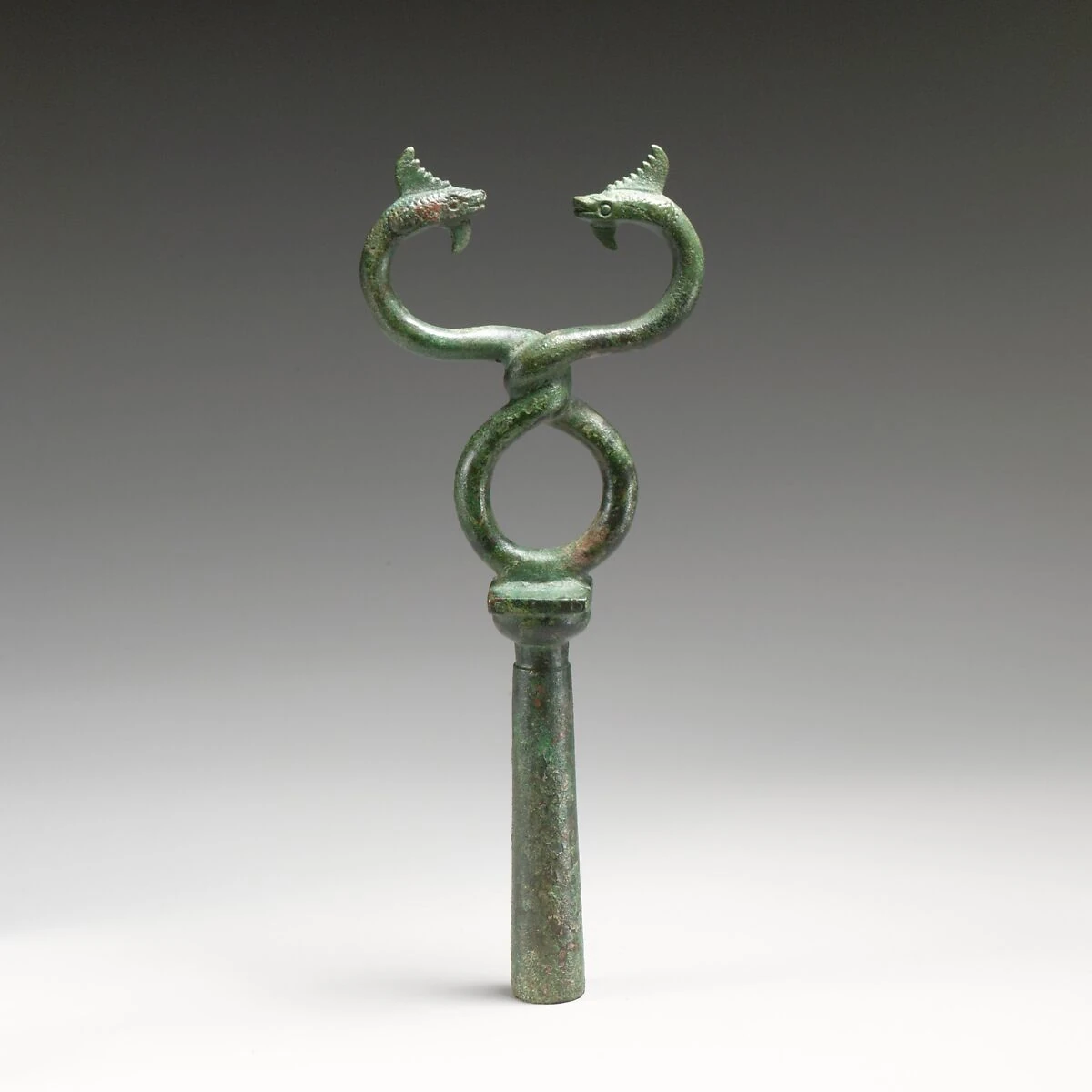
The Greek kerykeion, known in Latin as the caduceus, makes the serpent pair into an attribute carried by a god. Hermes’ staff bears two snakes whose opposed heads complete the symmetry above their crossing bodies. On this Archaic bronze finial, the artist carefully worked the little heads while reducing the bodies to the elegant curves needed by the emblem (Met, 1989.281.57).
An ancient explanation gives the pair a relationship of its own. In Hyginus’ account, Mercury receives the staff from Apollo in exchange for the lyre. Later, in Arcadia, he encounters two snakes with their bodies intertwined, apparently fighting. He puts the staff between them and they separate. The episode makes the staff an instrument of peace, explaining why artists represent it with the two entwined snakes (Astronomica 2.7.2, translated by Roger T. Macfarlane).
The story gives a useful turn to the tour. An interlace can express an intimate union, but it can also begin in conflict. The staff’s meaning comes from what happens between the two beings: an intervention makes separation and peaceful passage possible.
The final emblem holds them in a balanced relationship around an axis. The bodies remain paired even as the story tells us that the god stopped their struggle.
Cadmus and Harmonia: marriage survives the change of body #
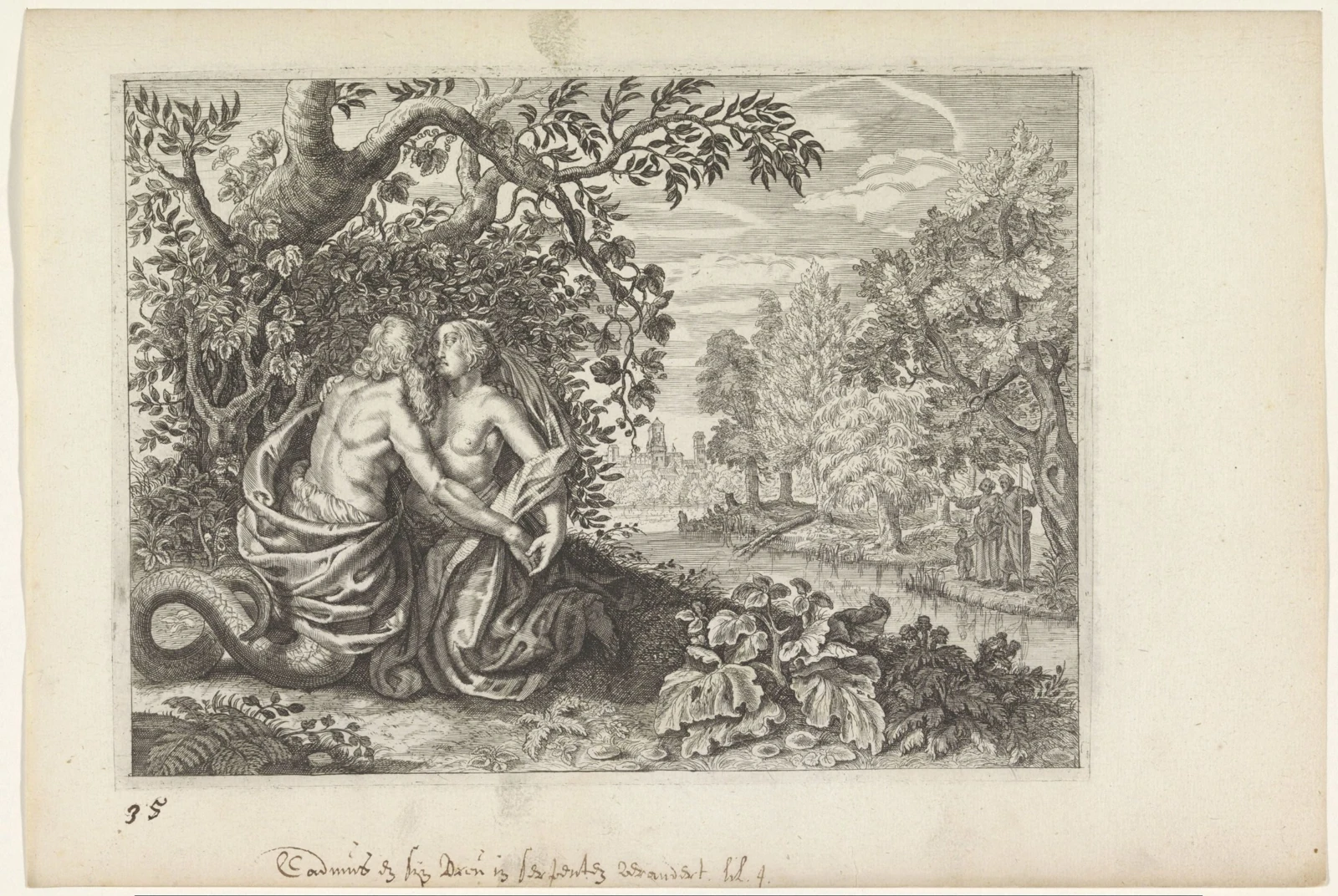
One ancient marriage brings the emotional meaning of the serpent pair into sharp focus. In Ovid’s account, Cadmus becomes a snake before Harmonia does. He tries to speak as his tongue changes. She recognizes him, laments the transformation, and asks to share it. When she too becomes a serpent, the two move together into the woods, their bodies joined. Their new form preserves their companionship (Metamorphoses 4.563–603).
Philostratus describes a painting of the same transformation with a remarkably close parallel to the human–serpent figures that opened this tour. Cadmus and Harmonia are already serpents from the thighs downward while their upper bodies remain human. As the change advances, they embrace the human forms they can still hold (Imagines 1.18, Greek text and translation).
The ancient painting is known through that description. The surviving print shown here belongs to the story’s much later visual life. Together, text and image reveal why this pair deserves a place beside the more familiar serpent ancestors.
For Nüwa and Fuxi, serpent form belongs to ancestral identity. For Cadmus and Harmonia, it arrives as a devastating change. The marriage crosses the boundary with them. Human likeness disappears, and recognition endures.
What the intertwined serpent pair makes visible #
| Image | Relationship carried by the pair | What the object brings into view |
|---|---|---|
| Nüwa and Fuxi | Ancestral and marital partnership | Human origins within celestial order |
| Nāga–nāginī couples | Intimate serpent beings | Embrace, water, fertility, and sacred architecture |
| Isis and Dionysos | Paired divine identities | Human faces joined through serpent bodies |
| Isis-Thermoutis and Serapis / Agathodaimon | Divine partnership; Isis–Serapis marriage attested in texts | Abundance, protection, and favorable destiny |
| Balinese ritual textile | Cosmological nāga pair, individual names unrecorded | Serpent continuity on deliberately continuous cloth |
| Dambala and Ayida Wedo | Husband and wife | Love, water, rainbow, and ritual encounter |
| Lienzo Seler II | Differentiated serpents in a place sign | Foundation, lineage, and territorial memory |
| Gudea’s vessel | Divine emblem dedicated to Ningishzida | Sacred presence in an act of offering |
| Caduceus | Two serpents brought out of conflict | Mediation and peace |
| Cadmus and Harmonia | A married couple transformed together | Companionship surviving a change of body |
The serpent offers an artist a body that can become a line, a loop, a border, or a support. Pair two of them and the possibilities multiply. They can face each other, cross once, make a knot, or braid repeatedly around a shared axis. Human heads, crowns, hoods, feathers, and markings keep identities readable inside the interlace.
The objects also give the pair something to do. It accompanies the dead, inhabits a temple, surrounds a dedication, encircles a wrist, receives a salute, or marks the place where a history begins. The relationship becomes active through its setting.
That is the enduring achievement of the form. Two lives remain visible while making one shape. A serpent braid gives union a structure the eye can follow: through each crossing, difference persists, and the relationship holds.
For the broader relationship between serpents, ancestry, and institutions, see The Serpents Who Founded the Human World.
Notes on the objects #
Dates throughout refer to the illustrated objects or their museum ranges. The age of an object, a story, and a photographic reproduction are different questions. This tour compares a visual form while retaining the relationships established for each example.
Sources and further reading #
- Bloch, Theodor. Supplementary Catalogue of the Archaeological Collection of the Indian Museum. 1911. P. 92, no. 4220.
- Campbell, Siobhan. “Sacred Textiles.” Australian Museum. E097463 and the separate E097462.
- Deren, Maya. Divine Horsemen: The Living Gods of Haiti. 1953. Pp. 36–37, 115–116.
- Gail, Adalbert J. “Serpents in Angkor: Apotheosis of a Decorative Motif.” Pandanus 6/2 (2012). P. 15, figs. 14–15.
- Hebblethwaite, Benjamin, Tahiri Jean-Baptiste, and Myrlande Denis. Racine Figuier, Vodou Lakay (2004): Transcription and Translation. 2013. P. 5, songs 3.b–c.
- Hyginus. Astronomica 2.7.2. Translation by Roger T. Macfarlane, Brigham Young University.
- Isidorus. Hymns to Isis, I–II. Translation from V. F. Vanderlip, 1972; same collection includes the Maroneia aretalogy.
- König, Viola, ed. On the Mount of Intertwined Serpents: The Pictorial History of Power, Rule, and Land on Lienzo Seler II. 2017. Elizabeth Hill Boone, p. 40; König, pp. 139–142.
- Kossak, Steven M., and Edith W. Watts. The Art of South and Southeast Asia: A Resource for Educators. Metropolitan Museum of Art, 2001. P. 118.
- Marcelin, Émile. “Les grands dieux du vodou haïtien.” Journal de la Société des Américanistes 36 (1947): 51–135. Especially pp. 71–72.
- Mohan, Urmila. “Looms Are Good To Think With!” Bard Graduate Center, June 7, 2017.
- Ovid. Metamorphoses, book 4, lines 563–603.
- Philostratus the Elder. Imagines 1.18. Greek text, University of Exeter; Arthur Fairbanks’s translation.
- Plutarch. On Isis and Osiris, sections 28 and 35.
- Potts, Timothy, interviewed by James Cuno. “Art and Writing in Early Mesopotamian Cities.” Getty, May 26, 2021.
- Stone, Adam. “Ningišzida.” Ancient Mesopotamian Gods and Goddesses, Oracc.
- Suhadolnik, Nataša Vampelj. “Transmission of Han Pictorial Motifs into the Western Periphery: Fuxi and Nüwa in the Wei-Jin Mural Tombs in the Hexi Corridor.” Asian Studies 7/2 (2019): 47–86.
- Threads of Life. “A Baby’s Touching the Ground Ceremony.” August 16, 2021.
- Veymiers, Richard. “Détourage et détournement, à propos d’un bas-relief dessiné par Pirro Ligorio.” Revue archéologique 2018/1: 47–76. Especially pp. 63–65.
Individual collection records and image credits are linked beside their illustrations. Photographs retain their stated rights separately from the article’s text license.
Compare the independent Nüwa creation and world-repair accounts preserved in Taiping yulan, chapter 78 and Huainanzi, “Lan ming xun”. Their textual histories should not be collapsed into the date of the Astana painting. ↩︎
The compound “Serapis-Agathodaimon” is a useful modern scholarly label, rather than an attested ancient compound cult name. Richard Veymiers distinguishes Agathodaimon from the human-headed Serapis serpent while explaining their overlapping imagery (2018, pp. 63–65). Local names matter: Isidorus’ second hymn calls the templemate Agathosdaimon Sokonopis, associated with Sobek. The Maroneia marriage passage has a Greek epigraphic record, lines 15–20. None of the four Egyptian compositions above requires a pictured Horus to complete it. ↩︎
E097463’s particular ceremony and the readings of its sacred signs are unrecorded in the museum account. The adjacent illustrated textile, E097462, depicts Kama and Ratih; those lovers’ names belong to that separate cloth. ↩︎
The Birmingham catalogue names Damballah and identifies two snakes around the post; the identification of the wife rests on the independently documented paired tradition and the explicitly identified Telemak flag. Spellings vary among sources: Dambala, Danbala, Dambalah, and Damballah; Ayida Wedo and Ayida Wèdo. ↩︎
Boone notes on p. 41 that Seler II itself does not explicitly implicate Lord 9 Wind / Quetzalcoatl in the way that related painted histories do. König’s proposed Cholula interpretation is developed on pp. 141–142. Other contributors to the same volume discuss alternative local or conceptual geographies. The object establishes a serpent-marked place, without establishing a marriage between its two serpents. ↩︎