~/hermeticism/alchemy
The Emerald Tablet of Hermes: Text, Translation and Origin
The Emerald Tablet is a 15-line Arabic text of c. 800, credited to Hermes and found in Balinus’s Secret of Creation. Full text, Latin version and origin.
TL;DR
- The Emerald Tablet is a riddle of about fifteen lines spoken by Hermes Trismegistus, first found in Arabic around 800 at the end of the Secret of Creation (Kitāb Sirr al-Khalīqa) credited to Balīnūs, the Arabic Apollonius of Tyana.
- The book dates to c. 750–800 by its editor Ursula Weisser, or c. 813–833 by Paul Kraus.1 Other early Arabic versions sit in the Jābir corpus and the Secret of Secrets.
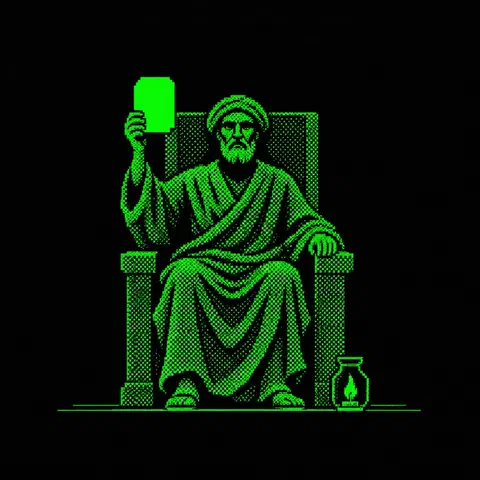
- In its frame story Balīnūs climbs down into a dark vault under a statue of Hermes at Tyana and finds an old man on a golden throne holding a tablet of green emerald. Latin editions call the vault Hermes’ tomb.
- Hugo of Santalla translated the whole book c. 1145–1151, but Europe read a separate 12th-century Latin version, the Tabula Smaragdina, printed at Nuremberg in 1541. It became the founding text of European alchemy.
- “As above, so below” comes from line 2. The Arabic says the upper is from the lower and the lower from the upper; the Latin turned “from” into “like”.
- The text is real and survives in dozens of manuscripts; the emerald slab never existed.
- Maurice Doreal’s Emerald Tablets of Thoth the Atlantean are a 20th-century American invention.
A Hermetic Riddle about the One Thing #
The Emerald Tablet (Arabic lawḥ al-zumurrud, Latin Tabula Smaragdina) is a short Hermetic text that tells, in riddles, how one thing comes from one and returns to it: born of sun and moon, carried by the wind, nursed by the earth, it rises to heaven, comes down again, and takes in the power of both. It ends with the speaker naming himself Hermes, “threefold in wisdom”. Medieval alchemists read it as a recipe for the philosophers’ stone; Renaissance readers read it as cosmology; modern occultists read it as a law of correspondence between heaven and the self.
It belongs to the “technical” Hermetica, the alchemical and magical writings under Hermes’ name, rather than to the philosophical Corpus Hermeticum. In the Arab world, where it was written, Hermes was already being identified with the prophet Idrīs (the biblical Enoch), which gave such texts prophetic weight (van Bladel 2009, The Arabic Hermes). The same equation of Hermes with Enoch is why later Europeans told stories of the tablet being found in Enoch’s burial cave at Hebron.
The Arabic Text, Translated #
This is the oldest version, from the Secret of Creation, in the Arabic edited by Ursula Weisser from the manuscripts (Weisser 1979, pp. 524–525). The English is my own, line by line from the Arabic. “It” is the one thing the text is about; Arabic has no neuter, so it could equally be “he”.
| Arabic (Sirr al-Khalīqa) | English | |
|---|---|---|
| 1 | حقٌّ لا شكَّ فيه صَحيح | True, without doubt, certain: |
| 2 | إنّ الأعلى من الأسفل والأسفل من الأعلى | the upper comes from the lower, and the lower from the upper. |
| 3 | عمل العجائب من واحد كما كانت الأشياء كلّها من واحد بتدبير واحد | The work of wonders is from one, as all things came from one, by one governing act. |
| 4 | أبوه الشمس، أُمّه القمر | Its father is the sun, its mother the moon. |
| 5 | حملته الريح في بطنها، غذته الأرض | The wind carried it in her belly; the earth fed it. |
| 6 | أبو الطِّلسمات، خازن العجائب، كامل القوى | Father of talismans, keeper of wonders, perfect in its powers. |
| 7 | نار صارت أرضاً ٱعزِل الأرض من النار | A fire that has become earth. Separate the earth from the fire:2 |
| 8 | اللطيف أكرم من الغليظ | the subtle is nobler than the gross. |
| 9 | برِفق وحُكم يصعد من الأرض إلى السماء وينزل إلى الأرض من السماء | Gently and wisely it rises from earth to heaven, and comes down to earth from heaven, |
| 10 | وفيه قُوّة الأعلى والأسفل | and in it is the power of the upper and the lower, |
| 11 | لأنّ معه نور الأنوار فلذلك تهرب منه الظُّلمة | for the light of lights is with it, and so darkness flees from it. |
| 12 | قُوّة القوى | Power of powers: |
| 13 | يغلب كلّ شيء لطيف، يدخل في كلّ شيء غليظ | it overcomes every subtle thing and enters every gross thing. |
| 14 | على تكوين العالَم الأكبر تكوّن العمل | The work was made on the pattern of the making of the greater world. |
| 15 | فهذا فَخْرِي ولذلك سُمّيتُ هرمس المثلَّث بالحكمة | This is my glory, and for this I am called Hermes, threefold in wisdom. |
Three words carry the meaning. Tadbīr (line 3), “governing” or “management”, is also the Arabic alchemists’ word for an operation, the regimen of the work. Ṭilasmāt (line 6) are talismans, the speciality of Balīnūs, whom Arabic writers called the “Master of Talismans”. And al-ʿālam al-akbar (line 14), “the greater world”, is the macrocosm: the work in the vessel repeats the making of the world. The tablet reads as the closing seal of a book about how the world was made, and it was probably talismanic before it was alchemical.3
The Latin Tabula Smaragdina #
Europe knew the text through a Latin version that scholars call the vulgate. It comes from an anonymous 12th-century compilation of commentaries on the tablet translated from a lost Arabic book, and it is the basis of every later European translation (Mandosio 2004; Steele and Singer 1928). The text below is the first printing, in De alchemia (Nuremberg: Johannes Petreius, 1541), p. 363, which follows the vulgate closely. The translation is mine.
| Latin (Nuremberg 1541) | English | |
|---|---|---|
| 1 | Verum sine mendacio, certum, et verissimum. | True, without lying, certain and most true. |
| 2 | Quod est inferius, est sicut quod est superius. Et quod est superius, est sicut quod est inferius, ad perpetranda miracula rei unius. | What is below is like what is above, and what is above is like what is below, to accomplish the miracles of the one thing. |
| 3 | Et sicut res omnes fuerunt ab uno, meditatione unius, sic omnes res natae ab hac una re, adaptatione. | And as all things were from one, by the meditation of one, so all things were born from this one thing, by adaptation. |
| 4 | Pater eius est Sol, mater eius est Luna. | Its father is the Sun, its mother is the Moon. |
| 5 | Portavit illud ventus in ventre suo. Nutrix eius terra est. | The wind carried it in its belly. Its nurse is the earth. |
| 6 | Pater omnis telesmi totius mundi est hic. | The father of every telesm of the whole world is here. |
| 7 | Vis eius integra est, si versa fuerit in terram. | Its power is whole if it is turned into earth. |
| 8 | Separabis terram ab igne, subtile ab spisso, suaviter cum magno ingenio. | You shall separate the earth from the fire, the subtle from the thick, gently and with great skill. |
| 9 | Ascendit a terra in coelum, iterumque descendit in terram, et recipit vim superiorum et inferiorum. | It rises from earth to heaven and comes down again to earth, and takes in the power of the upper things and the lower. |
| 10 | Sic habebis gloriam totius mundi. Ideo fugiet a te omnis obscuritas. | So you will have the glory of the whole world, and all darkness will flee from you. |
| 11 | Haec est totius fortitudinis fortitudo fortis, quia vincet omnem rem subtilem, omnemque solidam penetrabit. | This is the strong strength of all strength, for it will overcome every subtle thing and pierce every solid one. |
| 12 | Sic mundus creatus est. | So the world was created. |
| 13 | Hinc erunt adaptationes mirabiles, quarum modus hic est. | From this will come wonderful adaptations, of which this is the method. |
| 14 | Itaque vocatus sum Hermes Trismegistus, habens tres partes philosophiae totius mundi. | Therefore I am called Hermes Trismegistus, having the three parts of the philosophy of the whole world. |
| 15 | Completum est, quod dixi de operatione Solis. | What I have said of the operation of the Sun is finished. |
Set side by side, the two versions show what the Latin did. The Arabic’s light of lights, before which darkness flees “from it”, became a promise to the reader: “all darkness will flee from you”. The cosmogony became an operation of the Sun, gold. And the translator, who did not know the Arabic ṭilasm, simply wrote it down as telesmus, a Greek-looking word nobody understood. Medieval commentators made it mean “secret” or “treasure”; Isaac Newton made it “perfection” (Mandosio 2005).
From “The Upper from the Lower” to “As Above, So Below” #
The slogan comes from line 2, by three steps. The Arabic says the upper is from the lower and the lower from the upper (الأعلى من الأسفل, al-aʿlā min al-asfal): each realm proceeds from the other, a statement about origins. Hugo of Santalla kept that sense in the 1140s: superiora de inferioribus, inferiora de superioribus, “the upper from the lower, the lower from the upper” (Hudry 1997–1999, p. 152). The vulgate changed it to likeness: quod est superius est sicut quod inferius, “what is above is like what is below”. Nineteenth-century occultists then cut it to a four-word maxim, and the 1908 Kybalion made “As above, so below; as below, so above” its Principle of Correspondence.4
So the slogan is real Hermetic wording, but it is the Latin’s wording. The oldest text is about two worlds that generate each other.
Balīnūs and the Vault under Hermes’ Statue #
The author’s name is lost. The Secret of Creation presents itself as a work of Apollonius of Tyana, the 1st-century wonder-worker, translated and annotated by a priest of Nablus called Sājiyūs. That is a pseudonymous frame. The book was written in Arabic in the late 8th or early 9th century, by someone who knew Greek natural philosophy well; it is also the first text to teach that all metals are made of sulphur and mercury, the doctrine that ran alchemy for the next nine hundred years (Kahn 1994, pp. XIII–XIV; Weisser 1980). It was most likely composed in Arabic from older Greek and Syriac material.5
The frame story is the reason the text is called a tablet. Balīnūs, an orphan of Tyana, tells it himself (summarized from Weisser 1979, pp. 5–7):
- In his city stood a statue of Hermes on a glass column, inscribed: Whoever wants to know the secret of creation and the craft of nature, let him look beneath my feet.
- People looked at the statue’s feet and saw nothing. Balīnūs, grown up, understood, dug, and found a dark underground passage where a wind blew out every lamp.
- He fell asleep, and an old man who looked like him told him to put his light in a clear glass vessel. Asked who he was, the old man said: I am your perfect nature.
- Balīnūs went down with the lamp in its glass and found an old man seated on a throne of gold, holding a tablet of green emerald inscribed This is the craft of nature, with a book before him: This is the secret of creation and the knowledge of the causes of things.
The old man on the throne is Hermes, and the vault is his burial chamber; Julius Ruska, who first worked out the Arabic tradition, calls it the Grabkammer of Tyana (Ruska 1926, p. 164). The Latins said so plainly. A 1566 alchemical anthology prints the “emerald tablet of Hermes, found in his own tomb” (tabula smaragdina, in ipsius sepulchro inventa: Ars chemica, Strasbourg 1566), and from 1496 a new legend had Alexander the Great find it in Hermes’ tomb on his way to the oracle of Amun at Siwa. That is the source of the modern picture of the tablet clutched in a dead man’s hands. Arab writers told such stories about the pyramids too: Ibn al-Faqīh, writing in 903, reports a small pyramid opened under Aḥmad ibn Ṭūlūn in which a lead-sealed sarcophagus held “the mummy of an old man” with a tablet of white onyx under his head (Ruska 1926, p. 62).
No one ever saw an emerald slab; the green tablet in a vault is the book’s way of saying its wisdom came from Hermes. Medieval “emerald” also covered other green stones, and emerald was Hermes' own stone, as quicksilver was his metal and Mercury his planet (Ruska 1926, p. 116).
Ruska found the prototype of the scene in another Arabic Hermetic book, the Book of Crates. There the philosopher Crates, carried up to heaven, sees Hermes Trismegistus as a venerable old man in white on a throne, holding a shining tablet with a book on it. “This tablet,” Ruska concluded, “is the prototype of the Tabula Smaragdina” (Ruska 1926, p. 164). The Book of Crates calls itself the “expeller of darkness and illuminator of brightness”; the tablet says darkness flees from the light of lights.
Versions and Dates #
| Version | Language | Date | Notes |
|---|---|---|---|
| Sirr al-Khalīqa (Secret of Creation), pseudo-Apollonius (Balīnūs) | Arabic | c. 750–833 | Oldest; full text with frame story (Weisser 1979) |
| Kitāb Usṭuqus al-Uss al-Thānī, Jābir corpus | Arabic | 9th–10th c. | Shorter, partly corrupt; first noticed by Holmyard (1923) |
| Sirr al-Asrār (Secret of Secrets), pseudo-Aristotle | Arabic | 10th c. | Close to the Sirr al-Khalīqa; ed. Badawi 1954 |
| Ibn Umayl, Silvery Water and Starry Earth | Arabic | 10th c. | Tablet on the knees of a seated statue in a pyramid |
| Hermann of Carinthia, De essentiis | Latin | 1143 | Cites the tablet and the statue-and-cave story |
| Hugo of Santalla, De secretis naturae | Latin | c. 1145–1151 | Whole Secret of Creation translated; little read |
| Vulgate (Liber Hermetis de alchimia) | Latin | first half 12th c. | Standard European text |
| Secretum secretorum (Philip of Tripoli; Roger Bacon’s edition) | Latin | 13th c. | Separate translation; “the one worker of miracles is God” |
| Hortulanus, commentary | Latin | early 14th c. | Reads it as a laboratory recipe; most copied commentary |
| De alchemia, Nuremberg (Petreius) | Latin | 1541 | First printing, with Hortulanus |
| Isaac Newton, Keynes MS 28 | English | late 17th c. | Translation and Latin commentary |
| Maurice Doreal, Emerald Tablets of Thoth the Atlantean | English | mid-20th c. | Modern invention, unrelated |
The text survives in dozens of Arabic and Latin manuscripts, from the Paris and Tehran copies of the Secret of Creation to the Latin miscellanies listed by Steele and Singer (1928). The oldest text is the Arabic.
Newton’s Translation #
Isaac Newton made his own English version and wrote a Latin commentary on it, now Keynes MS 28 at King’s College, Cambridge (Chymistry of Isaac Newton). It opens “Tis true without lying, certain & most true” and renders telesmus as “perfection”. What he made of Hermes’ three parts of philosophy, and how faithful he was, is covered in Newton’s translation of the Emerald Tablet. He sits in a long line of famous Hermeticists, from Jābir and the Arabic alchemists to the occult revival.
Serpents, Dragons and the One Thing #
No serpent appears in the tablet’s fifteen lines. But the “one thing” that rises and falls, is born of opposites and contains them, is exactly what the alchemists drew as a serpent or dragon. The Greek alchemical sheet called the Chrysopoeia of Cleopatra puts the Ouroboros, the snake eating its tail, around the words hen to pan, “the all is one”, the same doctrine as the tablet’s “all things came from one” (Marcianus gr. 299, f. 188v). Ibn Umayl’s pyramid tablet shows two birds each biting the other’s tail, “like a circle, a symbol of ‘Two in One’” (Ibn Umayl 1933, pp. 119–120). The Latin Aurora consurgens of c. 1420 paints a serpentine Mercury beheading the Sun and Moon, the father and mother of the tablet’s line 4.

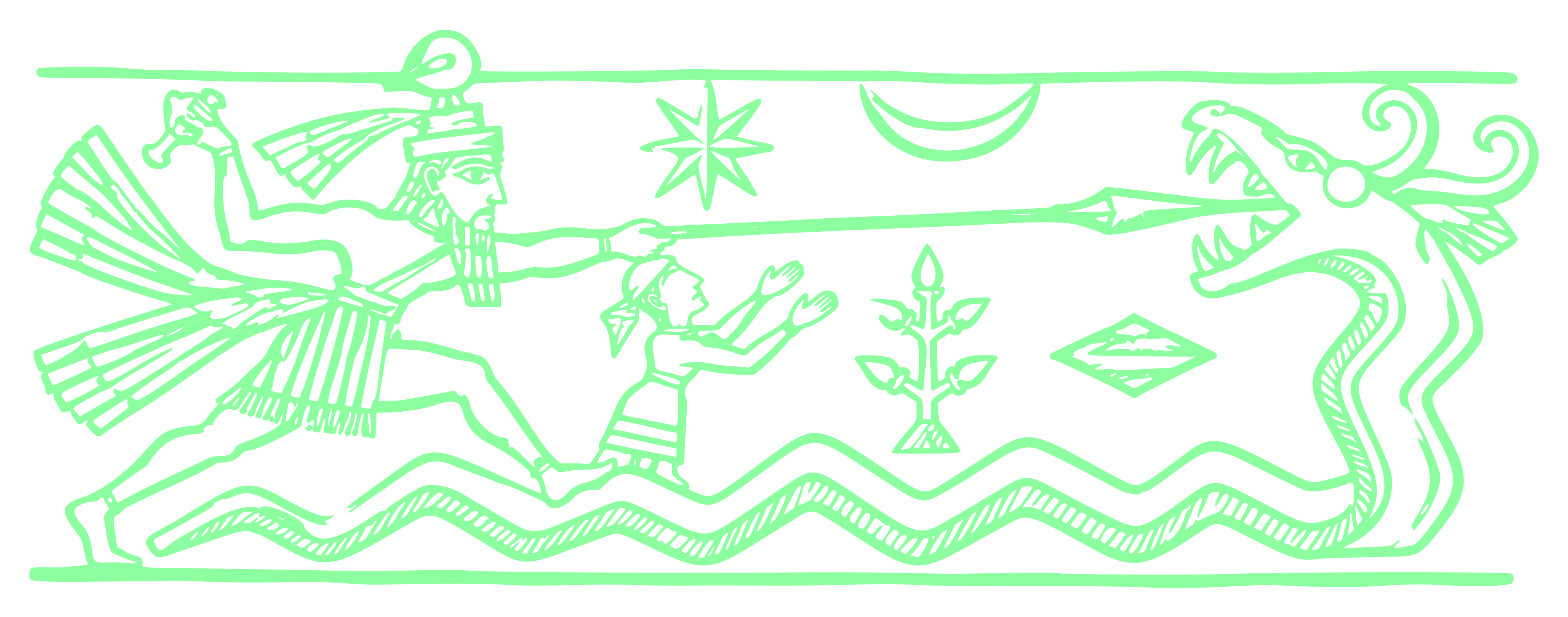
The Book of Crates, where Ruska found the tablet’s prototype, is a dragon story. A youth turns a dragon that threatens Crates to dust with spells, then orders him to write down what he saw: the dragon-slaying, he says, is the secret of Hermes Trismegistus, hidden in his book and kept from the ignorant (Ruska 1926, p. 53). A sister work from the same Arabic collection, the Book of al-Ḥabīb, even keeps the Greek name of the Ouroboros in Arabic letters (Ruska 1926, p. 53 n. 3). So the earliest frame around the tablet already puts a slain serpent at the centre of Hermes’ secret, and behind the Hellenistic sage stands an older Greek Hermes who was himself a snake. That fits the wider pattern of the snake cult, where the serpent guards, or is, the knowledge that makes the initiate.
Doreal’s Emerald Tablets of Thoth the Atlantean #
They are a different and much later thing. The Emerald Tablets of Thoth the Atlantean is a book by Maurice Doreal (born Claude Doggins, 1898–1963), who founded the Brotherhood of the White Temple in Denver around 1930 and claimed to have found and translated tablets left by Thoth, king of Atlantis, in the Great Pyramid in 1925. It was printed by his group in the mid-20th century, most likely before 1953 (Barkun 2003, pp. 115, 120), and borrows its mood from Theosophy and H. P. Lovecraft. It has a snake in it: Doreal’s Tablet VIII describes beings summoned “when the blood was offered”, “serpent-headed when the glamour was lifted but appearing to man as men among men”, who crept into the councils and killed the chiefs of the kingdoms (Tablet VIII). David Icke later built his reptilian conspiracy theory partly on Doreal (Barkun 2003, p. 120).
FAQ #
Q1. What is the Emerald Tablet?
A. A riddle of about fifteen lines in which Hermes Trismegistus describes the one thing, born of
sun and moon, that rises from earth to heaven and comes down again. Its oldest version is Arabic,
c. 800, from the Secret of Creation of pseudo-Apollonius (Balīnūs).1
Q2. Who wrote the Emerald Tablet?
A. An unknown author writing in Arabic in the late 8th or early 9th century put it in the mouth
of Hermes and framed it as a find made by Apollonius of Tyana. He probably reworked older Greek or
Syriac Hermetic material, but no earlier version survives.5
Q3. Is the Emerald Tablet real?
A. The text is real and survives in dozens of Arabic and Latin manuscripts. The emerald slab is
not: the vault under Hermes’ statue at Tyana is the book’s frame story.
Q4. Where does “as above, so below” come from?
A. From the Tablet’s second line. The Arabic says the upper is from the lower and the lower from
the upper; the 12th-century Latin made it “what is below is like what is above”, and the 1908
Kybalion fixed the short form.4
Q5. What does “telesm” mean in the Emerald Tablet?
A. It is the Arabic ṭilasm, “talisman”, copied into Latin as telesmus by a translator who did
not know the word. Medieval commentators guessed “secret” or “treasure”, and Newton wrote
“perfection”.
Q6. Did Isaac Newton translate the Emerald Tablet?
A. Yes. His English version and Latin commentary survive as Keynes MS 28 at King’s College,
Cambridge, opening “Tis true without lying, certain & most true”.
Q7. Are the Emerald Tablets of Thoth the Atlantean the same text?
A. No. They are a 20th-century book by Maurice Doreal, who claimed to have found them in the
Great Pyramid in 1925; they have nothing to do with the medieval Emerald Tablet.
Sources #
- Badawi, ʿAbd al-Raḥmān, ed. Al-Uṣūl al-yūnāniyya li-l-naẓariyyāt al-siyāsiyya fī al-islām. Cairo: Maktabat al-Nahḍa al-Miṣriyya, 1954. (Arabic Sirr al-Asrār, pp. 166–167.)
- Barkun, Michael. A Culture of Conspiracy: Apocalyptic Visions in Contemporary America. Berkeley: University of California Press, 2003.
- Doreal, Maurice. “Tablet VIII: The Key of Mystery.” In The Emerald Tablets of Thoth the Atlantean. Brotherhood of the White Temple, mid-20th century.
- Holmyard, E. J. “The Emerald Table.” Nature 112 (1923): 525–526.
- Hudry, Françoise. “Le De secretis nature du Ps.-Apollonius de Tyane, traduction latine par Hugues de Santalla du Kitâb sirr al-halîqa.” Chrysopoeia 6 (1997–1999): 1–154.
- Ibn Umayl. Three Arabic Treatises on Alchemy by Muḥammad bin Umail. Ed. H. E. Stapleton, M. Hidayat Husain and M. Turab ʿAli. Memoirs of the Asiatic Society of Bengal 12. Calcutta, 1933.
- Kahn, Didier. La Table d’émeraude et sa tradition alchimique. Paris: Les Belles Lettres, 1994.
- Kraus, Paul. Jâbir ibn Hayyân: Contribution à l’histoire des idées scientifiques dans l’Islam, vol. 2, Jâbir et la science grecque. Mémoires de l’Institut d’Égypte 45. Cairo, 1943.
- Mandosio, Jean-Marc. “La Tabula smaragdina e i suoi commentari medievali.” In La tradizione ermetica dal mondo tardo-antico all’umanesimo, ed. P. Lucentini, I. Parri and V. Perrone Compagni, 681–696. Turnhout: Brepols, 2004.
- Mandosio, Jean-Marc. “La création verbale dans l’alchimie latine du Moyen Âge.” Archivum Latinitatis Medii Aevi 63 (2005): 137–147.
- Newton, Isaac. “Hermes” (Keynes MS 28). Ed. William R. Newman. The Chymistry of Isaac Newton, Indiana University.
- Petreius, Johannes, publ. De alchemia. Nuremberg, 1541. (Tablet on p. 363.)
- Ars chemica, quod sit licita recte exercentibus … Eiusdem tabula smaragdina, in ipsius sepulchro inuenta, cum commento Hortulani. Strasbourg, 1566.
- Ruska, Julius. Tabula Smaragdina: Ein Beitrag zur Geschichte der hermetischen Literatur. Heidelberg: Winter, 1926.
- Steele, Robert, and Dorothea Waley Singer. “The Emerald Table.” Proceedings of the Royal Society of Medicine 21, no. 3 (1928): 485–501.
- Three Initiates. The Kybalion. Chicago: Yogi Publication Society, 1908.
- van Bladel, Kevin. The Arabic Hermes: From Pagan Sage to Prophet of Science. Oxford: Oxford University Press, 2009.
- Weisser, Ursula, ed. Buch über das Geheimnis der Schöpfung und die Darstellung der Natur (Buch der Ursachen) von Pseudo-Apollonios von Tyana. Aleppo: Institute for the History of Arabic Science, 1979. (Arabic text of the tablet, pp. 524–525; frame story, pp. 5–7.)
- Weisser, Ursula. Das “Buch über das Geheimnis der Schöpfung” von Pseudo-Apollonios von Tyana. Berlin: De Gruyter, 1980.
Kraus (1943, pp. 274–275) put the Secret of Creation under the caliph al-Maʾmūn, c. 813–833; Weisser (1980, p. 54) argued for c. 750–800; Ruska (1926, p. 166) had allowed the 6th to 8th centuries. Kraus dated the Jābir corpus as a whole to the later 9th and 10th centuries, which is why the Jābirian version is not counted as the oldest even though Jābir is traditionally placed in the 8th century. ↩︎ ↩︎
The Secret of Secrets reads fa-in ṣārat arḍan, “if it becomes earth”, where the Secret of Creation has nār ṣārat arḍan, “fire became earth” (Badawi 1954, pp. 166–167). The Latin vulgate follows the first reading: vis eius integra est, si versa fuerit in terram. In Arabic script the two readings look alike (نار / فان). ↩︎
Mandosio (2004, pp. 682–683, 686) and Kahn argue the tablet was first talismanic, becoming alchemical once it travelled separately from the Secret of Creation. In that book the tablet is an appendix; whether it was always attached is debated (Kahn 1994, pp. XVI–XVII). ↩︎
The free-standing maxim is first common in the Theosophical writing of Helena Blavatsky, whose use of it is discussed in the scholarship collected under “As above, so below”. The Kybalion (1908), published anonymously as by “Three Initiates” and usually attributed to William Walker Atkinson, fixed the form most people now quote. ↩︎ ↩︎
For a Greek or Syriac original: Kraus 1943, pp. 270–303; Weisser 1980, pp. 52–53. For an Arabic composition from older materials: van Bladel 2009, pp. 170–171; Ullmann’s reviews of Weisser (1980, 1981). Sājiyūs has been identified with Sergius of Reshaina (d. 536), but without proof. ↩︎ ↩︎