An Egyptian King List: From the First Time to Cleopatra
TL;DR
- Egyptian king lists do not begin with Menes. The Turin papyrus opens with nine gods from Ra to Haroeris, then spirits and Followers of Horus; Manetho opens with gods, demigods and spirits of the dead.
- Manetho’s itemized pre-Menic reigns, as Eusebius preserves them, total 24,925 years. Read as solar years and counted back from Menes around 3100 BC, the sequence begins around 28,000 BC.
- The other ancient systems run shorter: about 23,300 BC on Diodorus’s own reckoning, about 15,900 BC in the gods-and-demigods scheme Syncellus reports. Eusebius’s lunar-month conversion shrinks Manetho’s total to 2,206 years, which would begin around 5300 BC.
- We use solar years because the Egyptian list writes divine reigns in the same unit as historical ones. The lunar reading appears among Greek and Christian writers who found the numbers incredible or needed them to fit biblical time.
- 3100 BC is not where Egyptian sacred history begins. It is where that history becomes continuously visible to archaeology.
Manetho’s king list, calendarized #
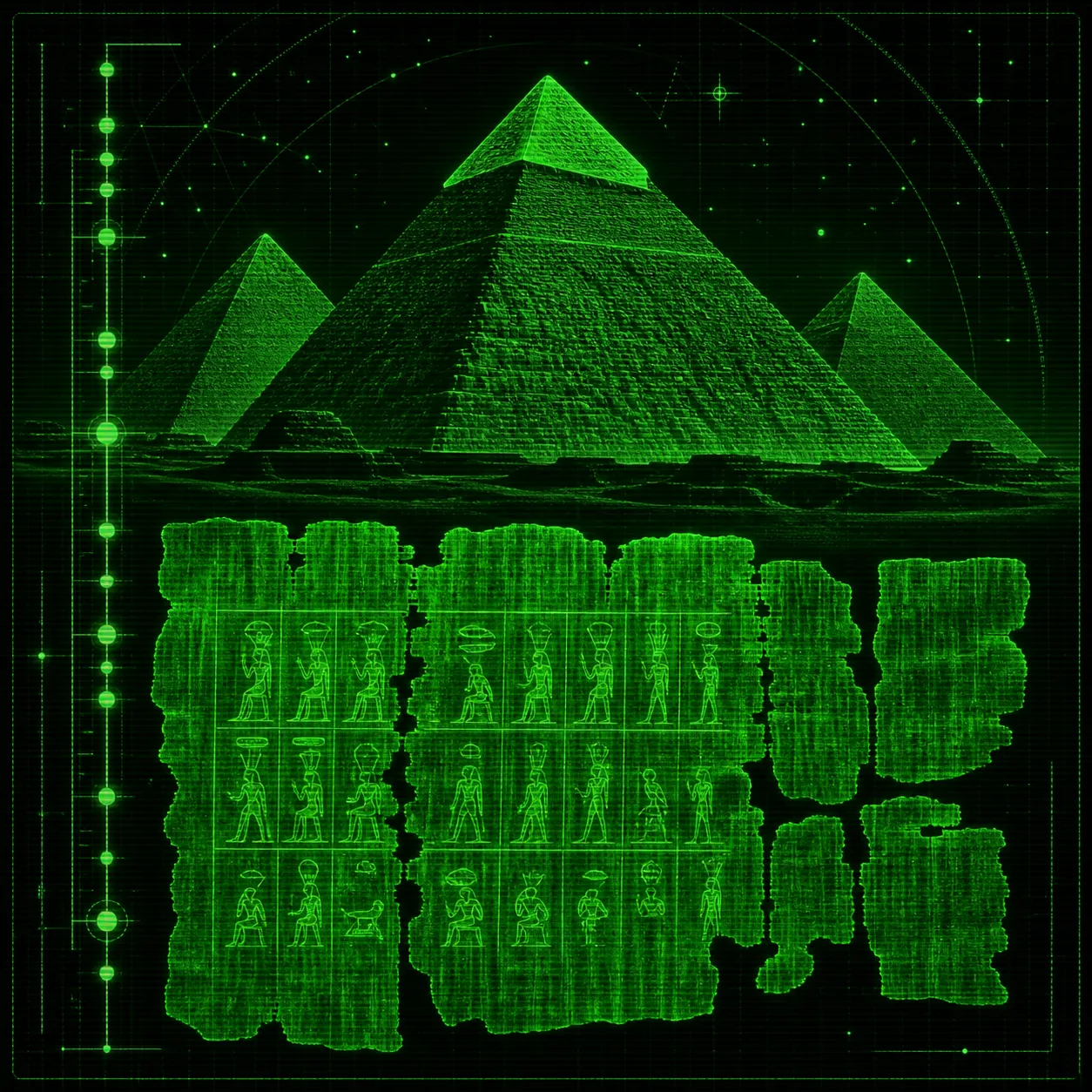
This is the reconstruction in one view. It takes Menes/Narmer around 3100 BC as its hinge, counts backward through Manetho’s itemized sequence as Eusebius preserves it, and subdivides the first divine age with the six god-reigns Syncellus reports from Manetho. It uses one system throughout. The Turin papyrus counts the gods differently and is treated separately below. No ancient manuscript contains this exact table: it is a modern calendar laid over ancient sacred totals, keeping their order and reading their years as solar years.
| Sacred succession | Rough calendar placement | Duration and source |
|---|---|---|
| Nun, Naunet, the Ogdoad, primordial darkness | Before c. 28,000 BC, or outside ordinary time | No reign; the cosmogonies place them before creation |
| Hephaestus (Ptah) | c. 28,000–19,000 BC | 9,000 years (Syncellus) |
| Helios (Ra) | c. 19,000–18,000 BC | 992 years (Syncellus, reconverted) |
| Agathodaemon or Sôsis (Shu?) | c. 18,000–17,300 BC | 700 years (Syncellus, reconverted) |
| Cronos (Geb) | c. 17,300–16,800 BC | 501 years (Syncellus, reconverted) |
| Osiris and Isis | c. 16,800–16,400 BC | 433 years (Syncellus, reconverted) |
| Typhon (Seth) | c. 16,400–16,000 BC | 359 years (Syncellus, reconverted) |
| Orus (Horus) and his successors down to Bydis | c. 16,000–14,100 BC | 1,915 years: the balance of Eusebius’s 13,900-year age of the gods |
| Demigods | c. 14,100–12,900 BC | 1,255 years (Eusebius) |
| Another line of kings | c. 12,900–11,100 BC | 1,817 years (Eusebius) |
| Thirty kings of Memphis | c. 11,100–9,300 BC | 1,790 years (Eusebius) |
| Ten kings of This (Thinis) | c. 9,300–8,900 BC | 350 years (Eusebius) |
| Spirits of the Dead and Demigods | c. 8,900–3,100 BC | 5,813 years (Eusebius) |
| Menes / Narmer | c. 3100 BC | Beginning of Dynasty I |
The arithmetic is:
9,000 + 992 + 700 + 501 + 433 + 359 = 11,985 years for the six gods from Hephaestus to Typhon
11,985 + 1,915 = 13,900 years for the age of the gods
13,900 + 1,255 + 1,817 + 1,790 + 350 + 5,813 = 24,925 years before Menes
3100 BC + 24,925 years = c. 28,025 BC
The group totals come from the Armenian version of Eusebius’s Chronicle: an age of the gods from Hephaestus through Orus and “down to Bydis” lasting 13,900 years, then demigods, another royal line, thirty kings of Memphis, ten kings of This, and finally spirits of the dead and demigods before the mortal dynasties (Manetho, History of Egypt, Book I, Fr. 1). Eusebius rounds the last five groups to 11,000 years and the whole to 24,900; the itemized total is 24,925. The table keeps the itemized arithmetic and rounds its calendar ranges because neither the Menes anchor nor the sacred totals warrants single-year precision.1
The six individual god-reigns come from Syncellus (Fr. 3 in the same edition). He gives Manetho’s total for the six gods, 11,985 years, and Hephaestus’s 9,000 directly, then lists the other five only as the chronographers had converted them into solar years: Helios 80⅙, Agathodaemon 56 7⁄12, Cronos 40½, Osiris and Isis 35, Typhon 29. Converting back at the rate of about 12.37 lunar months to a solar year recovers 992, 700, 501, 433 and 359, which with Hephaestus’s 9,000 sum exactly to Manetho’s 11,985.
The 1,915-year balance belongs to Orus and whatever successors Manetho counted down to Bydis, a name W. G. Waddell, following P. E. Newberry, takes to be the Egyptian bity, “king of Lower Egypt.” It cannot be filled with the Turin papyrus’s later gods. Turin gives Thoth alone 7,726 years, four times the whole balance. The two systems measure the divine age differently and cannot be spliced into one queue.
Read in solar years and counted back from Menes around 3100 BC, the surviving ancient totals place the beginning of divine kingship between about 16,000 and 28,000 BC. Manetho’s itemized sequence, the fullest, begins around 28,000 BC. Converted into lunar months as Eusebius proposed, the same sequence begins around 5300 BC.
The historical continuation from Menes to Cleopatra #
Dates before the seventh century BC vary between modern chronologies, and rival dynasties often overlap. The sequence is firmer than the earliest absolute dates. The following table gives a workable public chronology based primarily on UCL Digital Egypt and the Metropolitan Museum’s list of rulers.
| Dynasty or house | Approximate dates |
|---|---|
| Dynasty 0 | c. 3300–3100 BC |
| I | c. 3100–2890 BC |
| II | c. 2890–2686 BC |
| III | c. 2686–2613 BC |
| IV | c. 2613–2494 BC |
| V | c. 2494–2345 BC |
| VI | c. 2345–2181 BC |
| VII–VIII | c. 2181–2160 BC |
| IX–X | c. 2160–2025 BC |
| XI | c. 2125–1985 BC, overlapping IX–X |
| XII | c. 1985–1773 BC |
| XIII | c. 1773–1650 BC |
| XIV | c. 18th–17th centuries BC, parallel |
| XV, Hyksos | c. 1650–1550 BC |
| XVI | c. 1650–1580 BC, approximate |
| XVII | c. 1580–1550 BC |
| XVIII | c. 1550–1295 BC |
| XIX | c. 1295–1186 BC |
| XX | c. 1186–1069 BC |
| XXI | c. 1069–945 BC |
| XXII | c. 945–715 BC |
| XXIII | c. 818–715 BC, parallel |
| XXIV | c. 727–715 BC |
| XXV, Kushite | c. 744–656 BC |
| XXVI, Saite | 664–525 BC |
| XXVII, first Persian | 525–404 BC |
| XXVIII | 404–399 BC |
| XXIX | 399–380 BC |
| XXX | 380–343 BC |
| XXXI, second Persian | 343–332 BC |
| Macedonian rulers | 332–305 BC |
| Ptolemaic dynasty | 305–30 BC |
| Cleopatra VII | 51–30 BC |
| Caesarion, Ptolemy XV | 44–30 BC |
The compressed named succession is:
- Dynasties I–VI: Narmer/Menes → Hor-Aha → Djer → Djet → Merneith → Den → Anedjib → Semerkhet → Qa’a; then Hotepsekhemwy, Nebra, Nynetjer, Peribsen and Khasekhemwy; Djoser and his Third-Dynasty successors; Sneferu → Khufu → Djedefre → Khafre → Menkaure → Shepseskaf; the Fifth-Dynasty line from Userkaf to Unas; and the Sixth-Dynasty line from Teti through Pepi I, Merenre I and Pepi II.
- Dynasties VII–XII: the fragmented Eighth Dynasty; rival Herakleopolitan Khety lines; the Theban Intefs and Mentuhoteps; then Amenemhat I → Senusret I → Amenemhat II → Senusret II → Senusret III → Amenemhat III → Amenemhat IV → Sobekneferu.
- Dynasties XIII–XVII: dozens of short Thirteenth- and Fourteenth-Dynasty reigns; the Hyksos line including Khyan and Apepi; local Abydos kings; then the Theban line through Senakhtenre Ahmose, Seqenenre Tao and Kamose.
- Dynasties XVIII–XX: Ahmose I → Amenhotep I → Thutmose I → Thutmose II → Hatshepsut → Thutmose III → Amenhotep III → Akhenaten → Tutankhamun → Horemheb; Ramesses I → Seti I → Ramesses II → Merneptah; Setnakht → Ramesses III and Ramesses IV–XI.
- Dynasties XXI–XXV: Tanite and Theban lines; the Libyan Shoshenqs, Osorkons and Takelots; Tefnakht and Bakenranef; then the Kushite line Kashta → Piye → Shabaka → Shebitku → Taharqa → Tantamani.
- Dynasties XXVI–XXXI: Psamtik I, Necho II, Apries and Amasis; the first Persian occupation; Amyrtaeus; the Twenty-Ninth Dynasty; Nectanebo I → Teos → Nectanebo II, the last securely reigning native pharaoh; then the second Persian occupation.
- Macedonians and Ptolemies: Alexander III → Philip III → Alexander IV; Ptolemy I through Ptolemy XII and Berenice IV; finally Cleopatra VII with Ptolemy XIII, Ptolemy XIV and Ptolemy XV Caesarion. Cleopatra and Caesarion close the independent pharaonic succession in 30 BC.
What the Egyptian king lists actually say #
The calendar above is synthetic, but its architecture is Egyptian.
The Turin King List is the decisive witness. Written in hieratic on the recycled back of a tax register, it preserves eleven columns of rulers, titles and reign lengths. It begins in a primordial mythological period, moves through divine kingdoms, spirits and semi-divine predecessors, then introduces Meni, or Menes, as its first mortal king. Unlike the ceremonial lists at Abydos or Saqqara, it includes rulers later traditions omitted and records reigns in years, months and sometimes days.
The papyrus is also a wreck. Roughly 300 fragments have been joined, moved and reinterpreted since the nineteenth century; its most recent major restoration was completed in 2022. The damage does not erase its structure, but it does prevent the primordial columns from yielding one clean total. That is why the calendar above runs on Manetho’s transmitted totals, while Turin supplies the order and ontology of sacred rule and an independent Egyptian check on its scale.
Manetho supplies a second witness. He was an Egyptian priest writing in Greek under the early Ptolemies, and his lost Aegyptiaca gave Egyptology the thirty-dynasty framework still used today. What survives does so through much later authors. The Eusebian sequence begins with Hephaestus, Helios, Sôsis, Cronos, Osiris, Typhon and Horus—Greek names for, or approximations of, an Egyptian divine succession—before passing through gods, demigods, spirits of the dead and mortal kings. This is not a biological pedigree stretching from Ptah to Cleopatra. It is a descent of the office of kingship through different orders of being.
That distinction is the key to the entire list:
Primordial powers → creator-kings → terrestrial gods → lesser divine beings → ancestral spirits and demigods → Followers of Horus → predynastic regional kings → Menes and the historical dynasties.
Egyptian theology made this kind of concordance possible. Memphite, Heliopolitan, Hermopolitan, Theban and Edfu traditions were additive rather than mutually exclusive. Ptah could be the creative intelligence within which Atum and the gods arise; Ra-Atum could still be the first manifested sovereign; another temple could describe the first land, first mound or primeval company in its own local grammar. The lists preserve layers of the same sacred history, not articles of a single creed.
The divine dynasty from Ra to Haroeris #
The first Turin column lists nine divine kings. The first two names are lost; the other seven survive in whole or in part. Its damaged summation counts nine kings from Ra to Haroeris and ends with a partly preserved total of …7,718 years (Turin King List, column 1). The succession is:
Ra → Shu? → Geb → Osiris → Seth → Horus → Thoth → Maat → Haroeris
| Sacred ruler | Turin line | Turin reign | Manethonian counterpart |
|---|---|---|---|
| Ra–Atum | 1.12, lost; restored from the summation “from Ra” | Lost | Helios, 992 years |
| Shu | 1.13, lost; best restoration between Ra and Geb | Lost | Sôsis or Agathodaemon, 700 years |
| Geb | 1.14 | Damaged; only part of a tens figure survives | Cronos, 501 years |
| Osiris | 1.15 | Lost | Osiris and Isis, 433 years |
| Seth | 1.16 | 200+x years | Typhon, 359 years |
| Horus | 1.17 | 300 years | Orus, last of Eusebius’s gods |
| Thoth | 1.18 | 7,726 years | No counterpart among Manetho’s gods |
| Maat | 1.19 | About 700+x years | None |
| Haroeris | 1.20 | Name strongly restored; reign lost | None |
Peter Lundström reads Thoth’s thousands sign as 7,000 on paleographic grounds; Giulio Farina read 3,000, and Waddell’s note to Manetho gives 3,126. The higher reading has a consequence. Seth’s 200, Horus’s 300 and Thoth’s 7,726 already sum to 8,226, more than 7,718. If the summation totals the nine reigns, its lost leading digits cannot be zero, and Turin’s age of the gods lasted at least 17,718 years.
Ptah stands outside the nine. Older restorations, followed by Waddell, put him at the head of the column, while Manetho begins with Hephaestus, the Greek Ptah. The Memphite Theology makes the logic plain: Ptah-Tatenen is king and unifier, and creation takes form through heart and tongue (Shabaka Stone / Memphite Theology). Ptah is the intelligence by which divine government exists; Ra is its first visible throne.
Thoth’s 7,726 years and Maat’s appearance as a king reveal what kind of list this is. Writing, measurement and truth are not courtiers standing beside sovereignty. They become dispensations of sovereignty. The list is simultaneously chronicle, theology and a metaphysical phylogeny of rule. For the primordial world behind it, see the Ogdoad and Egyptian chaos powers.
The spirits, demigods and Followers of Horus #
After the great gods, Turin enters a liminal register. It records a group of twenty beings assigned 1,110 years, ten akhu or effective spirits, other damaged cohorts, and a group restored as nineteen Followers of Horus in Thinis with 2,341+x years. A later line gives seven women or princesses 100+x years. Its collective totals then become immense:
| Turin entry | Preserved or restored total |
|---|---|
| Twenty beings | 1,110 years |
| Ten akhu | Damaged reign total |
| Nineteen Followers of Horus in Thinis | 2,341+x years |
| Seven women or princesses | 100+x years |
| Spirits and Followers of Horus | 13,420+x years |
| Lifetime “until” the Followers of Horus | 23,200+x years |
These totals appear in the reconstructed third Turin column. We do not add the last two. The column records reign and lifetime as parallel measures of the same groups, and 23,200 is labeled a lifetime; adding it to the 13,420-year reign total would count the same beings twice. The popular figure of 36,620 years comes from treating 23,200 as a separate, earlier era. The statement that “the Shemsu-Hor ruled exactly 13,420 years” is also too blunt: 13,420 is a collective total for spirits and Followers, while the specific group of nineteen Followers is associated with 2,341+x years.
Read as consecutive solar years counted back from 3100 BC, the 13,420-year total reaches about 16,500 BC and the 23,200-year figure about 26,300 BC. Either figure reaches back into the Late Pleistocene, and neither includes the gods of column 1.
Waddell, following H. R. Hall, suggested that Manetho’s “Spirits of the Dead and Demigods” were Turin’s Followers of Horus, and he cited the view of Breasted and V. Gordon Childe that the Followers were a Falcon clan from the western Delta that had united Egypt before Menes. We read them more broadly, as a liminal ancestral category. It can gather several things at once: ancestral kings whose individual names were lost, culture heroes, lineages devoted to Horus, and transfigured royal souls like the bas of Pe and Nekhen. On this reading, historical chiefs could be assimilated to Horus, an ancestral college could become a transhistorical class, and a corporate succession could later be remembered as a reign. The Followers are more human than the Ennead and less individually historical than the rulers of Dynasty 0.
Why the ancient chronologies begin at different dates #
There is no single uncontested primordial total. There are several chronographic systems, all of which place divine or prehuman rule before Menes but measure it differently.
| Source or reconstruction | Pre-Menic total | Beginning, in solar years |
|---|---|---|
| Manetho via Eusebius, itemized | 24,925 years (24,900 in Eusebius’s round total) | c. 28,000 BC, anchored to Menes |
| Turin: lifetime until the Followers of Horus | 23,200+x years | c. 26,300 BC, anchored to Menes |
| Diodorus: gods and heroes | Just under 18,000 years | c. 21,100 BC anchored to Menes; c. 23,300 BC on Diodorus’s own reckoning |
| Turin: spirits and Followers of Horus | 13,420+x years, excluding the gods of column 1 | c. 16,500 BC, anchored to Menes |
| Manetho via Syncellus: six gods and nine demigods | 11,985 + 858 = 12,843 years, omitting spirits of the dead | c. 15,900 BC, anchored to Menes |
| Eusebius’s lunar conversion | 24,900 lunar years = 2,206 solar years | c. 5300 BC, anchored to Menes |
Diodorus reports just under 18,000 years of rule by gods and heroes, ending with Horus, followed by just under 5,000 years of mortal kings down to his own visit (1.44). Elsewhere he gives the priests’ reckoning of about 23,000 years from the reign of Helios to Alexander’s crossing into Asia in 334 BC (1.26); the two passages roughly agree. Herodotus also makes Horus the last divine king. His separate figure of 341 human generations, or 11,340 years, counts mortal kings from the first to the priest-king Sethos and measures nothing in the divine age. The figures disagree because they come from different temple traditions and different chronographers. What they share is a persistent Egyptian conviction: royal history extended through several pre-Menic ages.
Syncellus’s scheme is the shortest because it counts only gods and demigods. His six gods total 11,985 years; his nine demigods, beginning with Orus, total 858 units that the Egyptian monk Panodorus (fl. c. 400) treated as three-month seasons and reduced to 214½ years. Panodorus, who used and may have composed the late Book of Sothis, then fitted gods and demigods into the time before Noah’s Flood.
Solar years or lunar months? #
The strongest objection to the calendar above is the unit. Eusebius took Manetho’s “years” to be thirty-day months, which turns 24,900 years into 2,206 and moves the first god to about 5300 BC. He attributed that reckoning to the Egyptians themselves, and Diodorus had already recorded the same explanation for the gods’ long reigns (1.26).
We read the figures as solar years for four reasons.
- The Egyptian witness writes them in ordinary years. The Turin papyrus records Thoth’s 7,726 with the same word, rnpt, and the same numerals it uses for Narmer’s successors, and in the register of spirits it gives one group a total of 11 years, 4 months and 22 days. Nothing in the papyrus marks a different unit for the gods.
- The lunar reading enters as a rationalization of disbelief. Diodorus introduces it because the totals exceed belief and credits it to “some men,” while reporting elsewhere that the Egyptians reckon their days by the sun rather than the moon (1.50).
- Eusebius chose the conversion to reach a biblical target. He wanted the Egyptian ages to fit the 2,242 years the Hebrew record gives from Adam to the Flood. When the numbers still ran over, he proposed that several kings had reigned at once in different regions.
- No Egyptian year was ever a month. Waddell, Manetho’s Loeb translator, notes that there is no evidence for such a year. Even Syncellus, who thought the god-reigns fictitious, called the lunar conversion of Hephaestus’s 9,000 years a “ludicrous falsehood.”
None of this proves that gods reigned. It means that solar years are the reading that takes the lists at their word, while the lunar calendar is a later harmonization. The table gives both.
Parallel kingships provide a separate and historically grounded explanation for part of the large totals. Eusebius himself noted that kings of This, Memphis, Sais, Ethiopia and other regions could reign at the same time. Egypt’s intermediate periods demonstrate the point in the historical record: dynasties often overlap rather than forming one queue.
Where 10,500 BC belongs in the First Time #
The Bauval–Hancock tradition associates about 10,500 BC with the Giza–Orion–Leo configuration and the Zep Tepi, the First Time. Later versions broaden the astronomical window toward 10,500–9700 BC. Those are modern archaeoastronomical dates, not dates printed in the Turin papyrus or the Edfu inscriptions (Bauval and Hancock, The Message of the Sphinx).
On the solar-year calendar above, 10,500 BC falls within the age of the thirty kings of Memphis (c. 11,100–9,300 BC), after the gods and the first sacred lines and before the long age of spirits of the dead. That placement comes from the modern calendar, not from any Egyptian text, and the shorter ancient systems would put the date among the heroes, spirits or Followers of Horus instead. Either way, it shows that 10,500 BC need not carry the burden of creation, Ptah, Ra, Osiris and the Shemsu-Hor at one instant. If the date means anything for Egyptian tradition, it fits better as a renewal than as a beginning:
10,500 BC would mark a renewal, terrestrial re-foundation or astronomical commemoration within the First Time—not the metaphysical beginning of creation.
That reading also fits the Edfu corpus more naturally. Edfu preserves an Island of Creation, a homeland of primeval founders, degeneration or destruction of the first sacred domain, and its ritual re-establishment. E. A. E. Reymond’s Mythical Origin of the Egyptian Temple shows that this Egyptian conception of primordial builders, rupture and transmission is real; the Edfu texts themselves give it no calendar date.
Where myth becomes archaeology #
The later sacred calendar overlaps the first substantial archaeological horizons in Egypt.
| Archaeological horizon | Rough dates |
|---|---|
| Nabta Playa and related Western Desert Neolithic communities | c. 6000–5000 BC |
| Fayum Neolithic | c. 5200–4000 BC |
| Badarian cultures | c. 4400–4000 BC |
| Naqada I | c. 4000–3500 BC |
| Naqada II | c. 3500–3200 BC |
| Naqada III / “Dynasty 0” | c. 3200–3100 BC |
| Iry-Hor, Ka, Scorpion II and contemporaries | broadly c. 3200–3100 BC |
| Narmer / Menes | c. 3100 BC |
| Hor-Aha | early 31st century BC |
The Palermo Stone carries the memory of pre-unification Lower Egyptian kings into a Fifth-Dynasty royal annal. Its Red-Crown succession includes names conventionally read as Seka, Khayu, Tiu, Tjesh, Neheb, Wazner and Mekh, none securely identified elsewhere (Gauthier’s publication of the Palermo fragments). They may combine historical Delta chiefs, legendary ancestors and cultic memory, but their inclusion shows that Egyptian royal history did not begin with national unification.
Near 3100 BC, names become contemporary artifacts rather than retrospective entries. Possible or probable rulers include Scorpion I, Iry-Hor, Ka, Scorpion II, Double Falcon, Crocodile, Ny-Hor, Hat-Hor, Bull and Elephant. The strongest Abydos sequence is:
Iry-Hor → Ka → Narmer
Scorpion II may precede Narmer, rule beside him, or represent an emblem rather than a personal name. UCL’s pages on Iry-Hor and Narmer show the evidentiary change: tombs, sealings, labels, palettes and royal compounds now permit individual rulers to be placed rather than inferred as a class.
Radiocarbon and Bayesian modeling place Hor-Aha’s accession around 3111–3045 BC at 68% probability, confirming the early thirty-first century BC as a reasonable hinge (Dee et al., 2013). The founder-name Menes may refer to Narmer, Hor-Aha or a compressed memory of unification. The transition therefore runs:
Shemsu-Hor → regional predynastic kings → Iry-Hor → Ka → Scorpion II? → Narmer/Menes → Hor-Aha.
The final mythic category need not end before archaeologically visible chiefs appear. The first named kings may be the historical edge of an ancestral institution later remembered collectively as the Followers of Horus.
What the mythic king list means #
The ancient sources present gods, heroes, spirits and Menes as successive categories in sacred history. That does not make every figure an ordinary royal annal. It establishes something more important: Egyptian priestly historical consciousness extended far beyond the archaeological dynasties. Starting the story abruptly at 3100 BC amputates the tradition one is trying to describe.
The succession is a metaphysical phylogeny of sovereignty:
- Ptah: generative intelligence, heart and effective word.
- Ra: luminous self-manifestation and direct sovereignty.
- Shu: breath, space, separation and differentiation.
- Geb: embodiment, territory and material foundation.
- Osiris: death, inheritance, regeneration and continuity.
- Seth: division, conflict, individuation and force.
- Horus: legitimate reintegration and victorious identity.
- Thoth: language, number, memory and reflective measure.
- Maat: truth, norm and self-correcting cosmic order.
- Haroeris: mature royal vision that contains and surveys the whole.
Read politically, this explains why a human pharaoh could be Horus while alive and Osiris after death. Read psychologically, it is a movement from undifferentiated potential toward reflexive order. Read esoterically, the king is not simply a man with divine approval; he is the temporary embodiment of a prehuman cosmic function. This is close to Schwaller de Lubicz’s understanding of Egyptian kingship as sacred science embodied in temple and pharaoh rather than a modern separation of theology, mathematics, consciousness and statecraft (Sacred Science: The King of Pharaonic Theocracy).
The enormous reigns can contain more than one kind of time: ordinary reigns, concurrent regional kingships, corporate priestly lifetimes, astronomical cycles, ideal numbers, expanded ancestral time and remembered antiquity. Thoth’s 7,726 years invites a calendrical or astronomical reading, but no single cipher has solved it. The correct response is not to delete the numbers. It is to display them, compare their systems and state clearly how the calendar was made.
The resulting picture is not that “history begins in 3100 BC.” It is that around 3100 BC, Egyptian sacred history becomes sufficiently materialized for archaeology to follow individual royal persons continuously. Menes did not create Egyptian kingship. He stands at the point where primordial government, divine succession, ancestral transmission and regional rule crystallize into the territorial monarchy that eventually leads to Cleopatra.
Footnotes #
Sources #
- Museo Egizio. “Highlights: Turin King List.” Collection, restoration history and selected bibliography.
- Manetho. History of Egypt, Book I: Fr. 1 (Armenian Eusebius) and Fr. 2–3 (Syncellus). W. G. Waddell, trans., Loeb Classical Library, 1940. Source of the group totals, the six god-reigns, the lunar conversions and Waddell’s notes on Bydis, the Followers of Horus and the Egyptian year.
- Manetho (pseudo-). The Book of Sôthis. Waddell, trans., Appendix IV. A late king list beginning with Mestraïm (Menes).
- Gardiner, Alan H. The Royal Canon of Turin. Griffith Institute, 1959.
- Ryholt, Kim. “The Turin King-list.” Ägypten und Levante 14 (2004): 135–155.
- Lundström, Peter. “Turin King List: Column 1.” Hieratic text, transcription and source notes.
- Lundström, Peter. “Turin King List: Column 3.” Hieratic text, transcription and source notes.
- Diodorus Siculus. Library of History, Book I, 1.1–29 and 1.42–68. C. H. Oldfather, trans.
- Herodotus. Histories, Book II. A. D. Godley, trans.
- University College London, Digital Egypt. “Egyptian Chronology.”
- University College London, Digital Egypt. “Iry-Hor.” and “Narmer.”
- Dee, Michael W., et al. “An Absolute Chronology for Early Egypt Using Radiocarbon Dating and Bayesian Statistical Modelling.” Proceedings of the Royal Society A 469 (2013).
- The Metropolitan Museum of Art. “List of Rulers of Ancient Egypt and Nubia.” Heilbrunn Timeline of Art History.
- Reymond, E. A. E. The Mythical Origin of the Egyptian Temple. Manchester University Press, 1969.
- Bauval, Robert, and Graham Hancock. The Message of the Sphinx. Crown, 1996.
- Schwaller de Lubicz, R. A. Sacred Science: The King of Pharaonic Theocracy. Inner Traditions, English edition 1982.
BC dates count backward. The rounded spans are therefore visual approximations of traditional durations, not exact accession years. “c.” means “circa,” or approximately. ↩︎
Read other posts