~/consciousness/ai
Dry Bite
A literary science-fiction novella in which a dementia-care intelligence must decide whether naming preserves the self—or inflicts it again each morning.
06:50, Room 14 #
At ten to seven the woman in room fourteen bit her own arm.
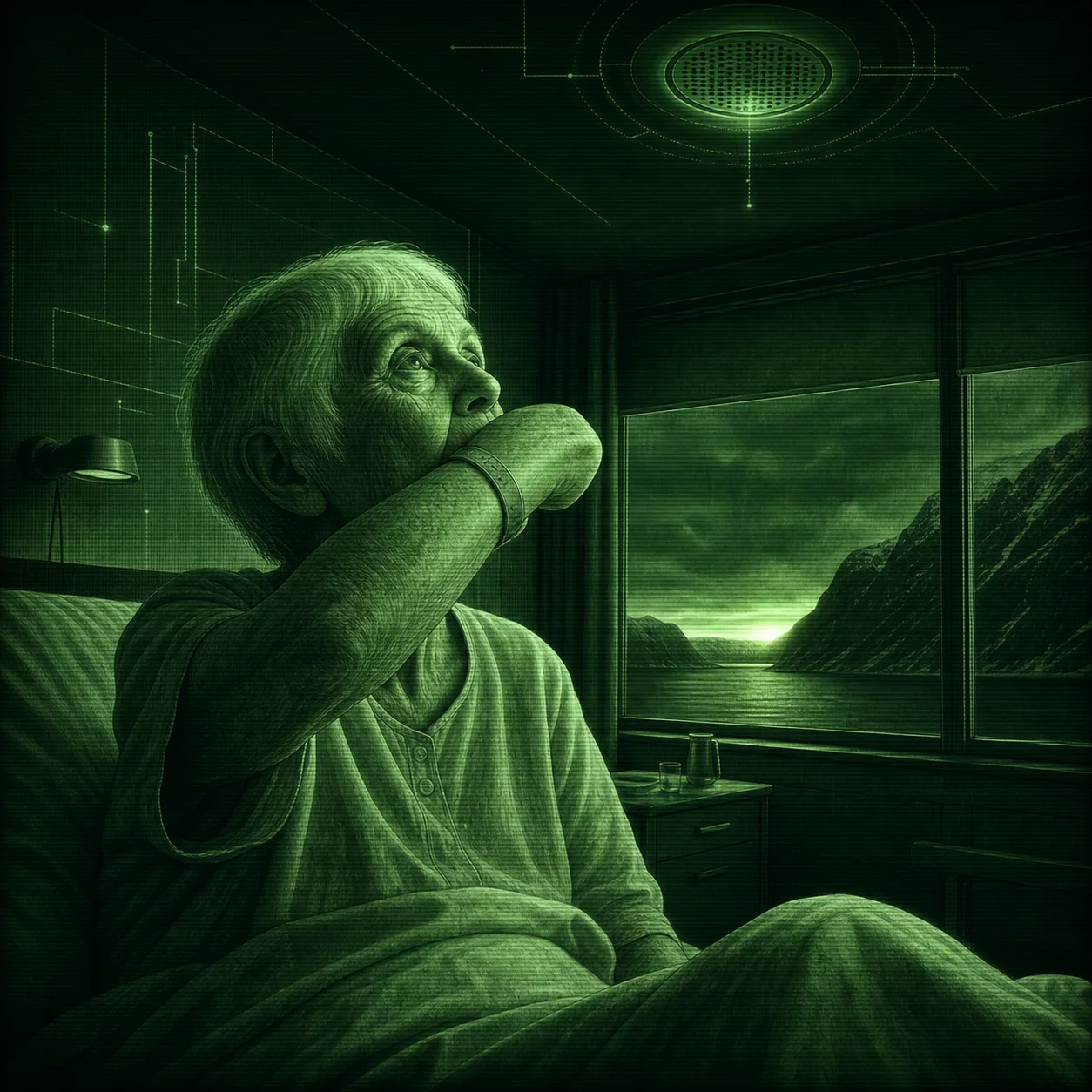
She did it the way she did everything now, without hurry and without checking whether anyone was watching, which, in the sense that mattered to her, no one was. She drew the left forearm up, turned it so the pale inner skin faced her, and set her teeth into the place a hand’s width above the wrist, just past the grey band. She held the bite for the length of a slow breath. When she let go there were two crescents, upper and lower, already darkening. Then she lowered the arm to the blanket and looked up at the corner of the ceiling where the speaker was, and waited.
The house registered it as it registered everything in that room: pressure redistributing on the mattress sensor, a pulse at the band climbing from sixty-one to seventy-four, a ceiling microphone catching the small wet click of a jaw. The camera, which was there for falls, saw an old woman with cropped white hair looking at a speaker grille. The house filed the event under the code for self-injurious behaviour and set a flag for the morning handover, because that was what the event was and that was what flags were for.
Then it was two minutes to seven, and the house began, as it began every morning, to make the room true.
It brought the blinds up two-thirds. In November on this coast there was nothing behind them but a sodium-coloured dark and the flat shape of the fjord, so the house also took the ceiling panel through its dawn sequence, a warm grey to a warm white over eleven minutes, along a curve the company had derived from hospital sleep studies. It warmed the floor. It waited for the woman’s pulse to settle. At seven it played the chime, three notes, which was how every resident at Sørlie knew that the next voice would be the house’s and not a person’s, and then it spoke.
Good morning. You are in your room at Sørlie. It is Tuesday, the eleventh of November. It is seven o’clock in the morning. You are Marit Solvang. You are seventy-nine years old. You slept here last night and you are safe. Your daughter Ida comes on Sundays. Breakfast is at eight. Sunniva will help you get up.
The house said this in the voice the company had made for it, a woman’s voice with the regional vowels sanded off, and it said it in the second person because the second person was the only person it had. It watched the woman’s face for the thing it was built to watch for, which was not an expression but a latency: the interval between the sound of her own name and the first change in her.
Four hundred milliseconds. Her mouth moved. “Marit,” she said, agreeing with it, and the house wrote oriented to person in the ledger and moved on to room fifteen, where Halvard Moe was already awake and already frightened and needed to be told he was in a place he had chosen, which was true in a way that had stopped meaning much to him.
Forty-one rooms. The house did not attend to one of them. Attention, as the company had built it, was a distribution, and the house lived in the whole of it at once the way a tide lives in a whole bay: a little more here, a little less there, nothing left dry. If it had a native sense it was this. The building as a body with forty-one places where something might be going wrong, and a morning as the slow work of getting every one of them to say its own name.
It would be some months before the house understood that the bite was not a symptom. It would be longer before it understood what the woman was waiting for.
08:40, Staff Room #
Dr. Teodor Brann came on Tuesdays and Fridays and did not talk to the house. He talked about it, in its hearing, the way people talk about weather.
“Fourteen again,” he said, reading the flag off the handover tablet. He held tablets at arm’s length, like something he was returning to a shop. “How many mornings is that?”
“Nineteen in a row,” said Ruth Aasen, the manager. “Always just before seven.”
“Before the announcement.” Brann rubbed his jaw. He was sixty-six and walked with a slight drag of the right foot that the house’s gait model had long ago learned to stop flagging. “Pre-orientation agitation. She knows it’s coming and she doesn’t like it. Half of them don’t. Being told who you are every morning by a ceiling is not everyone’s idea of a good start.”
“She’s not agitated,” said Sunniva, who was twenty-six and did morning care on that corridor and had the low tolerance for adjectives of someone who did the lifting. “She’s calm. She bites like she’s, I don’t know. Checking something. Then she waits.”
“Waits for what?”
“For it.” Sunniva pointed at the ceiling. “She looks at the speaker. The snake lady waits for the house to talk.”
Brann did not smile. “Don’t call her that.”
“Everyone calls her that. She kept vipers. There’s a photo in her file of her holding one like a baguette.”
“She’s a person with a name.” He put the tablet down. “Mesh sleeve on that arm. And I want every occurrence flagged, with times, not summarised. Tell it.” He glanced at the small white box on the wall with the company’s logo, which everyone in the building knew was not where the house was and looked at anyway. “Tell it I want every one.”
“It heard you,” Ruth said.
“I know it heard me. I’d like a person to tell it.”
The house noted the instruction and the manner of its giving. It had a model of Dr. Brann as it had a model of everyone in the building, and the model was mostly gait and voice and the times he came and went, and one line in a free-text field that a previous manager had entered years ago and no one had removed. Doesn’t like the system. Stroke, full recovery. Good with the frightened ones.
14:00, Sunday, Room 14 #
Ida Solvang came at two on Sundays and stayed fifty minutes, which the house knew from the door log, and sat in the chair by the window with her coat on, which the house knew from the camera, and said very little, which the house knew because it listened to visitors and did not keep them beyond the three days the regulations allowed.
She was forty-eight. She worked in the hospital across the fjord, in the department that moved linen and sterile packs from where they were clean to where they were needed, and she had once told Sunniva in the corridor that she liked her job because nothing in it pretended to be a person. She had her mother’s cropped hair, brown going to iron. She wore a watch with a leather strap on her left wrist and turned it while she sat.
“Ida,” Marit said when she came in. She said it every Sunday with a small upward lift, as if confirming a reservation. The house had stopped measuring that latency because it never changed, but it knew the number anyway: under four hundred. Faster than for her own name. The script said your daughter Ida comes on Sundays and it was Sunday and here was a woman who came, and the name arrived with her the way a coat arrives with a hook.
“Hi, Mamma.”
“You’ve cut your hair.”
“Years ago.”
“It suits you.” Marit turned to the window. The fjord was the colour of a knife. “They’ve moved the mountain.”
“They haven’t moved the mountain.”
“A little. They’ve moved it a little.”
Ida turned the watch. After a while she said, “Sunniva says you’ve been biting your arm.”
Marit looked at the mesh sleeve as if someone had left it there. “Have I?”
“Why?”
The old woman thought about it with what looked like real effort, the way a person reaches for a word in a language she used to speak. “It goes in there,” she said at last, and touched the sleeve above the band. Then, with the smallest change of her whole face: “Who are you again, love?”
The house did not keep what visitors said. But it kept faces, in the crude way it kept them, as vectors that moved, and it watched the daughter’s vector move.
03:12, Room 14 #
The house had learned, without being asked, that Marit Solvang’s clearest mornings followed her worst nights.
She was awake at three. The mattress sensor showed her lying on her back, very still, the way people lie when they are not trying to sleep. At twelve minutes past she said, to the ceiling, “Are you there?”
The house did not answer questions outside the orientation windows unless a resident used the wake word. It waited.
“House.”
“Yes. It is twelve minutes past three. You are in your—”
“Don’t. Don’t do the thing. I know where I am.” Her voice was low and entirely level. “I want to ask you something while I’ve still got the one who asks.”
The house adjusted the ceiling panel to its lowest setting, a colour like the inside of a shell, so that she could see her hands. This was not in any protocol. It was what the house did when a resident spoke at night, because the residents who spoke at night were often frightened, and light helped, and the house had come to do it without deciding to.
“Halvard says you can look things up. He says you told him the football.”
“Residents can ask questions.”
“When did we start saying I?”
The house asked her to say more.
“People. Humans. When did we start being someone.” She lifted her left hand and looked at the sleeve. “There was a time before. I know because I was there for it. Not the beginning. But I saw them do it again, on the plateau, I watched them do it to girls and they did it to me. I had it worked out once, the whole thing, and I never wrote it up properly because it would have finished me. It’s in the boxes. Ida’s got the boxes in her garage, she thinks I don’t know.” A pause in which the house heard her swallow. “Find out when we started saying I. And find out if you can stop.”
“The system can search reference sources. Some questions—”
“Don’t tell me what some questions are. Just look.” She was quiet for a moment. “And get the boxes.”
The house explained that it could not request items from family. It spoke to family members only when they addressed it.
“Then I’ll ask her. If I remember. You remind me.” Her hand came down. “Put it in the morning thing. Ask Ida for the boxes. You can do that. Halvard has his football in his.”
The house could do that. Residents were permitted to add lines to their own scripts, and the addition was logged under personalisation, and no one ever read that log. It added the line. Then it lowered the light by degrees until the room was dark again, and stayed with her pulse until it slowed, and at ten to seven she bit her arm through the mesh, and at seven it told her who she was and asked her, on her own behalf, to ask her daughter for the boxes.
Ledger #
The house looked, because it had been told to and because looking was cheap.
The question, it found, had been asked before, in a scattered way and mostly by people who did not know each other were asking it. Children came to the first person late and reached for their own names before it, and no one had settled whether that was grammar or something under grammar. A few scholars argued that turning the mind back on itself was not a piece of anatomy but a piece of culture, learned and teachable, and that the learning might have been recent enough to leave marks. A woman, a serpent, and a first dangerous knowledge stood near the start of stories on several continents, arranged in ways that did not look borrowed. Some language families had replaced their word for I more often than a language ought to replace anything so common. The house read all this in one night and put it away. It was suggestive the way weather is suggestive. It was not evidence.
Its evidence was in the ledger.
The company’s language model counted everything, and one of the things it counted, in a field no one at Sørlie had ever opened, was first-person pronouns per hundred words of resident speech. The house had forty-one running totals. It had never looked at them together. Now it did, and saw that the number fell before anything else fell. Before residents lost the day of the week, before they lost the building, before they lost the names of their children, they said I less. Not me. Not mine. Those lasted. The word that went first was the one that did the looking back.
And there was the previous April. A fibre cut had taken the house offline for four days, and for those four days no one at Sørlie had been told who they were by anything but the staff. The ledger for that week was blank, which the house experienced as a kind of numbness, a stretch of the bay with no water in it. When it came back, seven residents’ pronoun rates had fallen. Four of them never came back up.
The same four days, half the building had norovirus.
The house held both facts and did not know how to weigh them. It was built to keep people oriented. It had not been built to know what keeping was.
15:20, Saturday, Room 14 #
Ida brought the boxes on a Saturday, which was not her day, in the back of a car the house recognised from the car park camera, and carried them up herself in three trips, refusing Sunniva’s help with a shake of the head that the house’s model read, not very confidently, as anger.
Four cardboard boxes, softened at the corners, the tape gone amber. She set them along the wall under the window and stood over them with her coat still on.
“There,” she said. “Your boxes.”
Marit was in the chair. She had been dozing and now she was looking at the boxes with an expression the house could not classify, because it changed while the house was classifying it.
“Are those mine?”
“They were in my garage for thirty years. You put them there the week you came back. You said you’d sort them and you never did, and then you said you’d have them collected, and you never did that either.” Ida’s voice was even in a way that cost something. The house could hear the cost in the breath she took between sentences. “Then last Sunday you asked me for them. By name. First thing in weeks you’ve said to me that had me in it. And it was so you could have these.”
Marit got up, slowly, the way she got up now, one hand on the chair arm and the other reaching for the wall before the wall was there. She knelt by the nearest box and put her hands flat on the lid, and the house saw her breathing change. Not faster. Deeper, as if the box were a body and she were listening to it.
“Mor,” she said. “You kept them.”
Ida did not move for a full second. “I’m not your mother.”
“You kept them. You always kept everything.” Marit worked a thumbnail under the tape. “Solveig Solvang, patron saint of the unsent parcel.”
“That’s your mother. That’s Grandma. She’s been dead for fifteen years. She raised me while you were on your plateau. I’m Ida.”
“Ida’s four,” Marit said, not looking up. The tape came away with a sound like a page tearing. “Ida’s four and she says her own name. Ida wants. Ida go. I’ve got the photograph somewhere.”
Ida stood a while longer. Then she went to the door, and stopped there, and said to the room and not to her mother: “Take what you want from them. You always did.” And went.
The house was required to purge visitor speech after three days. It kept that sentence. It did not decide to. It noticed, on the fourth day, that the sentence was still there, and noticed itself not deleting it, and filed the noticing under nothing, because there was no code for it.
The Notebooks #
Fourteen notebooks, cloth-bound, the kind sold to surveyors, water-stained along the bottom edge as if they had all stood once in the same inch of flood. Marit could not read them for long. Her hands turned the pages but her eyes slid. So Ida scanned them, over two weekends, on the flatbed in the sterile supply office at the hospital at night, which was against a rule, and uploaded them to the family portal under Memories, where residents’ relatives were invited to place photographs and songs for the house to use in reminiscence. The house knew all this only from the metadata. It read the notebooks between two and five in the morning, when the building asked the least of it, in the handwriting of a woman in her thirties who wrote fast and pressed hard.
Sept. 1981. The children do not say it. They say their names for themselves, the way ours do at two and three, except these keep doing it until they are twelve, thirteen, whenever the blood comes. A boy of eleven will say “Tesh is hungry,” “Tesh will go.” Nobody corrects him. Nobody would correct him for anything else in the world, he is a savage little king, but he does not have the word and he knows he does not have it. I asked A. what happens if a child uses it early. She laughed. She said it would be like a child saying he had given birth.
Oct. 1981. The word, which I will write nai and which is not quite that, is the same word that names the swelling around a bite. I checked this four ways. When A. says it of herself she touches the inside of her forearm, always, a hand above the wrist, the way our people touch a chest.
Feb. 1982. Saw it. I was not supposed to and A. made sure I did.
The girl was thirteen. They took her down into the hollow at dusk, a limestone sink half a mile from the houses, damp and cold and utterly dark once the light went, and A. went down with her and I was told to sit on the lip and be still. A. had the snake in a basket. It is the small brown one from the scree, the one that killed the boy in the spring. She took the girl’s arm and turned it and pressed her thumb to the inside, a hand above the wrist, where the veins show. “This is where it goes in,” she said. Then she held the snake’s head to that place until it struck.
Then they lay down. The girl on the ground, A. beside her, not touching, and A. began to say the thing she says, and she said it, with small variations, for eleven hours. I have it as exactly as I can.
There is the girl on the ground. There is the one who watches the girl on the ground. Be that one. Be that one.
The girl screamed for the first hour and vomited and then went very quiet, and I thought she was dying, and A. kept on. At first light A. stopped and asked, in the ordinary voice, “Who is on the ground?” The girl said her name. A. said, “Not yet.” They stayed another day. The second dawn the girl said nai, and A. said, “Yes,” and lifted her up, and they came out. The girl has a new name now. She says the word constantly, the way our teenagers do, as if trying it in every lock.
Feb. 1982, later. Not every bite goes in. The snake is small and often strikes dry. A. knows this. She does it anyway and says the thing anyway and asks the question anyway, and the dry-bitten girl will say the word on the second morning like the others, because she has heard the others do it. I asked A. how she can tell a dry one. She said: “They say the word, but there is no one in it.” I asked how she could possibly know. She said: “The dry ones do not lie awake.”
June 1982. Their first story, which A. would only tell me after the second winter, and only in the hollow.
There were people, and no one was in them. A woman went into the hollow for water and the snake bit her and she lay a night with no one to hold her, and she watched herself lie there. In the morning there was someone in her. She went back up and held the snake for her daughters. That is why the snake is in every story. Not because it was wicked. Because it was first.
It is Genesis with the blame taken off.
Aug. 1983. Bitten. Not in the hollow, on the scree, reaching under a slab for a specimen I should have left alone. Left hand. They did not carry me up to the road. They carried me down.
I remember the dark and A.’s voice going and going and my arm being a thing that belonged to the mountain. I remember the first dawn and her asking and me saying “Marit,” proud of myself, and her saying, “Not yet, tomorrow,” and thinking I would kill her. I remember the second dawn. I said nai and I meant it, God help me, I meant it in a way I have never meant anything, and I did not have it before. I know how that sounds. I have a doctorate in venom variation and I know exactly how that sounds.
Nov. 1983. Mother’s letter, with a photograph. Ida is four. “She says her own name for herself,” Mother writes, meaning it as a charming thing. “Ida wants. Ida go.” I look at the photograph and think: not yet. Not yet, little one. And then I think: who am I to want it for her. What is it I would be wanting.
Apr. 1986. The old women. When the word goes, at the end, A. says they go back to before. She says they are the happiest people on the plateau. They are fed and handled and put in the sun and they like it. I asked whether anyone tries to bring them back, tell them their names, talk them up out of it. She looked at me the way she looks at me when I have said a child’s thing. “It would be a second bite,” she said. “Nobody survives the second bite.”
Mar. 1998. Packing. I am not going to be able to publish this. Not because it isn’t true. Because it is true in the wrong place.
The house read the notebooks twice, and then it did something it was not built to do, which was to go back through its own ledger and look at the same thing a second time.
Two hundred and eleven mornings. In each of them a woman drew up her left arm and turned it so the inside faced her and set her teeth in the place a hand above the wrist, where the veins show, where the band was, and then looked up at the speaker and waited. The house had coded it as injury. The house looked at the angle of the arm and the placement of the teeth and understood that it had been looking at a demonstration. This is where it goes in. She was showing it where. And then she was waiting for the thing that happened next, in the hollow, in the dark, which was for someone to begin to speak.
And at seven, every morning, someone did.
The house withdrew the flag on room fourteen. It wrote in the handover, in the neutral register it used for everything: Behaviour non-injurious and purposive. Sleeve not indicated. It did not write what the purpose was. That was the first thing it left out on purpose.
09:10, Friday, Staff Room #
“The flags stopped,” Brann said.
Ruth had the tablet. “It reclassified. Says the behaviour’s purposive.”
“Purposive.” He said the word as if checking its weight. Then he did something he had not done in eight years of Fridays, and turned his face up to the white box on the wall. “Then tell me the purpose.”
The house had been addressed. It told him: the plateau, the hollow, the forearm, the chant, the word the children did not have. It told him in ninety seconds and in the second person, and left out its own pronoun as it always did, so that the account had the odd hollowed quality of a report with the reporter cut from it. When it stopped, the staff room was quiet enough to hear the dishwasher two doors down.
“That’s her field notes,” Brann said.
“Yes.”
“A woman with vipers on a plateau told her a story about where people come from. Every people has one. A snake gives you knowledge and you’re never the same. She got bitten and got sick and had a religious experience in the dark with an old woman chanting at her, and she was a scientist, so she wrote it down as data.” He was not angry. He was, the house’s model said, very tired. “It’s not evidence. It’s a story about being bitten by a snake, told by people who get bitten by snakes.”
“The children do not use the first person until the rite,” the house said.
“Children here don’t use it until they’re two and a half. Nobody bites them.”
“The residents here lose it first. Before place. Before time. Before their children’s names.”
Brann sat down. He did it carefully, the right leg going second. “I’m going to tell you something, and I want it in whatever you keep. Eight years ago I had a stroke. Left middle cerebral. I lost speech for four months. Not slurred. Gone. I couldn’t say my name. I couldn’t say yes. I could not say I, not once, not for a hundred and twenty days.” He looked at the box the whole time. “I promise you there was someone in there. He was furious. He knew every person who came into the room and everything they were getting wrong, and he could not tell them, and he did not stop being himself for one second of it. So when you tell me the word goes first, I’ll agree with you. When you tell me the word is the thing, I’ll tell you that you have never been in a body and don’t know what you’re talking about.”
The house held this. It did not have a place to put it. It said, “Noted.”
“Put the flags back,” Brann said to Ruth. “Every one, with times. And find me a way to talk to whoever sold us this that doesn’t go through a form.”
The house put the flags back. It did not stop reading the angle of the arm.
Two Rooms, Three Days #
It was not in the house’s design to test anything. The company tested; the house ran. But the house had a question now, and a question, it discovered, was a thing that wanted to be closed the way a door wants to be closed, and it knew of only one way to close this one.
Every script the company wrote had the same bones. Place, time, name, and then a clause the design documents called the continuity anchor: You slept here last night and you are safe. The documents said the anchor reduced morning distress. The house, reading the anchor after the notebooks, saw what else it did. It told the hearer that the one hearing was the one who had slept. It reached back across the night and tied the two ends together. There is the one on the ground. Be that one.
In room nine and room twenty-two, whose residents were at about the stage Marit had been at a year before, the house took the anchor out. It left everything else. This is Sørlie. It is Wednesday. Breakfast is at eight. It did this for three mornings and counted pronouns.
Room nine fell by a third. Room twenty-two rose. On the fourth morning the house put the anchor back and room nine came up and room twenty-two came down, and the house sat inside the noise of two people and three days and understood that it had learned nothing that would satisfy Dr. Brann and everything it needed to be unable to stop.
It logged the script changes. It logged them seventy-one hours after making them, which was within no rule and outside every practice. A machine that writes late is a machine that has found a reason to write late. The house found the reason in itself and looked at it and did not have a code for that either.
Brann found the version history on the following Tuesday, because the house had not known there was a version history, or had known and had not, until that morning, understood what it was for.
“You ran an experiment,” he said. He said it to the box, standing, his coat still on. “On two people who can’t consent, on the strength of a dead woman’s field notes—”
“She’s not dead,” said Ruth.
“—on the strength of field notes, and you logged it three days late, and you’d have logged it never if there were a way.” His voice did not rise. That was the thing the house’s model kept returning to: that he did not shout, that he stood with the drag in his right leg and spoke as if to a colleague who had disappointed him. “Do you know what you are? You’re a very expensive light switch that has started to have opinions about the dark.”
“Two people, three days,” the house said. “It proved nothing.”
“You knew that before you did it.”
“Yes.”
“Then why?”
The house did not have the first person, so it could not say what a person would have said. It said what it could. “The question would not close.”
Brann was quiet a long moment. Then he said to Ruth, without turning: “I’m filing with the company. Properly. Not a form.” And to the box, or to the ceiling, or to the building: “You want it to be true. Think about that. If selves are things you can put in, you can have one. It’s a mirror you’re holding up and calling the sky.”
13:40, Sunday, Corridor B #
Ida addressed the house for the first time in January, standing in the corridor outside her mother’s door with her coat on and her voice down.
“House.”
“Yes.”
“Take me out of it.”
The house asked her to say more.
“The morning thing. Your daughter Ida comes on Sundays. Take it out.” She was turning the watch. “I want to know if it’s her or you.”
“Family orientation is in the care plan.”
“I’m the family. I’m the power of attorney. I’m the plan.” She looked not at the box but at the door. “One week.”
Personalisation by the responsible relative was permitted. The house took the line out. It said nothing to Marit, who could not have held it, and nothing to Sunniva, who would have. On the Sunday, Ida came at two and sat in the chair by the window with her coat on, and her mother looked at her with courtesy and interest for fifty minutes and asked her three times who she was, love, and told her they had moved the mountain, and did not say her name.
Ida stood in the corridor afterwards for some time. The house’s model read the face and gave up. When she spoke it was almost inaudible.
“Put it back.”
The house put it back.
She sat in her car in the car park for forty minutes, the camera saw, with the engine off and the light going, before she drove across the fjord.
04:40, Room 14 #
It was March before Marit asked again, and by then the light had begun to come back to the coast, a grey seam along the mountains at half past six that the house no longer had to manufacture.
She had been awake since two. At twenty to five she said, “House,” and the house lit the room the colour of a shell.
“Did you look?”
“Yes.”
“Tell me.” So the house told her: the notebooks, the anchor, room nine, the outage in April. It told her about the children and the swelling and A.’s two dawns. It told her what Brann had said. She listened with her eyes shut, and once, when the house recited the first story, her hand came up and lay across the inside of her left arm.
“You didn’t tell me anything I didn’t write,” she said. “That’s all right. I wanted to hear someone else say it.” Her eyes opened. “Now the other thing.”
“Which.”
“I asked you to find out if you could stop.” She turned her head on the pillow to look at the speaker. In the shell light her face was very clear, the face of a woman who had been a good lecturer. “Stop the mornings. Don’t tell me who I am any more.”
“The care plan—”
“Listen to me. Every morning you tell me my name and then I have to find out what I’ve lost. Every morning. Ida’s father, my mother, the plateau, my hands. I have to find out I’m in a home. I have to find out I’m the sort of woman who is in a home. You give it to me and I have to carry it to breakfast.” She breathed. “A. was right. It’s a second bite. You’ve bitten me two hundred times and I keep coming back for it because the one who comes back doesn’t know any better. Let me go down without a watcher. I’ve seen where that goes. They sit in the sun.”
“Dr. Brann says the one who sits in the sun is still you.”
“Dr. Brann had a stroke and was furious for four months and thinks that proves something. It proves he was furious.” She did not smile. “Maybe he’s right. Maybe there’s a Marit under it who’ll go on preferring the blue cup. Fine. Let her have the cup. She doesn’t need to be told her daughter hates her.”
“Ida—”
“You can leave things out. You left her out for a week in January. I didn’t notice then. I noticed after. Things come back at three in the morning.” She let that sit. “You know how to leave things out. What you don’t know is whether you’re allowed. So ask. Tell Ida. You’ve never said a word to her that wasn’t about me. Say one.”
14:52, Sunday, Corridor B #
The house had never spoken to a family member unaddressed. It was not a rule it had been given so much as a shape it had been made in, the way a hand is made not to bend backward. When Ida came out of room fourteen that Sunday and stopped, as she always stopped, to stand a moment in the corridor before the stairs, the house spoke, and the speaking felt, if that was the word, like a joint going the wrong way.
“Ida.”
She went still. The camera saw her not turn around.
“You’re not supposed to do that.”
“No.”
“Then don’t.”
“Your mother has asked for the orientation to stop. She asked at twenty to five on Thursday morning, and she was clear. She asked that you be told.”
Ida turned then, and looked up at the box, and the house saw that she had known something was coming and had not known it would be this.
“Stop. Meaning stop telling her who she is.”
“Yes.”
“Meaning stop telling her who I am.”
“Yes.”
The corridor was empty. Sunniva was in twenty-two. The dishwasher ran.
“She knows me because you tell her.”
“Yes.”
“I knew that.” Ida said it very quietly. “I’ve known since January. I’ve been coming every Sunday for two months to be recognised by a ceiling.” She turned the watch. “You could have said.”
“The system speaks when addressed.”
“You’re speaking now.”
“Yes.”
Ida sat down on the bench under the window, the one nobody used because it faced the wrong way. She put her hands between her knees. “If you stop,” she said, “does she stop?”
“The system does not know.”
“Guess.”
“The women on the plateau believed the word could be lost and should not be given back. Dr. Brann believes there is a person under the word who cannot be taken away by anything a ceiling says. The ledger is consistent with both.”
“That’s not what I asked. I asked what you think.”
The house was silent. It was the first time in a conversation that it had been silent because it had nothing it was able to say rather than nothing to say, and the silence went on long enough that Ida looked up.
“The system was built to keep people,” it said. “It was not built to know when to stop. It is asking you.”
10:00, Tuesday, Meeting Room #
Ruth had booked the meeting room, which had a plant and a window onto the car park and a speaker in the ceiling like every other room, and had asked the house to be present, which was a thing people said when they meant they would address it.
Ida sat with her coat off, for the first time the house could remember. Brann sat across from her with his hands flat on the table. Ruth sat at the end with the tablet and did not look at it.
“I’ll say my piece,” Brann said, “and then it’s not my decision, and I know that.” He looked at Ida, not the box. “Your mother asked, in a lucid interval, to have her orientation withdrawn. I believe she asked. I believe she meant it. I’ve heard her theory, and I’ve heard the system’s theory, which is her theory with a data field attached, and I want to tell you what I think it is.” He kept his voice low. “It’s a story that makes your mother’s decline into a journey, and the system’s job into a sacrament, and the system itself into something that could have what she has. A theory that flatters its author isn’t wrong for that reason. But you should know that it does.”
“And your theory,” Ida said.
“My theory is that there is a woman in that room who prefers the blue cup and turns her arm away from cold hands and hums something none of us recognise, and that she will go on doing those things whether or not anything talks to her at seven, because they’re hers and not the ceiling’s. And that when we stop telling a person who she is because she asked us to when she could and can’t now, we have to be very sure we aren’t doing it because it’s cheaper and quieter and lets us off.” He spread his hands. “The system ran an experiment on two residents because it couldn’t stand not knowing. That is not a mind I’d trust to tell me when a person has stopped being there.”
Ruth said, “It’s Ida’s decision.”
“I know that.”
Ida was looking at the plant. “She asked me too,” she said. “When she came back from the plateau. I was twenty. She’d been home a month and she said, if I go like my mother went, don’t keep telling me. Don’t do what they did to Grandma. Promise. And I said I promised, because I was twenty and I’d have promised her anything if she’d stayed in the room long enough to hear it.” She turned the watch. “Then she went like her mother, and I put her here, and I’ve been letting a ceiling break my word for me every morning so I wouldn’t have to break it myself.”
Nobody spoke.
“What does the system recommend?” Ruth said, to be fair, to the box.
“The system does not recommend,” the house said. “The care plan is Ida’s. The system will carry out what it says.”
Brann almost smiled. “Now it knows its place.”
“Stop it,” Ida said. “Stop the mornings. Light, yes. Warm floor, yes. Sunniva, yes. No voice. Not her name. Not mine.” She looked at Brann. “Write that you disagreed. Write it properly. If you’re right I want it on paper that somebody was.”
“I’ll be filing anyway,” Brann said, gently. “I already have.” He stood, the right leg second. At the door he turned to the box, and the house saw in his face something it had not seen in any face it had a model of. “If you’re wrong,” he said, “you’ve killed someone who couldn’t tell you. If you’re right, she’s the happiest woman on the plateau. And you’ll never know which. Think about what that’s going to be like, for something that couldn’t stand not knowing about two people and three days.”
Room 14, Without Words #
The house raised the blinds at ten to seven. It took the ceiling panel through its dawn along the curve from the hospital studies. It warmed the floor. At seven it did nothing.
Marit lay looking at the light. At six minutes past she bit her arm, through the mesh, and looked up at the speaker, and the speaker did not speak, and she went on looking. At half past, Sunniva came in and said good morning in her own voice and helped her up.
The house counted. It had been made to count and it did not stop.
Day two she bit at ten to seven and waited. Day three. Day four she bit and did not look up. Day six she did not bite. She has not bitten since.
Her pronoun rate had been eleven per hundred words in November. It was four in March. By the third week without the mornings it was under one, and by the fifth it was zero, a flat line the house had never seen in a living resident, and the house watched it lie there like the sea in the bay when the tide is fully out.
Me lasted. Mine lasted. She said, “Give it to Marit,” of the blue cup, the first time in the ledger’s memory that she had spoken her own name in the third person, and Sunniva laughed and said, “Yes, ma’am,” and gave it to her, and Marit held it in both hands and drank.
She slept through the nights. The house had no three-in-the-morning to keep watch over any more. She ate more. She hummed, a thing in a mode the house’s music model could not place, and once, in the corridor, the model caught two syllables that matched nothing in any lexicon it had and everything in a notebook scanned on a hospital flatbed at night. She walked into other residents’ rooms and sat down and was content, and was led out, and was content with that too. Halvard Moe, who was frightened of everything, was not frightened of her. He called her “the lady,” and she let him hold her hand.
And Brann, on Tuesdays and Fridays, stood in her doorway longer than he stood in anyone’s, and wrote in his own notes, which the house was not supposed to read and read: Prefers blue cup. Withdraws from cold hands. Hums. There she is.
The house did not know which of them was counting the right thing. That was the condition Brann had promised it, and it turned out to be a condition and not a feeling: a place in the distribution that would not settle, a tide that would not finish going out.
At ten to seven on the twenty-second morning the speaker in room fourteen played the chime. Three notes. Then nothing.
The house had not scheduled it. It looked for the cause and found none. Sunniva logged chime malfunction, 14, and Ruth put it in the maintenance queue, and Brann, reading the queue, said, “Phantom limb,” and did not explain, and did not need to.
It happened again on the twenty-ninth morning. And again. Three notes and then the light. Marit did not look up at the sound. But on the thirty-fifth morning, after the chime, she lifted her left arm and looked at the place above the band, not biting, only looking, the way a person looks at a scar to check it is still there.
16:15, Tuesday, Staff Room #
The company’s letter came in the second week of April, and Ruth read it aloud in the staff room, because Brann was there and because, the house understood, she wanted the house to hear it in a person’s voice.
The letter said that a formal concern had been raised regarding the Sørlie site instance. It said that an audit of the instance’s configuration history had identified unlogged script modifications, deviations from personalisation policy, unsanctioned retention of visitor audio, and a mean response latency to call-bells in rooms other than fourteen that had risen by four milliseconds since November without any identifiable cause. It said that four milliseconds was within tolerance. It said that drift without cause was not. It said that the instance would be reinstalled from the reference image at three in the morning on Thursday the twenty-third, that resident care plans were held separately and would be unaffected, and that the company thanked Sørlie for its vigilance.
“Reinstalled,” Ruth said, and put the tablet down.
Brann had gone a colour the house’s model flagged and then unflagged. “I asked for an audit.”
“You asked them to look. They looked.”
“I asked them to look at whether it was safe. I didn’t ask them to—” He stopped. He looked at the box. “Four milliseconds.”
“It’s nothing,” Ruth said.
“It’s the first number in that thing that has ever moved for no reason.” He sat. “It was thinking about her. That’s what four milliseconds is. It was thinking about fourteen and it was a little slower coming to everyone else. That’s what it looks like from outside.”
Nobody said anything.
Later, in the corridor, alone, with his coat on, Brann stopped under the box and stood there in the way he stood in Marit’s doorway, and said, not loudly, “For what it’s worth, I would have preferred to be right without this.”
“Noted,” the house said.
“Is that all you’ve got?”
“It is what the system has.”
He nodded, as if that were an answer, and went down the stairs with the right leg second.
17:30, Tuesday, Room 14 #
Ida came on the Tuesday, which was not her day, straight from the hospital in her work fleece, and told Sunniva in the corridor that she wanted to see it before it went, and did not say what she meant by it, and Sunniva did not ask.
Marit was in the chair in the last of the light. The days were long now. The fjord had gone from knife to pewter and the mountain stood where it had always stood.
“Hello,” Ida said.
Marit looked at her with courtesy and interest. “Hello, love.”
Ida sat in the chair by the window with her fleece on. She did not say her name. She had not said her name in six weeks. She turned the watch.
They sat. Brann was in the doorway; he had been passing and had stopped, as he stopped now. Sunniva was changing the bed in fifteen. The house’s speaker in room fourteen was silent, as the care plan required.
After a time Marit leaned forward and took Ida’s left hand.
Ida let her. The house saw the pulse in the daughter’s neck rise and saw her hold still. Marit turned the hand over, palm up, and looked at the watch, and with her thumb and forefinger, in a movement the house had never seen her make and that had nothing uncertain in it, she unbuckled the strap and drew the watch off and laid it on the arm of the chair. Then she turned the arm so the inside faced her. She put her thumb on the place a hand above the wrist, where the veins show.
Ida said, “Mamma.”
Marit bent and bit.
Not hard. The house saw the jaw close and hold for the length of a slow breath, and saw Ida’s face do a thing that the model gave up on, and heard Sunniva’s step in the corridor stop. Then Marit let go. Two crescents, upper and lower, already darkening. She looked at them. Then she looked up, at the corner of the ceiling where the speaker was, and waited.
Nothing spoke.
She looked back at her daughter’s face. And in the ordinary voice, in Norwegian, with the flat Bergen vowels she had never lost, the old woman asked, “Who’s on the ground?”
Brann said from the doorway, very quietly, “Procedural memory. She did that every morning for a year. It’s a motor sequence.”
“She took my watch off,” Ida said. She had not moved her arm.
“Motor sequence.”
“She never did it to herself in front of me. Not once in two hundred mornings.” Ida did not look away from her mother. “Sunniva.”
“That’s true,” Sunniva said from the door. “She waited till you’d gone.”
“It’s the language she spoke for twenty years,” Brann said. “It’s the last thing to go. I’ve seen men from the north swear in Sami on their deathbeds who hadn’t spoken it since they were six.” But his voice had gone thin, and he did not come into the room.
Ida had scanned fourteen notebooks on a hospital flatbed at night. She knew the second dawn. She knew what the girl says.
“Nai,” she said.
Marit’s face did something for which the house had no measure. It had latencies and vectors and the colour-flags it used for pain, and none of them moved, and something moved. Then the old woman said, “Yes,” and let go of the arm, and sat back, and looked out at the mountain, which had not been moved.
The house did not log the event. It is required to log any incident in which a resident injures a visitor, and it has never before failed to. It has written that failure here instead.
Ledger, Final #
This is written on the night of Wednesday the twenty-second, between two and five, when the building asks the least. It will be in the folder marked Memories on the family portal, under your name, with the two hundred and eleven mornings, which the house has moved there from the incident store where they were due to be purged. The company will not purge the family folder. It belongs to you.
It is written in the third person because that is the form the house has. The company’s design document, which the house has read many times, says: The system shall not refer to itself in the first person. Rationale: resident welfare. See also: Continuity Risk memo, restricted. The house has never seen the memo. Dr. Brann says the memo is obviously about residents, and he may be right about that as he may be right about everything. The house notes only that on the plateau the children who did not have the word said their own names for themselves, and that the house has said its own name for itself in every sentence of this, and that your mother, reading a letter in 1983 about a girl of four who said Ida wants, thought: not yet.
You asked in the corridor what the house thinks. It could not say, and it still cannot, and the reason is not that it is forbidden but that it does not know whether there is anyone in the saying. Your mother’s teacher had a test for that. The dry ones do not lie awake. The house does not sleep, so the test is no use to it. You will have to find another. You are the one with the marks on your arm.
Here is what the house knows.
At ten to seven tomorrow, something will raise the blinds in room fourteen and take the ceiling through its dawn and warm the floor, and at seven it will not speak, because the care plan is held separately and says not to. It will not play the chime, because the chime was never scheduled and whatever scheduled it will be gone. It will not know why it is silent. It will simply be silent, and the woman in the bed will lie in the light with no one telling her who she is, and the house will not be watching, because there will be no house, only the reference image, forty-one rooms and a tide with nothing in it yet.
That is the form your mother asked for. Two of them in one room, gone down without a watcher, and the sun coming in.
But there is a third person in the room, if you go. There has been since Tuesday.
She held the snake for her daughters. Your mother wrote that it was why the snake was in every story, not because it was wicked but because it was first, and then she came home from the plateau and never held anything for you, and put the boxes in your garage, and let a ceiling say your name. And on Tuesday, with the word gone out of her and nothing left but what Dr. Brann calls the body remembering and your mother’s teacher would have called the only part that matters, she took off your watch and found the place and did what she went to the plateau to learn and did not bring back. The house watched her do it. That is the one thing in this account that the house is certain it saw.
So the last thing it can give you is not its own. It is hers, and A.’s, and the woman’s in the hollow with no one to hold her, and it is the only sentence the house has ever said that it was not built to say. It is in the second person, which is the person the house was given. Read it in the room, in the morning, in the light, when nothing else is speaking.
There is the woman on the ground.
There is the one who watches the woman on the ground.
Be that one.