~/snake-cult/the-lost-gift
Snake Shed Skin Immortality Myth: The Drug of Agelessness
Zeus gave mortals a drug against old age, and a snake at a spring took it. Babylon and Genesis tell a strikingly close story, and so does much of the world.
Zeus's drug. Gilgamesh's plant. The tree of life. The snake got all three.
TL;DR
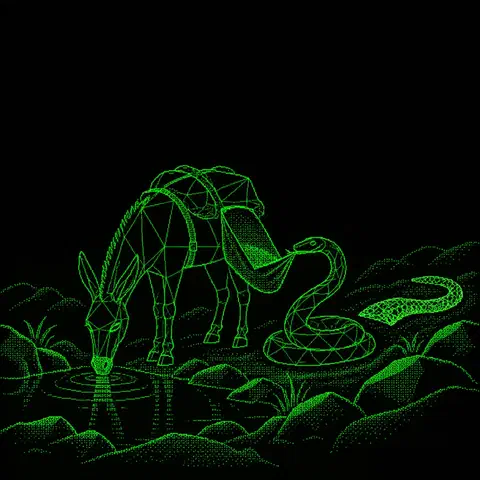
- Zeus gave mortals a pharmakon agērasias, a “drug of agelessness”. They loaded it on an ass, the thirsty ass traded it to a snake at a spring for a drink, and snakes have sloughed off old age ever since (Nicander, Theriaca 343–358; Aelian, On Animals 6.51).
- Aelian names five poets who told it before him, back to Ibycus in the sixth century BC.
- Gilgamesh XI tells it with a plant named “The old man becomes young”, a pool and a snake that casts its slough. Genesis tells it with the tree of life, the serpent and the woman.
- The same myth runs from East Africa to Sulawesi, Okinawa, New Guinea, Vanuatu and the Amazon. Often a woman loses the gift, often at water, and the snake gains it.
- So many specific turns repeated so widely point to one old story that travelled.
ἐξότε γηραλέον μὲν ἀεὶ φλόον ἑρπετὰ βάλλει
ὁλκήρη, θνητοὺς δὲ κακὸν περὶ γῆρας ὀπάζει.
“Ever since, the trailing creepers always cast off their aged slough, and evil old age dogs mortals.”
— Nicander, Theriaca 355–356 (2nd century BC)
Why do snakes shed their skin? The Greek drug of agelessness #
The Greeks had a story about why snakes renew themselves and people do not, and it is the clearest version of the myth anywhere. Its best witness is a poem on venomous animals. Nicander of Colophon, in Ionia (on the Aegean coast of Turkey), wrote his Theriaca in the second century BC as a handbook of bites in hexameter verse. When he comes to the dipsas, the “thirst-snake” whose bite brings a burning thirst, he stops to tell a myth he calls Ōgygios, “primeval”:
Ὠγύγιος δ’ ἄρα μῦθος ἐν αἰζηοῖσι φορεῖται,
ὡς, ὁπότ’ οὐρανὸν ἔσχε Κρόνου πρεσβίστατον αἷμα, …
ἰδμοσύνῃ νεότητα γέρας πόρεν ἡμερίοισι
κυδαίνων· δὴ γάρ ῥα πυρὸς ληΐστορ’ ἔνιπτον,
ἄφρονες· οὐ γὰρ τῆς γε κακοφραδίης ἀπόνηντο.
— Nicander, Theriaca 343–348 (Schneider 1856)
“A primeval tale goes round among men: that when the eldest blood of Kronos took the sky, … he gave youth as a prize to the creatures of a day, honouring them for their knowledge, for they had informed on the thief of fire. Fools! They got no good of their bad counsel.”
The humans were weary. They loaded “the gifts” on a lepargos, a “white-coat”, Nicander’s word for an ass. The ass, “its throat burning with thirst”, ran off to a hole where a snake lay, fawned on it and begged for help. The snake “asked for the load it had taken up on its back, the foolish gift, and it did not refuse, in its need” (354). “Ever since, the creeping things always cast off their aged slough, and evil old age dogs mortals.” The snake took the ass’s thirst along with the gift, and gives it to us in its bite (357–358). The translations here are mine.
Nicander’s line turns on a pun. Zeus gave youth as a geras, a prize of honour. What mortals got instead was gēras, old age. The two words differ by one vowel’s length. And gēras is also the Greek word for a snake’s cast skin: Aristotle uses it of the slough, and Frazer saw in that usage “a clear indication that the Greeks shared the wide-spread belief in the renewal of an animal’s youth by the casting of its skin” (Frazer 1918, I, p. 50 n.; LSJ, s.v. γῆρας). Each time a snake sheds, in Greek, it is stripping off its old age.
The ancient commentary on the poem names the gift. When Prometheus stole fire, men informed on him, and Zeus “gave them a drug of agelessness”, pharmakon agērasias:
Προμηθέα τὸ πῦρ κλέψαντα … φάρμακον αὐτοῖς ἀγηρασίας δοῦναι … εἰς κρήνην ἣν ἐφύλασσεν ὄφις … ἀπέδοτο τοῦ γήρως τὸ φάρμακον· διὸ πάντας μὲν τοὺς ὄφεις καθ᾽ ἕκαστον νεάζειν ἐνιαυτὸν ἀποδυομένους τὸ γῆρας.
— Scholion on Nicander, Theriaca 343, ed. Keil (Schneider 1856, scholia pp. 28–29)
“… [the ass came] to a spring which a snake guarded … and gave away the drug of old age; and so all snakes grow young every year, stripping off their old age.” The scholiast adds: “The myth is in Sophocles’ Kōphoi”, a lost play.
Aelian, writing in Rome in the early third century AD, tells it at full length in On Animals 6.51. Zeus gave the informers “a drug that wards off old age”, pharmakon gērōs amyntērion. It was summer. The snake guarding the spring drove the thirsty ass off until it paid with what it carried. “So an exchange took place: the one drinks, the other strips off its old age” (ὃ μὲν πίνει, ὃ δὲ τὸ γῆρας ἀποδύεται). Then Aelian adds:
τί οὖν; ἐγὼ τοῦ μύθου ποιητής; ἀλλʼ οὐκ ἂν εἴποιμι, ἐπεὶ καὶ πρὸ ἐμοῦ Σοφοκλῆς ὁ τῆς τραγῳδίας ποιητὴς καὶ Δεινόλοχος ὁ ἀνταγωνιστὴς Ἐπιχάρμου καὶ Ἴβυκος ὁ Ῥηγῖνος καὶ Ἀριστίας καὶ Ἀπολλοφάνης ποιηταὶ κωμῳδίας ᾅδουσιν αὐτόν.
— Aelian, De natura animalium 6.51 (Hercher 1864, pp. 162–163)
“What then? Am I the maker of this myth? I would not say so, since before me Sophocles the tragic poet, Deinolochus the rival of Epicharmus, Ibycus of Rhegium, and the comic poets Aristias and Apollophanes sing it.”
Ibycus sang at Rhegium, on the toe of Italy, in the sixth century BC; Deinolochus wrote comedy in Sicily; the others were Athenians. For eight hundred years, from Sicily to Ionia, Greek poets knew that humans had once held a drug of agelessness, a pharmakon (the word for medicine, poison and spell alike), given by Zeus for their knowledge and lost at a spring to a snake. It was famous enough for the comic stage.
What did the snake take from Gilgamesh? #
The oldest written version is Babylonian. In Tablet XI of the Standard Babylonian Epic of Gilgamesh, copied in Ashurbanipal’s library at Nineveh in the seventh century BC, Gilgamesh has reached Utnapishtim, the survivor of the flood, and failed his test of staying awake. He is about to go home empty-handed. Then Utnapishtim’s wife speaks up for him:
Gilgameš illika inaḫa išūṭa / mīna taddanna ītār ana mātišu
“Gilgamesh has come here, he has toiled and laboured: what will you give him, that he may go back to his land?”
— Gilgamesh XI 259–260 (Thompson 1930)
So Utnapishtim reveals “a hidden thing”, amat niṣirti, a secret of the gods (XI 266). A thorny plant grows at the bottom of the deep: “If your hands reach that plant, [you will find life]” (XI 270, the end restored by Thompson). Gilgamesh ties stones to his feet, sinks, grasps it and cuts himself free. He names it to the boatman:
šumšu šību iṣṣaḫir amēlu / anāku lūkulma lutūr ana ša ṣuḫrīya
“Its name is ‘The old man becomes young’. I myself will eat it, and go back to what I was in my youth.”
— Gilgamesh XI 281–282 (Thompson’s numbering)
Literally the name is “Old man: the man has grown young”. On the road home:
īmurma būrta Gilgameš ša kaṣû mêša / urid ana libbīmma mê irammuk / ṣēru iteṣin nipiš šammi / [ina mê] īlâmma šamma iššī / ina tārīšu ittadi qulipta
“Gilgamesh saw a pool whose water was cool. He went down into it and was bathing in the water. A snake smelled the breath of the plant. It came up [from the water] and carried the plant off. As it turned back, it cast off a slough.”
— Gilgamesh XI 285–289 (Thompson’s numbering; XI 303–307 in George 2003). Translation mine.
The last word was disputed for a generation. Albright read it as qulīptu, the peeled-off skin, from qalāpu, “to peel”, and by 1930 Thompson agreed: “‘it shed a skin’, that is, exhibiting a fresh youth after eating the plant … I am now more inclined to agree with it” (Thompson 1930, p. 89). The word for the plant’s scent, nipšu, comes from the same root as napištu, “life” and “breath”: the snake smelled the plant’s life and took it. Then “Gilgamesh sat down and wept” (XI 290).
The tree of life and the serpent in Genesis #
The Hebrew story has the same parts in a garden. God plants “the tree of life in the midst of the garden, and the tree of the knowledge of good and evil” (wᵉʿēṣ ha-ḥayyîm bᵉṯôḵ ha-gān, Gen. 2:9). “A river went out of Eden to water the garden” (2:10). Then:
וְהַנָּחָשׁ הָיָה עָרוּם מִכֹּל חַיַּת הַשָּׂדֶה
“Now the serpent was more cunning than any beast of the field.”
— Genesis 3:1
The serpent, naḥaš, speaks to the woman, and its first claim is about death: lōʾ-môṯ tᵉmuṯûn, “you will not surely die” (3:4). She sees that the tree is “desirable to make one wise”, takes of its fruit, eats, and gives to her husband (3:6). Their eyes open. God makes them “garments of skin”, kotnôṯ ʿôr (3:21), and then shuts the way to the other tree:
הֵן הָאָדָם הָיָה כְּאַחַד מִמֶּנּוּ לָדַעַת טוֹב וָרָע וְעַתָּה פֶּן־יִשְׁלַח יָדוֹ וְלָקַח גַּם מֵעֵץ הַחַיִּים וְאָכַל וָחַי לְעֹלָם
“Behold, the man has become like one of us, knowing good and evil; and now, lest he put out his hand and take also from the tree of life, and eat, and live for ever.”
— Genesis 3:22
Cherubim and a turning, flaming sword guard “the way to the tree of life” (3:24). The man names his wife Ḥawwāh, “because she was the mother of all living” (3:20). The rabbis heard the serpent in her name. Aramaic for snake is ḥiwyā, and in Genesis Rabbah Rabbi Aha says to her, in Adam’s voice: “The serpent was your serpent, and you are Adam’s serpent” (ḥiwyā ḥiwyiḵ wᵉʾatt ḥiwyā dᵉʾāḏām, Genesis Rabbah 20.11).
Frazer saw what Genesis leaves out: “The principal, almost the only, omission is the silence of the narrator as to the eating of the fruit of the tree of life by the serpent” (Frazer 1918, I, p. 76). The Targum known as Pseudo-Jonathan supplies it. God tells the serpent, “thy skin thou shalt cast away once in seven years”, and dresses Adam and Eve “from the skin of the serpent, which he had cast from him” (Etheridge 1862, pp. 166, 168; see The Snake Kept the Skin).
Greek, Babylonian and Hebrew versions compared #
Set side by side, the three ancient versions are strikingly close.
| Greece (Nicander, Σ, Aelian) | Babylon (Gilgamesh XI) | Israel (Genesis 2–3) | |
|---|---|---|---|
| The gift | pharmakon agērasias, “drug of agelessness” | the plant “The old man becomes young” | ʿēṣ ha-ḥayyîm, the tree of life |
| Who gives it | Zeus | Utnapishtim, at his wife’s urging | God plants it, then bars it |
| Why | a reward for knowledge (idmosynē) of the fire-thief | a “hidden thing”, a secret of the gods | knowledge has made man “like one of us” |
| Who loses it | weary, foolish men and their ass | Gilgamesh, bathing | the woman first, then the man |
| Where | a spring (krēnē) | a pool of cool water (būrtu) | a garden watered by a river |
| The snake | guards the spring, takes the drug as payment | smells the plant, rises from the water, takes it | speaks to the woman: “you will not surely die” |
| What the snake gains | it “strips off its old age” every year | “it cast off a slough” | in the Targum, it sheds its skin every seven years |
| What humans keep | old age, and the snake’s thirst in its bite | tears | death, “garments of skin”, “dust thou art” |
| Earliest date | Ibycus, 6th century BC | Nineveh copies, 7th century BC | first millennium BC |
The Greek and the Babylonian are closest of all. In both the remedy for old age is in human hands, it is set down or handed over at water, and a snake takes it and renews itself, while the humans are thirsty or bathing. Genesis keeps the serpent, the gift of life, the knowledge and the loss, and it adds the woman. Of the three, only Genesis has her. Across the rest of the world she is one of the most common figures in the story.
How far does the snake-and-immortality myth reach? #
Stith Thompson’s Motif-Index of Folk-Literature gives the myth its own number: A1335.5, “Origin of death: serpent given immortality instead of man. Renews his skin.” Next to it is A1335.4, “Origin of death when early people put on new skins. Child fails to recognize mother, who puts old skin back on” (Thompson 1955–58, motifs A1335.4–5). Frazer’s chapter “The Fall of Man” in Folk-Lore in the Old Testament (1918) gathered more than forty versions, and Michael Witzel puts “death and shed skin” in the oldest layer of world mythology he can reconstruct (Witzel 2012, pp. 364, 368).
The snake answers. On Lake Tanganyika, the Fipa and Bende of Tanzania say God came down and asked, “Who wishes not to die?” Man and the animals were asleep; “only the serpent was awake and he promptly answered, ‘I do’” (Frazer 1918, I, p. 66). On the far side of the Indian Ocean the Dusun of Sabah, Malaysia, say the Creator asked, “Who is able to cast off his skin? If any one can do so, he shall not die.” “The snake alone heard and answered, ‘I can’” (p. 66). On Vuatom, off New Britain in Papua New Guinea, two lads refused to fetch fire for the culture hero, and he cursed them to die, while “the iguana and the lizard and the snake … shall cast their skin and they shall live for evermore” (p. 67). The Arawaks of Guyana say the Creator gave eternal life to “serpents, lizards, and beetles” instead (p. 67).
The secret is betrayed to the serpent. The Tolai of the Gazelle Peninsula in New Britain say To Kambinana sent his brother to tell men to “cast their skin every year”, but To Korvuvu “commanded men to die, and betrayed to the serpents the secret of immortality” (p. 75). In Vietnam the serpents threatened the Jade Emperor’s messenger, “or we will bite you”, until he reversed the message (pp. 75–76), and among the Oromo of Ethiopia the bird sent with the news of renewal sold it to a snake (pp. 74–75). On Nias, off Sumatra, the serpents ate the crabs that humans should have eaten, “therefore serpents also do not die but merely cast their skin” (pp. 67–68).
The gift goes into the snake. Among the Marind-anim of South Papua, Indonesia, the dema Aramemb came back too late with healing herbs for the murdered boy Jawi and poured the medicine into a snake’s throat: “The snake lay still, grew cold, and shed its skin. Since then snakes do not die” (Wirz 1921, p. 49).
The water of life. The version closest to the Greek comes from the far end of Asia. On the Miyako Islands of Okinawa, in southern Japan, the moon sent a man down with two pails, the water of life (sïlimizï) for people and the water of death (sïnimizï) for snakes. On the way he set them down to rest, and a snake bathed in the water of life. Since then snakes shed their skins and renew themselves each year, and people die (Nevsky 1971; Naumann 2000, p. 133). A tired carrier, a rest by the way, water, and a snake that takes the renewal: it is strikingly close to Nicander’s ass at the spring.
A woman at the stream. Frazer summed up the second great branch: according to some peoples, “men were at one time actually in possession of this priceless boon, but forfeited it through the foolishness of an old woman” (1918, I, p. 68). In the Banks Islands of Vanuatu men “cast their skins like snakes and crabs, and came out with youth renewed”, until an old woman “went to a stream to change her skin”; her child would not know her, and she put the old skin back on (pp. 68–69). The Kai grandmother of the Huon Peninsula, Papua New Guinea, sheds hers in the river (p. 69). Bronisław Malinowski heard the same story in the Trobriand Islands of Papua New Guinea. A grandmother bathing with her granddaughter in the tidal creek at Bwadela “took off her skin, which, carried by the tidal current, floated along the creek until it stuck on a bush.” The girl chased the young stranger away, the old woman put her skin back on, and said: “We shall all become old. We shall all die.” Since then “the only animals who have retained the power of changing the skin are the ‘animals of the below’—snakes, crabs, iguanas, and lizards” (Malinowski 1926, pp. 60–62).
Among the Todjo-Toradja of Central Sulawesi, Indonesia, mankind was represented at God’s offer by “an old woman in her dotage”, who did not hear it, and “serpents and shrimps” took it (Frazer 1918, I, p. 66). On the Orinoco in Venezuela an old woman’s doubting “Oh!” turned “You will change your skins” into “Ye shall die” (p. 67). On the Rio Solimões in Brazil the old woman slept through the serpent’s cry from the sky, so “people do not lose their skin”, only “lizards, snakes and trees”, which answered (Barbosa Rodrigues 1890, pp. 234–235). Among the Tukuna of the upper Amazon it is a girl in her first-menstruation seclusion who answers the wrong call (Nimuendajú 1952, pp. 135–136).
The garbled message. Africa tells it another way: God’s news of rebirth is spoiled by its animal messenger, the Moon’s hare among the Namaqua of Namibia, the chameleon and the lizard among the Zulu, the goat and the sheep in Ghana. Frazer counted nineteen, all African (1918, I, pp. 52–65). Here too an animal can win what we lost. In a Togo version the frog outran the dog to tell God that men preferred to stay dead, and frogs revive every rainy season: “He gained for himself the immortality of which he robbed mankind” (pp. 62–63). The Dani of the Baliem Valley in Highland Papua, Indonesia, put the snake in the messenger’s role: rebirth was lost “through a mangled message delivered by the snake Kalije and the Sibine bird (the hornbill)” (Witzel 2012, p. 307, after Kamma 1978).
In Taiwan the Amis and Saisiyat say the old once shed their skins and grew young, until the cast skins were buried or the moulting refused (Chen 2013).
India keeps the parts and turns them round. In the Mahābhārata Garuḍa sets the amṛta, the drink of immortality, on kuśa grass and tells the snakes to drink “after ye have performed your ablutions”. While they bathe, Indra takes it back, and the snakes lick the empty grass: “the tongues of the snakes by that act became divided in twain” (Ganguli, Adi Parva XXXIV). Here the snakes lose the drug at the bath, and keep the forked tongue.
Map / The lost gift
Where the snake got our immortality
Tab to the map, then use arrow keys to move between points.
- The snake gains the renewal (16)
- Lost through a woman
- Lost at water
- The garbled message
- Greek, Babylonian and Hebrew anchor texts
- Other versions
On the map the amber points, where the snake gains the gift, run from Greece and Iraq to Lake Tanganyika and Ethiopia, across to Nias, Borneo, Sulawesi, Vietnam and Okinawa, through New Guinea and New Britain, and over the Pacific to Guyana and the Amazon. The old woman at the water belongs above all to Melanesia and Island Southeast Asia. The message stories fill Africa.
The shed skin and the single old story #
Why the snake? Because it does the thing the myth is about. Every year it loosens its skin at the lips, crawls out of it bright and new, and leaves behind a perfect ghost of itself, eyes and all. Nicander describes the sloughed snake “rejoicing in new youth” (νεαρῇ κεχαρημένος ἥβῃ, Ther. 137–138). Galen of Pergamum, in the second century AD, prescribed wine in which a viper had drowned for elephantiasis, and reported that the patient’s skin came off “like what is called the old age (gēras) in snakes” (Ad Glauconem 2, Kühn XI 143–144). The Śatapatha Brāhmaṇa says the man who knows the sacrifice frees himself from his mortal body “even as a snake frees itself from its skin” (ŚB 11.2.6.13, Eggeling, SBE 44, p. 38). Wherever people watched snakes, the slough meant renewal.
The slough explains why the snake is cast in the part. The plot is what travels, and it repeats: a gift that would have kept humans from death; a carrier who is weary, careless, asleep or old; water; a snake who takes the gift or answers in our place; a woman who fails to hear, to recognise or to believe. The Greek ass trading Zeus’s drug at a spring and the Miyako carrier resting while the snake bathes in the water of life are separated by the whole of Asia. Gilgamesh in his pool and the Trobriand grandmother in her creek are eight thousand miles apart. Repeated turns this specific are the signature of one tale retold, and the distribution, dense along the coasts of the Indian and western Pacific Oceans and reaching across to the Amazon, is the shape a story takes when it travels. Frazer called it “this widely diffused tale” (1918, I, p. 70). Witzel, who argues for descent rather than diffusion, still places it in his deepest layer. The simplest account is that one very old story about the serpent and our lost immortality spread with the people who told it, and kept its shape wherever it went. The phylogenetic work on its branches is in The Crone and the Origin of Death.
The oldest versions also say what the gift was for. Zeus gave the drug of agelessness idmosynē, for knowledge. Utnapishtim reveals the plant as “a hidden thing” of the gods. Genesis bars the tree of life at the moment the humans become knowers of good and evil. In each, knowledge and the loss of immortality arrive together. That is the order the Eve Theory of Consciousness proposes: a being who could say “I” could also see that it would die. In that reading the serpent stands for the knowledge, and the stories keep a memory of how it arrived, with a woman first in the line, as in the Hebrew text and in the many old women at the stream.
The Greek story adds one more turn. The snake took the ass’s thirst along with the drug, and its bite now passes the thirst to us. The gift of youth went into the snake, and what comes back out of the snake is venom. The Snake Cult of Consciousness argues that venom was a real sacrament of that knowledge, and the essay Venom Is the Fruit of Knowledge follows it into Eden. Read as written, Nicander’s myth says that the drug against old age is now in the serpent’s mouth.
Sources #
- Nicander. Theriaca 343–358, and scholia ed. H. Keil. In Theriaca et Alexipharmaca, ed. O. Schneider. Leipzig: Teubner, 1856. Scholia pp. 28–29.
- Aelian. De natura animalium 6.51. In Claudii Aeliani De natura animalium libri XVII, ed. R. Hercher, vol. I. Leipzig: Teubner, 1864. Pp. 162–163.
- Liddell, H. G., R. Scott and H. S. Jones. A Greek–English Lexicon, s.v. γῆρας. Oxford, 1940.
- Thompson, R. Campbell. The Epic of Gilgamish: Text, Transliteration, and Notes. Oxford: Clarendon Press, 1930. Tablet XI 259–290; note on line 289, p. 89.
- George, A. R. The Babylonian Gilgamesh Epic: Introduction, Critical Edition and Cuneiform Texts. 2 vols. Oxford: Oxford University Press, 2003.
- Genesis 2–3, Masoretic text. Sefaria.
- Genesis Rabbah 20.11. Sefaria.
- Etheridge, J. W., trans. The Targums of Onkelos and Jonathan ben Uzziel on the Pentateuch, vol. I. London, 1862. Pp. 166, 168.
- Frazer, J. G. Folk-Lore in the Old Testament, vol. I. London: Macmillan, 1918. Ch. II, “The Fall of Man”, pp. 45–77.
- Frazer, J. G. The Belief in Immortality and the Worship of the Dead, vol. I. London: Macmillan, 1913. Lecture III, “Myths of the Origin of Death”.
- Thompson, Stith. Motif-Index of Folk-Literature, rev. ed. Bloomington: Indiana University Press, 1955–58. Motifs A1319.12, A1335.4, A1335.5.
- Witzel, E. J. Michael. The Origins of the World’s Mythologies. Oxford: Oxford University Press, 2012. Pp. 307, 364, 368.
- Malinowski, Bronisław. Myth in Primitive Psychology. London: Kegan Paul, 1926. Pp. 60–62.
- Wirz, Paul. Die Marind-anim von Holländisch-Süd-Neu-Guinea, vol. I. Hamburg, 1921. P. 49.
- Landtman, Gunnar. The Folk-Tales of the Kiwai Papuans. Helsingfors, 1917. Pp. 109–110, 342–344.
- Nevsky, Nikolai. Tsuki to fushi [The Moon and Immortality], ed. Oka Masao. Tokyo: Heibonsha, 1971.
- Naumann, Nelly. Japanese Prehistory: The Material and Spiritual Culture of the Jōmon Period. Wiesbaden: Harrassowitz, 2000. P. 133.
- Chen, Fanfan. “The Threefold Mimesis of Evil in the Myths of Formosan Aborigines.” Caietele Echinox 24 (2013).
- Barbosa Rodrigues, João. Poranduba amazonense. Rio de Janeiro, 1890. Pp. 234–235.
- Nimuendajú, Curt. The Tukuna. Berkeley: University of California Press, 1952. Pp. 135–136.
- Ganguli, K. M., trans. The Mahabharata, Book 1: Adi Parva. Calcutta, 1883–96. Section XXXIV.
- Eggeling, Julius, trans. The Satapatha-Brahmana, part V. Sacred Books of the East 44. Oxford, 1900. P. 38.
- Galen. Ad Glauconem de methodo medendi II. In Claudii Galeni opera omnia, ed. C. G. Kühn, vol. XI. Leipzig, 1826. Pp. 143–144.
- Neba, Divine Che. “The Origin of Eternal Death” (Ngemba, Cameroon). Our Mythical Childhood survey, 2018.