Do Not Look Back: Lot’s Wife, Jangjamot, and the Global Myth of the Fatal Glance
TL;DR
- Jangjamot and Lot’s wife share a rare sequence: flee catastrophe, do not look back, look anyway, and become a mineral landmark.
- Folklorists index this as overlapping motifs—C331/C331.3 plus C961.1–2—not one universal tale type.
- Close matches occur in Gujarat and the Peruvian Andes; Orpheus, Izanagi, and Medusa belong to neighboring but structurally different families.
- The broad backward-glance taboo is worldwide, while the complete stone-transformation plot is not.
- Each culture rebuilds the pattern from its own moral world: Buddhist alms, biblical judgment, a shepherd’s bread, an Andean wedding, a Korean loom, or a Dead Sea salt pillar.
“Do not look behind you, nor stop anywhere in the Plain.”
Why does looking back turn people to stone? #
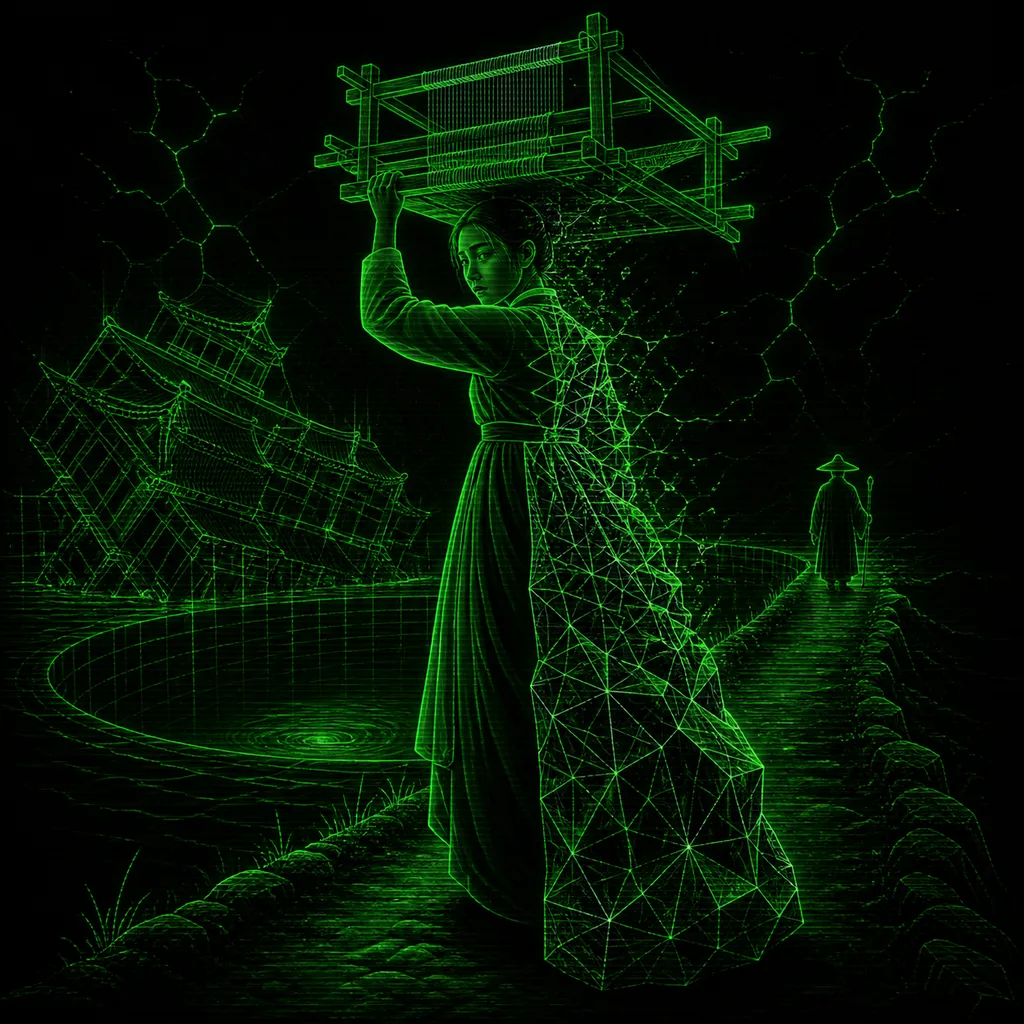
In the Bullroarer Atlas survey of East Asian flood traditions, one Korean story compressed an apocalypse into the destruction of a single household. A rich man named Song refuses to give alms to a monk. His daughter-in-law secretly gives the monk one mal of rice and asks him not to blame her father-in-law. The monk tells her to bring the thing she values most. She emerges carrying her loom on her head and follows him toward Gorangpo. Whatever happens, he says, she must not look back.
Then heaven and earth seem to break open behind them. She turns. Her body becomes stone under the loom, while Song’s estate collapses into the pond now called Jangjamot—the Rich Man’s Pond. The Paju text preserved by Gyeonggi Memory is unusually specific about the rice, loom, route, sound, and stone woman. Its ordered sequence recalls Lot’s wife because both stories turn a backward glance during escape into a permanent mineral landmark. Jangjamot, however, gives that machinery a different moral center: not an implicated wife leaving a wicked city, but a merciful daughter-in-law leaving a cruel household.
That resemblance opens a much larger question: what kind of pattern joins Lot, Jangjamot, Orpheus, Izanagi, and Medusa? “Dangerous looking” is too broad. In some stories the glance breaks an escape, in others it reopens the boundary of death, and in Medusa it exposes the viewer to a hostile power.
There is no single international tale type containing every story in which a look kills, petrifies, blinds, or loses someone. There are several neighboring narrative machines. The rare Jangjamot–Lot machine joins catastrophe, escape, prohibition, backward glance, and mineral transformation. Orpheus, Izanagi, and Medusa use sight differently.
The point of comparison is not to manufacture one universal myth. It is to see what each kind of dangerous glance does. That structural approach also guides the Bullroarer Atlas and the question of how long myths can remain recognizable.
Is there one international “do not look back” myth? #
No. The most useful scholarly vocabulary comes from Stith Thompson’s Motif-Index of Folk-Literature, which indexes portable narrative elements rather than forcing every story into a complete plot type.1
Thompson gives C331, “Tabu: looking back.” Its cited distribution is enormous: Greek, Jewish, Hindu, Indian, Lithuanian, Chinese, French-Canadian, Inuit, Tongan, Hawaiian, Tuamotuan, Yuracaré, Fang, and Luba material. But that geographic list refers to the broad taboo, not to the full Lot–Jangjamot sequence. Thompson subdivides it further:
- C331.1: looking back over the left shoulder;
- C331.2: travelers to another world must not look back;
- C331.3: looking back during flight.
The same index cross-references C961.1, transformation into a pillar of salt for breaking a taboo, and C961.2, transformation into stone. It separately points to F81.1, the Orpheus journey to recover someone from the dead. These distinctions are visible in the C331 index entry and the C960–C961 transformation entries.
The narrow family that concerns us is therefore an intersection, not a single code:
C331 or C331.3 + C961.1 or C961.2
No single Aarne–Thompson–Uther type captures the whole compound. ATU indexes complete tale plots; Thompson’s motif system is better suited to a village legend assembled from hospitality, catastrophe, flight, taboo, transformation, and landscape explanation.
Korean scholarship arrived independently at much the same morphological result. In a 2025 retrospective, folklorist Choi Rae-ok recalled that the corpus behind his 1968 master’s research contained about 200 Jangjamot variants. He reduced their stable core to four motifs: mistreatment of a monk, the look-back taboo, submergence, and petrification (Folktales as Oral Literature, pp. 52–53). Those 200 tellings establish Jangjamot as a Korean tale family, not a resemblance created by cherry-picking one Paju version.
| Complex | Narrative grammar | Examples |
|---|---|---|
| Catastrophic backward glance | Flee destruction; do not look back; the looker becomes stone or salt | Jangjamot, Lot’s wife, Pattan, Sigrenacocha |
| Otherworld retrieval | Lead someone out of death or another realm; looking back aborts the return | Orpheus and Eurydice, Greenland Inuit traditions |
| Forbidden sight | Do not see a deity, spouse, initiate, or ritual in a dangerous state | Izanagi and Izanami, Psyche, Actaeon, Tlingit puberty taboo |
| Petrifying gaze | A monster, deity, or magical image petrifies whoever sees it | Medusa and the Gorgons |
| Petrification without gaze | Hubris, grief, impiety, or betrayal produces a stone landmark | Niobe, Battus, Aglauros, stone-circle legends |
| Local adaptation | A portable plot is rebuilt around a particular landscape and moral world | European “Lot’s wife” rocks and other localized escape legends |
The table is not merely tidy classification. Each complex imagines sight differently. In one, turning the head violates an order. In another, vision crosses the boundary between living and dead. In a third, a dangerous being projects its power through the eyes. Only the first gives us the exact moral and spatial drama of Jangjamot.
How closely does Jangjamot match Lot’s wife? #
The Academy of Korean Studies treats Jangjamot seolhwa as a nationwide Korean legend family with comparatively stable variants. Its standard plot is more severe than the Paju version. The miser may fill the monk’s alms bowl with cow dung. The daughter-in-law replaces it with clean rice. When the monk tells her to take what she values most, she carries a baby or dog. After she looks back, the child and dog may petrify beside her. The pond and stone remain as physical evidence for the story.
Korean scholarship itself compares the legend with Sodom and Gomorrah. That comparison is not an outsider’s cleverness. The correspondences are ordered and diagnostic:
| Element | Jangjamot | Genesis 19 |
|---|---|---|
| Social offense | Greed and refusal of alms | Collective violence and wickedness |
| Supernatural visitors | A Buddhist monk | Angels |
| Favored escapees | The charitable daughter-in-law | Lot’s household |
| Command | Do not look back, whatever the sound | Do not look back or stop in the plain |
| Catastrophe | Estate sinks and becomes a pond | Cities destroyed by fire and brimstone |
| Mineral witness | Woman with loom, baby, or dog | Unnamed wife as a pillar of salt |
| Landscape function | Explains pond and neighboring stone | Localizes judgment in the Dead Sea landscape |
| Emotional register | Tragedy of a good but frightened helper | Judgment and incomplete separation from Sodom |
Genesis states the mechanism with extraordinary compression. The angels command the family to flee without looking back. Ten verses later, Lot’s wife looks behind him and becomes salt (Genesis 19:17–26). Later Jewish and Christian interpretation supplies motives the text does not: attachment to Sodom, concern for relatives, curiosity, disbelief, or sympathy with the condemned city.
The Qur’an preserves the night escape and the command that no one look back, while saying that Lot’s wife will suffer the people’s fate. It does not say she becomes salt or stone. Later commentary supplies variants in which she turns at the sound of destruction, cries out for her people, and is struck by a stone from heaven (Qur’an 11:81 and tafsir). The Qur’anic tradition is therefore part of the Lot complex, but its mineralization should not be read back into the verse.
Jangjamot changes the moral center. Lot’s wife is usually made complicit in the city she cannot relinquish. The Korean daughter-in-law has just performed the story’s one unambiguously merciful act. Her fault is fear or curiosity when the universe breaks behind her. The Academy of Korean Studies consequently offers a richer reading than simple punishment: the petrified woman becomes the sacred center of the village landscape. Her failure creates the stone that allows the community to locate its beginning.
The stone also keeps the story in circulation. Jung Kyung-min’s 2026 study of Korean “stone-women” argues that the petrified figure is not merely the narrative’s residue: its fixed, visible presence gives the tale a material prompt that repeatedly makes people ask why the stone is there and tell the story again (pp. 35–62, especially 46–47). This is one reason an etiological legend can remain locally precise even while its plot travels.
The loom sharpens that difference. Lot’s wife becomes an abstract pillar, stripped even of a name. At Paju, the woman carries the machine of domestic production and textile skill into stone. Read beside the recurring mythic association between women and weaving explored in Women Weave Civilization, the object is not incidental scenery. It turns the anonymous taboo-breaker into a recognizable worker bearing what she values.
What are the closest non-biblical parallels? #
Once the full sequence is required—failed hospitality, a single helpful woman, privileged warning, catastrophe, backward glance, and mineral landmark—the supposedly universal story becomes rare.
Dharamnathji and the shepherd’s wife in Gujarat #
In the Gujarat legend of Pattan, the saint Dharamnathji’s disciple, Gharibnathji, receives no charity and must carry firewood to buy flour. A shepherd’s wife bakes it and adds a loaf of her own. Seeing how the city has mistreated his disciple, the saint curses it to be swallowed. He warns the woman to leave and not look back. She disobeys and becomes stone (The Legend of Perseus, volume III, pp. 132–33).
Its morphology is remarkably close to Jangjamot:
uncharitable settlement → solitary charitable woman → holy mendicant → warning → swallowed settlement → backward glance → stone woman
This is not a faint resemblance. Pattan and Jangjamot both make the charitable woman the sole exception to a condemned community. The holy stranger offers escape, but the sound of destruction pulls her attention backward. Her stone body becomes both the proof that she was chosen and the sign that she never completed the crossing.
Sigrenacocha in the Peruvian Andes #
Near Pacchanta, Daniel Thomas Spotswood recorded a story with local school students. An unkempt old man arrives at a wedding. Everyone refuses him food except one woman, who cleans his face and feeds him. He tells her to leave the party without looking back. She looks, becomes stone, and the settlement is drowned beneath Lake Sigrenacocha. Her stone remains on the shore.
The story appears in Daniel Thomas Spotswood’s Fractals of a Mountain, p. 114. Here the pattern enters an Andean moral world. Reciprocity at a wedding determines who deserves rescue; the lake consumes the failed community; the woman joins a landscape in which mountains, water, and stone are active social presences. Sigrenacocha does not merely repeat Lot. It makes the backward glance answer to Andean obligations of care.
The backward-glance taboo is widespread, but the full Lot–Jangjamot sequence is rare. When it does appear, local ethics supply the condemned community, the exceptional helper, and the substance of the final landmark.
Which myths combine looking back with stone but not catastrophe? #
Several traditions preserve two or three components without the destroyed settlement. They are important because they show how the bundle can be assembled—and how misleading it would be to treat every member as the same story.
Putri Pukes in Gayo country, Aceh #
After her marriage, Putri Pukes leaves her parents to join her husband. Her mother tells her not to return or look behind. Homesickness overcomes her. She turns, a violent storm erupts, and she shelters in a cave where her body slowly hardens into stone.
Retellings preserve the same prohibition, storm, cave, and transformation (“Loyang Koro and Putri Pukes”; doi:10.37249/jlllt.v1i2.379). This is a departure-and-petrification story without the rejected mendicant or drowned settlement. Its crisis is marriage: Putri Pukes cannot enter a new household without turning toward the parents and identity she must leave behind.
The Tlingit girl who looks too soon #
In John Swanton’s 1909 Tlingit Myths and Texts, a girl is covered so that she will not look at her brothers during a dangerous river crossing. Their mother thinks the young men are drifting downstream. The girl raises the covering, and the brothers, their dog and pack, and the women on shore become rock. Travelers later pray and leave offerings at the stones (Swanton, pp. 105–06).
This is forbidden sight plus landscape petrification, but not a backward glance. Even the direction of agency differs: the girl’s look petrifies the people she sees, not simply the disobedient viewer. It stands midway between taboo punishment and the Medusan gaze.
The speaking bird and the voices behind #
Some variants associated with ATU 707, “The Three Golden Children,” send brothers toward a prophetic bird or magical object. Voices threaten or entice them from behind. They turn and become stone. Their sister succeeds by refusing to look back, obtains living water, and revives them. A comparative synopsis and its French regional references appear in Berezkin’s motif database.
Here C331 and C961.2 genuinely intersect, but the story is a quest ordeal rather than a catastrophe or hospitality legend. Other stone-transforming folktales, including ATU 516, Faithful John, likewise belong near the discussion without belonging to it: Faithful John becomes stone after revealing forbidden knowledge, not after turning around.
Kashmir and north Indian ritual prohibitions #
William Crooke records a Kashmiri youth warned that looking back would turn him into a stone pillar, as well as a Brahman whose backward glance causes the following deity to become stone (Popular Religion and Folk-Lore of Northern India). He places these beside the rule that mourners should not look back while leaving a cremation ground. The shared logic is separation: the living must leave death without reopening the path behind them.
Why does Orpheus lose Eurydice when he looks back? #
Orpheus is the famous non-petrifying member of the cluster. His music wins permission to lead Eurydice from Hades on one condition: he may not turn his eyes toward her before they reach the upper world. Near the exit, anxiety, love, or distrust overcomes him. He looks. She falls back among the dead (Ovid, Metamorphoses 10).
This is C331.2, the otherworld traveler’s prohibition, joined to F81.1, recovery of a dead person. Orpheus is not petrified; the rescue is revoked. That difference exposes the ritual logic. The backward look is not always an offense punished with a new substance. Sometimes it breaks a process that is still incomplete.
The Greenland entrance that disappears #
Hinrich Rink’s nineteenth-century Greenland collection includes old people journeying toward the rock entrance of the ingnersuit. They are told to keep their eyes fixed on the leader’s kayak and not look back, or the entrance will close. When the rock opens onto a beautiful country, joy makes them turn. The country vanishes, their boat strikes bare rock, and they remain separated from the otherworld forever (“The Revived Who Came to the Under-World People,” pp. 298–300).
Again, no one becomes stone. The rock is a door whose visibility depends upon disciplined attention. Looking back collapses the route between worlds.
Izanagi does not actually look back #
Izanagi’s descent to retrieve Izanami is repeatedly called “the Japanese Orpheus,” but the comparison often overwrites the Japanese text. In Yomi, Izanami tells Izanagi not to look at her while she negotiates her return. He lights a tooth of his comb and sees her body in decomposition, inhabited by thunder deities. She pursues him, and the worlds of life and death are permanently divided.
He looks at her, not backward while leading her out. No one becomes stone. The episode belongs to forbidden sight at the boundary of death. An open scholarly English text is available from Kokugakuin University’s Kojiki project.
Hawaiian traditions offer yet another mechanism. Maui’s brothers must not look back while he fishes up the islands; they do, the line breaks, and the land fails to become a single island. In a floating-island romance, a departing husband looks back despite a warning and the island and wife disappear. These stories belong to C331, but the consequence is a broken creation or vanished world, not petrification.2
Is Medusa part of the same myth family? #
Medusa is adjacent, not homologous. “Looking causes stone” is not enough to make the stories the same.
| Jangjamot and Lot | Medusa and the Gorgons |
|---|---|
| Someone issues a prohibition | No prohibition is necessary |
| The viewer disobeys | The viewer may be innocent |
| Danger lies behind a fugitive | The dangerous being faces the viewer |
| Petrification enforces a boundary or judgment | Petrification is the Gorgon’s power |
| The stone explains a local landscape | Victims become obstacles, trophies, or weapons |
| Not looking completes an escape | Indirect vision permits heroic combat |
Perseus defeats Medusa by refusing direct sight, using a reflective surface, and later turns the severed head against enemies. Ovid’s Atlas and Phineus episodes give the familiar mechanics of transformation (Metamorphoses 4; book 5). The looked-at being projects power outward. Lot’s wife and the Korean daughter-in-law transform because their own act of looking violates a protected transition.
Which famous stone myths are false friends? #
An exhaustive survey must contain a rejection table. Otherwise the corpus grows every time the words look and stone occur on the same page.
| Story | Actual mechanism | Why it is not Lot–Jangjamot |
|---|---|---|
| Niobe | Becomes a weeping rock after boasting and losing her children | Grief and hubris; no gaze prohibition |
| Anaxarete | Sees Iphis’s funeral and becomes stone | Retribution for emotional hardness, not looking back |
| Battus | Hermes petrifies him for betraying a secret | Broken promise, not forbidden sight |
| Aglauros | Hermes petrifies her for envy and obstruction | No backward glance |
| Baucis and Philemon | Survive an inundation that destroys an inhospitable town; later become trees | Hospitality and catastrophe match, but looking is neither forbidden nor punished |
| Deucalion and Pyrrha | Throw stones behind themselves; stones become people | Reverse transformation; no punishment |
| Persephone | Bound to the underworld after eating pomegranate | Consumption taboo, not gaze taboo |
| Actaeon | Sees Artemis bathing, becomes a stag, and is killed | Forbidden divine sight; no stone or backward flight |
| Psyche and Cupid | Lamp reveals the hidden husband; separation and trials follow | Forbidden sight, but no mineralization |
| Sun-struck trolls | Sunlight petrifies nocturnal beings | Environmental exposure, not disobedient looking |
Baucis and Philemon are especially instructive. They supply an exemplary hospitable couple, a disguised divine visitor, and a town destroyed by water. They even turn to observe the catastrophe. Yet the gods have not forbidden the look, and the couple’s later transformation into trees is a granted wish. The story demonstrates how many shared pieces can coexist without producing the diagnostic sequence.
Where are do-not-look-back myths found around the world? #
Thompson’s C331 references establish a broad worldwide distribution. But when explicit flight, prohibition, catastrophe, and mineralization are all required, the distribution contracts sharply.
| Region | Characteristic form | Relationship to the full plot |
|---|---|---|
| Korea | The nationwide Jangjamot family | Full catastrophe, escape, glance, and petrification |
| Near East | Genesis and Lut traditions | Full escape plot; the mineral ending varies by tradition |
| South Asia | Ritual, quest, and saint legends | Full plot at Pattan; many separation and stone variants |
| Southeast Asia | Putri Pukes and related departure legends | Looking back, storm, and stone without the condemned settlement |
| Europe/Mediterranean | Orpheus, folktales, and biblical localizations | Otherworld retrieval and localized Lot stories |
| Arctic | Otherworld and ritual prohibitions | Looking back closes the route or causes loss |
| Indigenous North America | Otherworld, star, puberty, and rock legends | Transformation and forbidden sight usually occur in different combinations |
| Andes | Sigrenacocha | Full hospitality, catastrophe, glance, and stone plot |
| Sub-Saharan Africa | Fang and Luba look-back motifs; many stone etiologies | The components usually occur separately |
| Oceania | Hawaiian, Tongan, and Tuamotuan taboos; Māori transformation motifs | Looking back breaks creation or passage rather than petrifying the traveler |
| Indigenous Australia | Sacred-sight taboos and ancestral landscape transformations | A rich forbidden-sight complex with a different narrative grammar |
One Huron-Wyandot story, for example, sends starving boys upward to become stars. Their leader tells them not to look back; one does, falls, and becomes a cedar tree. The story confirms that backward-looking transformation is not confined to Eurasia, but it is not a catastrophe-flight or stone legend.3 In a Luba animal tale, creatures repeatedly forget a divine name when they look back during a journey; the gazelle succeeds by keeping its attention forward. The broad ritual psychology travels farther than the exact plot.
Is Jangjamot simply a Korean Lot’s wife? #
No. The resemblance is best understood as a portable narrative grammar, not as Lot’s wife dressed in Buddhist clothing. Treating Jangjamot as a copy explains the shared plot by erasing everything that gives the Korean story its force. Its moral economy is Buddhist: a monk asks for alms, a rich household refuses, and karmic judgment falls upon hoarded wealth. Its emotional center is a daughter-in-law whose mercy cannot free her from the household she serves. Its material world is Korean: rice, pond, baby, dog, loom, and village stone.
The clearer model is a portable grammar rebuilt by local storytellers. Leave one world; do not reattach yourself by looking; lose the passage if you do. The same grammar can take on Buddhist rice, a shepherd’s loaf, an Andean wedding, a Korean loom, or a Dead Sea salt pillar without becoming the property of any one tradition.
This is the same middle position required by serious studies of global flood myths: stories travel, recur, and become local at the same time.
Why is the backward glance such a powerful mythic act? #
Looking back makes an internal failure externally visible. A person can walk away while remaining loyal, curious, frightened, doubtful, or emotionally attached to what is behind. The turning head exposes that divided state.
Across the different complexes, the prohibition governs a liminal passage:
- From a condemned world to a saved one: Lot’s household, Jangjamot, Pattan.
- From death to life: Eurydice and the Greenland otherworld.
- From one household to another: Putri Pukes leaving her parents after marriage.
- From ignorance to dangerous knowledge: Izanagi seeing the corpse, Psyche seeing her husband, initiates seeing a forbidden ritual object.
- From incomplete creation to finished world: Maui’s half-raised islands.
The command demands more than obedience. It demands that the traveler behave as if the transition is already complete while it is still terrifyingly incomplete. The forbidden sound behind—thunder, collapse, a loved voice, supernatural threats—tests whether the old world can still command attention.
Petrification is the perfect consequence because it reverses the action. The fugitive is moving; stone is absolute arrest. She is leaving a place; the rock becomes permanently attached to that place. She is forbidden to serve as a witness; her transformed body becomes the landscape’s most durable witness. The myth converts failed separation into geology.
Gender intensifies this structure without defining it. Wives and daughters are often the people transferred between households and accused of divided loyalty. The Korean daughter-in-law, Putri Pukes, and Lot’s unnamed wife stand at precisely that fracture. Stories about women introducing mortality or failing a primordial command are examined more broadly in Women Bring Mortality. Yet Orpheus, Maui’s brothers, Inuit elders, and questing princes demonstrate that the backward glance is not inherently female. Its deepest subject is attachment.
What the stone woman finally means #
The Stone Woman is not one person with many cultural names. She is a position in a narrative machine: the person who has been selected to cross a boundary but cannot complete the crossing without acknowledging the world behind.
Sometimes that acknowledgment is condemned as nostalgia for evil. Sometimes it is a reflex of fear. Sometimes it is love demanding proof that the beloved is still there. Sometimes the look reveals decay that must remain unseen. And sometimes, as with Medusa, the entire grammar reverses: looking is not a breach of trust but exposure to a hostile power.
Jangjamot is not “just Lot’s wife,” and the resemblance is not superficial. The two stories occupy the same rare junction in the motif network. Gujarat and Sigrenacocha show that the junction can be rebuilt elsewhere. Orpheus, Izanagi, Putri Pukes, the Tlingit rocks, and Medusa reveal the larger field of dangerous sight surrounding it.
The forbidden glance is the instant the abandoned world reasserts its claim. Petrification gives that divided loyalty a body: the traveler meant to escape becomes the permanent landmark of what she could not leave.
Footnotes #
Sources #
- Academy of Korean Studies. “Jangjamot Legend (장자못 설화).” Encyclopedia of Korean Culture, written 2022, revised 2023. National overview, standard plot, interpretation, and bibliography.
- Gyeonggi Memory Digital Archive. “Legends, Folk Tales, and Stories of Paju.” Based on 파주의 전설, April 17, 1995, SE0001179. Source for Song, the mal of rice, loom, Gorangpo, cosmic crash, and petrified woman.
- Thompson, Stith. Motif-Index of Folk-Literature, C331 and subdivisions. Revised edition, 1955–58. See also C960–C961.
- Hebrew Bible. Genesis 19:17–26. The escape command and transformation of Lot’s wife.
- Qur’an. Hud 11:81 with Ibn Kathir commentary. Distinguishes the verse from later mineralizing and backward-glance expansions.
- Hartland, Edwin Sidney. The Legend of Perseus, vol. III. London: David Nutt, 1896, pp. 131–35. Gujarat/Pattan legend and nineteenth-century comparative discussion.
- Spotswood, Daniel Thomas. Fractals of a Mountain: Human–Environment Relations in the Peruvian Andes. PhD diss., University of Edinburgh, 2022, pp. 113–15. Modern Sigrenacocha account and interpretation.
- Juraini, Astri, Dina Wulansari, Muhammad Abrar Muda, and Dina Syarifah Nasution. “Moral and Cultural Values in the Story of Putri Pukes from Central Aceh.” Journal of Linguistics, Literature and Language Teaching 1(2) (2022): 69–75.
- Swanton, John R. Tlingit Myths and Texts. Bureau of American Ethnology Bulletin 39. Washington, DC, 1909, pp. 105–06.
- Rink, Hinrich. “The Revived Who Came to the Under-World People.” In Tales and Traditions of the Eskimo. Edinburgh and London: William Blackwood and Sons, 1875, pp. 298–300.
- Ovid. Metamorphoses, book 10, lines 1–85. Orpheus and Eurydice. See also book 4 and book 5 for the Gorgon’s head.
- Kokugakuin University. The Kojiki: An Account of Ancient Matters, English translation. 2021 edition. Izanagi and Izanami in Yomi.
- Crooke, William. The Popular Religion and Folk-Lore of Northern India. 2nd ed. Westminster: Archibald Constable, 1896. Backward-looking prohibitions and north Indian stone traditions.
- Beckwith, Martha Warren. Hawaiian Mythology. New Haven: Yale University Press, 1940. Maui’s island-fishing taboo and disappearing-island traditions.
- Choi Rae-ok. “Folktales as Oral Literature” (구비문학으로서 설화). In the 2025 Comparative Folklore Society autumn conference proceedings, pp. 41–64; Jangjamot corpus and four-motif analysis at pp. 52–53.
- Jung Kyung-min. “The Meaning of Objectification in the Transformation into a ‘Stone-Woman’ in Folktales.” Korean Classical Studies 73 (2026): 35–62. Jangjamot and the stone woman as material prompts for continuing narration.
A motif is a small narrative element capable of persisting in tradition; a tale type describes a more complete recurring plot. Jangjamot is better represented as a bundle of motifs because no single international type contains all of its parts. ↩︎
Martha Warren Beckwith gathers both the island-fishing prohibition and the floating-island romance in Hawaiian Mythology. Thompson accordingly lists Hawaii under C331 while placing Hawaiian transformation material under other codes. ↩︎
Marius Barbeau recorded the Huron-Wyandot star story in the early twentieth century; see Huron and Wyandot Mythology. It is a valuable transformation-by-looking-back case but not a stone or catastrophe legend. ↩︎
Read other posts