Every Extant Death-and-Rebirth Text of Dionysus
Every Extant Death-and-Rebirth Text of Dionysus #
TL;DR
- The “death and rebirth of Dionysus” is not a single story but a bundle of attested micro-narratives—infant dismemberment, heart-salvage, ritual cooking, burial at Delphi, and the “twice-born” rescue from Semele’s death.
- The most explicit “sparagmos” (tearing) sequence appears in Clement of Alexandria’s Exhortation to the Greeks: toys → dismemberment → cauldron on tripod → boiling/roasting → thunderbolt punishment → burial near a mountain sanctuary.
- The most explicit “anthropogony” link (Titan punishment → human material; “our bodies are Dionysiac”) is preserved in Olympiodorus’s Phaedo commentary as quoted and translated in a modern scholarly discussion.
- The “heart into Semele” rebirth mechanism is clearest in Hyginus’s Fabulae (Liber = Dionysus): the god is dismembered; the heart becomes a potion for Semele; then the familiar thunderbolt episode follows.
- The mainstream “twice-born” cycle is fully explicit in Apollodorus’s Bibliotheca and is dramatized/defended inside Euripides’ Bacchae.
“He it is whom you mock, because he was sewn up in the thigh of Zeus.” — Euripides, Bacchae (lines ~290ff., trans. shown in an open educational edition)
What counts as a Dionysus death-and-rebirth version #
The phrase “Dionysus dies and returns” is misleadingly singular. The surviving evidence looks more like a textual swarm: different authors preserve different atoms of the myth (toys, dismemberment, boiling, heart-salvage, burial, reincorporation into Semele, cosmic punishment, anthropogony), and later writers often stitch them into an argument rather than narrate them “for its own sake.”
Because the goal here is exhaustive primary attestation, I treat each discrete ancient witness that explicitly links Dionysus (or Liber) to (a) violent dissolution and (b) some form of restoration, continuation, or second-birth logic as a “version,” even when it is abbreviated, polemical, or allegorical.
Orphic sparagmos texts you can actually quote #
The “toys → dismemberment → cooking → thunderbolt → burial” version #
This is the most narratively complete surviving witness in a single stretch of prose. It appears in Exhortation to the Greeks where Clement is trying to render mystery-rites morally obscene by narrating them as anthropology of error. The bias is obvious—but the details are gold, because they are precisely the kind of ritual furniture (toys, tripod, cauldron) that a later neutral mythographer might omit.
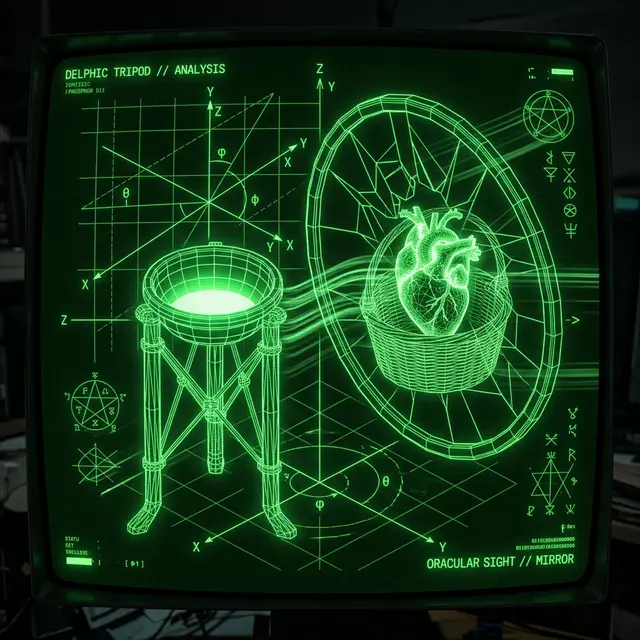
Text (Clement’s account, retranslated/paraphrased into fresh English to avoid inheriting any one translator’s cadence): A child Dionysus is ringed by dancers; the Titans creep in. They distract him with childish toys, then tear him limb from limb. A catalog of ritual “tokens” follows (knucklebone, ball, spinning-top, apples, wheel, mirror, fleece). Athena snatches away the heart. The Titans set a cauldron upon a tripod; the god’s limbs go into it—boiled, then skewered and roasted over fire. Zeus arrives (Clement snarks that a god “smells” the cooking steam), strikes the Titans with thunder, and hands the remains to Apollo for burial at a mountain sanctuary.
What “rebirth” looks like here: not an explicit re-birth scene, but a continuation mechanism: (1) the heart is saved; (2) the corpse is ritually handled and buried; (3) the narrative structure is already the skeleton that later sources will flesh into reconstitution or reincarnation.
The “Titan ash → human bodies → we are part of Dionysus” version #
Here the myth is explicitly weaponized for philosophy: the question is why self-killing is forbidden, and the answer is that the body is not mere prison; it is partly Dionysiac because humans are materially downstream of the Titans who consumed Dionysus.
Text (Greek lemma as preserved in a scholarly presentation of the passage): Zeus becomes angry, “thunderbolts” the Titans, and from the “soot / sublimate” of the vapors that rise from them comes the matter from which humans are generated; therefore “we must not release ourselves,” not because the body is a shackle (too obvious), but because “our body is Dionysiac,” and—crucially—“we are a part of him,” since we are composed from the Titan residue after they tasted the god’s flesh.
Fresh translation (my own, with minimal metaphysical embroidery): Zeus’ wrath strikes the Titans; humans are made from what remains when they are blasted—ash, soot, the condensed aftermath. So one must not “undo oneself.” The reason is not the banal one (that the soul is chained in a body), but the more esoteric claim: the human body is Dionysiac, because humanity is compounded from Titan residue after the Titans tasted Dionysus’ flesh; hence we are, in a sense, a portion of Dionysus.
What “rebirth” looks like here: explicitly distributed rebirth: Dionysus returns not only (or not primarily) as “one child again,” but as a hidden component inside human embodiment—an imploded divinity, smeared thin across the species. That idea is late, but it’s in the text we’ve got.
The “Apollo reunites what Titans tear” Delphic purification version #
Later in the same scholarly presentation, a second Greek tag is cited: Dionysus “is torn” by Titans but is “made one again” by Apollo. That sentence is important because it makes the rebirth mechanism ritually Delphic (Apollo as purifier/unifier), not simply obstetric (Semele) or mechanical (heart).
Text (minimal form): Dionysus is torn by Titans; he is “unified” again by Apollo.
The “cauldron at Delphi” Hellenistic fragment tradition (via Byzantine scholia) #
A Byzantine witness reports a tradition attributed to Hellenistic poets, where the post-mortem handling is Delphic: the Titans’ act ends with a cauldron/tripod and Apollo’s custody near the Delphic tripod.
Text (compressed, since the witness is itself a report): the Titans tore Dionysus’ limbs, placed them in a cauldron, and Apollo set the vessel beside the tripod at Delphi; the report explicitly anchors this to poets (including Callimachus and Euphorion) as authorities for the motif.
Why it matters as a “rebirth” version: even without an explicit resurrection scene, the story is already shaped like a mystery-initiation script: dismemberment → cauldron/tripod → Delphi → purification/unification. It is “rebirth” as ritual-processing, not as infant-birth.
The “Delphi keeps his remains” tomb-and-waking motif #
A striking, half-open cult claim: at Delphi, Dionysus has remains near the oracle, and a secret sacrifice is offered when devotees “wake” him. This is not a full narrative of death and rebirth, but it is a cultic statement that presupposes a divine oscillation between absence (deathlike) and presence (awake).
In a discussion of Egyptian-Osirian parallels, Plutarch reports that “tales regarding the Titans” and nocturnal rites align with stories of dismemberment and “revivification and regenesis,” and he adds that Delphi believes Dionysus’ remains lie beside the oracle, with secret rites enacted around waking the god.
The twice-born Dionysus texts #
Here the “death” is displaced: Dionysus does not die (or is at least not emphasized as dying), but his mother does, and he is rescued from that catastrophe by being re-gestated in Zeus. The logic is rebirth-by-transfer: womb → lightning-death → thigh-womb.
To keep this genuinely “textual,” I’m giving each major surviving articulation, because each frames the rebirth differently: handbook-summary, dramatic defense, genealogical fact, and hymnographic epithet.
The “Semele incinerated; fetus sewn into thigh” handbook version #
In Apollodorus’ narrative, Hera manipulates Semele into requesting that Zeus come in full divine mode; Zeus arrives with thunder and lightning; Semele dies; Zeus snatches the premature child from the fire and sews it into his thigh.
Fresh translation (tight, but faithful to the sense): Zeus loves Semele. Hera tricks her into demanding that Zeus appear as he did when courting Hera. Zeus cannot refuse the oath-binding request; he comes with thunder and lightning and hurls the bolt. Semele perishes. Zeus snatches the six-month child from the fire and stitches him into his thigh.
The “defense of the thigh-birth” dramatic version #
In Bacchae, the thigh-birth is mocked as absurd—then defended as a “mystery” with divine counterplotting: Zeus protects the child from Hera’s rage through a deceptive substitution. That matters because it makes rebirth not only biological but political: succession warfare in the Olympian household.
Text (fresh translation of the gist of the cited passage): You laugh that Dionysus was stitched in Zeus’ thigh; but when Zeus rescued the child from lightning and brought him to Olympus, Hera tried to drive him out—so Zeus devised a stratagem worthy of a god, offering a decoy-pledge while keeping the true Dionysus safe.
The “Insewn” epithet in hymnography #
A short but revealing witness: a hymn acknowledges multiple claimed birthplaces, then calls Dionysus “Heaven-born” and “Insewn” (i.e., stitched into Zeus), explicitly encoding the rebirth motif into a cult-title rather than a story.
The genealogical “Semele bore joyful Dionysus” baseline #
Hesiod’ Theogony gives the blunt genealogical fact: Semele bears Dionysus; “a mortal woman an immortal son,” and “now both are gods.” This doesn’t narrate death/rebirth, but it is the baseline against which the later “twice-born” elaboration reads like a theological fix for how an immortal can pass through a mortal mother.
The heart-into-Semele rebirth bridge text #
Now the hinge version: it explicitly fuses the Titan sparagmos tradition to the Semele pregnancy. This is structurally invaluable because it makes the rebirth mechanism pharmacological: not a reassembly, not an adoption, but ingestion of heart-fragments that re-seed Dionysus in Semele.
Hyginus’ Fabulae says (in essence): Liber, son of Zeus and Persephone, is dismembered by Titans; Zeus gives Semele his heart, crushed into a drink; she becomes pregnant; Hera disguised as the nurse urges Semele to demand Zeus’ full theophany; Semele is blasted; Zeus removes Liber from her womb and assigns him to be raised.
Fresh translation (one coherent “text version,” matching the surviving witness): Liber, child of Zeus and Persephone, is torn apart by Titans. Zeus salvages what remains of the heart, crushes it into a potion, and gives it to Semele to drink; from that draught she becomes pregnant. Hera, disguised as Semele’s nurse, persuades her to demand Zeus’ visit “as he comes to Hera,” so she can know the pleasure of coupling with a god. Semele makes the request and is struck by the thunderbolt. Zeus takes the child from her womb and places him in another’s care to be reared.
This is the cleanest surviving “death → rebirth” pipeline in which Dionysus’ first destruction directly causes his second gestation.
A synoptic comparison of the versions and their mechanics #
| Witness you can cite | Rough date | “Death” event | What survives | Restoration / rebirth logic | Signature detail |
|---|---|---|---|---|---|
| Clement, Exhortation II.8–9 | late 2nd c. CE | Titans tear infant apart; limbs cooked | Heart saved; body buried | Continuation via heart-salvage + burial; rebirth implied rather than shown | Tripod + cauldron; boiling then roasting; Apollo as undertaker |
| Olympiodorus, In Phaedonem (quoted) | 6th c. CE | Titans tear and taste flesh; Zeus blasts Titans | Dionysiac “portion” in humans | Distributed rebirth: humans as Dionysiac-Titanic composite; Apollo unifies Dionysus | “Soot of vapors” becomes human material; “we are part of him” |
| Byzantine scholia reporting Hellenistic poets | medieval witness of earlier material | Titans tear limbs; cauldron handling | Remains handled by Apollo/Delphi | Rebirth implied as Delphic purification/unification | Cauldron placed by Delphic tripod; names Callimachus/Euphorion as authorities |
| Hyginus, Fabulae 167 | early imperial (tradition) | Liber dismembered | Heart fragments | Heart potion → Semele pregnancy → “second” Dionysus | Heart becomes drink; Semele’s request engineered by Hera-nurse |
| Apollodorus, Bibliotheca 3.4.3 | imperial handbook | Semele killed by theophany | Fetus | Fetus stitched into Zeus’ thigh; born again | “Six-month” child snatched from fire, sewn into thigh |
| Plutarch, Isis and Osiris (Delphi note) | 1st–2nd c. CE | Not narrated; implied dismemberment/revivification motif | “Remains” at Delphi | Cultic “waking” suggests cyclical return | Dionysus’ remains near oracle; secret sacrifice when god is awakened |
Footnotes #
Sources #
- Clement of Alexandria. Exhortation to the Greeks (Book II, §§2.8–2.9) in a public-domain English presentation.
- Olympiodorus. In Phaedonem (passages quoted with Greek + English and contextual discussion).
- John Tzetzes. Report of the Dionysus cauldron/tripod tradition in scholia context (as presented in an accessible text page).
- Hyginus. Fabulae 167 (Liber dismembered; heart potion; Semele; thunderbolt).
- Apollodorus. Bibliotheca 3.4.3 (Semele’s death; fetal rescue; thigh sewing).
- Euripides. Bacchae (defense of the thigh-birth as coherent divine strategy).
- Hesiod. Theogony (Semele bears Dionysus; baseline genealogy).
- Plutarch. Isis and Osiris (Delphi: Dionysus’ remains; secret waking rite; “Titan” tales aligned with revivification/regeneration talk).
- Radcliffe G. Edmonds III. Modern scholarly synthesis and argumentation around Orphic fragments and their reception (used here as a navigational spine to the ancient quotes).
Read other posts